Self-Publishing Experiments

Experiment

With millions of books to choose from, why would anyone choose to buy an experiment?

If the author treats a book like it’s an experiment, the quality of the content, packaging, and marketing will reflect this. Customers will see it.

  • It’s not worth putting a fantastic cover on a book that’s an experiment.
  • It’s not worth perfecting the editing or formatting for an experiment.
  • It’s not worth crafting a most wonderful story for an experiment.
  • It’s not worth marketing an experiment.
  • The author won’t be confident in or passionate about an experiment.

So why bother making an experiment?

If you just want to know if your writing appeals to others, simply share drafts of it or join writing groups.

It’s not Necessary to Experiment First!

Why not? Because there are already millions of books on the market. Researching those, especially successful indie books, will prove far more valuable than any experiment you might do yourself.

  • Sales ranks and reviews can help you gauge which kinds of books are or aren’t popular.
  • Repeated comments in a subgenre can help you learn specific things that many readers do or don’t like.
  • Writing samples in the Look Insides can help you see what kind of writing appeals to readers.
  • Covers of bestselling indie books can help you learn how to attract your target audience and signify your subgenre.
  • Look Insides of bestselling traditionally published books can show you what a nicely formatted book should look like.
  • Product pages of bestsellers can show you how to make the most of your book’s detail page.
  • Author pages and websites of top indie authors can show you a variety of marketing possibilities.
  • A ton of free and low-cost publishing and marketing resources can help you perfect your book.

Study books that have succeeded. That’s experimental data that you have right at your fingertips.

It’s a Mistake to Experiment First!

Why? Because your first impression is very important. A big part of marketing is the author’s brand. It takes time to build credibility as an author.

If your first effort is an experiment, many shoppers who come across your book and were interested in it may remember your book or name in the future. The next time they see one of your books, even though it may be much better, they may pass on it simply from their first experience.

Success in the publishing business is difficult to come by, so start out by putting your best foot forward.

About My Blog

I started this blog to provide free help with writing, publishing, and marketing. You can find many free articles by clicking one of the following links:

Chris McMullen, Author of A Detailed Guide to Self-Publishing with Amazon and Other Online Booksellers

Follow me at WordPress, find my author page on Facebook, or connect with me through Twitter.

Authors, Don’t Write Books; Create a Whole New World

Image of Mars from NASA.

Image of Mars from NASA.

People don’t buy books. People buy the experience that a story provides.

So authors shouldn’t write books, and they shouldn’t market books. Authors should create a whole new world, and they should market the experience of visiting that world.

Don’t think of your book as a book. Think of the story as one part of the world that you created.

Don’t think of how to market your book. Think of how to get people interested in your world.

The world you create is far more than a mere book. It’s the world, not the book, which people want.

How do you do this?

  • Give your world life before your book is published. Spread the word about the world you are creating. Create buzz for it. Reveal the cover, blurb, and sample chapter in advance.
  • Design striking, relevant images for your cover, blog, social media pages, website, bookmarks, business cards, brochures, PR kit, all your online activity, and all your printed materials. These materials come in different sizes, so you need a flexible design. All the products should fit together. They don’t all have to be exactly the same, but it should be immediately obvious that they match. Everything prospective shoppers, readers, and fans see are a visual representation of your book.
  • Supplement your book with additional material. Post free bonus content on your website or an email newsletter to give fans an incentive to stay in touch. This might include maps, character sketches, or short stories or poems, for example. Not everything has to be free. For example, you can sell a short story that relates to your book.
  • The great thing about a series is that the world can last well beyond just one book. It also helps you create anticipation for each book in the series and steadily grow a following. You can make the first e-book permanently free or 99 cents to help lure readers into your world. An omnibus with significant savings can entice readers to buy the whole world all in one shot.
  • Sell, give away, or hold contests for additional products like bookmarks, special editions, t-shirts, buttons, or maps.
  • Create a highly marketable world and it will help attract visitors to your world. Some ideas are more marketable than others. Some writing is more pleasing than others. The packaging—cover, blurb, and Look Inside—are also very important in attracting attention to your world.
  • Find your target audience—especially, people who aren’t already in your following—in person and online, interact with them, and show them the benefits that your world has to offer. You’re not selling a book, but a roundtrip ticket to paradise. Introduce people to your world. Create a video trailer that depicts your world visually.

Self-publishing world

I started this blog to provide free help with writing, publishing, and marketing. You can find many free articles by clicking one of the following links:

Chris McMullen, Author of A Detailed Guide to Self-Publishing with Amazon and Other Online Booksellers

Follow me at WordPress, find my author page on Facebook, or connect with me through Twitter.
What Readers Want

readers want

If you’re a writer, the most effective way to attract readers is to carefully consider what readers want. It really is that simple.

But don’t fall into the common trap of thinking things like, “Most people won’t mind if there are typos,” “I know someone who paid $25 for an e-book, so I can sell mine for $9.99,” or “The content is more important than the cover.”

Don’t think, “What will the reader settle for?” Think, “What does the reader want?”

Fewer customers will settle for it. Many more customers will buy what they want.

I don’t mean that you have to write in the most popular genre. I don’t mean that you have to sell out, compromising your beliefs. I don’t mean that you have to study the bestsellers and copy their techniques.

You do need to think long and hard about what your specific target audience wants if you wish to maximize your sales. Following are specific examples of what I mean:

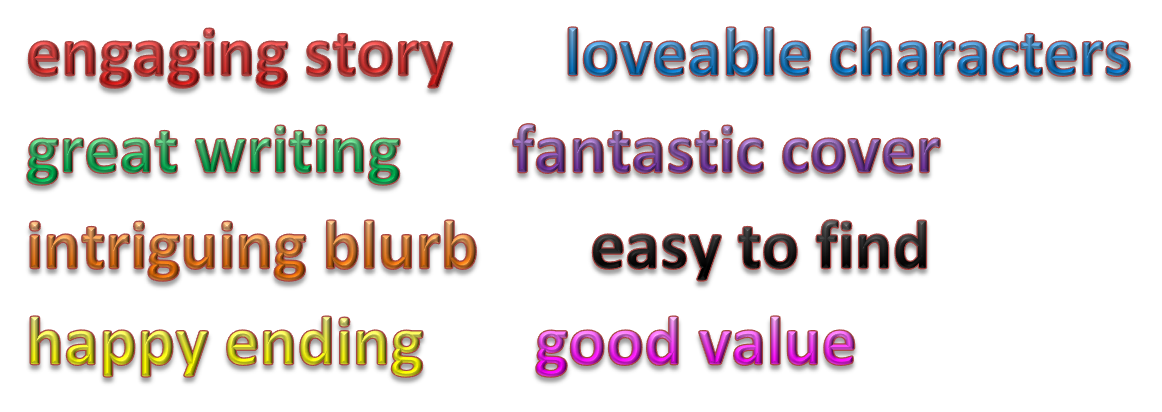
  • Readers want stories that they will enjoy and nonfiction books that will be useful. The storyline or content should be complete, thought out well, engaging throughout, pleasing to the specific target audience, better than average, and within reasonable scope of their expectations (based on the cover, blurb, and category). Readers want to love or despise the main characters, and they want to relate to characters or enjoy a new experience.
  • Genre readers want their expectations for the genre to be met. For example, romance readers want to fall in love, cry over broken hearts, see broken hearts mended, enjoy a happy ending, etc.; in a given romance subgenre, they want just the right amount of explicitness. They don’t want the protagonist to have certain behavior flaws. It pays to research and understand the specific target audience. Readers don’t want stories that violate important rules for the genre.
  • Readers want a clear indication of what they’re getting at a glance. This means that the cover must visually show what your book is about. The precise fiction subgenre or nonfiction subcategory should be obvious from a quick glance at your cover. The cover should also indicate the nature of the content. Why? Because the reader wants to find books quickly. Books that don’t send a clear signal, or which send mixed messages or the wrong signal, won’t get the limited attention that shoppers have to offer.
  • Readers want the blurb to be honest, clear, concise (so they can decide quickly), and pique their interest. If 100 words don’t interest the reader, it wouldn’t be wise to read 100,000 words by the same author.
  • Readers want books to be easy to find. They want to find it in the relevant subcategory (and not find it where it doesn’t belong). They want to find it with relevant keywords (but not find books that shouldn’t show up in the search). They want the cover to depict the content and genre clearly to help them find the book. They want a title that’s easy to remember and spell. They want to see book reviews that help them find good books. They want the author or publisher to go to the trouble of helping them find books they are likely to enjoy. But they don’t want intrusive advertising.
  • Readers want books that are well-written, nicely formatted, and free of spelling, grammar, and other mistakes. They are paying money for a book and they are investing time in the book, so why shouldn’t they expect to receive a professional book in return?
  • Readers want a great value. They don’t just want a low price. They want a great book at a fair price. Some readers shop a higher price range thinking that you get what you pay for. But no matter what the reader pays, the reader expects to receive a great book. Even if the book is free. It’s not worth investing several hours on a book for it not to be professional and good, even if it’s free.
  • Readers want a great story, great characterization, great editing, great writing, great formatting, a great cover, a great blurb, and a great price. Why not? When there are books out there that are great all around, why should any reader settle for less?

Give readers what they really, really want, and your book is apt to find many more readers. Give them something they must settle for, and only some (if any) will choose to settle.

Remember to ask yourself what readers want. Ask yourself this when you’re writing your book, when you’re formatting your book, when you’re pricing your book, when you’re writing your blurb, when you’re deciding on your cover, when you’re marketing, and in your public relations.

For example, there are customers who absolutely do not want you to invade their space in the review section and comment on a review. Since some customers feel very strongly about this, it may be best to give them what they want.

If you were an entrepreneur running a small business, it would serve you well to think about what the customers want.

As an author-preneur, it serves you well to think about what your specific target audience wants.

About My Blog

I started this blog to provide free help with writing, publishing, and marketing. You can find many free articles by clicking one of the following links:

Chris McMullen, Author of A Detailed Guide to Self-Publishing with Amazon and Other Online Booksellers

Follow me at WordPress, find my author page on Facebook, or connect with me through Twitter.
Turning Pro: Taking Indie Authorship to the Next Level

Pro

You would like to start out looking like a pro.

Many wise authors strive for this:

  • Searching for similar titles to see what may be highly marketable.
  • Asking experienced authors, editors, publicists, and small publishers for advice.
  • Doing research on writing, formatting, publishing, and marketing.
  • Trying to build a following before publishing.
  • Joining a writing group to improve as a writer.
  • Receiving ample feedback from the target audience.
  • Hiring a cover designer and editor.
  • Building buzz prior to a book’s release.
  • Writing a press release and distributing it to the media.

These are great things to do, and they can help immensely.

Yet, no matter how hard you try to nail your first book, you always improve and grow as an author:

  • After establishing yourself as an author, you have a fan base to work with and toward.
  • You find yourself reading a book, wondering why you didn’t think of that, or something you see triggers a design idea for your book.
  • A reader provides a helpful suggestion that you hadn’t considered.
  • You come across publishing tips you wish you’d known previously.
  • Once you have enough books out, you may start thinking more and more about becoming a small publisher.
  • New connections may open new possibilities for your books.

Unless your book is free or you donate 100% of the proceeds to charity, then technically you’re a professional author. But that’s not what I mean by professional. Rather, there comes a point in every writer’s career where you feel that you’ve made the transition from amateurish to professional. When you’re more experienced, wiser, and your writing has matured, you realize you’ve made some transition. This probably doesn’t happen just once, but several times over the course of writing.

Another thing I don’t mean is any distinction between indie and traditional authors. More and more traditional authors are also indie publishing, often with a pen name, which really blurs any line you might want to draw between them. It’s not how you publish that matters most to a reader, but how professional the book is. There are different degrees of professionalism even within traditionally published books.

As you grow as an author and strive to become more professional, here are some of the things you might consider:

  • ISBN options. When you start out, it’s hard to invest more than about $10 in an ISBN option. As your sales grow, you start to consider buying a block of ISBN’s. For example, in the US Bowker offers 10 for $250 or 100 for $575. As you start to think of developing a serious imprint and expanding your distribution options, this might fit your needs.
  • Professional websites. You may want something that looks more like a website and less like a blog. You might want your own domain name. You may add a site for your book and another for your imprint. At Facebook, you may add an author page or book page. If you create a Facebook page (i.e. more than just a Facebook account), it will have a Like option, and if you feed your WordPress blog into Facebook (but beware of this issue), those Facebook page Likes add to your follower tally (so do Twitter Follows if you feed your blog into Twitter). From your Facebook home, find the Create a Page option on the bottom-left. For an author page, click Artist, Band, or Public Figure; one of the options is author. (You can also make a page for your book by selecting Entertainment.)
  • Professional help. As your sales grow, you might consider investing more on cover design or editing, or even interior design. Although I’ve enjoyed designing my books, I’ve found a cover designer and had covers made for my most recent books and works in progress. I like the new covers much better, so I’m very pleased with this decision. I’ve also purchased illustrations and designs for book interiors.
  • Advertising. It’s difficult to invest in advertising when you’re starting out. There is a huge risk that you won’t recover your investment. You wish you could throw a little money out there to relieve you of the need to market your books, but it doesn’t work out that way. But once you’ve achieved some degree of success, you can better gauge your book’s marketability, you know you will have some initial support, and your current royalties can help cover your investment. You may be looking for ways that an advertisement can complement your marketing, such as a paid advertisement for a one-day book promotion.
  • Giving back. When you start out, you need a lot of help. As you gain experience, you have more knowledge to share and need less help. You might pay it forward, helping new authors through blog posts or who approach you with questions (whereas most people don’t like unsolicited advice). As you become more efficient with your own marketing, you might help a little to promote up-and-coming new authors whose work you like.

I’m presently collaborating on a publishing project with other authors to create a new series of math and writing workbooks. There is a creative element that will hopefully help engage children in learning fundamental skills. We’re getting professional covers for the series and professional illustrations for the interiors. We have a logo. We’ll use an imprint and purchase ISBN’s. We’ll be setting up a website. Our goal is to create a professional series of math and writing workbooks that meet the needs of students, parents, homeschoolers, and teachers.

Maybe a traditional publisher would like to have this series. But we’re indie all the way. 🙂

We’re hoping to launch the series in the spring or summer of 2014.

Chris McMullen, author of A Detailed Guide to Self-Publishing with Amazon and Other Online Booksellers, Volume 1 (formatting/publishing) and Volume 2 (packaging/marketing), Facebook page, Twitter