Marketing the Wrong Element of Your Book

Marketing Images

THEMES & TOPICS

The big challenge of book marketing is finding what works for you.

It’s often not just what you do, but how you do it.

The difference between a successful or unsuccessful marketing technique may lie in something incredibly simple.

Like which element of your book you mention.

You do mention your book in all your marketing.

Online, at the very least, you show the title of your book or a picture of the cover.

In person, you also mention the title of your book.

Online, you include a link to your product page.

In person, you pass out a business card—or even better, a bookmark.

But the title of the book may not be enough to really show potential readers if your book really is a good fit for them.

And a lengthy description is too much to give in passing.

What you need is very brief clarification.

But not the genre. That’s not enough.

You say something like, “It’s a mystery.”

No, that’s not enough.

But your description won’t work either. That’s way too long. (Until they finally arrive at your product page.)

I know, every newbie author would be thinking, “I want every mystery lover to read my book.”

Or, more realistically, “I don’t want to lose out on a possible sale from any mystery lovers.”

You don’t want to clarify that it’s set in Brooklyn in the 1800’s because anyone who doesn’t care for Brooklyn or the 1800’s will pass it up.

Newsflash: Once they check out the Look Inside, if they really don’t like Brooklyn or the 1800’s, it’s not going to matter that you got the customer all the way to your product page.

Instead, you’re losing traffic from your specific target audience—those mystery readers (and non-mystery readers) who really would like to read a book set in Brooklyn in the 1800’s.

Those readers hear, “It’s a mystery,” and think to themselves, “So are thousands of other books.”

If instead they hear, “It’s a mystery set in Brooklyn in the 1800’s,” those who would like such a book think, “Hey, that’s a mystery that I might really enjoy.”

Think through the various elements of your book. Talk it out with others who are familiar with your book.

Which aspects of your book may attract specific target audiences?

It could be the theme (a historical novel that takes place in the Civil War), topic (a spy novel about submarines), setting (a city that many people have visited or would like to imagine living in), an era (a time period like the Renaissance), character traits (a protagonist dealing with a particular medical condition), or a number of other qualities.

What can people relate to? What might draw interest in your book? What could serve as a helpful conversation piece?

Check out the following article on Just Publishing, which describes this and nine other common book marketing mistakes:

https://justpublishingadvice.com/11-mistakes-new-self-published-authors-make/

Chris McMullen

Copyright © 2014 Chris McMullen, Author of A Detailed Guide to Self-Publishing with Amazon and Other Online Booksellers

  • Volume 1 on formatting and publishing
  • Volume 2 on marketability and marketing
  • Boxed set (of 4 books) now available for Kindle pre-order

Follow me at WordPress, find my author page on Facebook, or connect with me through Twitter.

Comments

Click here to jump to the comments section:

https://chrismcmullen.wordpress.com/2014/11/16/read-more/#comments

Who Wants to Read Your Self-Published Book?

Love Indies Pic

SELF-PUBLISHING?

You may have read an interesting article in the Washington Post recently, entitled, “No, I don’t want to read your self-published book.”

This particular article evolved from a letter from the editor in Horn Book Magazine.

The context of the letter is to explain, essentially, to indie writers why publications that review traditionally published books can’t consider reviewing self-published books.

This is in spite of the big “BUT”—i.e. but there are a few outstanding indie books, yet there are also some bad traditionally published books.

WHAT DOES THIS MEAN?

I think it’s great news for self-published authors:

  • In the beginning, traditional publishers and professional book reviewers simply IGNORED self-published books.
  • Self-publishing has grown tremendously. There are many millions of self-published books being sold and read each year, taking up a very significant market share.
  • We’ve finally caught the attention of traditional publishers and, now, even editors who review traditionally published books. They’ve taken notice.
  • It’s an article in the Washington Post about self-publishing. It’s angled so as to explain what’s wrong with self-publishing books, in a way.
  • Maybe it’s not just a message to authors. I read it this way: They see more and more readers enjoying self-published books, and this is a marketing attempt to sell the perception that traditionally published books are better.
  • It may be more than that, too. Traditional publishers not only want more readers to prefer their books, they also want the best indie authors to try to jump through the hoops via agents so that they will have more good material from which to choose.

But I’m looking a little beyond the actual context with my last couple of points.

What is clear is that we’ve seen many articles on various aspects of self-publishing in major publications in the past few years. Self-publishing is gaining more traction.

ART VS. BUSINESS

Writing is an art.

Publishing is a business.

Authors tend to prefer feeling like artists when they write.

Publishers tend to prefer to publish what they feel is more likely to sell.

Self-publishing opens up a fascinating possibility: Writers can write for art’s sake, not worrying if they may be sacrificing some business.

An author can choose to write for a smaller audience.

But there’s another side to this coin: Readers are paying money or, at a minimum, investing time to read books.

As a reader, if you pay for a book, you expect quality.

Unfortunately, not all self-published books have delivered on quality, which brands a poor image for self-publishing at large.

On the other hand, there are self-published books that have delivered on quality, which helps brand a good image for the possibilities of self-publishing.

And then there are traditionally published books that have failed to live up to readers’ expectations. This tends to make readers think about investing much less money on a self-published book next time.

STAMP OF APPROVAL

This brings up to an important question: How do you know what’s worth reading and what’s not?

An intuitive idea is some sort of stamp of approval; some attempt at quality control.

It might sound good at first, but it gets a bit tricky.

Traditional publishing would have you believe that their publishing label is the ultimate stamp of approval.

It may be true that most traditionally published books have better editing than most self-published books.

Nothing prevents self-published authors from hiring quality editors. There are, in fact, very well-edited self-published books.

But if editing is quite important to you, traditional publishing might be more likely to deliver on editing. Or if you can find a quality editor whose work you like, you could read books edited by that editor, traditionally published or not. There are many ways to go about this.

Some self-publishers would like their own stamp of approval. Those who believe their books are better in some way often wish to have some means of easily differentiating their books from what they believe to be worse books among customers.

Here’s where it gets a little tricky: There are many ways to judge what makes a book better. Editing is just one. Storytelling is another. There are several qualities that factor into this. And then there is more than one way to tell a great story.

To a large extent, customers judge what’s better. Sure, they can leave reviews (but let’s not open that can of worms just yet). They can also recommend books they enjoy. Let’s give the customer some credit: He or she is likely to check out the product page and Look Inside.

But there are various stamps of approval. You can get an independent review from Kirkus, for example. You can get review quotes. There are indie reviewers and publications that review indie books. There are author groups and reader groups attempting to identify quality as measured in some way.

WRITING AS ART

Imagine that we’re talking about painting, not about writing. Both are art forms, right?

Suppose we give the painters a challenge: They must paint a picture using a page from a coloring book.

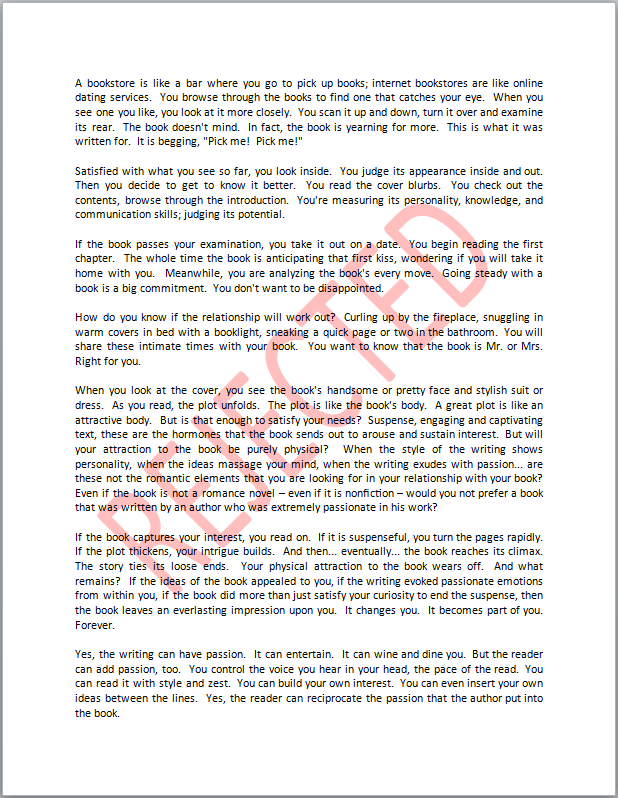
Would it be fair to take all the painters who fail to stay within the lines and REJECT their chances to display their art in a gallery because they failed to meet this elementary standard?

We’d lose some brilliant masterpieces if we did this.

Staying in the lines is arguably not the most important talent that one can find in a painter. Though for some kinds of painting, this talent may be quite desirable.

Not everyone appreciate the same art. Some may prefer paintings created by artists who could easily stay within the lines; some may prefer paintings by those who couldn’t do this.

Following the rules of spelling, grammar, and style are, in a sense, like painting within the lines.

The analogy isn’t perfect though.

  • A painter can’t find an editor to polish up the painting. A painter must perfect his or her own masterpiece.
  • An author can hire an editor to polish up grammar and spelling so that more readers can appreciate the art, and so that readers won’t be distracted by hiccups along the way.

Saying that the art of storytelling is more important than the art of grammar isn’t an EXCUSE to completely ignore the latter.

RULES OF ENGLISH

Are the rules of English really rigid?

If you master the art of spelling, grammar, and style, you want credit for your strengths. These are important to you: That’s why you learned them.

You look around and see others making mistakes. You see a few immensely popular books making spurious spelling and grammar mistakes. Frustrating, isn’t it? But there is more to a good book than just spelling and grammar.

There really isn’t an excuse for books to lack spelling and grammar correctness, but, alas, it happens. Even those who are very good at these make mistakes, and those who self-edit often read what they intended to write instead of what’s actually there.

Some people believe that there is only one rule of English: To communicate your idea clearly to others.

If others can easily understand what you’ve written, then you’ve followed the rules.

Many will see an instant problem with this: As soon as most people abandon the rules of English, it will soon become a challenge to communicate clearly.

We do need some rules.

A painter must perfect every square millimeter of his or her canvas. And so a writer must perfect every character on the printed page.

IMPROVE, IMPROVE, IMPROVE

You can’t say that your writing is a work of art and therefore consider your book finished just because you’ve reached the end.

As an artist, you must work diligently to perfect your masterpiece.

As a craftsman, you must learn to master all elements of your craft.

Because there is much more to writing a great book than just writing a great story.

The way you choose your words, the way your story flows, the variation in sentence length, the choice of vocabulary to suit your intended audience, the way you present your ideas, the perspective from which you describe events, the way you develop characters—these and so many other things go into storytelling.

And, yes, spelling, grammar, and style do matter. Because when they aren’t right, they do detract from the story itself.

WHO WANTS TO READ YOUR SELF-PUBLISHED BOOK?

I do. Well, I obviously can’t read EVERY self-published book. But I do read several self-published books every year. I throw in a few classics, too, because I believe that reading these is valuable toward writing well.

I’m not the only reader out there who supports self-publishing.

There are hundreds of thousands—perhaps millions—of self-published authors. Many of these authors read books. Not all, but many do like to support self-publishing by reading other self-published books.

These self-published authors have families, friends, acquaintances, and coworkers who also support self-publishing.

There are hundreds of thousands—perhaps millions—of authors who have been rejected by publishers, agents, magazines, and newspapers. Many rejected authors choose to invest their reading money on self-published books. (Yes, those polite rejections do have a cost; and the not-so-polite ones, well, maybe that wasn’t such a good business decision. Exclusivity may have benefits, but it also has disadvantages.)

Many people view traditional publishers as businesses. Guess what: They’re right! Do these businesses have writing as their top priority? Or is the top priority financial? With these questions in mind, there are many readers willing to give self-published authors a chance, hoping to find writing that was written for art’s sake, not for the sake of business. (It’s not easy to find such books, but there are books written this way, and there are readers who’d like to find them.)

Many people don’t want to read what’s popular. Many do: Bestsellers sell an insane number of copies. Many people do browse the bestseller lists, expecting those books to be better. But there are millions and millions of readers, and so a significant number do prefer to read what’s not popular. They’ve tried popular books and didn’t, for whatever reason, appreciate them. Maybe they will like a book written for a much smaller niche audience.

SELF-PUBLISHING IMAGE

The main thing is that readers want great books.

Self-publishing may have good potential, but readers need to be able to find books that they enjoy. Out of the millions to choose from.

How do you define ‘great’? One man’s trash is… you know how it goes.

But it doesn’t matter: As a reader, you want to find the kinds of books that you believe are great.

And you don’t want to find books that you can’t imagine anyone calling great.

Image counts.

When customers try self-published books and have a poor experience, they’re less likely to try self-published authors again.

Until they find themselves dissatisfied with expensive traditionally published books. Then they might reconsider.

There isn’t much that we can do about the worst of the worst at the bottom. Not all those at the bottom are bad books: There are some well-written books that simply have little audience, or just didn’t have the right cover or blurb to get attention. The problem with removing the worst books is the impossibility of efficiently identifying them. The other problem is that Amazon makes an amazing amount of money off even the books at the bottom, simply through huge numbers, and so it wouldn’t make sense financially for Amazon to remove them.

But everyone can help to improve the image. Small things go a long way:

  • We can all do our best to continually strive to improve our own books.
  • We can refrain from publicly discussing bad books, as that paints a poor perception that hurts even the best self-published books.
  • We can find great examples of excellent self-published books and mention those publicly. The more people who read and enjoy self-published books, the more readers there will be who support self-publishing.
  • We can offer tips for other self-published authors (indirectly, perhaps—not as unsolicited advice, which often has unintended effects).
  • We can educate readers about ways to find quality books.

Chris McMullen

Copyright © 2014 Chris McMullen, Author of A Detailed Guide to Self-Publishing with Amazon and Other Online Booksellers

  • Volume 1 on formatting and publishing
  • Volume 2 on marketability and marketing
  • Boxed set (of 4 books) now available for Kindle pre-order

Follow me at WordPress, find my author page on Facebook, or connect with me through Twitter.

Comments

Click here to jump to the comments section:

https://chrismcmullen.wordpress.com/2014/10/08/who-wants-to-read-your-self-published-book/#comments


Authors’ Best Friend Is… Ape!

The Story Reading Ape

If man’s best friend is… dog,

Then authors’ best friend is… ape.

The Story Reading Ape, that is.

Chris, the Story Reading Ape, is an avid supporter of authors:

  • Frequently supporting authors with guest blogs and promotions.
  • Housing helpful resources for authors on his blog.
  • Posting words of wisdom for authors.
  • Supporting authors with reblogs.

The Story Reading Ape’s blog is very author-centric (and therefore quite reader-centric).

Check out the resources on the Story Reading Ape’s blog:

http://thestoryreadingapeblog.com

Once there, click Authors Resources Central. Check out:

  • Author Promotion
  • Guest Author
  • Information about CreateSpace, Kindle, and Smashwords
  • Proofreaders
  • Professional Editors
  • and more

Chris, the Story Reading Ape, had no idea that I was writing this post. He is just so generous in his support of authors, I thought we should do something nice in return. 🙂

Don’t get the two Chris’s mixed up. I’m Chris McMullen, not to be confused with Chris, the Story Reading Ape.

Copyright © 2014 Chris McMullen, Author of A Detailed Guide to Self-Publishing with Amazon and Other Online Booksellers

Learn Much about Self-Publishing by… Blogging

Blog First

Hands-on Self-Publishing Experience

Blogging at WordPress can teach you more about self-publishing than you might realize.

Think about this, and strive to get the most out of it.

It would be wise to blog before self-publishing for the hands-on experience every authorpreneur needs to be successful.

But even if you’ve already self-published, it’s not too late to make the connection between blogging and indie publishing.

Here are several ways that blogging at WordPress can help you become a more successful authorpreneur:

  • Crafting the title. You have to write titles for your blog articles, so you get plenty of experience trying out titles and seeing how much attention your posts get. The title is a very important part of your book. Without blogging, most authors would have no experience or practice writing titles and seeing what interest they stimulate. Study the titles of articles from popular bloggers.
  • Content popularity. Writing about different topics, you can see which seem to be more popular or less popular among bloggers. The best way to learn what people like is through first-hand experience.
  • Keywords and categories. Gain experience choosing categories and tags for your articles at WordPress. You’ll need to choose categories and keywords when you publish. For your blog, you can type phrases in Google to see how popular they are, and for your book, you can try phrases out at Amazon’s home page. When you come across popular blog articles similar to what you write, check out the tags and categories that they used.
  • Cover design. Preparing or linking to images in your posts gives you some feedback regarding how to attract an audience visually. You also see images that evidently attract much attention to popular blog articles. The more you prepare your own images, the more you learn little tips.
  • Look Inside. In the WordPress reader, people only see a short sample. Bloggers strive to learn how to use the beginning of the article to create interest in the article. Similarly, at Amazon, you need to write an engaging blurb and Look Inside.
  • Writing practice. Blogging offers writing practice for self-published authors. You can even try out a new style or genre, with real readers to offer feedback.
  • Build your brand. At WordPress, you strive to build your blogging brand. This will carry over to becoming an authorpreneur, where you need to develop brands as an author and for your books.
  • Learn about marketing. You get firsthand experience trying to market your blog, which will carry over to book marketing. You get to see what other authors do in the way of marketing. Plus, blogging helps you build helpful relationships that can help you with your marketing when your book comes out. Some of your followers will serve as your initial fan base, too.
  • Monitor traffic. WordPress shows several stats that help you analyze your blog traffic. This can help give you a sense of the potential of your blog to help with marketing—a small percentage may be your initial fan base, but more importantly, the search engine traffic helps you see what frequency of outside visitors discover your website daily. The number of likes per post gives you some idea of your active following, which can pale in comparison to your total following; the search engine traffic is the number with the greater potential.
  • Get support. Relationships that you build on WordPress can support you with advice, reblogs, feedback, and more when you begin your self-publishing journey.
  • Explore formatting options. You have to format your posts here at WordPress. As you try new things in your articles, you gain some formatting experience. An e-book formats much like a webpage.
  • Test an idea. Got an idea that you want to test out? Try a sample on your blog and get some feedback.
  • Meet your audience. A thin slice of your WordPress following will include readers from your target audience. These interactions are golden.
  • Device management. Over time, you happen to view your blog from your pc, laptop, a friend’s iPad, a cell phone, etc. This gives you some idea about how various things format on different devices. That’s good experience for the challenge of formatting e-books that read well across all devices.
  • Analyze stats. Stats at Amazon are pretty limited—royalties, sales rank, reviews. You get many more stats here at WordPress—countries, views, likes, follows, shares, comments, etc. Such data can be valuable. You could even make a graph of your blog views for the month and compare it with your sales graph to see if there may be any correlation.
  • Website development. Indie publishers need to have websites, Facebook author or book pages, author profiles, etc. The experience you gain transforming your blog into a website will help you anytime you need to create a webpage or website.
  • SEO. You write articles hoping to pull in traffic from search engines. You gain experience with SEO as you try out categories, experiment with how to include keywords in headings and body text, etc.
  • Grow a following. You’ll develop a following here at WordPress. Setup an author page at Facebook and link to it at the end of your posts, and feed your WordPress posts into Facebook (but don’t also feed Facebook into WordPress or you’ll get double posts). Similarly, feed your blog into Twitter (but don’t feed from Twitter to WordPress or Facebook, or again you’ll get double or triple posts). Create profiles at Google Plus and LinkedIn, and your WordPress traffic can help you grow a following everywhere.
  • Build connections. Meet fellow authors, editors, graphic designers, small publishers, and more in your WordPress interactions. Indie authorship is a supportive community, for the most part.
  • Create buzz. When you release a book, your blog will help you create buzz for it.

Of course, there are many other benefits to blogging. For example, you can make some great online friends, and you can find some excellent material to read for free here at WordPress. Arguably, friendships and great reading material are the BEST parts of WordPress.

Chris McMullen

Copyright © 2014 Chris McMullen, Author of A Detailed Guide to Self-Publishing with Amazon and Other Online Booksellers

  • Volume 1 on formatting and publishing
  • Volume 2 on marketability and marketing

Follow me at WordPress, find my author page on Facebook, or connect with me through Twitter.

Comments

Click here to jump to the comments section:

https://chrismcmullen.wordpress.com/2014/08/03/learn-much-about-self-publishing-by-blogging/#comments

So Your Friend Is an Author…

Judge

Amazing, Isn’t It?

Yes. It is.

How many authors do you actually know?

Now your friend is one.

The key word there is friend.

This was your friend before. Becoming an author doesn’t change that.

Sure, you can tease your friend about this, if your relationship ordinarily involves teasing.

But your friendship is based on more than just teasing:

  • You support one another. Even if one of you writes a book.
  • You’re honest with one another. Even if you think the book isn’t quite, well, you know.
  • You know each other well. How to get on one another’s nerves. How to put things gently. So you can figure out the right way to share honest feedback.
  • You motivate one another. So in addition to honest feedback, you’ll provide encouragement, motivation, and direction.

Your friend wrote a book. That’s a huge accomplishment. Treat it as such.

There are some things you should know about writers:

  • Writing is a lonely process. Literally: Alone with the computer, writing. Marketing can be lonely, too. This same author, all alone, is reading reviews, which sometimes tear down the author’s hard work. Friends can remind that author that he or she isn’t alone. They can help the author handle criticism, and prevent the author from doing anything rash.
  • Once in a while, the author needs to be dragged outdoors into the real world, kicking and screaming. But if you try this when the author’s muse has just shown up after a long absence, it could prove to be a fatal mistake. You have to judge how vigorous the kicking and screaming is.
  • Writers can be a little eccentric at times. Your friend has some personality. You’ll be occasionally entertained. What’s not to like about this?

There are many ways that you can support an author (and still be honest and scrupulous):

  • Read the book, especially if it’s a kind of book that you’d normally be interested in. But if it’s not your kind of book, you can still support the author without reading it.
  • Help spread the word, especially if you’ve read the book and enjoyed it. But even a “Hey, my friend, Joe, just wrote a mystery” mention is valuable advertising for your friend. Most authors feel uncomfortable with the necessity of promoting their own books (even if they do this, they often feel uncomfortable doing so). Readers, also, sometimes put more stock in what someone else says about the book than the author’s own self-promotion. Gee, if only that author had some wonderful friends who could help spread the news… Hint, hint.
  • Do you know someone who read the author’s book? Ask that person to write an honest review. Authors need reviews, but asking for reviews of your own book… can look unprofessional (and again, authors can feel uncomfortable doing that). But an author’s friend, taking the initiative to do this (i.e. the author didn’t ask you to ask for reviews)… you could be that secret helping hand. You’d be like a superhero with a secret identity.
  • Follow the author’s blog, tweets, and Facebook posts. Encourage the author to keep separate Facebook pages for personal and authorship (e.g. there are author and book pages at Facebook). You should follow both. Expect to get tired of hearing about your author’s book. Don’t feel obligated to read and comment on every one of the author’s book-related posts. Your name is there. You participate occasionally. This means a lot.
  • If you have your own blog or website… just imagine if you mention the author’s book. Don’t even tell the author. Let him or her happen to come across it someday. “Wow! When did you do that? That’s so cool!”
  • Check out your friend’s product page at Amazon. Vote on reviews. Offer some feedback to the author on the cover, description, and Look Inside.
  • Visit local libraries and bookstores. Ask them why they don’t have this most amazing book right there on the shelf.
  • Attend a signing or reading. Encourage your author friend to do these. If you don’t feel like attending yourself, you can still help spread the word and encourage other people to attend.

Your friend spent months finding a little extra time each week, typing tens of thousands of words, massaging those words into a book. That’s no small achievement.

Your friend has considered agents, publishing houses, and self-publishing. There is no easy answer, no clear road to success. It’s a challenge.

Your friend is navigating the deep waters of marketing. It’s a strange world, but necessary to share the book with others. It’s daunting.

A little support from a friend would go a long way.

Mix that with some patience and understanding.

Remind the author that there is a real world here, which the author is part of… which the author needs to physically seem be a part of from time to time.

Remind the author that friendship works both ways. You have needs, too. It’s not just all about the author.

Throw in a little teasing, perhaps.

If your friendship survives authorship, it’s mean to last forever.

Copyright © 2014 Chris McMullen

Chris McMullen, Author of A Detailed Guide to Self-Publishing with Amazon and Other Online Booksellers

Follow me at WordPress, find my author page on Facebook, or connect with me through Twitter.

Comments

Click here to jump to the comments section:

https://chrismcmullen.wordpress.com/2014/06/17/so-your-friend-is-an-author/#comments

Authors, You Are Amazon

Me yes you

Why You

Because your book is available for sale at Amazon.

Amazon does sell many other products, but most customers think of books when they think of Amazon.

Millions of customers will buy other books besides yours, but some will (hopefully) buy your book.

When those customers read your book, your book—for that period of time—represents Amazon.

If the customer enjoys the shopping and reading experience that your book provides, the customer doesn’t just think highly of your book and you, but Amazon, too.

A poor buying or reading experience produces the opposite effect.

Of course, you have your own reasons for wanting to create a positive reading experience: You want the customer to recommend your book to others and to look for more of your books.

You want other authors’ books to create positive reading experiences. The more customers who enjoy shopping for books at Amazon and reading those books, the more likely those customers are to buy more books from Amazon and recommend Amazon to their friends, which improves the sales potential of your own books.

So it’s in your interest to support your fellow authors when they need and ask for help. (Offering unsolicited advice isn’t always received well, though.)

It’s also in your own best interest to help brand a positive image for Amazon, Kindle, and CreateSpace. The more customers who shop on Amazon, the better for all authors.

It’s even in your best interest to have good things to say about books similar to yours because those books are likely to appear on your customers-also-bought lists, and even if they don’t, most customers buy multiple books that are similar, not just one of them. Similar books can thrive together (or they can sink together).

When you hear negative things about Amazon, Kindle, or CreateSpace, take a moment to calmly and concisely say something good—and then let it be. Don’t get into a confrontation. Brand a positive image for yourself, too.

If you ask a customer what Amazon is, he or she will probably mention that it’s a huge website with an enormous selection of well-priced books.

But that’s not how the customer feels about Amazon. How the customer feels depends on shopping experiences and reading experiences. Each sale of your book contributes to a customer’s perception of Amazon.

You are Amazon.

We are Amazon.

Even the customer is Amazon. Anyone who enjoys the great selection, convenience, and prices benefits from helping to brand a positive image for Amazon.

Of course, indie authors must be thankful for the opportunities that Amazon has created.

Indie authors account for a significant share of Amazon’s book sales.

Indies are Amazon, too.

And the best indie books have shown that they can create wonderful reading experiences.

Beyond Amazon

You’re more than Amazon.

If you sell books on Nook, Kobo, Sony, Smashwords, etc., you’re all of these.

Wherever your book is sold, your book represents that retailer.

You want to brand a positive image for all of these outlets, and for whatever publishing service you use.

Chris McMullen, Author of A Detailed Guide to Self-Publishing with Amazon and Other Online Booksellers

Follow me at WordPress, find my author page on Facebook, or connect with me through Twitter.

Can You Be too Professional?

Pro Am

Amateurish!

There are many ways that a book or author may be perceived as amateurish.

Many of these correspond to doing what seems intuitive or convenient:

  • Commenting on reviews.
  • Not realizing that the cover is a visual representation of what quality to expect.
  • Including the word “by” before your name.
  • Using the default settings in Microsoft Word.
  • Creating indents with the spacebar or using the Enter key to pagebreak.

Others are more subtle:

  • Not seeking editorial reviews to earn buyer confidence.
  • Typing two spaces after a period.
  • Poor font selection.
  • Not using Word’s style functions and First Line Indent from the Paragraph menu.
  • Getting a free .wordpress.com site instead of buying a domain or using .org.

Add to this at least 90% of the things done in the name of “marketing.”

Too Far?

If it’s not professional, does that make it amateurish?

Unfortunately, I see comments about other books and authors of the sort:

  • “That’s so amateurish!”
  • “You need to enroll in Publishing 101.”
  • “What a newbie!”
  • “Nothing says ‘amateur’ like Times New Roman.”
  • “Didn’t you preview your book first?”
  • “That book is in bad need of editing help.”

In a moment, I will come to an alternative to professional and amateurish.

First, let’s consider some of these points:

  • If there is something reasonable that you can do to improve the formatting of your book, you should do it. A better-formatted book makes a better impression. It’s certainly harder for readers who enjoy a story to recommend a poorly formatted book. A better-looking Look Inside is more likely to close the sale. However, once the book looks pretty good, for most buyers who support indie publishing, there will come a point where the formatting is good enough to earn the sale.
  • Some of the people who are avidly complaining about grammar, spelling, and writing style, and who are pointing out editing issues, are themselves editors. They want to advertise the importance of editing to drum up business. If they love editing books, naturally editing will be quite important to them. But it’s also important to readers. Frequent mistakes will lose reader interest. Not just in spelling and grammar, but using a vocabulary and style that suits the audience, having the book flow well, even improving the storyline and characterization. There are many different kinds of editors, and all editing is important. However, like formatting, customers who support indie books have some degree of tolerance. The important thing is to be on the safe side of where this line is drawn for the majority of your target audience.
  • A lousy cover suggests a lack of effort. Who wants to read a book where little effort was put into it? If the cover reflects much effort, the cover should, too. The cover is also a valuable visual tool. Customers searching on Amazon see the thumbnail among many others before deciding which books to check out. Most of the thumbnails don’t receive any attention. The cover is also a valuable branding tool. An effective cover makes the genre and content immediately clear to strangers in the target audience and appeals to the target audience. In nonfiction, sometimes large keywords can be effective with little imagery. If you interact with people personally, this can offset not having a great cover. But a fantastic cover opens many doors, and is a must for selling fiction through discovery online.

Option 3

If not professional nor amateurish, what else?

Stephen King is a professional author. Sold millions of books, traditionally published, famous.

You don’t expect to see Stephen King use his children’s school artwork for his cover. You don’t expect to see him commenting on many of his reviews. You expect his books to be professionally edited and formatted. You probably have really high expectations for the quality of his stories. Stephen King can easily get a ton of editorial reviews, famous authors to write forewords, professional book reviews, etc. His author site is stephenking.com, which looks very professional.

You’re not Stephen King. (If you were, why on earth would you be reading this blog?)

But you don’t need to be.

In fact, you can do some things that you wouldn’t expect Stephen King to do. (I’m not saying he doesn’t do them, just thinking what average expectations are.)

Personalization.

It’s your asset. You can interact with your fans, your target audience. Stephen King can interact personally with fans, too, and probably does. You can easily interact personally with a much larger percentage of your fan base. By the sheer numbers, Stephen King is pretty limited percentage-wise.

The Personal Touch

I see some authors with an AuthorName.com website without a blog. I’ve even see a few authors switch from the free WordPress .com site to .org, and I’ve seen the Likes and Follows disappear to be replaced by Facebook and Twitter options only.

I perceive this as an attempt to appear more professional (and .org may also offer more flexibility, although .com has everything I feel that I need). Also, displaying a tally of views, likes, and follows might show that a website isn’t too popular, so perhaps some aim to hide this data.

But it seems less personal.

In addition to personalization, humility may be another factor.

We like to discover the small guy, with a humble book that tells a great story, that we can support.

By the way, WordPress.com is huge and may help, rather than hurt, with search engine traffic compared to .org. See here: http://onecoolsitebloggingtips.com/2014/05/05/no-metadata-required-for-good-seo/. There is a lot of helpful info there; for this point, look at the end of the first paragraph under “Keyword Use in Branding.” I have .com (with the WordPress extension in it) and draw in over 100 views per day from search engines, so .com seems to work well for me.

Readers who want a professional, impersonal reading experience can already find that with traditional publishing. One of the advantages of self-publishing is the opportunity to provide a more personal experience to a larger percentage of readers. There are disadvantages, too, so it’s important to take advantage of the benefits.

Readers can also choose a personal experience, with a perhaps more humble book and author. I’m not saying to not worry about being professional. Get the formatting, editing, and cover to look as good as you can. Marketing-wise, think personal. That’s your advantage.

An interactive blog, where it’s easy to interact and follow however the fan prefers (WordPress, Facebook, Twitter, Google, Pinterest, email, etc.), with the convenient option of commenting from WordPress without having to sign into Facebook or Twitter, encourages participation. A simple Like while logged into WordPress offers a quick and easy show of support.

Think of ways to find and interact with your target audience. Readers who personally interact with an author, online or in person, and who enjoy the experience are more likely to buy the book, and to recommend the book to others if they enjoy it.

Many of the ways that books are bought are inaccessible to new authors: bestseller lists, showing up high in a category, professional reviews, name recognition, etc. But one of the big ways that books are purchased is following personal interaction with the author. Every indie author has this opportunity.

How about editorial reviews and advance review copies? This is very common among traditionally published books. Should indie authors be copying what traditional publishers do? I know, there are some incentives to reviews, as some sites that promote indie books set a bar to reach.

Some customers don’t like to see numerous reviews show up shortly after a book is published: It can create buyer suspicion. Some disregard all those quotes of how wonderful a book is. At the same time, customers want to see an assortment of neutral opinions. Ah, what is neutral? Are all those glowing remarks inside a top-selling book really “neutral”?

Is it possible for a humble book with a personal touch, along with a possible personal experience, to have more appeal than a book that seems “too” professional? Food for thought, perhaps.

Chris McMullen, Author of A Detailed Guide to Self-Publishing with Amazon and Other Online Booksellers

Follow me at WordPress, find my author page on Facebook, or connect with me through Twitter.

Better

Better

The Good and the Bad

Better can be a great concept:

  • Trying to do better leads to improvement.
  • Not satisfied with how things are, it can be a great motivator.

Yet the concept of better does have drawbacks:

  • Other people may feel jealous of someone who seems to be better.
  • A feeling of superiority can lead to a variety of social consequences.

A Better Balance

The trick is to try to derive the benefits of the idea of doing better while avoiding the drawbacks.

I will apply this specifically to books and authors so that we have a concrete example in mind.

Striving to write a better book, focus on these positives:

  • Use this goal to motivate your writing.
  • Do research that will help with your book.
  • Seek feedback that may help you improve.
  • Think of how your book may benefit readers.
  • When dealing with criticism, remind yourself of the extra efforts that you made.

but avoid these negatives:

  • Feeling that your book is better than others. It probably is in some ways, but can’t be better in every way; so in some ways, it will be worse. Not every author has the same priorities: Maybe richer, more in-depth characterization appeals to you, and this makes your book better to readers who appreciate this, but it doesn’t make your book better to all readers. Maybe realism appeals to you, which makes your book better for readers who want that, but for those who want a fantastic world different from reality, it’s not better. Maybe your story is better, but the way the words are strung together isn’t. Different books are better for different readers. No book is best. Find one book that thousands love, and you’ll find that hundreds hate it.
  • Claiming that your book is better than another book. It may seem tempting to say, “If you liked ___, you’ll love ___,” but this can cause problems. First, this creates unrealistic expectations. Second, you don’t want to insult another book’s loyal fan base. It can be helpful to mention another book to give an idea of what to expect, but if you do this, do it in such a way that it in no conceivable way makes your book sound better than the other book.
  • Feeling that you’re a better author. Maybe you spent more time studying the craft of writing, but others may make up for this through life experience or imagination. Maybe you have done years of research, while others have a gift for knowing how to please an audience. You may be better in some ways, but you can’t be better in every way.

It is definitely worth trying to do better. This pursuit leads to better books, which creates more enjoyable reading experiences.

Trying to write a book that is better, in various ways, than other books you’ve read is good. Other readers are likely to appreciate this. But not all readers will agree.

Trying to improve over what you’ve seen other authors do, in various ways, is good. But you won’t be better in every way.

Comparing yourself to others can lead to jealousy, if other books seem to be selling better or receiving better reviews. Comparing yourself to others can lead to an air of superiority if your book seems to be above average. Either way, thee comparisons can create big problems.

There is one person you should compare yourself to. That’s you. Try to improve over your former self. That’s a noble ambition, it will make the world a better place, and you have no reason to feel jealous or superior when you’re comparing yourself to yourself.

About Me

I started this blog to provide free help with writing, publishing, and marketing. You can find many free articles on publishing and marketing by clicking one of the following links:

Chris McMullen, Author of A Detailed Guide to Self-Publishing with Amazon and Other Online Booksellers

Authors, What Are You Selling?

Selling

The Question

Aren’t you selling more than just a book? much more?

If all you’re selling is a book, that’s a big problem for you: It’s easy to find books. The library has thousands. You can find thousands in bookstores, millions on Amazon, and hundreds at yard sales.

It takes more—much more—than just a book to make it worth reading.

  • What more are you offering than just a book?
  • Who is likely to benefit from what your book offers?

You want to identify the benefits your book offers, the people most likely to appreciate those benefits, and figure out how to match those people (your target audience) with your book.

Well, duh!

But many authors either aren’t doing this, or aren’t taking full advantage of this seemingly simple logic.

Features vs. Benefits

People don’t buy anything.

People don’t buy features.

People may buy benefits (if those benefits are a good fit for them and they perceive the benefits as a good value).

Example: Someone asks you, “Was self-publishing your book easy to do?”

  • Nothing special: “The writing was fun, but the editing and formatting were nightmares.” You missed a golden opportunity here to introduce a benefit.
  • Features: “It was because I really enjoyed the writing, which took two years, and I hired an editor for the tedious part.” This highlights two features: Ample time spent on the writing and having your book edited.
  • Benefits: “I really enjoyed the months that I spent studying swordsmanship and how to describe it in fiction, and I hired an editor to make sure it reads very well.” First, if you’re really into swords and sorcery, this sounds authentic. Second, people don’t care for the editor (that’s a feature), but they may appreciate that it will read well (that’s the benefit).

You might be thinking, “Well, if you mentioned the editor, it should be obvious that the book should read well.” But not necessarily. For one, there are different types of editors. Some customers might interpret mention of the editor to mean that there are no spelling mistakes, but that doesn’t mean that it will read well.

And not everyone will make the connection. Sales people have better success when they describe benefits than when they list features, especially when they describe specific ways that a product will benefit each individual.

Example:

  • Nothing special: “This television measures 27 inches diagonally.” Everyone is thinking, “So do many other televisions.”
  • Feature: “This television comes with picture-in-picture.” Many customers are thinking, “Well, I don’t need that. I’d rather save money.”
  • Benefit: “With picture-in-picture built-in, your husband won’t have to change the channel during your soap opera to check the score of the game every few minutes.” Now if this applies to you, you may be starting to consider the benefit that this feature offers. You might not have considered this benefit just from the feature itself. You might have interpreted the feature to mean you could watch two shows at once, which you didn’t intend to do.

Just-a-Book Marketing

If all you have to offer is a book, then it should be satisfactory to just:

  • Tell people that you have a book. That should do it, right? Maybe tell the genre, too. But a romance novel is still one of thousands. What makes it special?
  • Keep mentioning the title so that people can remember it. But if they do remember, why should they read it?
  • Show people the cover so they can see it. But if they do see it, why should they care to find out what’s inside it?
  • Advertise that it’s on sale. But people don’t buy prices. They need a reason to want the book before price helps to create value.

Branding is important, and branding does involve getting your target audience to see your cover, your title, and your name multiple times over a long period so that they recognize it.

But branding is more effective when they associate some benefit with your book.

When you hear Sony, do you think high quality? When you hear Costco, do you think large quantities and good savings? When you hear Disneyland, do you think your kids would be happy to go there? When you hear McDonald’s, do you expect fast service and low prices? When you hear Bounty, do you think absorbent?

You want to associate some benefit with your brand. Then, when your target audience is shopping for a book in your genre and remembers your book, they will have some positive quality to associate with it.

They might not buy your book just because they recognize it. But if they recognize it and a benefit comes to mind, this greatly improves your chances for a sale.

But it’s not just about the book. It’s about you, too.

More-than-a-Book Marketing

There are two ways to offer more than just a book:

  • Mention a specific benefit that your book offers.
  • Remember that the author is an important part of the book and marketing.

This second point can make a big impact on marketing effectiveness. We’ll get to this in the next section.

Your product description is a valuable marketing tool. Think about the important benefits that your book offers your target audience. These benefits should be clear from reading your blurb, but fiction is a little tricky because the benefits generally must be implicit.

The author’s biography provides a chance to show how the author is qualified to write the book. For nonfiction, this is often a relevant degree or experience. For fiction, if you have a writing degree, you should play your card, but if not, you may still have relevant experience. Have you traveled to the place where part of your book is set? Have you spent a significant amount of time learning or studying a relevant skill, like forensics for a crime novel?

Instead of trying to brand just your book’s title, you might develop a concise phrase to serve as a hook. Use this to create interest in your book and to associate your book with a positive quality. Anywhere you mention your book’s title, you could include the hook next to it, such as at the end of blog posts, emails, or on business cards. You can even mention it in person, at readings, signings, or anytime you get the opportunity to interact with your target audience and the subject of your book comes up.

Example: Instead of just mentioning the title, A See-Through Relationship, you could also include the hook, “What if you fell in love with a ghost?”

It’s not easy to come up with a clever, appropriate, effective, very short hook, but it can really be worth it if you pull it off. It’s definitely worth spending time thinking about this.

I bet you recognize some company slogans. The hook works for authors much the same way.

When you have the chance to describe your book, online or in person, you want to make the benefits of your book clear. The better you know your target audience’s interests, the better you can show them how your book may benefit each individual.

The Author

It’s challenging to get people interested in your book.

Imagine you’re at a cocktail party, but it’s not an ordinary cocktail party. 90% of the people in attendance are sci-fi enthusiasts, and you have a science fiction book.

Suppose you set your book on a table in the center of the room and leave. I bet a few people will pick up the book, if the cover has good appeal, and check it out. But it’s just a book, and people didn’t attend a cocktail party looking for a book. They went to the party to meet people.

If instead you leave your book at home, but this time you stay at the party, there is a good chance that you will meet many people and get people interested in you.

You have a pulse. You move around. You talk. You interact. Unlike your book.

It’s easier to get people interested in you, the author, than it is to get people interested in your book.

Once people become interested in you, let them naturally discover that you’re an author, and their interest in you may translate into interest in your book.

By discover, I mean waiting for, “So what have you done lately?” instead of volunteering, “I just published a new book.” Wait for the prompt.

Use this to your advantage: Interact with your target audience, both in person and online.

You have a personality; your book doesn’t. You can interact with people; your book just sits there.

People in the target audience who personally interact with an author are more likely to check out a book, buy it, and leave a review than some random stranger who happens across it.

Online, a large number of people can come across your book. But to most of them, it’s just a book they see while passing through.

On your product page, your description may help to show the benefits, but first you need them to find your product page.

In person, your interactions can help to get people interested in your book through their interest in you, and then you can show them the benefits personally. Now you’re selling more than just a book.

You can also provide the personal touch online. You can also let people see that you’re more than just a name; you can help them discover the person behind the book.

More Than Just an Author

Chris McMullen, more than just the author of A Detailed Guide to Self-Publishing with Amazon and Other Online Booksellers

Follow me at WordPress, find my author page on Facebook, or connect with me through Twitter.

Even Indie Authors Get Rejected

Rejection

One great benefit of self-publishing is that it’s a sure thing.

You don’t need to send out query letters or book proposals.

You won’t be rejected by agents or editors.

But that doesn’t mean you won’t feel rejected.

Formatting Rejection

Once your manuscript is complete, you spend several days hammering that square peg of a book into a round hole, trying to reshape it into acceptable formatting.

You might be rejected by Microsoft Word, refusing to number pages, format headers, or keep the layout the way you would like it.

The publishing service might reject your file because it didn’t meet the technical guidelines.

Kindle might show you a preview that doesn’t look anything like your Word file.

Smashwords might not accept your e-book into the premium catalog.

Editing Rejection

People may point out spelling and grammar mistakes in your writing.

They might suggest that you really need an editor.

You might receive some constructive criticism on your writing, which, even when it has merit, can be hard to swallow.

Even worse, when you seek to hire an editor, the editor can choose to turn down the job.

Technical Rejection

When you order printed books, there is a chance of receiving defective copies.

A customer can receive a defective copy. No manufacturing service is perfect.

Even an e-book customer can experience technical hiccups while downloading or reading a book.

When one of your few customers encounters a problem that’s beyond your control, it can be frustrating.

Content Rejection

You can’t publish anything.

Amazon has content guidelines.

CreateSpace has content guidelines.

Kindle, Nook, and Kobo have content guidelines.

If you probe the limits of your writing freedom, your work could get rejected.

Sometimes there isn’t a clear line between what is or isn’t acceptable, but a murky gray area.

Legal Rejection

If you quote a line from a song, you could receive legal notice to take your book down.

If your writing infringes upon the rights of others, your book could lead to a lawsuit against you.

Legal action could cause a retailer to stop selling your book, or the publishing service to stop distributing your book.

Article Rejection

With the hope of gaining more exposure among your target audience, you may submit an article for publication.

Just like submitting a book proposal, your article may be rejected.

Contest Rejection

If you enter your book into a contest, you might not win.

You might not even make the first cut.

Review Rejection

Critics can leave bad reviews.

They can post one-star reviews right on the product page, where every shopper can see it.

Where your family and friends can see it.

Where you can see it.

Those comments can cut deep.

Sales Rejection

There is no guarantee that you will sell a single copy of your book.

Many books never sell 100 copies.

Not 100 per month. Not 100 per year. Not ever.

There are books that have been on the market for over a year that have no sales rank.

To not sell any books must hurt worse than receiving thirty rejection letters.

Public Rejection

People you know can complain about your book.

Or about how you’re wasting your time pretending to be an author.

While you strive to build positive publicity for yourself, once you enter the public eye’s scrutiny, one false step can lead to negative publicity.

Bully Rejection

Cyberbullies can target you.

Family Rejection

Your own family might not appreciate your writing.

They might wish you did something more “meaningful” with your time.

Self Rejection

You could be your own worst critic.

You might regret your prior writing.

You might delete your work and start over before you ever finish.

You might not even find the courage to publish in the first place.

Approved!

You write, therefore you are an author: See “Intimidation is nine-tenths of the writer’s law,” by Ionia Martin.

You don’t need permission to share your passion. You are approved!

Don’t focus on the worst that can happen. Focus on readers who can benefit from your writing. Those are the people worth writing for.

Writing and publishing a book is a huge accomplishment, no matter how you do it. Give yourself a round of applause. Congratulations!

Grow a thick skin. Find a support system. Don’t let ’em bring you down.

When you feel rejected, turn it around. Use it as a motivator. Let it boost you up.

Support

Offer support to other authors.

Read. When the writing is good, leave positive reviews. Spread the word about good books.

Share your wisdom and experience with authors who seek help from you.

Provide emotional support where it’s needed. Oh, yes, it’s needed.

Applaud authors everywhere for working hard to create wonderful reading experiences.

Listen.

It’s faint, but listen.

Do you hear it?

Sounds like a clap.

More clapping.

It’s growing louder.

Applause.

Take a bow. That applause is for you.

Publishing Resources

I started this blog to provide free help with writing, publishing, and marketing. You can find many free articles on publishing and marketing by clicking one of the following links:

Chris McMullen, Author of A Detailed Guide to Self-Publishing with Amazon and Other Online Booksellers

Follow me at WordPress, find my author page on Facebook, or connect with me through Twitter.