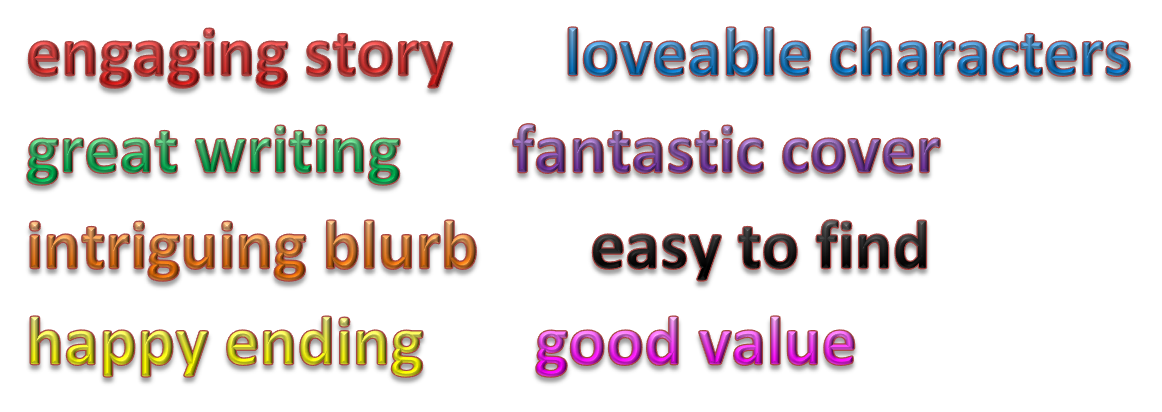
What Readers Want

readers want

If you’re a writer, the most effective way to attract readers is to carefully consider what readers want. It really is that simple.

But don’t fall into the common trap of thinking things like, “Most people won’t mind if there are typos,” “I know someone who paid $25 for an e-book, so I can sell mine for $9.99,” or “The content is more important than the cover.”

Don’t think, “What will the reader settle for?” Think, “What does the reader want?”

Fewer customers will settle for it. Many more customers will buy what they want.

I don’t mean that you have to write in the most popular genre. I don’t mean that you have to sell out, compromising your beliefs. I don’t mean that you have to study the bestsellers and copy their techniques.

You do need to think long and hard about what your specific target audience wants if you wish to maximize your sales. Following are specific examples of what I mean:

  • Readers want stories that they will enjoy and nonfiction books that will be useful. The storyline or content should be complete, thought out well, engaging throughout, pleasing to the specific target audience, better than average, and within reasonable scope of their expectations (based on the cover, blurb, and category). Readers want to love or despise the main characters, and they want to relate to characters or enjoy a new experience.
  • Genre readers want their expectations for the genre to be met. For example, romance readers want to fall in love, cry over broken hearts, see broken hearts mended, enjoy a happy ending, etc.; in a given romance subgenre, they want just the right amount of explicitness. They don’t want the protagonist to have certain behavior flaws. It pays to research and understand the specific target audience. Readers don’t want stories that violate important rules for the genre.
  • Readers want a clear indication of what they’re getting at a glance. This means that the cover must visually show what your book is about. The precise fiction subgenre or nonfiction subcategory should be obvious from a quick glance at your cover. The cover should also indicate the nature of the content. Why? Because the reader wants to find books quickly. Books that don’t send a clear signal, or which send mixed messages or the wrong signal, won’t get the limited attention that shoppers have to offer.
  • Readers want the blurb to be honest, clear, concise (so they can decide quickly), and pique their interest. If 100 words don’t interest the reader, it wouldn’t be wise to read 100,000 words by the same author.
  • Readers want books to be easy to find. They want to find it in the relevant subcategory (and not find it where it doesn’t belong). They want to find it with relevant keywords (but not find books that shouldn’t show up in the search). They want the cover to depict the content and genre clearly to help them find the book. They want a title that’s easy to remember and spell. They want to see book reviews that help them find good books. They want the author or publisher to go to the trouble of helping them find books they are likely to enjoy. But they don’t want intrusive advertising.
  • Readers want books that are well-written, nicely formatted, and free of spelling, grammar, and other mistakes. They are paying money for a book and they are investing time in the book, so why shouldn’t they expect to receive a professional book in return?
  • Readers want a great value. They don’t just want a low price. They want a great book at a fair price. Some readers shop a higher price range thinking that you get what you pay for. But no matter what the reader pays, the reader expects to receive a great book. Even if the book is free. It’s not worth investing several hours on a book for it not to be professional and good, even if it’s free.
  • Readers want a great story, great characterization, great editing, great writing, great formatting, a great cover, a great blurb, and a great price. Why not? When there are books out there that are great all around, why should any reader settle for less?

Give readers what they really, really want, and your book is apt to find many more readers. Give them something they must settle for, and only some (if any) will choose to settle.

Remember to ask yourself what readers want. Ask yourself this when you’re writing your book, when you’re formatting your book, when you’re pricing your book, when you’re writing your blurb, when you’re deciding on your cover, when you’re marketing, and in your public relations.

For example, there are customers who absolutely do not want you to invade their space in the review section and comment on a review. Since some customers feel very strongly about this, it may be best to give them what they want.

If you were an entrepreneur running a small business, it would serve you well to think about what the customers want.

As an author-preneur, it serves you well to think about what your specific target audience wants.

About My Blog

I started this blog to provide free help with writing, publishing, and marketing. You can find many free articles by clicking one of the following links:

Chris McMullen, Author of A Detailed Guide to Self-Publishing with Amazon and Other Online Booksellers

Follow me at WordPress, find my author page on Facebook, or connect with me through Twitter.

Fortune Cookie for Authors

fortune cookie

A local Chinese restaurant was one of the few places open last night. I found this note in my fortune cookie: “In great attempts it is glorious even to fail.”

Writers often have extraordinary ideas and make extraordinary efforts.

Authors shouldn’t be content with failure. They should work hard to succeed.

But they shouldn’t fear failure. Focus on perfecting the book. Completing the attempt itself is a success and reward of its own.

I had several book ideas beginning in the late 1980’s. I wrote some books. Started other books. Drew thousands of illustrations on the computer. Typed up worksheets. But didn’t publish my first book until 2008.

The idea that finally motivated me to publish was an introduction to the fourth dimension. I put much time, effort, and energy into my book on the fourth dimension for a couple of intense years, then explored my publishing options. Not content with my traditional publishing options, I looked into CreateSpace, and wound up publishing my extensive backlist over the next few years with them.

My book on the fourth dimension1 was my top seller for several months, but is no longer one of my top ten in sales. It had peaked with a sales rank of about 5,000 (it’s a paperback) for a couple of weeks in 2009, but is presently in the hundred thousands.

I had familiarity with publishing, formatting, and editing from several articles that I had published in Physical Review, and I had previously prepared 100-page master’s and doctoral dissertations, which are highly technical books with precise formatting criteria. Even then, formatting, editing, and publishing a book with hundreds of figures plus tables and equations proved to be a monumental task.

It’s not perfect. If I were formatting this book today, I would use a different design and font choice, plus I now know about things like widows, orphans, tricks to perfect vertical spacing, and foliation.

But I remember how much time, thought, and effort went into that book. From that, I would count this book as a success even if it hadn’t sold, and even though I could make it better with what I know now. I can appreciate the attempt itself.

For artists, isn’t the attempt itself what matters most? Make an extraordinary attempt. Do your best to perfect your art. Then no matter what, it’s a success.

I’ve been fortunate to have many publishing successes. The first six months seemed like a disaster, things started out very slowly, and there have been many trials and tribulations along the way. But I persisted.

I could have failed. For six months, it seemed like I had. But I didn’t fear failure. I gave it my best shot. It paid off in the long run. But even if it hadn’t, I’d still have my book on my shelf in my office, and consider the attempt an accomplishment.

Really, there is nothing to lose. If you finish your book and feel that you have perfected it, you’ve already won before you even sell one copy.

Many authors have extraordinary ideas and make valiant attempts. But not every author feels successful. Part of this has to do with perspective: Polishing and publishing a book is quite an accomplishment. Part of this has to do with expectations and patience. And part of it has to do with the book’s marketability.

Don’t undervalue the attempt itself. That’s the art. It can have much value and its value may be independent of sales or praise.

Don’t lose hope and patience. I know firsthand that things can improve considerably even if they start out very slowly. There is no guarantee that things will improve, but they can, so there is hope. All you can do is your best with the things you can control, and if you succeed at that, that’s an accomplishment of its own.

May you see improvement in 2014. 🙂

Perfecting Your Book

I started this blog to provide free help with writing, publishing, and marketing. You can find many free articles by clicking one of the following links:

Author of A Detailed Guide to Self-Publishing with Amazon and Other Online Booksellers

Chris McMullen

Follow me at WordPress, find my author page on Facebook, or connect with me through Twitter.

1. My original book on the fourth dimension is The Visual Guide to Extra Dimensions, Vol. 1 (paperback)

2. My newer book on the fourth dimension is available in Kindle or paperback, and appears in color: A Visual Introduction to the Fourth Dimension

Creative Marketing Ideas for Books

Envelope

Imagination. Authors use it to write books. Readers look for books that apply it effectively. So why not use that creativity in marketing, too?

Here are some creative marketing ideas for generating book publicity:

  • Small stickers with your book cover on them. Use them to seal envelopes and the recipient will surely see your book cover when opening your mail. An alternative is to print your book cover directly onto the envelope. Stickers can also be applied to many other items besides envelopes.
  • How about a nice tattoo of your book cover on a visible body part? What more could an author do to show how much he or she believes in his or her book?
  • But you can achieve a similar effect without the pain or a permanent mark on your body. It’s called a t-shirt. If it looks nice, other people might even wear them. It doesn’t quite show the commitment of a tattoo, but I’ve never met a reader who only reads books by authors who tattoo the covers on their bodies. In cold weather, t-shirts might get covered up, so a hat might be a good alternative.
  • Advertise your book on your car. The mild way to do this is with a bumper sticker. But you see more and more small businesses with extensive paint jobs to market their products and services. Sometimes, it’s just a website written on the back. Other times, the entire vehicle is transformed. Imagine thousands of people stuck in traffic, seeing your book on your car. Would this brand your book’s image effectively? Or would people think you’re a nut? Maybe it depends on how professional it looks and how mild it seems.
  • More traditional ways to publicize your book include business cards, bookmarks, flyers, and brochures. A bookmark that looks nice enough to use (i.e. not like an advertisement) helps to brand your image, at least with readers who still use print books. Wouldn’t it be cool if someone, who knows who, accidentally misplaced a few of your bookmarks inside similar books at a bookstore? How did those get there?
  • Wouldn’t it be cool to have some pens or pencils that feature your book? After all, you’re a writer.
  • Suppose you are friends with some experienced authors and between you, you have dozens of books. Imagine spending a day renting a small kiosk in a mall or other highly visible area, selling your books. Even if you don’t sell too many, people will see your books and browse them. In the worst-case scenario where you don’t sell any, you have a cool picture to post on your author page, blog, and all over the internet.
  • Think of all the advertising in sports: ballcaps, towels, golf tees and markers, wristbands, duffel bags, etc. You could have your book on one of these, advertising your own product instead of some big business. If your book relates to that sport, even better. People might even want one of their own.
  • I was watching a MLB game once where during the game the announcer mentioned a book that a fan had sent him and they showed pages of the book on the air. It had pictures of a fan’s collection of baseball memorabilia. If you send your product to a t.v. announcer, it probably won’t get aired, but if it does, that’s some major publicity. In the more likely case where it doesn’t get aired, it might still get read or mentioned to other people.
  • Don’t forget, it’s not just sight, there is also sound. People don’t just see your book, they can also hear about it. When you interact with people, let them discover that you’re an author and inquire about your book.
  • Imagine eating a peaceful dinner with your family. The phone rings. Telemarketer, of course. An author telling you all about his book. Yeah, this probably isn’t cost-effective for most authors, and might be rather irksome.
  • A less disruptive, more effective way to create book publicity is to get your book in the news. Prepare a professional-looking press release kit and contact newspapers and radio stations, for example. Start small and local. Many local papers have column inches to fill and like to highlight local talent; a small, local radio station might need to fill minutes. You can look for book reviews or interviews. You can also think of what else might make you newsworthy and let you plug your book.
  • Online, you can show your book cover and author photo and mention your book on all your sites. You can interact with your target audience at other sites and let them discover that you’re an author.
  • Write an article relevant for your target audience. Try to get it published in a newspaper or magazine, or a website online. There are so many websites online, that if you’re determined and your article is well-written and interesting, you have very good prospects. In the worst case, you can still post your article on your blog, so it won’t go to waste. Get your article posted where there is significant traffic from your target audience and you might get some healthy traffic to your book. At the end of the article, write Your Name, Author of Your Book.
  • There are many advertising opportunities online. The big question is whether or not it will be cost-effective. You can spend as little as about $5 a day and try to match your book with readers in your target audience at Goodreads, Facebook, or Twitter, for example. The click-through rate is pretty small these days, less than a percent on average; and of the products and services offered, a book by an unknown author probably won’t attract much attention this way.
  • If you really want to invest big, you can spend $10,000 or more advertising your book or series of books online. For example, that’s the starting amount to advertise a book through Amazon’s marketing department. This is for a professional campaign for highly marketable books, for authors with multiple books. Even then, you might not recover the investment after a couple million shoppers see your book over the course of a month.  The publishers and authors who use this service may have other objectives that may offset an initial loss, such as the hope of getting on a coveted bestseller list or stimulating initial sales and reviews for a new series. This is a huge risk for a new author, as the worst-case scenario is virtually no sales; there are no guarantees.
  • A more cost-effective way to advertise may be to run a short-term promotion and promote the sale through a service like BookBub. You can find a sample list here.

Marketability

It’s not just about marketing. It’s also about marketability. Do you have a book that readers will really enjoy? Do you have a book that has a significant audience? It can be a niche audience, as long as it’s significant and you can reach your audience effectively. Do you have a cover that will attract your specific target audience? Do you have a blurb that will make your target audience want to look inside? Does the look inside grab the reader’s attention and make him or her want to buy your book? Is your content good enough to get referrals, reviews, and recommendations? Will the editing and formatting satisfy the target audience?

If your cover isn’t appealing, or if your cover attracts the wrong audience, or if the blurb doesn’t make the reader curious, or if the look inside doesn’t attract the reader, or if the story doesn’t satisfy the reader, or if the reader finds many mistakes, or if there isn’t a significant audience for your book… then the first thing you need to do is improve your book’s marketability. You’re not ready to start marketing your book yet.

For an in-depth discussion of marketability, click here.

Target Audience

With any marketing and advertising, you need to gear it toward your specific target audience for it to be effective. Marketing efforts that reach your specific target audience effectively can do wonders for a highly marketable book. Spend time thinking about the characteristics and habits of your target audience. Interact with fans; direct them to your email, blog, or fan page. The more you interact with fans, the better you will understand the variety of people who enjoy your book.

Cost-Benefit Analysis

The easy thing to calculate is cost. If you invest in an advertisement or service, you can easily estimate how much you’re paying. Remember, time is money, too. If you’re spending hours marketing your book, this is costing you even if it’s free.

The hard thing to calculate is the benefit. It’s not easy to predict what impact your marketing effort will have on sales. If you do some new marketing, you can try to see if it’s improving sales compared to your average, but there are many complications (like maybe Amazon also made changes to customers also bought lists at about the same time, or maybe you got a few new reviews).

There are also many valuable benefits besides immediate sales. Most marketing requires patience, on the scale of many months. Branding takes time. People don’t run out and buy products immediately when they see an advertisement. The might see an advertisement a few different times over the course of months, then one day when they are shopping for that product, they see one that was advertised and recognize it. Things like branding really complicate the figuring of benefits in a cost-benefit analysis. Branding is highly important, but difficult to predict, and a challenge to calculate after a couple of years.

Nonetheless, you should be weighing costs and benefits with all of your marketing.

Author Image

If you’re trying something creative, ask yourself how it might impact your image as an author. You want to be viewed as a professional author. An author’s brand is difficult to establish, but very easy to destroy.

Chris McMullen

I have a Ph.D. in physics, but don’t let that scare you. I love to read and write. If you just look around my blog or at the books I’ve published, you’ll see that I love to write. I’ve come to understand and appreciate the marketing aspect, too. I didn’t like it when I first started publishing, back when I naively thought marketing meant salesmanship and advertising. Now that I realize that marketing is more about branding, showing that you’re a person and not a name, and letting your target audience discover your passion—and more meaningful and subtle things like these—I’ve come to enjoy it. I hope to reveal the enjoyable and fascinating side of marketing—the parts that aren’t so obvious—to other authors. Focus on this side of marketing, and you may find yourself more motivated to do it, the process more rewarding, and hopefully better long-term results.

Follow me at WordPress, find my author page on Facebook, or connect with me through Twitter.

I started this blog to provide free help with writing, publishing, and marketing. You can find many free articles by clicking one of the following links:

Author of A Detailed Guide to Self-Publishing with Amazon and Other Online Booksellers

Authors: Pretend You’re the Customer

You

Try to put yourself in the shoppers’ shoes. See their perspective.

Search for your book on Amazon. (When it’s first published, the ‘Last 30 Days’ filter on the left, once you’re searching in Books—not All Departments—will help you find it with a wise choice of keywords.)

Study this page of search results. Look at the thumbnails, titles, subtitles, authors, publication dates, and review tallies. For customers browsing on Amazon, this is how they will first see your book. How does your thumbnail look among these others? Try different searches that pull up your book.

They Aren’t the Competition

Realize that these are complimentary titles, not competing titles. Only a fool would view the other titles as obstacles to selling his or her book. (Unfortunately, there are some fools out there.) Rather, these similar books are opportunities for sales. Books tend to sell together as teams much more than solos. It’s usually not the case, “Which one do I buy?” but, “Which books will I buy?” and weeks after the purchase, “Where can I get more like those?” Those Customers Also Bought lists are valuable marketing tools.

Fools who succeed in thwarting the sales of similar titles often shoot themselves in the feet because fewer sales for that team means fewer sales for each title on that team. You don’t get to pick your team; similar titles form their own teams.

Well, you do have control over the packaging. The way to get on a different team is to study a variety of books similar to yours. Look at the covers, blurbs, biographies, product pages, reviews, look insides, and sales ranks. Your packaging needs to be a good fit for your book’s content, but it can also put you on a better-selling team (however, wearing the uniform of a hot team while not having content to match will be a disaster).

What Are You Looking For?

As an author, you love your book, you’re focused on your book, and you’re focused on sales. When you shop for books, you tend to be selective and critical.

Put yourself in the mindset of the shopper:

  • Does your thumbnail appeal to you? Is it easily readable? Do the key words stand out? Do any parts of the cover bother you, even slightly? Pretend you know nothing about the book: Does the cover depict the right content?
  • Does the blurb grab your interest and engage it throughout? Do the words flow well? Does anything bother you?
  • Check out the look inside. How does the cover look on your pc monitor in this large size? Is it pixelated? Do you see any problems here that you don’t see in the thumbnail? Does the front matter, including the copyright page, look professional? (Compare with a variety of other books.) Does the beginning grab your attention? How do the words flow?
  • Also check out your photo and biography. Imagine you don’t know yourself. Do these make a good impression? Does anything bother you?
  • Consider the book as a whole. Will it meet the readers’ expectations? Will it seem like a good value? Will it please the target audience? Is it likely to produce word-of-mouth recommendations?

You should do this every few months. Sometimes you catch a few typos when you haven’t read something for a while. Sometimes your future self can be a little more objective or critical looking back at your former work.

Objectivity

No matter what, though, it’s still your book. While you need to look at it, and need to try your best to be objective, you can’t look at it with the same perspective as a customer.

You really need feedback from other people. Friends and family can give you some, though that won’t likely be completely objective either. However, someone may offer you some helpful suggestions or show you something useful that you hadn’t realized. Try to find people who can be objective to look at your thumbnail, cover, blurb, look inside, and product page. Have them search for your book and see how your thumbnail compares to others. Have them read a few other blurbs and compare those with yours.

Honest feedback can be quite valuable. It can also be self-contradictory. It won’t all be helpful. You’re faced with the task of determining what is worth changing and what isn’t, with the problem of being biased toward things that reinforce what you’d like to hear. However, if you hear the same thing repeatedly, you should be thinking that many customers are apt to feel the same way.

About Me

I’m Chris McMullen. I have a Ph.D. in physics, but don’t let that scare you. I love to read and write. If you just look around my blog or at the books I’ve published, you’ll see that I love to write. I’ve come to understand and appreciate the marketing aspect, too. I didn’t like it when I first started publishing, back when I naively thought marketing meant salesmanship and advertising. Now that I realize that marketing is more about branding, showing that you’re a person and not a name, and letting your target audience discover your passion—and more meaningful and subtle things like these—I’ve come to enjoy it. I hope to reveal the enjoyable and fascinating side of marketing—the parts that aren’t so obvious—to other authors. Focus on this side of marketing, and you may find yourself more motivated to do it, the process more rewarding, and hopefully better long-term results.

Follow me at WordPress, find my author page on Facebook, or connect with me through Twitter.

I started this blog to provide free help with writing, publishing, and marketing. You can find many free articles by clicking one of the following links:

Author of A Detailed Guide to Self-Publishing with Amazon and Other Online Booksellers

Breaking the Genre Boundaries

Genre

A New Genre

People like to try new things. They’re looking for something new.

At local restaurants, though they know the menu by heart, diners hope to find a new dish. Listening to the radio, people hope to hear a new tune. Shopping for clothes, customers want to see a new style.

Do people really want to keep reading the same kinds of books? The truth is, readers are hoping to discover something new. All the different genres came about from brave authors who tried something different and succeeded.

Ah, but people won’t try anything just because it’s new. It must not only be fresh, it must also be very good, appealing, and easy to find.

Traditional publishers like to see books that are fairly similar to what is already established. They want to find new ways of doing much of the same. They know which books have a history of success. They know there is an audience for those books.

Indie authors have the freedom to try something wildly different. Fortunately, there are readers who are looking for out-of-the-book writing. The trick is to help those readers find the ground-breaking novels.

These are the hurdles you must overcome:

  • Which category will you choose?
  • How will your book signify its genre?
  • How will people discover your book?

The Category Problem

If you write a book that defines a new genre, none of the standard genres will quite fit. The next best thing may lead to disappointment. For example, if it’s not quite romance, but you list your book as contemporary romance, suddenly many loyal contemporary romance fans will pin their contemporary romance expectations on your book.

You can try to explain this in the blurb, but then you may lose some sales from customers who are thinking, “Oh that’s not what I was expecting.” If you don’t make this clear in the blurb, you may get some reviews that criticize your book for not being as expected.

No category is perfect, but you must choose some category. You just have to go with the closest match. Choose a genre where the readers are most likely to appreciate your new genre. Make it clear in the blurb that your book isn’t the same old thing, but try to do it in a way that will catch the interest of readers who may be looking for something new.

It would be ideal if Amazon had a special category for books that are exploring brand new genres. I bet this would be a popular category for readers if it had the right name. For example, eBay has special categories for Strange and Bizarre. The trick is to combine name appeal with product appeal. If a bunch of standard items are listed as Bizarre, for example, people will stop browsing that category.

Amazon lumps things that don’t fit into Other and Everything Else. This just doesn’t have the appeal of Strange or Bizarre. It’s the island of misfit products that nobody will ever discover.

You can’t change the categories. (But you can send Amazon a suggestion to make a new book category like Fresh New Genres. With enough requests that show Amazon the potential of doing this, maybe it will happen someday.) All you can do is make the best use of what’s available.

Or we indies can get together and create a website for misfit books. There are many authors who write outside the standard genres. If we could succeed in spreading the word, we may be able to attract readers and authors to our website, making it easier to match readers who would like to try something fresh with authors who are writing different kinds of novels. What do you think? Or just get on Google, and you might find there are already some websites (or Facebook groups) that do this.

The Marketability Problem

Highly effective covers tend to clearly signify the correct genre. Readers who are looking specifically for detective novels, for example, know what the covers of detective novels typically look like, so these are the kinds of covers they will be looking for when they shop.

But how do you signify a genre that doesn’t yet exist? How do you design a cover that will attract readers?

If the cover is indicative of a standard genre, you run into the problem of shoppers expecting one thing, but getting something different. Nonetheless, this may be the way to go. That is, design a cover that attracts the audience who is most likely to try your book out, then in the blurb show that your book is different, but in a good way.

An alternative is to create a cover that is different, but do it in such a way that it may catch plenty of attention. This is a much tougher challenge. It’s not just the difficulty of creating an eye-catching cover. There is the additional challenge of appealing to your target audience. Your cover basically needs to imply, “This is a brand new genre, and it’s worth checking out.” It’s a tough message to get across effectively on a thumbnail image.

In between these two ideas, you can design a cover that’s similar to the category that you select, but just different enough to show visually that your book isn’t quite the same old stuff.

Realize that authors who write standard stories in standard genres have great difficulty designing highly effective covers. You’re trying to do something far more difficult if your book doesn’t fit into a standard genre.

It’s possible for a short subtitle to help, but even this is a challenge.

The Marketing Advantage

Marketing will be your best friend. This is your opportunity to meet people in your target audience and help them discover your book firsthand. You’re interacting with these people, so you have a chance to get them interested in your book idea without having to worry about them finding your book in a category that doesn’t exist.

Emphasize what makes your book special. That’s why you wrote the book, right? You saw some problem with traditional stories and found a way to improve upon them.

Get prospective readers interested in the things that make your book unique. When it comes to categories and packaging, your book is a misfit and those differences count against you. But when it comes to marketing, your book is special and the differences are on your side. Play your cards right.

Breaking Publishing Boundaries

I’m Chris McMullen, an indie author. All indie authors are breaking boundaries. We’re part of a publishing revolution.

I have a Ph.D. in physics, but don’t let that scare you. I love to read and write. If you just look around my blog or at the books I’ve published, you’ll see that I love to write. I’ve come to understand and appreciate the marketing aspect, too. I didn’t like it when I first started publishing, back when I naively thought marketing meant salesmanship and advertising. Now that I realize that marketing is more about branding, showing that you’re a person and not a name, and letting your target audience discover your passion—and more meaningful and subtle things like these—I’ve come to enjoy it. I hope to reveal the enjoyable and fascinating side of marketing—the parts that aren’t so obvious—to other authors. Focus on this side of marketing, and you may find yourself more motivated to do it, the process more rewarding, and hopefully better long-term results.

Follow me at WordPress, find my author page on Facebook, or connect with me through Twitter.

I started this blog to provide free help with writing, publishing, and marketing. You can find many free articles by clicking one of the following links:

Author of A Detailed Guide to Self-Publishing with Amazon and Other Online Booksellers

What Attracts Me to Blogs of Fiction Authors

Brainstorm

Marketing fiction books and especially blogging are quite a challenge. Nonfiction authors have an advantage: They can attract the target audience with free content, seminars, etc. Very often, a nonfiction book has information that people need or will find helpful. A novel, on the other hand, may primarily serve to entertain. There are very many hot selling fiction books, but it takes a book that is highly marketable from cover to cover and, with rare exceptions, required effective marketing.

Fiction authors who take up marketing start a blog as one part of their marketing strategy, but often struggle with how to attract the target audience.

  • Much thought, time, and effort can be put into a short story that scarcely gets read. Blogs grow very slowly, and most posts don’t receive much attention until a blog has really blossomed. Most blog readers aren’t particularly looking for short stories, especially from unknown authors. And even if they are, there are many different kinds of short stories, most of which won’t appeal to a given reader. In some cases, it might be harder to get readers for free short stories on blogs than it is to sell a short story on Amazon (and that’s a challenge, too).
  • It’s hard to attract an audience when you mostly blog about yourself, unless you happen to be a celebrity (but if you are, attracting a following should be easy). Sure, once you get fans, they might want to learn more about you. Occasionally blogging about yourself reveals your personality and shows that your human. But this won’t attract an audience.
  • Posting about things that don’t relate to your book might get attention if they’re fascinating topics. However, most of the people who check these things out won’t be in your target audience. Plus, if they’re popular topics, there are many other popular resources writing about them online.

So what should you blog about?

You should have some variety. People have varied interests, so this helps you catch different people from your target audience. Variety also helps you reach new readers while also engaging fans; you want some posts for both parts of your blogging audience. (Include the url for your blog in your book; that will help attract some fans.)

Here are some things that have attracted me to the blogs of fiction authors:

  • I like to see snippets of things you’ve done as part of your writing process. Show me a scratch sheet with a word cloud, a photo of sticky notes with ideas for your book, sketches of characters, a preliminary map for your fantasy novel, etc. These kinds of things show the effort that you’ve put into your work. It’s kind of cool; something more than just a book. I like to see this whether I’m just discovering your blog or if I’m already a fan. It gets me interested in your writing.
  • Short poems don’t require me to invest too much time in an unknown (to me) writer. If I like the way you combine words together and express ideas in short poems, this gets me interested in your writing. I’ve discovered a few different authors this way. There is a lot of poetry out there, though. Your poem won’t appeal to everyone, won’t be discovered by everyone, and has to be pretty good to stand out with so many good poets here. No matter what, though, it helps you achieve variety with your blogging and provides a short writing sample to prospective readers.
  • Occasional posts to show what’s going on with your book catch my attention. Cover reveals, blurb posts, debut announcements, rare promotions, rank achievements, and so on give you an opportunity to mention your book without solely saying, “Buy my book.” I enjoy seeing highly marketable covers; they grab my interest. You’re not likely to attract and hold an audience by constantly blogging about your book. But mixing such updates about your book in with many other kinds of posts rounds you out as a complete author.
  • Support for other authors shows me that you’re not focused solely on yourself. I don’t mean that if you reblog Author X’s post, then Author X will be interested in your book. I mean authors in the community recognize other authors who are interactive, supportive bloggers in the community, and we all tend to support one another in various helpful ways.
  • Your experience as a writer and writing ideas attract my interest. I like to discover concepts that I’d never thought about. For example, I’ve read many fantasy novels, but never realized how many challenges fantasy writers face until I discovered a variety of blog posts describing them. Such posts also show me that you’re an experienced author who has spent much time contemplating complex writing problems in your genre.
  • A weekly goal post shows me that you’re organized. It looks professional. It should be a minor thing among other kinds of posts, but it’s nice to see your objectives and progress.

* * *

Follow me at WordPress, like my author page on Facebook, or connect with me through Twitter.

I started this blog to provide free help with writing, publishing, and marketing. You can find many free articles by clicking one of the following links:

Chris McMullen, author of A Detailed Guide to Self-Publishing with Amazon and Other Online Booksellers

Positive Reading Experience

Customer Service

Everything that you want to know about buying and selling books comes down to three simple words:

Positive Reading Experience

That’s what it’s all about.

This is exactly what readers want. Put your focus on maximizing the reading experience for a significant target audience. When your book is perfected, switch your focus to showing the target audience that your book provides an excellent reading experience.

What Makes a Good Reading Experience?

Several factors go into delivering this:

  • The storyline engages the reader’s interest.
  • The characters fascinate the reader.
  • The information is helpful to the reader.
  • The content is what the reader was hoping to find.
  • The words, structure, and ideas flow well for the reader.
  • There are virtually no editing or formatting hiccups to distract the reader.
  • The reader perceives the book to be a good value.
  • The book pleases the reader.

If you can go beyond the reader’s expectations, really impressing the reader can be a wow-factor worthy of many referrals and recommendations.

How Do You Show This to a Customer?

  • Design a cover that reflects the quality of the book.
  • Design a cover that attracts the specific target audience that will most appreciate the book.
  • Devise a short title that appeals to your specific target audience.
  • Prepare a concise blurb that captivates your target audience’s interest.
  • Structure the beginning of the book in a way that will show your target audience that your book is what they were hoping to find.
  • Market your book to your specific target audience to help them discover your book.
  • Let your passion for your book show through implicitly in your marketing.
  • Offer a short sample of your book that will make them want more.
  • Provide excellent customer service in your interactions with your audience.
  • Develop a reputation as a professional author.
  • Show samples of diagrams, notes, photos, and other things you use to help prepare your book as these reflect your diligence and dedication while also helping to create interest.

There are two parts to this, and both are critical. One part is showing the customer that the book will provide an excellent reading experience, and the other part is delivering on the promise.

Positive Customer Experience

Many businesses, like Amazon, orient themselves toward excellent customer service. This is what brings customers back for more, and it’s what generates referrals and recommendations.

Authors can similarly benefit from striving to provide a positive reading experience.

Did you see this article about Jeff Bezos and leadership in Forbes in April, 2012? If not, it’s worth checking out. I like point two, where an empty chair was used to signify the customer who was crucially important, but not present at the meeting.

I spoke with a representative from Amazon’s marketing department over the phone a couple of weeks ago, and one thing that repeatedly stood out was a “positive customer experience.” For example, consider those advertisements you see on Amazon’s website that drive traffic to a particular product. If that product runs out of stock, the algorithm stops displaying those advertisements because that wouldn’t provide a positive customer experience.

Ultimately, Amazon’s algorithm is trying to determine which books provide the best reading experience. The best way to benefit from this is to deliver a book that provides an excellent reading experience and market your book effectively to your target audience.

Think, “What can my book do for my target audience?”

The things that your book does to impress your target audience are your strengths that can help attract the target audience. The things that your book does to detract from the reading experience are your weaknesses. You can’t hide these, so you must shore them up as best you can.

Who Am I?

Chris McMullen.

I’m not just a name. I’m a person, too.

I have a Ph.D. in physics, but don’t let that scare you. I love to read and write. If you just look around my blog or at the books I’ve published, you’ll see that I love to write. I’ve come to understand and appreciate the marketing aspect, too. I didn’t like it when I first started publishing, back when I naively thought marketing meant salesmanship and advertising. Now that I realize that marketing is more about branding, showing that you’re a person and not a name, and letting your target audience discover your passion—and more meaningful and subtle things like these—I’ve come to enjoy it. I hope to reveal the enjoyable and fascinating side of marketing—the parts that aren’t so obvious—to other authors. Focus on this side of marketing, and you may find yourself more motivated to do it, the process more rewarding, and hopefully better long-term results.

Follow me at WordPress, find my author page on Facebook, or connect with me through Twitter.

I started this blog to provide free help with writing, publishing, and marketing. You can find many free articles by clicking one of the following links:

Author of A Detailed Guide to Self-Publishing with Amazon and Other Online Booksellers

A Different Kind of Book Marketing

New

Authors are trying to market their books. Yet this is only a fraction of the book marketing that occurs daily:

  • Many publishers, bookstores, and literary agents are trying to brand the notion that traditionally published books are much better. And why not? Many feel that it’s in their interest to reinforce this perception.
  • Many editors are striving to advertise common editing mistakes and the need to correct them. Indeed, editing is important. Exactly what is good enough?
  • Many cover designers wish to reinforce the importance of a good cover and to negate the saying, “Don’t judge a book by its cover.” But will the benefits outweigh the costs?
  • Publicity consultants, e-book formatters, PR services, advertising agencies, professional review specialists, font licensers, contract attorneys… So many individuals and businesses have products to help you with your book. Which ones do you really need? You may need some, and it’s a tough call to make.

Do you see frequent remarks online pointing out problems with self-published books? That’s exactly what many businesses and individuals want. Some of the people pointing this out don’t have anything to gain by it; others believe that they do. The indies who point this out are shooting themselves in their feet; the overall perception of indie books does have an impact on sales.

Those in the traditional publishing industry, or who are closely tied to it, may also be shooting themselves in their feet when they blast indie books. For example, when they paint a picture of e-book formatting problems, it may deter sales of e-readers and e-books to some extent, affecting traditionally published e-book sales, too.

There are some indie books with formatting, editing, cover, or writing issues. The worst offenders aren’t selling much; they aren’t even discovered much in search results, since the bestsellers tend to be much easier to find. We know about them from customers who bought them by mistake and learned their lesson from not reading the blurb and checking the Look Inside (probably a more common occurrence with freebies), and it’s been reinforced by many people who, for whatever reason, like to point this out.

Nearly everyone in the book industry would benefit, whether they realize it or not, from painting a positive image of the best books, rather than focusing on negatives. Just knowing there are problems out there weighs on a reader’s mind. People like to shop for products where the experience seems positive. Indies, especially, should point out features of quality indie books. Marketing to help spread news of the best books helps everyone.

Just like authors need to market their books, editors need to market their services. The better way to go about this is to focus on the benefits of good editing, rather than describing the problems with poorly edited books. Here’s the difference: Painting a positive picture of books helps a little to stimulate book sales overall, whereas a negative picture deters book sales a little. The better books sell, the more demand there will be for editing and other services.

Similarly, cover designers should focus on the benefits of hiring a graphic artist, instead of pointing out the problems with lousy covers.

Authors shouldn’t just be marketing their own books, they should also paint a positive picture of books, e-books, Amazon, Barnes & Noble, CreateSpace, Ingram Spark, Lightning Source, Kindle, traditional publishing, self-publishing, editing, cover design, and all things books.

Create a positive world that will attract and please book lovers of all kinds. This will maximize sales and services all around.

There isn’t a true distinction between traditional and self-publishing. Many traditionally published authors also self-publish; it’s becoming increasingly popular. What? Are they awesome at the same time as they are lousy? That’s ridiculous!

What counts, ultimately, to any reader, is how positive the reading experience is. A traditionally published book that provides a reader with a not-so good experience isn’t better than an indie book that wows the reader. Perhaps traditionally published books, on average, tend to impress readers more often. (Maybe not. Many indie books might be read mostly by their target audience with great pleasure, while some traditionally published books might be read by many readers outside their target audience. A personal marketing experience and fewer sales might, just might, on average result in a better reading experience. The pleasure of meeting and interacting with a small-time author has its benefits.)

But that’s not the point. The point is for everyone to sell more books by focusing on providing the best possible reading experience, and not for everyone to sell fewer books by focusing on the negatives.

Books that provide better reading experiences are inherently going to sell more. Advertising the negatives isn’t really helping anyone; books with those negatives tend to deter their own sales, as soon as word spreads. Rather, giving attention to those negatives is just hurting everyone, including those at the top.

The book industry is changing. Many publishers, bookstores, and agents don’t like it. Many fear it.

What they need to do is adapt; not complain about it.

The book industry is becoming inclusive. It used to be exclusive.

Publishers might still be inclined to play the exclusivity card. The proper way to try this is to market the benefits of publishing traditionally, not by marketing the negatives of self-publishing. Again, a positive experience for buyers helps everyone overall. This actually affects big businesses much more than it affects the small guys. If everyone loses 5% as a result of painting a negative picture, this hardly impacts the indie author at all, but 5% is huge for a big business.

There are benefits to publishing traditionally. Each author and book is unique. Some will benefit by publishing traditionally, others won’t.

Publishers could adapt toward inclusivity (and to be fair, some are moving toward this in small ways).

Amazon played the inclusivity card in a huge way: With CreateSpace and Kindle Direct Publishing (KDP), everyone can now publish a book.

Smashwords played the inclusivity card. Several other companies have, too.

This seems to be working well for them.

Imagine winding back the clock. What if Barnes & Noble or one of the big five publishers had played the inclusivity card before Amazon did? How might things be different today?

Maybe it’s not too late. Maybe there is a way for big businesses to become more inclusive without sacrificing too much quality. There may even be a demand for it. There are authors who would like something in between traditional and self-publishing, where you could get some benefits of both.

We can’t control what the big companies do.

We can be grateful for the opportunities that companies like Amazon, CreateSpace, Ingram Spark, Smashwords, and many others have provided.

And most of all, we can remember to market a positive image for books in general in addition to marketing our own books and services, realizing how creating a positive reading experience for buyers may have a significant impact on book sales overall.

Love books? Check out Read Tuesday, a Black Friday event just for books (all authors can sign up for free): website, Facebook page, Twitter

Chris McMullen, author of A Detailed Guide to Self-Publishing with Amazon and Other Online Booksellers, Volume 1 (formatting/publishing) and Volume 2 (packaging/marketing), Facebook page, Twitter

CreateSpace Discount Codes—Suddenly Better

40 off

Amazon.com recently raised the qualifying total of eligible purchases from $25 to $35 in the US for Free Super Saver Shipping.

(Yes, this is significant for CreateSpace discount codes. You’ll see.)

When you reach the bottom of this post, you will find an incredible reward. No peeking!

In the past, many customers who were buying a $10 book would simply add a couple of more books to make the total $25 in order to qualify for free shipping. Now you need another $10 on top of that. Suddenly, for some customers it might be better to just buy one book with shipping than to spend $35 or more.

(Some customers do have Amazon Prime. They get free shipping on eligible purchases regardless of the total. Perhaps the price change will get a few more customers to give Amazon Prime a shot. However, many customers don’t have Amazon Prime. Those who don’t may be reluctant to purchase $35 worth of books all at once.)

So how does this relate to CreateSpace discount codes?

Until now, many customers would rather buy a book at Amazon.com with free shipping than get a discount at CreateSpace because shipping isn’t free at CreateSpace. The new Free Super Saver Shipping requirements change this to some extent.

Customers who would now pay for shipping at Amazon will also pay shipping at CreateSpace. With shipping charges being roughly equal, now a discount code at CreateSpace may entice customers to shop there.

(Another hurdle is that customers must sign up for an account at CreateSpace. That’s true of most shopping sites. They don’t have to publish a book. They just need to enter minimal information to place an order. If the discount is compelling, it will be worth the effort.)

Do you want customers to shop at your CreateSpace eStore? That’s a good question you must ask yourself:

  • The royalty rate is higher: 80% minus the author cost vs. 60% minus the author cost.
  • However, if you offer a discount code, this cuts into your royalty.
  • When customers buy your book at Amazon, it helps your sales rank. CreateSpace eStore sales don’t affect your sales rank.
  • If a customer buys your book through CreateSpace and leaves a review, the review will show as an unverified purchase.
  • Your book is probably on sale at Amazon. You may need to give 5 to 10% off just to compete. It may take 15% or more to entice customers over to your eStore.
  • Discount codes help you reach customers who wouldn’t pay full price. If you can target customers who wouldn’t buy your book at Amazon because of the price, offering them a discount of 20% or more may get you sales that you would ordinarily miss out on. (But if your discount is large, you may earn a smaller royalty than usual.)
  • Offering a discount at your eStore is a good way to create a short-term sale on your paperback. If you run an effective promotion for a short-term sale, you may succeed in gaining exposure. This might lead to more full-price sales at Amazon months down the road. There are some big IF’s here. Things might not work out this way.
  • For books that tend to sell more often as e-books than in print, a discount code may help to stimulate more paperback sales. (Now ask yourself if that’s something you want to do.)

European customers can probably get much better shipping rates by purchasing directly through Amazon.co.uk, Amazon.fr, Amazon.de, Amazon.es, or Amazon.it. They probably won’t be interested in your CreateSpace eStore if they have to pay international shipping charges.

Once you decide you would like to sell some books at your CreateSpace eStore, the next challenge is driving traffic there. Customers are very unlikely to discover it all on their own.

You must market your eStore and provide a link to it. An effective promotion can drive traffic there. One way to do this is to offer a compelling discount and be effective at spreading the word about it.

How do you make discount codes at CreateSpace?

  • Click on a book from your dashboard to open its project homepage.
  • Select ‘Channels’ on the ‘Distribute’ column.
  • Choose ‘Discount Codes’ under CreateSpace eStore.
  • Look for the ‘click here’ link in the paragraph above the table.
  • This will create a new code. Click ‘View Codes’ to see them all.
  • Copy and paste the code into the table (previous window).
  • Choose dollars off or percentage off.

Enter a ridiculous amount, like 99% off, and CS will tell you the maximum discount you can offer. This way, you don’t have to guess or figure it out yourself.

If you want to make a royalty on the sale, don’t choose your maximum discount. The smaller your discount, the greater your royalty.

Here is the formula for computing your eStore royalty:

(List price — discount) x 0.8 — author cost = royalty.

Example: List price = $7.99, author cost = $2.53, discount = 20%.

($7.99 — 20%) x 0.8 — $2.53

= ($7.99 —$1.60) x 0.8 — $2.53

= $6.39 x 0.8 — $2.53

= $5.11 — $2.53

= $2.58.

Make sure you are happy with your royalty. If you want to double-check your math, feel free to use the comments section below.

The link to your CreateSpace eStore will be https://www.createspace.com/titleid, where you must replace “titleid” with the numerical value for your title id (find it on your Member Dashboard). You can alternatively find the url for your eStore by clicking eStore Setup from the Channels page for your book (this will also let you customize your store).

Unfortunately, each book has its own store and you can’t consolidate them. However, you can add a Continue Shopping URL and Continue Shopping Text to let customers go back to your site, where they can conveniently find each of your books. (This reminds me, I haven’t done this yet…)

You can use the same discount code for multiple books. This makes it easy to put several books on sale for 20% off, for example. However, you must add the discount code to each book separately (use copy/paste).

Shipping is cheaper when purchasing multiple books. Encourage customers to buy multiple books at CreateSpace to reduce the per-book shipping charges. If you get together with other authors to create discount codes, promoting all of your discount codes may help to inspire multi-book sales and encourage customers to shop in your eStores.

A customer can use multiple discount codes on the same order, even if purchasing books by different authors. I tested this out. After logging out of my account, I went to two different CreateSpace eStores by different authors, added 3 books of one and 2 books of the other to my cart, and then entered my discount codes (save this until after adding all the books) one at a time. It correctly reduced the price when each code was entered.

(The discount code is only good on the book or books associated with it. John’s discount code won’t work on Sue’s book or vice-versa. But you can buy John’s and Sue’s books together, enter both discount codes, and CreateSpace will automatically discount each book correctly.)

If you decide to deactivate your discount code, return to the table of discount codes, check the box to delete the discount, and save your changes.

(As you probably know, CreateSpace discount codes are only good at CreateSpace. They don’t work at Amazon.)

Oh yeah, I almost forgot. I promised an incredible reward.

This discount is good for 40% off all of my books at CreateSpace from now thru Tuesday, December 10. That’s crazy! Especially, since almost all of my books already have very competitive prices, $6.99 to $9.99, to begin with.

N6BSBJ36

It’s good on my self-publishing books, math workbooks, fourth dimension books, science books, puzzle books, golf books, and chess books.

Why? I’m participating in Read Tuesday—a Black Friday type of event just for book lovers. Hopefully, this amazing deal, 40% off my paperbacks, will help attract a little attention. (I sell half a dozen paperbacks for every e-book. If I ever start publishing fiction, maybe that will change some.)

If you want to use this discount code, you’ll need to find my eStore. Click here to find links to my books at CreateSpace. Enter the code N6BSBJ36 to save 40% when you’re ready to check out. Offer is good now thru Read Tuesday, December 10, 2013.

No limit. Buy as many of my books as you want at these amazing prices. These would make nice gifts. You can also save on per-book shipping charges with larger orders.

It’s not just my books. Many authors will be participating in Read Tuesday on December 10. Check it out.

Don’t call me Crazy Chris. Call it Crazy Read Tuesday.

Love books? Check out Read Tuesday, a Black Friday event just for books (all authors can sign up for free): website, Facebook page, Twitter

Chris McMullen, author of A Detailed Guide to Self-Publishing with Amazon and Other Online Booksellers, Volume 1 (formatting/publishing) and Volume 2 (packaging/marketing), Facebook page, Twitter

The Transition from Newbie Indie to Complete Author Package

Complete

The newbie indie author typically launches with a humble beginning:

  • One book on the market.
  • First attempt at formatting.
  • Just friend and family support.
  • Could use some editing help.
  • Not sure how to promote the book.
  • Very tentative about any marketing.

The professional indie author has a complete package:

  • Multiple books available.
  • Several customer reviews.
  • Substantial fan base and following.
  • Extensive online platform includes blog, website, and social media.
  • Knows many formatting and publishing tips.
  • A variety of connections provide valuable support.
  • Experienced with several marketing strategies.
  • Shows confidence to setup promotional events.

It’s easy for a newbie author to encounter a professional author and feel overwhelmed.

Yet every author starts out new.

(You can do research and start out wiser, and you can start to build a following before you publish… but no matter what, the author you are on your debut doesn’t compare to the author you are when you become wiser, more knowledgeable, and more experienced.)

Here’s the thing: Every newbie has the opportunity to evolve into a professional author with a complete package.

It’s easy, really; much easier than you think:

  • Time is on your side. Improve a little here and a little there, and over the course of time, you’ll have a complete package. Time also gives you experience. Learn what you can.
  • You need initiative. If you’re negative and tend to convince yourself that this won’t pay off, that won’t be worthwhile, and you’ll never be able to do that, then you’re right: It won’t. There are so many opportunities out there for those who are patient, show initiative, and don’t give up.

Most marketing strategies don’t pay quick dividends.

This doesn’t mean that they’re not worthwhile. Many free and low-cost strategies pay long-term dividends that make them worthwhile.

Here’s the difference:

  • When you spend a couple of years diligently branding your image on a variety of online platforms and in person, you can eventually build a name for yourself. When only do this short-term, you aren’t noticed or are quickly forgotten.
  • When you post content relevant to your target audience for several months, eventually you attract a healthy following as word spreads about your gold mine. Early on, there isn’t as much material and you haven’t been around long enough to get discovered.
  • When you only use one online medium, only people who favor that one online platform can find you. When you have a blog, Twitter, Facebook, Google+, LinkedIn, etc., you’re visible to everybody and you also look like a more complete author.
  • When you’ve been posting for a couple of years, you look like an established author who has been around. When your content is relatively new, you’re still struggling to get discovered and build your following.
  • When your blog is new, you have a basic blog with a few posts. Over time, you can have several pages on your website with valuable content geared toward your target audience, and your website evolves as you come across and try out new features.
  • When you’ve interacted with other authors for a couple of years, you learn many useful formatting, publishing, and marketing tips. This helps you improve over time.
  • Researching marketing strategies and trying them out takes time. The more effort you put into this, the more knowledgeable and experienced you become.
  • After a few years, you will have more books out, a larger fan base, a bigger following, more reviews, more connections, more experience, more knowledge, more wisdom… you’re more of an author than you were.

Success doesn’t happen overnight. It takes hard work, motivation, initiative, a thick skin, a good support system, and much patience.

You don’t write a whole novel overnight. (I hope!) You don’t do all of your marketing overnight, either.

It’s a choice you can make. Do you want long-term success and to thrive as an author? Or not?

There are many opportunities out there. Grab them.

  • Have you signed up for free exposure through Read Tuesday? You still can.
  • Did you take up Green Embers’ gracious offer for free indie advertising? It’s not too late.
  • Are you contacting bloggers for possible guest posts, interviews, or book reviews? You can’t do it if you don’t try. Check out the Story Reading Ape, for example.
  • Which local bookstores and libraries have you approached? Put together a press release kit, grab a few copies of your book, and give it a shot.
  • Check out complete authors to see what they’re doing, that you aren’t trying. Take the word “can’t” out of your vocabulary. Figure out how you can. Don’t expect immediate dividends. Strive for a complete package a couple of years from now. Be patient, work hard, and let time be on your side.

The difference between an author who develops a complete, professional package and one who doesn’t is very often as simple as showing initiative. It’s not really a secret, and it’s easy enough for anyone to do it.

Love books? Check out Read Tuesday, a Black Friday event just for books (all authors can sign up for free): website, Facebook page, Twitter

Check out the CNN iReport for Read Tuesday. You can help support Read Tuesday by voting on it, commenting, and sharing the iReport on Facebook or Twitter. Click here to see the iReport. Tell your friends and maybe we can get additional national exposure for Read Tuesday. Any help will be much appreciative. Here is another example where a simple thing like initiative can make a huge difference.

Chris McMullen, author of A Detailed Guide to Self-Publishing with Amazon and Other Online Booksellers, Volume 1 (formatting/publishing) and Volume 2 (packaging/marketing), Facebook page, Twitter
