Kindle Unlimited Math with KENPC

Images from ShutterStock.

Images from ShutterStock.

KINDLE UNLIMITED 2.0 MATH

I will address a variety of Kindle Unlimited math in this article:

  • Just how does $0.0058 per page compare with the old system?
  • Interpreting the value of pages read.
  • How to figure out what your royalty is from your KENPC.
  • Understanding the KENP read in your reports.
  • Projecting what you will earn in July.
  • How to make a spreadsheet to do the math for your KDP Select books.

If you haven’t read Hugh Howey’s take on the new Kindle Unlimited policy, you should. The analysis is amazing, includes several excellent points that I haven’t read elsewhere, and even has proactive suggestions for illustrated children’s authors. Hugh Howey’s article (featuring math by author Susan Kaye Quinn), makes similar comparisons between the new and old Kindle Unlimited royalties and interpretation of the value of the projected $0.0058 per page.

KINDLE UNLIMITED 2.0 VERSUS 1.0

KDP Select authors were earning a flat rate of approximately $1.35 per borrow read to 10% under the original Kindle Unlimited.

The new Kindle Unlimited pays a royalty per page read. Based on Amazon’s announcement that the KDP Select Global Fund will be $11M in July and August, along with Amazon’s release that 1.9B pages were read in June, this projects to a royalty of $0.0058 KENP read (Kindle Edition Normalized Pages read).

That’s slightly less than 0.6 cents per page. The actual payout may be somewhat different. There is no guarantee that 1.9B pages will be read in July, and sometimes Amazon adds to the KDP Select Global Fund. (I wouldn’t count on the latter. Amazon usually starts the KDP Select Global Fund at $3M, and recently has added $7M or so to bring it to $10M or higher. They’re just skipping that initial $3M now, so $11M doesn’t seem as likely to change. But it could change.)

Here are some examples to help illustrate this change in policy. The examples naively assume $0.0058 per page. Pages are KENP (i.e. normalized pages, not actual pages). It also assumes that the customer reads 100% of the book (which, for some books, will not be the case on average).

  • 50 pages. Old royalty = $1.35. New royalty = 29 cents. 79% loss.
  • 100 pages. Old royalty = $1.35. New royalty = 58 cents. 57% loss.
  • 150 pages. Old royalty = $1.35. New royalty = 87 cents. 36% loss.
  • 200 pages. Old royalty = $1.35. New royalty = $1.16. 14% loss.
  • 250 pages. Old royalty = $1.35. New royalty = $1.45. 7% gain.
  • 300 pages. Old royalty = $1.35. New royalty = $1.74. 29% gain.
  • 350 pages. Old royalty = $1.35. New royalty = $2.03. 50% gain.
  • 400 pages. Old royalty = $1.35. New royalty = $2.32. 72% gain.
  • 450 pages. Old royalty = $1.35. New royalty = $2.61. 93% gain.
  • 500 pages. Old royalty = $1.35. New royalty = $2.90. 115% gain.

Note that this is only for Kindle Unlimited borrows. This has absolutely nothing to do with sales.

These are not actual pages, print pages, nor estimated pages from the product page. These are from the KENPC (Kindle Edition Normalized Page Count), which you find by clicking on the Promoe and Advertise button from your KDP Bookshelf.

The KENPC is nearly double the print page count for many books. It often works out to around 200 words per page. So a typical 200-page novel may have a 300 to 400 page KENPC.

So when you look at the chart and see that you have to write approximately 250 pages to break even, that’s not a normal 250-page book. It might be a typical 150-page print book, where the KENPC turns out to be 250 pages.

150 page print novel, that’s kind of on the short side among novels. Browse your local bookstore and see how many novels have 200 to 800 pages. (I’m not saying there is anything wrong with 150 pages or less. I’m just saying, it’s not like you have to write an epic to reach the break-even point.)

Here’s another way to look at this comparison:

  • Old system. 50-pages, 250 pages, and 500 pages all received the same $1.35 royalty.
  • New system. 50-pages = 29 cents, 250 pages = $1.45, and 500 pages = $2.90.

Really, it’s just redistributing the $11M payout.

Longer books aren’t necessarily favored. Shorter books may get read more, shorter books may get read to 100% more.

Reader engagement is favored, not book length.

Look at it another way. If you write 4 books of 50 pages each, while your friend writes 1 book of 200 pages, when a customer reads 100% of the pages you each wrote, you both earn the same royalty. Your friend didn’t earn more money by putting all of the pages in a single book. (You might actually earn more money by getting more people to try your shorter books and getting more people to finish them.)

LESS THAN A PENNY PER PAGE. TOTAL RIP-OFF, RIGHT?

Really? Let’s compare.

Suppose you traditionally publish a book and earn a 10% royalty (it might be a little less). You write a 300-page novel. The book retails for $14.99. Your royalty works out to $1.49. You just earned $0.0050 per page.

Now traditionally published books come in different page lengths and different list prices, yet it’s not uncommon for the royalty to work out to less than a penny per page.

Suppose you self-publish with KDP, but opt out of KDP Select. You write a 450-page novel (maybe it’s really 300 pages in print, but the KENPC is 450 pages—though you don’t know it because you didn’t enroll in KDP Select). You set your list price at $2.99. Your royalty for sales $2.09. Nobody borrows your book. You’re earning $0.0046 per page for sales.

You can earn more per page for sales. Write a shorter book or set a higher list price. But $2.99 is a very common list price. 99 cents is even more common, and then for your 450-page book you’d be earning $0.00076 per page. KDP Select is paying you nearly 8x more per page in that case.

The average reader reads about 200 words per minute, which is about the same as 1 normalized page (KENPC). So Amazon is paying you about $0.0058 for each minute of entertainment that your provide to readers, or 35 cents per hour. (Don’t freak out. They’re not paying you 35 cents per hour of work, much less than minimum wage. They are paying you 35 cents per hour that one customer spends reading your book.)

You don’t plan to have just one customer borrow your book, right? If 100 different customers spend 1 hour per day reading your book, on average, you earn about $35 per day, or $1000 per month.

I rent blockbuster movies for about $1. The movies often last 2 hours. I pay about 50 cents per hour of entertainment. Amazon is paying you 35 cents per hour of entertainment for books read through Kindle Unlimited. Even if your book isn’t a blockbuster.

That’s an important point. People don’t have to read to seek entertainment:

  • You can watch television for free. (Well, maybe somebody paid a cable or satellite bill.)
  • You can stream many movies for free as part of a subscription.
  • You can rent movies for about a dollar.
  • You can spend the day texting on your cell phone for free.
  • You can interact on Facebook for hours of free entertainment.
  • You can play games on your cell phone with free apps.
  • You can play video games at home and trade them in for new ones later.

Books are competing against all those other forms of entertainment, many of which are free or very low cost.

Does somebody have to pay you money to write one page? How much do you have to earn per page to be happy?

Look at my blog. I’ve published 746 posts on self-publishing on my blog. Most of my posts have 1000 to 5000 words. That’s 4 to 20 pages KENPC. Even more, since images count, too.

I earn ZERO for all that writing. I write because I love writing, and enjoy sharing knowledge.

But if you want to pay me 2 cents for my thoughts, feel free to borrow one of my books through Kindle Unlimited and read 3 pages. 🙂

WHAT IS YOUR NEW KINDLE UNLIMITED ROYALTY?

First, visit your KDP Bookshelf and click the Promote and Advertise button. This page will show you what your KENPC (Kindle Edition Normalized Page Count) is.

The KENPC is often greater than the print page count or estimated page count shown on the product page (unless you have a fixed format book).

Multiply the KENPC by $0.0058. This projects what you are likely to earn if a customer reads 100% of your book through Kindle Unlimited. It could be less, it could be more, but this is a handy reference.

EXAMPLE: If your KENPC is 300 pages, this comes out to 300 x $.0058 = $1.74. ♦

Of course, reader engagement is a huge factor. That $1.74 assumes customers will read 100% of the book, which may be far from the case for many books.

Next, visit your Sales Dashboard in your KDP Reports. Calculate the average KENP read per day. Add up the pages read per day and divide by the number of days. Now multiply this by 31 for the 31 days of July. Multiply this by $0.0058. This projects what you will earn for July based on the pages read so far.

EXAMPLE:

  • 50 pages read on July 1
  • 350 pages read on July 2
  • 750 pages read on July 3
  • 550 pages read on July 4

50 + 350 + 750 + 550 = 1700 pages read.

1700 divided by 4 days = 425 pages read per day on average.

425 x 31 days = 13,175 pages read in July. (Based on the fluctuation in this example, this could be way off. Only 4 days into July is very early to make projections.)

13,175 x $0.0058 = $76 monthly royalties for July borrows. ♦

Note that this projection is very crude. You may be seeing a lot of fluctuation in the early days of this program, and your numbers may grow on average as more people borrow your books and finally get around to reading them. The later we get through July, the better this will work.

Obviously, nothing will work as well as waiting until August 15, when we learn what the actual payout is.

Now visit your Month-to-Date Unit Sales report. Click the link near the top of the page to view June’s numbers (this link will be there for June until August, 2015).

Multiply the number of borrows in June by $1.35 to approximate what you earned in June. (Once July 15 comes, you can use the actual amount.)

Multiply the number of borrows in June by your KENPC royalty (which we calculated earlier) to project how much you would have made in June under the new terms.

EXAMPLE: Your book had 30 borrows in June. The KENPC royalty is $1.74.

Your estimated monthly royalty is 30 x $1.35 = $40.5 based on the old terms.

Your estimated monthly royalty is 30 x $1.74 = $52.2 based on the new terms, with the wild assumptions that every customer will read 100% of your book, the payout will be $0.0058 per page, and customers who read less than 10% of your book are insignificant. ♦

HOW TO MAKE A SPREADSHEET

Let me thank Carol Ervin for providing this suggestion.

Her husband created a spreadsheet for her, and she offered this as a suggestion for a future post on my blog.

I will provide step-by-step instructions for producing a simple Excel sheet for your KDP Select books. (There is more than one way to do it. Here is one way.)

  1. If you only have a few books, type the word Title in cell A1, and type the title of each book (or a shortened version of it) in the cells below A1. Type the word Borrows in cell B1. View your Month-to-Date Unit Sales report. Click the link to view your June sales and borrows. Enter the number of copies borrowed in June in column B, next to the corresponding book from column A. Skip step 2. Go onto step 3.
  2. If you have so many books that you don’t want to do step 1 by hand, view your Month-to-Date Unit Sales report. Click the link to view your June sales and borrows. Highlight everything from the 1 on the top left to the 0 (or whatever number is there) on the bottom right. Right-click and click Copy. In a blank sheet in Excel, go to Paste Special (click the arrow at the bottom of the Paste button on the Home ribbon) and choose Unicode Text. Delete columns H, I, D, E, F, C, and A. Click the top of a column to select it, then press the top half of the Delete button on the Home ribbon (not on your keyboard). After deleting unwanted columns, you should only have data in columns A and B. Column A will have your titles, column B will have the number of borrows. View your Month-to-Date report and make sure that column B has your borrows and not something else. Click the 1 on the left (of the spreadsheet in order to highlight the first row) and click the top half of the Insert button on the Home ribbon to add a blank row at the top. Type the word Title in cell A1 and the word Borrows in cell B1. (You can keep some of those other columns if you want, but realize that the cell names in the following steps may be different if you do so.)
  3. Type the words June Royalties in cell C1. Place your cursor in cell C2. Type =B2*1.35. (That’s an equal sign B2 asterisk 1.35.) Make sure you have the equal sign. Press Enter or click the green checkmark. Select cell C1 again. This will place a black rectangle around cell C1. Look closely and you will see a tiny black rectangle in the bottom right corner of the large black rectangle. Place your cursor over that tiny black rectangle in the cell’s bottom right corner. The shape of your cursor will change from a thick white + to a narrow black + if you do this correctly. When your cursor is correctly positioned, left-click and drag the formula down to the bottom of the column (as far as you need to go based on the number of books you have in column A). For example, if column A ends in cell A8, drag the formula down to cell C8. This column shows your estimated June royalty for borrows.
  4. Type the word KENPC in cell D1. Enter the KENPC for each book in column D. (Unfortunately, it looks like you have to do this manually, unless you can find a page on your KDP Bookshelf that lists all of your KENPC’s together.) Click the Promote & Advertise button from your Bookshelf to find your KENPC.
  5. Type the words New Royalty in cell E1. Place your cursor in cell E2. Type =D2*0.0058 (don’t forget the equal sign). Drag this formula down as instructed in step 3. This shows your projected royalty if a customer reads 100% of your book.
  6. Type the words July 100% in cell F1. Place your cursor in cell F2. Type =B2*E2 (remember the = sign). Drag this formula down. This projects your July royalties with the wild assumptions that every customer will read 100% of your book, that the payout will be $0.0058, and that books not read to 10% are insignificant.
  7. Place your cursor in the first blank cell in column C (just below the list of June royalties for borrows). Click AutoSum on the Home ribbon and press Enter. This projects your total June royalties.
  8. Place your cursor in the first blank cell in column F (just below the list of projected July royalties for borrows). Click AutoSum and press Enter. This projects your total July royalties with the wild assumptions that every customer will read 100% of your book, that the payout will be $0.0058, and that books not read to 10% are insignificant. This may not be very reliable, but some info may be better than no info. You will have some basis for comparison later.
  9. If you want to go on, you can calculate the average number of pages read per day (shown how in the previous section) and enter this in column G (put the title of Ave Pages Read in G1). Now go to cell H2 and type =G2*31*0.0058 (put the title of July Royalties in H1). This projects your July earnings based on average KENP read so far and the estimated $0.0058 per page payout. Again, this is not perfect, and early in July you’re likely to see much fluctuation; the payout may also be different from the estimated value of $0.0058 per page. AutoSum column H to estimate your July royalties based on the pages read so far and a $0.0058 per page payout.

Write happy, be happy. 🙂

Chris McMullen

Copyright © 2015

Chris McMullen, Author of A Detailed Guide to Self-Publishing with Amazon and Other Online Booksellers

  • Volume 1 on formatting and publishing
  • Volume 2 on marketability and marketing
  • 4-in-1 Boxed set includes both volumes and more
  • Kindle Formatting Magic (coming soon)

Follow me at WordPress, find my author page on Facebook, or connect with me through Twitter.

Comments

Click here to jump to the comments section.

What I Love about the New Kindle Unlimited Policy

Background image from ShutterStock.

Background image from ShutterStock.

KINDLE UNLIMITED PAGES READ

I’m not saying that the new Kindle Unlimited policy is perfect.

I realize that it works better for some books than for others.

And it doesn’t seem to particularly favor my books.

But overall, there is much that I like about the new Kindle Unlimited policy.

I think it’s a nice improvement, a good step in the right direction.

NEW KINDLE UNLIMITED POLICY

In case you don’t already know, Kindle Unlimited now pays authors royalties for borrows based on the number of pages read.

  • Click the advertise and promote button on your bookshelf to discover your Kindle Edition Normalized Page Count (KENPC). That’s the official number of pages of your book, which is likely quite different than what you see on your product page.
  • You now see KENP read on your reports, which is the Kindle Edition Normalized Pages read. It no longer shows the number of borrows, but instead shows the total number of pages read.
  • Amazon announced that 1.9B KENP were read in June, 2015. If the same number of KENP are read in July, 2015, with the announced $11M Global Select Fund for July, this would mean that authors would receive $0.0058 for each KENP read.

WHAT I LOVE ABOUT THE NEW KINDLE UNLIMITED TERMS

There are several things that I like about the new Kindle Unlimited policy:

  • The reports give me some information about my customers’ reading habits. Last night, it appears that a customer read one of my science books from cover to cover. That’s pretty cool. I had a book that was started, but the page count is sitting there: It makes me wonder why. It’s more information about our customers than we’ve had before.
  • Although the new payout isn’t perfect, and seems to disfavor a few types of books like illustrated children’s books (perhaps), overall I feel that the new payout is fairer than it was before. There are exceptions, of course, but overall, it seems fair that the more words you type that actually get read, the more you should earn for your effort. Maybe not perfect, but I feel that it’s fairer than it was.
  • The new payout seems more sustainable for Amazon. That’s important, because if it wasn’t sustainable, in the long run the program wouldn’t have been good for readers or for authors. In the original program, a customer could easily read dozens of very short books per month, in which case Amazon was paying out $30, $40, even $50+ in royalties for a single customer that paid a mere $9.99 subscription fee. Now Amazon is taking the $11M payout and dividing by the number of pages read, so customers can read to their heart’s content without Amazon losing money as a result.
  • It doesn’t seem nearly as easy for authors to game the new system. Padding the book seems flat-out stupid: If the content isn’t engaging, extra pages will hurt, not help. Changing the font size has no impact. Breaking up paragraphs and other formatting nonsense that’s more likely to frustrate customers won’t get more pages read. Throwing in pictures where they don’t fit will frustrate customers. The new system rewards books that engages customers, not those that frustrate them. Building a robot to tap 1000’s of pages per day is likely to trigger the monitoring system.
  • I don’t hear authors complaining loudly and frequently about scamphlets. It was never good marketing for Amazon, or for any of the authors who publish Kindle e-books, to advertise about poor quality books. The new system won’t reward such nonsense (I’m not talking about engaging stories or useful nonfiction content that happens to be very short, I’m talking about shorts designed to game the system), and so it won’t encourage more of it.
  • The new policy doesn’t favor longer books, it favors engaging reads of any length. If you want to write 90,000 words, whether you write one 90,000-word book, three 30,000-word books, or nine 10,000-word books, if a customer reads all of it, you earn the same royalty for the same number of words written. But you should choose the option that’s most likely to get your pages read. Engaging reads, whether short or long, are favored in the new program. (If you compare short works in the new program to the old program, that’s different. But that’s a sunk cost. The old program is out the door.)
  • We finally earn money when customers read less than 10% of a book. Now if a customer tries your book out and decides it isn’t for them, you at least get paid something.
  • No customer should be worried about reading too much and abusing the system. As a Kindle Unlimited subscriber, I was reluctant to let my daughter read 3-4 children’s stories too many times during the month, thinking how much that would cost Amazon. Now, I have no reservations about using Kindle Unlimited to our heart’s content.
  • The new terms reward successful books (depending on how you would like to define success, of course). From the sense that successful books result in more pages read, that aspect is rewarded. Imagine very short books that were being opened thousands of times, but almost no customer was reading more than 20% of the story (and being very short, that might just have been a page or two). Was that a success or a failure? Now they will still get paid, but based on the pages read. If those authors can find ways to get their customers to read 100% of their stories, they will make more money from the improved success.
  • The new model seems to fit better for what is essentially an e-library. One goal of a library is for people to read the books. The books that get read more provide a good service to the library, and the new system rewards that. (Of course, any real library has valuable books that don’t get read much, but show their value in other ways. As I said, the system isn’t perfect, but I feel that it’s better than it was.)
  • Authors who wish to utilize KDP Select should be focused on how to write engaging content. That’s a great incentive, isn’t it? More engaging content will surely attract more customers, making Kindle Unlimited better than ever. (Again, while I can think of a few exceptions, overall, this seems like an improvement.)

BUT IT’S NOT ALL GRAVY

Obviously, the change to Kindle Unlimited won’t be good for all books.

What it really does is redistribute the $11M payout based on pages read instead of the number of borrows.

About half the books, on average, should do better (at least a little, if not a lot), and about half the books, on average, should do worse to some degree.

Overall, it seems fairer, and there are several qualities which I like, but it’s not perfect. It may be a good step in the right direction.

There are a few kinds of books that are losing out.

You can’t feel much pity about the short works which were intentionally designed to abuse the system.

But the well-thought out short stories, illustrated children’s books, graphic novels, and informative reference works likely to be read only in part, well, these may be a few examples of books that are disfavored by the new system, but which provide good value to Kindle Unlimited.

Engaging short reads, while they will likely earn much less than before, should make up for that somewhat by getting read to 100% more often.

Illustrated children’s books suffer from the KENPC, which counts fixed layout books literally, whereas reflowable books tend to have more pages than their print counterparts. Even worse, some children’s layouts show as two-pages per screen, which cuts the page count in half.

It’s an important issue for children’s authors and for parents who subscribe to Kindle Unlimited (since if the books pull out of Select, it may make the subscription less appealing).

It’s also a difficult issue to address. Some children’s books have much more involved, time-consuming illustrations, while others have pictures that were made with much less effort or time (sometimes, it’s also because the artist can produce high quality in less time, but other times it’s the nature of images that made the work easier). Some children’s authors also invest heavily in professional illustrators.

I don’t know what the solution is, if there is a good one. Maybe Amazon will address it in some way.

But if you’re wondering whether or not there is a mass exodus of certain kinds of books from Kindle Unlimited, I’ve been tracking the numbers and don’t see any significant movement yet.

No need to panic yet.

Amazon is surely monitoring the numbers, too, and is in a position to act if at some point there is any cause for concern. Based on the enrollment numbers, there isn’t cause to worry at this stage.

Write happy, be happy. 🙂

Chris McMullen

Copyright © 2015

Chris McMullen, Author of A Detailed Guide to Self-Publishing with Amazon and Other Online Booksellers

  • Volume 1 on formatting and publishing
  • Volume 2 on marketability and marketing
  • 4-in-1 Boxed set includes both volumes and more
  • Kindle Formatting Magic (coming soon)

Follow me at WordPress, find my author page on Facebook, or connect with me through Twitter.

Comments

Click here to jump to the comments section.

Are Authors Leaving Kindle Unlimited? (Actual Data)

Images from ShutterStock.

Images from ShutterStock.

KINDLE UNLIMITED ENROLLMENT NUMBERS

With the July 1, 2015 changes to Kindle Unlimited comes much anxiety among KDP Select authors.

But before you press your PANIC button, maybe you should consider this novel idea: Check the numbers.

That’s exactly what I did, and you can, too:

  • Visit Amazon’s homepage.
  • Hover your mouse over Shop by Department, then hover over Books, and select Kindle Books.
  • See the number listed with the Kindle Unlimited filter.
  • Click the Kindle Unlimited filter. Now check the numbers in the categories.
  • Copy/paste the numbers of interest into Microsoft Word, for example.

I did that on July 1, and I’ve done that periodically for several months so that I can compare the numbers.

There is a lot of talk about authors possibly leaving Kindle Unlimited, but you don’t have to guess. The data is in plain sight.

ARE AUTHORS LEAVING KINDLE UNLIMITED?

There were about a million books in Kindle Unlimited heading into July, and there are approximately 1,015,000 today (July 3). Of course, this figure is constantly changing.

It’s gone down by about 4,000 (out of over 1,000,000) since July 1. That’s 0.4%. A few authors are taking advantage of the early opt-out opportunity, but 0.4% doesn’t constitute a mass exodus.

In comparison, over 40,000 books were added to Kindle Unlimited in the past 30 days, and the overall number of 1,000,000 is way up from 600,000 when Kindle Unlimited made its debut one year ago. Throughout the program, KDP Select books have had a 95% (or greater) renewal rate, and overall number of participating books has steadily grown every month.

If indeed authors are pulling their books from KDP Select, which books do you think are leaving?

Are children’s books leaving Kindle Unlimited?

There are 104,441 children’s books in the program as of July 3.

There were 104,374 children’s books in the program on July 1.

Wait a minute! This number has actually increased.

Although some illustrated children’s authors have complained about the recent changes to Kindle Unlimited, books don’t seem to be dropping from the children’s category.

Are short reads leaving Kindle Unlimited?

There are 354,000 books in the program with 100 pages or less.

There were 302,000 in mid-February and 314,000 in mid-March. It has steadily increased.

4% of Kindle Unlimited books had 11 pages or less in February and March, and that’s still true in July.

Are self-help books leaving Kindle Unlimited?

There were exactly 38,276 self-help books on July 1, and this number is exactly the same on July 3.

Are romance books leaving Kindle Unlimited?

This number has dropped slightly from 89,179 to 88,314. (It’s probably changed since I last looked, too.)

That’s 865 books out of 89,000 (about 1%). There are still plenty of romance books in the program, of all lengths and subgenres.

Over 6,000 new romance books have been added to Kindle Unlimited in the last 30 days.

However, Scribd recently announced cuts to romance and erotica titles. Maybe some of those books looking for a new home will try Kindle Unlimited.

Looking at all of the genres, I see no significant changes between July 1 and July 3.

Will that change? Maybe. But we won’t have to guess. Anyone can visit Amazon and check the numbers.

KINDLE UNLIMITED ANXIETY

With the Kindle Unlimited policy change comes concern:

  • What if a huge number of books pull out of KDP Select?
  • What if a huge number of books pull out of the children’s, erotica, or other categories?
  • What if subscribers cancel their Kindle Unlimited subscriptions because they can’t find the books they want?

These are valid concerns. But it hasn’t happened yet.

You should keep an eye on the numbers. Then you won’t have to guess or worry. You’ll know.

If any of those things happen, you can be aware of it, plan for it, react to it.

So far, they haven’t happened, so you don’t need to pull the plug prematurely on your own books.

What if the number of books in Kindle Unlimited stays roughly the same? What if the number of subscribers remains roughly the same?

What if you earn more money with the policy change than you had been?

You should plan for these cases, too.

You’d hate to pull out, then find out later that books very much like yours are thriving with the change.

Keep in mind that there are about 100,000 traditionally published books in Kindle Unlimited, including Amazon’s own imprints. These books attract readers, and since they don’t adhere to the terms of KDP Select, they will likely stay in the program.

SHOULD YOU PULL YOUR BOOKS OUT OF KINDLE UNLIMITED?

Every book is different, so there is no one-size-fits-all answer.

First, you shouldn’t compare what you make with the new terms to the $1.35 per borrow read to 10% that you had been earning previously. That’s in the past.

The wise thing is to look at what you’re making with the new Kindle Unlimited policy, and compare that with how much you might be losing due to exclusivity.

Short books may actually do quite well in the new program.

The new terms appear to reward reader engagement.

Short, engaging books may be more likely to get read to 100%.

Just because a book is short doesn’t mean you should pull it from KDP Select.

Here are some things you should consider to help with your decision:

Kindle Unlimited helps sales rank

Every borrow helps your sales rank (whether or not it’s read to 10%).

If you leave KDP Select, you lose this sales rank benefit.

Some authors who leave Kindle Unlimited see their sales rank slip and blame Amazon for favoring KDP Select books.

But Amazon doesn’t need to do anything special to favor KDP Select books.

Since every Kindle Unlimited borrow helps sales rank, the benefit is built-in.

How much money will you earn with the new Kindle Unlimited policy?

According to Amazon, 1.9 billion pages were read through Kindle Unlimited in June, 2015.

Amazon is paying $11 million for Kindle Unlimited (and Amazon Prime) borrows in July and August, 2015.

If the number of pages read remains relatively constant…

…the new program will pay approximately $0.0058 per page.

Visit your KDP Bookshelf. Click the Advertise & Promote button. Check what your KENPC is. That tells you how many pages your book is (it’s not the same as what’s listed on your product page, and may be somewhat larger).

Multiply your page count by $0.0058. That’s how much you will earn if a customer reads 100% of your book.

Multiply this by the number of times your book was borrowed in June. That’s how much you will earn if (A) customers read 100% of your book, (B) you have as many borrows in July as you did in June, and (C) the actual payout turns out to be $0.0058.

Since these are three big unknowns, this is just an estimate.

The only way to know for sure is to wait until August 15.

But keep in mind that many books won’t be read to 100%. If you have engaging content, this gives you an edge and you may make more than this simple projection gives. (Every book that averages much less than 100% read helps you.)

Another way to estimate this is to look at the average number of pages read per day on your Sales Dashboard (add up the numbers for each day and divide by the number of days), then multiply by 31 (for 31 days in July), and then multiply by $0.0058. However, your numbers are likely to grow for the first several days, in which case the first few days may under-project. If so, it’s better to wait until your numbers stabilize and only use those numbers to project.

How engaging is your content?

More engaging content is more likely to thrive in the new program.

Are customers very likely to read 100% of your book? Maybe it’s a captivating read, or maybe it’s short enough not to demand too long of an attention span.

Nonfiction content where customers are more likely to read just a chapter or two will have much lower percentages read.

High content engagement may help to offset a shorter page count.

A longer page count doesn’t help at all if the readers aren’t finishing the book.

What if other authors in your subgenre pull their books out of Kindle Unlimited?

Then their readers will be looking for other books to read.

Maybe yours.

If a small percentage pull out of your subgenre, this may help more than it hurts.

If there is a mass exodus, well, that might cause readers to look elsewhere.

So keep an eye on the number of Kindle Unlimited books enrolled in your subgenre.

Then you won’t have to guess whether or not there is a mass exodus. You’ll know.

Will your book sell elsewhere?

Now this is a tough question, but it’s very important.

If you pull out of KDP Select, you’re going to lose the income from Kindle Unlimited borrows.

And you’re going to lose the favorable effect that those borrows have on your Amazon sales rank.

So you need to sell enough books at other retailers to make up the difference.

There is no guarantee that you’ll sell enough books elsewhere to compensate.

You might do a little research, visiting Nook, Kobo, Apple, etc. Check out your subcategory there. Especially, how are indie authors faring there? Not all sites are as indie-friendly as Amazon (well, Smashwords may be one exception).

Marketing your book at other venues is a different art. Before you embark on this, you want to have a solid marketing plan in place.

How much trouble will it be to publish elsewhere?

It’s generally not too much trouble if you publish with an aggregator like Smashwords or Draft 2 Digital.

Do you have an image-heavy book, such as an illustrated children’s book? If so, you might find that most other sites don’t have such generous limits as KDP has on maximum file size, and formatting may be a little different. If you have a Mac, formatting a picture book for Apple is one option.

At least look into the formatting before you make the plunge.

What if it doesn’t work out elsewhere?

It happens. A few authors leave KDP Select and sell well elsewhere, but many find that their books don’t sell much elsewhere.

You might make less elsewhere than you would have earned from pages read.

And your Amazon sales rank might slide because you’re not getting those borrows.

If you get back into KDP Select a few months later, in the meantime, your sales rank may have slid considerably.

I don’t know if it will happen to your book. But it is something you should consider before you make your decision.

HOW LONG A BOOK SHOULD YOU WRITE?

If you’re going to sit down right now and write 120,000 pages, it doesn’t really matter whether you write 3 short books of 40,000 pages each or 1 long book of 120,000 pages. In the end, if a customer reads 100% of what you write, you earn the same amount of money.

It also doesn’t make sense to pad or reformat your book. That nonsense is likely to cause readers to stop reading your book, in which case fewer pages will be read.

Here’s what does make sense:

  • Write a book that’s more likely to get borrowed.
  • Write a book that’s more likely to get finished.
  • Write a book that’s more likely to compel the reader to read your other books, too.

Whatever length of book does those three things best, that’s the length that will be most profitable.

Whether that length is 10,000 words, 40,000 words, or 100,000 words, it’s not the length that counts, but those three points above.

You should also consider such things as:

  • What length story can you tell well?
  • What kind of story are you interested in telling?

Just because a particular length turns out to be most profitable in general doesn’t mean that every author will succeed at writing a story of that length. Some lengths are quite challenging to pull off.

WILL KINDLE UNLIMITED ENROLLMENT NUMBERS GO DOWN?

Historically, KDP Select has had a 95% or greater renewal rate every month.

Over the past year, many authors have complained about scamphlets receiving the same royalty for a borrow as full-length novels.

Despite all those loud complaints about shorter books in Kindle Unlimited receiving the same pay, 95% of authors were content enough with those terms to leave their books enrolled in Kindle Unlimited.

With the new Kindle Unlimited policy, different authors are complaining loudly. The only difference really is who’s complaining. The complaints have always been there.

So it would surprise me if there were a mass exodus now, since there wasn’t one before. Rather, over the past year, the number of Kindle Unlimited books grew from 600,000 to 1,000,000.

I expect it to keep growing. But I’ll keep an eye on the number, just in case I’m wrong.

Of course, Amazon is watching the enrollment numbers carefully.

So if a cause for concern does develop, Amazon will be in a position to act on it and try to keep the program successful.

Write happy, be happy. 🙂

Chris McMullen

Copyright © 2015

Chris McMullen, Author of A Detailed Guide to Self-Publishing with Amazon and Other Online Booksellers

  • Volume 1 on formatting and publishing
  • Volume 2 on marketability and marketing
  • 4-in-1 Boxed set includes both volumes and more
  • Kindle Formatting Magic (coming soon)

Follow me at WordPress, find my author page on Facebook, or connect with me through Twitter.

Comments

Click here to jump to the comments section.

Follow Authors at Amazon (Hear all about it)

Amazon Follow

FOLLOWING AUTHORS AT AMAZON

A really cool thing happened to me recently.

I received an email from Amazon a week or two ago.

I almost deleted it. At first, I thought it was an advertisement for a book. I get those a lot.

But I noticed the subject line and realized it was different.

The email subject was: A Question about Your Book “Learn or Review Trigonometry: Essential Skills.”

My first thought was to wonder what was wrong. But it was good news, not bad.

The question was, “Would you like to share this release with your Amazon Followers?”

You bet I would! (Too bad I don’t have that many Amazon followers. But I’ll take what I can get.)

The email included a picture of my book cover, the title, and Yes and No buttons. I clicked Yes.

I published this book on June 10. I received the email from Amazon on June 26, a little over two weeks after the publication date. I responded Yes on the 26th.

According to Amazon, “…you may be invited by Amazon Follow to share a personal message about an upcoming release to your followers.”

It’s available by invitation only. I’ve published dozens of books, and this was my first invitation. (Maybe I deleted a few others!! At least, this was the first invitation that I noticed.)

If you receive an invitation, when you click the Yes button, you must compose a message for your followers.

At 1:07 a.m. this morning, I received an email from Amazon. That’s about a week after I clicked Yes.

The subject states that I have 1 new update from people I follow on Amazon. Inside the email, there is:

  • One of my pictures from my author page, but not the default main image. How and why they chose the image, I have no idea.
  • Text: “Chris McMullen released and wrote a personal message about Learn or Review Trigonometry: Essential Skills.”
  • A See More button.

When I click the See More button, I come to an Amazon page with:

  • the same author page picture
  • my name as a hyperlink (click on it and you visit my author page)
  • the message I had composed
  • the cover thumbnail
  • the title of the book as a hyperlink (to visit the product page)
  • the list price
  • and the review count (0 reviews as of now)

One thing I regret is that the Look Inside still hasn’t activated, even though the book has been out for a few weeks. Usually, the Look Inside shows up quickly, but this time it seems to be stuck. It’s odd that Amazon didn’t check this out and either delay my message until it was resolved or speed up the Look Inside process. (The Kindle edition doesn’t have a Look Inside because I used the Kindle Textbook Creator, but if the print Look Inside shows up, that should show up with the Kindle edition, too.)

FOLLOW AUTHORS ON AMAZON

First, if you’re an author, whether you’ve self-published or traditionally published, you should follow yourself at Amazon.

That way, if you ever get the chance to send a message to your followers, you’ll get to see firsthand what it looks like from the other side.

Next, you should visit the author pages of your favorite authors at Amazon and follow them.

Amazon might let you know when their new books come out.

Visit the author’s Author Central page. From any of the author’s books, if the author has an Amazon author page, you can find a link to it with their picture and biography on the book’s product page.

Once you reach the author page, click the large yellow Follow button under the author’s picture.

LEARN OR REVIEW TRIGONOMETRY

Paperback: http://amzn.com/1941691021

(Has a #1 new release tag, though the sales rank is around 300,000 right now. Nice thing about some nonfiction categories is that you don’t have to sell dozens of books per day to get extra exposure, though there was a magical day a couple of weeks back where it sold 15 copies.)

Kindle: http://amzn.com/B0106X7NL4

Write happy, be happy. 🙂

Chris McMullen

Copyright © 2015

Chris McMullen, Author of A Detailed Guide to Self-Publishing with Amazon and Other Online Booksellers

  • Volume 1 on formatting and publishing
  • Volume 2 on marketability and marketing
  • 4-in-1 Boxed set includes both volumes and more
  • Kindle Formatting Magic (coming soon)

Follow me at WordPress, find my author page on Facebook, or connect with me through Twitter.
Comments

Click here to jump to the comments section.

Nice Exposure for Countdown Deals on Amazon

Countdown Amazon

COUNTDOWN DEALS: HOW WILL ANYONE FIND THEM?

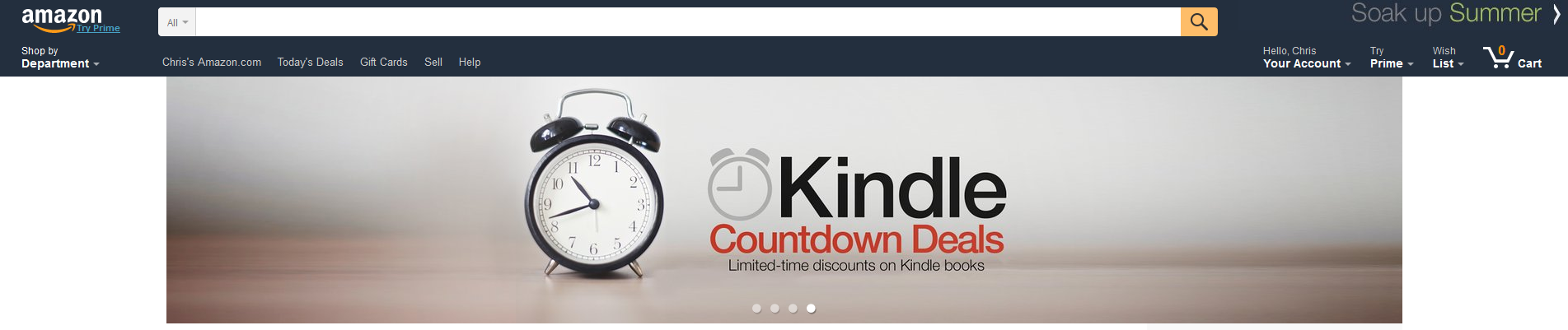
Yesterday, I saw this cool banner on the top of Amazon’s homepage, advertising Kindle Countdown Deals.

When I clicked on it, I was taken to the Countdown Deal homepage.

I thought this was pretty cool. It’s a small step (not too small—advertised on Amazon’s homepage) toward helping publicize Kindle Countdown Deals.

This is good news for authors with books in KDP Select.

I noticed that 6 of the books on the first page of the Countdown Deals had the #1 bestseller tag. Obviously, some authors are making effective use of this promotional tool.

And the top selling books that happened to have Countdown Deals running yesterday probably received a nice boost from Amazon’s ad.

It’s a nice step in the right direction. I actually sent a suggestion into Amazon about this about a week ago.

Countdown Deals need more publicity. How does anyone find them?

Well, you could find the book itself, then you see it’s on sale and maybe feel more compelled to purchase the book.

But you’d really like to attract customers who wouldn’t have otherwise discovered the book. That’s the goal.

Of course, it helps if you advertise it on BookBub, E-reader News Today, or one of several other similar services. See a list here.

Yet Amazon is where you really want your Countdown Deal advertised. KDP advertises that one of the benefits of KDP Select is that the Countdown Deals are advertised on Amazon.

They are, just not as well as they could be.

Where are they? Visit Amazon’s homepage. Hover over Shop by Department, hover over Books & Audible, and click Kindle Books.

Look under Kindle Book Deals. You’ll usually find Countdown Deals on the list.

But here’s the problem. Imagine you’re a customer who has no idea what a Countdown Deal is. Here are the options that you see:

  • Kindle Daily Deals. (Sounds good, right?)
  • Monthly Deals, $3.99 or less. (Low prices, sounds good, too.)
  • 50 Kindle Books for $2 each. (Great price, that’s enticing.)
  • Kindle Countdown Deals. (What on earth is that?)
  • 30 Kids’ Books for $1. (Great price again.)

You see the problem: Kindle Countdown Deals has the least compelling name on the list. It doesn’t mention price, % off, and it doesn’t sound like a good deal.

But many of the Countdown Deals are 99 cents or $1.99, with discounts of 50% to 90% off. The deals are a lot better than the name suggests. So what’s to attract Kindle customers to this option?

I feel like it could be merchandised better. I think Amazon wants to help KDP Select books (at least, those with better potential to engage readers), and wants to attract indie authors into KDP Select. So why not merchandise this better? There is an opportunity here.

This advertisement on their homepage is a good sign. It shows that Amazon wants to help merchandise KDP Select books and make the program more compelling for authors.

If you want to check out some Kindle Countdown Deals, click here to visit Amazon’s Countdown Deal page.

Write happy, be happy. 🙂

Chris McMullen

Copyright © 2015

Chris McMullen, Author of A Detailed Guide to Self-Publishing with Amazon and Other Online Booksellers

  • Volume 1 on formatting and publishing
  • Volume 2 on marketability and marketing
  • 4-in-1 Boxed set includes both volumes and more
  • Kindle Formatting Magic (coming soon)

Follow me at WordPress, find my author page on Facebook, or connect with me through Twitter.
Comments

Click here to jump to the comments section.

How Much Will Amazon Pay for Kindle Pages Read?

Background image from ShutterStock.

Background image from ShutterStock.

KINDLE UNLIMITED PAGES READ

How much will KDP Select authors earn for KU/KOLL pages read?

According to Amazon, nearly 1.9 billion (1,900,000,000) Kindle Edition Normalized Pages (KENP) were read during June, 2015 through Amazon Prime and Kindle Unlimited.

If the same number of pages are read during July, KDP Select authors will earn 0.58 cents per Kindle Edition Normalized Page (KENP) read.

Update: Amazon paid $0.005779 per KENP page read for July, 2015, almost identical to the forecast.

A little more than half a penny per page.

Or $1.00 for every 173 pages read.

How does Amazon calculate pages read?

Amazon keeps track of how many pages the customer has viewed.

So if the customer simply jumps to the last page of the book, that only counts as one page. They have to open every page for all of them to count.

Amazon starts counting from the start reading location.

Each KDP Select book has a KENPC (Kindle Edition Normalized Page Count), which may be different from the actual page count of the print edition and may also be different from the estimated page count.

It can be much different.

How do you find out what your KENPC is?

  • Visit your KDP Bookshelf.
  • Click the Promote and Advertise button.

How do I know how many people borrowed my book?

You don’t. You only know how many pages have been read.

If you have multiple books, click on the Month-to-Date Units Report to see a breakdown by book.

It would be helpful to know how many people borrowed our books. That way, we can figure out how many pages are read on average. This could be valuable data. Perhaps if KDP receives enough requests for it, they will supply this data…

DON’T PANIC!

Everybody’s pages read should be low on the first day.

Why? Because it takes time to read the books.

You know how many people usually borrow your book in one day.

You can’t expect everyone to read your entire book on the first day that they buy it.

So it’s silly to add up the pages read for day one, compare it with the number of borrows you normally get, and decide whether to opt out of the program.

Here’s my advice:

  • See if the number of pages read increases tomorrow, the day after that, and so on.
  • If the pages read per day (you’ll have to keep track—see the example below) is improving, this is a good sign.
  • Eventually, the number of pages read per day should stabilize. It might happen in a week, a few weeks, or months.
  • When the pages read per day stabilizes, compare that to how it was in the past. Use 0.58 cents per page to figure out what you’re making per day now, and compare that to the average number of borrows times $1.35 from previous months.

Don’t forget to check your KENPC. Your book might have more pages than you realize. I have books where the KENPC is 2-3 times the actual print page count. Things might be better than you realize.

EXAMPLE

  • July 1, 200 pages read.
  • July 2, 600 pages read. That’s 400 pages read on the 2nd.
  • July 3, 1200 pages read. That’s 600 pages read on the 3rd.
  • July 4, 2000 pages read. That’s 800 pages read on the 4th.
  • July 5, 3000 pages read. That’s 1000 pages read on the 5th.
  • July 6, 4000 pages read. That’s 1000 pages read on the 6th.
  • July 7, 5000 pages read. That’s 1000 pages read on the 7th. It has stabilized. This book is getting 1000 pages read per day now.

1000 pages per day yields an estimated $5.80 per day (multiply 1000 pages read by 0.58).

If this book averaged 4 borrows per day in the past, it was making about $5.40 in previous months. We want to compare the new estimated $5.80 per day to the old estimated $5.40 per day, but don’t do this until your number of pages read per day stabilizes, or you’ll be disappointed.

If you had based this off the 200 pages read on the first day in my example, it would have looked like this book was losing money in the new system, but that’s not how it looked after it stabilized.

On average, about half of the books will see improvement to some degree, while about half of the books will see a loss to some degree. It will be good for some, bad for some.

But you have to wait until your data stabilizes before you can tell how it’s working out for you. Good luck.

Write happy, be happy. 🙂

Chris McMullen

Copyright © 2015

Chris McMullen, Author of A Detailed Guide to Self-Publishing with Amazon and Other Online Booksellers

  • Volume 1 on formatting and publishing
  • Volume 2 on marketability and marketing
  • 4-in-1 Boxed set includes both volumes and more
  • Kindle Formatting Magic (coming soon)

Follow me at WordPress, find my author page on Facebook, or connect with me through Twitter.
Comments

Click here to jump to the comments section.

Kindle Edition Normalized Page Count (KENPC): The new KDP Select & Kindle Unlimited

Images from ShutterStock.

Images from ShutterStock.

KINDLE EDITION NORMALIZED PAGE COUNT

As of July 1, KDP Select books will be paid for the number of pages read—rather than by the borrow—for Kindle Unlimited and Amazon Prime borrows.

Authors can now visit KDP to learn what the Kindle Edition Normalized Page Count (KENPC) is for each of their KDP Select books.

  • Visit your KDP Bookshelf.
  • Click the Promote and Advertise button.
  • There you will find the KENPC for your book.

The KENPC tells you how much you will earn if a customer reads 100% of your book.

My ‘Detailed Guide’ self-publishing books weigh in at over 600 pages each with KENPC, which is quite amazing considering they have a little over 200 pages in print at 8″ x 10″.

My 4-book self-publishing boxed set has 2039 pages according to KENPC, while it has 628 printed 8.5″ x 11″ pages.

Fixed layout books, such as those made with the Kindle Textbook Creator or Kindle Kids’ Book Creator, have exactly the same KENPC as the actual page account (after accounting for the start reading location).

As the page counts seem fairly generous across the board with conventional Kindle e-books, it seems that fixed layout books may be somewhat disadvantaged by the KENPC.

Note that it’s called KENPC v 1.0. That version 1.0 suggests an intent to improve it with more versions over time.

Maybe one of the changes will help put illustrated children’s books on a more equal footing. At least, that’s one issue several children’s authors have raised regarding the change in Kindle Unlimited policy.

The sales reports will soon show how many pages have been read through Kindle Unlimited (rather than how many borrows have been read to 10%; that 10% mark no longer matters with the new Kindle Unlimited policy changes effective July 1, 2015).

This will be a cool new stat: the number of pages read. (But it would be meaningful if the reports also showed how many books were borrowed. Feel free to suggest that to Amazon.)

What is your KENPC?

NEW KDP REPORTING

The KDP Sales Dashboard now shows two separate charts: one shows sales and freebies, like before, while a new chart shows the KENP (Kindle Edition Normalized Pages) Read.

The Month-to-Date Unit Sales report shows the KENP Read per book.

This will make the stats more engaging. If you used to only see a couple of borrows per day, now you will see pages read changing throughout the day. The trick is to not fall into the trap of checking your reports more frequently.

Unfortunately, the reports no longer show how many books are borrowed, only how many pages are read. (If you would like this feature that could make your pages read stat more meaningful, send in a request to KDP. Visit KDP and look for the Contact Us button in the corner.)

Write happy, be happy. 🙂

Chris McMullen

Copyright © 2015

Chris McMullen, Author of A Detailed Guide to Self-Publishing with Amazon and Other Online Booksellers

  • Volume 1 on formatting and publishing
  • Volume 2 on marketability and marketing
  • 4-in-1 Boxed set includes both volumes and more
  • Kindle Formatting Magic (coming soon)

Follow me at WordPress, find my author page on Facebook, or connect with me through Twitter.

Comments

Click here to jump to the comments section.

How to Write a Book Blurb . . . Maybe . . . I’ve Not Idea What I’m Doing

Helpful tips for that oh-so-difficult-to-write blurb.

Charles Yallowitz's avatarLegends of Windemere

Funny from Yahoo Image Search Funny from Yahoo Image Search

I was asked to write a post about writing a book blurb.  At least I think I was since it’s sitting on my topic list with a blogger’s name next to it.  To be fair, I have part of a shopping list on this thing too.  Still need to pick up those eggs.

Now I’ve written several book blurbs and synopsis and one or two of them could even be called good.  The thing is that I truly hate writing these things because they leave me drained and stressed.  Why?  Because there is so much I want to say and I never know what’s the important stuff and what hooks should be used.  Keep this in mind as I tread into the list.  As I said in the title, I don’t always know what I’m doing.  In fact, I had to rewrite all of mine…

View original post 554 more words

Lending & Borrowing mean different things at Amazon

Image from ShutterStock.

Image from ShutterStock.

LENDING ≠ BORROWING

Amazon has two completely unrelated Kindle programs which use similar words.

  • borrowing: readers can borrow Kindle e-books through Amazon Prime or Kindle Unlimited.
  • lending: the Kindle Book Lending program allows customers to lend one book to someone else for up to 14 days.

These two programs have absolutely nothing to do with one another.

To make matters potentially more confusing, Amazon uses the word lending in KOLL: Kindle Owners’ Lending Library. In this abbreviation, ‘lending’ does actually refer to Kindle Unlimited and Amazon Prime. But in Kindle Book Lending, the word ‘lending’ means something entirely different.

Both options—borrowing as it relates to Kindle Unlimited and lending as it relates to Kindle Book Lending—appear in different places when you publish an e-book with KDP (Kindle Direct Publishing).

  • The top of the first page of the publishing process has the option to enroll in KDP Select. This includes your book in Kindle Unlimited and Amazon Prime (which are two separate programs).
  • The bottom of the second page of the publishing process has the option to participate in Kindle Book Lending. This has nothing to do with Kindle Unlimited (or Amazon Prime).

KINDLE BOOK LENDING

This allows a customer to lend the Kindle e-book to one friend or family member for up to 14 days:

  • Each customer can only lend the e-book one time only.
  • The original customer can’t read the book until it’s returned.
  • It can only be loaned for up to 14 days.

Authors have no control over this if they choose the 70% royalty option.

If authors choose the 35% royalty option, then can choose to opt out of Kindle Book Lending.

Since each customer can only loan the e-book to a single person, any possible loss through lending is severely limited.

The Kindle Book Lending option doesn’t affect Kindle Unlimited or Amazon Prime in any way.

KINDLE UNLIMITED

Customers can subscribe to Kindle Unlimited for $9.99 per month in the US (the fee is different in the UK).

A monthly subscription to Kindle Unlimited entitles customers to borrow as many Kindle Unlimited e-books as they would like.

Not all e-books participate in Kindle Unlimited. All KDP Select books are included in Kindle Unlimited, plus about 100,000 traditionally published books.

Approximately 1,000,000 of over 3,000,000 Kindle e-books are included in Kindle Unlimited.

Customers can borrow up to 10 books at a time. After that, the customer must return one of the 10 books before borrowing another.

Kindle Unlimited is unrelated to Amazon Prime.

(While Kindle Unlimited now pays authors by the page, customers are not charged by the page. Customers pay $9.99 per month and can then read as many pages of Kindle Unlimited e-books as they would like with no additional charge.)

AMAZON PRIME

Customers pay an annual fee to join Amazon Prime.

Amazon Prime offers many benefits, such as free two-day shipping of many eligible products, instant streaming of Amazon Prime videos, and borrowing up to one Kindle e-book per month.

There are about 100,000 Kindle e-books which are available to Kindle Unlimited customers, which are not available for Amazon Prime customers.

Unlike Kindle Unlimited, Amazon Prime customers can only borrow one Kindle e-book per month.

Customers must browse for Amazon Prime e-books using a Kindle device registered to the Prime account. (Before Kindle Unlimited, Amazon Prime customers could shop for Kindle e-books from their pc, mac, or laptop, but now they must shop for Amazon Prime books using a registered Kindle device.)

(In contrast, you don’t need to own a Kindle device to use Kindle Unlimited.)

Write happy, be happy. 🙂

Chris McMullen

Copyright © 2015

Chris McMullen, Author of A Detailed Guide to Self-Publishing with Amazon and Other Online Booksellers

  • Volume 1 on formatting and publishing
  • Volume 2 on marketability and marketing
  • 4-in-1 Boxed set includes both volumes and more
  • Kindle Formatting Magic (coming soon)

Follow me at WordPress, find my author page on Facebook, or connect with me through Twitter.
Comments

Click here to jump to the comments section:

https://chrismcmullen.wordpress.com/2015/06/26/lending-borrowing-mean-different-things-at-amazon/#comments

Marketing your book on Father’s Day and other holidays

Images from ShutterStock.

Images from ShutterStock.

MARKETING BOOKS NEAR HOLIDAYS

Father’s Day and other holidays can be book marketing opportunities.

Did you take advantage of this book marketing opportunity this Father’s Day? You could have.

If not, Independence Day in the US is coming up soon.

So how could Father’s Day be a book marketing opportunity?

Here are a few ways:

  • Your book might make for a nice gift for dads.
  • The father-son relationship may be a significant part of your novel.
  • Your nonfiction book might relate to tools, classic cars, or something that many fathers may enjoy.

If your book might make for a nice Father’s Day gift, you have the opportunity to say, basically, “Here’s a Father’s Day gift idea,” instead of another, “Check out my book,” message.

Or you might put your book on sale temporarily and advertise the promotion. You can advertise not just that your book is on sale, but that it would be a nice gift for dads.

Check out this example on Read Tuesday, which collected some Father’s Day gift book ideas.

Some authors use the holidays which best relate to their books to get media coverage through press releases. Local papers are looking for holiday themed articles, and your book’s relevance to a holiday might be a good fit. You don’t know until you try.

But Father’s Day is just one of many holidays:

  • December 31, New Year’s Eve. Great for books that tie into New Year’s resolutions.
  • February 14, Valentine’s Day. This one may be too obvious.
  • March 17, St. Patrick’s Day. Have an Irish theme to your book? Is part of your book set in Ireland?
  • March/April, Easter Sunday. One of many religious holidays.
  • April 1, April Fool’s Day. I suppose you could even use a practical joke as part of your marketing strategy.
  • May 5, Cinco de Mayo. But if you have a book that relates to Mexico in some way, beware that May 5 is not Mexico’s Independence Day (which falls on September 16, another opportunity to market your books a few months later).
  • May, Mother’s Day. Would your book make a nice gift for moms? Does it feature a strong mother-daughter relationship?
  • June, Father’s Day. Covered that earlier.
  • July 4, Independence Day. Patriotic books get a few holidays, including Memorial Day and Veteran’s Day.
  • November, Thanksgiving. It could be a book that relates to the spirit of giving thanks.
  • December 25, Christmas. A huge day in the US for gift giving, even with gifts that don’t directly relate to the religious holiday.

Which days (possibly not on my short list) are the best fit for your books? Those times offer your book marketing opportunities. Look out for them.

Write happy, be happy. 🙂

Chris McMullen

Copyright © 2015

Chris McMullen, Author of A Detailed Guide to Self-Publishing with Amazon and Other Online Booksellers

  • Volume 1 on formatting and publishing
  • Volume 2 on marketability and marketing
  • 4-in-1 Boxed set includes both volumes and more
  • Kindle Formatting Magic (coming soon)

Follow me at WordPress, find my author page on Facebook, or connect with me through Twitter.