The Most Common yet Critical Publishing Mistake (?)

Perhaps the most common mistake that I see when shopping for self-published books is a target audience mismatch. Either many indie authors don’t realize how much this may deter sales or they didn’t consider how significantly this affects marketing when they were selecting the title, designing the cover, and preparing the blurb.

When authors with slow sales ask what they are doing wrong, very often their books suffer from this same marketing flaw.

In the simplest terms, the problem will seem very obvious, but knowing is only half the battle:

Imagine that you’re browsing through search results for a sci-fi novel. Are you likely to click on thumbnails that look like they might be mysteries, romances, or fantasies? If it doesn’t look like a sci-fi novel, will you click on the book? What if the title doesn’t sound like sci-fi? What if the cover looks suitable for kids, but you’re an adult?

After you click on the book, if the blurb sounds like adventure or erotica instead of sci-fi, will you look inside? What if it sounds like a blend of sci-fi, romance, and mystery? If you were in the mood for sci-fi, maybe you would prefer pure sci-fi.

(Don’t contemplate the exceptions. It’s what the majority will do that influences your sales.)

When you look inside, if it starts out like historical fiction or comedy, will that satisfy your hunger for sci-fi?

If you’re a sci-fi fan, you know what sci-fi covers usually look like, what sci-fi titles often sound like, what you expect to see in the blurb, how the novels usually begin, etc. When readers are looking for something in particular, they usually don’t settle for something else.

When a thumbnail cover looks like genre A, but the blurb sounds like genre B, then all of the potential readers who are attracted to the cover won’t be buying the book, and all of the potential readers who would be attracted to the description will never check it out.

A target audience mismatch is a huge sales killer!

Even a slight mismatch is a major problem. For example, readers should be able to distinguish between contemporary romance, historical romance, teen romance, and erotica. A contemporary romance cover with too much sex appeal might be mistaken for erotica, and vice-versa.

I understand that it’s not easy for most writers to design excellent covers. But it’s not enough to just have an appealing cover. If it doesn’t attract the right audience, the cover isn’t helping at all.

Many authors struggle with their image searches, often settling on stock photos that are in the ballpark, but really aren’t a good fit for the book. Others get a concept in their minds that either isn’t a good fit for the book or that they can’t pull off well enough for it to work. If the cover doesn’t appeal to the intended audience, this isn’t satisfactory.

If you’re in the mood for a candy bar, you won’t purchase a snack that looks like potato chips from a vending machine (and those in the mood for potato chips that wind up with chocolate will be irate customers). It’s no different and should be no less obvious for books.

If you value sales, don’t make this costly mistake.

Develop the title, cover, blurb, and Look Inside with the specific target audience in mind.

Check out other covers in the same genre to see what buyers are accustomed to seeing. Make sure that your cover appeals to the right audience. Receive feedback from readers in the target audience as you develop your cover.

You don’t need to copy the ideas of the bestsellers; in fact, copycat covers may backfire. But you do need to see what’s common.

If you absolutely loathe a very common concept, you can work around it. For example, if you write contemporary romance and find that most covers feature a romantic couple, but refuse to put people on your cover, you can find other elements common in the genre that signify romance. It is possible to make a cover without people that clearly looks like a romance (how about a red heart?). However, be sure that you do this for the right reasons. Don’t sacrifice your sales simply because you can’t find people to put on your cover; do it because it’s something you believe in so firmly that you don’t mind if it deters sales.

Do similar research for the title and blurb. Ensure that the title, cover, blurb, and Look Inside present a unified message regarding the content and genre. Have people in your target audience check these out before you publish, specifically asking them if they all sound like your book’s specific genre.

The cover and title are most important because if these send the wrong message, nothing else matters. Next, the blurb and Look Inside must reinforce the same signals.

Will the story and characters also appeal to your target audience? This is very important for reviews and the prospects for valuable word-of-mouth sales.

Chris McMullen, self-published author of A Detailed Guide to Self-Publishing with Amazon and Other Online Booksellers (Volumes 1 and 2)
Wear the Indie Badge Proudly

Badge

Authors who choose to self-publish should do so proudly.

Times have changed. Not too long ago, there were very few self-publishers. Most had a garage full of books. Some paid large sums of money to vanity presses.

Now the majority of authors are self-published. Authors no longer need to pay money to be self-published; it can be done for free. With print-on-demand and eBook technology, they no longer need to stock up on thousands of books.

Some of the companies who have made self-publishing possible are no small names. Authors can publish paperbacks with CreateSpace – an Amazon company – and eBooks with Amazon (using Kindle Direct Publishing) and Barnes and Noble (through Nook), for example.

CreateSpace

Kindle

Nook

A number of indie authors have achieved high levels of success with top-selling titles. Amazon periodically features indie success stories on their homepage. Reputable newspapers and magazines are highlighting self-publishing achievements.

Hugh Howey

Amanda Hocking

There is no reason to be embarrassed to be a self-published author:

  • Indie authors have strength in numbers.
  • Self-publishing represents freedom of creativity, content, and style.
  • Some traditionally published authors are choosing to self-publish their new titles.
  • There are many high-quality indie books out there, which show the true potential of self-publishing.

Move to Self-Publishing

Authors who choose to wear the self-publishing badge should wear it proudly.

They should also polish their badges so that they shine bright by perfecting their books and making them look as professional as possible. This improves the image of self-publishing for all indies, and also improves their own chances of success.

Chris McMullen, self-published author of A Detailed Guide to Self-Publishing with Amazon and Other Online Booksellers (Volumes 1 and 2)
Branding Distinction for Authors

What distinguishes your book from others? What makes it special? How is it unique?

You don’t just want people in your target audience to see your name and the name of your book repeatedly. You want people in your target audience to associate something with the kinds of books that you write.

Knowing the author’s name or the book’s title provides recognition when they see it. You don’t just want people to buy your book when they recognize it. You want people to search for your book.

If you brand a distinction for your writing, people in your target audience may search for your book when they’re next in the market for a book of that kind. This is better than recognition.

When people in your target audience discover your name or the title of your book while they interact with you, you’re branding your name or your book’s title. It may be more effective to brand a signature that distinguishes your writing. Give your target audience a compelling reason to search for your book.

First, you must identify your target audience. Secondly, you must market your brand effectively – e.g. through discovery or by providing valuable content (whereas self-promotion and being too frequently visible may get you tuned out).

Interact with people in your target audience and let them discover that you’re a writer and what makes your work special. The more you write or say, the less people will remember. You want the emphasis on a concise phrase (just a few words, nowhere near an entire sentence) that brands your specialty and something to go along with it – your name, your book’s title, or the name of a series, especially if it’s very short – so that they can easily find it when they’re ready to search for it.

Here are some examples of how to brand distinction:

  • Your Name, writer of clean romance
  • Series Title, featuring Brooklyn’s modern day Sherlock Holmes
  • Book Title, a dancing guide for people with two left feet
  • Author’s Name, specializing in vampire erotica
  • Workbook Series, math for children with ADHD
  • Name of Book, sick of implausibly perfect characters?

Chris McMullen, self-published author of A Detailed Guide to Self-Publishing with Amazon and Other Online Booksellers (Volume 2, on editing/marketing, is now available)

Inspiration from Alfred Hitchcock

http://www.foxsearchlight.com/hitchcock/

Last night, I watched the recent movie, Hitchcock. Don’t worry: I won’t spoil the plot for you.

In this movie, I saw many parallels with the art and business of self-publishing:

  • The name Alfred Hitchcock was very well branded. The movie, while it may have a little more Hollywood style and a little less reality, provided some insight into his character as a movie maker. You can guess how his distinctive personality and specific talents helped with his branding.
  • The silhouette of Alfred Hitchcock was also very well branded. It wasn’t just a logo. Remember how he used to walk into the position where the silhouette would form? This technique really helped brand his image.
  • The movie revealed a few marketing tactics. He was not only renowned for creating suspense, but he was even effective at utilizing suspense in his marketing tactics.
  • At a stage where he may have been expected to retire, he dared to take a new direction with his filmmaking. He didn’t have the backing of the film industry (i.e. the big money) – at least, not to exercise his creativity and pursue this new direction his own way. So he was very much like an indie filmmaker. Of course, he had financial resources of his own, but he took a huge risk.
  • He abandoned the rules of what works and pursued his own ideals. Authors have long had traditional publishers telling us what works, not wishing to deviate more than about 10% from this established path. We now have the opportunity to pursue something different on our own. There is a great risk, as very often these new paths don’t succeed. But the door is now open.
  • Back in his day, censorship was fairly heavy. We have a great deal of freedom to write as we please these days, but a few authors still push the boundaries further. There will always be critics and lawmakers strongly involved in this.
  • Hitchcock didn’t just film a movie. You could get a sense for how much editing and formatting was involved afterward, and how important this was for the movie’s success. Similarly, there is much more to selling books than just writing them. The importance of editing and formatting cannot be overlooked.
  • In making a movie, there is a large production team involved with many people working on different tasks. These days, there are many indie authors trying to do the writing, editing, formatting, cover design, marketing, and public relations all on their own. At least, collaborating with others to share skills or ideas would help a little with teamwork.
  • It wasn’t just the movie idea that led to its success. You could see how the marketing ingenuity and seemingly little things like sound effects could play a very significant role. People skills and developing contacts are important, too. The same is true with publishing books.

Chris McMullen, self-published author of A Detailed Guide to Self-Publishing with Amazon and Other Online Booksellers (Volume 2 now available)

Murphy’s Laws of Writing

Writing

(1) You are more likely to be interrupted when you’re in the middle of a very deep thought. Silencing your phone, sending the kids out, and disabling the doorbell simply inspire Murphy’s creativity.

(2) Your muse will abandon you whenever you need her the most. But don’t worry: She’ll return as soon as you become too preoccupied to write.

(3) Your best ideas are most likely to come when you don’t have anything to write with or to write on. You’re also likely to be frequently interrupted between your moment of inspiration and the moment you’re able to jot it down.

(4) Whenever you correct a set of typos, you introduce some new ones.

(5) The fewer words you write, the greater the chances that there will be a glaring typo.

(6) Your worst typos are most likely to occur in the most prominent places, such as the first paragraph of the book or the book description.

(7) It’s much easier to see somebody else’s mistakes than it is to find your own.

(8) Not checking your preview or proof is like waving a large red flag with Murphy’s name on it.

(9) If you’re not sure about something that you’re writing, but don’t take the time to check, it will probably be wrong. However, if you do take the time to check, it will probably be right.

(10) The more people who read your writing, the greater the chances that there will be an embarrassing mistake in it. Presenting it to a large audience via PowerPoint improves the odds.

(11) After submitting revisions, if you quickly thumb through your book, your eye is very likely to spot a typo.

(12) The more frequently you check your sales report, the more likely you are to be disappointed.

(13) The more frequently you check your book reviews, the more likely you are to be disappointed.

(14) You’re much more unlikely to see a sale post on your report while you’re spending money.

(15) A good review is 100 times more likely to disappear than a bad review.

(16) One stupid comment that you make in the most remote corners of the internet is far more likely to generate publicity than anything else that you do.

(17) If you only have one copy of your file, this improves the chances that the file will become corrupt. The closer the book is to completion, the greater the odds.

(18) If all of the versions of your file are stored on the same computer, this improves the chances that the hard drive will crash.

(19) If you download a program to help with your book without paying attention to where the file is saved, it will be buried in the least obvious place.

(20) If you need to revise your book, but didn’t keep track of the location and name of the most recent file, you’re more likely to reintroduce old typos when you correct new ones.

Chris McMullen, self-published author of A Detailed Guide to Self-Publishing with Amazon and Other Online Booksellers (Volume 2 now available)

Stages of Branding

A brand is a name that people in the target audience recognize. It’s not necessarily the name of the product, like Levi’s. Names of people can be branded, too, like Michael Jackson. Even an image can be branded, such as a logo or cover art.

Sometimes, branding the person’s name is more effective than branding the name of the product. This is especially true for singers, writers, and artists of all kinds. For example, it’s much easier to remember Stephen King than it is to remember the titles of all of his books.

Branding occurs when members of the target audience see or hear the name of the product or person or see the image repeatedly over a period of time.

Companies that have money to invest and products or services for which there is a wide target audience may achieve this, in part, through advertisements on television, radio, magazines, billboards, websites, etc.

Advertisements aren’t always effective for all products. For example, a book at first seems to have a wide possible audience because millions of people read. However, there are twenty million books to choose from; even in a specific genre, there are thousands of competitors. Compare this to toilet paper: There are a dozen or so brands of toilet paper in a store, not millions to choose from. Compared to artistic works like books, products like toilet paper have a much large target audience and much less competition.

Fortunately, advertising isn’t the only way to brand a name or image. There are many ways to market a name, product, or image through branding. The goal is to have the name, product, or image seen or heard among the target audience.

For artistic goods and services, such as books, cd’s, editing, and cover art design, getting discovered or providing valuable content is often far more effective than self-promotion. The idea of self-promotion is like shouting, “Here I am! Look at me!” Discovery is about getting noticed through personal interaction. For example, a potential customer may discover that a person is a singer or real estate agent when asking, “What do you do for a living?” The self-promotion equivalent is walking into a room and saying, “I just released a new album.” For online interactions, discovery can occur by posting information in an online profile, whereas self-promotion posts this information clearly out in the open.

How the information is conveyed is also important. It should relate to the target audience and make it clear what the product or service is. It should convey this in a way that the target audience will respond positively. Generally, it should generate interest, convey passion, and sound confident, but should not seem boastful.

Providing valuable content geared toward the target audience, especially for free, is another way to get discovered. Sending a press release package to local media can help with this, too. Creating buzz for a newly released product is another common tactic.

Another way for branding to occur is through reviews, such as in magazines or on websites, and word-of-mouth recommendations. Companies sometimes give away free samples or accessories, hold contests, or mail out advance review copies with the hope that some customers who appreciate the product or service will tell their friends and family members.

These are some ways that a product, name, or image can become branded. Branding occurs in various stages. It can take several months for branding efforts to achieve a full effect. First, people in the target audience must be exposed to the branding efforts. This must occur not just once, but on multiple occasions (but not so frequently that it gets tuned out) over an extended period of time. Once they buy the product or service, it may be a while before it is used, and used enough for them to judge the quality. If they are pleased with it, it takes even more time to recommend it to others.

Branding isn’t about achieving instant sales. It’s about the potential for long-term success. Branding requires patience.

Stage 1: Recognition

When people in the target audience see the name or image, they recognize it. People tend to favor products that they have heard of before.

Stage 2: Awareness

People think of the name of the brand when they consider shopping for that product or service. At this stage, people search for the product or service, rather than simply recognizing it in a store or directory.

Stage 3: Backing

People have heard good things about a product or service. This may have come from a recommendation or a review, for example. At this stage, the prospective customer feels some measure of confidence about the purchase decision.

Stage 4: Association

Potential customers associate the brand with a favorable attribute. For example, Wal-Mart is regarded for low prices and Sony is regarded for high quality. At this stage, customers have a particular expectation for a product or service. In some cases, such as high quality, customers may be willing to pay extra for this distinction.

Stage 5: Experience

Customers have used the product or service and they enjoyed it. At this stage, they are likely to invest in the same brand in the future.

Stage 6: Charm

A personal interaction with an artist, agent, or representative, for example, made the customer feel special. The personal touch can go a long way beyond just the product or service.

Publishing Resources

I started this blog to provide free help with writing, publishing, and marketing. You can find many free articles on publishing and marketing by clicking one of the following links:

Chris McMullen, Author of A Detailed Guide to Self-Publishing with Amazon and Other Online Booksellers

Follow me at WordPress, find my author page on Facebook, or connect with me through Twitter.

A Humble Little Book

Part 1

She worked from 9 to 5. It was a boring job, but it paid the bills.

From 6 to 10, she sat at her computer, typing a book. This was very fun, but just a hobby.

Several months later, her book was finished, but not yet complete. She spent a few more months reading, revising, proofreading, editing, perfecting.

Then it was time to share her work. She viewed her writing as a hobby, not as a profession. So she opted to self-publish.

Specifications. Formatting. Googling computer skills. Researching. PDF conversion. Formatting problems. Asking for help. Reformatting. Not the fun part of her hobby, but at the same time, she was growing anxious. So thrilling and nervous at the same time!

She thought about hiring an editor to help revise and format her book. She considered hiring a cover designer. But as this was just a hobby, should would settle for a humble little book. However, she did proofread it carefully again, and even sought help from friends.

The description was the hardest part to write. All in all, she wrote a dozen descriptions, and the last didn’t remotely resemble the first. It wasn’t a killer blurb, but she researched descriptions of similar books and sought advice from friends. It would suffice.

The biography was a stumper, too. Qualifications? Experience? Skills? Background? Then she realized that she wasn’t writing a resume. Writing was her hobby, not her profession. Readers might be interested in her life experience, not her writing career.

Author photo… (she was a little shy). But her writing was very personal, and she was sharing that. So she would share her photo, too. Not glamorous, but much better than the DMV.

Approve Proof. Click! Ta-da! Celebration coming on!

There it is on Amazon. Check that out. She showed her friends and family. Some pats on the back. A show of support. A little unexpected criticism.

Way down the search results. No reviews. Occasional sales. Well, she wasn’t a bestselling author; not bad for a hobby. Wrote and published a book: Quite an accomplishment!

Part 2

He saw the thumbnail. Not a Picasso. Not eye-popping. But there was something about it. So he clicked the link.

Didn’t sound like the popular books. But it was intriguing. So he looked inside.

Wasn’t fancy. But it was nice enough. And the story caught his interest. So he bought it.

Wasn’t flawless. A few typos. An occasional formatting mistake. But not enough to detract from the story. So he read it.

Wasn’t a nail-biter. Not a page-turner. Yet he enjoyed the story. So he finished it.

He even left a review and told a few friends.

Part 3

It wasn’t a bestseller. But it sold occasionally.

She didn’t market avidly. Yet many (to her) people read her book and truly enjoyed the story. She touched their minds. They shared experiences and emotions that she created. And they appreciated this.

She continued her hobby.

It was a humble little book. Yet it was a success.

Chris McMullen, self-published author of A Detailed Guide to Self-Publishing with Amazon and Other Online Booksellers (Volume 2 now available)

Common Blurb Mistakes

For online bookstores, the cover, title, blurb, and sample are the book’s only salesmen at the point-of-sale. A great blurb can help motivate purchases, whereas a lousy blurb tends to deter them.

(1) Summarizing the book.

The blurb’s number one priority is to create interest in the book, not to summarize it. Summaries often don’t sound interesting and provide too much information.

(2) Giving too much information away.

An effective blurb arouses the reader’s curiosity. Rather than answering all of the reader’s questions about the book, ask some questions – either explicitly or implicitly. A customer who wants to know something about the story has to read it to find out, unless the blurb answers the question.

However, nonfiction books should make the content clear.

(3) Building suspense.

Customers tend to be impatient. If the blurb (or sample) starts out slow, some customers will walk away without reaching the main part of the blurb. Start out by creating interest to capture the reader’s attention.

(4) Sending mixed messages.

The title, cover, blurb, and sample should send a unified message regarding the genre and content. The message should be clear in each component. Confused buyers look for other products that aren’t confusing. If the cover looks like fantasy, but the blurb sounds like science fiction, for example, then the audience that is drawn to the book won’t buy the book.

(5) Spelling and grammar mistakes.

If the hundred or so words in the blurb have any spelling or grammar mistakes, the tens of thousands of words in the book itself must be plagued with editing problems. At least, this is what potential customers will expect.

(6) Too long.

Buyers tend to have short attention spans. If a buyer becomes bored while reading the blurb, the buyer will check out a different book. The longer the blurb, the more difficult it is to hold the buyer’s attention throughout.

A long blurb also looks intimidating to some readers. There are customers who immediately return to the previous page when a blurb looks too long. This depends in part on the target audience, and is a bigger concern for fiction than for nonfiction.

(7) Overselling.

If the blurb makes the book sound far better than it actually is, the blurb will backfire as soon as customer reviews reflect this disparity. Also, when a book sounds too good, many customers will be skeptical.

(8) Bragging.

Boasting tends to deter sales. Avoid comments like, “This Book is much better than That Book.” However, stating that a book is similar to a well-known book or movie – without making it sound better – can help potential buyers understand what to expect. Compare this comment with the previous one: “This Book is similar to That Book,” or, “This Book is a cross between Book A and Book B.”

(9) Telling readers what to think.

If a book is funny, for example, there is no reason to come right out and say this. Let customers form their own opinions. Most people don’t like to be told what to think. Saying that the book is a comedy may be helpful, whereas saying, “You will laugh your pants off,” tells readers what they will do.

(10) Poor formatting.

Insert a linespace to separate paragraphs. Break large paragraphs into smaller ones. Don’t use returns to force text onto a new line in mid-sentence. Don’t format each sentence on a separate line (unless using bullets). Boldface, italics, linebreaks, and bullets are available through AuthorCentral for Amazon book descriptions.

(11) Not giving readers a good idea of what to expect.

While it’s important not to reveal too much information, it’s also necessary to provide a general idea of what type of book to expect. Nonfiction should also make the content clear. The blurb should attract the right target audience for the book. Otherwise, customers are likely to express negative feedback in customer reviews.

(12) Lack of feedback.

Share the blurb with several people from the book’s intended target audience prior to publishing. Discover how they react to the blurb – especially, what they do and don’t like about it.

Chris McMullen, self-published author of A Detailed Guide to Self-Publishing with Amazon and Other Online Booksellers (Volume 2 now available)

Cover Art Critics

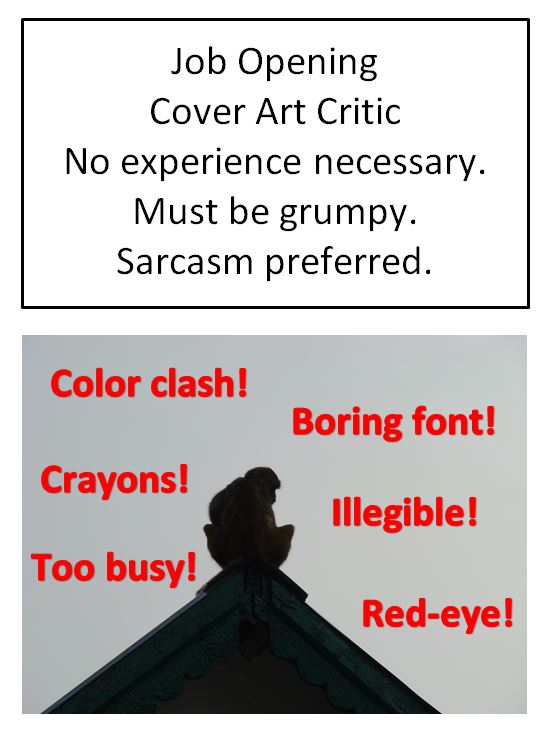
Cover Critics

The self-publishing revolution has brought forth a generation of cover art critics. It seems that there are many more cover art critics than there are art critics.

To be fair, they also criticize traditionally published covers, and a few of the best covers out there are actually on self-published books. However, the reality is that the vast majority of lousy covers are on self-published books.

Anyone can be a cover art critic. No talent for cover design is needed to form an opinion.

But that’s the point. Don’t create a cover to satisfy the critics. Instead, create a cover that will please potential readers. Back to the point: All potential readers are cover art critics! Complaints that are common among the cover art critics tend to deter sales because many readers feel the same way.

Here are some common complaints:

(1) Can’t tell what the book is about!

(2) Text is illegible!

(3) Colors don’t work well together!

(4) People look deformed!

(5) Used crayons or colored pencils!

(6) Photo-bombing image!

(7) Used Comic Sans for font!

(8) Aspect ratio is distorted!

(9) Illustrator’s name appears on a lousy cover!

(10) Image appears blurry or pixelated!

(11) Cover is too busy!

(12) Fonts are boring!

(13) Hard to read fonts!

(14) Wrong words emphasized in title!

(15) Three different fonts used!

(16) Images have nothing in common!

(17) Settled for image that doesn’t quite work!

(18) Doesn’t look good both full-size and as thumbnail!

(19) Red-eye!

(20) Typo in title!

(21) Poor drawing skills!

(22) Poor photography skills!

People do judge books by their covers. As they should! At least to the extent that buying a book where the author or publisher didn’t put much effort into the cover is a risk: If little effort was put into the cover, there isn’t any reason to expect that greater effort was put into writing, editing, and formatting.

The cover is a marketing tool. Customers do browse for books in search results and click on thumbnails that interest them. Trying to avoid common cover design mistakes may pay off. It’s challenging to design a perfect cover, and any cover – no matter how good – can still be criticized. It’s much easier to find fault in a cover than to make a cover without fault. (No wonder there are more cover art critics than there are great covers.) But the cover is very important, so striving to design a great cover is worth the effort.

Chris McMullen, self-published author of A Detailed Guide to Self-Publishing with Amazon and Other Online Booksellers (Volume 2 now available)

Rush, Rush, Rush to Self-Publish!

Day 0:

Think, think, think. Think. Think… think.

Idea!

Day 1:

Type, type, type. Type. Type. Type, type, type.

Day 14:

Type, type, type.

Day 30:

Writer’s block.

Day 35:

Type, type, type.

Day 60:

T. Y. P. E.

Day 90:

Ta-da!

Day 91:

Proofread, proofread, proofread.

Day 92:

P. R. O. O. F. R. E. A. D.

Day 100:

Research publishing options.

Day 101:

Decide to self-publish.

Sign up for an account.

Day 102:

Learn about formatting.

Day 103:

Format, format, format.

Day 104:

F. O. R. M. A. T.

Day 110:

Upload.

Day 111:

Check digital proof.

Day 112:

Ask for help on the community forum.

Day 113:

Implement formatting changes.

Day 114:

Re-upload.

Day 115:

Publish!

Day 116:

Celebrate!

Day 117:

Encounter Look Inside issues.

Day 118:

Post question on community help forum.

Day 119:

Reformat.

Day 120:

Republish.

Day 121:

Find book way down in search results.

Day 122:

Still no sales rank.

Day 123:

No activity.

Day 130:

Request feedback on community help forum.

Day 131:

Look for cover designer and editor.

Day 191:

Republish.

Day 200:

Sales still infrequent.

Day 201:

Look into marketing.

Day 210:

Why was I in such a rush to publish my book?

* * *

If only there were a better way, like:

  • Researching the book idea before writing.
  • Perfecting the craft of writing.
  • Reading bestsellers in the genre to learn what works.
  • Checking out covers of top sellers in the genre to see what readers expect.
  • Reading blurbs of best sellers in the genre to learn how to draw interest.
  • Getting the book edited before publishing.
  • Seeking feedback on the cover and blurb before publishing.
  • Learning how to create buzz for an upcoming book.
  • Learning about marketing before the book is published.
  • Marketing before the book is published.
  • Coming up with an effective promotion plan.
  • More marketing after the book is published.

Chris McMullen, self-published author of A Detailed Guide to Self-Publishing with Amazon and Other Online Booksellers (Volume 2 now available)