What do you think about the new product pages at Amazon?


NEW AMAZON PRODUCT PAGES

You may have noticed that product pages on Amazon now have a new look.

Amazon began rolling these new product pages out about 2 weeks ago at Amazon.com.

In the beginning, the old page was sometimes showing; now only the new page appears. This suggests that Amazon has tested this out extensively. Evidently, the new page is working better overall (although some books may be hurt by the new look, on average more books must be benefiting from the new look, otherwise Amazon will revert back to the old look).

That’s the thing:

  • Amazon knows how to sell books.
  • Amazon has sales data.

If sales are down overall, Amazon will quickly change the look again. So the longer the new pages remain, the more we know that the new look is working (at least more often than not).

I saw several variations of the new product page in the first few days when the change was introduced. Amazon was surely testing variations out to see which worked best. The ‘final’ product page must be the variation that was most effective overall.

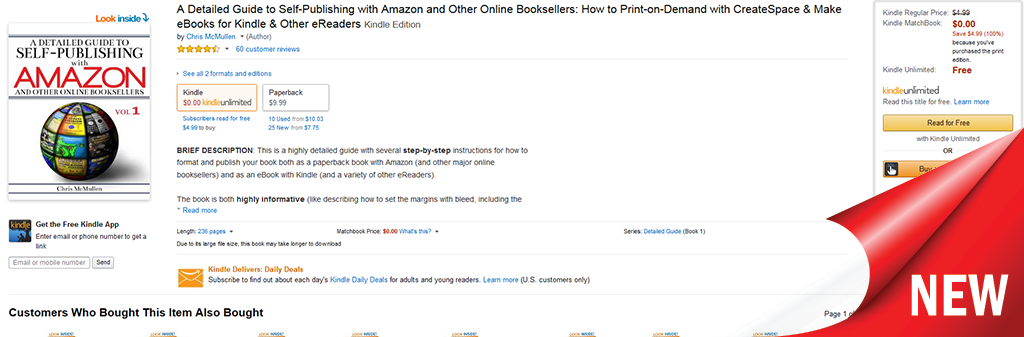
Following are the changes.

KINDLE BOOK DESCRIPTION

The Kindle book description now shows fewer lines before being interrupted by the Read More link.

Remember, Amazon knows how to sell books!

You have to trust Amazon on this.

Most (I didn’t say ‘all’) customers shopping for books aren’t going to spend too much time on most of the product pages.

Therefore, if you have a long blurb, most customers aren’t reading the whole blurb anyway.

This is Amazon’s way of telling authors, “Hey, your description is too long. Whichever part of your description you feel is most important to convey to shoppers, move that before the Read More link.”

If this change were hurting sales more often than helping sales, Amazon would change it back. Amazon sees the overall sales numbers. Amazon knows.

AVAILABLE BOOK FORMATS

On the Kindle product page, other book formats, such as paperback and audio book, now stand out much better.

However, on the paperback book product page, the available formats appear in a format similar to the old layout.

Evidently, it’s more beneficial, on average, for Amazon to highlight the print and audio book editions on the Kindle page than it is for Amazon to highlight the Kindle edition on the print page.

MATCHBOOK OFFER

If you’ve already purchased the print edition from Amazon and visit the Kindle product page, the MatchBook offer is highly visible near the purchase button.

However, if you haven’t already purchased the print edition, the MatchBook offer still fails to jump out at you.

On the print product page, you must scroll way down to product details, then look way over to the right, and it’s rather plain, not jumping out at you.

On the Kindle product page, it’s really tiny and just under the book description. I’ve missed it several times and I know exactly where it is!!

However, if you’ve already purchased the print edition, it’s really easy to find the MatchBook offer on the Kindle edition.

The thing is, authors would like for the MatchBook offer to be more visible to customers who haven’t already bought the book.

Amazon generally knows best, so I suppose I’ll have to trust Amazon here, too.

BUYING OPTIONS

The purchase options appear larger and are better spread out on the right side of the Amazon product page.

For books in Kindle Unlimited, the buying option looks different depending upon whether or not the customer is a Kindle Unlimited subscriber.

If you’re a Kindle Unlimited subscriber and the book is in Kindle Unlimited, Amazon shows the price as FREE directly beneath the Kindle price.

If you’re not a Kindle Unlimited subscriber and the book is in Kindle Unlimited, you don’t see the FREE price below the purchase price. But it does mention Kindle Unlimited with the option to Learn More.

ADVERTISEMENTS ON AMAZON

There are a few different positions where an advertisement may show on an Amazon product page.

For books, an AMS ad is most likely to get noticed if it shows directly below the book description. However, that’s the tiniest ad thumbnail.

A somewhat larger ad (but not the largest) sometimes shows on the right side, below the purchase options. However, unless you have an extremely large monitor, customers won’t notice this ad unless they scroll downward.

Ads may also show down near the customer review section.

But AMS ads placed through KDP only charge for clicks, not impressions, so if the ad doesn’t get noticed, it doesn’t cost the author anything.

AUTHOR CENTRAL OPPORTUNITIES

Are you frustrated over losing space in the book description? (If the description is too long, part of it is hidden by a Read More link.)

The solution is to visit Author Central.

The From the Author, From the Back Cover, and About the Author sections show much more fully further down the product page. If you have any editorial reviews, these show more fully, too.

Maybe you can find a way to use these sections effectively (without abusing the system, of course).

OTHER CHANGES

Have you noticed any other changes to the Amazon product page?

If so, please check that the change is still showing, and leave a comment to let everyone know.

Thank you.

Write happy, be happy. 🙂

Chris McMullen

Copyright © 2015

Chris McMullen, Author of A Detailed Guide to Self-Publishing with Amazon and Other Online Booksellers

  • Volume 1 on formatting and publishing
  • Volume 2 on marketability and marketing
  • 4-in-1 Boxed set includes both volumes and more
  • Kindle Formatting Magic (coming soon)

Follow me at WordPress, find my author page on Facebook, or connect with me through Twitter.

Comments

Click here to jump to the comments section:
https://chrismcmullen.wordpress.com/2015/05/24/what-do-you-think-about-the-new-product-pages-at-amazon/#comments

Advertising on Amazon with AMS via KDP: Research, Experience, & Tips

Advertising Research

Images from ShutterStock


ADVERTISING BOOKS WITH AMS

KDP now lets indie authors advertise their KDP Select books directly on Amazon.com through AMS (Amazon Marketing Services).

I’ve now placed 36 different ads through AMS on over a dozen books in multiple author names, with different targeting and bids from 2 cents to $1.01 per click. So I have quite a bit of firsthand experience with this. Although I publish nonfiction, I’ve also discussed AMS with several fiction authors who have used it—including some who love it, some who hate it, and more with mixed feelings. Many of these authors have shared their AMS numbers.

EASY MONEY, HUH?

Well, not ‘easy.’

Marketing books is never easy. But advertising books on Amazon through AMS, like other marketing tools, has potential; the trick is learning how to use the tool effectively, and whether or not this tool is a good fit for you and your books.

BENEFITS OF ADVERTISING WITH AMS

  • Prime real estate. Your ad shows directly on Amazon product pages, where customers are already shopping for books. You’re not trying to make people leave one site to visit another.
  • Optional product targeting. You can hand-pick specific books (and even movies and other products, if applicable) to target. This allows you to tailor your targeting to your unique book.
  • Budget-friendly. Although you must set an advertising budget of at least $100, you’re not committed to spend one penny. You can pause or terminate your AMS ad campaign at any time. (However, the ad report does not show in real-time, so when you pause your campaign, the expenses may be higher than you realize. If you bid low, this won’t be an issue, but if you bid very high, you can be out of budget before you realize it.)
  • Free impressions. You only pay for clicks. If 2,000 people see your ad, but nobody clicks on the ad, you don’t pay a penny.
  • Product page data. The AMS ad report shows impressions, clicks, detail page views, and sales generated through the ads. This lets you see what percentage of traffic to your product page actually buys your book. Even in the worst case that your ad is an utter failure, learning your sales-to-clicks ratio can help you assess the effectiveness (or lack thereof) of your book’s product page at selling your book to your target audience.
  • Improving. AMS at KDP is improving. For example, you can now enter a phrase designed to catch interest and at least one of the possible ad locations shows this as an orange headline directly above your ad.

CHALLENGES YOU MUST OVERCOME

  • Competition. Many other authors bid high (often, much higher than they should), which can make it challenging to get impressions with an affordable bid, especially in competitive genres. However, there are ways to deal with this (like wise targeting).
  • Tiny thumbnail. The ads show a tiny image of your cover thumbnail. The ads come in a few different sizes, but many book covers are difficult to make out in the ads. (Obviously, if you design a cover that stands out well and is easy to read at this tiny size—possible, as I’ve seen it done—you have a distinct advantage.) So although impressions are free (you only pay for clicks), possible branding benefits from those impressions are somewhat limited.
  • Click-throughs. The CTR (click-through rate) can vary considerably from one book to another, but often it’s in the ballpark of 0.1%. That is, for every 1000 times your ad displays, 1 person will click on your ad. This isn’t really a downside though, since you only pay for clicks; impressions where the customer ignored your ad don’t cost you a penny.
  • Closing rate. The closing rate and your average CPC show whether or not your ad is a success or failure. The closing rate is your sales-to-click ratio. The books with the most marketable product pages and wise targeting can achieve a closing rate of 10% or better, but some books achieve a much lower closing rate.
  • Not real time. The ads do not show in real time; there are often delays of several hours (or more). So you must be patient and wise. Too many authors conclude prematurely that nothing is happening, so what do they do? They raise their bids to make something happen. That’s a great way to lose money fast.
  • Targeting. Take time to target wisely. This is one thing you have much control over, but you have to take the time to do the research. And when things don’t seem to be working, this is one area you can try to improve. The more frequently your ad shows to customers who are likely to be interested in your book, the better your chances of achieving a better closing rate.
  • Stoppage. Your AMS can actually be stopped due to low relevance by Amazon. Low relevance is either a sign of poor targeting, or a product page that has room for improvement (cover, blurb, Look Inside, even the book idea comes into play here). Your ad is likely to be stopped due to low relevance if your CTR is well under 0.1%. If only 1 out of 3000 people who see your ad click on it, there is a good chance that your ad will be stopped. If your ad is stopped, you can create a new ad, but be sure to strive for more relevant targeting.

RESEARCH & EXPERIENCE WITH AMS

I placed my first ad through AMS on January 29, 2015, shortly after the program was launched at KDP. I have now placed 36 different ads through AMS on several different books under a few different author names.

In February and early March, I had bid too high (upwards of $1 per click). But my primary goal was to get valuable data, even if that meant cutting into my ROI.

Most of my early ads were making many impressions (as many as 461,673 impressions). I received as many as 661 clicks (on an ad with 108,689 impressions). Most of my CTR’s (click-through rates) were in the neighborhood of 0.1% (1 in 1000), though I had a few above 0.5%, but also a few below 0.05%. But the CTR really doesn’t matter, since you only pay for clicks. (Well, it does matter now: If your CTR is well below 0.1%, there is a good chance that your ad will be stopped for low relevance.) From my numbers and stats that other authors have shared, 0.05% (1 in 2000) to 0.5% (1 in 200) is typical; if your CTR is below this, you can probably improve it through targeting (well, your cover matters, too).

I had a few ads with a closing rate (sales to clicks) of 10% or more, but most of my ads had closing rates below 10%. I had some closing rates of just a few percent. This stat is very important, as it determines how much you can afford to bid and whether or not your short-term ROI (return on investment) is worthwhile. With a variety of books, success rates, and targeting strategies, I’ve learned some ways to help improve my closing rates (reflected in my more recent ads). I’ve met a few other authors who achieved closing rates above 10%, but many more authors with closing rates closer to 5% or less.

I’ve placed 12 new ads since April 19, 2015, with wiser bids and targeting, based on my prior experience. The new ads are much more successful in terms of short-term ROI. I now have more ads where the short-term royalties exceed the amount spent on the ad. I also have some slower-running ads that are getting very cheap exposure. For example, I have one ad that’s been running for 31 days, which has cost me a total of $2.16, but has generated 177,537 impressions, 73 clicks, and already returned over $4 in royalties. That’s not much in terms of sales for a whole month of advertising, but look, that’s not bad for having invested a whole two dollars. I have some ads generating activity with as little as 2-cent bids. A low bid may not make many impressions (though occasionally it does), but it’s also more likely to earn a short-term return rather than a loss (and if it earns a loss, imagine how much you would have lost bidding high).

Another thing that I’ve seen are indirect benefits. Many other authors have seen similar indirect benefits. Several authors have seen an increase in borrows. A couple authors reported an increase in borrows, then a decrease in both sales and borrows when the ad stopped, and a return when a new ad was run. A few series authors have reported improvement in other books in the series. But not all authors have seen such improvements; indirect benefits are not guaranteed.

I sell about 9 paperbacks for every Kindle e-book, overall (I have a few books where it’s the other way around). When I ran my ads in February and early March, I saw a substantial increase in related paperback books. I toned down my advertising significantly in late March and early April (I had been bidding upwards of $1 per click; I stopped some of my ads, and lowered my bids in others). My paperback sales declined. Around April 19, I placed several new ads (remember, the ads are for Kindle e-books), but with lower bids, and I’ve seen sales of paperback books improve again.

I’ve tried a variety of targeting strategies. I only used category targeting for a couple of ads, and didn’t generate many impressions that way. The problem is that every other book with the same targeting category is competing for the exact same list of books. Product targeting seems to give you an edge, even when all of the books on your list seem to fit into the same broad category. But product targeting also lets you select specific books outside your genre or category, and even other kinds of products, like movies. I’ve tried compiling narrow lists of 50 books, long lists with 1000 books, books of very popular and very similar products, movies and other products likely to interest my target audience, and lists of books that aren’t too popular and which are more likely to appeal to an indie audience. There are a lot of possibilities when it comes to targeting.

If you select fewer than 50 products, it will be tough to make impressions (unless you pick some hugely popular products, even then, you have to outbid others). If you target movies or other products likely to interest your target audience, but they only interest a small fraction of your audience, this can greatly diminish your CTR, putting you in danger of low relevance (so your ad may be stopped), especially if those movies or other products are hot items. You really have to judge your target audience well to make the most of your targeting (you can go back and change product targeting; but if you select category targeting, the only way to change it is to pause your ad and start a new one). If you target books where the readers are more likely to actually purchase your book once they reach your product page, this can help your conversion rate. It pays to spend extra time contemplating the probable habits and interests of much of your target audience (and it may take some trial and error).

But you probably don’t care so much about my experience, as what I’ve learned from it. So let me move onto tips and suggestions, based on my experience with AMS.

TIPS & SUGGESTIONS FOR USING AMS

  • Create a short catch-phrase likely to interest your target audience (and sound relevant to the subgenre, subcategory or content) to use for your headline. Don’t simply copy your title into the headline. This shows above your ad (when the headline displays).
  • Click the option to display your ad as quickly as possible (don’t let Amazon spread it out evenly). Unless you’re overbidding, it’s hard to make impressions, so get as many as you can.
  • Change the month of the end date. Set the end date as far into the future as the system will let you (several months). You can end it anytime manually.
  • Choose product targeting instead of interest targeting. Check the box to include similar products.
  • Devote some time to research books (and perhaps other products, like movies) to target. Think about whether the majority of the target audience for those books (or products) is likely to be interested in your book. Browse for similar books and products on Amazon before you start working on your ad campaign so that you have ideas ready. Select a minimum of 50 books, perhaps several hundred is better, but it really depends on your book and audience.
  • Some of the books you target need to be popular enough for your ad to show enough times to make impressions. Some need to be not too popular, otherwise you’ll be consistently outbid (or you’ll be overpaying). Select several less popular books too, as there may be less competition for those ads.
  • Enter specific keywords, even key-phrases, highly relevant to your book, in order to help find more books like yours. Try a variety of keywords and phrases, but remember that relevance is key.
  • Relevance matters when targeting, not only to get the most out of your ad (you want it to sell once you get traffic), but also to prevent your ad from being stopped.
  • Bid low to begin with. You can always raise your bid later. If you do, only raise it a little at a time.
  • Don’t raisee your bid more than once in a 48-hour period (better yet, wait at least 1 week). Stats don’t show in real time, but can actually be delayed by several hours (even more than a day). Don’t let your impatience squander your money.
  • Be patient. What’s the hurry? Why pay $1 to spend your money fast, possibly with little to show for it? Let your ad run for weeks, or even months, if necessary. The most common way to lose money with AMS is to bid too high too fast.
  • Remember that there are many other authors, and their bids and targeting change over time. So if you aren’t getting many impressions now, a few weeks from now when other ads run out, you might get more. Sometimes, simply waiting out higher bidders can help you generate impressions at a lower cost.
  • Remember that you can go back and change product targeting. Try to find wiser ways to target effectively before yielding to the temptation to raise your bid.
  • Keep an eye on your ad report. You can lose a lot of money fast if you’re not careful. Out of the blue, an ad that had been going slow can start getting several clicks. If you’re spending tens of dollars, but not generating sales, stop your ad before you lose more money. Try to improve your ad before running it again.
  • Look at your short-term ROI (return on investment). Compare your royalties (the report shows sales instead; you have to figure this out) to the money spent so far. If you’re losing money (more than you wish to risk), pause the ad. You can try changing your targeting. Try bidding less. Something isn’t working, so either stop the ad or try to improve it. (Or if it’s only a small loss, maybe indirect or long-term benefits will offset this; that’s a tough decision that you have to make.)
  • If your closing rate (# of sales divided by # of clicks) times your royalty exceeds your average CPC, your ad is making money; if not, your ad is losing money short-term. Example: 100 clicks, 8 sales, royalty $2.10, average CPC is 15 cents. Divide 8 sales by 100 clicks to get 0.08. Multiply 0.08 by $2.10 to get $0.168. This exceeds the average CPC of $0.15, so this ad is yielding a short-term ROI (so any indirect or long-term benefits will be gravy).
  • Bidding much less can improve your short-term ROI. If you’re losing significant money short-term, first try lowering your bid significantly. Your impressions, clicks, and sales rates may go down, too, but your short-term ROI is likely to be better. It’s better to make a small profit at a slow rate, than to lose money at a fast rate. Only bid what you can afford to bid.
  • The alternative to lowering your bid is improved targeting (or improving your product page and Look Inside). In some cases, it may take a combination of a lower bid and improved targeting. And we know that not every book can be saved, so the same is true with ads. Sometimes, it’s just not in the cards.
  • If your CTR (clicks divided by impressions) is less than 0.05% (1 in 2000), your ad is in greater danger of being stopped due to low relevance. Try changing your product targeting. (If it does get stopped, you can start a new ad, but again you’ll want to try to improve your product targeting.)
  • If you plan on using this in the future, when designing your next cover, strive for a layout and color scheme that will catch attention even at this tiny ad thumbnail size (and still look good as a regular thumbnail and also full-size).
  • You’re not obligated to spend your whole ad campaign budget. You can pause or terminate your ad at any time.
  • Imagine you’re at a casino. If you’re having bad luck, get out fast! Walking away when you’ve lost $15 is a lot better than losing $100.
  • Don’t place ads for multiple books simultaneously, unless you can do so with significantly different targeting.
  • If you have multiple books or plan to run multiple ads, change the name of your ad campaign to help you remember which book the ad is for. The default names aren’t helpful at all.
  • Create an ad with limited, focused targeting. After getting appreciable data, stop the ad. Start a new ad with different, but still limited, focused targeting. Compare your results. You can learn a lot with brief controlled experiments like this.

Write happy, be happy. 🙂

Chris McMullen

Copyright © 2015

Chris McMullen, Author of A Detailed Guide to Self-Publishing with Amazon and Other Online Booksellers

  • Volume 1 on formatting and publishing
  • Volume 2 on marketability and marketing
  • 4-in-1 Boxed set includes both volumes and more
  • Kindle Formatting Magic (coming soon)

Follow me at WordPress, find my author page on Facebook, or connect with me through Twitter.

Comments

Click here to jump to the comments section:

https://chrismcmullen.wordpress.com/2015/05/20/advertising-on-amazon-with-ams-via-kdp-research-experience/#comments

Author Central INDIA

Image from ShutterStock

Image from ShutterStock

AUTHOR CENTRAL now in INDIA

Amazon’s Author Central is now available in India.

Authors can now setup free author pages for Amazon India.

But unlike the UK, France, Germany, and Japan, this is really, really easy.

In fact, it’s automatic.

Once you setup Author Central in the US, it automatically propagates your Author Central page to India.

If you already have Author Central in the US, your author page should already show in India.

Would you like to check if your author page shows up at Amazon India?

If so, use this link: http://www.amazon.in. Once there, search for one of your books. Scroll down the product page and you should eventually find your author photo on the left-hand side.

Note that the Author Central info appears farther down the page than usual, below the review section.

Don’t have an Author Central account yet?

You should. It’s free. Visit http://authorcentral.amazon.com to setup a free Author Central account at Amazon’s US site. Your author page will automatically show up in India, too.

Want to setup Author Central in other countries?

It’s not available in every country. The following list shows where it is available (but for the US, look above).

Every author should setup an author page in the US and the UK, at a minimum.

In the UK, France, Germany, and Japan, you should be able to log into Author Central with your US account info, and it should eventually pull up your books once you get it set up.

Not every feature from the US translates into the other Author Central sites. For example, you can feed your WordPress blog into the US site, but not into the UK site.

While it may pull up your list of books, you may need to input your biography or photos. Check and see what shows up, and then add anything that’s missing.

Works written in English show up under foreign authors in France, Germany, and Japan.

Write happy, be happy. 🙂

Chris McMullen

Copyright © 2015

Chris McMullen, Author of A Detailed Guide to Self-Publishing with Amazon and Other Online Booksellers

  • Volume 1 on formatting and publishing
  • Volume 2 on marketability and marketing
  • 4-in-1 Boxed set includes both volumes and more
  • Kindle Formatting Magic (coming soon)

Follow me at WordPress, find my author page on Facebook, or connect with me through Twitter.

Why Was Your AMS Ad Stopped?

Stopped

AMS AD STOPPED

Advertisements for KDP Select books placed through Amazon Marketing Services (AMS) can now be stopped by Amazon.

Why are some KDP ad campaigns stopping?

Due to low relevance.

Low relevance can mean more than one thing.

The most common explanation is that the click-to-views ratio is very small, probably small compared to 1 in 1000 (or 0.1%). If you’re getting 4000 views per click, for example, your AMS ad is likely to be stopped due to low relevance.

That’s not the only possible explanation, but the click-to-views ratio is the simplest way for Amazon to measure the relevance of your ad. If only 1 out of 4000 people who see your ad clicks on it, your ad evidently isn’t very relevant to the people who see it. In contrast, if 1 out of 300 people who see an ad click on it, that ad is more relevant to the people who see it.

There are other ways to determine relevance, such as comparing the list of targeted products to the categories and keywords of the book.

Most of the factors that affect relevance also impact the click-to-views ratio, so this probably is a very good indicator.

Why does Amazon care?

  • Authors only pay for clicks, not views. So Amazon is losing money on ads with very low click-to-view ratios.
  • The advertisements will lose their effectiveness if many ads have low relevance, as people will start ignoring them out of habit. (Don’t worry: Amazon is preventing this by stopping ads that show low relevance.)
  • A few authors have indubitably abused the system by intentionally targeting products with low relevance. (Yes, I can think of examples, but I won’t share them. Let’s not add to the abuse.)

HOW TO IMPROVE RELEVANCE

If your AMS ad was stopped due to low relevance, you can start a new KDP ad campaign for the same book.

You’ll want to improve the relevance for your ad so that your next ad doesn’t get stopped.

Here are ways to improve your ad’s relevance:

  • If you originally targeted by interest, switch to product targeting instead.
  • If you originally targeted by product, select a shorter list of more relevant products. Spend more time researching a product list.
  • If your cover may not instantly reveal the book’s genre or content, a cover that better attracts your target audience may impact your relevance.

Better targeting is usually the cure to improved relevance.

Write happy, be happy. 🙂

Chris McMullen

Copyright © 2015

Chris McMullen, Author of A Detailed Guide to Self-Publishing with Amazon and Other Online Booksellers

  • Volume 1 on formatting and publishing
  • Volume 2 on marketability and marketing
  • 4-in-1 Boxed set includes both volumes and more

Follow me at WordPress, find my author page on Facebook, or connect with me through Twitter.

Comments

Click here to jump to the comments section:

https://chrismcmullen.wordpress.com/2015/05/11/why-was-your-ams-ad-stopped/#comments

Put a Video Trailer on Amazon’s Author Central

Author Central

AUTHOR VIDEO

I created an author video and uploaded it to Amazon’s Author Central today. If interested, you can check it out on my author page:

https://amazon.com/author/chrismcmullen

It’s incredibly simple: You just make a video, upload it to Author Central, and wait up to 24 hours for the video to be processed and approved (mine showed up on Amazon in less than an hour).

On the background, you can see a white dry erase board installed in a spare bedroom. I used a Sony camcorder (surprisingly small and inexpensive, compared to 20 years ago), which recorded the video in MP4 format. If you have a smartphone, you might be able to use that instead. Or maybe you can borrow a recording device from someone. Many computers even come with basic video editing software, in case you need to edit the video or add effects. (Though sometimes keeping it simple works best.)

I mounted the camcorder on a tripod, adjusted the angle, level, and zoom. When I was done, it was easy to transfer onto my computer and then upload to Amazon.

For me, the ‘hard’ part was the ‘simple’ things that I had never thought about before:

  • It’s allergy season, so I was trying desperately all morning not to rub my eyes and make them any redder.
  • Unlike writing a book, you have to give a little thought to your appearance.
  • Lighting, reflection, shadows. Sunlight entering through windows, overhead lights, not too bright, not too dark, reflection from lights on the dry erase board. It takes some thought, patience, and effort to combat these issues.
  • Noise pollution. If you’re writing, noises disrupt your concentration and train of thought. But if you’re filming a video, you have to do another take. Even if you wait until the house is empty, the phone or doorbell will surely ring, or a garbage truck will stop by.
  • Then you have to figure out what you’re going to do or say. I got all my props together (books, since it’s my author video), placed them nearby with bookmarks in key pages, turned my Kindles on and opened books (just before pressing record), and wrote some words on the dry erase board in the background.
  • I found myself a little camera shy at first. Surprisingly, for me it’s easier to stand in front of 80 students than it is to stand in front of the camera. (Normally, I find it difficult to be among large groups of people, yet somehow I love to be in a large class and teach.)

Unfortunately, Amazon doesn’t let authors post book trailers on the product pages. But you can post an author video (or book trailer) on your author page.

The author video doesn’t show up on your product page. But if a customer clicks on your author profile from your product page, in order to pull up your author page, your author video will show up on your author page.

(Evidently, Amazon can ‘invite’ an author to post a book trailer on a product page. Good luck receiving an invitation. The next best thing, which requires no invitation, is to post a video on your author page.)

Do you have an author video on Amazon? If so, please post a link to your Amazon author page so that we may check it out.

I actually installed the dry erase board and invested in the camcorder so that I could create books with instructional videos. The free Kindle Textbook Creator tool allows you to embed videos in your Kindle e-books. I’m going to try it out with some math and science e-books. You may see a post about embedding video in an e-book in the near future.

Write happy, be happy. 🙂

Chris McMullen

Copyright © 2015

Chris McMullen, Author of A Detailed Guide to Self-Publishing with Amazon and Other Online Booksellers

  • Volume 1 on formatting and publishing
  • Volume 2 on marketability and marketing
  • 4-in-1 Boxed set includes both volumes and more

Follow me at WordPress, find my author page on Facebook, or connect with me through Twitter.

Comments

Click here to jump to the comments section:

https://chrismcmullen.wordpress.com/2015/05/05/put-a-video-trailer-on-amazons-author-central/#comments

Audio Book: Reach Ears as well as Eyes

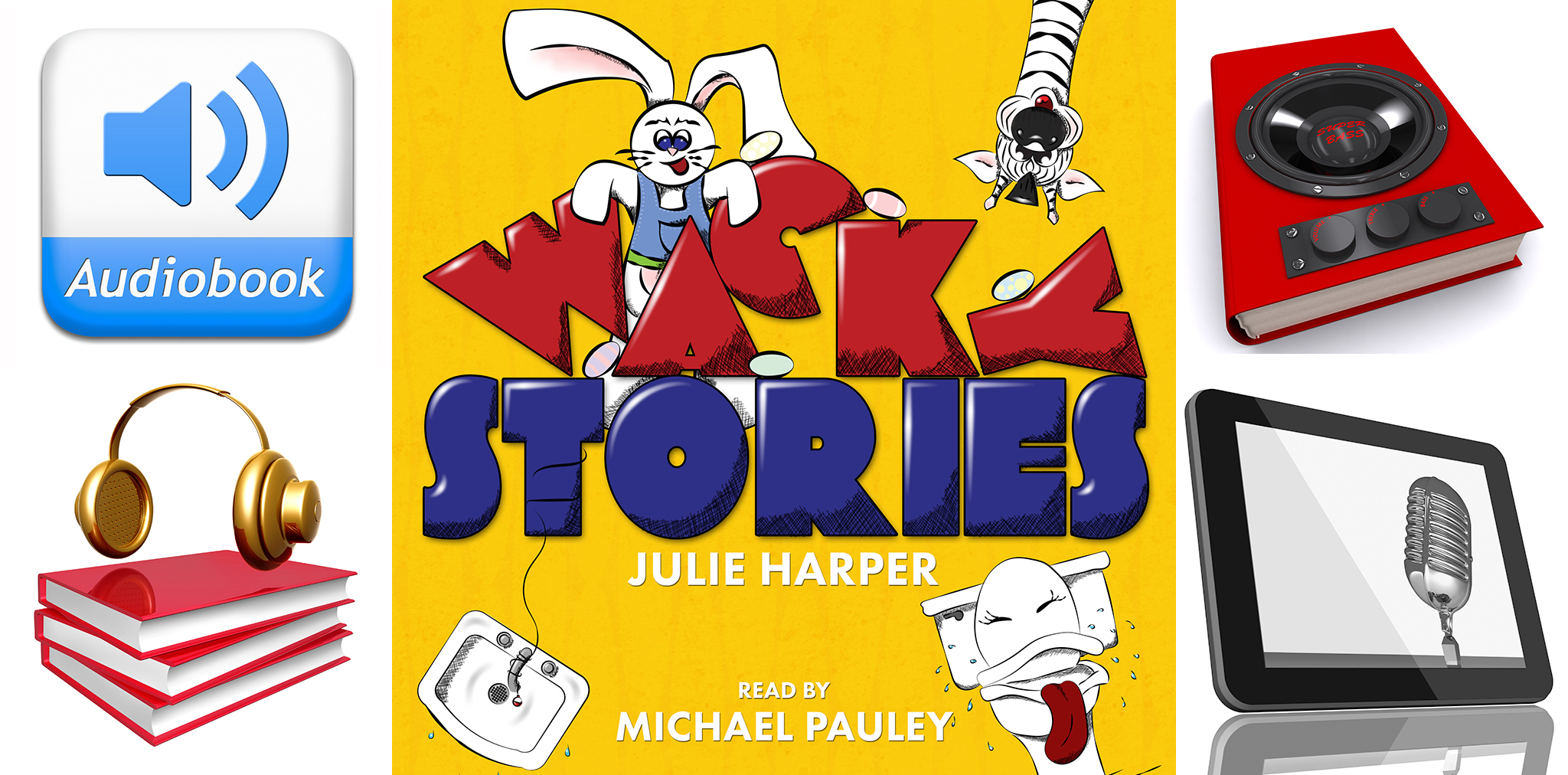
Wacky Stories cover designed by Melissa Stevens at www.theillustratedauthor.net. Side images from ShutterStock.

Wacky Stories cover designed by Melissa Stevens at http://www.theillustratedauthor.net. Side images from ShutterStock.

CREATE AN AUDIO BOOK

There are 27 million paperback books on Amazon.com, 9 million hardcovers, and 3 million Kindle e-books.

But there are only 180,000 audio books on Amazon.com. The audio book market has much better odds.

You can publish an audio book even through self-publishing. Amazon lets you publish an audio book through the Audiobook Creation Exchange (ACX), which makes your audio book available on:

There is a market for audio books. Many truck drivers enjoy listening to audio books on long trips. They’re great for anyone taking a long trip (even kids). But they’re not just for trips. Anytime you’d just like to relax and enjoy having a book read to you. Or you could even read and listen together (check out Amazon’s Whispersync—you need an unabridged audio book with a nearly perfect sync rate for your book to be eligible for this feature). And there are yet other reasons that many audio book customers enjoy listening to books.

HOW DOES IT WORK?

I recently got involved in the audio book development process. Author Julie Harper wanted to create an audio book for her new Wacky Stories collection. I was fortunate to be able to get involved in the process and get a firsthand look. The experience was amazing, so much that now I’m thinking of which of my books might be a good fit for this.

You start out by visiting the Audiobook Creation Exchange (ACX):

http://acx.com

Log in with your Amazon account. (Wondering which one? Well, you should only have one. You can use the same account as a customer, at KDP, and even at Author Central. But if you didn’t, well, I guess you have to choose.)

Then you need to find a book that you’ve already published and is already available at Amazon. (For example, you can find this option from Projects > Open for Auditions > Assert more titles.) The title of your audio book will be the same as the title of the edition already published (in print or Kindle).

You can hire a narrator, try to sell the audio rights to your book, or narrate your own story (you’ll need sufficient equipment or access to a studio). Julie took the option to find and hire a narrator for her Wacky Stories, and it worked out far better than we were expecting.

Find a narrator by holding an audition at ACX. You need to provide a small excerpt from your book to serve as the audition script. Julie uploaded the first story of her Wacky Stories book for the audition. It’s a children’s story with animal noises (like “Moooo” and “cock-a-doodle-doo”). The narrators seemed to have some fun with this in the auditions. It was pretty cool listening to their performances.

The financial aspect of hiring a narrator includes two options:

  • Offer 50% of your audio book royalties, paying nothing up front.
  • Offer a fixed fee, payable upon completion of your audio book and before your audio book is available for sale.

There is no guarantee that you’ll sell any books. So if you wish to offer 50% royalties instead of a fixed fee, it may help if you can provide compelling reasons to believe that your audio book will sell. Note that the narrators will see your current Amazon.com sales rank when they find your book, so if your sales rank is in the millions, 50% of the audio book royalties may not sound like much. If your Kindle or print edition is currently a hot seller with many reviews, these are worth mentioning in the Additional Comments field. If you have a large following online, quote these numbers, too.

Julie selected the option to pay a fixed fee up front instead of 50% royalties. This is less risky for the narrator (but instead places the risk with the author). Julie’s Wacky Stories book is short enough (the reading time is 33 minutes) that it didn’t cost too much to produce the audio book. If you have a long book that would translate to several hours of reading time, a flat rate can get pretty expensive. You pay per finished hour (PFH). You offer a range of PFH’s when you make your audition available. Once you receive auditions, you can make a specific offer and negotiate the terms of the contract.

ACX pays a 40% royalty on the audio book list price if you distribute your audio book only through Amazon, Audible, and iTunes. ACX sets the list price. If you offered 50% of your audio book royalties to the narrator, you’ll effectively receive 20% royalties on your audio book sales. (If you know of other audio book distributors and have plans for significant sales through other outlets, in order to widen your distribution beyond Amazon, Audible, and iTunes, the royalty would be 25% instead of 40%.)

AUDITIONS AND PRODUCTION

I was able to listen to the auditions for Julie Harper’s Wacky Stories audio book, and was really impressed with the performances.

Julie made her audition available late in the evening. There were already 3 performances for that audition later the same evening.

And they were all amazing. Any of the narrators would have worked very well. They were actually better than we had imagined. This made Julie’s decision very difficult.

She selected Michael Pauley as the narrator, and was quite pleased with the production. I’ve listened to the Wacky Stories audio book, and I love Michael Pauley’s narration.

You can check out a free sample here (it’s fun to listen to):

Once you offer a contract and it’s accepted, the narrator produces a sample chapter, and once you’re satisfied with that, the narrator completes the entire audio book (the deadlines for each are specified in the contract when you make your offer).

Be sure to set aside time in your own schedule when you begin the process. You’ll need time to listen to the audio book carefully when you receive it.

Once you’re happy with the audio book, you submit payment to the narrator directly (e.g. with PayPal; that’s between you and the narrator, and something you should work out in advance). Unless you picked the option to split the audio book royalties 50/50.

The narrator tells ACX when payment is received. Then it takes a few weeks for your audio book to become available at Amazon, Audible.com, and iTunes.

Michael Pauley

Michael Pauley narrated Julie Harper’s Wacky Stories audio book.

He has an impressive resume in theatre: http://www.michaelpauley.info/resume.html.

Here is his ACX page: https://www.acx.com/narrator?p=AKV8NSYEMQHEK.

Find audio books that he has narrated on Audible.com.

Julie Harper

Julie Harper is the author of a popular series of handwriting workbooks.

Here is her Author Central page at Amazon.com: amazon.com/author/julieharper.

Check out her author website: http://wackysentences.com.

Her Wacky Stories audio book can be found here: http://www.amazon.com/dp/B00W5PJIVU.

Chris McMullen

Copyright © 2015

Chris McMullen, Author of A Detailed Guide to Self-Publishing with Amazon and Other Online Booksellers

  • Volume 1 on formatting and publishing
  • Volume 2 on marketability and marketing
  • 4-in-1 Boxed set includes both volumes and more

Follow me at WordPress, find my author page on Facebook, or connect with me through Twitter.

And the Current #1 Bestseller on Amazon Is…

Images from ShutterStock

Images from ShutterStock

AMAZON BESTSELLER

Go ahead. Guess.

What kind of book do you think is currently the number one bestseller on Amazon?

  • Romance novel? Nope.
  • Fantasy novel? Nuh uh.
  • A short story? Wrong.
  • Children’s book? No.
  • How-to guide? Wrong again.
  • Suspense thriller? Not even close.

Among print books,

the number one bestseller on Amazon,

presently,

first of all is

out of stock

and,

secondly,

(would you believe?)

is

a

coloring book

(no, children’s book is still wrong!)

for

adults.

That’s right:

The bestselling book on Amazon right now is a coloring book for adults.


Secret Garden by Johanna Basford.

But that doesn’t mean you should rush to publish one.

I typed in “adult coloring books” in the Amazon search and it pulled up nearly 2000 matches in books.

As usual, you need to deliver good content and market effectively to stand out from the crowd.

Chris McMullen

Copyright © 2015

Chris McMullen, Author of A Detailed Guide to Self-Publishing with Amazon and Other Online Booksellers

  • Volume 1 on formatting and publishing
  • Volume 2 on marketability and marketing
  • 4-in-1 Boxed set includes both volumes and more

Follow me at WordPress, find my author page on Facebook, or connect with me through Twitter.

Where are all the Children’s Books?

Image from ShutterStock

Image from ShutterStock

THE CHILDREN’S MARKET

There are currently 1,314,394 books listed on Amazon.com in children’s.

Over a million children’s books. At first, that sounds like a lot. But it’s really not so much.

  • There are 28,000,000 paperbacks listed on Amazon, but only 700,000 of these are children’s books. That’s a mere 2.5%.
  • There are 9,000,000 hardcover books; 300,000 are children’s books. 3.3%.
  • There are 3,300,000 e-books listed in the Kindle Store; 230,000 of these are children’s. That’s nearly 7%.
  • There are 900,000 Kindle Unlimited e-books; 89,000 of these are children’s. 10%.

Let’s look at the 230,000 Kindle children’s e-books, for example:

  • 82,000 are classified under literature and fiction. That’s about one-third. That leaves only 150,000 for the other categories.
  • 34,000 are sci-fi and fantasy.
  • 32,000 are in animals. (Most of these also appear in a second category.)
  • 32,000 relate to growing up and the facts of life.
  • 26,000 are action and adventure.
  • 14,500 are fairy tales.

Maybe it’s more instructive to look at what’s missing:

  • Just 1167 are categorized as humor. It seems like there should be more competition here.
  • Just 7788 are under science and nature, which covers many subcategories.
  • Just 7265 fall under education and reference, and 3000 of those are foreign language. A mere 587 of these are math books.
  • Just 3460 are classified as early learning, like basic concepts and beginning readers.
  • Just 3285 cover history.

If you try searching for keywords on Amazon, the holes are even more apparent. The following searches were done under children’s books in the Kindle Store.

  • 524 matches show up for Common Core, the new national curriculum (adopted by most states). This curriculum teaches skills differently than the current generation of parents learned the material. Thus, many parents are looking for resources to help. But there are few books on it. Many of the top matches don’t seem like they would help directly with it. There are only 61 results for Common Core math, and that 61 gets divided into a host of different topics within math.
  • 26 matches show up for homophones, and many of those aren’t focused on this topic.
  • 57 matches show up for writing prompts. None of the covers on page 1 seems geared toward kids. (To be fair, there are some better matches in paperbacks. Basically, the same book could be published in both print and Kindle, just including blank lines for composition in the print edition.)
  • 150 matches show up for recycling. Isn’t green the big thing? Where are the books?
  • If you publish poetry for kids, you get lost in a sea of 4500 other children’s poetry books. But if you write one of every kind of poem you can think of to introduce kids to the different kinds of poems, and present this as a form of learning or teaching poetry, you suddenly narrowed your market tremendously. Only 66 are listed under teaching poetry.
  • Similarly, there are 11,000 matches for short stories, but only 190 matches for reading comprehension. If you take your children’s short story collection and add multiple choice (for example) questions after each story, with an answer key in the back, suddenly your collection becomes dual purpose, with possibly better exposure in the second niche market.

CRACKING THE CHILDREN’S MARKET

My daughter often demands a certain kind of book, and when I search for it, there are very few matches. This happens quite frequently.

And when I try to narrow the results by clicking on the Kindle Unlimited filter, there are sometimes just a few to choose from.

Part of the children’s market is saturated, but there are also many opportunities.

The trick is to search for books within the children’s market to find popular search results and popular topics for which there aren’t many search results, or, as is often the case, where most of the top matches don’t seem too relevant to the search. Don’t just look at how many books are in the category, but also look at sales ranks of the top matches and how many books show up under particular keyword combinations.

The children’s market isn’t easy to crack, but there is much long-term potential for those who break through.

Although there are many challenges, there are ways to help overcome them:

  • There are some highly popular brands like Dr. Seuss, Disney, and Scholastic, and popular characters like Dora, Spongebob, and Barbie. But many of these get filtered out customers search specifically for Kindle Unlimited books (and there is a filter, i.e. a simple link that you can press, when shopping to see just Kindle Unlimited results). And as you publish more books, you begin to develop your own brand. Not everyone prefers the most popular brands.
  • Many parents prefer print books and many children’s authors find the most success with print. But there is still a significant number of parents who let their kids spend some time on Kindle, and there is much less competition in Kindle, and even less in Kindle Unlimited. The wise course is to publish both print and e-book editions to help reach both markets.
  • Editing is arguably more important in the children’s market as parents and teachers are the ones buying the books. Since children are learning to read, or learning to read at a higher level, naturally parents and teachers want to ensure that children are learning to read well, which means that the book must be virtually free of spelling, grammar, and punctuation errors. On the other hand, children’s books are often shorter and easier to read, which makes the editing easier to manage.
  • Your newly published book won’t show up at the top of search results, but if you first research the children’s market well, you can publish in a niche that is both in demand and has limited competition, and a wise choice of keywords will help with exposure. For example, there are nearly 14,000 children’s books in romance and 2900 in vampires, but only 393 in vampire romance. (I’m not saying this is a wise topic for children’s books; I’m just illustrating how to choose keywords wisely.) You want keywords specific to your book (usually, consisting of 2 or more words between commas, as single-word keywords tend to pull up way too many results; but you will want a couple of highly relevant single-word keywords in the mix, too), which are popular searches on Amazon. Just visit Amazon, browse children’s books, and start typing keywords to gauge which ones are popular enough to be searched for. You can always change your keywords at any time.
  • The real keys are writing several similar books, publishing quality content that parents will want their kids to read, and learning effective marketing strategies. Involve parents and educators in the developmental stages, running ideas by teachers at various stages and recruiting parents as beta readers. This will not only better help you understand your audience’s specific and possibly diverse needs, but it will also help you with word-of-mouth marketing when you involve people personally and take some of their advice. Personal interactions can have a powerful influence: You want to meet parents, librarians, and educators in person and let them discover your book and your passion for it.

Amazon KDP has a new free tool to help with formatting children’s books for Kindle:

https://chrismcmullen.wordpress.com/2014/09/04/how-to-use-the-new-kindle-kids-book-creator-tutorial

SURVEY

If you haven’t already done so, please participate in a survey on how people read books. The more participation we get, the more meaningful the results will be.

Here is one question, for your convenience. (If you’ve already answered this before, please don’t answer it a second time.)

You can find more questions here:

https://chrismcmullen.wordpress.com/surveys

Chris McMullen

Copyright © 2015

Chris McMullen, Author of A Detailed Guide to Self-Publishing with Amazon and Other Online Booksellers

  • Volume 1 on formatting and publishing
  • Volume 2 on marketability and marketing
  • 4-in-1 Boxed set includes both volumes and more

Follow me at WordPress, find my author page on Facebook, or connect with me through Twitter.

Comments

Click here to jump to the comments section:
https://chrismcmullen.wordpress.com/2015/03/29/where-are-all-the-childrens-books/#comments

Did you know? Amazon has Several Publishing Options. Not just KDP.

Image from ShutterStock

Image from ShutterStock

PUBLISHING WITH AMAZON

There are at least a half dozen different ways to publish a book with Amazon.

Most people think of Kindle Direct Publishing, but that’s just one of many options:

  • Amazon has multiple imprints, such as 47 North. However, like most major traditional publishers, Amazon Publishing does not accept unsolicited manuscript submissions.
  • Another way to publish with Amazon as your “publisher” is through the new Kindle Scout program. This option is based on reader voting, not solely on an editor’s decision.
  • For those who would like to write fan fiction, there is Kindle Worlds.
  • Kindle Singles is a competitive publishing option for certain kinds of shorter Kindle e-books.
  • Anyone can self-publish with Amazon using Kindle Direct Publishing.
  • You can also self-publish a paperback book with Amazon using CreateSpace.
  • The Audiobook Creation Exchange (ACX) lets you publish an audiobook that will be available through Amazon.

AMAZON IMPRINTS

Amazon Publishing includes multiple imprints. However, they don’t currently accept unsolicited submissions.

  • Montlake Romance for romance novels.
  • Thomas & Mercer for mysteries, thrillers, and suspense.
  • 47 North for science fiction, fantasy, and horror.
  • Skyscape for teen and young adult.
  • Amazon Publishing for nonfiction, memoirs, and general fiction.
  • Lake Union Publishing for contemporary and historical fiction, memoirs, and popular nonfiction.
  • Two Lions for children’s picture books, chapter books, and novels.
  • Little A for literary fiction.
  • Jet City Comics for comics and graphic novels.
  • Grand Harbor Press for personal growth and self-help.
  • Waterfall Crest for Christian nonfiction and fiction.
  • Story Front for short fiction.
  • Amazon Encore for rediscovered works.
  • AmazonCrossing for translated works.

You can learn more at Amazon Publishing here:

https://www.apub.com

KINDLE SCOUT

Unlike Amazon Publishing, Kindle Scout is open to submissions from US authors. Categories currently include:

  • Science fiction and fantasy
  • Romance
  • Mysteries, thrillers, and suspense
  • Action and adventure
  • Literature and contemporary fiction

You submit a complete copy-edited, never-before-published manuscript with at least 50,000 words. Readers will nominate books based on the first 3000 words (and the cover, title, description, and your biography). Nominations help you earn consideration, but having the most nominations by itself doesn’t guarantee acceptance. They stress that they are looking for professional, copy-edited manuscripts. If accepted, they pay a $1500 advance and 50% royalty (less than KDP’s 70% royalty, but perhaps the stamp of approval will help authors make up the difference).

You can learn more about Kindle Scout here:

https://kindlescout.amazon.com

KINDLE WORLDS

You can publish fan fiction through Kindle Worlds.

Learn about Kindle Worlds here:

https://kindleworlds.amazon.com

Once there, click See All Worlds and How It Works. Make sure that you adhere to the content guidelines and rules, otherwise you’ll have wasted your time and effort.

KINDLE SINGLES

You can publish a shorter e-book, with 5,000 to 30,000 words, with Kindle Singles, if it is “exceptional ideas–well researched, well argued, and well illustrated.”

This is a competitive process, and you submit your idea much like submitting to a traditional publisher or agent. In addition to an exceptional idea, they may also be considering the marketing aspect, much like a traditional publisher would, and why you should be the one to write book. (If someone else has better qualifications to fulfill that role, what’s to prevent them from asking a more qualified candidate to write a similar book? Nothing, really. You can copyright the words, but not the general idea that you’re trying to get published.)

KINDLE DIRECT PUBLISHING

Anyone can self-publish an e-book on Amazon with Kindle Direct Publishing (KDP):

https://kdp.amazon.com

Read Amazon’s free guide, available in PDF form, before you publish. Also, preview your book carefully on each device before you publish.

https://kdp.amazon.com/help?topicId=A2MB3WT2D0PTNK

Click on the Kindle Tips link at the top of my website for more free help.

CREATESPACE

Anyone can also self-publish a paperback book on Amazon with CreateSpace:

https://www.createspace.com

If you’re writing your book in Word, click on the Microsoft Word Tutorials link at the top of my website for free formatting help (e.g. with page numbers and headers).

AUDIOBOOK CREATION EXCHANGE

Learn more about creating an audiobook with the Audiobook Creation Exchange (ACX):

https://www.acx.com

Chris McMullen

Copyright © Chris McMullen, Author of A Detailed Guide to Self-Publishing with Amazon and Other Online Booksellers

  • Volume 1 on formatting and publishing
  • Volume 2 on marketability and marketing
  • 4-in-1 Boxed set includes both volumes and more

Is Kindle Unlimited Being Flooded with Short Books? (Actual Data from Amazon)

Image from Shutterstock

Image from Shutterstock

KINDLE UNLIMITED QUESTIONS ANSWERED

I researched the answers to two common questions about Kindle Unlimited. I obtained my data directly from Amazon.com, as I will show.

  1. Is Kindle Unlimited being flooded with short books?
  2. Are KDP Select authors dropping out now that the KOLL payment had dropped to about $1.40?

I hear a lot of speculation about these two points. Most of the answers are based on guesswork and emotions such as fear.

So I decided to find out for myself. I didn’t know the answer for sure. I researched the data and let the numbers speak for themselves.

DATA STRAIGHT FROM AMAZON

I gathered my data directly from Amazon. No, I didn’t ask them for it. I didn’t need to; you don’t either.

Rather, I simply browsed the Amazon.com website as follows:

  • I visited Amazon.com. I browsed the Kindle Store. The left-hand column tallies numbers of books in various categories.
  • On February 17, 2015 I did my first search. I recorded data for books in Kindle Unlimited, new releases, new releases in Kindle Unlimited, Kindle short reads, Kindle short reads in Kindle Unlimited, Kindle short read new releases in Kindle Unlimited, and many other numbers.
  • I repeated my search on March 17, 2015, one month later.
  • I compared the numbers. For specifics, see below.

(1) Are Short Books Flooding Kindle Unlimited?

In the Kindle store at Amazon.com, the left-hand column actually displays the number of books in Kindle short reads. If you click on the Kindle short reads link, it further breaks these down by page count. Kindle short reads have 1 to 100 pages.

Here is what I found:

  • On February 17, there were 301,747 Kindle short reads in Kindle Unlimited out of 864,164 Kindle Unlimited books. That’s 34.9%.
  • On March 17, there were 314,020 Kindle short reads in Kindle Unlimited out of 894,423 Kindle Unlimited books. That’s 35.1%.

This percentage is up slightly: 0.2%. But don’t panic yet.

Let’s look at another pair of numbers:

  • There were 42,638 books added to Kindle Unlimited in the last 30 days.
  • There were 12,273 more Kindle Unlimited books in Kindle short reads on March 17 than on February 17.

Only 29% of the books added to Kindle Unlimited in the last 30 days are short reads. 71% of books published and added to Kindle Unlimited in the past month have 101 pages or more. That’s definitely not flooding the market with short reads. (In fact, this 71% exceeds the 65% of books in Kindle Unlimited presently that are full-length books. Imagine that!)

However, 12,379 books were removed from Kindle Unlimited. If you account for this, there were 30,259 more books in Kindle Unlimited on March 17 compared to February 17.

Of those, 30,259 books, 40.6% were Kindle short reads.

(Furthermore, 23% of the books in Kindle short reads are 65-100 pages in length. Many of the short reads books aren’t all that short.)

What does this mean?

If 40% of the books added to Kindle Unlimited each month are short reads (100 pages or less), then the ratio of short reads to full-length Kindle e-books will approach 40%.

That means at least 60% of the books in Kindle Unlimited will be full-length books in the future, based on the current rate. That’s a majority that are full-length.

That’s certainly not flooding the market with short reads. There are currently 35% of Kindle Unlimited books classified as short reads, and this is approaching 40%.

Based on the current rate of growth (0.2% per month), that’s not too different from how things were back in July before Kindle Unlimited was introduced. It was nearly 35% then, too. If Kindle Unlimited changes the ratio of short books to full-length books from 35% to 40%, that’s not significant in the grand scheme of things.

You don’t have to worry about it exceeding 40% until the ratio of books added to Kindle Unlimited per month begins to exceed this. That’s not happening now. I’ll keep an eye on this number, but I’m not worried about it at this point; it hasn’t changed much in the past six months.

On the related question, “Are full-length books dropping out of KDP Select?” let’s look at the next question. It turns out that very few books are dropping out.

How about those really short books?

Only 4% of the books in Kindle Unlimited have 11 pages or less (and this number isn’t going anywhere either). Of these, many are short stories (and not “scamphlets”).

If you hear all the rumors about people trying to game the system with very short books in Kindle Unlimited, or the stories of websites encouraging people to do this, just discard it unless and until this percentage starts to climb. It’s just 4% and Kindle Unlimited was introduced way back in July; it hasn’t changed noticeably in all that time. We’ll keep an eye on it, but there is presently no reason to worry about it.

(2) How many books are dropping out of KDP Select?

There appears to be a 98.6% renewal rate in KDP Select, as I’ll demonstrate below.

  • There were 864,164 books in Kindle Unlimited on February 17, 2015.
  • There were 894,423 books in Kindle Unlimited on March 17, 2015.
  • 42,638 books were added to Kindle Unlimited in the last 30 days.

I subtract 42,638 books from 894,423 to get 851,785. That removes the new releases since February 17. (Actually, this number should be somewhat higher than 851,785 if you adjust for the fact that February only has 28 days. It will just make the renewal rate even higher.)

Comparing 851,785 to 864,164, there is a 98.6% renewal rate for KDP Select books staying in KDP Select. (The percentage is higher if you adjust for February’s short calendar.)

Only 1.4% are opting out, and more new books were added than opted out, which means the overall number of Kindle Unlimited books is climbing. (42,638 new books were added, compared to 12,379 that opted out.)

Amazon KDP has publicly advertised a KDP Select renewal rate in excess of 95% since July, 2014, and my data easily backs this up. Very few books are dropping out.

Note that some of the books that have dropped out are Kindle short reads! It’s not just the full-length books that are dropping out. 15,539 books were added to Kindle Unlimited short reads in the last 30 days, yet there are only 12,273 more books in Kindle Unlimited short reads compared to one month ago. The difference opted out of Kindle Unlimited. (So if you wish to claim that only full-length books are opting out of Select, it won’t be true.)

CONCLUSIONS

Two myths frequently rumored are absolutely BUSTED:

  • Myth 1: Soon, there won’t be any good books left in Kindle Unlimited. With 98.6% of Kindle Unlimited books renewing their enrollment, and with many more books being added each month than are dropping out, this is an unfounded concern.
  • Myth 2: Soon, the vast majority of Kindle Unlimited books will be short reads. Actually, 65% of the books in Kindle Unlimited have 101 or more pages, and 60% of those added in the last 30 days have 101 or more pages. More authors are adding full-length books to Kindle Unlimited than are adding short reads, so this concern is also unfounded.

READING SURVEY

If you haven’t already done so, please participate in a survey on how people read books. The more participation we get, the more meaningful the results will be.

Here is one question, for your convenience. (If you’ve already answered this before, please don’t answer it a second time.)

You can find more questions here:

https://chrismcmullen.wordpress.com/surveys

Chris McMullen

Copyright © 2015

Chris McMullen, Author of A Detailed Guide to Self-Publishing with Amazon and Other Online Booksellers

  • Volume 1 on formatting and publishing
  • Volume 2 on marketability and marketing
  • 4-in-1 Boxed set includes both volumes and more

Follow me at WordPress, find my author page on Facebook, or connect with me through Twitter.

Comments

Click here to jump to the comments section:

https://chrismcmullen.wordpress.com/2015/03/18/is-kindle-unlimited-being-flooded-with-short-books-actual-data-from-amazon/#comments