What Did Kindle Unlimited Pay for Pages Read in November, 2015?

Image from ShutterStock.

Image from ShutterStock.

KENP PAGES READ FOR NOVEMBER, 2015

November, 2015 marks the first month that Amazon KDP is paying different royalty amounts in different countries for KENP pages read.

Here is the breakdown for November, 2015 by country:

  • United States: $0.00492 per page (US dollars). That’s an increase of 2.3% from October’s payment of $0.00481.
  • United Kingdom: £0.00327 per page (British pounds). That’s also an increase of 2.3% from October’s £0.003196.
  • Germany: €0.00425 per page (Euro). That’s a drop of 5.1% from October’s €0.00448.
  • France: €0.00458 per page (Euro). That’s an increase of 2.2% from October’s €0.00448.
  • Canada: $0.00608 per page (Canadian dollars). That’s a drop of 5.0% from October’s $0.0064. (Remember, these are Canadian dollars, not US dollars.)
  • India: ₹0.1075 per page (Indian rupees). That’s a drop of 66% from October’s ₹0.3163.

Are these changes to Kindle Unlimited pages read payments good or bad?

The most significant change occurred for India: KENP read for India dropped by 66% (from ₹0.3163 to ₹0.1075). As of today, 1 USD equates to 66.944 Indian rupees. So while ₹0.1075 may seem like a big number compared to $0.00492, it’s actually much less. Converting from ₹0.1075 (Indian rupees) to US dollars, it equates to $0.0016 per page read. (Compare this to October: The October payment of ₹0.3163 was equivalent to the US figure of $0.00481 per page read, using slightly different exchange rates from October’s reporting period.)

So we make about 1/3 the usual rate for Kindle Unlimited pages read in India, but every other country is within 5% of the US rate of $0.00492 per page. Why? It’s based on the local market. Whereas Amazon charges $9.99 per month for US subscribers to Kindle Unlimited, Amazon charges approximately $4 per month (after conversion) to customers in India.

Did you know that the population of India is approximately 1.3 billion, a close second to China’s 1.4 billion? Compare that to the United States, in third position with 0.3 billion. There are a lot of potential readers in India, but their subscription price is 2.5 times less. So the per page rate is now much less, too.

The US rate is slightly higher this month, and no doubt it’s because Amazon is paying different rates in different countries. India went down; the US went up. There was compensation.

I see positive indicators for Kindle Unlimited again this month:

  • The payout rose to a record $12.7M. That’s up 2.4% from October’s $12.4M payout. That’s a sign of either more subscribers or more pages read by the average customer. Either way, more pages are being read. Isn’t that what authors want? Our pages to be read?
  • The US pages read rate increased 2.3%. Although this is likely due to redistributing the payout by country (i.e. compensation for the significant reduction in India), it’s still nice to see the rebound.

Does it strike you as odd that Amazon is paying $0.00492 per page in the United States? It’s a mere $0.00008 per page from being $0.005. Wouldn’t $0.005 per page have psychological value? But while $0.00008 would scarcely make a difference to most authors, it would have cost Amazon approximately $200,000 to raise the per page rate from $0.00492 to $0.005.

Write happy, be happy. 🙂

Chris McMullen

Copyright © 2015

Chris McMullen, Author of A Detailed Guide to Self-Publishing with Amazon and Other Online Booksellers

Click here to view my Goodreads author page.

  • Volume 1 on formatting and publishing
  • Volume 2 on marketability and marketing
  • 4-in-1 Boxed set includes both volumes and more
  • Kindle Formatting Magic (coming soon)

Follow me at WordPress, find my author page on Facebook, or connect with me through Twitter.

Comments

Click here to jump to the comments section.

Ad Performance Impacts Your Ad’s Chance of Being Shown with Amazon’s AMS

Image from ShutterStock.

Image from ShutterStock.

AMS ADVERTISING: CLICK HISTORY

It’s not just your cost-per-click (CPC) bid that matters.

It’s also your click history.

When you advertise with Amazon Marketing Services (AMS), click history in addition to your CPC bid determine the chances that your ad will be shown to customers.

Amazon’s bidding algorithm for advertising space via AMS takes into account the click-through rate (CTR) as well as the CPC bid.

That should make sense. You only pay for clicks; impressions are free. Also, ads with higher CTR’s and closing rates (sales per click) are more relevant to customers.

Amazon would prefer to show ads that are (A) more relevant for customers and (B) where customers are more likely to click on the ad (and then buy the product, and then be satisfied with their purchase).

A good CTR also helps you. For example, if you’re a self-published author advertising with AMS via KDP Select, a higher CTR and a higher closing rate mean that customers are interested in your book. Those are also the customers who are more likely to purchase and then enjoy your book.

Here are ways to improve the CTR of your ad, and hence improve the chances of your ad being shown to customers:

  • Choose your targeting well so that it’s a good match for your customers. If you target by product or keyword, use keywords that are a good fit for your specific target audience.
  • The ad thumbnail should clearly reveal the nature of the product. For a book, the tiny cover thumbnail that appears in the ad should make the expectations clear.
  • The title of the product and the tag line should both create interest and help to make the nature of the content clear.

Write happy, be happy. 🙂

Chris McMullen

Copyright © 2015

Chris McMullen, Author of A Detailed Guide to Self-Publishing with Amazon and Other Online Booksellers

Click here to view my Goodreads author page.

  • Volume 1 on formatting and publishing
  • Volume 2 on marketability and marketing
  • 4-in-1 Boxed set includes both volumes and more
  • Kindle Formatting Magic (coming soon)

Follow me at WordPress, find my author page on Facebook, or connect with me through Twitter.

Comments

Click here to jump to the comments section.

Kindle Unlimited: Global Expansion and Impact

Image from ShutterStock.

Image from ShutterStock.

KINDLE UNLIMITED NEWS

Amazon’s payment for Kindle Unlimited KENP pages read has dipped a hair below $0.005 per page.

There is a downward trend for KENP pages read, although is a reason behind the most recent dip, and, as we shall see, there may be good signs to offset this trend.

  • July, 2015: $0.0058
  • August, 2015: $0.0051 (11% drop)
  • September, 2015: $0.0051 (1% drop)
  • October, 2015: $0.0048 (5% drop)

It started in July at $0.0058, likely to match the projections forecast when Amazon shared their pages read data for June.

It dropped 11% from July to August, likely because there were changes in the readership and/or reading habits when the Kindle Unlimited changes were implemented, and perhaps also Amazon was adjusting KENP settings and measurements.

We saw nice stability from August to September. When we finally see some long-term stability, that will be nice. I think we’ll get there.

The drop from September to October has a simple explanation: Amazon expanded Kindle Unlimited globally, introducing it to India. The subscription price is much cheaper in India (around $4 US per month).

This global expansion pulled more readers into Kindle Unlimited, which is a good thing. But the lower subscription price in India effectively lowered the pages read rate by 5%.

That’s about to change. Starting in November, Amazon will pay different pages read rates in different countries. So pages read in India will likely pay less than pages read in the United States, for example.

Does that mean the US pages read rate will rise back up to $0.005 per page? Good question! Maybe it won’t go up, or up much, maybe it will. But hopefully it won’t drop as much next month, if at all.

But I continue to see good news in the data. For example, the KDP Select Global Fund keeps growing:

  • July, 2015: $11.5M
  • August, 2015: $11.8M
  • September, 2015: $12M
  • October, 2015: $12.4M

I see two potentially good points for authors in these numbers:

  • continued increase in the number of Kindle Unlimited subscribers
  • continued increase in the number of Kindle Unlimited pages read

Not everyone is seeing growth, but overall, I’m seeing improved pages read data for my books on average.

Of course, there is another piece of data equally important: 38,500 Kindle Unlimited books added in the last 30 days. There are now over 1.1M books in the program (it was closer to 0.6M when Kindle Unlimited started). There were 85,000 Kindle books added in the last 30 days, so competition for sales is even more fierce than for pages read.

Most authors must keep writing, publishing, and marketing to keep up in the current marketplace. Otherwise, most likely, both sales and pages read will drop.

Write happy, be happy. 🙂

Chris McMullen

Copyright © 2015

Chris McMullen, Author of A Detailed Guide to Self-Publishing with Amazon and Other Online Booksellers

Click here to view my Goodreads author page.

  • Volume 1 on formatting and publishing
  • Volume 2 on marketability and marketing
  • 4-in-1 Boxed set includes both volumes and more
  • Kindle Formatting Magic (coming soon)

Follow me at WordPress, find my author page on Facebook, or connect with me through Twitter.

Comments

Click here to jump to the comments section.

Kindle Unlimited: Global Fund Stability and Marketplace Changes

Image from ShutterStock.

Image from ShutterStock.

KINDLE UNLIMITED UPDATE

Amazon announced that the KDP Select global fund for November, 2015 will be at least $12M.

It has consistently been $11M or more since May, 2015.

So this shows some nice stability.

Under the original Kindle Unlimited scheme, critics used to comment on how Amazon would low-ball the KDP Select global fund, promising around $3M at the beginning of the month, and then providing a much larger fund after the month’s end. Some tried to argue that Amazon was taking a loss because they raised the fund much higher than their initial projection.

When the new Kindle Unlimited unrolled this summer, critics revised their argument, saying that just because Amazon is offering $11M or more up front doesn’t mean they will continue to do this. Maybe it would drop down much lower later on, or maybe after a brief welcoming period, they would revert back to their old habits.

Yet from May thru November, the KDP Select global fund has held steady from $11M to $12M.

This stability is nice, and I haven’t heard such arguments from the critics recently.

Maybe the proponents for the new Kindle Unlimited who argued that the new system is more viable than the old system were right. Maybe it is more viable for Amazon financially, maybe it has added stability.

Whatever the reason, the global fund has held steady for 7 straight months.

The payment for pages read has dropped to just over $0.005 per page. There was a significant drop after the first month of the new Kindle Unlimited program, but that last two months held steady.

A new variable to the KDP Select global fund and to the KENP pages read is the added marketplaces offering Kindle Unlimited.

For example, Kindle Unlimited recently launched to India.

Whereas it costs $9.99 per month to subscribe to Kindle Unlimited in the US, the local India subscription price is the equivalent of $3.00.

This could significantly impact the payment for KENP pages read, and it probably will for October, 2015.

However, Amazon announced that they would revise their one-size-fits-all plan for pages read beginning in November, 2015.

The payments for pages read in each marketplace will take into account differences in local marketplaces. This should help to stabilize the payment per page.

However, there may be a drop for October, 2015 (we’ll find out on November 15), where this wasn’t yet factored into the payment for pages read.

The best news to me was this statement from Amazon KDP:

“Our long-term goal, as always, is to build a service that rewards authors for their valuable work, attracts readers around the world, and encourages them to read more and more often.”

Of course, it’s difficult to balance the rewards for authors with the other goals of attracting readers and getting them to read more.

But I believe this is a great long-term goal, and I do feel that in a number of ways Kindle Unlimited has helped with this goals.

Write happy, be happy. 🙂

Chris McMullen

Copyright © 2015

Chris McMullen, Author of A Detailed Guide to Self-Publishing with Amazon and Other Online Booksellers

Click here to view my Goodreads author page.

  • Volume 1 on formatting and publishing
  • Volume 2 on marketability and marketing
  • 4-in-1 Boxed set includes both volumes and more
  • Kindle Formatting Magic (coming soon)

Follow me at WordPress, find my author page on Facebook, or connect with me through Twitter.

Comments

Click here to jump to the comments section.

Kindle Unlimited KENP Read for September, 2015

Image from ShutterStock.

Image from ShutterStock.

KINDLE UNLIMITED PAGES READ FOR SEPTEMBER, 2015

Good news, I think:

Kindle Unlimited paid $0.00507 per KENP read for September, 2015.

That’s just over half a penny per page.

Why is this good news?

Because in August, 2015, Kindle Unlimited paid $0.00514 per normalized page read.

We now have two consecutive months with only a very slight change in the Amazon payment for pages read.

Recall that the payment for July was somewhat higher: $0.00580.

When July’s $0.00580 dropped to August’s $0.00514, I was concerned with this 11% drop.

I was worried about stability.

But with September’s $0.00507 roughly matching August’s $0.00514, I see prospects for stability.

It’s still early. We only have three months of data for the new Kindle Unlimited payout.

But we do have a year of data for the previous Kindle Unlimited payout, along with a few years of payouts for Amazon Prime borrows.

And that data shows that the payout tends to approach a fairly stable number (until significant changes to the program were introduced).

So there is reason to expect the payment to stabilize. Will it stabilize at or near half a penny per normalized page? Good question, but for two months in a row, that’s about what it is.

There is a little more good news, too:

The KDP Select Global Fund has risen to $12M for September, 2015.

This figure has steadily grown, and has been fairly stable.

The KDP Select Global Fund for August was $11.8M, and it was approximately $11M in May, June, and July.

This represents a very large, indie-friendly customer base. Amazon is paying over $100M per year just for KDP Select books borrowed through Kindle Unlimited and Amazon Prime.

This customer base is not just very large, its stable; if anything, it appears to be growing a little.

Write happy, be happy. 🙂

Chris McMullen

Copyright © 2015

Chris McMullen, Author of A Detailed Guide to Self-Publishing with Amazon and Other Online Booksellers

Click here to view my Goodreads author page.

  • Volume 1 on formatting and publishing
  • Volume 2 on marketability and marketing
  • 4-in-1 Boxed set includes both volumes and more
  • Kindle Formatting Magic (coming soon)

Follow me at WordPress, find my author page on Facebook, or connect with me through Twitter.

Comments

Click here to jump to the comments section.
You Can Extend the Deadline for AMS ads via KDP

Image from ShutterStock.

Image from ShutterStock.

AMS AD DEADLINE

When you create an advertisement for KDP Select books via AMS, you must choose an end date.

The end date must be within the next 6 months.

But suppose you have a successful advertisement running, but when the deadline approaches, you don’t want to stop your AMS ad campaign.

Especially, if you spent several hours handpicking books to target, and your ad is doing well; you don’t want to have to do that research again, and you might not choose such a good list next time.

Fortunately, you can extend the deadline of your KDP ad.

Extend the deadline before the ad runs its course.

When the deadline is near, simply view your AMS ad report.

Click the Edit button next to your ad.

Revise the end date. It will let you choose a date up to six months from today.

Click save.

Return to your ad report, just to check that the end date has properly updated.

When the new deadline comes up, you can repeat the process, if you want.

A FEW TIPS

The real trick is getting the AMS ad to work well enough that you actually want to extend the deadline when the time comes.

So here are a few tips:

  • Don’t overbid. Most authors can’t afford to spend 50 cents or more per click. Start out very low. Wait three days (or more) because ad report data can be significantly delayed (if it seems like nothing’s happening, wait 3 days to find out if indeed nothing is happening, or if you’ve already spent a lot of money that just hasn’t posted to your report yet because of delays). If nothing happens after a few days, raise your bid just a little. Then wait a few more days. This strategy gets you affordable clicks. It won’t drive a ton of daily traffic to your book, but it will help you generate some interest without overspending. Time is on your side. Take what you can afford to get, even if it comes very slowly. Too many authors bid much higher than they should, blowing their budgets before they realize it with little to show for it. I have several ads that perform well, with very low bids, even though it may take weeks for them to deliver significant results. Personally, I prefer to be patient and get a good return on my investment.
  • Test it out. I ran a few dozen tests in the first couple of months before I learned the most effective ways to make these ads work for my books. You’re not obligated to spend the entire $100 budget. You can pause or terminate your ad at any time. (But if you bid high, you can blow your budget without realizing it because there can be significant delays.) So you can try an ad over a short period, then cancel it and start a new ad. Maybe you try changing your targeting list, or maybe you try a different catch phrase. Some trial and error can help you learn more effective ways to use this advertising tool.
  • Close the deal. If your sales to clicks ratio is 3% or less, this suggests that you could improve (A) your targeting or (B) your product page. Is your product page closing the deal as well as it could? Does the cover properly suggest what to expect? Does it achieve this goal in the tiny ad thumbnail, too? Does the book description arouse interest and curiosity without giving away too much? Does the Look Inside grab the reader right away? Does everything look professional? The great thing about AMS is that you can test out the performance of your product page. You can get two weeks of data, then revise your book description, get another two weeks of data, and compare. Did changing the product page actually make a difference, for better or for worse? Your AMS ad report can be a tool to help you perfect your product page. A closing rate of around 5% is reasonable achieve; a closing rate of 10% or more is rare, but it can be done. A closing rate of 1% or less isn’t good, but it happens.

Write happy, be happy. 🙂

Chris McMullen

Copyright © 2015

Chris McMullen, Author of A Detailed Guide to Self-Publishing with Amazon and Other Online Booksellers

Click here to view my Goodreads author page.

  • Volume 1 on formatting and publishing
  • Volume 2 on marketability and marketing
  • 4-in-1 Boxed set includes both volumes and more
  • Kindle Formatting Magic (coming soon)

Follow me at WordPress, find my author page on Facebook, or connect with me through Twitter.

Comments

Click here to jump to the comments section.
Kindle Unlimited Pages Read Rate for August, 2015

Image from ShutterStock.

Image from ShutterStock.

KINDLE UNLIMITED PAGES READ

Amazon paid $0.00514 per KENP read in August, 2015.

Compare that to the $0.005779 pages read rate in July, 2015.

That’s a drop of 11%. If you had 10,000 pages read in July, would earned $57.79, but for the same 10,000 pages read in August, you only earned $51.40.

On the one hand, an 11% drop is significant, but on the other hand, unless you had a million pages read through Kindle Unlimited and Amazon Prime, that 11% doesn’t amount to a whole lot.

And if you had a million pages read, you’re thriving in the program (compared to most authors).

But the concern really isn’t over one drop in the payout of 11%.

The concern extends beyond that. 11% is a pretty sizable change. It’s not a small fluctuation.

So one concern is stability.

If it drops 11% in August, another 11% in September, another 11% in October, and so on, that would really add up.

Since these are the early days of KENP, we don’t have much data to go on. We don’t yet have a pattern of KENP payouts established to lend us a feeling of stability.

What we really need is more data. But authors also want to make sound decisions now. And it will take a few months to get solid data.

I expected the pages read rate to drop toward $0.0050. What I didn’t expect is for it to jump straight there in one fell swoop.

And hence stability is in question.

But I think it’s premature to run for the hills.

One drop of 11% isn’t too much for me. Maybe stability will be there. I need a few months’ more data to assess this.

If it levels off around $0.0050, that will be what I had been expecting anyhow; it will just have gotten there faster than I was predicting.

If it drops even below $0.0050, the question will be how much below. What’s your magic number, where if it goes below that, you feel like KDP Select isn’t worth it? This magic number will be different for everyone, but it’s worth thinking about. We’re not near my magic number yet.

And what’s your backup plan for the worst-case scenario? It wouldn’t hurt to sketch out a backup plan and store it in a safe place. If you’re not below your magic number, I wouldn’t initiate the backup plan yet. But it’s smart to have a plan in mind, just in case.

I feel I’ve given too much attention to this lone 11% drop. Who knows what next month will bring? We don’t have enough data yet to see a pattern emerge.

POSITIVE INDICATORS

But there are other positive indicators that may help offset that 11% drop. Let’s look at a few of these.

GLOBAL FUND STABILITY

The KDP Select Global Fund is suddenly more stable than ever.

It was approximately $11M for May, June, July, and now $11.8M in August.

It’s starting at $11M for September.

They used to commit a mere $3M to the pot, and then raise it to $8M or more.

Now they commit to $11M on a regular basis.

So while the pages read rate may have dropped 11%, the KDP Select Global Fund has been very stable, more stable than ever.

KINDLE UNLIMITED IS THRIVING

KDP Select authors are earning a combined $10M per month just from KENP read.

Amazon has paid out over $100M in royalties just for KDP Select borrows in 2015.

Approximately 2 billion pages of KDP Select books are read through Kindle Unlimited and Amazon Prime per month.

That’s a huge readership. And it’s been a consistent readership (if anything, it appears to be growing).

And this readership supports indie books. Not every indie book, but the top KDP Select books are thriving in Kindle Unlimited.

Most of these readers are reluctant to buy books any other way.

AMAZON PAID MORE ROYALTIES OVERALL

Although the per-page rate dropped from $0.005779 to $0.00514, the KDP Select Global Fund rose from $11.5M to $11.8M.

Amazon paid $300,000 more in KDP Select royalties in August than they paid in July.

Overall, KDP Select authors earned more than ever.

So although they paid 11% less per page, there were more than enough additional pages read to compensate overall, enough such that Amazon actually paid more money in royalties overall.

Either there were (A) more Kindle Unlimited subscribers or (B) Kindle Unlimited customers are reading more than usual.

Either way, in general, KDP Select books benefited from this additional reading and the extra $300,000 paid in KDP Select royalties in August compared to July.

MORE BOOKS IN KINDLE UNLIMITED

Another sign that the program is thriving is that the number of books in Kindle Unlimited steadily rises.

Even through the new Kindle Unlimited 2.0.

Even through the 11% drop in the per-page rate.

The number of books in Kindle Unlimited keeps climbing.

It’s up to 1.1M presently. It was about 1M just a few months ago, but despite the new program and even the drop in the per-page rate in August, still 100,000 more books have added in the past few months than have dropped out.

127,000 books were added to Kindle Unlimited in the past 90 days. Whereas only about 27,000 have dropped out during this same time. For every book that has dropped out, 4 more were added in.

44,000 books were added just in the last 30 days. The number of books added to Kindle Unlimited each month keeps rising.

There is plenty of content for customers, and plenty of new content each month.

The top KDP Select books are thriving with millions of pages read per month, and the customers enjoying those top books want more top books to read. And those authors feel motivated to write more similar books. And other authors want to become KDP Select All-Stars, so they’re working to try to please Kindle Unlimited customers.

Many books benefited from the extra pages read and higher KDP Select Global Fund for August.

For many books, overall, this made August better than July, even though the per-page rate dropped.

WHAT IF YOUR BOOK DIDN’T BENEFIT?

If your book didn’t benefit from the extra pages read and the higher KDP Select Global Fund, there are a number of possible reasons:

  • There are many complicating factors involved in a book’s sales. Most books go through sales slumps at some time all on their own. If your book’s sales slumped in August, it’s quite possible that it had nothing to do with Kindle Unlimited. In fact, more pages were read through Kindle Unlimited than ever, and the payout was $300,000 more than in July.
  • August is typically a slow season for very many books. If your book’s sales slumped in August, it may just be a seasonal effect. The interesting thing is that more pages were read in Kindle Unlimited in August, even though sales often slump in August. Overall, this seasonal effect didn’t impact KDP Select borrows (although it surely did for some KDP Select books, overall there were more pages read in August than July).
  • Many authors changed their publishing and marketing strategies when Kindle Unlimited 2.0 rolled out. Many authors believed that Kindle Unlimited 1.0 favored short books, and now many authors believe that Kindle Unlimited 2.0 favors long books. What Kindle Unlimited 2.0 favors is reader engagement. As many other authors adjust their marketing strategies, that impacts other books.

Here are a few proactive ideas:

  • Marketing, of course. For a book that has appealing content, the trick is to get more customers to learn about your book. Learn free and low-cost marketing strategies, and try them out.
  • Marketability is another factor. Are you writing the kinds of books that appeal to Kindle Unlimited customers? Are the cover, blurb, and Look Inside helping to close sales? If so, your book is more likely to benefit from KDP Select borrows in addition to sales, and those borrows can help your sales rank.
  • Are you making the most of Kindle Countdown Deals? Just scheduling the promotion isn’t apt to be as effective as searching out websites that can help you promote the Countdown Deal.
  • Are you using AMS wisely? Most authors tend to overbid. The safer route is to bid very low, wait a few days, raise your bid only slightly if necessary, wait a few more days, and use patience and frivolity to your advantage. It may take a month or more to generate significant activity, but it’s less risky that way. Also, once you have several similar books out, with good marketability, that improves your prospects for advertising success.
  • Personal interactions can go a long way. When you interact with your target audience, a personal interaction is more likely to inspire a sale during a slow period, and it’s also more likely to lead to a review. Get a few sales in a slow period and it can help you rebound.
  • Write more books. And do some research to see what kinds of books are selling. Which are a good fit for you to write. For which customers are likely to support indie books.

THE OTHER SIDE OF THE FENCE

Is the grass greener in KDP Select or outside of it?

That’s a good question, and it may depend in part on the particular book, as well as the marketing capabilities of the author.

If you can build a strong following all on your own, you stand better prospects of growing a readership outside of KDP Select. But it’s not easy to do.

Another big factor is sales momentum.

If you start in KDP Select, once you get initial borrows and sales, you have sales momentum. Each Kindle Unlimited or Amazon Prime borrow helps your sales rank.

If you now opt out of KDP Select, you lose that benefit on sales rank. You lose your momentum.

Sales momentum is really tough to build. Once you have it, you don’t want to lose it. But you lose part of it when you switch to the other side.

Similarly, if you have sales momentum on several sites and join KDP Select, you lose it on those other sites.

Kindle Unlimited has a huge readership (2 billion pages read per month of KDP Select), which supports very many indie books (through KDP Select).

This audience can potentially benefit new authors. (But it takes a marketable book and marketing to improve your chances.)

Hence, it’s appealing to start out in KDP Select.

You can opt out after 90 days (but you must uncheck the auto-renewal box to do this successfully). But you risk losing that sales momentum.

Unless, of course, you hardly have any sales to speak of. But Kindle is the main market. If you hardly have any sales to speak of, the sales aren’t likely to be found elsewhere. But it can happen, and you might feel like there is nothing to lose in trying. (The real problem may be with the marketability of the book, or with marketing.)

One intriguing idea floating around is to write multiple series (or similar books) under multiple pen names, and rotate one (or more) of these series in and out of KDP Select. One idea behind this is diversification, and to try to reach customers on the other side of the fence.

But the risk in this strategy is that rotating a title in or out of KDP Select will hurt sales momentum.

It is wise to have a backup plan in place. But I wouldn’t do anything to risk hurting sales momentum unless and until the per-page rate goes below your magic number.

I’M STILL IN

KDP Select has been good to me.

I have pages read, but where I’ve seen the largest increases are (A) Kindle sales and (B) paperback sales.

I have no doubt that this is largely due to KDP Select.

First, all those KDP Select borrows improve my sales ranks.

Secondly, I’ve learned how to make effective use of AMS. It took a couple of months of overbidding to develop my low-bid strategy, and to refine my targeting, and it’s begun to pay dividends.

Not every one of my books has benefited (nor are they all in ‘my’ name), but overall my Kindle sales and paperback sales have improved.

Not all authors are thriving in KDP Select. But many are, and the potential is there.

Write happy, be happy. 🙂

Chris McMullen

Copyright © 2015

Chris McMullen, Author of A Detailed Guide to Self-Publishing with Amazon and Other Online Booksellers

  • Volume 1 on formatting and publishing
  • Volume 2 on marketability and marketing
  • 4-in-1 Boxed set includes both volumes and more
  • Kindle Formatting Magic (coming soon)

Follow me at WordPress, find my author page on Facebook, or connect with me through Twitter.

Comments

Click here to jump to the comments section.
How to Find Kindle Books with the new Typesetting Enabled

Typesetting NoteNEW KINDLE TYPESETTING

Amazon has introduced new typesetting features for about 500,000 Kindle e-books (for devices and apps that support the new typesetting features). This number will rise to about 3,000,000 over the course of the next year.

For example, Kindle Paperwhite’s latest update now supports new typesetting features for Kindle e-books that have this enabled.

The new Kindle typesetting features include, for example:

  • automatic hyphenation
  • the new Bookerly font
  • improved justification

I’m a big fan of the new Bookerly font. Just switching the font to Bookerly on my Kindle Paperwhite makes a significant difference.

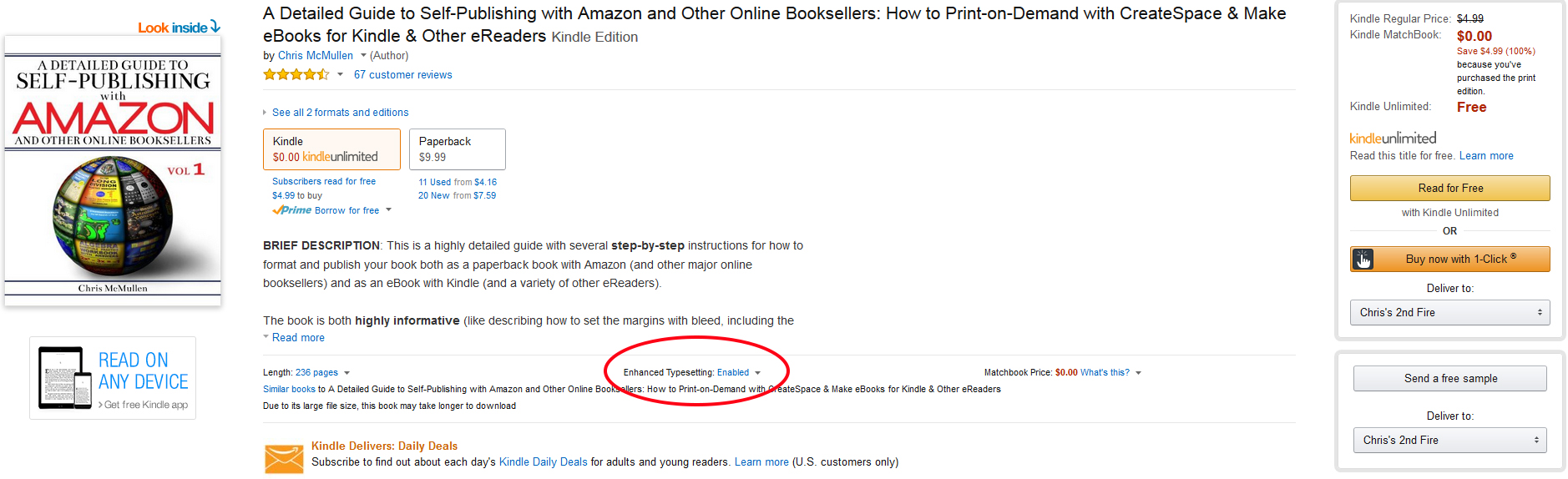
Not all Kindle e-books support enhanced typesetting presently, but there is a way to tell. Here is how to determine whether or not a Kindle e-book supports the new typesetting features:

  • If you’re shopping on the Amazon.com full site, look just below the book description. In very small print, look for Enhanced Typesetting: Enabled.
  • If you’re shopping from a Kindle device, look just above the book description. Look for Enhanced Typesetting: Enabled.

Note: If you already have a Kindle e-book that supports enhanced typesetting, but you downloaded the book before this feature was enabled on your device, you will need to re-download the book before the enhanced typesetting will take effect.

I was surprised to discover that the new enhanced typesetting was available on some of my books, such as my detailed guide to self-publishing. That was a pleasant surprise. Amazon never informed me about it. (Click the image for this post above to zoom in for a better look.)

I recently downloaded a novel that supported this new feature and was quite pleased with how it looked. The automatic hyphenation feature worked correctly in the instances I have come across thus far.

If you’re an author, check out your Kindle e-books and see if this has been added yet. Only 500,000 Kindle e-books support the new typesetting features presently, but since they will expand this to 3,000,000 in the next year, if your e-book doesn’t support it yet, it probably will in the coming months.

(Authors don’t do anything to have this enabled. It will be done automatically. Don’t enable hyphenation in Word. Let Amazon KDP take care of everything from their end.)

If you’re a reader, when browsing for Kindle e-books, on the book’s product page you will find Enhanced Typesetting: Enabled near the description if the book supports the new typesetting. (Then you must also have a device that supports this new feature before it will work.)

Write happy, be happy. 🙂

Chris McMullen

Copyright © 2015

Chris McMullen, Author of A Detailed Guide to Self-Publishing with Amazon and Other Online Booksellers

  • Volume 1 on formatting and publishing
  • Volume 2 on marketability and marketing
  • 4-in-1 Boxed set includes both volumes and more
  • Kindle Formatting Magic (coming soon)

Follow me at WordPress, find my author page on Facebook, or connect with me through Twitter.

Comments

Click here to jump to the comments section.
Kindle Typesetting Improvements

Image from ShutterStock.

Image from ShutterStock.

KINDLE TYPOGRAPHY

When I turned on my Kindle Paperwhite today, I received a nice surprise.

It automatically downloaded an update: version 5.6.5. When it finished, a note popped up describing new Kindle typesetting improvements.

This is a cool development because Kindle typography has been very limited. The new Kindle typesetting has appeared on various devices over the course of the past several weeks. This is the first time I found a note with the update.

Before you publish a book with the new features in mind, you want to get a feel for how many devices use the new Kindle typesetting engine, as well as how many books implement it. Presently, the new features work for about 500,000 Kindle e-books, but within a year, that should be a few million. (There are nearly 4 million Kindle e-books at the moment.)

So if you publish today, the new features probably won’t matter. But within a year, it appears that they will. (Except for customers using a device—perhaps an older Kindle—which doesn’t support the new engine. It may not have yet even finished rolling out to customers with new devices.)

The new typesetting engine is geared toward an improved reading experience: subtle typography tricks to create faster reading, less eye strain, easier word recognition, and a nicer look to the digital ‘page.’

Following are some of the improvements:

  • Kindle introduced the new Bookerly font. I opened a page where the justification was quite poor, and changing the font to Bookerly. The justification improved tremendously.
  • Justification is supposed to be improved. I didn’t really notice this except with the Bookerly font, though maybe I just don’t have one of the books that fully benefits from the new typesetting engine.
  • There is supposed to be improved spacing and improved character positioning. The Bookerly font may be more Kindle-kerning friendly.
  • One of the new features is hyphenation, which has me concerned. For weeks, I’ve read about Kindle hyphenation that doesn’t hyphenate in the proper breaking positions. However, the note that came with the new typesetting engine claims that it will hyphenate properly. I haven’t yet seen a hyphen, though I checked out several books. So I’m hopeful, but waiting to see it firsthand before I get too excited.
  • There is supposed to be more natural spacing and more words per page (so less clicking or swiping to paginate).
  • Drop caps are supposed to be much improved. I opened every book on my Kindle and downloaded many recommendations and top sellers from Kindle, yet I didn’t see one drop cap. That’s because most e-book formatters have learned to shy away from the drop cap because of formatting problems they’ve discovered in the past. If you happen to know a book that has drop caps that was likely to be among the first to adopt the new typesetting engine, please suggest it in the comments. I’d love to check it out.
  • Another feature was a smart card with smart lookup, which works with the dictionary, Wikipedia, and x-ray. These are great ways to improve vocabulary and comprehension, and to take notes or make flash cards. It’s also great for educational books.

The note said that it had changed the order of my books on my device, showing those with enhanced typesetting first. However, when I checked my book list, the order appeared unchanged. First on the list was a book from 47North, one of Amazon’s own imprints. Yet I didn’t notice the new typesetting features (except for the cool Bookerly font) with this book or any other book that I downloaded today. If you happen to know of a book that definitely works with the new typesetting features, especially one that includes drop caps (but it’s okay if it doesn’t), I’d love to check it out.

Have you received a similar update on your device? Which device? Have you noticed the new features? What do you think of them?

Write happy, be happy. 🙂

Chris McMullen

Copyright © 2015

Chris McMullen, Author of A Detailed Guide to Self-Publishing with Amazon and Other Online Booksellers

  • Volume 1 on formatting and publishing
  • Volume 2 on marketability and marketing
  • 4-in-1 Boxed set includes both volumes and more
  • Kindle Formatting Magic (coming soon)

Follow me at WordPress, find my author page on Facebook, or connect with me through Twitter.

Comments

Click here to jump to the comments section.
How about an * Optional * Pages Read for Sales?

Image from ShutterStock.

Image from ShutterStock.

PAGES READ FOR SALES?

Before you race to the comments field to say what a bad idea this is, please note the important word OPTIONAL. 🙂

If you still feel it’s a bad idea, then please do rush to leave a comment. 🙂

Here is what I’m proposing for Kindle sales (not to be confused with Kindle borrows):

  • Authors set one list price for outright purchase, just as usual. No change to this.
  • Authors also set an optional price per page. Emphasis on authors getting to choose this.

Example:

  • List price = $2.99. Customers can buy the book for $2.99.
  • Optional price per page = 3 cents per page. Customers can choose this option instead of buying the book. Remember, in my proposal, the author gets to choose this price.

Let’s say that the book in my example has 150 pages. Then the customer has two choices:

  • Buy the book for $2.99. Customer can read as little or as much of the book as desired.
  • Pay 3 cents per page (re-reads of pages already read are free). Just pay for how much you read. If you read the whole book in my example, this will cost you $4.50, but you could have just bought the book outright for $2.99.

In my proposal, the author receives the usual royalty rate, 35% or 70%, the same as for sales (though the delivery cost has to be factored in somehow for the 70% plan, maybe divide the delivery charge for the book by the number of pages and subtract this from the per page royalty).

So, in my example, the author earns more if (A) the customer chooses to pay by the page and (B) the customer eventually reads the whole book.

Amazon isn’t going to take a credit card payment for one page read: The fees would cost more than 3 cents. What Amazon would do is charge the customer, say, 99 cents up front, then bill the customer for every $9.99 spent, or some other increments, kind of like they do for AMS advertising. In the long run, Amazon might make more money with such a billing program than when they sell 10 books for 99-cents each and have 10 separate credit card fees. (They could do the billing up front if ‘credit’ is a concern.)

WHY DO THIS?

This might impact reference books and cookbooks, for example. These are books where customers sometimes only need to read part of the book now. Maybe they will want the rest later, maybe not.

Let’s say the customer doesn’t want to pay the list price for the whole book. If pages read isn’t an option, the customer will walk away. If so, it’s a lost sale for the author.

Would the author have been willing to set a per-page price so that the customer could read, say, just Chapter 4? Maybe if the author could set a high enough per-page price, the author would be okay with this. It’s better than nothing, right? And the transaction improves the book’s sales rank, a nice little perk.

It might impact fiction, too. With the option to pay for pages read, even though you might spend more when reading a whole book, it gives you some flexibility to try a book out that you’re strongly interested in, but don’t want to commit to for its list price.

Based on the Kindle Unlimited model, Amazon seems interested in tracking customer engagement. They are probably measuring pages read for sales, even though it presently only matters for borrows. It’s possible that in the future visibility on Amazon will be based in part on successful customer engagement (i.e. getting a higher percentage of pages read). That’s purely speculative. I have no reason to believe that’s in place now, nor have I heard that it’s coming. But it is possible, isn’t it? It wouldn’t be good for some types of books, like reference books and cookbooks. But that doesn’t mean it won’t happen.

Heck, they could change the payout for sales to a pages read scheme and not even make it optional. Amazon determines the rules, right?

Presently, pages read doesn’t impact paid sales in any way. It’s only for Kindle Unlimited and Amazon Prime borrows. I haven’t heard anything to suggest that it might change, so don’t panic.

I’m just curious. What you do you think about this idea? As an author, or as a reader.

To be honest, I’m not even sure if I’m in favor of it or against it. I am curious about it, though.

Write happy, be happy. 🙂

Chris McMullen

Copyright © 2015

Chris McMullen, Author of A Detailed Guide to Self-Publishing with Amazon and Other Online Booksellers

  • Volume 1 on formatting and publishing
  • Volume 2 on marketability and marketing
  • 4-in-1 Boxed set includes both volumes and more
  • Kindle Formatting Magic (coming soon)

Follow me at WordPress, find my author page on Facebook, or connect with me through Twitter.

Comments

Click here to jump to the comments section.