Cart before the horse (Not always a bad thing)

Some great marketing ideas.

Ionia Froment's avatarreadful things blog

As any author will tell you, writing the book is the easy part. After that comes the fun of editing, cover design, book blurbs and the ultimate in evil, MARKETING.

Most authors are already aware of how this all works, but there is a question that many authors don’t think to ask until they are finished or nearly finished with their books. When should you start marketing your work?

Beginning the first stages of marketing before your book is complete can be an important factor in success. I’m not saying you should write your first sentence and then begin pushing the book. Sometimes books become something other than what we intended them to be, plus having a general idea of word count and the ability to put together a book blurb and some excerpts for promotional use is necessary.

There is no exact right time for promo, but

View original post 796 more words

WHY I support and encourage Authors

Some great ideas here. 🙂

Chris The Story Reading Ape's avatarChris The Story Reading Ape's Blog

I’ve made no secret of the fact that I believe Sir Terry Pratchett may have had an excellent point when he surmised that OUR species of Hominid survived, while all the others didn’t, because we were Story Telling Apes, or at least better at telling, and learning through, stories!

I’m not the only one who thinks so, “Our brains are structured to make sense of the world in the form of narratives – stories. Not only that, we are primed to believe the stories we hear.” see the re-blogged post last Thursday HERE!

I concede that there are probably other factors involved as well, but storytelling was (and hopefully still IS) a significant part of our species survival strategy.

If we cease to tell and learn from stories, then we too may become extinct because without them we will have created our very own ELE (Extinction Level Event).

View original post 452 more words

Mirror Interviews: Authors Wanted

If only opportunity would knock…

Ionia Froment's avatarreadful things blog

So, I’ve been thinking about doing a Wednesday feature here on Readful again as I haven’t done one in a while. Usually the Wednesday feature is a guest blog, and I’d like to keep that tradition running…sort of.

See, there’s two things. First thing: I was talking to an author the other day who pointed out that all author interviews seem to ask the same questions over and over. Not a lot of people pay attention to them, and it gets rather monotonous answering the same boring things all the time.

second thing: I’m lazy.

So, here is my solution:

I am looking for a handful of authors who want to do a blog interview. The catch is, I’m looking for a handful of authors who want to interview–themselves. Yep. I won’t send you any boring, already answered questions. I won’t ask you boxers or briefs or who would play…

View original post 104 more words

5 Things You Should Never Do On Your Author Blog…

A great list with tips.

The Owl Lady's avatarViv Drewa - The Owl Lady

Author Blog HeaderWhether you’re published yet or not, a vibrant author blog should sit at the heart of your promotional efforts – the “homebase” for your author brand.

Used properly, your blog will help you to impress agents and attract a publisher.  And if you’re already published, it can be used to attract new readers, create a successful launch of your next book, generate buzz and bring your work positive reviews.

But it’s crucial that you use your blog the right way to achieve all of this.  There are certain blogging mistakes I’m going to tell you about that can seriously hurt your book sales and your reputation as an author.

To help you avoid these pitfalls, here are five things you should never do on your author blog and what you should be doing instead:

1. Projecting That You’re A Beginner Or That You’re Unsuccessful

blog fireworksWhile being a retiring…

View original post 1,561 more words

The three reasons I have fallen in love with writing short stories

Here, a successful author shares how she has used short stories effectively. Series authors may be interested in the comments section, as I specifically asked how she handles short stories with her series (the answer surprised me, and the more I think about it, the more her strategy makes sense). Every author is unique, but it’s always helpful to study ideas that work for some authors.

loulocke's avatarM. Louisa Locke

stories_vol1_cover_1600x2400F-2I am the last author you would think would be writing short stories. As a writer who tends to be prolix, the short form wouldn’t seem a good match for me. I don’t write anything short––not emails, not blog posts, not books. Twitter, forget it––the most I can do is retweet those of you who are good at being succinct. I don’t even read many short stories, (except by 19th century writers like Alcott, Wharton, and James).

Yet, this spring I took time off from doing the research for Deadly Proof, the next book in my Victorian San Francisco Mystery series, to write my third and fourth short stories, which are now part of a collection, Victorian San Francisco Stories, that I just published on Kindle, and I have every intention of putting out more short stories in the coming year.

So what happened?

Dandy Detects, my…

View original post 2,356 more words

How To Prepare For An Author Signing…

Some good tips here. 🙂

mandyevebarnett's avatarMandy Eve-Barnett's Blog for Readers & Writers

articlesWith any new experience on our writing journey, it is always best to prepare and gather assistance from more experienced authors and writers. Although, I have attended several author readings, this coming Saturday 7th June, will be a new venture for me. A book signing!

While my publisher, Dream Write Publishing, will be present and has organized the promotional element as well as the initial contact with the venue’s owner’s, there are still several things I can do too.

The first is to ensure I have my own ‘book signing kit’. This will comprise of several pens, book marks, visual representations of the book, which in this instance is my Rumble soft toy for Rumble’s First Scare, a mailing list sign up sheet, a pre-order sheet for my next children’s book, a copy of a child’s review of Rumble, business cards, a notepad to write down the spelling of people’s names –…

View original post 242 more words

Will he finish the book?

A great little poem for readers or authors. 🙂 To be, or not to be? It’s good motivation not to lack attention writing the middle of the book.

What Is the Most Important Part of a Story?

Book Play Pic

That Depends

For someone who will definitely be reading the story, the most important part is likely to be something like:

  • the storyline
  • the characterization
  • the writing style
  • the way the words flow

But unless you’re an established author who already has a large fan base, you don’t have many people who will definitely be reading your story.

The problem is that nobody can read your story until the story is found.

And people who discover your story judge the story by many other factors besides the story itself.

Therefore, the most important part of the story could actually be something like:

  • a cover that attracts the target audience and visually indicates the genre
  • a very well-written blurb that captures the interest of the target audience
  • a professional-looking Look Inside and a really great beginning
  • an assortment of balanced, genuine reviews

It almost seems like today’s marketplace is saying that the story itself doesn’t matter at all.

But that’s not true:

  • A fantastic cover, amazing blurb, and stellar Look Inside will backfire if the story isn’t good. So the story will be critical.
  • Word-of-mouth recommendations are invaluable. It’s hard to find a good book. it’s not easy to gauge how good a book will be from the product page. But when someone you trust recommends a book, suddenly a good book is easy to find. But it takes more than just a “good” book to really thrive on recommendations.

Yet, an incredible story with a so-so cover, so-so blurb, and so-so Look Inside has major hurdles to overcome:

  • It doesn’t matter how wonderful the story is if people don’t discover it and decide to read it.
  • Sales rank counts against a book with a great story when it takes a long time for people to discover the book and start spreading the word. For a book with a history of slow sales, the growth to a stronger sales rank is harder to achieve than to maintain strong sales out of the box.

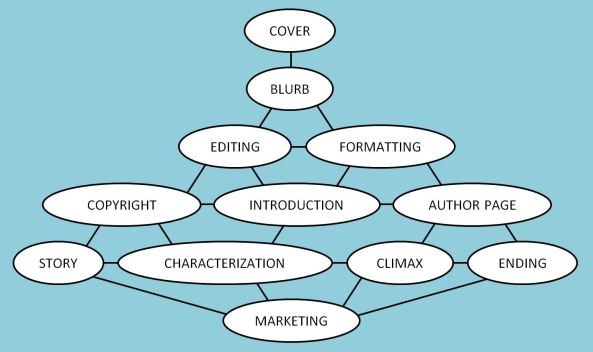
Therefore, the most important part of a story may very well be marketing.

Effective marketing (which is often free or very low-cost) can help a book get discovered, and can help to generate word-of-mouth referrals.

Marketing isn’t the answer for a lousy story. But effective marketing can help a great story get off to a good start and grow.

It’s kind of unfair, perhaps, but it is what it is:

  • Those few sentences you write in the blurb are in some ways more important than a hundred thousand words carefully strung together to craft a story.
  • The thumbnail image of the cover can impact sales more than the story itself.
  • Today’s marketplace in many ways favors traits that many gifted writers lack:
    • Social interactions to help spread the news about your book.
    • Publicity skills to help build a positive image as an author.
    • Marketing skills to build your book and author brands.
    • Business orientation (and more social skills) to put together and benefit from a focus group.
    • Financial investment to prevent editing and formatting from deterring sales.

There are some exceptionally gifted authors who are highly introverted, passionate but not business-minded, great at writing novels but not at writing blurbs, and focused on the story but not the cover, who could really write books very much worth reading.

The current market makes it tough for their books to get discovered and rise to the top. Even if you hire someone to help with marketing, much of the most effective marketing involves your personal interactions.

The current market rewards a book with a pretty good story that has a fantastic cover, killer blurb, and stellar Look Inside. The bestselling books should all have killer stories, right? The market should be structured in such a way as to promote the best stories.

There are some incredible stories at the top. But there are also many okay stories where the books thrive in other ways (including the author’s reputation or the publisher’s name). And there are some gems of stories hiding in the haystack.

(One way that writing multiple similar books helps is by generating your own fan base and reputation. Provided that your books get discovered and sell.)

Customer reviews could help with this, and many do, but in reality there is nothing in place to prevent a review from making a book seem much worse than it actually is. And there is nothing in place to guarantee that a favorable review is accurate.

Again, the story does matter. If it’s not good, it will ultimately become a sales deterrent. An exceptional story can generate valuable word-of-mouth sales… once it finally gets discovered.

But there is much more to success than crafting an excellent story.

Between the story, cover, blurb, Look Inside, editing, formatting, and marketing, if you could have one of these be good and all the rest outstanding, your best option might be to have the story itself to be the one that is merely good. That’s insane, isn’t it?

It’s easy to criticize the system, but not so easy to suggest an efficient, economical solution. The real problem is that you can’t properly judge the story without first reading it, so we’re trying to buy books based on other criteria.

Any gatekeeping system seems to introduce its own set of problems, and so doesn’t seem to be a practical solution. The current system works on free enterprise, and the worst tend to drop to the bottom (i.e. the lousiest books aren’t getting in the way of the best books, except for those rare excellent books that just aren’t getting discovered at all).

It’s not really about what it should be. We’re not in charge to make such decisions. (And whatever we would do might be worse. It’s easy to criticize, not as easy to solve the problem.)

It’s about understanding how the system works and making the most effective use of this knowledge.

Chris McMullen

Author of A Detailed Guide to Self-Publishing with Amazon and Other Online Booksellers

  • Volume 1 on formatting and publishing
  • Volume 2 on marketability and marketing

Follow me at WordPress, find my author page on Facebook, or connect with me through Twitter.

Comments

Click here to jump to the comments section:

https://chrismcmullen.wordpress.com/2014/05/22/what-is-the-most-important-part-of-a-story/#comments

You READ – but do you leave REVIEWS?

Read any great books lately? What a wonderful way to convey to those authors your wish for them to write more, and to tell them what great things they should keep doing right. 🙂

Chris The Story Reading Ape's avatarChris The Story Reading Ape's Blog

66d5ad99b798ba6027bffa79777b0979

If not, why not?

I don’t have time

The author probably spent a heck of a lot more time writing the story than you took to read it, no matter how slow you think you are, so why not take a few minutes to record your feelings about it.

I can’t write long fancy reviews like those I see on book review blogs

You don’t have to, Amazon, for example, only ask you to use a minimum of 25 non repeating words.

I can’t express myself very well

No-one is asking you to produce a literary masterpiece, start off with things you liked, didn’t like or a mix of both about the book, e.g.,

I liked this book because –

it reminded me of –

it made me think about –

it made me so scared I couldn’t sleep for –

it made me feel homesick for –

it made…

View original post 505 more words