Is Kindle Unlimited Being Flooded with Short Books? (Actual Data from Amazon)

Image from Shutterstock

Image from Shutterstock

KINDLE UNLIMITED QUESTIONS ANSWERED

I researched the answers to two common questions about Kindle Unlimited. I obtained my data directly from Amazon.com, as I will show.

  1. Is Kindle Unlimited being flooded with short books?
  2. Are KDP Select authors dropping out now that the KOLL payment had dropped to about $1.40?

I hear a lot of speculation about these two points. Most of the answers are based on guesswork and emotions such as fear.

So I decided to find out for myself. I didn’t know the answer for sure. I researched the data and let the numbers speak for themselves.

DATA STRAIGHT FROM AMAZON

I gathered my data directly from Amazon. No, I didn’t ask them for it. I didn’t need to; you don’t either.

Rather, I simply browsed the Amazon.com website as follows:

  • I visited Amazon.com. I browsed the Kindle Store. The left-hand column tallies numbers of books in various categories.
  • On February 17, 2015 I did my first search. I recorded data for books in Kindle Unlimited, new releases, new releases in Kindle Unlimited, Kindle short reads, Kindle short reads in Kindle Unlimited, Kindle short read new releases in Kindle Unlimited, and many other numbers.
  • I repeated my search on March 17, 2015, one month later.
  • I compared the numbers. For specifics, see below.

(1) Are Short Books Flooding Kindle Unlimited?

In the Kindle store at Amazon.com, the left-hand column actually displays the number of books in Kindle short reads. If you click on the Kindle short reads link, it further breaks these down by page count. Kindle short reads have 1 to 100 pages.

Here is what I found:

  • On February 17, there were 301,747 Kindle short reads in Kindle Unlimited out of 864,164 Kindle Unlimited books. That’s 34.9%.
  • On March 17, there were 314,020 Kindle short reads in Kindle Unlimited out of 894,423 Kindle Unlimited books. That’s 35.1%.

This percentage is up slightly: 0.2%. But don’t panic yet.

Let’s look at another pair of numbers:

  • There were 42,638 books added to Kindle Unlimited in the last 30 days.
  • There were 12,273 more Kindle Unlimited books in Kindle short reads on March 17 than on February 17.

Only 29% of the books added to Kindle Unlimited in the last 30 days are short reads. 71% of books published and added to Kindle Unlimited in the past month have 101 pages or more. That’s definitely not flooding the market with short reads. (In fact, this 71% exceeds the 65% of books in Kindle Unlimited presently that are full-length books. Imagine that!)

However, 12,379 books were removed from Kindle Unlimited. If you account for this, there were 30,259 more books in Kindle Unlimited on March 17 compared to February 17.

Of those, 30,259 books, 40.6% were Kindle short reads.

(Furthermore, 23% of the books in Kindle short reads are 65-100 pages in length. Many of the short reads books aren’t all that short.)

What does this mean?

If 40% of the books added to Kindle Unlimited each month are short reads (100 pages or less), then the ratio of short reads to full-length Kindle e-books will approach 40%.

That means at least 60% of the books in Kindle Unlimited will be full-length books in the future, based on the current rate. That’s a majority that are full-length.

That’s certainly not flooding the market with short reads. There are currently 35% of Kindle Unlimited books classified as short reads, and this is approaching 40%.

Based on the current rate of growth (0.2% per month), that’s not too different from how things were back in July before Kindle Unlimited was introduced. It was nearly 35% then, too. If Kindle Unlimited changes the ratio of short books to full-length books from 35% to 40%, that’s not significant in the grand scheme of things.

You don’t have to worry about it exceeding 40% until the ratio of books added to Kindle Unlimited per month begins to exceed this. That’s not happening now. I’ll keep an eye on this number, but I’m not worried about it at this point; it hasn’t changed much in the past six months.

On the related question, “Are full-length books dropping out of KDP Select?” let’s look at the next question. It turns out that very few books are dropping out.

How about those really short books?

Only 4% of the books in Kindle Unlimited have 11 pages or less (and this number isn’t going anywhere either). Of these, many are short stories (and not “scamphlets”).

If you hear all the rumors about people trying to game the system with very short books in Kindle Unlimited, or the stories of websites encouraging people to do this, just discard it unless and until this percentage starts to climb. It’s just 4% and Kindle Unlimited was introduced way back in July; it hasn’t changed noticeably in all that time. We’ll keep an eye on it, but there is presently no reason to worry about it.

(2) How many books are dropping out of KDP Select?

There appears to be a 98.6% renewal rate in KDP Select, as I’ll demonstrate below.

  • There were 864,164 books in Kindle Unlimited on February 17, 2015.
  • There were 894,423 books in Kindle Unlimited on March 17, 2015.
  • 42,638 books were added to Kindle Unlimited in the last 30 days.

I subtract 42,638 books from 894,423 to get 851,785. That removes the new releases since February 17. (Actually, this number should be somewhat higher than 851,785 if you adjust for the fact that February only has 28 days. It will just make the renewal rate even higher.)

Comparing 851,785 to 864,164, there is a 98.6% renewal rate for KDP Select books staying in KDP Select. (The percentage is higher if you adjust for February’s short calendar.)

Only 1.4% are opting out, and more new books were added than opted out, which means the overall number of Kindle Unlimited books is climbing. (42,638 new books were added, compared to 12,379 that opted out.)

Amazon KDP has publicly advertised a KDP Select renewal rate in excess of 95% since July, 2014, and my data easily backs this up. Very few books are dropping out.

Note that some of the books that have dropped out are Kindle short reads! It’s not just the full-length books that are dropping out. 15,539 books were added to Kindle Unlimited short reads in the last 30 days, yet there are only 12,273 more books in Kindle Unlimited short reads compared to one month ago. The difference opted out of Kindle Unlimited. (So if you wish to claim that only full-length books are opting out of Select, it won’t be true.)

CONCLUSIONS

Two myths frequently rumored are absolutely BUSTED:

  • Myth 1: Soon, there won’t be any good books left in Kindle Unlimited. With 98.6% of Kindle Unlimited books renewing their enrollment, and with many more books being added each month than are dropping out, this is an unfounded concern.
  • Myth 2: Soon, the vast majority of Kindle Unlimited books will be short reads. Actually, 65% of the books in Kindle Unlimited have 101 or more pages, and 60% of those added in the last 30 days have 101 or more pages. More authors are adding full-length books to Kindle Unlimited than are adding short reads, so this concern is also unfounded.

READING SURVEY

If you haven’t already done so, please participate in a survey on how people read books. The more participation we get, the more meaningful the results will be.

Here is one question, for your convenience. (If you’ve already answered this before, please don’t answer it a second time.)

You can find more questions here:

https://chrismcmullen.wordpress.com/surveys

Chris McMullen

Copyright © 2015

Chris McMullen, Author of A Detailed Guide to Self-Publishing with Amazon and Other Online Booksellers

  • Volume 1 on formatting and publishing
  • Volume 2 on marketability and marketing
  • 4-in-1 Boxed set includes both volumes and more

Follow me at WordPress, find my author page on Facebook, or connect with me through Twitter.

Comments

Click here to jump to the comments section:

https://chrismcmullen.wordpress.com/2015/03/18/is-kindle-unlimited-being-flooded-with-short-books-actual-data-from-amazon/#comments

Kindle Unlimited KOLL for February, 2015

Images from ShutterStock

Images from ShutterStock

KINDLE UNLIMITED: FEBRUARY, 2015

Kindle Unlimited paid $1.41 per download read to 10% (or Amazon Prime borrow) in February, 2015.

This KOLL payment is up slightly from $1.38 in January, 2015.

The KDP Select fund was $8,000,000 for February, compared to $8,500,000 in January.

There are 3 fewer days in February than in January, which helps compensate for the difference.

The numbers held surprisingly steady. January can be a better month for Kindle sales and borrows compared to February, since many people receive new Kindles and other electronic devices that support Kindle as holiday gifts. Yet the Kindle Unlimited numbers didn’t change much from January to February.

Let’s go back to the days when it was just Amazon Prime, i.e. before Kindle Unlimited. February, 2012 paid $2.01 compared to $1.60 in January, 2012. That had been a 25% increase. In 2014, it went up from $1.93 in January to $2.24 in February, a 16% increase. It was 4% in 2013. In 2015, with Kindle Unlimited, KOLL is up a mere 2% in comparison.

Kindle Unlimited seems to be holding steadier beyond the holidays, which can be a nice compensation if sales decline after the holidays. It seems logical. If you have Kindle Unlimited, there is nothing to discourage you from reading in February, but if you’re paying for books individually, well, those holiday bills make you think about buying one more book. Those bills seem to have a smaller impact on $9.99/mo. subscriptions than on sales.

Of course, individual books and authors will see a variety of results. I’m looking at the stats for the program as a whole. Overall, Kindle Unlimited books seem to be holding fairly steady at a time when one might predict more of a drop.

READING SURVEY

If you haven’t already done so, please participate in a survey on how people read books. The more participation we get, the more meaningful the results will be.

Here is one question, for your convenience. (If you’ve already answered this before, please don’t answer it a second time.)

You can find more questions here:

https://chrismcmullen.wordpress.com/surveys

Chris McMullen

Copyright © 2015

Chris McMullen, Author of A Detailed Guide to Self-Publishing with Amazon and Other Online Booksellers

  • Volume 1 on formatting and publishing
  • Volume 2 on marketability and marketing
  • 4-in-1 Boxed set includes both volumes and more

Follow me at WordPress, find my author page on Facebook, or connect with me through Twitter.

Comments

Click here to jump to the comments section:
https://chrismcmullen.wordpress.com/2015/03/16/kindle-unlimited-koll-for-february-2015/#comments

Advertising Books with AMS, BookBub, ENT, GR, FB, Twitter & More

Images from Shutterstock

Images from Shutterstock

ADVERTISING BOOKS

Millions of books are on the market, with a few thousand released each day.

Striving to get your book discovered, advertising is one option.

It may not be the best option for you. But if you’re thinking about placing an advertisement for your book, you want to advertise in the right place and you want to get the most out of it.

But there are so many places to advertise:

  • Right on Amazon with AMS (if your book is enrolled in KDP Select).
  • Through social media with Facebook, Twitter, etc.
  • On websites geared toward readers, such as Goodreads.
  • E-book promotion websites, like BookBub, Ereader News Today, Book Gorilla, and a host of others. See the end of this article for a more comprehensive list.
  • Websites related to the interests of your specific target audience.
  • Contacting bloggers, going on blog tours, social media groups, and so on.
  • Local newspapers, local radio stations, magazines, online magazines, etc.
  • Offline advertising with flyers, bookmarks, business cards, etc.
  • With contests or giveaways.
  • Running a blog or building a content-rich website.
  • & many more.

WHICH IS MOST EFFECTIVE?

Wouldn’t you love to know?

Author Nicholas Rossis has taken the initiative to find out. How? By asking authors to complete a simple 3-question survey.

If you’ve ever placed an advertisement for a book, please visit the following page to share your book advertising experience:

http://nicholasrossis.me/2015/03/02/take-the-3-question-ad-results-survey

Please help. We need more authors to complete the survey for the results to be meaningful.

It’s quick. It’s easy. And when you finish, please encourage other authors to take the survey, too.

Once there is enough participation, Nicholas Rossis will share the results with helpful analysis.

That will help us answer the important question, “Which advertising service should you use?”

BOOK ADVERTISING ADVICE

Here is my advice for getting the most out of your book advertisements:

  • If you write a series, once you have multiple volumes out, you have a distinct advantage as one sale can lead to multiple sales. If you have multiple similar books, you have a similar advantage. If you only have one book out, advertising may help to build a small fan base and establish your brand, but might be more effective after you deliver more quality content to the market. In that case, you might invest more of your current time toward writing.
  • If you have a complete online author platform and if you use free marketing strategies, that will help supplement your advertising efforts and the combined traffic may be more effective than driving traffic from just one source.
  • Start out with free and very low cost book marketing and advertising strategies. Gain experience with paid advertising by beginning with affordable options. This minimizes your risk, helps you assess your prospects for advertising, and helps you learn how to advertise effectively before investing larger sums of money. Advertise wisely.
  • Interact with other authors. Learn what they have tried in the way of advertising, including what worked and what didn’t. Research your advertising options before trying them out. However, realize that every book and author is unique, so what’s true for others may not be true for you.
  • Long-term planning and thinking is far more likely to lead to success. Put your priorities on (1) writing quality content, (2) targeting a viable audience, and (3) packaging your book wisely in terms of cover design and blurb. Devote a little time toward (4) slowly developing a complete author platform, (5) learning new marketing strategies and trying them out, (6) interacting with other authors, and (7) slowly growing a fan base, but put most of your time into writing until you have a few similar books out.
  • Throwing money at advertising isn’t a substitute for learning how to market your book effectively and developing your brand as an author.
  • The more your cover attracts your specific target audience and the better it visually signifies the precise subgenre or subject, the more potential your advertising will have. The better your blurb and Look Inside sell your book, the more effective your advertising will be.
  • Advertising options with more specific targeting will be more effective, all other things being equal.
  • Driving traffic to your book’s product page isn’t your only advertising option. For example, at Goodreads you can place an advertisement to drive traffic to a giveaway or to help get your book added to more to-read lists. At Twitter or Facebook, you can place an advertisement to help grow a following or drive social media engagement. If you run an Amazon Giveaway for a print book, this can help you attract a following at Twitter. These other options may not be as good as driving traffic directly to your book’s product page, especially if your main focus is on immediate sales, but they may have some relevance depending on your goals.
  • Short-term discounts and freebies help you promote a sale price, rather than simply announcing your book. These tools can be effective if you promote the discount effectively; they also help to provide a sense of urgency to the customer. However, price by itself doesn’t sell books. To get the most out of a discount, you must research websites and blogs that can help you spread the word about your sale price to your target audience. This includes e-book promotion websites like BookBub, E-reader News Today, Book Gorilla, and more, as well as blogs and even other kinds of websites on topics that may interest your readers (like a sport that relates to your book).
  • Branding, marketing, and advertising take time and patience. People don’t run to the store after they see a commercial on television. Rather, months later when they’re shopping for a product, they tend to prefer a product they’ve heard of before. Similarly, many people who see your ad won’t run over and buy it immediately. Branding, through occasional repetition among your target audience over a period of months, can help readers recognize your book months down the line when shopping for a book like yours.

LIST OF E-BOOK PROMOTION WEBSITES

There are several e-book promotion websites that can help you spread the word about a temporary price reduction:

Tip: Type the names of a few of these sites together into a Google search to help pull up comprehensive lists.

READING SURVEY

If you haven’t already done so, please participate in a survey on how people read books. The more participation we get, the more meaningful the results will be.

Here is one question, for your convenience. (If you’ve already answered this before, please don’t answer it a second time.)

You can find more questions here:

https://chrismcmullen.wordpress.com/surveys

Chris McMullen

Copyright © 2015

Chris McMullen, Author of A Detailed Guide to Self-Publishing with Amazon and Other Online Booksellers

  • Volume 1 on formatting and publishing
  • Volume 2 on marketability and marketing
  • 4-in-1 Boxed set includes both volumes and more

Follow me at WordPress, find my author page on Facebook, or connect with me through Twitter.

Comments

Click here to jump to the comments section:

https://chrismcmullen.wordpress.com/2015/03/14/advertising-books-with-ams-bookbub-ent-gr-fb-twitter-more/#comments

A Public Service Announcement: Common Grammar Goofs

A must for writers with great visual presentation. 🙂

Nicholas C. Rossis's avatarNicholas C. Rossis

Copyblogger and BlueGlass have created this awesome infographic with some common grammar mistakes, and how to avoid them. Enjoy!

From the blog of Nicholas C. Rossis, author of science fiction, the Pearseus epic fantasy series and children's books

My children’s book, Runaway Smile, is mercifully free of grammar goofs. Don’t believe me? Read it for free and find out for yourself!

View original post

Have Reading Survey. Need Readers. :-)

Reading Habits

Image from Shutterstock.


READING SURVEY

Please take this survey regarding your reading habits.

The more participation, the merrier. 🙂

Thank you for volunteering some of you precious time.

After you answer a question, view the results.

You can return to this survey in the future and see updated results.


Questions 1-4 allow you to select multiple answers (if relevant).

1. How do you read e-books? Select all that apply.

2. Have you subscribed to Kindle Unlimited? Select all that apply.

3. How do your kids read books? Select all that apply.

4. How you do read books? Select all that apply.


Have you already taken the following surveys?

If so, please don’t take them again. 🙂

The following questions were included with my original reading surveys a couple of weeks ago.

These questions haven’t changed, but I included them in case you missed my original survey.

5. How do you prefer to read books?

6. Where do you prefer to buy your e-books?

7. How often do you read?

8. How often do you read books from indie authors or small publishers?


Feel free to leave additional feedback in the comments section.

Chris McMullen

Copyright © 2015

Chris McMullen, Author of A Detailed Guide to Self-Publishing with Amazon and Other Online Booksellers

  • Volume 1 on formatting and publishing
  • Volume 2 on marketability and marketing
  • 4-in-1 Boxed set includes both volumes and more

Follow me at WordPress, find my author page on Facebook, or connect with me through Twitter.

Comments

Click here to jump to the comments section:

https://chrismcmullen.wordpress.com/2015/03/08/have-reading-survey-need-readers/#comments

#AmazonGiveaway Tip: How to find more giveaways

Giveaway 4D

AMAZON GIVEAWAYS

You can win free stuff shipped by Amazon.

Note: As of October, 2019, the Amazon Giveaway program has been canceled. However, Goodreads Giveaways are still available.

Visit the Twitter page for the hashtag #AmazonGiveaway:

https://twitter.com/hashtag/AmazonGiveaway

When you visit this page, it only shows you a few of the results.

It doesn’t show you all of the results

UNLESS… you click the ALL link at the top of the page, under where it says, “Results for #AmazonGiveaway.”

By default, it only shows what it considers to be the top results.

When I browse the top results, I find a limited number of giveaways from the past several hours, and below that I find expired giveaways.

Increase your chances of winning by clicking ALL instead of the default TOP.

When I pull up all of the giveaways, I find many more giveaways that I can enter, which haven’t expired.

If you create your own giveaway, tweet about it with the hashtag #AmazonGiveaway.

This adds your contest to the Amazon Giveaway page at Twitter.

However, when you search for your contest on the Amazon Giveaway hashtag page, you might not see it unless you click the ALL link.

After clicking ALL, you should be able to find your contest.

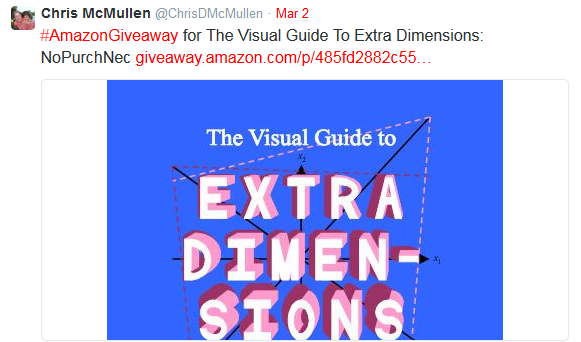
Here is your chance to win my Visual Guide to Extra Dimensions book in an Amazon Giveaway. No purchase necessary. See official rules: http://amzn.to/GArules. Just click this link to enter (you can enter even if you already follow me; it’s not restricted to new Twitter followers):

https://giveaway.amazon.com/p/485fd2882c555252

Note that the hashtag page for #AmazonGiveaway shows all tweets using this hashtag, whereas the similar @AmazonGiveaway does not. (Of course, one is the hashtag, the other is the entity.) However, if you visit @AmazonGiveaway by mistake, you can click the #AmazonGiveaway hashtag in one of their recent tweets to reach the hashtag page.

Chris McMullen

Copyright © 2015

Chris McMullen, Author of A Detailed Guide to Self-Publishing with Amazon and Other Online Booksellers

  • Volume 1 on formatting and publishing
  • Volume 2 on marketability and marketing
  • 4-in-1 Boxed set includes both volumes and more

Follow me at WordPress, find my author page on Facebook, or connect with me through Twitter.

Comments

Click here to jump to the comments section:
https://chrismcmullen.wordpress.com/2015/03/04/amazongiveaway-tip-how-to-find-more-giveaways/#comments

Advertising on Amazon w/ AMS via KDP—Is it Worth it?

Images from Shutterstock

Images from Shutterstock

MY EXPERIENCE WITH ADVERTISING ON AMAZON

The new option for KDP Select authors to advertise their Kindle e-books with Amazon Marketing Services (AMS) is intriguing.

I have now run 14 different ads through AMS. I’ve also studied the results that several other authors have posted.

Today, I’m sharing some of my preliminary results and offering my thoughts on this critical question:

IS IT WORTH IT?

I’ll also mention a couple of alternative uses of this tool.

CONTENTS

  1. Initial Return on Investment
  2. Estimating Short-term ROI
  3. Your Safe CPC Bid
  4. Advertising Results
  5. Possible Side Benefits
  6. Long-term ROI
  7. Countdown Deals and Freebies
  8. Creative Uses of Book Advertisements

1. INITIAL RETURN ON INVESTMENT

The short-term return on investment (ROI) depends on these factors:

  • your average cost-per-click (CPC) bid
  • the royalty you earn for each sale
  • your sales-per-click (SPC) conversion rate
  • possible side benefits, like selling similar books, like selling print copies, or like getting more Kindle Unlimited downloads

You already know your royalty when you place your ad.

You can cap your average CPC by setting a modest bid.

But you won’t know your SPC conversion rate until you’ve invested money in an ad.

From running 14 different ads, I see firsthand that it’s reasonable to attain an SPC conversion rate of 4 to 10%.

A few other authors, including one who shared a screenshot, have shown that it’s possible to achieve an SPC of 10 to 20%. My feeling is that 20% will be quite rare.

On the other side, I’ve seen data for SPC’s of 1% or less.

Your SPC conversion rate depends on:

  • how well your product page (cover, blurb, Look Inside, reviews) sells your book
  • how well you target your advertisement to your specific audience
  • how well what your ad conveys (visually in the tiny thumbnail, along with the first words of the title) matches what shoppers discover on your product page
  • whether or not there is an audience for your book

The third point can have a huge impact. If customers glance at your tiny thumbnail and expect one thing, but find something different on your product page, this will kill your SPC.

The second point you can control through a wise choice of product targeting (not necessarily books). What matters most for your SPC is how well the target audiences of the selected products fit your book. But you must weigh this with how frequently you wish to make impressions: If the targeting is too precise, your ad might struggle to get impressions.

2. ESTIMATING SHORT-TERM ROI

There is a formula to calculate your short-term ROI:

(s.t ROI %) = (royalty) x (SPC %) / (ave. CPC)

EXAMPLE 1: Your book earns a royalty of $4.20. Your average CPC bid is 25 cents. Your SPC is 5%.

Your short-term ROI = $4.20 x 5% / $0.25 = 84%.

This example has a high royalty, a modest bid, and a decent SPC.

EXAMPLE 2: Your book earns a royalty of $2.10. Your average CPC bid is 25 cents. Your SPC is 5%.

Your short-term ROI = $2.10 x 5% / $0.25 = 42%.

If you earn a lower royalty, you either need to have a high SPC or bid lower to make up for it.

EXAMPLE 3: Your book earns a royalty of 34 cents. Your average CPC bid is 10 cents. Your SPC is 10%.

Your short-term ROI = $0.34 x 10% / $0.10 = 34%.

Here we have an excellent SPC and a lower bid, but that 34-cent royalty is the killer.

The lower your royalty or the lower your SPC, the lower you should bid.

3. YOUR SAFE CPC BID

Let’s spin this formula around and look at it from another angle:

(safe CPC bid) = (royalty) x (SPC %) / 100%

This tells you the maximum CPC bid you should place if you want your short-term ROI to break even. You need to have some prior experience to properly estimate your SPC %.

EXAMPLE 4: Your book earns a royalty of $2.10. Your SPC is 5%.

Your safe CPC bid = $2.10 x 5% / 100% = $0.105

In this example, a bid of 10 cents is safe (provided that your SPC turns out to be what you expect).

Not getting enough impressions? So what. With a safe CPC, you’re not losing anything (again, assuming your SPC is reliable; that’s a big IF, but you can monitor your ad and pause or terminate it at any time). This basically works out to free publicity, with possible long-term benefits.

4. ADVERTISING RESULTS

I’m not going to bore you with complete data from all 14 of my ads. I’ll share what I believe may be helpful.

My original ads had click-through-rates (ctr) of about 0.1% to 0.2%. After becoming more experienced with product targeting, my most recent ads have ctr’s of 0.4% to 0.9%. My last two ads are 0.85% and 0.90%.

The ctr doesn’t matter directly, since you pay for clicks, not impressions. Your impressions are free. However, better targeting will make your ad more cost-effective, so your ability to improve your ctr is one step toward getting the most out of your ad. It’s not uncommon for online advertising to yield a ctr of 0.1%. Most of my ads have done much better than 0.1%. That’s a plus for AMS, though of course it will vary by genre and by book. Not all books will achieve a ctr higher than 0.1%. But the potential is clearly there.

Several of my ads have a sales-to-clicks (SPC) ratio of 4%. My highest is 11%. I’ve heard from a few other authors who’ve done better (upwards of 20%); one shared a screenshot. I’ve also heard from authors who’ve done worse (1% or lower). SPC conversion rate is highly sensitive to targeting and packaging. Some books won’t get 1%. But 4% to 10% (or more) is attainable.

One reason my SPC may be under 10% is that my books tend to sell more often in print than in Kindle, and my print sales actually improved during the ad. Thus my short-term ROI may be better than it seems.

My recent average CPC bids have ranged from 25 to 35 cents. A week or more ago, these were around 50 cents. I’ve heard from other authors who also see their average CPC’s coming down. The value does depend strongly on genre or subject, as well as targeting. But in general, it seems to be coming down. This is expected, as there was a bidding frenzy in the early weeks, and it’s probably fizzled out to some extent. The bids may continue to come down, a nice reward for those who have exercised patience.

Remember, Amazon’s recommended CPC bid is 5 cents. I predict a day will come when that 5-cent bid can generate a decent impression rate, or at least a 10-cent bid.

Here are the numbers for a couple of my most recent ads (for educational books; one is in a pen name, yet the CPC and SPC are very similar):

  • 21,365 impressions / 181 clicks / $0.28 average CPC bid / 7 sales / 0.85% ctr / 3.87% SPC
  • 47,499 impressions / 174 clicks / $0.35 average CPC bid / 7 sales / 0.37% ctr / 4.02% SPC

One of these books sells for $5.99, so the short-term ROI is around 60%. The other sells for $2.99, so the short-term ROI is around 30%.

But maybe I just bid too high. If my average CPC bid had been 15 cents, my ROI’s would have been much higher (assuming I could achieve similar results with a lower bid).

However, I observed some strong side benefits during the ad campaigns, which I discuss next. My short-term ROI would actually exceed 100% if these factors are attributed to the ads.

5. POSSIBLE SIDE BENEFITS

Print Sales

One of my books, which ordinarily sells better in print than Kindle, saw paperback sales double during the month of February. This wasn’t just double January, but double months from 2014, too.

When I first started running KDP ad campaigns, I saw a bump in print sales of a few of the advertised books. Only one saw print sales double, but a few saw them improve.

I don’t think it will be typical of advertised books to sell more in print. This clearly favors books that ordinarily sell more often in print.

Similar Books

Another thing that I noticed was that for several advertised books, similar books saw an increase in sales.

In the best case, I saw sales of a closely related title double in February compared to previous months. This was the most extreme case, but I saw significant improvement in many titles where a similar book had been advertised.

If these two factors are due to the ads, then my short-term ROI’s on these ads actually exceed 100%. I need more data to be sure, but it’s encouraging.

Series

I don’t have a sequential series like many fiction authors have, but I have interacted with series authors who have seen sequential volumes sell much better after advertising the first in the series.

It helps to already have a measure of your progression ratios. For example, R2 = Vol. 2 sales / Vol. 1 sales, R3 = Vol. 3 sales / Vol. 2 sales, and so on.

Suppose R2 = 50%, R3 = 40%, and R4 = 25%. Then for every 100 copies of Volume 1 you sell, you should expect to sell 50 copies of Volume 2, 20 copies of Volume 3, and 5 copies of Volume 4. (For example, 100 x R2 x R3 x R4 tells you how many copies of Volume 4 you should sell, on average, for every 100 sales of Volume 1.)

If you have good measures of your R’s, you can actually calculate how much you can afford to lose advertising Volume 1 and still come out ahead overall. (If you’re thinking about making Volume 1 perma-free, there is a similar calculation that you’d like to apply.)

Kindle Unlimited

Another possible side benefit is that the ad might result in more Kindle Unlimited downloads. (Your book must be enrolled in KDP Select in order to be eligible for an AMS ad campaign.)

This helps your sales rank, and if they are read to 10%, they also show up as borrows.

6. LONG-TERM ROI

Even if your short-term ROI is a loss, your book advertisement may still be profitable.

It’s harder to predict and measure long-term benefits. If you can break even short-term, or at least only suffer a small percentage loss, then you have good prospects for reaping long-term rewards. If you suffer a large short-term loss, then you’re putting pressure on those long-term benefits just to break even.

However, there may be situations where you have other goals, like just getting readers as a new author, branding an image, going all out for a hot promotion, supplementing other marketing, etc. In those cases, it may be worth a short-term loss for possible long-term gain.

Possible long-term benefits include:

  • creating brand recognition (this is how advertising really works: people tend to buy products they recognize; most people don’t run out to the store when they see an ad, but after enough repetition, months later they tend to favor a product they’ve heard of before)
  • future sales from readers who want to read more of your work
  • improved exposure through sales spurts, customers-also-bought list expansion, improved sales rank, etc.

If you’re taking a big short-term loss, this can get stressful. It’s hard to count on possible benefits. You hope to see actual sales.

It may be easier if you currently earn good monthly royalties. If you only invest a small percentage of your average monthly royalties on paid advertising, this lessens the impact of your advertising risk. When you’re a new author investing more than you’re initially making, the risk seems much more significant.

7. COUNTDOWN DEALS AND FREEBIES

An interesting possibility is running an AMS advertisement to help promote a Countdown Deal or KDP Select free promo.

Two downsides of the freebie are that you don’t earn any royalties during the promo and “sales” won’t show on your KDP ad report, so you won’t know if any of your “sales” came from the ad or not.

However, it’s not uncommon for authors to pay for advertising to help promote their freebies. For example, this is common with BookBub. So for those who already do this, running a KDP ad for a freebie is just another possible way to bring exposure to freebies. Obviously, your immediate ROI will be 0%. This is a big risk, but a possible way to bring exposure.

Freebies and Countdown Deals are sort of hit or miss. I tried a couple of Countdown Deals coupled with advertisements. I didn’t do any external promotion. (That’s not recommended; I was just testing this out.)

Two of my advertised Countdown Deals turned out to be duds; just slight improvements to sales when advertised at regular price. But one of my advertised Countdown Deals was extraordinary, bringing 20 times as many sales during this week compared to advertising at regular price. In this case, the added sales easily made up for the lower royalty of the promotional price.

Why did two show a slight increase and the other explode? Great question! I think it helps to get lucky; a few initial sales help to get the ball rolling. Once sales rank takes off, if it does, things can really get rolling with an advertised hot promotion.

But if the ball doesn’t get rolling, your promotion just sits there and fizzles out before it starts.

So my recommendation is to market your promotion externally, and just use AMS as one of multiple means of bringing exposure to your promotion. Use BookBub, E-reader News Today, Book Gorilla, or other means of externally bringing attention to your promotion, and consider combining AMS with this. (Or advertise externally and then at regular price, just after the ad finished, perhaps AMS can help you capitalize on some added sales at regular price.)

CREATIVE USES OF BOOK ADVERTISEMENTS

Measure Your Book’s Marketability

I recommend running an ad just to measure your SPC conversion rate. Divide your sales by your clicks. If this is about 1% or less, it suggests that your product page (or targeting) have substantial room for improvement. It could be the cover, blurb, Look Inside, or book idea, for example. If your SPC is 10% or higher, it shows that your book has great potential for sales, and should motivate you to work hard at your marketing, knowing that you have good prospects for selling books if you can just drive (relevant) traffic to your product page. When only 1 out of 100 customers who reach your product page buys your book, it’s a lot harder to be motivated to market.

Test the Market

I saw another author run two short-term ads with very specific targeting in order to gauge the popularity of similar, but different products. The author was deciding between two book ideas. This was a creative way to use these ads.

Chris McMullen

Copyright © 2015

Chris McMullen, Author of A Detailed Guide to Self-Publishing with Amazon and Other Online Booksellers

  • Volume 1 on formatting and publishing
  • Volume 2 on marketability and marketing
  • 4-in-1 Boxed set includes both volumes and more

Marketing Your Indie Book – A Rough Nautical Map In A Sea Of Advertising Options

Here’s a handy example of data comparing various paid advertising options to book sales.

Tara Sparling's avatarTara Sparling writes

So you’ve published your book! Congratulations! All your hard work is now… beginning.

Marketing Your Indie Book: A Rough Nautical Map They told me all I had to do was write the damn thing… now you tell me 80% of the work is yet to be done?

That’s right, folks: it’s now time to sell your book. So roll back your sleeves, grab a sweatband, pull on the waders and let’s go into the murky waters of indie book advertising.

I got some lovely data from fantasy author and blogmate Nicholas C. Rossis, author of the dark epic fantasy Pearseus series featured in this data here. Nicholas has crunched some numbers beautifully in his own time – not least here, and here, and you should definitely go and have a look at them. Do that in a minute, though, once we’re done here, because seriously, folks, this data is only GORGEOUS.

Firstly, he had a comprehensive rundown of e-book advertising options which, although helpful, full…

View original post 845 more words

Suggestions for Improving Our Reading Survey

Image from Shutterstock

Image from Shutterstock

READING SURVEY FEEDBACK

Our survey on how people read books have received much attention. We’ve had over 100 referrals today from Facebook and LinkedIn, and it’s been a week since the survey started.

I’ve also received some valuable feedback on how the survey could be improved.

My plan is to create a new and better survey, while continuing to let the original run, too. This way, we won’t lose the original data. It won’t be consolidated either. The new survey will start over. I’ll go into the original survey and add the new survey to it, so anyone finding the original can also take the new one.

The purpose of this post is to give you a chance to provide helpful feedback, comments, and suggestions before the new survey goes live. (Doh! Why didn’t I do that the first time?)

I will consider all feedback, but may not be able to accommodate all requests (especially on occasions where two people offer contradictory suggestions), though I will try in most cases.

Multiple Answers

One suggestion was that some questions should allow for multiple answers.

Here’s a sample poll. You should be able to select two or more answers. I’ll make the new survey questions work like this, where relevant.

Cookies

I set up the poll to block by cookies. It’s not perfect, but helps to prevent multiple voting by the same person that might skew the results. Do you have any strong opinions on this?

1. Which of the following methods do you use to read Kindle e-books?

  • Kindle Fire
  • Kindle Paperwhite
  • Other Kindle device
  • iPhone
  • iPad
  • Kindle for PC reading app
  • Kindle for Mac reading app
  • Android device
  • Other option not listed above
  • I don’t read Kindle e-books

Would you like to see additional options? If so, which ones?

Suggestions so far include Kindle app for iPhone, Kindle app for Android, and Kindle Keyboard.

Maybe it’s worth knowing both the main preference and seeing all devices used, but that would take two separate questions.

I’ll change this to allow for multiple selections (with no limit).

2. Which of the following methods do you prefer for reading?

  • E-book (any type of digital book)
  • Paperback (any type of softcover)
  • Hardbound (any kind of hard cover)
  • Audio book

The questions asks which you prefer. But I could change the question to ask which of these you read, allowing for multiple answers. If I leave the question unchanged, I think it should only allow for one answer. Maybe it’s worth knowing both the preference and seeing all that are used, though that would take two questions. Another idea is asking which methods would you not use.

Would you prefer the original question, or to change it?

3. Where do you prefer to buy your e-books?

  • Amazon’s Kindle
  • Barnes & Noble’s Nook
  • Apple
  • Kobo
  • Google
  • I don’t read e-books

Would you like to see additional options? If so, which ones?

Suggestions so far include Smashwords, Google, and Gutenberg.

I’ll change this to allow for multiple selections (with no limit).

4. How many e-books do you let your kids read per month (on average)?

  • 0
  • 1-2
  • 3-4
  • 5+

I can add an option for, “I don’t have kids.”

One issue is that it may depend on age… Another issue is that you might babysit or otherwise have an opportunity to let kids read e-books even if you’re not a parent… And what if the kids are grown up?

Would you like me to change the question, add more choices, refine the answers, or anything else?

5. How many books do you read per month (on average)?

  • 0
  • 1
  • 2
  • 3
  • 4
  • 5+

Would you like me to change the question or add more answer choices?

6. Do you have Kindle Unlimited?

  • yes
  • no

Any suggestions here, like adding a Scribd option?

7. Do you read books by indie authors or small publishers?

  • Always
  • More often than not
  • About half the time
  • Fewer than half the books
  • Never
  • I’m not sure

Any suggestions?

Offline Feedback

One criticism was that this survey only reaches people who go online. This might be quite relevant for the questions regarding print books.

That’s a tough one. If you have any ideas regarding this challenge, please share them.

Other Questions?

Are there other questions that you’d like to see on the survey?

I tried to restrict the number of questions. My feeling was that if I asked too many questions, it may deter participation. I can include more questions, though. If you have suggestions, please share them.

One possibility is where to shop for print books: chain bookstore, indie bookstore, Amazon, BN.com, The Book Depository, the library, etc. If you like this question or have suggestions for more answers, please let me know.

Original Survey

Here is the original survey:

https://chrismcmullen.wordpress.com/2015/02/21/survey-about-reading-habits-how-do-you-read/

Here are the preliminary results for the original survey:

https://chrismcmullen.wordpress.com/2015/02/22/how-do-people-read-books-survey-results/

Here is a survey page on my blog. You’ll be able to find both the new and original questions here at any time (well, obviously, not until I add the new ones):

https://chrismcmullen.wordpress.com/surveys/

Chris McMullen

Copyright © 2015

Chris McMullen, Author of A Detailed Guide to Self-Publishing with Amazon and Other Online Booksellers

  • Volume 1 on formatting and publishing
  • Volume 2 on marketability and marketing
  • 4-in-1 Boxed set includes both volumes and more

Follow me at WordPress, find my author page on Facebook, or connect with me through Twitter.

Comments

Click here to jump to the comments section:
https://chrismcmullen.wordpress.com/2015/02/28/suggestions-for-improving-our-reading-survey/#comments