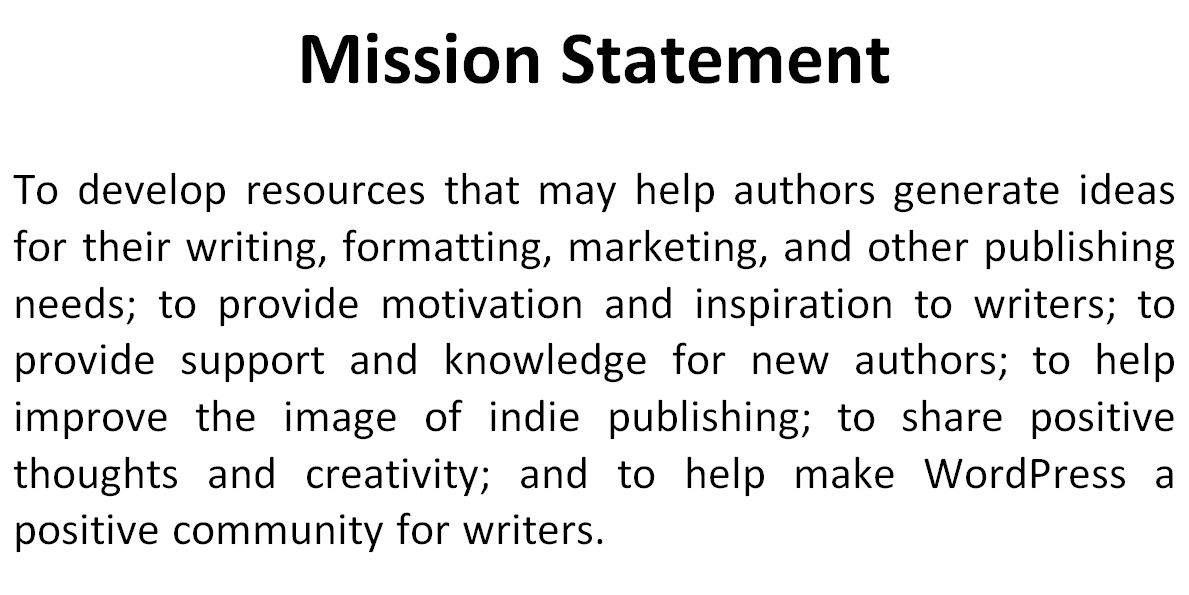
Authors: How about a Mission Statement?

Mission Statement Pic

Companies have mission statements. It’s a short paragraph that says what the company is all about.

Writing is a business. Even if you write for the love of writing, as most writers do, selling books is still a business activity.

So should an author have a mission statement?

Here are a few possible benefits:

  • Seeing and reading it every once in a while can help you focus on your main goals. What really drives you to write? It can help keep you from losing sight of this.
  • You can use it as a motivator. A few aspects of the writing business can occasionally discourage an author. When you’re feeling down, read your mission statement to remind yourself of some pros that may outweigh any cons.
  • Show that you’re human. Fans and potential customers who see your mission statement might notice your passion for what you do – i.e. it’s not about the money. They might see what really drives you.

Search for mission statements that companies write to get a feel for what a mission statement looks like and to help generate some ideas. Obviously, don’t plagiarize their mission statements; write your own statement in your own unique words. Just browse their mission statements to see some options and to get a feel for it.

Think about what really drives you to write. What are you really striving to accomplish through your writing?

What do you do with your mission statement after you write one?

  • At the very least, keep it handy – someplace where you will see it occasionally to remind yourself what your writing is all about.
  • You could add it to your website(s).
  • Should you include it in your books? You can. You could put it in your copyright page, about the author page, or anywhere else – it’s your book. Realize that including the words “Mission Statement” is optional. You probably don’t see mission statements explicitly declared in books unless the publisher chooses to include it somewhere. However, there are many authors or publishers who somewhere in the front or back matter do make some note that could very well be part of a mission statement.

If you publish with your own imprint, so that you look like a real publisher, then you can include a mission statement for the publisher – instead of the author.

Chris McMullen, author of A Detailed Guide to Self-Publishing with Amazon and Other Online Booksellers, Vol. 1 (formatting/publishing) and Vol. 2 (packaging/marketing)

Marketing: “Why Isn’t It Working?”

Almost all authors love to write. This makes writing the book the easy part.

When authors finish their books, they are often surprised to learn that there is much more work to do. Marketing tends to come as the greatest surprise. Marketing is the hard part.

Marketing is a challenge to most authors, and most authors don’t share the same passion for marketing that they do for writing.

New authors ask two very common questions about sales. The first is, “Why isn’t my book selling?” The answer to this, of course, largely involves marketing. (The other part of the answer involves the book itself – good idea, well-written, well thought-out, nicely formatted, etc. Well, you could lump these things into marketability.)

The second question is, “I’m marketing like crazy. Why isn’t it working?”

Following are several factors that impact marketing effectiveness.

(1) Is the book worth reading? Is the idea good enough to sell (both the big picture and the details)? Is the book readable, both in terms of storyline and characterization (for fiction) or content (for nonfiction), and the writing (style, flow, punctuation, grammar, and spelling) itself?

If the book isn’t worth reading (to the vast majority of the target audience), marketing should be a waste of time. Writing groups, focus groups, and good editors can help to gauge this. If the book isn’t worth reading, presently, it may still have the potential to reach this point. In this case, the first step of marketing is to make the book marketable.

(2) Is there an audience for this book? It doesn’t have to be a huge audience; it’s possible to succeed in reaching a niche audience. But there has to be an audience for the book. An idea that people just won’t or don’t read is very tough to sell. Writing and focus groups can help to judge this, as can researching what is already on the market and how well it does or doesn’t sell.

It’s not necessary to write to the widest possible audience, but the writing must address an actual audience.

A common mistake is to combine multiple genres together, hoping that this will widen the audience. Unfortunately, this tends to narrow the audience. The author is thinking, “Anyone who likes science fiction, mystery, or westerns may buy this book. That triples the audience.” What most readers are thinking is something along the lines of, “I was looking for a western, but I really didn’t want to read science fiction.”

If there isn’t an audience for the book, marketing won’t help. Before invest time in marketing, ensure that the book is worth marketing. The ideal time to research this is prior to writing the book.

For an author who isn’t sure, trying may be better than nothing; but if marketing doesn’t help, this could be the reason.

(3) Will the packaging attract the target audience? The cover, title, blurb, categories, and Look Inside must make it clear what to expect. Otherwise, the marketing will attract an audience that doesn’t buy the book. Marketing can’t help if the people who check out the book don’t buy it.

A very common mistake is a target audience mismatch. The cover might attract romance readers, who check out the book and decide it’s really a mystery, for example (or the cover might attract contemporary romance readers, when it’s really a historical romance – just as bad).

The cover has to clearly fit the genre. This is incredibly important, yet it’s also very common. If the cover doesn’t clearly fit the genre, it won’t attract the right audience. It shouldn’t just fit the genre, it should fit the precise subgenre. Research top-selling books in the subgenre to see what readers in the target audience are looking for when they browse for books.

The cover must not only fit the genre, it must also be appealing. It needs to attract the target audience. Furthermore, it must look professional (not just appealing) – it has to look like it’s worth buying. It should look like much effort was put into the book.

The title, blurb, categories, and Look Inside all need to send a unified message. If most of these scream that the book is a mystery, but one makes it look like the book is fantasy, for example, this will confuse the buyer. Confused buyers don’t make purchases.

(4) Will the blurb and Look Inside close the deal? While the cover and title must attract the target audience, the blurb and Look Inside must convince the shopper to buy now. The blurb and Look Inside are the only salespeople at the point of sale for online shopping. Marketing doesn’t help when the blurb and Look Inside don’t generate sales from the lookie-lous.

Excellent marketing can direct traffic to the book’s product page. An excellent blurb and Look Inside increase the percentage of sales that result from these window shoppers. Both points are critical to success (i.e. getting people to check it out and closing the deal).

A blurb is not a synopsis. A synopsis gives away too much plot. Readers who feel that they know what will happen don’t feel compelled to buy the book. A great blurb doesn’t give much away, but does succeed in drawing in the reader’s curiosity. A good blurb doesn’t start out slow and build up because most shoppers won’t exercise enough patience to read past the slow part. (Why should they? They have hundreds of books to check out. If the blurb bores them, that doesn’t bode well for the book.) The style, flow, and readability of the blurb are also very important. For fiction, it’s better to err on the side of a shorter blurb. For nonfiction, any relevant qualifications are helpful.

Don’t forget critical details, like the target age group for children’s books (research this – omitting it doesn’t boost sales by widening the audience, it reduces them by introducing doubt). What would the reader like to know that would help generate the sale? (If it’s not likely to help the sale, don’t include it.)

Wise customers check out the Look Inside before investing in a book. The Look Inside can easily make or break the deal. If it doesn’t make the deal, it’s killing the book’s marketability.

The Look Inside must look professional (formatting, writing, front matter, etc.). The customer is about to spend money – but not if it doesn’t look worth buying.

The beginning must grab the customer’s attention and run with it. Make the customer curious. Let the action begin. The words should flow well. If the reader gets drawn into the story, the book will sell.

Readers will buy books with slow beginnings, lengthy forewords, and excess front matter when they are already familiar with the author – i.e. they know from experience that the book will be worth reading.

Most readers will not buy books with slow starts from unknown authors. It’s a big risk to take. There are so many books to choose from, why not pick one that’s more likely to reward the buyer? If the Look Inside doesn’t impress the reader, it doesn’t bode well for the rest of the book. Put the best stuff here.

Sales killers also include frequent spelling, grammar, or punctuation mistakes, poor sentence structure, writing that doesn’t flow well, point of view problems, or unappealing writing style, for example, in the Look Inside. Don’t let the Look Inside kill sales; make it generate sales. This is critical, as it can make the difference between few or many sales. Marketing won’t make up for mistakes in the Look Inside.

(5) Is the book worth recommending? If the book isn’t worth recommending, it will struggle to generate customer reviews, bloggers may be reluctant to review it, the media won’t want to touch it, and any reviews that it does get might explain why it wasn’t worth recommending. A book that isn’t worth recommending isn’t worth marketing. (Marketing is basically the author’s – tactful, if done well – way of recommending it, right?)

The most valuable sales of all are word-of-mouth sales from customers to their family members, friends, acquaintances, and coworkers (not the author’s friends – the customer’s friends). Such sales are very difficult to come by, yet can have a major impact on the book’s success (or lack thereof).

Customer book reviews, blogging reviews, social media shares, and so on can also have a significant impact on a book’s success.

What makes a book worth recommending? It must be highly readable. The storyline (or nonfiction content) must appeal to the target audience. The characterization must be excellent. It must be professional from cover to cover (otherwise, it reflects poorly on the reader to recommend it). If the book moves the reader emotionally (in a positive way), that’s a huge plus.

Comment: The first five points are critical toward marketing success, but so far there hasn’t been any mention of actual marketing techniques. The marketing strategies themselves are not the only things that strongly affect marketing effectiveness. The product’s marketability is equally important.

(6) Are you using social media effectively? The proper use of Twitter, Facebook, and other social media sites is counterintuitive to many authors.

Advertising to the effect of, “Buy this book for…,” on social media is ineffective for most authors. Even just announcing, “I wrote a book called…,” may be ineffective.

People who check their social media accounts are bombarded with numerous messages because they have several acquaintances and also follow their favorite celebrities. So they will visually filter through it.

What will they filter out? Anything that looks like an advertisement! People don’t like advertisements. Do they come home, looking forward to which commercials are on t.v.? Do they like it when commercials interrupt songs on the radio? Do they like pop-up windows that advertise products? NO!

People tend to tune out posts that look like advertisements. They also tend to tune out authors who post repeatedly about their books, even if they aren’t advertisements.

Social media and blogging aren’t about generating many instant sales from people who see advertisements. They are about branding an image (professionally), letting people discover the author’s book, providing content that will gradually draw in the target audience, interacting with other authors and fans, making connections, and widening the author’s exposure gradually.

Think discovery rather than overt advertising. If a man walks into a room and says, “Hey! I just wrote a mystery. You should buy it,” people probably won’t. (Does it seem like the kind of thing a professional author would do?)

If instead a man walks into a room, interacts with people, and makes a good impression, eventually someone will ask what he does for a living. When they discover that he’s an author, rather than having this information thrust upon them, they are far more likely to check his book out.

The same concept can be applied online. Consider an author who is on a website that’s a good fit for the target audience. If the author makes a good impression, people are more likely to click on the author’s profile and discover the author’s book (along with the fact that the person is an author).

The first step with social media is to become an active (but not overactive!), welcome participant in a setting where many people in the target audience can be reached. Ideally, this should start one or more years prior to publishing. When an author suddenly shows up just to market the book, it doesn’t make a good impression.

See how other authors use the social media site successfully before starting to use it as a marketing tool. Also study how some authors misuse it. Learn about hashtags before using them at Twitter. Find author fanpages at Facebook to get ideas for making one.

A personal Facebook account (this isn’t a fanpage) can help to create a little buzz and possibly get an early boost from friends, family, acquaintances, and coworkers – but if they aren’t in the target audience, don’t expect too much help here.

Once a fanpage has grown, it can help to create buzz for a new book. It must provide valuable content in order to draw the audience in the first place. The website for it should be visible in the author’s books. An email group can serve a similar purpose – but people won’t subscribe to advertisements.

Fewer than 10% of the posts on social media should be geared toward promoting the book directly. This reduces the chances of being tuned out.

Remember, building connections and interacting with other authors and fans is a very important part of social media.

For example, most bloggers are bombarded with numerous review requests. Suppose an author has already made a connection with a blogger in the target audience who sometimes reviews books. They have been mutual followers and actively communicating for months. Will this author have an edge when it comes to making a polite review request (that follows the blogger’s posted instructions)? The author may have even already reviewed the other blogger’s book.

(7) Are you blogging effectively? Effective use of blogging shares many common traits with effective use of social media. It’s largely about connections and interactions, and not about direct advertising or immediate sales.

But blogging does have a different feel. When blogging, authors tend to provide more content, which has many benefits. It provides extra writing practice. Extra practice means a chance to find a voice and a style, to try out new forms of writing, or to develop a character. (But lengthy fiction may have trouble finding an audience in the blogging world.)

There are more benefits than just practice. A popular post may be searched for and discovered through a search engine. Writing a post can help relieve stress or receive needed support. The sense of community can make this a place of comfort for the author.

A blog can gradually draw in members of the target audience by providing valuable content. Excellent content may not get many views at first. It takes quality and time, which means care and patience from the author. Don’t give up.

Since blogging is a writing sample, punctuation, spelling, grammar, style, etc. are important. Mistakes can deter potential buyers or followers.

It’s also important to appear professional: People who discover the blog are potential customers. Unprofessional behavior can deter sales.

(8) Are you branding successfully? Successful branding is very important part of an effective marketing campaign. Most marketing efforts’ dominant effect is branding.

A big part of social media and blogging is to help with an author’s branding. Although it may not result in immediate sales, and the connection between the sales and the social media may not be obvious, successful branding is very important.

All of an author’s exposure (not just social media and blogging) contribute to the author’s branding.

The brand is one or more of the following: the book, the book cover, the author’s name, the author’s photo, a distinctive character (like Sherlock Holmes), the title, the series title, etc.

Commercials don’t succeed because people see a product on t.v. and immediately run out to the store. Rather, they succeed through branding. When people buy paper towels, they usually go with a brand they’ve heard of before. That’s branding.

The more the target audience sees a book (and associates positive qualities with the book’s brand), the more likely audience members are to recognize the book.

When a customer is shopping for a book in that genre, if the customer sees the book and recognizes it, it’s due to branding. The customer thinks, “I remember seeing this before and it seemed interesting at the time.” Branding helps to sell books.

As the brand becomes more well-known, it becomes better than just recognition. Perhaps a customer has bought one book and loved it. Now the customer searches for the author’s name. This is a higher level of branding.

Maybe a customer has seen this author’s name on several books in the genre. The author is looking increasingly well-known through branding.

Successful branding doesn’t bring instant sales, but it brings very important sales. Branding requires patience. A customer might see the book today, three months from now, and six months from now. After that, it might be weeks before the customer is shopping for a book in that genre. Then several months after first seeing the book, it may generate a sale.

This is why marketing requires patience. It can take one to two years of active, diligent marketing for the efforts to really pay off. (Even then, points one thru five are critical.) Once branding starts to pay dividends, word-of-mouth sales can really grow (assuming the book is likely to generate them).

Branding is also about exposure. If a book meets the first five points above, then the more people who discover and read the book, the more people are likely to refer it to others.

Freebies can generate exposure. But if the freebie doesn’t satisfy the first five points above, it probably won’t help. Also, price doesn’t sell books. Just making it free may not result in many actual readers (although it may result in many downloads – though this isn’t even guaranteed – many don’t result in actual reads).

To get actual readers, the author must successfully promote the freebie (that’s where part of the 10% of the social media or blog posts can be helpful; a little advertising may have potential, or sites that list freebies may help). Promoting a temporary sale rather than a freebie can also generate exposure.

(9) Did you wait too long to begin marketing? Marketing begins with pre-marketing – i.e. marketing strategies employed before the book is ever released.

Start out by creating buzz for the book. Build a following before publishing. Occasionally let fans and acquaintances know how the book is progressing – to try to create interest. A focus group among fans or potential fans can help with this. Do a cover reveal. Ask for input on the cover and title (separately) – this gives you useful feedback while creating buzz, too.

Strive to generate sales right out of the box. Get the book to reviewers months in advance of its release to help time blogging, media, or other reviews with the book’s debut. Setup preorders for a paperback with Amazon Advantage. Throw a book launch party. Do an advance reading (build a local following first and promote this effectively). Send out advance review copies to people in the target audience.

As with much of life and marketing, where there is a will, there is a way. Some creativity can help, too – not just generating interest, but getting motivated. (Example: Arrange and promote a zombie race, then follow it with a reading – if marketing a zombie book, of course.)

(10) Are you reaching your target audience? Blind marketing won’t net many sales. Yet there are authors who promote their books in front of audiences that don’t primarily consist of their target audience. This tends to make such marketing ineffective.

The target audience isn’t anyone with eyes. Think long and hard about who the target audience is. Specifically, where can these people be found? Meet and interact with the target audience in person and online. Direct branding efforts toward the target audience. Post content online that is likely to attract the target audience.

If only a small percentage of the people who see the branding efforts are in the target audience, this severely limits the potential of the branding.

The target audience is a specific group of people who are most likely to buy the book when it is discovered. Gear all marketing toward this specific audience. Strive to build a following among this audience.

Interacting personally among the target audience, making a good impression, charming them, and letting them discover the book (rather than overtly advertising it) significantly improves the prospects for sales, reviews, and recommendations. Making a concerted effort to find the target audience (and look and feel like the author belongs there – instead of seeming like the author is just there to sell a book) in person (online counts, too, but in person is the best) can be a very valuable tool.

People like to buy books by authors they have actually met, especially when they feel that the author is a professional and they enjoyed the interaction. This valuable resource is available to every author.

(11) Do the benefits outweigh the costs? Before investing money or time (that’s valuable, too!) in advertising or any other form of marketing, consider both the benefits and the costs. Realize that some of the benefits, like branding, may be quite valuable, even though they may not pay immediate dividends (or may be difficult to predict).

Paid advertising often isn’t cost-effective with regard to book sales. There may be an exception when investing to promote a temporary sale, for example, with wide visibility among the target audience.

Long-term branding is more likely to pay off than advertising efforts intended to generate immediate sales.

(12) Are you impatient, or looking for a shortcut? Marketing is work, and it requires patience.

Marketing isn’t about a finding a shortcut. It’s not about instant sales. It’s not just about making money (authors who feel this way betray their marketing efforts – prospective customers see right through them).

Marketing is about building and establishing a brand, growing a following and fan base, and interacting with other authors and fans. It takes wisdom, commitment, effort, patience, and belief.

Good things can come in time to those who earn them and wait.

Another important marketing point is future works: It’s not just about one book. The first book attracts notice and slowly develops an author’s reputation. Subsequent books market to the existing fan base in addition to new customers. Multiple books allow for add-on sales.

A readership can grow significantly over the course of time, especially as the author writes more books. Some marketing strategies – like generating buzz or a book signing – become easier once a readership has formed.

Don’t think big money, quickly, with little work. Think long-term success.

But writing subsequent books is not a substitute for marketing. Many authors get frustrated with marketing and avoid it, concentrating on what they like better – writing. However, selling a set of books successfully still requires effective marketing. Books don’t sell themselves. It takes marketing to get people to read books.

(13) Are you properly motivated, passionate, and genuine? It’s unrealistic to expect anyone else to buy a book if the author doesn’t believe in it. The author must convince himself or herself that the book is worth buying before trying to sell it to others. If the book is worth reading, it’s worth marketing.

The author who is passionate about the book must translate this passion into the marketing. It’s not about being a salesman (coming across like one may very well backfire!). It’s about helping the target audience discover a book that’s a good fit.

It’s about sharing. Think of marketing as helping to share a book that’s worth reading. It’s about sharing it with the target audience.

People can see through half-hearted attempts. Think about marketing until understanding it in terms that make it seem very much worth doing. To help people find a book that they will enjoy.

Get motivated to market the book. Make a concerted effort. Make a long-term commitment to marketing (it’s okay to abandon one thing that doesn’t seem to be working to explore another form of marketing – but realize that many forms of marketing don’t pay quick dividends).

Consider This: A few extra weeks or months spent improving the marketability (cover, blurb, Look Inside, editing, formatting, etc.) of a book that has great potential (this part is very important) could pay huge dividends long-term.

If the book hits the market a few months sooner, it starts to generate sales sooner. But if the book would generate a higher frequency of sales by waiting a few months, it may generate many more sales in the long run. It’s not just a matter of how many more books may be sold in one month. For how many years will this book be on the market? How many other books will be available (since the success of one book may improve the sales of the others)?

Does the book have enough potential to warrant the extra work or expense? That’s the million-dollar question. To some extent, research can help.

Do you have enough motivation to market your book effectively and diligently over a long period (and to pre-market your book, too)? The commitment is very important.

How much do you believe in your book? If you really believe in it, why not go all out? In the worst case, you won’t have doubts about whether or not you should have put more effort into its marketability.

4,000 Words: Wow. This post is as long as many short stories. I suppose I could have published it as an e-book. But I think it looks better here on my blog. 🙂

Chris McMullen, author of A Detailed Guide to Self-Publishing with Amazon and Other Online Booksellers, Vol. 1 (formatting/publishing) and Vol. 2 (packaging/marketing)

Marketing: Is It All Just a Popularity Contest?

If you’re an author, when you first learn about book sales and marketing, there are some ways that it could look like it’s just a popularity contest:

  • The books that show up at the top of search results tend to be books that have been clicked on and bought several times – i.e. popular books seem to have much better visibility.
  • Customers are more likely to buy a book online when its sales rank is a lower number than when it is a higher number. It is as if to say, “If that book isn’t good enough for everyone else, it isn’t good enough for me, either.”
  • Authors with thousands of friends on Facebook, followers on Twitter, or followers on their blogs appear to have a big advantage. Celebrities, especially, can use their popularity to sell their stories.
  • Once authors become well-known, their new releases tend to be immediately very popular. Many customers are more reluctant to go with new authors, and tend to inspect their books more fully before making a purchase.
  • Better-selling books generate more exposure through customer-also bought lists, referrals from readers who have already bought them, special placement in bookstores, etc.
  • Establishing good connections helps to improve popularity. These can be connections with book reviewers, members of the media, and so on.
  • Agents and publishers are looking for books that are likely to be popular. Authors who have established popularity have an advantage here.
  • Marketing, branding, and advertising: Ultimately, authors and their books are asking readers to notice them in their efforts to gain popularity among readers.
  • In the blogging and social media world, authors are busy interacting with readers and other authors, making connections, and supporting one another. Many followers are themselves other authors. Do you ever wonder if it’s all just one big popularity pyramid?
  • Does an author with great looks have an advantage in marketing? Do their photos make their covers, author pages, or websites more attractive? Do they make a quicker impression when interacting with their target audience?
  • How about an author with a great personality for social occasions? Does an author who is popular for good conversation have an advantage in interpersonal marketing?
  • People who have a knack for marketing have an inherent advantage in selling books. Does this trump the gifted writer who stinks when it comes to marketing?

Does it remind you of being in high school? Some classmates are in with the popular kids; others are not. The class president is the candidate who was most popular with the student body.

The newbie wonders: If only all of the books would be judged and bought on merit alone… Won’t the best books naturally rise to the top? Why do I need to market my book?

There are tens of million books out there. Who is going to read them all, judge them all, and tell readers which are best? Well, you could have editors and agents read through proposals… or you can look for published book reviews… The screening and judging process has many issues of its own.

Let’s look at the practical side of things:

  • tens of millions of books to choose from
  • hundreds of thousands of gifted writers (plus millions of others who love to write)
  • millions of people with great book ideas (plus millions of others with not-as-great book ideas)

The problem is this: How will the reader discover your book?

Effective marketing revolves around two things:

  • Writing a book that will please a real audience.
  • Helping your audience discover your book and showing your audience that your book is just what they want.

Selling a book isn’t like selling ice-cream. When you go to buy ice-cream, there are only a few brands to choose from. When you go to buy a book, there are millions of competitors. Advertising is cost-effective for ice-cream, but not for books (unless you already have a huge advantage in popularity to begin with, in which case your book may still sell very well without advertising).

You’re also not going to drive through the neighborhood in a book truck, with pictures of books painted on it, and playing music… with the result of everyone running out of their houses with ten-dollar bills in their hands, lining up to buy your books. (But hey, maybe it’s worth a shot: It might just be cute enough for the six o’clock news to cover it.)

The first issue the complete and utter newbie comes across is whether or not people judge a book by its cover. Why, how dare they!

But look at it this way: If the publisher believes in the book, wouldn’t the publisher put an appealing, professional-looking cover on it that attracts the target audience? Doing otherwise is like saying, “Don’t buy me. I’m not worth reading. My publisher didn’t even expect me to sell. Maybe as little thought and effort were put into the book as is reflected in the cover.”

From a practical perspective, shoppers don’t have time to thoroughly check out every book in the genre. They do have time to sort through an array of thumbnails to see which ones look like the kinds of books they read. The most important screening process is the customer’s screening process.

Despite the title of this post, I don’t view it as a mere popularity contest.

For one, you’re not just trying to become popular. It’s your book that you’d like to be popular. Readers may pay money to read your book. It’s ultimately about whether or not they will enjoy your book, not whether they would like to be your friend or take you out on a date.

For another, the writing definitely matters. If you’re the most popular person on the planet, but stink as a writer, that will severely limit your sales. (But in that case, all you really have to do is show wisdom in hiring a ghost writer.)

Look at it this way. You’re not just a writer. Especially, if you self-publish, you may be a writer, editor, cover designer, marketing consultant, publicist, and public relations expert all wrapped into one, just for the sale of one book. Even traditionally published authors have to fill more than one role.

But I think of the author as being a combination of just two parts: one part writer, and one part brander.

As a writer, you create a book that people will enjoy. As a brander, you help people find your book. In the process of branding, you have the opportunity to show people that you believe in your book. If you don’t believe in your own book enough to brand it, why should anyone else want to read it? You must first convince yourself that your own book is worthy before anyone else can buy it. (You can see that I experienced a taste of this myself in my previous post, “More clichés?”)

What, exactly, is a brander? I’m using this word first to mean that you brand your book and image as author, but also more loosely to mean that you’re helping your target audience discover your book. This entails:

  • Packaging your book in a way that will attract your target audience. This includes a cover representative of your specific sub-genre that says loud and clear, “I’m your type of book.” It also includes a blurb and Look Inside that efficiently grab the attention of and hook your target audience. There are thousands of books in your genre, so shoppers won’t invest much time checking out your blurb and Look Inside – and they won’t even find your book if not for a relevant cover.
  • Making your cover and interior look professional and appealing. The first impression must show customers that you have put much time, effort, and thought into the book before they will look beyond the superficial qualities. Plus, you want the reader thinking positively, looking forward to the story, not critically, distracted with what else may be wrong with your book.
  • Finding and interacting with the target audience to help the book get discovered. Shouting repeatedly (online, too) for people to please buy your book is more likely to annoy people, while providing value to your target audience and having them discover your book may be more successful. Personal interactions tend to be effective, so interact with your audience in person and online. Blogs, reviews, media, workshops, readings, conferences – find ways to meet your target audience to help them discover your book. Make a good impression. Charm them.
  • Creating a brand for your book and your image as the author. The more people in your target audience hear your name, see your photo, hear your book’s title, and see your cover, the more likely this is to influence sales. Branding doesn’t occur overnight; you must be patient. Months down the road, someone in your target audience may see your cover in search results. You want this person to think, “I remember seeing this before, and at the time it seemed interesting,” or, “I met this author and really enjoyed the interaction.” Do you buy dish detergent because you’ve heard the brand name before? Many people do.
  • Generating buzz for your book. Premarketing is especially important in fiction. Marketing isn’t an afterthought (click on the link before if you’d like a list of several pre-marketing ideas). If you succeed in building interest in your book before it’s released and several sales right out of the gate, this can help you start out with several sales and improves your prospects for early reviews. Advance review copies can help, too. You can even arrange preorders for early sales.
  • Showing your passion for your book. When others see an artist’s passion, this helps to create interest in the art itself. The more you interact with others and let them discover your passion (don’t force it by being explicit, just let it show), the more you can benefit from this. You want to show your genuine passion, without coming across as a salesperson or self-promoter.

 https://chrismcmullen.wordpress.com/2013/03/23/marketing-isnt-an-afterthought/

Your goal isn’t to be Mr. or Mrs. Popularity. Your goals are simple: First write a book that will please an audience, then help your target audience discover your book. (The second goal includes formatting, packaging, etc. – not just social media, reviewers, and so on.)

Bookstores want to carry books that (1) please a significant audience and (2) where the target audience is likely to walk into the store to find that specific book.

Marketing is geared toward the second point. You’re not just trying to become popular. You’re specifically striving to develop and grow a following and fan base among your specific target audience. You’re not just trying to become popular with reviewers. You’re trying to find reviewers in your target audience to help readers discover a book that’s a great fit for them.

You’re trying to get your book discovered because – back to the first point – you believe that once people find it, they will enjoy it and recommend it to others.

Ultimately, excellent writing and ideas matter much more than popularity. But you have to get your book discovered before the writing and ideas will matter at all.

Chris McMullen, author of A Detailed Guide to Self-Publishing with Amazon and Other Online Booksellers, Vol. 1 (formatting/publishing) and Vol. 2 (packaging/marketing)

Has a Book Ever Made You. . .?

Emotion Pic


Have you ever read a book that made you fall in love with a character?

It succeeded in arousing your passion.

Have you ever read a book that made you yearn for a better place?

It succeeded in creating a better world.

Have you ever read a book that made you feel warm and fuzzy inside?

It succeeded in giving you happiness.

Have you ever read a book that you used to decorate your coffee table?

It succeeded in catching your interest.

Have you ever read a book that taught you how to do something?

It succeeded in passing along knowledge.

Have you ever read a book that couldn’t put down until it was finished?

It succeeded in holding your attention.

Have you ever read a book that made you laugh out loud in public?

It succeeded in providing entertainment.

Have you ever read a book that made you cry?

It succeeded in stirring your emotions.

Have you ever read a book that caused you to reach out to the author?

It succeeded in getting your concern.

Have you ever read a book that made you act toward a noble and worthy cause?

It succeeded in improving the world.


What great thing has a book done for you?

Traditional vs. Indie Publishing: Which Is More Rewarding?

The rewards of traditional publishing include:

  • If you get traditionally published, you can experience the euphoria of acceptance. This can be especially gratifying after receiving several rejection letters. You get a stamp of approval.
  • There is much better potential for getting stocked on bookstores’ shelves, getting large-scale media coverage, and receiving editorial reviews that have wide circulation. Seeing your book in a bookstore or reading about your book in a newspaper can be quite satisfying.
  • You should expect to have a book with a professionally designed cover and professional editing. The better the quality of your book, the more you appreciate the result of your hard work. (Of course, professional cover design and editing are options with self-publishing, too.)
  • The top traditionally published books have many potential benefits. For example, they may be more likely to sell paperbacks in some genres, which may help with some bestseller ranks, and they can arrange for e-book preorders at Amazon. A highly successful book can be very rewarding. If you’re able to become one of the bestselling traditionally published authors, you can achieve very high levels of success. It’s not easy to achieve this, which makes doing so very rewarding.
  • There is a self-publishing stereotype. Through traditional publishing, you can escape this, and you’re more likely to receive praise from the critics of self-publishing. People are more likely to be impressed if a big publisher accepts your book or if they can find your book in a store. It’s satisfying to have friends and family praise your success.

Indie publishing has some nice rewards, too:

  • Self-publishing offers independence and freedom of expression. A traditional publisher may want you to change ideas, style, or wording in order to broaden the potential audience or to avoid offending anyone. It can be satisfying to exercise freedom and independence.
  • If you achieve success (at least mildly), the feeling of being self-made is very satisfying. The more challenging path offers the potential of a greater reward. I hold a great deal of respect for the indie authors who have made their own success.
  • The indie author whose book cover and editing rival those of the top traditionally published books has much reason to be proud of the finished product. For a traditionally published book, this is expected; but for indie publishing, it’s an option – it’s also an investment, which carries some risk. Therefore, it’s more rewarding for the indie author to produce a professional looking book.
  • There is a strong sense of community and a great support group available to indie authors. Being part of the WordPress community, for example, is a great feeling. (Of course, traditionally published authors can take advantage of this, too.) Experienced indie authors may also enjoy the feeling of helping newbies out.
  • It’s more rewarding to get a bookstore to carry an indie book, to get the local media to feature an indie book in the paper, or to get a serious reviewer to cover an indie book. Access tends to be easier for traditionally published books, which is a benefit of traditionally published, but at the same time it makes the achievement more rewarding for the indie author.
  • Being part of the indie movement has its rewards, too. Indie publishing is growing stronger with modern technology and support from major businesses like Amazon. It’s a revolution in the book industry. Publishing a professional indie book helps to break the stereotypes. Succeeding as an indie author helps to open doors for others.
  • There is a great deal to learn just to self-publish: writing skills, editing, formatting, cover design, marketing, public relations, and more. Learning can be very rewarding.

It’s not a war. It’s not traditional authors against indie authors. All authors are in it together.

It’s not a choice between traditional or indie publishing. Either way, you write a book and share your ideas with readers.

The fact is that many authors are doing both. Many traditionally published authors are self-publishing, too. They may accomplish this using a pseudonym for one or both. The author who publishes both ways definitely can’t knock self-publishing! There are many benefits of publishing both ways – e.g. maybe some of your ideas are more suitable for traditional publishers than others. You get all of the rewards from both lists when you publish both ways.

Some authors also self-publish hoping to make names for themselves and eventually become traditionally published. If you succeed as a self-published author, maybe you will find this to be highly rewarding. Perhaps you will want to continue to be self-made. Or maybe you will want to prove to yourself that you could also succeed as a traditionally published author.

Chris McMullen, author of A Detailed Guide to Self-Publishing with Amazon and Other Online Booksellers, Vol. 1 (formatting/publishing) and Vol. 2 (packaging/marketing)

Book Reading or Signing: Is It Worth the Effort?

The best way to answer this question is from a cost-benefit analysis.

You have to be careful with this. You might get the answer wrong if you only consider the financial costs and benefits. There are some indirect costs and benefits that are important to consider, too.

With this in mind, I will try to demonstrate how every author can benefit from doing at least one reading or signing, but that most authors shouldn’t hold multiple events.

Costs include:

  • Transportation: Gas and wear and tear on your car getting to and from the event, airline tickets, hotel stays, food expenses that you wouldn’t have otherwise incurred (if you’re out of town), etc. If it’s a local event, it should just be gas and mileage.
  • Stocking titles: Ordering paperbacks or hardcovers (don’t forget to include shipping and handling from the publisher to you) to stock up for the event.
  • Materials: You may be able to keep this free, but it could include a nice pen, a sign with your name on it, bookmarks to put in the books, business cards, jump drive (to load the files onto a computer supplied by the venue, for example), and anything else that you may need to buy in order to hold the event.
  • Venue fees: I suggest trying to avoid this, if possible. If the local bookstore is charging a hefty fee, it may be a way of trying to discourage indie authors from doing this. (However, if you’re holding a conference and planning to sell tickets to the conference, for example, then paying a venue fee may be worthwhile.) If you’re having trouble finding a venue, what prevents you from doing a reading at a public park? Maybe a coffee shop would host it with the prospects of selling coffee to your audience. Where there is a will and some creativity, there is a way. For example, if you have a zombie book, setup a zombie race, then do a zombie reading at a campfire.
  • Miscellaneous financial expenses. For example, you might want to get setup with PayPal to accept non-cash payments, in which case you must account for transaction fees. You might make a special trip to the bank to get plenty of change for cash payments, too (there is more gas and mileage, unless you plan ahead and get this during a routine trip to the bank).
  • Time and effort: These are costs, too! Your time is worth money. It is possible to spend just a little time finding a possible venue, setting it up, promoting the event, attending the event, and getting there and back. If so, then there may not be much time and effort involved. But if you’re spending many hours on this, don’t forget to consider time and effort as part of the total cost.
  • Money and effort that you put into promoting and populating your event. Running an advertisement costs money. If you’ve already built up a very large following in the location of your event, it should be easy to share the news and gather an audience. If you’re a new author or don’t yet have a very large following, it may be difficult to get an audience (it’s not impossible, though: First, you can get friends, family, acquaintances, and coworkers to help populate the event; you can also be creative, and put Zombie Race flyers, for example, all over town where your target audience is likely to see them). Either way, you can populate an event with little cost to you. In fact, advertising to generate a following probably won’t pay off.

Benefits include:

  • Immediate direct sales of physical copies or e-books (come prepared to transfer a .mobi file right onto a Kindle, or a PDF right onto a laptop; and you can even find an electronic tool for signings). If you already counted your purchased author copies as a cost, then figure the total sale price as a benefit.
  • Leftover author copies may not be a sunk cost. You might be able to reuse them at a future event, supply them to a bookstore, send them to the media as part of a press release package, or sell them in person. If so, the leftover copies do provide you some value.
  • You may sell future copies from bookmarks, business cards, and other promotional materials that you passed out. Someone who didn’t buy a copy at your event may go home and buy a copy later.
  • A very important factor is referrals that you generate during your signing, which may not have come otherwise. This is difficult to predict and still difficult to gauge months later. How much do you believe in your book? Is the material so good that it’s likely to generate referrals, and is the packaging so good that it’s likely to generate sales from those referrals. Another issue is that it can take many months for branding and referrals to pay off. Unfortunately, many referrals don’t pay instant dividends. But those future sales are important benefits. They count, too.
  • Any promotion that you do to spread awareness of the event also helps with your overall marketing and branding efforts. It’s not easy to judge what effect this may have, if any, on your sales, but it has the potential to improve sales a little.
  • Suppose you want to tour the country in your r.v., or suppose that you’d like to visit the Statue of Liberty with your family, for example. The trip itself may have many benefits. If so, you might be willing to invest in the trip simply from a vacation perspective. This could have a large benefit to you or your family, personally, which may offset the financial business cost to some degree. If you would take the trip anyway, but are thinking about holding the event while you’re there, then the costs and benefits of the trip may cancel one another out, more or less.
  • There may be some tax benefits. You get to subtract your business expenses when you prepare your tax forms (see an accountant or attorney to be sure).
  • Here is an important benefit that may make it worthwhile to hold the event once, even if otherwise the cost-benefit analysis would suggest not to do it: Think how your AuthorCentral page, fan page, blog, social media, and any other websites will look. First, you can put the event on your schedule, announcing that you’ll be holding the event. Afterward, you should post a picture of yourself at the event (showing a professional-looking, well-attended event in the background). You can even post a video on YouTube (and link to that from your blog and elsewhere). Will it improve your author image? If so, it may help with the image that you brand.
  • The experience of holding the event itself has value, especially the first event. This counts, too.
  • You get to interact with some of your readers and potential readers. This by itself provides some value to you. In addition, readers are more likely to buy your books when they meet you in person, interact with you, and enjoy the interaction. This also improves the prospects for sales, reviews, and referrals (of course, if the book doesn’t look professional or isn’t well-packaged, the event seems unprofessional, or you make a poor impression, then all of this will be negated; you have to judge all of these things, too, in order to properly weigh the costs and benefits).

Why should every author do (at least) one reading or signing?

See the last three points above. If the costs seem to outweigh the benefits financially, you should still strive to put together a low-cost event, populate the event as best you can, and aim for the benefits that these last three points have to offer. If you get a few sales and referrals, too, great; but focus on the last three points.

You can keep the costs down by finding a free local venue (like a picnic in the park), only holding one event, not spending money on advertisements or promotions, limiting the stock to just a few copies (or going e-book only), not spending too much time on setup, using only materials that you have handy, etc. If you want to, you can definitely keep it affordable. If you’re a new author or have very little local following, and if you have friends, family, acquaintances, or coworkers to support you, you can at least put a small group together. This still gives you the chance to announce the book on your blog and author page and to post photos of the event afterward (do your best to make it look professional in the photo – you signing a book with a couple of people in line is fine). If you get a few readers you don’t know to attend, you sell any copies, or get any referrals, that’s gravy.

Who should do multiple readings and signings, and who should only do one?

You shouldn’t invest much time and money on a reading or signing, and you shouldn’t hold multiple events unless and until you have a very large following in the area.

A new author should just hold one low-cost event and shouldn’t expect outside attendance (i.e. beyond what you can put together with people you know). Any other author who doesn’t have a significant following in the area should do the same.

Your blog following consists of people from around the world. Very few are likely to live in any given city (well, if you have friends, family, and acquaintances on your blog or if your followers gravitated toward you because of your common roots, these might be exceptions). You can’t look at your total number of followers either: How many people are likely to view one post? If about 10 people view a post, and these 10 people live all over the world, you can’t expect your blog following to generate an audience at your event.

If you’re only selling 10 copies per day at Amazon, most of the customers won’t even check out your author page, and if they do, most live all over the US. So you can’t expect random customers to populate your event.

If you have a fan page with thousands of fans signed up, that could be significant. If you’ve sold thousands of books, that may help you to generate an audience at your event. If you’re a celebrity of sorts, you may have a significant following on FaceBook and Twitter. In these cases, it could pay off to go on a tour, especially when you release a new book. But in these cases, you’re probably already a very well-established author.

If you have a strong local following, that’s significant, too. In this case, multiple events in your region may be worthwhile. This is one way that a new author can benefit from multiple events.

Chris McMullen, self-published author of A Detailed Guide to Self-Publishing with Amazon and Other Online Booksellers, Vol. 1 (formatting/publishing) and Vol. 2 (packaging/marketing)

Authors, What Are Your Writing Superstitions?

I’m very curious about this.

If you’re a writer and you have any superstitions, quirks, or rituals that relate to writing, please take a moment to share them.

Or if you know a writer with such habits, please share them.

Let me suggest a few examples for you to consider while think about this:

  • Do you check every chapter to make sure that it doesn’t have 13 pages?
  • Do you refuse to wash your underwear until the book is finished? (Well, that might explain why writing tends to be such a solitary experience…)
  • Do you read your horoscope before you decide to write that day?
  • Do you use a Ouija board to help get book ideas?
  • Do you insist on ending every book on page 451 (hoping that sales will be ‘on fire,’ in degrees Fahrenheit)?
  • Do you walk precisely one mile on the treadmill for every page you write?

Well, then, what do you do?

Bird Food for Writing Thoughts

Bird Food

We bought two bird feeders, filled them up with bird feed, and hung them from branches.

The birds knew what to do.

It was amazing. It didn’t take long before it looked like a Bird-Mart Supercenter. There were more birds than I could imagine sitting on the rim of the bird feeder. A few more birds would hover around the edge. A couple of birds would fall off and be replaced before they could recover. Another bird sat on the top. Other birds sat on nearby branches or the fence top, waiting their turn.

After a while, birds found spilled bird feed on the ground. Eventually, there were more birds underneath the bird feeder than there were above it. This may not have been the wisest course of action, considering that the birds above were neither potty-trained nor did they wear diapers. But perhaps eating was more important.

Perhaps birds recognize bird feeders. Maybe a small gathering of birds suggests there is food and attracts others. However it worked, news spread quickly.

It seems that some birds also knew how to signal for danger. Every once in a while, all of the birds that were eating would suddenly fly away, except for one bird who came in to eat. Perhaps that was the bird who cried wolf.

A huge block of bird feed quickly disappeared. We enjoyed having the birds visit, but if we feed them every day, we might be spending more money on bird feed that we spend on our own food. So we decided just to attract the birds on the weekend.

So what does this have to do with writing?

Tweet tweet. Chirp chirp. H-o-o-t . . . h-o-o-t.

The sounds. Pleasant sounds from happy birds. Not waking to an annoying beep beep beep. A sweet melody from nature.

And a beautiful sight of birds in the yard. Most of the birds of a single feather, but some other feathers mixed together, too. An occasional red or blue feather among black and brown feathers.

Busy birds. Pecking away. Flying. Walking. Chirping.

Wonderful sights and sounds.

It was bird food for a writer’s thoughts. What a wonderful way to write.

Sometimes noises are distracting. And there is usually noise in this house. A little girl who plays nonstop. A television that is often on. Weedwackers and lawnmowers outside. Noises are common here.

So writing amid pleasant sounds was a refreshing change.

The art of writing isn’t as simple as sitting down and spitting out ideas in the form of words strung together.

Somebody who suddenly decides to try writing first thinks, “Where will I write?” You need a comfortable place to do this. An office. A man-cave. A girl-cave. Some kind of writing retreat.

This chair is too short. That chair is too soft.

This monitor is too small. That monitor is too dim.

Just the right chair, just the right keyboard, just the right mouse, just the right monitor. Even a mousepad on which to rest the wrist.

Spend a few hours writing on someone else’s computer at someone else’s desk. You might wonder how you could possibly write there at all. Or you might go home and wonder how you’ve ever been able to write there.

When there are distractions, silence is golden but seldom heard. When it is silent, some sounds are needed, like birds chirping or music. When the birds are out, it’s such a wonderful day outside, why stay inside and write?

Starting is the hard part. Once we settle in and begin writing, we become less fickle. We really get into the writing. We wake up at one in the morning to write some more. We write when we’re sick. We write in a motel room on a laptop with a slow internet connection. We write on the subway.

We write anywhere we can with whatever distractions there may be.

Our muses would have it no other way.

Then a day comes when you’re back in your comfortable writing spot, the birds are chirping, and you just want to sit in your desk chair and enjoy the pleasant writing conditions, casually writing.

Chris McMullen, self-published author of A Detailed Guide to Self-Publishing with Amazon and Other Online Booksellers