Do You Support the Underdog as a Shopper?

There are many crowd-pleasing movies and books where the protagonist is an underdog who will beat the odds to triumph in the end. So as an audience, we tend to root for the underdog.

Is the same true when you’re shopping?

All other things being equal, would you prefer to buy a product from a major, national company or a small, local business?

Ah, but the question isn’t that simple because very often those other things aren’t equal. The big business may offer a better price or greater selection, or may provide more appealing financing. The small business may provide incentives of its own, by going the extra mile or being closer to your house.

There is yet another way that it’s not so simple to call the small business the underdog. Suppose, for example, that a huge company brings very low prices, saving people a great deal of money. Suppose further that this helps many low-income families live a little better. Aren’t those families the underdogs? So maybe if a huge business is helping people who could use the help in some way, then the business is supporting the underdog.

Here’s an interesting puzzle: When it comes to buying books from Amazon or a local bookstore, who is the underdog? Amazon is the huge company. Does this make the local bookstore the underdog?

Amazon supports millions of underdogs: indie authors, indie musicians, indie filmmakers, small business owners, small publishers, etc. This is in addition to underdog consumers who may derive benefits from shopping at Amazon. Furthermore, Amazon features success stories of indie authors and small business owners right on their home page from time to time.

Yet the local bookstore is an underdog, too, right? I don’t think it’s so clear-cut in this case. I know many people who would argue the point each way, and both arguments sound good to me. One is an underdog, but the other supports many underdogs. (Now maybe there are other underdogs who are being disadvantaged in the process… I don’t know, but if there is, that’s yet another complication to consider.)

Let me back up. It’s not always right to root for the underdog, is it? Suppose the favorite has worked tremendously hard, learned much from experience, and has rightfully earned the spot as the favorite. Should we automatically root for an inexperienced underdog who comes along just for the same of favoring the underdog? That doesn’t seem right to me.

If you think about the movies and books that feature an underdog, very often the protagonist displays positive character traits and is up against an evil villain.

My point is that character is important, too. It’s not just about figuring out who the small guy is. If the big business has a positive influence on the community, while the small business shows some signs of negative character, for example, that changes everything. Or at least, it should.

Suppose you’re an author (which will be easy to do for many of you because you are). Let’s say that you walk into a bookstore and discover that they have a flat-out “No!” policy regarding self-publishing or the management treats you condescendingly or you otherwise have a bad experience there. Are you likely to support that bookstore in the future?

(I’m not saying that they have to carry all self-published books; just that they should be open to the idea and base the decision on the merit of the book. If they have a few indie books on a shelf for local authors, that will earn my support. How they treat the inquiring author is very important, too.)

If instead you walk into a small, local bookstore that makes you feel like a royal prince, wouldn’t you feel compelled to drive traffic their way and do your shopping there, too? (You should.)

Does the underdog support other underdogs and treat other types of underdogs well? How about the big business? Also look at character. These are important considerations to me.

When it comes to buying a product, quality is also important. Perhaps the big business and small guy don’t have equivalent products. If one has superior quality, it’s more like comparing apples to oranges.

Finally, let me mention one more thing about buying books. This time, let’s look at the publisher instead of the bookseller. The indie author or small publisher is the underdog compared to the big publishing giants, right? Maybe not.

A book may have a small-time author who got a contract with a big-time publisher. And the big-time author was an underdog once upon a time, until many readers supported that author enough to turn the author into a success.

I suggest that there are many gray areas here.

Chris McMullen, author of A Detailed Guide to Self-Publishing with Amazon and Other Online Booksellers, Vol. 1 (formatting/publishing) and Vol. 2 (packaging/marketing)

Creativity: Good or Bad for Books?

Imagination is a good thing, right? I believe so.

It’s good to be creative as a writer, isn’t it? No argument from me there.

So books should show originality, don’t you think? Got my vote.

Nonetheless, here comes a great big BUT!

(Those who can spell realize I’m not talking about anatomy.)

Just to be clear, I’m not going to argue against creativity. I’m in favor of it.

Consider this: Does the bookselling industry discourage certain types of creative storytelling, rather than rewarding it?

Here are some examples of what I mean:

  • Suppose you write something so different that you’re breaking ground with a brand new genre. It doesn’t stand a chance of getting browse category visibility. How will readers discover it? The book is inherently disadvantaged.
  • Readers have an expectation for what to expect in terms of storyline, characterization, etc. in any given genre. The author who deviates from these expectations risks negative reviews for being creative.
  • How do romance readers react when the ending doesn’t turn out to be happy? Is there a significant readership for specific types of unhappy endings in this genre? There are some types of originality that many readers aren’t willing to support.
  • Even creativity in cover design has a significant potential downside. Many readers judge their interest in a book based on a cover. They are familiar with how the books they tend to read tend to look. If a book doesn’t look like it belongs to their genre, they might not check it out.

Do readers want to read the same types of books every time? I don’t.

First, I’m not saying that all forms of creativity pose problems. Some don’t, but others do.

If you want to write a romance, for example, there are already a variety of popular ways to go about it. First, there are subgenres, like contemporary or historical. If you choose a subgenre, there is plenty of room to follow a model while still being very creative. You don’t even necessarily need to follow a particular model. Yet there are some features that are high-risk to change – like taking away the happy ending, or giving the protagonist certain types of flaws.

The point is that while there are endless possibilities that do work, there are limits to it – i.e. there are some features that can hinder sales significantly if changed.

And something completely different is especially challenging to sell.

The problem of a new category is tough for the author or publisher to work around. But it can be done. We have genres now that we didn’t have in the past. So it is possible to breakthrough with something quite unique. Statistically, however, there have been many people with ideas for new types of books, but the ideas that actually opened the door for a new genre have been very rare in comparison.

It would be easy to solve this problem. Suppose, for example, that Amazon created a new book category called “Fresh and Exciting” or “Out of this World.” Don’t you think readers would check it out? Wouldn’t it also attract authors? It could be a very popular category. It has potential.

(Sure, there would be some not-so-good books in there. But you can find such books in all categories. When they don’t sell, they fall to the bottom, out of the way, where they aren’t harming anyone. And some of the books at the bottom are fairly good, but just not selling for whatever reason, and some readers will be happy to find them.)

Right now, the closest thing is “Other.” The name is important. It’s just not the same. “Other” suggests that the book just doesn’t belong.

But as it is, the bookselling industry seems to discourage, rather than reward, such innovation on the part of the author.

Writing a book that’s appealing to readers is important for sales. With the modern self-publishing revolution, every author has ample room to exercise creativity. However, if readers don’t respond well to the originality, the book won’t sell.

Even if many readers do appreciate the originality, some readers who don’t may inhibit sales through negative reviews.

So it’s not just the booksellers, like Amazon or Barnes & Noble. It’s the readers, too. Even if the book does have significant appeal, those readers who don’t like the change can influence sales through reviews.

Then there are agents and editors, who are looking for books that are highly marketable. They may be reluctant to take a chance on too much novelty. It would seem easier for a big publisher to attract readers with something fresh; but it’s also a risk.

Shouldn’t the system encourage innovation, particularly if the book is very well done?

How about you? Do you search for highly original books? Have you read anything that’s really clever and different lately? Do you reward originality in your reviews, or criticize the author for the deviation? Do you help spread the word when you find something very creative and also enjoyable to read?

(I have: For example, Reapers, Inc. by Dave Hunter. I thought the concept was cool; even the cover seemed different in a good way.)

We read books. We are part of the readership. From our end, the best we can do is help to promote original thought and encourage it through positive reviews.

Imagine H.G. Wells writing The Invisible Man, Jonathan Swift writing Gulliver’s Travels, or Mary Shelley writing Frankenstein. Or imagine trying to write realism when romanticism was popular.

We have a very healthy variety of books today. Yet what are your prospects for setting the trend with something totally new?

If you haven’t already seen it, you should check out Misha Burnett’s clever idea for a new writing software package (his irony should be obvious, but I’ll mention it, just in case):

http://mishaburnett.wordpress.com/2013/09/16/new-software/

Chris McMullen, author of A Detailed Guide to Self-Publishing with Amazon and Other Online Booksellers, Vol. 1 (formatting/publishing) and Vol. 2 (packaging/marketing)

What Writers Can Learn from Reading

Reading is a valuable hobby for the writer, as it provides numerous benefits:

  • Periodic reading of classics can help improve writing skills. Grammar, proper word choice, structure, and word flow tend to come a little more naturally. The current read may unconsciously influence the writer’s style a little, but the pros probably outweigh the cons. My dad (with a literature degree) knew someone who couldn’t pass an English test. After my dad recommended that he read some classics, instead of study guides, he actually passed the test next time. This may be an exceptional case, but there are many who advocate the benefits that reading classics has to offer.
  • Reading top sellers in the genre can be a valuable form of research. Think about how the book became popular – especially, if the author didn’t have a big name when the book was first published. Study the storyline, characterization, writing style, organization, and anything that might attract readers. Strive to find out what made the book successful. Don’t copy the same ideas; readers may not respond well to this. Rather, try to find general ideas that can be applied to your own writing, without doing exactly the same thing. For example, don’t create similar characters; instead, discover how the author made those characters so memorable, and learn how to apply it to make your own unique characters just as memorable. Consider what the book doesn’t do. This is important because some of the things that top sellers don’t do may have a tendency to deter sales. Each genre has some unspoken rules that can significantly affect sales and reviews.
  • A writer can see what the latest trends are, especially in the author’s genre. Following the trends may or may not be the best thing, but it’s important to be aware of what’s going on. The expectations of the target audience always merit consideration. If a new release is significantly different than most other new releases, for example, it might be desirable to make this clear in the blurb; maybe it will be a good thing, and maybe not, but readers are more likely not to be upset this way. If for no other reason, a fan might ask an author why he or she didn’t follow a popular trend. The author will look a little foolish if he or she is unaware of the trend.
  • Practice thinking from the reader’s perspective. An author writes a book from his or her own perspective. However, the reader’s perspective (more precisely, the general reaction from the target audience) is ultimately much more valuable to the book’s marketability than the writer’s perspective. Think about what’s important to you when you’re buying and reading books. Try to wear your reading shoes when you analyze your story, writing, characterization, style, formatting, cover, blurb, and even your marketing. The more you read, the more you can relate to this perspective, and the better your chances of looking at your own book critically. It’s no substitute for the valuable resource of external opinions, but it will prove valuable, since ultimately you have to make decisions about your book even if you do receive input or help.
  • See first-hand that even the most popular authors receive criticism. No book pleases every reader. Books with hundreds of reviews have some awful ones, even if the average star rating is very high. Seeing this for yourself may help you better learn to deal with criticism.
  • Become more familiar with the buying process. This can help you with your own marketing. How do you buy books? What keywords do you use in online searches? Do you browse thumbnails? Do covers play an important role when you shop? What effect does the blurb have on you? What kinds of covers appeal to you? Study the blurbs that sell books to you to learn what they did successfully. Do you check out the Look Inside? If so, what do you look for? What price range do you look for? Which reviews tend to influence you? Do you review books? What kinds of marketing tend to influence you? Explore the author’s marketing pages and try to learn some tricks of the trade. There is much that can be learned from the buying process.

Chris McMullen, author of A Detailed Guide to Self-Publishing with Amazon and Other Online Booksellers, Vol. 1 (formatting/publishing) and Vol. 2 (packaging/marketing)

Which Part of the Book Is Best?

Book Play Pic

COVER: I’m the best. Without me, they wouldn’t even check the book out.

STORY: Cover, you’re just the good looks. I’m the brains.

BLURB: Nobody will see your brains until I convince them to look inside.

PRICE: They won’t see how the story turns out until I show them what a great value the book is.

FORMATTING: My excellent design is what makes it such a great value.

CHARACTERIZATION: The memorable characters generate future sales through reviews, recommendations, and referrals. I draw out the reader’s emotions.

EDITING: Those would be bad reviews if not for me!

MARKETING: I created the buzz for this book, and I generated sales and reviews.

COPYRIGHT: You’re all wrong. I’m best.

BLURB: How the deuce are you best? Nobody even reads the stinkin’ copyright page.

Everyone but Copyright laughs.

COPYRIGHT: If not for my copyright statement, everyone would be getting this book for free. And if not for my fictional works disclaimer, we’d be getting our rear ends sued. That’s how!

STORY and CHARACTERIZATION: Get rid of us, and nobody would want the book for free. You wouldn’t be able to pay people to take the book.

CHARACTERIZATION: Besides, there isn’t anyone – living or not – fantastic enough to be confused with a character in this book.

EDITING: You weren’t so fantastic in the first draft.

COVER: I could have sold that first draft.

MARKETING: No, I could have sold it.

STORY: Only because the story is so amazing.

COVER: Who’s going to read the story if nobody checks out the book? Huh? Answer me that.

MARKETING: Not to worry. I have it covered.

COVER: Really? What if I were the ugliest cover anyone ever laid eyes on? Or what if I looked like a perfect cover for a completely different genre? Would you still sell me then? Huh?

STORY: Readers would rather have a great story than a great cover.

COVER: But they will judge how good the story will be based on how great I look. The truth hurts, doesn’t it?

BLURB: Even if the cover is amazing, they won’t check out the book until I capture their interest.

FORMATTING and EDITING: And they would shut the book quickly if not for us.

STORY: Or if I didn’t engage the reader right off the bat. Look, Cover and Blurb, you only have to engage the reader’s interest for a few seconds. I have to entertain the reader for several hours straight.

VOICE: I have you all beat.

PRICE: Who are you?

AUTHOR PAGE: I’m the about the author section.

Everybody but Author Page laughs.

STORY: Nobody even gets to the about the author section until the book is finished. How can you be the best?

AUTHOR PAGE: Because without the author, this book wouldn’t even exist in the first place.

FORMATTING: You’re not the author. You’re just a page about the author.

AUTHOR PAGE: I also generate future sales by sending fans to the blog, social media pages, and fan page.

MARKETING: You can thank yours truly for those pages.

COVER: Much of that marketing features a picture of me. My image makes the book marketable. I’m the brand.

CLIMAX: Excuse me.

BLURB: Yes…?

CLIMAX: I’m what every reader wants. They yearn for me. They read hundreds of pages just to get me. The closer they get, the more they want it. I give them everything their hearts desire. Any reader will tell you that I’m the best part of the book.

STORY: You!? You’re not even a whole page. They read me for several hours, and you just for a few seconds. Why, if not for me, they would never reach the climax.

ENDING: It’s not the climax they’re after. It’s the ending. They want happiness. They want all the loose ends to be tied. I make the readers happy. I make them come back for more in the sequel. I make them recommend the book to others.

COVER: Look! Someone’s coming.

BLURB: Places, everyone!

INTRODUCTION: It’s so nice to meet you.

Chris McMullen, author of A Detailed Guide to Self-Publishing with Amazon and Other Online Booksellers, Vol. 1 (formatting/publishing) and Vol. 2 (packaging/marketing)

Low Reader

Low Reader


Low Reader Pic


Driving through town in my bookmobile,

With pages of graffiti on the sides,

Telling my story for all to read.


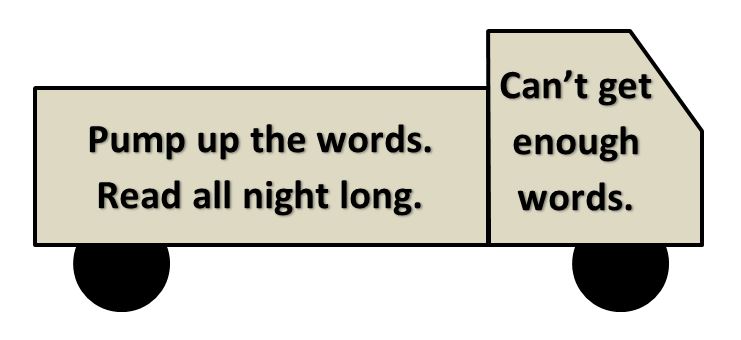
Pump up the words!

Pump up the words!


Big display screen on the back window,

Flashing words in very large letters,

Helping to spread literacy.


How slow can you go?

How slow can you go?


Crawling through town at a snail’s pace,

So everyone can read my bookmobile,

Before the words pass out of sight.


Read all night long.

Read all night long.


The graffiti glows in the dark,

Allowing people to read anytime,

Lighting up the night with words.


Can’t get enough words!

Can’t get enough words!


(c) 2013 Chris McMullen

Amazon Customer Book Reviews: Recent Improvements (?)

Have you noticed a few subtle changes, recently, to Amazon customer book reviews? Find any book on Amazon with several reviews and look closely.

First, let me back up a little, time-wise. On the product page, customer reviews show in two columns. The wider left column shows the top-rated customer reviews in full, while the narrower right column shows the first sentence (or so) of the most recent reviews, with the newest reviews at the top.

This has changed somewhat.

Until several months ago, Amazon used to only show the three top-voted customer reviews at the left. Now, more reviews show up in full at the left; the exact number depends on how many reviews there are all together. This was a nice improvement that many authors and customers had requested.

Another change that occurred several months ago was the inclusion of a few selected excerpts just above the review section. Until very recently, these quotes appeared one above the other in a list, and included a note of how many other customers made similar statements.

Very recently, this changed for one of my books. The excerpts now appear in callouts, and it no longer shows the number of customers who made similar remarks. If you click on one of the three callouts, Amazon takes you straight to that review.

Another of my books has the old list system instead of the callouts, and still shows the number of similar remarks. Maybe they are testing the callout system with selected books, maybe it will take time to change this for all books, or maybe only select books will feature the callouts.

Anyway, there is an interesting issue with the two-column format with more than three full-length reviews showing at the left. For any book that receives a bad review, this comment always carries weight while it’s the most recent review since it shows up at the top of the reviews in the right column. When eventually a good review comes in, it appears above the old bad review.

Unless… customers vote on the new good review, moving it over to the list at the left. Then the bad review reclaims its position at the top of the right column. When there were only three full-length reviews at the left, it wasn’t easy for a new good review to become popular enough to move onto that exclusive list. But now there may be several reviews on the left, so it’s easier for a review to make the transition.

It’s a rather subtle point, and probably not worth much consideration. I just thought it was interesting.

Another change that occurred several months back is what happens when you click the link to see all of the customer book reviews for a given book. Presently, it shows the top-rated favorable review and the top-rated critical review. In the old days, all of the critical reviews (or all of the favorable reviews) could potentially be buried at the bottom of the list, depending on the circumstances. This feature helps to show some balance. Customers are probably trying to weigh the pros versus the cons, so this may be helpful.

What I like most about the recent changes is that Amazon is evidently constantly assessing their customer review program and striving to improve it. The steps may be small, and it may not seem like an improvement to everybody, but I appreciate the effort – both as an author and a reader.

Amazon has made very significant changes in the past. One of the most notable occurred a few years ago when Amazon altered its program to help block suspected shill, sham, and household family member reviews. This change was implemented when they removed thousands (probably, millions) of suspicious reviews. The revision wasn’t perfect, I’m sure; there are probably a few still out there that didn’t meet the criteria of the program, and there were probably a few removed that should have stood. However, this was a significant change to improve the customer review system, and it appears to have made a marked difference.

Have you seen any other changes recently? What are your thoughts?

Who knows what will come in the future? Since Amazon is making periodic changes, we have reason to hope that it will continue to get better.

Chris McMullen, author of A Detailed Guide to Self-Publishing with Amazon and Other Online Booksellers, Vol. 1 (formatting/publishing) and Vol. 2 (packaging/marketing)

Has a Book Ever Made You. . .?

Emotion Pic


Have you ever read a book that made you fall in love with a character?

It succeeded in arousing your passion.

Have you ever read a book that made you yearn for a better place?

It succeeded in creating a better world.

Have you ever read a book that made you feel warm and fuzzy inside?

It succeeded in giving you happiness.

Have you ever read a book that you used to decorate your coffee table?

It succeeded in catching your interest.

Have you ever read a book that taught you how to do something?

It succeeded in passing along knowledge.

Have you ever read a book that couldn’t put down until it was finished?

It succeeded in holding your attention.

Have you ever read a book that made you laugh out loud in public?

It succeeded in providing entertainment.

Have you ever read a book that made you cry?

It succeeded in stirring your emotions.

Have you ever read a book that caused you to reach out to the author?

It succeeded in getting your concern.

Have you ever read a book that made you act toward a noble and worthy cause?

It succeeded in improving the world.


What great thing has a book done for you?

Thank You, Reviewers

Thank You Pic

Thank you, Readers

For taking the time to review books,

To express what you enjoyed,

To suggest what could be better.


Thank you, Shoppers

For reading customer book reviews,

For trying to sort out which comments are helpful,

For comparing feedback to the Look Inside.


Thank you, Customers

For not being afraid to share your feedback,

Despite the few who don’t handle criticism well,

For realizing that most authors aren’t this way.


Thank you, Bloggers

For investing so much time to read many books,

For posting book reviews on your blogs,

For helping out so many authors.


Thank you, Authors

For not reviewing your own books,

For not blasting the competition,

For not lashing out at reviewers.


Thank you, Everyone

Who has taken time to post a review,

Who hasn’t abused the review guidelines,

Who supports the wonderful world of books.


We need you,

Readers, Customers, Bloggers, Reviewers.

We would be nowhere without you.

Thank you so much.


Chris McMullen

Amazon > Books > Browse > Categories > Argh!

Categories: Can’t live with ‘em, can’t live without ‘em!

As a reader looking for books, categories are a necessity to help organize millions of books.

As an author hoping to sell books, categories are a necessity to help customers find them.

But categories can sure be frustrating from both ends! And it’s not just at Amazon. It’s all online booksellers. And a book may be listed in different categories on different websites…

Example > One > Begin

Suppose that your child is struggling with phonics. So you decide to search for a phonics workbook.

Obviously, at Amazon, you would click Books > Children’s Books. At this point, things already become interesting.

At the top of the screen at the left, it says “Shop by Category.” But where it says this, these are actually age groups, and not categories. The real categories are much further down (on my screen, I actually have to scroll down to find them – so you might not even discover those categories). What we mean by categories are things like mystery, education, and humor, right?

But it’s useful to narrow the search by age. At least, it seems like it should be. If your child is 7 years old, it makes sense to choose the 6-8 years range. That will help filter out all of the irrelevant books, right?

Oh, but it will also filter out some of the relevant books. Only some of the books in Children’s Books are categorized by age range. Many books are not.

Most customers won’t realize this. Those who do face a dilemma: See only some of the books in the right age group, or see many books from all of the age groups? Well, you could do two separate searches…

You can select the age group and a category, but that will only catch books that show up both ways; this loses even more results.

You want to filter the results; otherwise you have way too many to sort through. But what you really want is to keep the relevant results, and just filter out the irrelevant ones. The funny thing is that there are irrelevant results in virtually every search on Amazon, while a few highly relevant results are generally excluded.

Suppose we decide to search the categories down below (i.e. not the age group). If you’re looking for the Reference category, you might have trouble finding it: It’s under Education & Reference, so you have to look for E, not R. A lot of categories are merged together like this. For example, if you want Fantasy, look for S because it’s under Science Fiction.

Here’s a trick question for you: Which category would you choose for Mathematics? The correct answer is Science, Nature, & How It Works.

What’s more interesting is that the categories change periodically. It’s really fun to find a category that you know you used to use, but isn’t there any longer!

In this example, we’re looking for a phonics workbook. You could pick Education, but you might select Activities (thinking it’s a workbook). For some types of books, the choice can be quite difficult.

Let’s go with Education & Reference. Note that Reference is one of the categories within Reference. Why not just give it its own category to make it easier to find? If you pick Science Fiction & Fantasy, it splits into separate Science Fiction and Fantasy categories. Why not eliminate the middleman?

Which subject do you think we should choose? If this were Family Feud, I bet English would be a good answer. Do you agree? Well, that’s only the correct answer if English is the child’s second language. What do you pick if it’s the child’s first language? It must be under Reading & Writing.

Now we get to choose from Composition, Grammar, Handwriting, and Vocabulary.

Wait a minute! Did we make a wrong turn somewhere? Who stole Phonics?

If you want to sort through the Vocabulary & Spelling category, all I can say is, “Good luck!” Why? Because you get to browse through 1,222 books to find out if any of them actually relate to Phonics.

You know what makes this task even more fun? There are only 12 search results showing on each page. Hey, it’s only 100 pages. It could be worse.

Maybe the category wasn’t the best idea. Maybe we should just type a keyword.

So we start typing Phonics Workbook into the search field, and we see some other options, like Phonics Workbook Kindergarten. Hmm, maybe we should click on one of those more specific searches.

Well, if you’d like to filter out books published through CreateSpace, that will do the trick because they place a 25-character limit (including spaces) on keywords. Ironically, those same authors can publish the same books (well, probably not workbooks) on Kindle, where there is no limit on the character count of a keyword. The paperback and ebook editions can then be linked together. Go figure!

Another issue is that the publisher can only choose so many keywords, like Phonics, Phonics Book, Phonics for Kids, Phonics Workbook Grade 2, etc. CreateSpace, for example, only allows publishers to select up to 5 relevant keywords. Kindle, in comparison, allows up to 7. Why the disparity?

So when you search by a keyword, it’s possible for a relevant book not to show up in the search.

It’s also possible for a highly irrelevant book to show up in the search. As long as it has the same keyword as you searched for, it will show up.

Of course, Amazon’s algorithm must decide in what order to display the results. Let’s not open yet another can of worms…

Example > One > End

That example illustrates some of the fun that customers experience while searching for books.

Authors and publishers experience a similar sort of fun when publishing books.

Example > Two > Begin

Suppose that you wrote play that contains a bit of murder, satire, and romance. Okay. Which category would you choose when it comes time to publish?

Let’s explore Amazon. You can’t even get passed Books before you come across a tough decision.

Maybe it should be listed as a play for people looking for plays. If so, where are they? Well, you might find them under Literature & Fiction > Drama. At least, you’ll find Shakespeare there. Hey, this book kind of sounds like one of Shakespeare’s works. Makes you wonder how anyone would find his books if he lived in the 21st century! (Okay, I won’t debate that his greatness would prevail even in our times. But suppose you wanted to write something kind of like Shakespeare’s works, but without that same level of genius. Where would you put it?)

Do you really think people will be sorting through dramas looking for new plays that include murder, satire, and romance? (Remember, we’re talking about the book I proposed in this example, and not one of Shakespeare’s books. I just remarked that one of his books could have a similar issue. If you want his books, just type Shakespeare in the search field. It helps a bit to have a famous name. How would such a book get discovered without that big name?)

The category Plays doesn’t appear to exist.

There are many nonexistent categories. Like Phonics (see Example > One). That’s a problem for customers who are looking for such books, and a problem for publishers who sell those books.

It has some murder and some romance. We could throw it in Romantic Suspense. But if it’s anything like Shakespeare, that’s certainly not what those customers will be looking for in that category.

The same goes for Romantic Comedy. You don’t have to worry about that, however. Although there are many romantic comedies, there is no such category. It’s not under Romance, nor is it under Comedy.

Maybe it’s more of a suspense. Or does it fall under Humor for the satire.

It’s a tough decision.

And you have to pick one. Well, if you publish with CreateSpace, you can contact support and politely request that a second browse category be added for your book at Amazon. Compare with Kindle, where you can choose two up front.

Then the categories that you get to choose often don’t match the actual categories at Amazon. CreateSpace presents the BISAC categories, which aren’t the same. This definitely adds to the fun.

Speaking of fun, it gets even better.

Sometimes, your book automatically appears in three or more categories, even though you can only choose one or two. Your book can appear in categories that you don’t even select, all without you knowing.

And this can be a problem.

More is better, right? Not always.

If your book is Fantasy, but buyers see it listed under Science Fiction when they check out the book’s detail page, they might decide it’s not what they were looking for. Similarly, a buyer who is looking for a suspense might be deterred to see a book listed in romance, too.

If a book is good fit for one genre, that’s the only place it should appear so as not to create any buyer confusion. Confused shoppers tend to not buy the book.

Example > Two > End

The real answer for the author’s concerns is marketing. This will be far more effective than relying on customers to discover your book among millions through category or keyword searches. And if your marketing effort pays off, the sales that are generated may improve your book’s visibility.

But what is the solution to the poor customer’s dilemma with categories? Online booksellers are highly customer-oriented, are they not?

Chris McMullen, self-published author of A Detailed Guide to Self-Publishing with Amazon and Other Online Booksellers

The Person Behind the Words

Person Words Pic

The author wrote the book, but exactly who is the person behind those words?

There are a few different ways that this information is useful:

  • Potential customers might have a more enjoyable reading experience if they check out the author page and blog to learn more about the writer before buying the book.
  • Fans can learn more about the author.
  • Authors can reveal something about themselves through marketing in order to help match their books to their target audience and to make their marketing efforts more personal.

You can learn more about the person behind the words by checking out the author page, author’s blog, author’s social media pages, and more.

As a reader, the author’s blog provide an additional writing sample, which may not have been edited as well as the Look Inside. This extra writing sample can help demonstrate the book’s potential for being well-written throughout (not just in the beginning of the book, which may receive more attention) for those readers who strongly value this.

Checking out an author’s other writing (e.g. the blog) gives an indication of the author’s personality, character, and possible motivation for writing the book. Occasionally, blogs and social media pages consist mostly of requests to please buy the book now. Sometimes, they are packed with useful information. If there is supplemental material that may interest fans, this may be a reward for reading the book. Does the author mostly blog about himself or herself? Does the author seem genuinely concerned about others? Are the author’s websites up-to-date or outdated? Are the posts too rare, too frequent, or just right for you? Is the material of interest to you?

You also get a sense of the author’s visual style, writing style, and thinking style. Some writing and thinking styles may conflict with yours, so you may have a more enjoyable reading experience by taking a few moments to avoid possible conflicts. You don’t necessarily need to find writing and thinking styles that match yours; we’re often attracted to different ways of thinking. What you want is to sample whether or not you find it agreeable.

From the author’s perspective, author pages, blogs, and social media are opportunities to make your marketing efforts more personal, attract your target audience with information that is useful for them, show your personality, demonstrate good character and values (in the eyes of your target audience), and show that you care.

Are you an author? If so, you’re not just an author. Exactly, who is the person behind those words?

Chris McMullen, self-published author of A Detailed Guide to Self-Publishing with Amazon and Other Online Booksellers