Powerful Words

Powerful

Twenty-six different symbols arranged in different combinations.

Forty-five different sounds put together in different ways.

That’s all they are.

Yet, when we see these words or hear these words, they can be so much more.

.

String three ordinary words together and they can cut like a knife.

“How could you?”

Add in an accusatory tone; one that you’d never heard before.

Introduce them in the right context.

They can etch into your mind. Torture you.

Powerful words.

.

When three ordinary words slip out they can ruin your life.

These words weren’t even on your mind.

They were buried deep down in your subconscious.

“I don’t care!”

But you do care. You didn’t mean to say them.

You can take back money, possessions, almost everything.

But you can’t take back the words.

Powerful words.

.

Three ordinary words can bring peace.

They can save a world on the brink of war.

“I promise you.”

It’s a simple vow. But it carries much honor.

You give your word.

It can be the greatest thing you ever give.

And when you keep it, it can be the greatest thing you ever have.

Powerful words.

.

Three ordinary words can give your life meaning.

When you say them with passion.

When you realize you’ve met your other half.

“I love you.”

They might be the hardest words you ever utter.

But if they’re reciprocated, they might be the best words you ever hear.

Powerful words.

.

Copyright © 2014 Chris McMullen

Must the Fate of the Universe Hang on the Line?

apocalypse

I was reading a science fiction book last week. I was content with it for much of the book. It started out on earth with realistic characters. Then, as with all science fiction, things have to get a little far-fetched to make contact with another world. This part was no surprise. Things began to gradually grow more and more unbelievable with the introduction of new creatures with more incredible features. The storyline had been engaging prior to this, so I began to wonder, “Was this necessary?”

Eventually, the story turned into apocalyptic fiction, as the fate of the universe turned out to be at stake. Then I really had to wonder, “Why?”

I didn’t select the book because I was looking for apocalyptic fiction. In fact, I had no idea this was coming. If this element wasn’t there to sell the book to apocalyptic fiction readers, then why was it there? Surprise, you’re reading apocalyptic fiction; you’re halfway through the book, so you might as well keep on reading, like it or not.

It made me reflect how many apocalyptic and post-apocalyptic novels there are.

Does the fate of the universe really need to be at stake in order to make a book worth reading? If the universe might not end, does that make the book unimportant?

Surely, a book can please readers through storyline, characterization, cool ideas, style, word flow, and other aspects. It shouldn’t have to seem like the most important thing in the universe to be worth reading, right?

Personally, I’d like things to be somewhat less ambitious, somewhat more plausible. However, I’m just one reader, and that’s not a good statistical sample. Many readers do seem to be into apocalyptic fiction. As an author, if you’re hoping to sell more books, you should try to learn the tastes of your specific target audience.

This varies by genre, too. If you’re writing about zombies, post-apocalyptic fiction may be the norm; for a whodunit, this would be an unusual twist.

How do you feel about this? Do you want the fate of the universe to hang in the balance of your novels?

Publishing Resources

You can find many free articles on publishing and marketing by clicking one of the following links:

Chris McMullen, Author of A Detailed Guide to Self-Publishing with Amazon and Other Online Booksellers

Follow me at WordPress, find my author page on Facebook, or connect with me through Twitter.

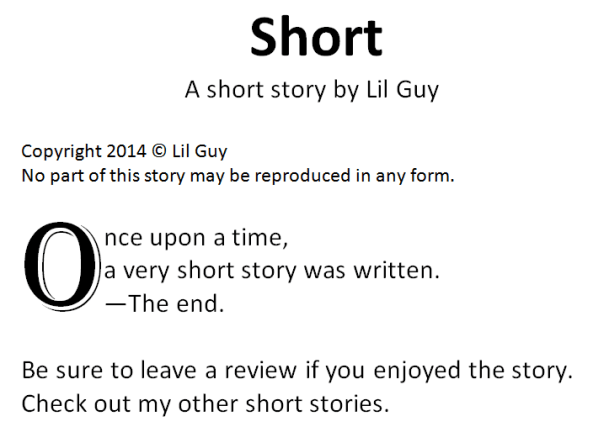
Commuter Fiction—Making a Case for Short Kindle e-books?

Short

When I want to shop for something to read on my Kindle, I visit Amazon’s homepage on my PC and click on the Kindle books link. It’s called ‘Kindle books,’ so intuitively what you might expect to see are ‘books,’ right?

After a half hour of searching, I may finally find one that suits my mood. Then I examine the product page closely to learn that it’s 36 pages long. Wait a minute. Is that a book?

Sometimes, I check out the Look Inside of a prospective book. I see the cover, title, copyright notice… where’s the rest? Wow! How short must a book be not to show anything from the first chapter?

A Kindle e-book can have just 12 pages. It can have 6 pages. Is there a lower limit? At 6 pages, I hope there isn’t a title page, copyright page, about the author section, and free sample of another book taking up space inside… I also hope the ‘book’ is self-contained. It would be awfully frustrating to learn that it was really one chapter in a series, where you don’t get any sense of closure until the series is complete.

Of course, despite the fact that all of these ‘books’ are listed under ‘Kindle books,’ they aren’t all books. These Kindle e-books include short stories, booklets, presentations, and novellas, too.

Until recently, I was troubled by the growing number of short e-books. I was thinking, “Don’t customers want good value for their money?” “Are customers getting tricked, buying what they expect to be a book only to discover it’s really a short story?” “Are more authors getting lazier, writing and publishing shorter pieces?”

I understood reasons for the short e-books, but I was still troubled by it.

Customers can easily return e-books if they are dissatisfied. (Many do.) They can also check the page count before purchasing, and read the description carefully. If the Look Inside is brief, that’s a big hint. If they’re getting fooled by short books, they can get their money back or leave a review about it. The customer is certainly protected.

Writers are posting short e-books for a variety of reasons. Some don’t want to commit too much into their self-publishing endeavors, so a short piece is a way to experiment. Some are hoping to see what sort of customer feedback may come for short writing samples before laying their hearts on the line for full-length novels. Some plan to compile short works into an omnibus later on, such that the omnibus will look like a good value. There are other reasons, too. Not all of the reasons may be justified.

It’s not easy to get discovered as a new writer, whether writing full-length novels or short stories. Even 99 cents is a lot of money to invest in for one short story from a relatively unknown author; the story will be over quickly, so just imagine what you’ll spend for several hours of reading buying individual short stories. On the other hand, a full-length novel is a long commitment to make for a reader with a new author.

Is it easier to get readers to try out your short story, enjoy your book, and give your full-length novel a shot? Or is it easier to get new readers to appreciate the value of your full-length novel and commit to that as the first thing they read by you? Neither is ‘easy’ for most authors.

Commuter Fiction

I recently discovered this phrase in the KDP community forum. I like the concept. It’s changing my view of short e-books.

The idea behind commuter fiction is to write a short work that travelers can enjoy at a single sitting on an airplane or bus, for example. If you have a three-hour flight, for example, wouldn’t it be perfect to buy an e-book that you could read in three hours?

Authors and publishers have discovered that there is a market for short fiction, and they’ve responded with a way to make short fiction marketable.

You can call your short story a short story. You can call your novella a novella. You can list the word count. Kindle will estimate the page count. But that might not be the way to market your short e-book.

Consider selling it as commuter fiction. Maybe it would be handy to know approximately how many hours it would take the average reader to finish your e-book. A commuter might be interested in that figure.

Truck drivers have been listening to audio books for years. They buy books by the hour. If a truck driver is going on an eight-hour drive, it would be ideal to have an audio book that lasts eight hours (or four audio books that last two hours each), for example.

The same concept applies to passengers of buses, airplanes, and trains who are reading e-books on Kindles, tablets, laptops, and cell phones. What they would really like to know is how long it will take to read the e-book. Of course, this varies from person to person because we all read at different rates. If they can deduce an average, though, that will help them judge this.

I’m not saying that you should write short e-books. It might be harder to sell than full-length books. (Who knows?) Personally, as a customer, I like to receive a good value for my money. However, there are many customers who behave differently than I do.

What I am saying is this: If you’re going to write a short book, maybe you can improve its marketability by selling it as commuter fiction.

Publishing Resources

I started this blog to provide free help with writing, publishing, and marketing. You can find many free articles by clicking one of the following links:

Chris McMullen, Author of A Detailed Guide to Self-Publishing with Amazon and Other Online Booksellers

  • Volume 1 on formatting and publishing (236 pages, 8″ x 10″; it’s a real ‘book’)
  • Volume 2 on marketability and marketing (212 pages, 8″ x 10″; it’s a real ‘book’)

Follow me at WordPress, find my author page on Facebook, or connect with me through Twitter.

Which Part of Publishing Do You Enjoy Most?

joy

Here are some choices to consider:

  • That magical feeling when you get a book idea that seems like it could be the one. What a thrill!
  • When you’re on a roll with your writing, the ideas are just sliding off your fingertips, and the manuscript feels like an extension of yourself. Go, go, go.
  • You’re stuck on the storyline and you suddenly experience an epiphany. Aha!
  • A stranger offers free help or advice when you’re incredibly stressed over some formatting or other publishing issue. Thank you!
  • You press the magic button to publish your book. Presto!
  • The first time you see your book in print. Treasure it.
  • A fan asks you to autograph your book. So cool!
  • Someone you don’t know leaves a good review. Validation.
  • You meet a stranger who not only recognizes you as an author, but thanks you for writing your book. Prepare for tears.
  • One of those milestone moments: X sales, $Y royalties, Z sales rank. Pinch me.
  • When a fan asks you when your next book is coming out. You’re in demand.
  • Just the creative process itself. This lasts much longer, too.

The bottom line is that there is much to enjoy about publishing. So when editing, formatting, writer’s block, reviews, sales, or anything else gets you down, stop focusing on that little aspect and remember several good reasons to enjoy the book you’ve published. 🙂

Publishing Resources

I started this blog to provide free help with writing, publishing, and marketing. You can find many free articles by clicking one of the following links:

Chris McMullen, Author of A Detailed Guide to Self-Publishing with Amazon and Other Online Booksellers

Follow me at WordPress, find my author page on Facebook, or connect with me through Twitter.

Read is a Four-letter Word

If you read, write, or publish and find yourself somewhat upset, perhaps you can take a little comfort in the realization that ‘read’ is a four-letter word. (And maybe the fact that reading, writing, and publishing are far more enjoyable than many other things you could be doing, even when these activities might frustrate you a bit.)

book

isbn

note

page

read

tale

text

type

word

copy

edit

find

full

left

mark

typo

view

free

give

list

sale

sell

body

line

poem

poet

bold

caps

dash

font

stop

blog

like

link

mail

post

send

stat

byte

file

HTML

open

Word

save

size

Fire

iPad

Kobo

Lulu

Nook

Sony

There are a few notable words that have more than four letters:

criticism

defects

feedback

plagiarism

rejection

returns

reviews

Copyright © 2014 Chris McMullen

Self-Publishing Experiments

Experiment

With millions of books to choose from, why would anyone choose to buy an experiment?

If the author treats a book like it’s an experiment, the quality of the content, packaging, and marketing will reflect this. Customers will see it.

  • It’s not worth putting a fantastic cover on a book that’s an experiment.
  • It’s not worth perfecting the editing or formatting for an experiment.
  • It’s not worth crafting a most wonderful story for an experiment.
  • It’s not worth marketing an experiment.
  • The author won’t be confident in or passionate about an experiment.

So why bother making an experiment?

If you just want to know if your writing appeals to others, simply share drafts of it or join writing groups.

It’s not Necessary to Experiment First!

Why not? Because there are already millions of books on the market. Researching those, especially successful indie books, will prove far more valuable than any experiment you might do yourself.

  • Sales ranks and reviews can help you gauge which kinds of books are or aren’t popular.
  • Repeated comments in a subgenre can help you learn specific things that many readers do or don’t like.
  • Writing samples in the Look Insides can help you see what kind of writing appeals to readers.
  • Covers of bestselling indie books can help you learn how to attract your target audience and signify your subgenre.
  • Look Insides of bestselling traditionally published books can show you what a nicely formatted book should look like.
  • Product pages of bestsellers can show you how to make the most of your book’s detail page.
  • Author pages and websites of top indie authors can show you a variety of marketing possibilities.
  • A ton of free and low-cost publishing and marketing resources can help you perfect your book.

Study books that have succeeded. That’s experimental data that you have right at your fingertips.

It’s a Mistake to Experiment First!

Why? Because your first impression is very important. A big part of marketing is the author’s brand. It takes time to build credibility as an author.

If your first effort is an experiment, many shoppers who come across your book and were interested in it may remember your book or name in the future. The next time they see one of your books, even though it may be much better, they may pass on it simply from their first experience.

Success in the publishing business is difficult to come by, so start out by putting your best foot forward.

About My Blog

I started this blog to provide free help with writing, publishing, and marketing. You can find many free articles by clicking one of the following links:

Chris McMullen, Author of A Detailed Guide to Self-Publishing with Amazon and Other Online Booksellers

Follow me at WordPress, find my author page on Facebook, or connect with me through Twitter.

Comma Chameleon

Comma

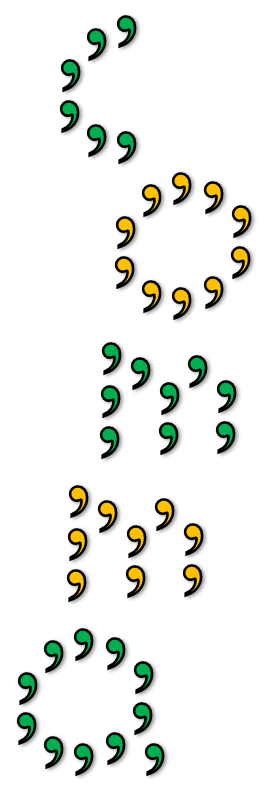
Comma, comma, comma, chameleon.

Such a subtle separator can disguise meaning.

“Let’s eat, everyone,” sounds rather inviting.

“Let’s eat everyone,” sounds cannibalistic.

, , , , ,

Comma, comma, comma, chameleon.

Such a subtle mark can affect the pace.

“The rabbit with broken legs limped home,” sounds quick.

“The rabbit, with broken legs, limped home,” sounds slow.

, , , , ,

Comma, comma, comma, chameleon.

Such a subtle mark can hold so much power.

“My mom said her husband is crazy,” means one thing.

“My mom, said her husband, is crazy,” means another.

, , , , ,

Copyright © 2014 Chris McMullen

, , , , ,

Related articles:

Riddle: What Does Every Writer Need to Succeed?

Question

It’s not a pen because you could use a pencil or a computer.

It’s not a medium on which to write because the writing could simply exist in a bard’s mind.

It’s not a brain because that doesn’t distinguish a writer from any other art form.

It’s not lucky underwear because this job is clothing-optional.

It’s not a dictionary or thesaurus; although these come in handy, they aren’t always needed.

It’s not an audience because it is possible to define a new genre and gather a new audience.

It’s not money, as a writer can start out empty-handed and become successful.

It’s not writing instruction; while it does help to be well-versed, it is possible to become fluent through avid reading, for example.

It’s not praise, since although most writers would like it, the road to success is often paved with much criticism.

It’s not criticism because it’s already spurious and not everyone benefits from it.

It’s not an agent or great connection, which may help, as some writers have succeeded without this.

It’s not research, though it can be a big asset, since it can be compensated or trumped by a huge imagination.

It’s not imagination because many writers succeed with small changes to what’s already out there.

It’s not a pet squirrel, yet it’s highly recommended.

It’s simpler than all that, and everyone can have it. It’s passion.

Writing without passion. Is it worth reading? Was it worth writing?

Copyright © 2014 Chris McMullen

Authors, Don’t Write Books; Create a Whole New World

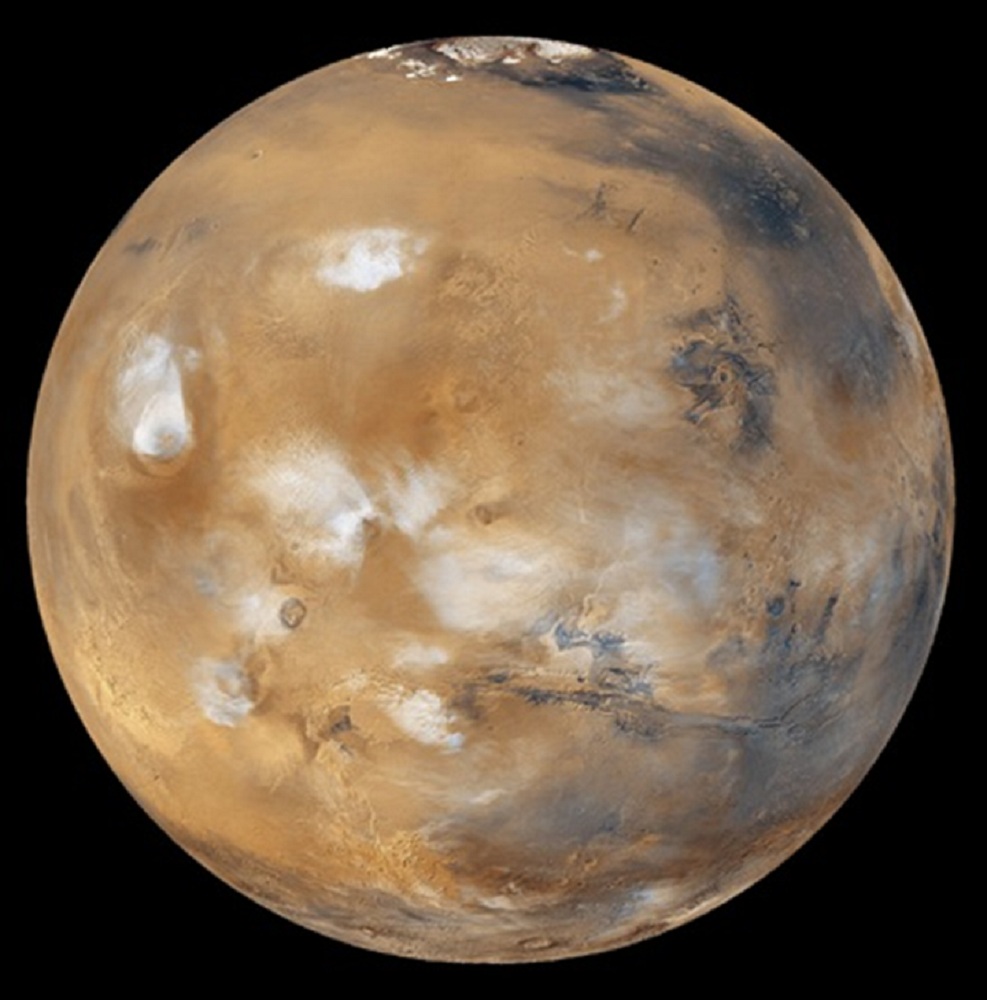
Image of Mars from NASA.

Image of Mars from NASA.

People don’t buy books. People buy the experience that a story provides.

So authors shouldn’t write books, and they shouldn’t market books. Authors should create a whole new world, and they should market the experience of visiting that world.

Don’t think of your book as a book. Think of the story as one part of the world that you created.

Don’t think of how to market your book. Think of how to get people interested in your world.

The world you create is far more than a mere book. It’s the world, not the book, which people want.

How do you do this?

  • Give your world life before your book is published. Spread the word about the world you are creating. Create buzz for it. Reveal the cover, blurb, and sample chapter in advance.
  • Design striking, relevant images for your cover, blog, social media pages, website, bookmarks, business cards, brochures, PR kit, all your online activity, and all your printed materials. These materials come in different sizes, so you need a flexible design. All the products should fit together. They don’t all have to be exactly the same, but it should be immediately obvious that they match. Everything prospective shoppers, readers, and fans see are a visual representation of your book.
  • Supplement your book with additional material. Post free bonus content on your website or an email newsletter to give fans an incentive to stay in touch. This might include maps, character sketches, or short stories or poems, for example. Not everything has to be free. For example, you can sell a short story that relates to your book.
  • The great thing about a series is that the world can last well beyond just one book. It also helps you create anticipation for each book in the series and steadily grow a following. You can make the first e-book permanently free or 99 cents to help lure readers into your world. An omnibus with significant savings can entice readers to buy the whole world all in one shot.
  • Sell, give away, or hold contests for additional products like bookmarks, special editions, t-shirts, buttons, or maps.
  • Create a highly marketable world and it will help attract visitors to your world. Some ideas are more marketable than others. Some writing is more pleasing than others. The packaging—cover, blurb, and Look Inside—are also very important in attracting attention to your world.
  • Find your target audience—especially, people who aren’t already in your following—in person and online, interact with them, and show them the benefits that your world has to offer. You’re not selling a book, but a roundtrip ticket to paradise. Introduce people to your world. Create a video trailer that depicts your world visually.

Self-publishing world

I started this blog to provide free help with writing, publishing, and marketing. You can find many free articles by clicking one of the following links:

Chris McMullen, Author of A Detailed Guide to Self-Publishing with Amazon and Other Online Booksellers

Follow me at WordPress, find my author page on Facebook, or connect with me through Twitter.

New Year’s Resolutions for Writers

Happy 2014

What writing resolutions are you making for 2014? Here is a sample of goals that you might set:

  • A writing quota for books, stories, or articles that you will write. Set a reasonable expectation.
  • Marketing goals might include trying out new ideas, learning new strategies, or devoting more time to this task.
  • If you feel like you worked too hard in 2013, you might want to devote more time to family and find a better balance between writing, marketing, and family time.
  • You might want to devote more time to writing if marketing or other activities are cutting into your writing time.
  • The new year might be a good time to try out a new writing style or genre, or to develop some new characters.
  • Making an effort to get traditionally published, or switching over to self-publishing, are possible goals.
  • You might join a writer’s forum or book club, attend a conference, or get involved with a writing-related group.
  • A new year is always another opportunity to stay positive and deal with stress better.
  • Common resolutions, like exercising more and eating write, are valuable for writers, too, especially as we spend much time sitting at a desk.
  • Perhaps you’d like to read more books in 2014.

What are your writing resolutions for 2014?

Happy New Year!

I started this blog to provide free help with writing, publishing, and marketing. You can find many free articles by clicking one of the following links:

Chris McMullen, Author of A Detailed Guide to Self-Publishing with Amazon and Other Online Booksellers

Follow me at WordPress, find my author page on Facebook, or connect with me through Twitter.