Riddle: What Does Every Writer Need to Succeed?

Question

It’s not a pen because you could use a pencil or a computer.

It’s not a medium on which to write because the writing could simply exist in a bard’s mind.

It’s not a brain because that doesn’t distinguish a writer from any other art form.

It’s not lucky underwear because this job is clothing-optional.

It’s not a dictionary or thesaurus; although these come in handy, they aren’t always needed.

It’s not an audience because it is possible to define a new genre and gather a new audience.

It’s not money, as a writer can start out empty-handed and become successful.

It’s not writing instruction; while it does help to be well-versed, it is possible to become fluent through avid reading, for example.

It’s not praise, since although most writers would like it, the road to success is often paved with much criticism.

It’s not criticism because it’s already spurious and not everyone benefits from it.

It’s not an agent or great connection, which may help, as some writers have succeeded without this.

It’s not research, though it can be a big asset, since it can be compensated or trumped by a huge imagination.

It’s not imagination because many writers succeed with small changes to what’s already out there.

It’s not a pet squirrel, yet it’s highly recommended.

It’s simpler than all that, and everyone can have it. It’s passion.

Writing without passion. Is it worth reading? Was it worth writing?

Copyright © 2014 Chris McMullen

Authors, Don’t Write Books; Create a Whole New World

Image of Mars from NASA.

Image of Mars from NASA.

People don’t buy books. People buy the experience that a story provides.

So authors shouldn’t write books, and they shouldn’t market books. Authors should create a whole new world, and they should market the experience of visiting that world.

Don’t think of your book as a book. Think of the story as one part of the world that you created.

Don’t think of how to market your book. Think of how to get people interested in your world.

The world you create is far more than a mere book. It’s the world, not the book, which people want.

How do you do this?

  • Give your world life before your book is published. Spread the word about the world you are creating. Create buzz for it. Reveal the cover, blurb, and sample chapter in advance.
  • Design striking, relevant images for your cover, blog, social media pages, website, bookmarks, business cards, brochures, PR kit, all your online activity, and all your printed materials. These materials come in different sizes, so you need a flexible design. All the products should fit together. They don’t all have to be exactly the same, but it should be immediately obvious that they match. Everything prospective shoppers, readers, and fans see are a visual representation of your book.
  • Supplement your book with additional material. Post free bonus content on your website or an email newsletter to give fans an incentive to stay in touch. This might include maps, character sketches, or short stories or poems, for example. Not everything has to be free. For example, you can sell a short story that relates to your book.
  • The great thing about a series is that the world can last well beyond just one book. It also helps you create anticipation for each book in the series and steadily grow a following. You can make the first e-book permanently free or 99 cents to help lure readers into your world. An omnibus with significant savings can entice readers to buy the whole world all in one shot.
  • Sell, give away, or hold contests for additional products like bookmarks, special editions, t-shirts, buttons, or maps.
  • Create a highly marketable world and it will help attract visitors to your world. Some ideas are more marketable than others. Some writing is more pleasing than others. The packaging—cover, blurb, and Look Inside—are also very important in attracting attention to your world.
  • Find your target audience—especially, people who aren’t already in your following—in person and online, interact with them, and show them the benefits that your world has to offer. You’re not selling a book, but a roundtrip ticket to paradise. Introduce people to your world. Create a video trailer that depicts your world visually.

Self-publishing world

I started this blog to provide free help with writing, publishing, and marketing. You can find many free articles by clicking one of the following links:

Chris McMullen, Author of A Detailed Guide to Self-Publishing with Amazon and Other Online Booksellers

Follow me at WordPress, find my author page on Facebook, or connect with me through Twitter.

New Year’s Resolutions for Writers

Happy 2014

What writing resolutions are you making for 2014? Here is a sample of goals that you might set:

  • A writing quota for books, stories, or articles that you will write. Set a reasonable expectation.
  • Marketing goals might include trying out new ideas, learning new strategies, or devoting more time to this task.
  • If you feel like you worked too hard in 2013, you might want to devote more time to family and find a better balance between writing, marketing, and family time.
  • You might want to devote more time to writing if marketing or other activities are cutting into your writing time.
  • The new year might be a good time to try out a new writing style or genre, or to develop some new characters.
  • Making an effort to get traditionally published, or switching over to self-publishing, are possible goals.
  • You might join a writer’s forum or book club, attend a conference, or get involved with a writing-related group.
  • A new year is always another opportunity to stay positive and deal with stress better.
  • Common resolutions, like exercising more and eating write, are valuable for writers, too, especially as we spend much time sitting at a desk.
  • Perhaps you’d like to read more books in 2014.

What are your writing resolutions for 2014?

Happy New Year!

I started this blog to provide free help with writing, publishing, and marketing. You can find many free articles by clicking one of the following links:

Chris McMullen, Author of A Detailed Guide to Self-Publishing with Amazon and Other Online Booksellers

Follow me at WordPress, find my author page on Facebook, or connect with me through Twitter.

What Are Your Writing Goals?

Goal

How you define success, establish expectations, and prepare a marketing plan depend on your objectives.

So as you plan the new year and make writing resolutions, take a moment to consider your objectives as an author.

Here is a sample of writing goals:

  • To master the craft of writing. Spend more time writing, of course. Also, spend time reading classics and the kind of writing you wish to master. Seek feedback from readers. Search for writing tips.
  • To share your writing with others. Post writing on your blog. Publish a book. Publish poetry, short stories, essays, or articles online or in print. Market your written works to your specific target audience.
  • To support your writing hobby financially. Research which kinds of books you are a good fit to write, where there is a significant demand. Perfect your book to improve your prospects for good reviews and recommendations. Seek a traditional publisher or design a highly marketable cover, blurb, and look inside. Learn how to market your book effectively. Look for related jobs that you may excel at, such as editing or cover design.
  • To have fun. Write in your spare time as a hobby. Enjoy it. Be creative. Devote more time to writing and less time to marketing and other related activities. Find fun and creative ways to do those other activities so you can keep the focus on enjoying your writing. Don’t get caught up in stats or reviews.
  • To leave a legacy for your children. Involve your kids with your books. Make up stories for them at bedtime. Write special stories or poems just for them and publish them privately. Encourage your kids to assemble books and publish those privately. Mention your family in the acknowledgments or dedications section of your book. Specify how royalties will be awarded and distributed in your will, and provide information that will help your heirs understand and manage your books and author platform.
  • To gain accolades. Master the craft of writing and storytelling. Focus on perfecting your book idea and the book itself. Enter contests. Learn from your experience and enter more contests. Create a fan page and include a link to it at the end of your books. Interact with your fans. Attend writing conferences. Build connections among writers, agents, and editors. Develop a very thick skin because there is much criticism on the road to praise.
  • To try out a new genre or writing style. Don’t view it as an experiment. Have fun with it, but also take it seriously. Research what you will be writing thoroughly. Motivate yourself to master the new art. Do your best, as if it’s the only way you will ever write.
  • To share your knowledge or help others. Master the material you wish to share. Master the art of explaining ideas clearly. Master the art of teaching effectively. Research your specific target audience’s learning styles and background level. Perfect your article or book. Post relevant free content on your website. Post relevant content on other websites to reach people who aren’t already in your following. This can be an online article or a YouTube video channel, for example.
  • To get published traditionally. Research books that are highly marketable which are a good fit for you to write. Master the craft of writing your book in a way that will please a specific target audience. Make connections with agents, editors, illustrators, cover designers, and publicists. Receive advice from experienced, successful publicists and agents at the outset of your project. Subscribe to magazines and newspapers that are a good fit for your writing. Read and study those articles for several months, then submit your own articles for publication. Research how to write query letters and book proposals. Find a literary agent. Post your rejection letters where you will see them every morning to fuel your motivated self-diligence. Strive to improve. Never give up.
  • To become instantly rich and popular without any effort. Don’t write at all. Get a full-time job. Be frugal. Spend every spare penny on lottery tickets. Hope. Pray. Don’t be disappointed if it doesn’t pan out.

Publishing help

I started this blog to provide free help with writing, publishing, and marketing. You can find many free articles by clicking one of the following links:

Chris McMullen, Author of A Detailed Guide to Self-Publishing with Amazon and Other Online Booksellers

Follow me at WordPress, find my author page on Facebook, or connect with me through Twitter.

Why Do You Write?

Why


Is your writing fueled by passion?

Is it a hobby that’s much fun?


Do you possess knowledge to share?

Do you give help because you care?


Perhaps you write to entertain.

Maybe you do it to heal pain.


Please don’t say you write for money,

Although sales are sweet as honey.


Are you just a muse’s vessel?

Are you writing to soothe your soul?


Could your books be your legacy?

Could they be art for all to see?


Copyright © 2013 Chris McMullen

What Readers Want

readers want

If you’re a writer, the most effective way to attract readers is to carefully consider what readers want. It really is that simple.

But don’t fall into the common trap of thinking things like, “Most people won’t mind if there are typos,” “I know someone who paid $25 for an e-book, so I can sell mine for $9.99,” or “The content is more important than the cover.”

Don’t think, “What will the reader settle for?” Think, “What does the reader want?”

Fewer customers will settle for it. Many more customers will buy what they want.

I don’t mean that you have to write in the most popular genre. I don’t mean that you have to sell out, compromising your beliefs. I don’t mean that you have to study the bestsellers and copy their techniques.

You do need to think long and hard about what your specific target audience wants if you wish to maximize your sales. Following are specific examples of what I mean:

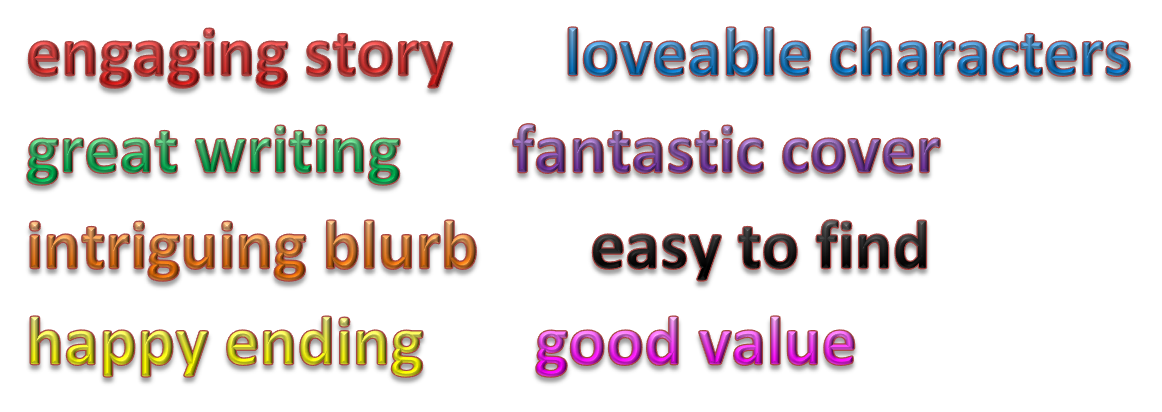
  • Readers want stories that they will enjoy and nonfiction books that will be useful. The storyline or content should be complete, thought out well, engaging throughout, pleasing to the specific target audience, better than average, and within reasonable scope of their expectations (based on the cover, blurb, and category). Readers want to love or despise the main characters, and they want to relate to characters or enjoy a new experience.
  • Genre readers want their expectations for the genre to be met. For example, romance readers want to fall in love, cry over broken hearts, see broken hearts mended, enjoy a happy ending, etc.; in a given romance subgenre, they want just the right amount of explicitness. They don’t want the protagonist to have certain behavior flaws. It pays to research and understand the specific target audience. Readers don’t want stories that violate important rules for the genre.
  • Readers want a clear indication of what they’re getting at a glance. This means that the cover must visually show what your book is about. The precise fiction subgenre or nonfiction subcategory should be obvious from a quick glance at your cover. The cover should also indicate the nature of the content. Why? Because the reader wants to find books quickly. Books that don’t send a clear signal, or which send mixed messages or the wrong signal, won’t get the limited attention that shoppers have to offer.
  • Readers want the blurb to be honest, clear, concise (so they can decide quickly), and pique their interest. If 100 words don’t interest the reader, it wouldn’t be wise to read 100,000 words by the same author.
  • Readers want books to be easy to find. They want to find it in the relevant subcategory (and not find it where it doesn’t belong). They want to find it with relevant keywords (but not find books that shouldn’t show up in the search). They want the cover to depict the content and genre clearly to help them find the book. They want a title that’s easy to remember and spell. They want to see book reviews that help them find good books. They want the author or publisher to go to the trouble of helping them find books they are likely to enjoy. But they don’t want intrusive advertising.
  • Readers want books that are well-written, nicely formatted, and free of spelling, grammar, and other mistakes. They are paying money for a book and they are investing time in the book, so why shouldn’t they expect to receive a professional book in return?
  • Readers want a great value. They don’t just want a low price. They want a great book at a fair price. Some readers shop a higher price range thinking that you get what you pay for. But no matter what the reader pays, the reader expects to receive a great book. Even if the book is free. It’s not worth investing several hours on a book for it not to be professional and good, even if it’s free.
  • Readers want a great story, great characterization, great editing, great writing, great formatting, a great cover, a great blurb, and a great price. Why not? When there are books out there that are great all around, why should any reader settle for less?

Give readers what they really, really want, and your book is apt to find many more readers. Give them something they must settle for, and only some (if any) will choose to settle.

Remember to ask yourself what readers want. Ask yourself this when you’re writing your book, when you’re formatting your book, when you’re pricing your book, when you’re writing your blurb, when you’re deciding on your cover, when you’re marketing, and in your public relations.

For example, there are customers who absolutely do not want you to invade their space in the review section and comment on a review. Since some customers feel very strongly about this, it may be best to give them what they want.

If you were an entrepreneur running a small business, it would serve you well to think about what the customers want.

As an author-preneur, it serves you well to think about what your specific target audience wants.

About My Blog

I started this blog to provide free help with writing, publishing, and marketing. You can find many free articles by clicking one of the following links:

Chris McMullen, Author of A Detailed Guide to Self-Publishing with Amazon and Other Online Booksellers

Follow me at WordPress, find my author page on Facebook, or connect with me through Twitter.

Fortune Cookie for Authors

fortune cookie

A local Chinese restaurant was one of the few places open last night. I found this note in my fortune cookie: “In great attempts it is glorious even to fail.”

Writers often have extraordinary ideas and make extraordinary efforts.

Authors shouldn’t be content with failure. They should work hard to succeed.

But they shouldn’t fear failure. Focus on perfecting the book. Completing the attempt itself is a success and reward of its own.

I had several book ideas beginning in the late 1980’s. I wrote some books. Started other books. Drew thousands of illustrations on the computer. Typed up worksheets. But didn’t publish my first book until 2008.

The idea that finally motivated me to publish was an introduction to the fourth dimension. I put much time, effort, and energy into my book on the fourth dimension for a couple of intense years, then explored my publishing options. Not content with my traditional publishing options, I looked into CreateSpace, and wound up publishing my extensive backlist over the next few years with them.

My book on the fourth dimension1 was my top seller for several months, but is no longer one of my top ten in sales. It had peaked with a sales rank of about 5,000 (it’s a paperback) for a couple of weeks in 2009, but is presently in the hundred thousands.

I had familiarity with publishing, formatting, and editing from several articles that I had published in Physical Review, and I had previously prepared 100-page master’s and doctoral dissertations, which are highly technical books with precise formatting criteria. Even then, formatting, editing, and publishing a book with hundreds of figures plus tables and equations proved to be a monumental task.

It’s not perfect. If I were formatting this book today, I would use a different design and font choice, plus I now know about things like widows, orphans, tricks to perfect vertical spacing, and foliation.

But I remember how much time, thought, and effort went into that book. From that, I would count this book as a success even if it hadn’t sold, and even though I could make it better with what I know now. I can appreciate the attempt itself.

For artists, isn’t the attempt itself what matters most? Make an extraordinary attempt. Do your best to perfect your art. Then no matter what, it’s a success.

I’ve been fortunate to have many publishing successes. The first six months seemed like a disaster, things started out very slowly, and there have been many trials and tribulations along the way. But I persisted.

I could have failed. For six months, it seemed like I had. But I didn’t fear failure. I gave it my best shot. It paid off in the long run. But even if it hadn’t, I’d still have my book on my shelf in my office, and consider the attempt an accomplishment.

Really, there is nothing to lose. If you finish your book and feel that you have perfected it, you’ve already won before you even sell one copy.

Many authors have extraordinary ideas and make valiant attempts. But not every author feels successful. Part of this has to do with perspective: Polishing and publishing a book is quite an accomplishment. Part of this has to do with expectations and patience. And part of it has to do with the book’s marketability.

Don’t undervalue the attempt itself. That’s the art. It can have much value and its value may be independent of sales or praise.

Don’t lose hope and patience. I know firsthand that things can improve considerably even if they start out very slowly. There is no guarantee that things will improve, but they can, so there is hope. All you can do is your best with the things you can control, and if you succeed at that, that’s an accomplishment of its own.

May you see improvement in 2014. 🙂

Perfecting Your Book

I started this blog to provide free help with writing, publishing, and marketing. You can find many free articles by clicking one of the following links:

Author of A Detailed Guide to Self-Publishing with Amazon and Other Online Booksellers

Chris McMullen

Follow me at WordPress, find my author page on Facebook, or connect with me through Twitter.

1. My original book on the fourth dimension is The Visual Guide to Extra Dimensions, Vol. 1 (paperback)

2. My newer book on the fourth dimension is available in Kindle or paperback, and appears in color: A Visual Introduction to the Fourth Dimension

Creative Marketing Ideas for Books

Envelope

Imagination. Authors use it to write books. Readers look for books that apply it effectively. So why not use that creativity in marketing, too?

Here are some creative marketing ideas for generating book publicity:

  • Small stickers with your book cover on them. Use them to seal envelopes and the recipient will surely see your book cover when opening your mail. An alternative is to print your book cover directly onto the envelope. Stickers can also be applied to many other items besides envelopes.
  • How about a nice tattoo of your book cover on a visible body part? What more could an author do to show how much he or she believes in his or her book?
  • But you can achieve a similar effect without the pain or a permanent mark on your body. It’s called a t-shirt. If it looks nice, other people might even wear them. It doesn’t quite show the commitment of a tattoo, but I’ve never met a reader who only reads books by authors who tattoo the covers on their bodies. In cold weather, t-shirts might get covered up, so a hat might be a good alternative.
  • Advertise your book on your car. The mild way to do this is with a bumper sticker. But you see more and more small businesses with extensive paint jobs to market their products and services. Sometimes, it’s just a website written on the back. Other times, the entire vehicle is transformed. Imagine thousands of people stuck in traffic, seeing your book on your car. Would this brand your book’s image effectively? Or would people think you’re a nut? Maybe it depends on how professional it looks and how mild it seems.
  • More traditional ways to publicize your book include business cards, bookmarks, flyers, and brochures. A bookmark that looks nice enough to use (i.e. not like an advertisement) helps to brand your image, at least with readers who still use print books. Wouldn’t it be cool if someone, who knows who, accidentally misplaced a few of your bookmarks inside similar books at a bookstore? How did those get there?
  • Wouldn’t it be cool to have some pens or pencils that feature your book? After all, you’re a writer.
  • Suppose you are friends with some experienced authors and between you, you have dozens of books. Imagine spending a day renting a small kiosk in a mall or other highly visible area, selling your books. Even if you don’t sell too many, people will see your books and browse them. In the worst-case scenario where you don’t sell any, you have a cool picture to post on your author page, blog, and all over the internet.
  • Think of all the advertising in sports: ballcaps, towels, golf tees and markers, wristbands, duffel bags, etc. You could have your book on one of these, advertising your own product instead of some big business. If your book relates to that sport, even better. People might even want one of their own.
  • I was watching a MLB game once where during the game the announcer mentioned a book that a fan had sent him and they showed pages of the book on the air. It had pictures of a fan’s collection of baseball memorabilia. If you send your product to a t.v. announcer, it probably won’t get aired, but if it does, that’s some major publicity. In the more likely case where it doesn’t get aired, it might still get read or mentioned to other people.
  • Don’t forget, it’s not just sight, there is also sound. People don’t just see your book, they can also hear about it. When you interact with people, let them discover that you’re an author and inquire about your book.
  • Imagine eating a peaceful dinner with your family. The phone rings. Telemarketer, of course. An author telling you all about his book. Yeah, this probably isn’t cost-effective for most authors, and might be rather irksome.
  • A less disruptive, more effective way to create book publicity is to get your book in the news. Prepare a professional-looking press release kit and contact newspapers and radio stations, for example. Start small and local. Many local papers have column inches to fill and like to highlight local talent; a small, local radio station might need to fill minutes. You can look for book reviews or interviews. You can also think of what else might make you newsworthy and let you plug your book.
  • Online, you can show your book cover and author photo and mention your book on all your sites. You can interact with your target audience at other sites and let them discover that you’re an author.
  • Write an article relevant for your target audience. Try to get it published in a newspaper or magazine, or a website online. There are so many websites online, that if you’re determined and your article is well-written and interesting, you have very good prospects. In the worst case, you can still post your article on your blog, so it won’t go to waste. Get your article posted where there is significant traffic from your target audience and you might get some healthy traffic to your book. At the end of the article, write Your Name, Author of Your Book.
  • There are many advertising opportunities online. The big question is whether or not it will be cost-effective. You can spend as little as about $5 a day and try to match your book with readers in your target audience at Goodreads, Facebook, or Twitter, for example. The click-through rate is pretty small these days, less than a percent on average; and of the products and services offered, a book by an unknown author probably won’t attract much attention this way.
  • If you really want to invest big, you can spend $10,000 or more advertising your book or series of books online. For example, that’s the starting amount to advertise a book through Amazon’s marketing department. This is for a professional campaign for highly marketable books, for authors with multiple books. Even then, you might not recover the investment after a couple million shoppers see your book over the course of a month.  The publishers and authors who use this service may have other objectives that may offset an initial loss, such as the hope of getting on a coveted bestseller list or stimulating initial sales and reviews for a new series. This is a huge risk for a new author, as the worst-case scenario is virtually no sales; there are no guarantees.
  • A more cost-effective way to advertise may be to run a short-term promotion and promote the sale through a service like BookBub. You can find a sample list here.

Marketability

It’s not just about marketing. It’s also about marketability. Do you have a book that readers will really enjoy? Do you have a book that has a significant audience? It can be a niche audience, as long as it’s significant and you can reach your audience effectively. Do you have a cover that will attract your specific target audience? Do you have a blurb that will make your target audience want to look inside? Does the look inside grab the reader’s attention and make him or her want to buy your book? Is your content good enough to get referrals, reviews, and recommendations? Will the editing and formatting satisfy the target audience?

If your cover isn’t appealing, or if your cover attracts the wrong audience, or if the blurb doesn’t make the reader curious, or if the look inside doesn’t attract the reader, or if the story doesn’t satisfy the reader, or if the reader finds many mistakes, or if there isn’t a significant audience for your book… then the first thing you need to do is improve your book’s marketability. You’re not ready to start marketing your book yet.

For an in-depth discussion of marketability, click here.

Target Audience

With any marketing and advertising, you need to gear it toward your specific target audience for it to be effective. Marketing efforts that reach your specific target audience effectively can do wonders for a highly marketable book. Spend time thinking about the characteristics and habits of your target audience. Interact with fans; direct them to your email, blog, or fan page. The more you interact with fans, the better you will understand the variety of people who enjoy your book.

Cost-Benefit Analysis

The easy thing to calculate is cost. If you invest in an advertisement or service, you can easily estimate how much you’re paying. Remember, time is money, too. If you’re spending hours marketing your book, this is costing you even if it’s free.

The hard thing to calculate is the benefit. It’s not easy to predict what impact your marketing effort will have on sales. If you do some new marketing, you can try to see if it’s improving sales compared to your average, but there are many complications (like maybe Amazon also made changes to customers also bought lists at about the same time, or maybe you got a few new reviews).

There are also many valuable benefits besides immediate sales. Most marketing requires patience, on the scale of many months. Branding takes time. People don’t run out and buy products immediately when they see an advertisement. The might see an advertisement a few different times over the course of months, then one day when they are shopping for that product, they see one that was advertised and recognize it. Things like branding really complicate the figuring of benefits in a cost-benefit analysis. Branding is highly important, but difficult to predict, and a challenge to calculate after a couple of years.

Nonetheless, you should be weighing costs and benefits with all of your marketing.

Author Image

If you’re trying something creative, ask yourself how it might impact your image as an author. You want to be viewed as a professional author. An author’s brand is difficult to establish, but very easy to destroy.

Chris McMullen

I have a Ph.D. in physics, but don’t let that scare you. I love to read and write. If you just look around my blog or at the books I’ve published, you’ll see that I love to write. I’ve come to understand and appreciate the marketing aspect, too. I didn’t like it when I first started publishing, back when I naively thought marketing meant salesmanship and advertising. Now that I realize that marketing is more about branding, showing that you’re a person and not a name, and letting your target audience discover your passion—and more meaningful and subtle things like these—I’ve come to enjoy it. I hope to reveal the enjoyable and fascinating side of marketing—the parts that aren’t so obvious—to other authors. Focus on this side of marketing, and you may find yourself more motivated to do it, the process more rewarding, and hopefully better long-term results.

Follow me at WordPress, find my author page on Facebook, or connect with me through Twitter.

I started this blog to provide free help with writing, publishing, and marketing. You can find many free articles by clicking one of the following links:

Author of A Detailed Guide to Self-Publishing with Amazon and Other Online Booksellers
Authors: Pretend You’re the Customer

You

Try to put yourself in the shoppers’ shoes. See their perspective.

Search for your book on Amazon. (When it’s first published, the ‘Last 30 Days’ filter on the left, once you’re searching in Books—not All Departments—will help you find it with a wise choice of keywords.)

Study this page of search results. Look at the thumbnails, titles, subtitles, authors, publication dates, and review tallies. For customers browsing on Amazon, this is how they will first see your book. How does your thumbnail look among these others? Try different searches that pull up your book.

They Aren’t the Competition

Realize that these are complimentary titles, not competing titles. Only a fool would view the other titles as obstacles to selling his or her book. (Unfortunately, there are some fools out there.) Rather, these similar books are opportunities for sales. Books tend to sell together as teams much more than solos. It’s usually not the case, “Which one do I buy?” but, “Which books will I buy?” and weeks after the purchase, “Where can I get more like those?” Those Customers Also Bought lists are valuable marketing tools.

Fools who succeed in thwarting the sales of similar titles often shoot themselves in the feet because fewer sales for that team means fewer sales for each title on that team. You don’t get to pick your team; similar titles form their own teams.

Well, you do have control over the packaging. The way to get on a different team is to study a variety of books similar to yours. Look at the covers, blurbs, biographies, product pages, reviews, look insides, and sales ranks. Your packaging needs to be a good fit for your book’s content, but it can also put you on a better-selling team (however, wearing the uniform of a hot team while not having content to match will be a disaster).

What Are You Looking For?

As an author, you love your book, you’re focused on your book, and you’re focused on sales. When you shop for books, you tend to be selective and critical.

Put yourself in the mindset of the shopper:

  • Does your thumbnail appeal to you? Is it easily readable? Do the key words stand out? Do any parts of the cover bother you, even slightly? Pretend you know nothing about the book: Does the cover depict the right content?
  • Does the blurb grab your interest and engage it throughout? Do the words flow well? Does anything bother you?
  • Check out the look inside. How does the cover look on your pc monitor in this large size? Is it pixelated? Do you see any problems here that you don’t see in the thumbnail? Does the front matter, including the copyright page, look professional? (Compare with a variety of other books.) Does the beginning grab your attention? How do the words flow?
  • Also check out your photo and biography. Imagine you don’t know yourself. Do these make a good impression? Does anything bother you?
  • Consider the book as a whole. Will it meet the readers’ expectations? Will it seem like a good value? Will it please the target audience? Is it likely to produce word-of-mouth recommendations?

You should do this every few months. Sometimes you catch a few typos when you haven’t read something for a while. Sometimes your future self can be a little more objective or critical looking back at your former work.

Objectivity

No matter what, though, it’s still your book. While you need to look at it, and need to try your best to be objective, you can’t look at it with the same perspective as a customer.

You really need feedback from other people. Friends and family can give you some, though that won’t likely be completely objective either. However, someone may offer you some helpful suggestions or show you something useful that you hadn’t realized. Try to find people who can be objective to look at your thumbnail, cover, blurb, look inside, and product page. Have them search for your book and see how your thumbnail compares to others. Have them read a few other blurbs and compare those with yours.

Honest feedback can be quite valuable. It can also be self-contradictory. It won’t all be helpful. You’re faced with the task of determining what is worth changing and what isn’t, with the problem of being biased toward things that reinforce what you’d like to hear. However, if you hear the same thing repeatedly, you should be thinking that many customers are apt to feel the same way.

About Me

I’m Chris McMullen. I have a Ph.D. in physics, but don’t let that scare you. I love to read and write. If you just look around my blog or at the books I’ve published, you’ll see that I love to write. I’ve come to understand and appreciate the marketing aspect, too. I didn’t like it when I first started publishing, back when I naively thought marketing meant salesmanship and advertising. Now that I realize that marketing is more about branding, showing that you’re a person and not a name, and letting your target audience discover your passion—and more meaningful and subtle things like these—I’ve come to enjoy it. I hope to reveal the enjoyable and fascinating side of marketing—the parts that aren’t so obvious—to other authors. Focus on this side of marketing, and you may find yourself more motivated to do it, the process more rewarding, and hopefully better long-term results.

Follow me at WordPress, find my author page on Facebook, or connect with me through Twitter.

I started this blog to provide free help with writing, publishing, and marketing. You can find many free articles by clicking one of the following links:

Author of A Detailed Guide to Self-Publishing with Amazon and Other Online Booksellers

Breaking the Genre Boundaries

Genre

A New Genre

People like to try new things. They’re looking for something new.

At local restaurants, though they know the menu by heart, diners hope to find a new dish. Listening to the radio, people hope to hear a new tune. Shopping for clothes, customers want to see a new style.

Do people really want to keep reading the same kinds of books? The truth is, readers are hoping to discover something new. All the different genres came about from brave authors who tried something different and succeeded.

Ah, but people won’t try anything just because it’s new. It must not only be fresh, it must also be very good, appealing, and easy to find.

Traditional publishers like to see books that are fairly similar to what is already established. They want to find new ways of doing much of the same. They know which books have a history of success. They know there is an audience for those books.

Indie authors have the freedom to try something wildly different. Fortunately, there are readers who are looking for out-of-the-book writing. The trick is to help those readers find the ground-breaking novels.

These are the hurdles you must overcome:

  • Which category will you choose?
  • How will your book signify its genre?
  • How will people discover your book?

The Category Problem

If you write a book that defines a new genre, none of the standard genres will quite fit. The next best thing may lead to disappointment. For example, if it’s not quite romance, but you list your book as contemporary romance, suddenly many loyal contemporary romance fans will pin their contemporary romance expectations on your book.

You can try to explain this in the blurb, but then you may lose some sales from customers who are thinking, “Oh that’s not what I was expecting.” If you don’t make this clear in the blurb, you may get some reviews that criticize your book for not being as expected.

No category is perfect, but you must choose some category. You just have to go with the closest match. Choose a genre where the readers are most likely to appreciate your new genre. Make it clear in the blurb that your book isn’t the same old thing, but try to do it in a way that will catch the interest of readers who may be looking for something new.

It would be ideal if Amazon had a special category for books that are exploring brand new genres. I bet this would be a popular category for readers if it had the right name. For example, eBay has special categories for Strange and Bizarre. The trick is to combine name appeal with product appeal. If a bunch of standard items are listed as Bizarre, for example, people will stop browsing that category.

Amazon lumps things that don’t fit into Other and Everything Else. This just doesn’t have the appeal of Strange or Bizarre. It’s the island of misfit products that nobody will ever discover.

You can’t change the categories. (But you can send Amazon a suggestion to make a new book category like Fresh New Genres. With enough requests that show Amazon the potential of doing this, maybe it will happen someday.) All you can do is make the best use of what’s available.

Or we indies can get together and create a website for misfit books. There are many authors who write outside the standard genres. If we could succeed in spreading the word, we may be able to attract readers and authors to our website, making it easier to match readers who would like to try something fresh with authors who are writing different kinds of novels. What do you think? Or just get on Google, and you might find there are already some websites (or Facebook groups) that do this.

The Marketability Problem

Highly effective covers tend to clearly signify the correct genre. Readers who are looking specifically for detective novels, for example, know what the covers of detective novels typically look like, so these are the kinds of covers they will be looking for when they shop.

But how do you signify a genre that doesn’t yet exist? How do you design a cover that will attract readers?

If the cover is indicative of a standard genre, you run into the problem of shoppers expecting one thing, but getting something different. Nonetheless, this may be the way to go. That is, design a cover that attracts the audience who is most likely to try your book out, then in the blurb show that your book is different, but in a good way.

An alternative is to create a cover that is different, but do it in such a way that it may catch plenty of attention. This is a much tougher challenge. It’s not just the difficulty of creating an eye-catching cover. There is the additional challenge of appealing to your target audience. Your cover basically needs to imply, “This is a brand new genre, and it’s worth checking out.” It’s a tough message to get across effectively on a thumbnail image.

In between these two ideas, you can design a cover that’s similar to the category that you select, but just different enough to show visually that your book isn’t quite the same old stuff.

Realize that authors who write standard stories in standard genres have great difficulty designing highly effective covers. You’re trying to do something far more difficult if your book doesn’t fit into a standard genre.

It’s possible for a short subtitle to help, but even this is a challenge.

The Marketing Advantage

Marketing will be your best friend. This is your opportunity to meet people in your target audience and help them discover your book firsthand. You’re interacting with these people, so you have a chance to get them interested in your book idea without having to worry about them finding your book in a category that doesn’t exist.

Emphasize what makes your book special. That’s why you wrote the book, right? You saw some problem with traditional stories and found a way to improve upon them.

Get prospective readers interested in the things that make your book unique. When it comes to categories and packaging, your book is a misfit and those differences count against you. But when it comes to marketing, your book is special and the differences are on your side. Play your cards right.

Breaking Publishing Boundaries

I’m Chris McMullen, an indie author. All indie authors are breaking boundaries. We’re part of a publishing revolution.

I have a Ph.D. in physics, but don’t let that scare you. I love to read and write. If you just look around my blog or at the books I’ve published, you’ll see that I love to write. I’ve come to understand and appreciate the marketing aspect, too. I didn’t like it when I first started publishing, back when I naively thought marketing meant salesmanship and advertising. Now that I realize that marketing is more about branding, showing that you’re a person and not a name, and letting your target audience discover your passion—and more meaningful and subtle things like these—I’ve come to enjoy it. I hope to reveal the enjoyable and fascinating side of marketing—the parts that aren’t so obvious—to other authors. Focus on this side of marketing, and you may find yourself more motivated to do it, the process more rewarding, and hopefully better long-term results.

Follow me at WordPress, find my author page on Facebook, or connect with me through Twitter.

I started this blog to provide free help with writing, publishing, and marketing. You can find many free articles by clicking one of the following links:

Author of A Detailed Guide to Self-Publishing with Amazon and Other Online Booksellers