I received an email from Amazon a week or two ago.
I almost deleted it. At first, I thought it was an advertisement for a book. I get those a lot.
But I noticed the subject line and realized it was different.
The email subject was: A Question about Your Book “Learn or Review Trigonometry: Essential Skills.”
My first thought was to wonder what was wrong. But it was good news, not bad.
The question was, “Would you like to share this release with your Amazon Followers?”
You bet I would! (Too bad I don’t have that many Amazon followers. But I’ll take what I can get.)
The email included a picture of my book cover, the title, and Yes and No buttons. I clicked Yes.
I published this book on June 10. I received the email from Amazon on June 26, a little over two weeks after the publication date. I responded Yes on the 26th.
According to Amazon, “…you may be invited by Amazon Follow to share a personal message about an upcoming release to your followers.”
It’s available by invitation only. I’ve published dozens of books, and this was my first invitation. (Maybe I deleted a few others!! At least, this was the first invitation that I noticed.)
If you receive an invitation, when you click the Yes button, you must compose a message for your followers.
At 1:07 a.m. this morning, I received an email from Amazon. That’s about a week after I clicked Yes.
The subject states that I have 1 new update from people I follow on Amazon. Inside the email, there is:
One of my pictures from my author page, but not the default main image. How and why they chose the image, I have no idea.
Text: “Chris McMullen released and wrote a personal message about Learn or Review Trigonometry: Essential Skills.”
A See More button.
When I click the See More button, I come to an Amazon page with:
the same author page picture
my name as a hyperlink (click on it and you visit my author page)
the message I had composed
the cover thumbnail
the title of the book as a hyperlink (to visit the product page)
the list price
and the review count (0 reviews as of now)
One thing I regret is that the Look Inside still hasn’t activated, even though the book has been out for a few weeks. Usually, the Look Inside shows up quickly, but this time it seems to be stuck. It’s odd that Amazon didn’t check this out and either delay my message until it was resolved or speed up the Look Inside process. (The Kindle edition doesn’t have a Look Inside because I used the Kindle Textbook Creator, but if the print Look Inside shows up, that should show up with the Kindle edition, too.)
FOLLOW AUTHORS ON AMAZON
First, if you’re an author, whether you’ve self-published or traditionally published, you should follow yourself at Amazon.
That way, if you ever get the chance to send a message to your followers, you’ll get to see firsthand what it looks like from the other side.
Next, you should visit the author pages of your favorite authors at Amazon and follow them.
Amazon might let you know when their new books come out.
Visit the author’s Author Central page. From any of the author’s books, if the author has an Amazon author page, you can find a link to it with their picture and biography on the book’s product page.
Once you reach the author page, click the large yellow Follow button under the author’s picture.
(Has a #1 new release tag, though the sales rank is around 300,000 right now. Nice thing about some nonfiction categories is that you don’t have to sell dozens of books per day to get extra exposure, though there was a magical day a couple of weeks back where it sold 15 copies.)
Feel free to follow my Alien Curiosity blog to see how I use it.
Note that I launched my blog months in advance of when I will release my science fiction series.
My goal is to have hundreds of visitors discovering my Alien Curiosity blog before I publish the first volume.
BLOGGING TIPS FOR AUTHORS
Realize that you have two separate audiences:
There is your current audience of followers and fans, who are likely to give your post initial views, likes, comments, and occasional shares.
Then there is your future audience who may discover your post through search engines.
Both audiences are important:
Fans and followers make your blog lively and interactive through likes, comments, and shares, and followers who are genuinely interested in your writing can give you initial support when you launch a new book.
Search engine visitors are people in your target audience who don’t already know about your book, which gives your blog a very wide and powerful reach.
Choose your content with both audiences in mind:
Prepare content that is likely to draw in search engine visitors from your target audience (so the content needs to be relevant to your book and its audience).
But the content also needs to interest and engage your current following (and that audience may be somewhat different from the audience for your book; many may be bloggers themselves, so you may share common writing interests, for example).
How to interpret your blogging stats:
In the early months, views, likes, follows, and shares will probably be scarce. Even the best blogs often start out very slow. Don’t sweat this data.
You start with zero followers, just like everyone else. It will take time, many posts, and even marketing your own blog (include a link in your book along with a reason to visit—it works both ways) to slowly gain traction. Don’t sweat the beginning.
The key is that blog stats can accelerate after months of blogging. If you can get your blog stats to steadily grow, this is a positive indicator.
Once you have several posts, look at the visitors you’re getting (or not getting) from search engines. If your search engine traffic is steadily growing (even if slowly), your blog has excellent long-term potential.
Your blog has two goals:
Slowly build a following and grow your views, likes, comments, and shares.
Strive to get 100+ daily visitors to find your blog through search engines (and don’t stop there). 100 daily visitors means that 3000 people who didn’t know about your book are discovering your blog every month.
Remember, these are long-term goals. It doesn’t happen overnight.
To help grow your following, be interactive. Find blogs that interest you. Read those blogs, like them if you enjoy them, leave comments, and reblog those that may be relevant for your followers.
To help gain search engine traction:
Content is king and will survive longer than the latest SEO tactics. Write good content that will attract your target audience. (For fiction books, you can still find relevant nonfiction content to blog about.)
You needn’t post every day. Once weekly can work. Posts needn’t be lengthy. Around 1000 words can work. (But there isn’t just one size that works. Some bloggers are highly effective with a very short daily post, others are effective with much longer, less frequent posts. But if you write very long posts, you really need great content to attract readers.)
Choose 3-5 broad categories that fit your article well. Choose 3-5 specific tags that are perfect fits for your article. For example, I wrote a post about Amazon & Goodreads giveaways. My categories were quite broad (yet relevant): Amazon, books, contest, giveaway, and Goodreads. My tags were much more specific: Amazon giveaway, book contest, free books, and Goodreads giveaway. I like for the tags to extend the categories by adding one or two words to make a keyphrase. But that’s not the only way to do it: See this WordPress example.
Start typing keyphrases into the Google search field and it will pull up popular matches. You at least want to make sure that your keyphrase is searched for daily. (Google also has apps to help you judge popularity. But you also have to consider, would you rather be on page 12 of the most popular keyphrase, or page 2 of a less popular one that’s still searched hundreds of times per day?)
The keywords and keyphrases that you used for categories and tags should appear quite naturally in the content of your post. Your post should have headings or subheadings. Chances are that one or more of these headings can include those keywords; other keywords will fit into the body text. First and foremost, your post needs to read well (and definitely not like a jumble of keywords). And you don’t want to overdo it. (Google can smell a rat.) The keywords and keyphrases should be a natural fit for your content, and if so, it should be easy to use them in a natural way.
Write your post so that it’s skim-friendly. That’s right, most people don’t read every blog article in its entirety, but skim through it. They skim to pick up the main points, to see how much the article interests them, and to decide which parts to read. They might read all of it, but you can’t count on everyone reading every article in its entirety. So make it skim-friendly. Use headings and subheadings to help organize your content. Use bullet points. Use boldface, italics, and color. But use them sparingly so that it’s effective. You can even use images as a visual aid.
Every post should have at least one relevant image. That visual appeal helps people decide which articles in their WordPress Reader to check out. You can also use the images for your posts to brand your image as a blogger; you just need a consistent style.
Be patient. You can’t build Rome in a day, not even a blog about Rome. 🙂
Many bloggers give up after a few months, not realizing that their blog stats may accelerate at some point. (If you stick with it, the dropout rate actually works in your favor.)
Do research:
Check out other blogs. See how other bloggers use their blogs effectively. There are many different ways to do it well. You can find great ideas just by checking out other blogs and interacting with other bloggers.
Try to learn a little SEO. It’s not really about knowing the latest trends, but about finding things that are likely to work long-term. Those who try to use SEO to fool Google often plummet way down the lists once Google catches on. Those who have great content are likely to rise to the top over time. But there are ways to help present great content in a way that’s search engine friendly, and those are the subtle tips you’re looking for.
Some variety is okay for your blog. Sometimes, when you explore something new for your blog, it winds up being better than what you were doing before.
One of the main book marketing strategies that I see focuses around a Big Bang.
Yet a book marketing strategy that focuses more on consistency may have better long-term potential.
There are benefits and disadvantages of each, which depend on the nature of the book and author.
And recent changes in the dynamic book publishing environment impact the decision for how to market.
BIG BANG
The Big Bang book marketing strategy focuses on driving as much traffic as possible to the book’s product page over a short period of time.
Pre-marketing and buzz-building are amped up for a powerful book launch with several early reviews and many early sales.
BookBub and related promotions are utilized to revitalize sales with additional Big Bangs throughout the year.
Email lists for a newsletter and online followings are grown to launch the next book with a Bigger Bang.
New content is released frequently to generate more Big Bangs.
STEADY-STATE
The steady-state book marketing strategy strives to fuel consistent sales.
Regular sales are favored more than sales spikes.
One main goal is to sustain sales long-term.
Another main goal is to reach a point where sales generate much on their own.
INFLATION
The inflation book strategy is similar to the steady-state strategy.
Emphasis is placed on long-term growth.
It’s not sufficient to sustain sales; the goal is to improve sales annually.
New content is released to help improve sales.
Branding, word-of-mouth, and long-term strategies are applied to generate future sales.
COMPARISON OF BOOK MARKETING STRATEGIES
Many successful indie fiction authors that I have met have used the Big Bang book marketing strategy quite effectively.
Traditional publishers often launch their books with a Big Bang.
I have drawn my success in nonfiction with the inflation book marketing strategy.
There are also popular authors who have earned their success with a combination of Big Bang and inflation strategies.
Personally, given a choice, I prefer sales consistency to sales spikes. That’s the key to long-term success.
You aren’t presented with a choice, though. For some books, a Big Bang is more attainable than sales consistency.
But if you can have both sales spikes and annual sales growth, you get the best of both worlds.
Furthermore, some recent changes in book publishing dynamics may shift the balance a little.
BIG BANG BENEFITS
If you succeed in generating many sales over a short time, your Amazon.com sales rank can really soar.
This improves your chances of landing on a hot new release or top 100 bestseller list (at least in a subcategory).
Some customers browse through the bestseller lists, so this is your one shot to reach those readers.
Frequent sales help give your book additional exposure through customers-also-bought lists, recommendations, etc.
In can take 100 to 1000 sales to get a review, so the sooner you get your sales, the sooner you get customer reviews.
You also get word-of-mouth exposure sooner, and you can build a fan club faster, which helps you release your new books.
If you have other similar books, a sales spike in one book can feed sales to your other books.
BIG BANG DRAWBACKS
It’s hard to maintain a stellar sales rank, which limits the benefits.
If you generate a lot of early reviews from an early sales spike, once the sales rank drops off, the review-to-sales-rank ratio may arouse customer suspicion. (But you can run new short-term promotions in the future to help revive your sales rank.)
Some of the popular methods of Big Bang book marketing, like BookBub and other advertisements, can be somewhat expensive, which makes Big Bang marketing riskier.
Amazon may have recently changed their algorithm to limit the long-term influence of sales spikes on sales rank.
If you could get many of those same sales distributed more evenly over a longer period (not that this is easy to do: a short-term promotion is easier), such sales consistency might have a better long-term impact on sales rank. (Analyzing which factors impact sales rank is complicated, though, and so this might not actually be quite the case.)
It can take a lot of work over a short period to create a high level of anticipation and to generate many early sales.
CONSISTENCY BENEFITS
Consistent sales over a long period lend better stability to your Amazon sales rank.
This may now also have a stronger long-term influence on your sales rank.
Customer reviews are more likely to seem aligned with sales rank at any given time.
Your book is less susceptible to one untimely influential review, technical problems beyond your control, etc.
If you invest in advertising, you can do it with a long-term promotional plan, risking less per month than with the short-term promotions involved in Big Bang marketing.
There is much long-term potential if you succeed in driving consistent sales over a long period.
Your first few books haven’t dropped off the chart when you release a new book, which makes it easier to help a new release feed sales to your older books.
You spread your work load out over a longer period.
CONSISTENCY DRAWBACKS
It takes very frequent sales to get the best exposure with bestseller and hot new release lists.
It’s not easy to generate consistent, long-term sales over a long period of time.
You need to find effective, long-term marketing strategies, and it takes dedication and patience to see them through.
Consistent sales over a long period often requires releasing new content periodically.
It takes longer to recover your investment, and more time to grow your sales.
While it would be great to achieve both, you do have to make some decisions that lean one way or the other.
For example, if you tell everyone you know about your new release at the same time, many are likely to buy it on the same day. But if you tell different groups on different days, you might get more consistent sales. Each option has its benefits and drawbacks. (Though if your book will be on sale for a short period, why not be a nice guy or gal and let people you know in on the deal?)
It happens. After you publish a book, you think of a way to improve it. Or you find a typo. Or you view it on a friend’s device and discover a formatting problem. Or a customer notifies you of an issue. Or a customer suggests something in a review that never occurred to you. Or the content of a nonfiction book becomes out-of-date.
For some reason or another, you need to update your Kindle e-book.
That’s the easy part: Simply visit your bookshelf at KDP (Kindle Direct Publishing), upload a new content file, preview your book carefully on each device, and publish the revision.
Your old book remains available for sale until the new one goes live, usually within 12 to 24 hours in the US. (If you don’t want the original to remain available in the interim period, simply unpublish the book from your KDP bookshelf.)
Naturally, you want all of your customers to receive your updated edition. You’d also like to notify your customers that a new edition is available.
That’s the hard part.
It’s never been ‘easy,’ but KDP’s policy on notifying Kindle customers of updates has actually changed.
Their policy is clearly customer-oriented, and that’s a good thing.
But it’s not customer-oriented in a way that’s intuitive to most authors. Authors are focused on how their Kindle e-book has improved, and so they tend to focus on how customers would appreciate having the new Kindle edition (or at least knowing that the new edition is available).
However, in many cases, that would actually be less customer-oriented.
Why? Because there is something else to consider.
Many readers:
highlight passages in their Kindle e-books
place bookmarks in their Kindle e-books
record notes in their Kindle e-books
Imagine customers who have spent hours not only reading your e-book, but highlighting, bookmarking, and taking notes in your e-book.
Those customers may become quite frustrated to lose all that hard work simply because your new edition overrides their original.
Therefore, Amazon must weigh the significance of your update and how customers might benefit from that against the possible loss of highlights, bookmarks, and notes.
The result is that KDP now only sends out automatic updates to Kindle customers when the update corrects serious readability issues, such as:
overlapping text
cutoff images
If the update does not correct a severe readability issue, KDP won’t issue an automatic update for your e-book.
(It’s true that customers can turn updates on or off, but not all customers take the time to do it or know how.)
KDP will ask you to describe the errors, and may ask you to provide the location numbers of the errors (you can read your book on a Kindle device or in the Kindle previewer to find the location numbers).
KDP will examine the errors to determine whether or not they hamper readability severely enough to warrant an update:
For destructive or critical errors (as deemed by KDP) replaced by major corrections, KDP will email current customers to let them know that an update exists and provide directions for how to obtain the updated Kindle e-book.
For distracting errors (as determined by KDP) replaced by minor corrections, current customers won’t be notified and updates will only be made available to customers who don’t yet own the book.
If KDP discovers critical errors that still need to be replaced, they will remove your book from sale until you correct those issues.
Of course, the best thing is to avoid needing an update, but it’s not always possible. Especially, in nonfiction, you can’t always future proof your book because information, technology, and trends are often dynamic.
For books where KDP chooses not to notify customers of updates, the next best thing is to let your following know on your blog, through social media, or via an email newsletter.
In addition to including information about how to follow you in an about the author section of your book, provide a compelling reason for readers to do this (e.g. a free relevant PDF file of something your audience is likely to want, or to learn about possible short-term promotional savings on your future books).
But you also have to balance publicly announcing that you made a mistake versus helping your current readers receive your updates (by contacting KDP to request that the updated edition be sent to their device, or perhaps you could send a copy of your book). If you have an email newsletter where the contact list consists predominantly of people who have purchased your book, then there is less concern about publicizing your mistakes; but if you post on your blog or social media about a mistake, then your mistake receives much exposure (and if you feed your blog or tweets into your Author Central page, current shoppers may see it).
Every week, I receive several questions from authors about publishing and marketing.
One of the most common requests is recommendations for book covers.
I designed all of my own covers until I met Melissa Stevens. She can pull off some amazing effects that I can’t, and she is very knowledgeable about PhotoShop and cover design. Melissa has designed my recent covers.
But hiring an illustrator for a custom cover isn’t easy. First, you have to find a capable illustrator who meets your budget.
A more affordable option is to browse for ready-made covers. But it’s not easy to find the right cover pre-made.
And in either case, you want assurances about quality and you want to make sure you have the rights to use the images as you intend.
So what many authors search for are recommendations from other authors.
There is only one designer who I have firsthand experience with. Yet I would like to help authors explore options in multiple price ranges.
YOU can help with that. If you’ve ever hired an artist to design a cover, or if you’ve ever purchased a pre-made cover, and if you found the result worth recommending, PLEASE take a moment and recommend that artist, website, or service in the comments section. Other authors will appreciate the time you took.
In addition to providing a link, please also explain what you liked about the cover, artist, or service, or why you’re recommending it. This will be even more helpful.
(But please don’t self-promote in the comments section. Recommend a service or artist with which you are not affiliated.)
It’s incredibly simple: You just make a video, upload it to Author Central, and wait up to 24 hours for the video to be processed and approved (mine showed up on Amazon in less than an hour).
On the background, you can see a white dry erase board installed in a spare bedroom. I used a Sony camcorder (surprisingly small and inexpensive, compared to 20 years ago), which recorded the video in MP4 format. If you have a smartphone, you might be able to use that instead. Or maybe you can borrow a recording device from someone. Many computers even come with basic video editing software, in case you need to edit the video or add effects. (Though sometimes keeping it simple works best.)
I mounted the camcorder on a tripod, adjusted the angle, level, and zoom. When I was done, it was easy to transfer onto my computer and then upload to Amazon.
For me, the ‘hard’ part was the ‘simple’ things that I had never thought about before:
It’s allergy season, so I was trying desperately all morning not to rub my eyes and make them any redder.
Unlike writing a book, you have to give a little thought to your appearance.
Lighting, reflection, shadows. Sunlight entering through windows, overhead lights, not too bright, not too dark, reflection from lights on the dry erase board. It takes some thought, patience, and effort to combat these issues.
Noise pollution. If you’re writing, noises disrupt your concentration and train of thought. But if you’re filming a video, you have to do another take. Even if you wait until the house is empty, the phone or doorbell will surely ring, or a garbage truck will stop by.
Then you have to figure out what you’re going to do or say. I got all my props together (books, since it’s my author video), placed them nearby with bookmarks in key pages, turned my Kindles on and opened books (just before pressing record), and wrote some words on the dry erase board in the background.
I found myself a little camera shy at first. Surprisingly, for me it’s easier to stand in front of 80 students than it is to stand in front of the camera. (Normally, I find it difficult to be among large groups of people, yet somehow I love to be in a large class and teach.)
Unfortunately, Amazon doesn’t let authors post book trailers on the product pages. But you can post an author video (or book trailer) on your author page.
The author video doesn’t show up on your product page. But if a customer clicks on your author profile from your product page, in order to pull up your author page, your author video will show up on your author page.
(Evidently, Amazon can ‘invite’ an author to post a book trailer on a product page. Good luck receiving an invitation. The next best thing, which requires no invitation, is to post a video on your author page.)
Do you have an author video on Amazon? If so, please post a link to your Amazon author page so that we may check it out.
I actually installed the dry erase board and invested in the camcorder so that I could create books with instructional videos. The free Kindle Textbook Creator tool allows you to embed videos in your Kindle e-books. I’m going to try it out with some math and science e-books. You may see a post about embedding video in an e-book in the near future.
What better way to attract positive readers than to show yourself as happy in your role as author?
Positive people, likely to be in a good mood shortly after discovering your book through your marketing—will those people be attracted to authors who themselves radiate positivity, or will they want to read books by authors who complain, criticize, or show their frustration?
If you can be a rare author who handles all the struggles of authorship—from critical reviews to slow sales to technical computer challenges—with a positive, uplifting personality, more than helping to brand you as a professional author, you may even stand out as extraordinary—the kind of person other people want to surround themselves with because your presence makes their lives seem better.
Don’t you feel better yourself when you spread positivity among others? A smile goes a long way—so far that it comes all the way back around to you.
Do you feel more productive, energized, and creative when you’re complaining, criticizing, or feeling frustrated, or when you have a positive outlook?
Help bring about success by being positive about the future and making the most of what may come. The path to success starts by visualizing it. Negativity steers the course towards failure.
Spread positivity toward others and you may find yourself part of a happier, more supportive ambiance.
Surround yourself with positivity, and strive to bring out the best in any situation.
Don’t let ’em bring you down.
But carrying this out can be challenge. Especially for authors.
Writers can’t escape criticism. Even the best writing has its critics. Check out your favorite popular author and you may be amazed to see one-star reviews tearing your favorite popular books apart. People have many different opinions. No book can please everyone. The challenge is learning how to deal with it, and not letting it affect you negatively.
Editors are in the habit of identifying what’s wrong. That’s their job: find the mistakes. When we self-edit, we adopt this mindset. After several hours, we get into a critical, what’s-wrong with-this mindset. As writers, we interact with professional editors, who spend most of their time finding faults in writing. That critical nature sometimes spreads into the lives of writers, through personal interactions or on writing or publishing discussion forums.
One way to succeed as an author is to think of how to write a better book. You see what’s already on the market. You try to do something that you believe is better. A danger in this is carrying this too far, into the I’m-better-than-you mentality. Remember, just because you think your idea is better in some way doesn’t mean that (a) it’s better in all ways or that (b) everyone else will agree that it’s better. Maybe ‘better’ is the wrong word. You’re providing an alternative. Your idea caters to a new audience.
Authors have to deal with jealousy. Imagine working hard for years. You’ve studied, you’ve learned much about writing and publishing. You’ve written several books. You’ve poured so much time into it. Then you see other authors who seem to find easy, early success. Doing many of the things you’ve come to learn are ‘mistakes.’ Wouldn’t you feel jealous? Many authors do feel jealous, and they act on it, spreading negativity as a result.
Different authors have different beliefs and opinions, which sometimes clash. Some authors feel strongly about KDP Select, for it or against it. Some authors feel strongly that there are too many short works, while obviously those who thrive on short works feel quite defensive when others express views against short works. There are many strong debates in the publishing industry. Just imagine how much more (or how much better) we, collectively, could write if so much of our energy weren’t zapped into these whirlpools of opinion.
Sales fluctuate, so no matter how good your sales are, you’ll go through some valleys. And when you start out, sales tend to start out slow. Things can get very slow. It’s one more thing you can feel frustrated about.
Self-published authors encounter frustrating formatting issues. All authors encounter frustrating technology issues, like possible data loss (have you backed up your files lately?).
The publishing industry is constantly changing. This makes many writers very anxious about the future. Combine this with anxiety over sales, reviews, and everything else, and writing is an anxious lifestyle. But you can learn to accept and deal with that.
But authorship shouldn’t be a challenge:
We write because we enjoy it, right? So enjoy writing.
Force yourself to see the fun in storytelling, character development, researching something new, trying out a different genre, exploring where an idea takes you, and the many other things that make writing so much fun.
Train yourself to respond positively to all the negative triggers, like criticism or rants from other people, recognizing the negativity and replacing it with thoughts of things that make writing fun.
Exercise and a healthy diet may help you deal with stress better. Some exercise may be in order if you’re spending much time in a chair writing. More sunlight may help, too. Interact with real people, in the flesh. Mixing your life with your writing life is a difficult balancing act.
If you focus on the negative, you can always find some reason to be unhappy. Either sales are slow, or you heard some criticism, or you hear others complaining, or some change in the publishing industry has you anxious, etc. There is always something. However, if you focus on the positive, you can always find some reason to be happy. It’s a conscious choice. You can find the positive if you train yourself to search for it. If nothing else, you enjoy writing, right? (If not, maybe that’s the problem.)
Foster a positive ambiance not only for yourself, but also for:
your readers
new readers you’re trying to attract through marketing
current fans going to check you out online
fellow writers part of your online circles
your social media reach
yourself, as the positivity you spread often comes back to you
There are 27 million paperback books on Amazon.com, 9 million hardcovers, and 3 million Kindle e-books.
But there are only 180,000 audio books on Amazon.com. The audio book market has much better odds.
You can publish an audio book even through self-publishing. Amazon lets you publish an audio book through the Audiobook Creation Exchange (ACX), which makes your audio book available on:
There is a market for audio books. Many truck drivers enjoy listening to audio books on long trips. They’re great for anyone taking a long trip (even kids). But they’re not just for trips. Anytime you’d just like to relax and enjoy having a book read to you. Or you could even read and listen together (check out Amazon’s Whispersync—you need an unabridged audio book with a nearly perfect sync rate for your book to be eligible for this feature). And there are yet other reasons that many audio book customers enjoy listening to books.
HOW DOES IT WORK?
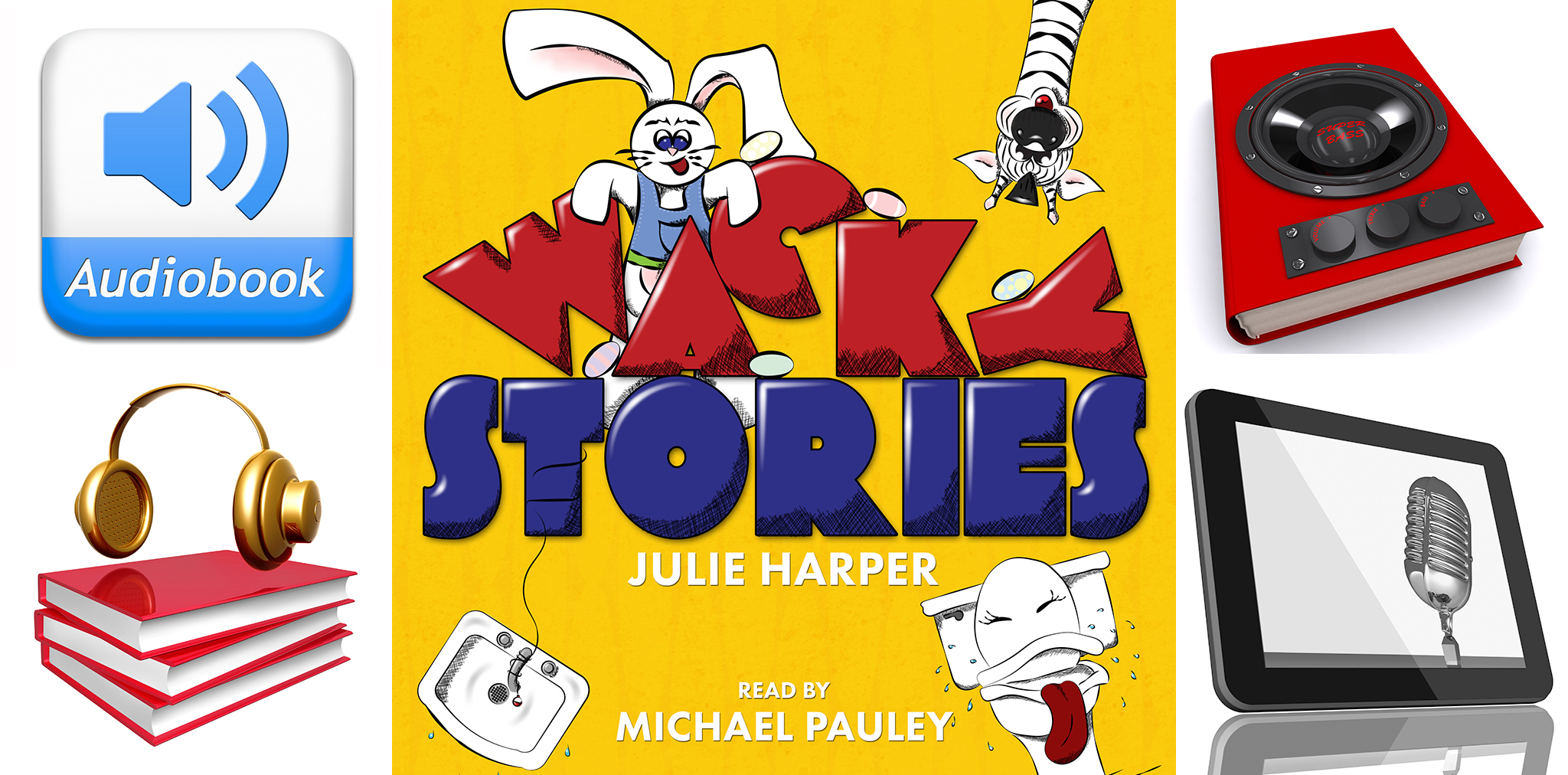
I recently got involved in the audio book development process. Author Julie Harper wanted to create an audio book for her new Wacky Stories collection. I was fortunate to be able to get involved in the process and get a firsthand look. The experience was amazing, so much that now I’m thinking of which of my books might be a good fit for this.
You start out by visiting the Audiobook Creation Exchange (ACX):
Log in with your Amazon account. (Wondering which one? Well, you should only have one. You can use the same account as a customer, at KDP, and even at Author Central. But if you didn’t, well, I guess you have to choose.)
Then you need to find a book that you’ve already published and is already available at Amazon. (For example, you can find this option from Projects > Open for Auditions > Assert more titles.) The title of your audio book will be the same as the title of the edition already published (in print or Kindle).
You can hire a narrator, try to sell the audio rights to your book, or narrate your own story (you’ll need sufficient equipment or access to a studio). Julie took the option to find and hire a narrator for her Wacky Stories, and it worked out far better than we were expecting.
Find a narrator by holding an audition at ACX. You need to provide a small excerpt from your book to serve as the audition script. Julie uploaded the first story of her Wacky Stories book for the audition. It’s a children’s story with animal noises (like “Moooo” and “cock-a-doodle-doo”). The narrators seemed to have some fun with this in the auditions. It was pretty cool listening to their performances.
The financial aspect of hiring a narrator includes two options:
Offer 50% of your audio book royalties, paying nothing up front.
Offer a fixed fee, payable upon completion of your audio book and before your audio book is available for sale.
There is no guarantee that you’ll sell any books. So if you wish to offer 50% royalties instead of a fixed fee, it may help if you can provide compelling reasons to believe that your audio book will sell. Note that the narrators will see your current Amazon.com sales rank when they find your book, so if your sales rank is in the millions, 50% of the audio book royalties may not sound like much. If your Kindle or print edition is currently a hot seller with many reviews, these are worth mentioning in the Additional Comments field. If you have a large following online, quote these numbers, too.
Julie selected the option to pay a fixed fee up front instead of 50% royalties. This is less risky for the narrator (but instead places the risk with the author). Julie’s Wacky Stories book is short enough (the reading time is 33 minutes) that it didn’t cost too much to produce the audio book. If you have a long book that would translate to several hours of reading time, a flat rate can get pretty expensive. You pay per finished hour (PFH). You offer a range of PFH’s when you make your audition available. Once you receive auditions, you can make a specific offer and negotiate the terms of the contract.
ACX pays a 40% royalty on the audio book list price if you distribute your audio book only through Amazon, Audible, and iTunes. ACX sets the list price. If you offered 50% of your audio book royalties to the narrator, you’ll effectively receive 20% royalties on your audio book sales. (If you know of other audio book distributors and have plans for significant sales through other outlets, in order to widen your distribution beyond Amazon, Audible, and iTunes, the royalty would be 25% instead of 40%.)
AUDITIONS AND PRODUCTION
I was able to listen to the auditions for Julie Harper’s Wacky Stories audio book, and was really impressed with the performances.
Julie made her audition available late in the evening. There were already 3 performances for that audition later the same evening.
And they were all amazing. Any of the narrators would have worked very well. They were actually better than we had imagined. This made Julie’s decision very difficult.
She selected Michael Pauley as the narrator, and was quite pleased with the production. I’ve listened to the Wacky Stories audio book, and I love Michael Pauley’s narration.
You can check out a free sample here (it’s fun to listen to):
At Amazon: http://amzn.com/B00W5PJIVU (Under the image of the cover, click the play button between Listen and Play Sample).
Once you offer a contract and it’s accepted, the narrator produces a sample chapter, and once you’re satisfied with that, the narrator completes the entire audio book (the deadlines for each are specified in the contract when you make your offer).
Be sure to set aside time in your own schedule when you begin the process. You’ll need time to listen to the audio book carefully when you receive it.
Once you’re happy with the audio book, you submit payment to the narrator directly (e.g. with PayPal; that’s between you and the narrator, and something you should work out in advance). Unless you picked the option to split the audio book royalties 50/50.
The narrator tells ACX when payment is received. Then it takes a few weeks for your audio book to become available at Amazon, Audible.com, and iTunes.
Michael Pauley
Michael Pauley narrated Julie Harper’s Wacky Stories audio book.
Every author can benefit from research in multiple ways.
Research isn’t just for nonfiction authors. It’s not just for the content of the book.
There are many kinds of research relevant for authors, including:
Researching the mechanics of grammar or style, or the art of storytelling, for example.
Researching historical, geographic, language, or other elements relevant to your plot.
Researching how people react to names, places, and ideas you’re thinking about using in your book.
Researching how beta readers react to your story.
Researching the potential market for your book concept.
Researching reader expectations for your genre.
Researching helpful marketing strategies.
Researching publication tips, like writing the blurb or designing the cover.
And, of course, researching content for nonfiction, educational books, or historical fiction.
Here are some examples of how research can help:
Any kind of research can be a helpful marketing point.
It demonstrates your motivation to write your book well.
Character sketches, idea bubbles, maps, etc. make for nice bonus material on your website.
Writing-related research helps show readers that a great deal of work goes into preparing a book.
It helps you develop a professional image as an author.
Research helps strengthen your author biography.
It gives you useful content to post on your blog or author website.
Bits and pieces of research here and there can help you build buzz or create a content-rich website.
Many of the things writers already do and take for granted can be presented as a form of research. And when presented as research, they can make a favorable impression upon potential readers.
PERCEPTION
The last fantasy and sci-fi novels that I read were immediately followed by about the author sections, and in each case the author section each author mentioned a great deal of research that had gone into preparing the book.
In one case (Jeff Wheeler’s Legends of Muirwood), even though it was a fantasy novel, I was intrigued to learn that the basis for much of the magic in the book related to Medieval Europe. It wasn’t just random. Most chapters of the book begin with a fictional “quote,” while the author’s note at the back begins by describing the author’s passion for collecting quotes.
In the other case, (Bob Mayer’s Area 51 series) the author had blended actual events with fiction. The author also demonstrated how the military component has authenticity and described his obsession with mythology.
Reading about how these authors had done their homework just after I finished reading their books:
It made me more eager to check out the next book in the series.
It made it easier for me to recommend their books to others.
It left a favorable impression just as I was about to head over and review the book.
Does your book involve other cities? Don’t you have to research the layout of the city? Don’t you have to research the culture, lingo, and accents?
Does your book involve a military component? Don’t you have to research the military? Don’t you have to research the technology?
How do readers know if your book is realistic? Showing that you did your homework helps. It can also help inspire reader interest.
Showing that you’ve done your research also helps to create a positive perception about you and your book. It helps you build a strong brand as an author.
Marketing that perception helps you play to your strengths. Have you done anything to master the art of writing or storytelling? Do you have firsthand experience regarding the setting of your book? Do you have any expertise relevant to any of the subjects involved of your book? If you do, it may pique a reader’s interest.
MARKETABILITY
Some research can help you make your book more marketable:
Keyword research. Visit Amazon.com and start typing keywords into the search field. You’ll see popular searches. Note that the results are different depending on whether you search within all departments, books, the Kindle store, a category, or a subcategory, for example. Results are also different for searches on Kindle devices. You should try a variety of possibilities. You want keywords that are specific (to help you stand out better), popular (so they get searched for), and highly relevant for your book (so you don’t get overlooked in search results).
What to write. Search for books that you might be a good fit to write. See what’s selling, what’s not. See if the market’s already flooded, or if there is a need that you can fill.
Packaging ideas. When you search for similar books, you come across a variety of covers and blurbs. These can help you get ideas (but don’t be a copycat), and can help you gauge what customers expect to see (though there isn’t just one kind of cover that signifies a particular genre). Follow other authors and you can learn some of their marketing ideas.
Content expectations. Read similar books to learn what readers are accustomed to in your subgenre (that doesn’t necessarily mean you have to do the same; but there are some features that most readers of a subgenre strongly want, so that can be helpful to know).
MY RESEARCH
I publish nonfiction, including math and science books. My background is physics, which I teach. I do all sorts of research for my books.
But, as you may know, I also have a sci-fi series that I’m working on. I’m in the beginning stages, and as I come across publishing decisions that I must make—like research—I’m sharing these experiences on my blog (with all the other kinds of posts that ordinarily write here). The image that I included with this post gives a subtle visual clue (though it will be set in modern times).
I’m doing much research to help write my series, such as:
Researching actual scientific data that may relate to extraterrestrial visitations of earth (in the past or present). Puma Punku in Bolivia, for example, has some fascinating finds. Most of such “evidence” isn’t necessarily “conclusive,” but can seem compelling and I find it fascinating. I want to know what my audience might know, and I want to make possible connections (after all, it’s fiction) that seem both deep and plausible.
Researching differences between writing fiction and nonfiction. I’ve been writing nonfiction avidly; obviously, fiction is quite different. I read a ton of fiction, especially sci-fi, fantasy, and classics, which will help. But writing isn’t quite the same as reading. For example, if there is a fight in my novel, I’ll need to describe the fight scene. (Fantasy author Charles Yallowitz gave me a great suggestion for this: Research some choreography.)
Researching sci-fi books in my subgenre that my readers are likely to be familiar with. I’ve already read some, but I’ve found several others. It’s kind of cool that the series that I’m writing is helping to fuel my own reading list.
And much more. I’ll save much of my research, including the details. It’s not just for writing the series, but much of it also figures into my marketing plans. You’ll see if you follow along.
CHANCE TO WIN 4-BOOKS-IN-1 ON SELF-PUBLISHING
You can win my 4-books-in-1 paperback book on Self-Publishing with Amazon.
This is an Amazon Giveaway hosted by Amazon. If you win, Amazon will fulfill the order and ship your prize directly to you. Click the following link for your chance to win. Every 300th entrant will win. Up to two winners.
NO PURCHASE NECESSARY. Ends the earlier of Mar 25, 2015 11:59 PM PDT, or when all prizes are claimed. See the Official Rules at http://amzn.to/GArules.
READING SURVEY
If you haven’t already done so, please participate in a survey on how people read books. The more participation we get, the more meaningful the results will be.
Here is one question, for your convenience. (If you’ve already answered this before, please don’t answer it a second time.)
This is one of the perennial questions authors face, even long after first making the decision. Once you choose, you question your decision, and wonder if the grass is greener on the other side.
But that first decision is important. More important than you realize at the time.
It seems intuitive that if self-publishing doesn’t work out, you can try traditional publishing later. Or vice-versa.
You can, but there are some complications that you don’t tend to realize at the time of that critical decision.
So before we discuss the pros and cons, and consider which option may be the best fit for your needs, let’s examine some of those complications.
SWITCHING: NOT SO FAST
Many authors self-publish first because that path seems easier to take. Then later, if their books aren’t selling, they wonder if they should switch to traditional publishing.
But there’s something they should know before the decide the first time:
First Rights vs. Reprint Rights
Traditional publishers and literary agents prefer first rights.
That is, they prefer to publish books that have never been published before.
Once you self-publish, you can no longer sell the first rights to your book.
Now you’re selling reprint rights, which are much harder to sell.
If your self-published book isn’t selling, why would a publisher want to invest in it? You need to convince a publisher that your book will sell. That’s nearly impossible when a simple search on Amazon shows the publisher that your book isn’t selling.
Even if your self-published book is selling, it has to really sell like hot cakes to interest a traditional publisher in reprint rights. And if that’s the case, why would you stop self-publishing? If you can sell thousands of books per week, you might interest a publisher in picking up your title. But why on earth would you do that if you can sell in large volume all on your own?
If you have moderate sales, that’s not attractive for reprint rights. Maybe those are all the sales you’ll get. The publisher has missed out on the initial splash. Why pick up the leftovers?
Switching from traditional to self-publishing carries its own challenge.
In this case, the difficulty lies in getting the rights to your book. The details lie in your contract. If and when rights do revert back to you, that doesn’t mean you’ll receive a copy of an editable file with all the editing and formatting built into it. Rather, you’ll probably start over with the formatting. And you’ll probably need a new cover.
BUT YOU CAN SWITCH: HERE’S HOW
There are a couple of ways that you can make the switch successfully.
The trick is to realize this before you first make the decision about whether to self-publish or publish traditionally.
Shop your book to an agent or publisher first.
This may even have its advantages if you’re already leaning heavily toward self-publishing.
If your book doesn’t wind up getting published traditionally, you’ll be able to self-publish instead. What’s the rush? If instead you self-publish first, you’ll lose your chance to sell the first rights to a publisher, which makes it hard to switch to traditional publishing.
Therefore, if traditional publishing is important to you or is something you’re strongly considering, you might explore agents or publishers first, and then self-publish if either you don’t find an agent or publisher or if you land a deal, but don’t like the terms.
While you’re shopping your book proposal around, you can write more books and get your online author platform going. This way, if after several months you decide to switch to self-publishing, you’ll be much better prepared to do it. Plus, the process of writing query letters and book proposals and thinking about the business side of your book will help you when it comes time to preparing your book description, back cover text, biography, marketing, etc.
You learn some valuable skills in the process. It may be worth going through even if you had been leaning toward self-publishing.
Write multiple books and use a pen name.
The alternative is to self-publish one book in one name, and if you decide you want to explore the traditional publishing route, write a different book in a different name.
There are actually many authors who do both—self-publish and traditionally publish.
Even if you do land a publishing deal, most authors write many more books than they can get published traditionally, so self-publishing offers a way to publish all of your books.
You get the best of both worlds by creating two brands as an author—one brand as a self-publisher, and another as a traditional publisher.
You’ll probably find it easier to market your self-published book using your own name (or a nick name).
SHOULD YOU SELF- OR TRADITIONALLY PUBLISH?
The main differences are:
Do you have a book that’s particularly well-suited for library use or bookstore purchases?
If so, if you can get your book traditionally published, there is better library and bookstore potential.
It’s not about hoping that it will sell in bookstores.
It’s about knowing that your book will thrive in that environment. If you have a great marketing plan for sending customers into bookstores across the nation, that will help a lot. Certain kinds of books sell this way.
Your book won’t wind up on an endcap. It won’t appear on the top shelf with the front cover facing the customer. It won’t have a dozen copies on the shelf.
Your book will have limited visibility. It will be buried among many others on some shelf. It will have a limited shelf life unless you succeed in driving sales in bookstores.
Certain kinds of books attract library use. Again, if you have a great marketing plan for how to send people across the nation to their local libraries to inquire about your book, that’s a huge plus.
Otherwise, what is a publisher really doing for you? Many publishers don’t do many of the things that authors hope they will do.
Unless you’re already a bestselling author or celebrity. And if you are, I can’t believe you’re over at my humble blog reading this article. 🙂
Even if you have a book well-suited for sales to bookstores or libraries, you need to convince a publisher or agent of this. If not, you can still sell books to libraries and bookstores as a self-published author. Distribution isn’t as easy, especially on a very wide scale, but there are self-published authors who’ve done their homework on this and who do sell many copies this way, especially to local and regional stores (not necessarily bookstores).
However, note that bookstore distribution isn’t guaranteed even with a traditional publisher.
Are you an author of a textbook or other academic resource?
There are advantages of publishing textbooks and educational resources through major textbook publishers.
For example, if you can get classes around the country to adopt your textbook, that can be huge for sales—especially if they are fundamental courses that most students take. Many textbooks are peer-reviewed and heavily researched, which appeals to teachers. Most instructors adopt textbooks that are traditionally published. It’s much easier to get a traditionally published textbook adopted by a college bookstore.
Whether or not you can land the deal is another question. Textbook publishers will likely scrutinize your resume. The strength of your resume, and current position, may weigh much higher than your content knowledge and communication skills.
Supplemental materials can sell quite well even if they are self-published. Your resume is more likely to impress a customer at Amazon than an editor for a publishing house (where all the proposals come from professors).
Do you have a scholarly or more literary fictional work?
This gets a little tricky because publishers want to publish books that are most likely to sell.
But publishers also need well-written scholarly and literary works to help build their brands and show customers that they have quality material to deliver.
No matter how you publish, many literary pieces may find sales hard to come by, but you might find your market more easily with traditional publishing.
Still, landing the publishing deal and finding readers in the more scholarly, literary market can be tough.
Do you have a resume that will appeal to a traditional publisher or literary agent?
Are you a celebrity? Celebrity status can help to land a publishing deal. But if you have a huge following, that can help you as a self-publisher, too.
Are you a nonfiction author with an impressive resume? That may appeal to traditional publishers. Though again, that resume can be a marketing asset even as a self-publisher.
Are you the perfect person to carry out your book idea? If you can convince a publisher that you have a book idea that will really take off, and you’re the perfect person to write that book, this can help you get published.
But:
Do you have a great book idea, but you might not be the best person to carry it out?
Then here is what may happen.
You might submit your book proposal to a publisher.
The publisher thinks, “That’s a great idea. But we need someone with relevant expertise to write this book.”
Guess what’s going to happen? Your proposal gets rejected.
Then a couple of years later, you see a book in the bookstore very similar to your proposal, written by someone with expertise on that subject.
No, it’s not plagiarism. They didn’t copy your book word for word. They took the overall idea, which you can’t copyright, and did something similar. Not so similar as to get sued for plagiarism. They probably changed your idea and made it even better.
Do you have some other goal or need besides reaching readers and selling books?
Maybe you just want to see your book on a bookshelf in a bookstore or library.
Maybe you just want to see a major imprint’s name on the spine of your book.
Maybe you want the status of being published traditionally.
Maybe you want to experience the feeling of getting accepted through a process that has a huge rejection rate.
These are reasons to favor traditional publishing, even if sales might be better otherwise.
Or…
Maybe you want to write a unique book that’s not likely to have much of an audience.
Maybe you have a time-sensitive topic that needs to reach the market quickly.
Maybe you have an idea for a series of books that you intend to publish once every month or two.
These are reasons to favor self-publishing.
IN A FEW WAYS, SELF- AND TRADITIONAL PUBLISHING IS THE SAME
A few things are equally tough no matter how you publish:
There is no easy path.
Traditional publishing requires learning about query letters, book proposals, and possibly approaching an agent. It takes much patience, persistence, and many queries. You must think about the business side of writing, as this interests the publisher. There is a lot of extra work that you must do besides just writing.
Self-publishing isn’t an easy alternative. Sure, you don’t have to worry about rejection letters. But do you actually want to sell books? If so, you need a marketable idea, you need to research your genre, you need to learn about your audience, you need to edit, you need to format, you need to design a cover, you need to package your book, you need to learn about marketing, etc.
No matter what, it takes self-motivated diligence to succeed as a writer. Neither self- nor traditional publishing offer an easy way to do it.
Marketing is your responsibility.
No matter how you publish, marketing is up to you, and it generally takes good marketing to sell books.
Publishers invest most of their marketing budget in bestselling authors and celebrities, i.e. books that they feel are most likely to sell.
Many new authors have the unrealistic expectation that publishers will market their books for them. You might benefit a little, but in general it’s largely up to you.
If you want to improve your chances of getting a second book published, you need to help your first published book sell very well.
Personal interactions can be a new author’s best asset. Nobody else can do this for you.
A writer’s life comes with challenges.
If you explore the traditional published route, you’re likely to receive many rejection letters.
No matter how you publish, your book will eventually receive public criticism in the form of reviews.
Criticism is a challenge that all authors face. You can run, but you can’t hide.
Earning good money from royalties won’t be easy.
It’s hard to sell books whether your self-publish or traditionally publish.
Even if you breakthrough and land a publishing contract, most authors still make much less from book royalties than most people realize.
However, you can get a decent advance (say, $1000 to $5000) if you land a publishing deal. You might not earn anything beyond that, but at least you have a chance to earn something up front.
With self-publishing, you can earn up to 70% royalties (via Kindle), compared to a typical 5 to 15% for traditionally publishing. A traditionally published book sometimes commands a higher price point, but self-publishing royalties can be lucrative. Either way, the challenge is to sell books. If your book doesn’t sell, it really doesn’t matter what your royalty percentage is.
Self-publishing pays you as your books sell. There is no advance. And there is no guarantee of sales.
IN WHICH CASE DO YOU HAVE A BETTER CHANCE OF SUCCESS?
Except for the special cases I noted previously that may favor traditional publishing…
Your best chance of succeeding as an author is:
to self-publish multiple similar books with a very long-term plan and marketable ideas
to self-publish multiple similar books and also traditionally publish under a pen name
If you happen to win the traditional publishing lottery, selling hundreds of thousands of your first book so that you become one of the very rare bestsellers that will gain premium bookstore exposure and publisher marketing, then traditional publishing can be very lucrative.
Or if you plan to only write one or two books and then quit… This greatly limits your chances of success no matter how you publish. You might get the most out of it by traditionally publishing.
But most authors who get traditionally published will be midlist authors, in which case it will take a lot of books to generate a lot of sales. And self-publishing is best-suited for publishing several books. You can publish some traditionally and others with self-publishing, or you can self-publish all of them, but your best chances of succeeding as an author are to include self-publishing at least as part of your long-term plan.
The key is that no matter what you need to:
think very long-term
have self-motivated diligence
be very patient
do your research before you write
be willing to learn and apply marketing strategies
produce quality content
But if you’re willing to write several similar books, figure out what your audience wants, gradually develop a professional author platform, focus on long-term publishing goals, and learn how to market your book, such self-motivated diligence naturally lends itself to self-publishing and gives you a healthy long-term edge. Things may start out very slowly, but there is much potential for the author who does his or her homework, produces quality content, and write several similar books.
These same skills can help with traditional publishing, too. But you may find it difficult to get all of your book ideas traditionally published, so even if you publish traditionally, you probably want to self-publish on the side, too (probably under different names).
CHANCE TO WIN 4-BOOKS-IN-1 ON SELF-PUBLISHING
You can win my 4-books-in-1 paperback book on Self-Publishing with Amazon.
This is an Amazon Giveaway hosted by Amazon. If you win, Amazon will fulfill the order and ship your prize directly to you. Click the following link for your chance to win. Every 300th entrant will win. Up to two winners.
NO PURCHASE NECESSARY. Ends the earlier of Mar 25, 2015 11:59 PM PDT, or when all prizes are claimed. See the Official Rules at http://amzn.to/GArules.
READING SURVEY
If you haven’t already done so, please participate in a survey on how people read books. The more participation we get, the more meaningful the results will be.
Here is one question, for your convenience. (If you’ve already answered this before, please don’t answer it a second time.)








 chrismcmullen