
The Importance of Facial Expressions for Authors

Facial Expression

There are a few ways that facial expressions are very valuable tools for authors:

  1. People pictured on the book cover.
  2. Author photos online and in the book.
  3. Interacting with people in the target audience.

Body gestures go hand-in-hand with the facial expression, even in still photos.

(1) Book Covers

A simple, subtle thing like a facial expression can make the difference between an amazing cover that attracts attention and a lousy cover that gets passed by. I’ve seen covers with eye-catching colors, amazing imagery, interesting fonts, and did everything right except for the facial expression. Unfortunately, the facial expression can be quite influential.

Would the following facial expressions compel you to buy a book that you discovered?

  • Blank expressions make prospective buyers feel dull and lifeless. Is that what the book will be like?
  • Lack of emotion makes the model seem bored. The model wasn’t too interested in the book, huh?
  • If the displayed emotion doesn’t fit the theme, it can have an adverse impact on sales.
  • If you want to design an awful cover, just photograph somebody who is yawning. (Unless perhaps you’re selling a book that relates to boredom…)

The right facial expression can put the potential reader in a good mood. Many shoppers are impulsive to the point that the right facial expression can actually help to inspire sales; whereas the wrong expression can greatly deter sales. Even an expression that usually puts people in a good mood is poorly suited if the writing is horror. Everything has to fit.

The expression has to match the content. For example, a model would have a different expression for historical romance than romantic comedy.

Remember, gestures are just as important as facial expressions. The pose has to look realistic. It shouldn’t look like the model is posing for a family picture. For an action book, it should look like an action shot; but it has to look real. The pose has to fit the genre; an action shot won’t look appropriate on many other kinds of books.

Study the facial expressions, poses, and gestures of the models on top selling books in the genre that have highly attractive covers. Get plenty of honest feedback about the cover prior to publishing.

The answer is not that three-letter word. There may be plenty of magazines and other items selling that three-letter word effectively. But if the book isn’t erotica or doesn’t include such scenes, it’s not really selling that three-letter word. Instead, this sort of appeal on the wrong book can create buyer confusion, which deters sales. Very often, it is overdone on a book where the audience really isn’t look for it, and it doesn’t have the intended effect. (There is also possible embarrassment if someone else sees what they are currently reading.)

Think about this: If a girl is dressed up like a barbarian in combat, does it look better if she is smiling flirtatiously at the audience or if she looks like she is focused on the battle? Should she have bright red lipstick on her lips and a clean face, or should she appear battle-scarred?

(2) Author Photos

Many authors include their photos on their books’ Amazon detail pages. They may also appear on their blogs, social media sites, and an About the Author section inside the book itself.

Just like front cover characters, the facial expression and gestures are important on the author’s photo. These help convey whether or not the author should be taken seriously, and seems like someone who could write such a book. A professional looking author photo helps to send the message that the author is, in fact, professional. The photo can convey a sense of personality, but only if it fits the kind of writing that the author sells.

Would you feel compelled to buy a book from an author who looks bored or disinterested?

(3) Personal Interaction

Potential readers can meet authors at book readings and signings. Anytime authors interact with people who might read their books, their facial expressions and gestures can influence sales.

When people from the target audience sense an author’s passion, knowledgeability, devotion, preparation, and genuine interest in them (i.e. they feel special), such things impact sales.

Just like great characters can sell books, authors’ personalities can also help to encourage or discourage sales. The personality also needs to fit the writing.

Imagine an actor or actress who is so passionate about a part that he or she is playing that it carries over to his or her interactions with friends, family, and acquaintances. Similarly, an author’s passion for his or her own book can carry over this way, showing through facial expressions and gestures.

Chris McMullen, self-published author of A Detailed Guide to Self-Publishing with Amazon and Other Online Booksellers
Cover Art Critics

Cover Critics

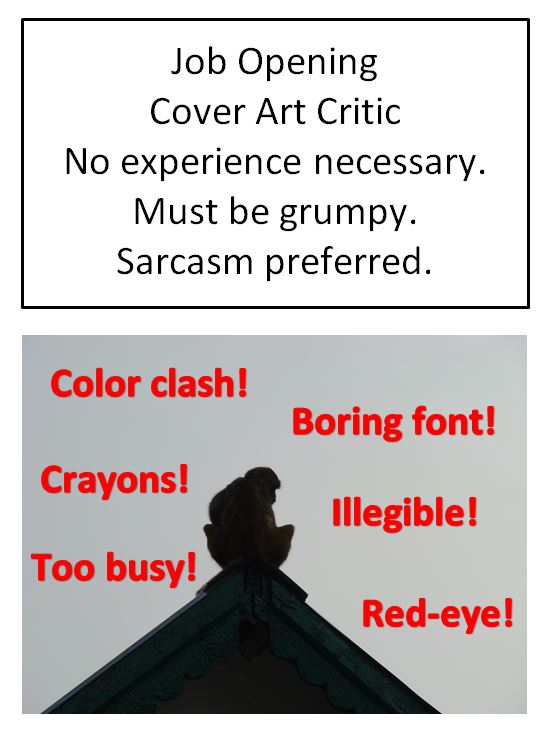
The self-publishing revolution has brought forth a generation of cover art critics. It seems that there are many more cover art critics than there are art critics.

To be fair, they also criticize traditionally published covers, and a few of the best covers out there are actually on self-published books. However, the reality is that the vast majority of lousy covers are on self-published books.

Anyone can be a cover art critic. No talent for cover design is needed to form an opinion.

But that’s the point. Don’t create a cover to satisfy the critics. Instead, create a cover that will please potential readers. Back to the point: All potential readers are cover art critics! Complaints that are common among the cover art critics tend to deter sales because many readers feel the same way.

Here are some common complaints:

(1) Can’t tell what the book is about!

(2) Text is illegible!

(3) Colors don’t work well together!

(4) People look deformed!

(5) Used crayons or colored pencils!

(6) Photo-bombing image!

(7) Used Comic Sans for font!

(8) Aspect ratio is distorted!

(9) Illustrator’s name appears on a lousy cover!

(10) Image appears blurry or pixelated!

(11) Cover is too busy!

(12) Fonts are boring!

(13) Hard to read fonts!

(14) Wrong words emphasized in title!

(15) Three different fonts used!

(16) Images have nothing in common!

(17) Settled for image that doesn’t quite work!

(18) Doesn’t look good both full-size and as thumbnail!

(19) Red-eye!

(20) Typo in title!

(21) Poor drawing skills!

(22) Poor photography skills!

People do judge books by their covers. As they should! At least to the extent that buying a book where the author or publisher didn’t put much effort into the cover is a risk: If little effort was put into the cover, there isn’t any reason to expect that greater effort was put into writing, editing, and formatting.

The cover is a marketing tool. Customers do browse for books in search results and click on thumbnails that interest them. Trying to avoid common cover design mistakes may pay off. It’s challenging to design a perfect cover, and any cover – no matter how good – can still be criticized. It’s much easier to find fault in a cover than to make a cover without fault. (No wonder there are more cover art critics than there are great covers.) But the cover is very important, so striving to design a great cover is worth the effort.

Chris McMullen, self-published author of A Detailed Guide to Self-Publishing with Amazon and Other Online Booksellers (Volume 2 now available)

What’s the Deal with Mannequin Covers?

A growing number of indie covers are featuring mannequins. Is this good or bad?

It’s a challenge to design a great cover. Indie authors don’t have the luxury of a cover design team or much money to invest in professional help, yet covers can be very important for the success of a book. Thus, many authors who are inexperienced artists are suddenly faced with the task of putting a great image together for the thumbnail and front cover.

This is no easy task, and the cover art critics are fierce:

  • Anything hand-drawn is deemed fit for a refrigerator, but not for a book.
  • Any photo in the foreground of a nice background is deemed a photobomber.
  • Highly detailed artwork is said to make the cover too busy.
  • Deformities in fingers, hands, limbs, or faces are ridiculed.
  • When the aspect ratio is tweaked slightly to fit the cover, it’s cursed for distortion.
  • If a person happens to strike an odd pose, even this is pointed out.
  • The photos must be cleaned up and professional, else the technique will be criticized.
  • Indie authors are supposed to know to use just three colors in a ratio of 60-30-10.
  • Colors must work well together, with the title large and easy to read.
  • You also need to watch out for the font police, who can be very picky.
  • But if the images don’t relate to the content, that’s a serious violation.

Drawings pose an instant problem. Taking your own photos requires professional skill. There are many stock photos available, but not always in the pose or colors that you want. To top this off, you must find images that signify the genre and relate to the content.

So what’s the solution? Maybe this is why more indies are featuring mannequins on their covers. It’s much easier to manipulate a mannequin with a graphic arts program. They are easy to adjust, clothe, maneuver, touch up, and preserve proper shape and size. Some of these mannequin covers are very well done, so much so that I didn’t realize that they were mannequins at first.

But now I see the cover art critics blasting indie covers that feature mannequins. For example, are there mannequins on the cover because it’s a romance between mannequins?

I actually hired an illustrator to design a cover for an upcoming fictional book, for which I was completely stumped on the cover. The result looks great, but the main image does look a little like a mannequin. I’m going to keep it, for better or for worse.

What’s your opinion? I’d love to hear your take on these mannequin covers. Is it good, is it bad? If you made it to the end of this post, please feel free to take a minute to express your opinion. Your opinion is welcome (encouraged even), and won’t likely offend me or the mannequins. 🙂

Chris McMullen, self-published author of A Detailed Guide to Self-Publishing with Amazon and Other Online Booksellers

Indie Cover Mistakes

The book cover is the only part of an indie author’s marketing campaign that every potential buyer has to see before purchasing the book. No wonder cover design is critical toward having a highly successful book.

“Hey there!” Just like that, the cover aims to grab attention, but in a positive way. Once it claims attention, it must be appealing, look professional, be clear, reveal the book’s content, and ultimately persuade the potential buyer to “pick me.”

There are many ingredients to a great cover, and just one flaw can turn a potentially great cover into a lousy one. Here are some common mistakes that indie authors make:

  • Text is hard to read. It seems intuitive to look for a fancy font, but the purpose of the text is to send a clear message. Rather than struggle to make out what the title or other text says, the prospective reader is more likely to look for a different cover that makes this task easy. Some text, like Comic Sans, even tends to evoke negative reactions from readers. Research which fonts are appropriate for cover design and for your genre. Wikipedia even provides statistics for how readers react to various fonts.
  • Poor image quality. Blurry, jagged, and pixelated images are quite common. So are tiny stray marks around text and images. Find sharp, focused images and clean up any quality issues to make the best impression. Photos should be touched up (e.g. no red-eye), well-lit, and precisely cropped. Use images with sufficient resolution (300 DPI for printed covers). Don’t distort the aspect ratio by changing the shape of an image (models with stretched out faces, for example, don’t sell books). If the cover image or text is poor, people will wonder if the content also has quality issues. Customers looking for professional content prefer professional-looking covers.
  • Emphasizing the wrong words in a title. It should seem logical to emphasize – through larger text or some text effects – a few key words in the title, which relate to the text. Yet it’s a common mistake to make short, meaningless words (like “the”) larger and long, meaningful words smaller – simply because the longer words had to be smaller in order to fit on the cover. But the most important words need to be the largest. The title must be larger than the subtitle. The author should be smaller than the title or subtitle – it’s just a minor ingredient to the cover (except for celebrities and popular authors). If there are several words in the title (bestsellers often have three or fewer), emphasize a few key words over the other words in the title.
  • The cover is too busy. It’s intuitive for indie authors and illustrators alike to feel the need to fill every void on a piece of paper. Especially, artists who have a gift for artistic detail want to show this talent off. But a great cover isn’t about the art itself. It’s about grabbing attention and conveying an idea – this book is about that. One image and a few words can convey this image effectively. Extra images distract the reader from the central concept, and require the customer to invest more time and effort to determine what your book is about. Look, there are thousands of books to choose from and customers are browsing through hundreds – they are likely to pass on those that don’t send a clear, quick signal.
  • Poor color choices. A great cover often utilizes three main colors. A primary color (60%) will create good contrast with a secondary color (30%), and include an accent color (10%) which complements either the primary or secondary. The two main colors shouldn’t clash; all three colors should coordinate well together. The text color and main image should stand out very well against the background.
  • Something looks unnatural or out of place. It’s a common mistake to place an extra image in a cover that just doesn’t seem to belong there. The indie author is trying to add an additional image that relates to the content, without realizing that the distraction isn’t worth this. An image in the foreground that ruins an otherwise nice cover is said to be photobombing the cover. Look out for potential photobombs. Use of a transparent foreground image can also result in a distracting background object. For example, if a small image in the background happens to be inside the head of a model in the foreground, this will ruin the cover.
  • Text arranged in a way that is difficult to read. It’s not easy to read text that is arranged vertically – either one word above another or, even worse, one letter above another. At the very least, don’t create special effects like this for every word in the title. When customers are browsing through hundreds of covers, they tend to skip the ones that don’t send quick, clear messages.
  • Hand drawings that aren’t expertly done. Crayon and colored pencils create a poor impression. Even handmade art that is fairly well done has a tough time competing against the amazing possibilities of graphic arts. It’s a much greater challenge to make a cover appear professional when images are made by hand. Let the customers see any slight fault in the cover and you’ve given them a reason to pass on the book.
  • Title and cover don’t relate to the content or genre. If the cover attracts the wrong audience, nobody will purchase the book. The cover and title both need to signify the precise audience (e.g. adult romance should not be confused with erotica or young adult romance), and should relate to the content of the book. Research the covers of top-selling books in your genre to see what those readers are accustomed to seeing. Which cover designs, color schemes, and font styles tend to work well in this genre?

I’m a self-published author myself and I enjoy designing my own covers. But I didn’t write this article with my own design skills in mind. Rather, I’m also an avid reader, and I know which covers tend to attract my attention, what mistakes I have seen when browsing through books, and what aspects of cover design tend to work for me or turn me off when I’m shopping for a book. I’ve also done some research to learn more about cover design. I’ve come across some very professional indie covers out there, and seen some amazing designs from graphic artists. I do enjoy designing my own covers, and have experienced many of these challenges firsthand (and also experienced a few of these mistakes, such as making a cover that’s too busy). If you’re an indie author, may you learn from and avoid some mistakes that others have made. 🙂

Chris McMullen, self-published author of A Detailed Guide to Self-Publishing with Amazon and Other Online Booksellers