Writing Is a Bad Romance

Bad Romance


It’s so easy to fall in love with writing.

Writing seduces you without you ever knowing it.

Subtle is its game; it doesn’t allure you through money, sex, or glamour.

Rather, it just seems like a good friend that grows on you.

You don’t realize you’re married to writing until your case is hopeless.

Writing: You can’t live with it, nor can you live without it.


The passion to write consumes you.

You must give it your full attention.

Even the slightest distraction must be avoided.

Just you and your writing. Alone. Together.

Long passionate nights writing and writing and writing.

It’s constantly on your mind.

You pull over in the car to write it a love note.

In the middle of the night, you wake up thinking about it.


It’s too much for you to keep it bottled up inside.

You crave to share your passion for writing with the world.

So you post articles on your blog.

Write a short story. Begin a novel.

You publish. You put your heart on your sleeve.

Now your writing is no longer a private affair.

Being a published author is like a celebrity dealing with the tabloids.

You thought the paparazzi didn’t care about small-time writers.

Oh, but they do. And, boy, do they ever.

Not only does everyone know about your writing relationship,

But everyone seems to have an opinion on it.


Your book is too different. We don’t like change.

Your book is too similar to what’s already out there. Such a copycat.

The sentences are too simple. Grow a vocabulary.

The sentences are too complex. Make it easy to read.

Your characters are too real. Show some imagination.

Your characters are unbelievable. We can’t deal with that.


Entertain me. Engage me. Hold my attention. Captivate me.

Have me begging for more.

Make me laugh. Make me cry. Anger me. Move me.

Give me a better life.


Design a perfect cover. Write a killer blurb.

Sell me your book with a gripping Look Inside.

Edit your book immaculately.

Write like a master wordsmith.

Develop intriguing characters.

Wow me with a sensational plot.

Market so I can find your book.

Is it too much to ask?


So many months of passionate writing.

More months of grueling editing.

Cover design, proofreaders, writer’s forum, blurb development.

Formatting, publishing, revising, learning.

Buzz, review copies, blogging, social media, website.

All that hard work, effort, imagination, and passion.


For what?

To sell a few books, then a lot, then a few, then a lot.

For praise, then criticism, more praise, more criticism.

For a few choice words to sting you like a poisoned dagger!

For that? Really? For that?

For a complete stranger to say two magically fantastically wonderful words.

Thank you.

To touch readers around the world.

To share your joys, your passions, your ideas.


Because you never, ever, ever, ever had a choice.

Writing had you when you first picked up your pen.


Chris McMullen, author of A Detailed Guide to Self-Publishing with Amazon and Other Online Booksellers, Vol. 1 (formatting/publishing) and Vol. 2 (packaging/marketing)

Whether you love writing or reading, Read Tuesday is the perfect occasion to celebrate either. Check it out.

Testing out Amazon’s new Kindle Countdown Deal

Cover Pages

I’m trying out Amazon’s new Kindle Countdown Deal for a couple of my lesser-known books. I’ll save the great deals for Read Tuesday. 🙂

The ‘proper’ way to do this would be to plan it much further in advance, build buzz for your promotion, promote it actively the day of (and maybe the day before, too), and recruit help promoting your discount (this is why you need to plan far in advance) from bloggers, websites, and any of your contacts willing to help you spread the word among your target audience. You might even consider investing in an advertisement that would get you plenty of exposure among your target audience.

However, the tool is also new, so although the books that are taking advantage of the countdown deal already haven’t had time to plan for the promotion, they may be getting a lot of initial traffic from the many people who are checking it out. Once this effect wears off, you’ll definitely need to plan ahead and promote effectively to get the most out of this.

I chose a couple of my lesser-known books that don’t tend to sell well for my experiment. Partly, I wanted to save my more popular books to help, in a tiny way, entice a little Read Tuesday traffic. Also, sometimes an experiment on a book that ordinarily doesn’t sell well on its own can provide a revealing marketing outcome.

One of the two books I chooe had been in free promos in years past, so I’ll be able to compare those results to the results of the Countdown.

Who else is testing out this Countdown Deal in the near future? (Not everyone is eligible. First, you need to be enrolled in KDP Select. If you’re just joining or rejoining KDP Select, you must wait 30 days. Even if you’re already in KDP Select, if you changed your list price in the last 30 days, you must wait, too. If your enrollment is expiring or renewing soon, that may also affect when you’ll next be eligible. Your list price must be between $2.99 and $24.99 in the US, for example, in order to be eligible.)

If you’re testing it out this week, I’d like to hear about it. Maybe I can find an excuse to mention it in a relevant post. And the combination of my data with your experience might be relevant for a future post. So if you’d like me to possibly discuss your promotion and your experience with it, please let me know.

The two books I’m trying out are:

(1) Formatting Pages for Publishing on Amazon with CreateSpace, Chris McMullen, B00BGPK70G, February, 2013. This book is geared specifically toward using Microsoft Word 2010 to format a paperback book for publishing with CreateSpace. It’s a short, concise book (104 pages in print, but the paperback version is 5″ x 8″ and divided into several chapters and includes figures, so the written content is much less). One reason that it doesn’t sell well is that my Detailed Guide is a better value, being much more detailed. Also, I don’t market the Formatting Pages book. I’m curious to see if the Countdown tool has any impact on a book that ordinarily doesn’t sell much.

(2) Far Out Multiplication Flash Cards 1-12 (Decorated with Solar System Photos), Chris McMullen and Carolyn Kivett, January, 2012. This flash card set is a book, not a game. The first half of the book consists of 1 x 1 thru 12 x 12 in order with the answer immediately following the question. The first half is designed for kids to practice and memorize. The second half has the cards shuffled, still with the answer following the question. Here, kids test their memory by checking the answer on the next page. The cards are visually decorated with solar system photos. There are two reasons that this book doesn’t sell much. First, I have another multiplication flash card book that has 11 reviews, while this one has none, so naturally people tend to buy the one that has all the reviews. Second, this book used to be more expensive than my other multiplication book, so the other multiplication book has a history of more sales (the other book is also part of a complete set). They are now the same regular price, so this book is actually the better value because it goes up to 12 x 12 instead of 10 x 10.

In the past, this flashcard book always did well with the free promo (over a thousand books in the good old days when KDP Select was new, and hundreds in later months), so I have something to compare it with. The free promo generally resulted in a boost of sales afterward. So I’ll be able to compare the overall effect on royalties, too.

Both of these books are presently $2.99 in the US and will be 99 cents during the Countdown promotion. The Countdown will be all day on Tuesday, November 5, Pacific Daylight Time (PDT).

In the UK, the price will be 0.99 pounds (I actually had to raise the price of one book slightly to make it eligible).

Both books have pictures, so the delivery fee is 50 to 60 cents on each book. This is important because my royalty during the promotion would actually be higher at 35% than at 70%. KDP doesn’t show you what your royalty would be during the promotion. So it’s worth checking your delivery fee and doing the math first. You’d hate to learn later that you were making one penny per sale!

So I first changed the royalty rate to 35% and republished. You can add the Countdown Deal while it’s republishing (check the box and select the Actions button on your Bookshelf). Note that you must change your royalty option at least 24 hours before your promotion begins.

Here is what you should do:

  • First try to create a Countdown Deal to see what dates you’re allowed to choose. This way you won’t waste your time for a promotion that you’re not allowed to schedule.
  • Next, check your delivery fee.
  • Now calculate your royalty at the promotional price. Subtract the delivery fee and then multiply by 0.7, like ($0.99 – $0.60) x 0.7 = $0.27. (If you don’t normally earn 70%, skip this step and the next step.)
  • Compare this with what you would make at 35%. If 35% gives you a higher royalty, you must change your royalty rate at least 24 hours prior to the start of your promotion.
  • Finally, schedule your promotion. Be sure to choose the start and end times in addition to the dates. See how many hours your promotion will last before you confirm. It would be very easy to accidentally make your promotion last just one hour without even realizing it!

Chris McMullen, author of A Detailed Guide to Self-Publishing with Amazon and Other Online Booksellers, Vol. 1 (formatting/publishing) and Vol. 2 (packaging/marketing)

Planet Flash Cards Multiplication Cover Thumbnail

Attending a Book Fair

20131102_104248


Allow me to share my own experience, while also providing a few tips for what you might do when you attend an author event.

First, let me provide a little background for the event I attended.

Reading on the River

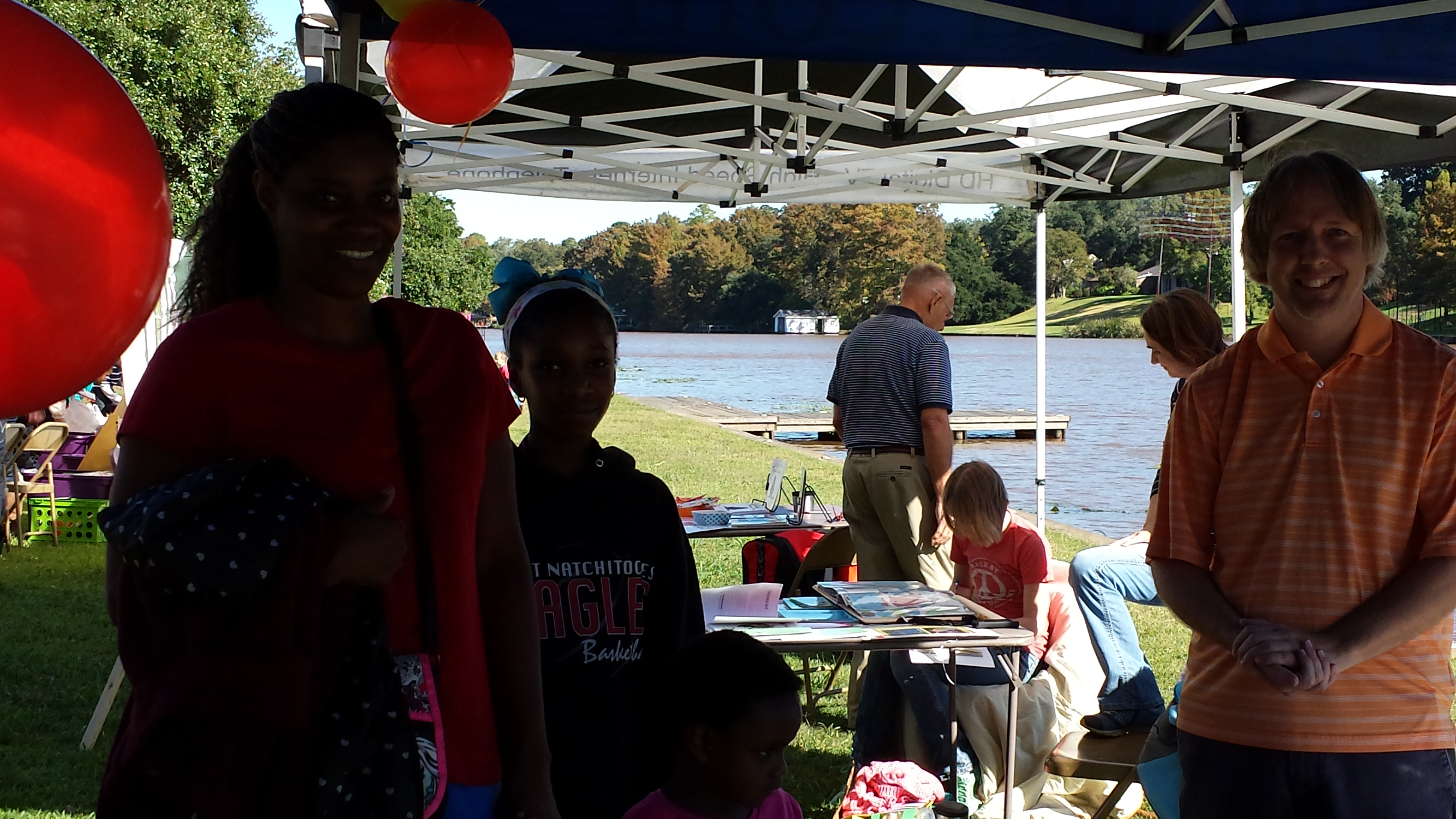
I attended a local reading-oriented event for children today called Reading on the River. There were a couple of hundred children and their parents. They had several reading-related activities sponsored by preschools and daycare centers, a magic show on stage, and even Smokey the Bear and a D.A.R.E. lion. Authors of children’s books were also invited (even little ole me).

They had given me information and forms to fill out a few weeks ago. They set up the tent, table, chairs, and even prepared the board shown above (it was placed in front of the pole, but after it blew over from the wind, I placed it between the poles; the aesthetic problem of the pole blocking part of the sign is totally my own fault).

What to bring?

First, do a little research to learn more about the event. What will be going on? What have other authors done in the past? Who will be attending? What is attracting these people to the event? Will your target audience be in attendance? This will help you decide what to bring. Past-year average attendance numbers will also help you decide how many books to bring; too many is better than too few.

Order copies of your books well in advance. It may take a couple of weeks to print a large order. It takes more time to deliver it. Order more than you need. Plan for the possibility of needing to replace defective copies. When the order arrives, take time to go through every book. Allow for time to replace defective copies, and defective copies of those replacements. Plan for the worst-case scenario, then you won’t be in the frustrating situation of not having enough books.

In addition to books, print out nice looking informational sheets. These should include your name, your books, pictures of your covers, blurbs for your books, quotes from any editorial reviews that you have permission to use this way, where to find your books (give simple, easy-to-type url’s), the url for your author page, your blog, your website, and your Facebook and Twitter pages, for example. The sheet should visually look impressive and the text and imagery should get your target audience interested in your book.

Tip: On the profile page at AuthorCentral, use the feature to create a simple url for your author page (probably, just your name at the end of it). It will take about half an hour for this to go live. Visit the link to ensure that it works, then copy and paste this into your promotional materials. This will be much easier for people to type than the url you see at Amazon. Note that you can only create one special url like this, so choose wisely. For example, mine is http://amazon.com/author/chrismcmullen (but yours won’t be this way by default; you must create this url from your profile tab).

If you have a promotion going on they day of the event and the day after, highlight this on your informational sheet; or you can include a CreateSpace or Smashwords discount code, for example (but note that some people will prefer to buy from Amazon or Barnes & Noble, for example; if you restrict yourself to one option, you’ll lose some sales).

A bookmark that looks appealing is a great promotional tool. If it looks like a bookmark you’d pay money for, but mentions your name and book and any other pertinent information, it will likely get used, which means your name and book will be seen frequently. If it looks like an advertisement in the shape of a bookmark, it’s less likely to be used. This may be more valuable than a business card, although you should have these, too, since they easily fit inside a wallet or pocket.

Prepare a portfolio. Do you have handwritten notes or hand-drawn sketches from when you were developing characters, working out elements of your plot, or choosing names, for example? These would be cool to include in your portfolio. How about a printed page showing several editing notes? Include your final cover, and perhaps a draft or two of your cover showing how it evolved. Your portfolio will be a handy conversation piece to get people interested in talking to you about your book. It will also help convey how much hard work went into preparing your book.

Think about how to decorate your table or booth with objects that relate to your book. Browse images of book fairs, readings, and signings online and you may get some good ideas to help inspire your own creative design. Small household objects that inspire your writing may be relevant; or souvenirs that relate to your genre (but be sure you don’t mind it getting handled, and there is the possibility of items wandering off). If you know someone who is into arts and crafts, they may be willing to help you decorate your booth or table.

If the venue is outdoors, prepare for possible weather issues. Remember, wind can be very important, too, not just rain or snow. Bring a water bottle and multiple writing utensils.

What else?

It may help to prepare a related activity. Since the event I attended was promoting literacy to children, I brought a large stack of Halloween word scrambles from one page of my latest word scramble book and passed these out. A few of the kids asked me for a pencil (I’m glad that I brought several, just in case) and worked on these at my table. They really got into it. A few of the younger kids needed a couple of hints. They really seemed to enjoy receiving a hint so they could still figure it out on their own.

In addition to interacting with people, passing out materials to your target audience, and perhaps selling some books (ask for their names and then sign the books), there are a few other things you should do. Interact with your fellow authors and exchange business cards with them. It’s important to build local connections and support groups. Meeting other authors in person is a cool experience, too. Also, get photos of the event to display on your blog and author page, especially a photo of you interacting with people in your booth at a busy event.

The most popular person in the author section at Reading at the River was an illustrator, Annabel Jones (check out the illustrations and fine art on her website). She had a portfolio of illustrations that she’d made for books. Annabel is an art instructor and artist. She’s made illustrations for authors who are submitting to publishers and she has an e-book. She had her artist tools with her and was creating watercolor caricatures of children for many parents (I got one, too).

One little girl fell in love with one of my books so I let her keep it. I gave a couple of more books away at the end of the event. I passed out several word scramble sheets. I didn’t sell anything (the spirit of this event was to promote reading and literacy), but several children and parents did browse through my books. If I attend in future years, I plan to bring several more books for younger children and give them away, too. There was a book zone where every child could receive a free book or two. Kids received stickers for engaging in activities, then traded the stickers in for books at the book zone.

Chris McMullen, author of A Detailed Guide to Self-Publishing with Amazon and Other Online Booksellers, Vol. 1 (formatting/publishing) and Vol. 2 (packaging/marketing)

I have some more images of the event below, including a bookmobile (I think it looks cool with the rays of sunshine radiating just before it). 🙂

20131102_09053420131102_10434220131029_16374920131102_104423

The New and Improved Read Tuesday Book Catalog

If you didn’t care much for the old catalog, there is good news… 🙂 Read Tuesday will be a Black Friday type of event just for books.

Kindle Countdown Deals—Better than the Original KDP Select?

Countdown

Amazon’s Kindle Direct Publishing (KDP) sent out an email announcement today about the new Kindle Countdown Deals—a new promotional tool for KDP Select users.

This looks very promising. It will entice some authors who’ve left to switch back to KDP Select; and any who have been contemplating leaving KDP Select may be swayed to stay.

The drawbacks to the KDP free promo are well-known:

  • You don’t earn any royalties for your promotion.
  • The freebies affect your free rank, but not your paid rank. So your sales rank goes up while your book is free.
  • Changes in Amazon Associates’ policies have greatly discouraged sites from promoting the freebies.
  • People who loathe the KDP Select freebies can take out their frustrations by leaving one-star reviews, and they don’t even have to buy or read the book to do this and get it to show as an Amazon Verified Purchase.
  • Many customers from outside your target audience are attracted to the free price; since they aren’t familiar with your genre, they’re less likely to leave a favorable review.
  • When the book is free, many shoppers won’t bother to read the description and check out the free sample, so they are more likely to be disappointed with your book.
  • An abundance of freebies and 99-cent books makes it difficult to create the perception of value.

The new Kindle Countdown Deals solves these problems:

  • Your book won’t be free—but it will be at least $1.00 less than the list price. So you don’t have to worry about not earning royalties during your promotion.
  • You can even earn 70% if your sale price is lower than $2.99, but you do have to contend with the usual delivery fee. Your book must have the 70% option to begin with, of course, for this to apply.
  • Websites can promote your discounted book through Amazon Associates without having to worry about the penalty for linking to freebies.
  • You will have paid sales during the promotion, so this should affect your sales rank, unlike free promotions.
  • If anyone wants to slam your book, at least they’ll have to pay for it if they want it to show as an Amazon Verified Purchase.
  • Shoppers are more likely to read your description and check out the Look Inside, so they are less likely to be frustrated with a book that’s really not for them (provided that your packaging is clear).
  • Customers are more likely to be in your target audience since they actually have to pay for your book.
  • There won’t be as many free books because many authors who ordinarily use the free promotion tool will be using the countdown tool instead (you must choose one or the other for any 90-day period). Similarly, many of the books that are always 99 cents will now be $2.99 or higher for 83 out of every 90 days. Amazon has given everyone an incentive to choose a higher list price.

Here are some more notes about the new countdown tool:

  • You can use the tool for up to 7 out of every 90 days, with as many as 5 price increments.
  • You can only schedule one Countdown Deal per 90-day enrollment period. (You can schedule one in the US and another in the UK). Unlike the free promo, you can’t run two or more separate sales. The only way to use all 7 days is to use them all at once. See https://chrismcmullen.wordpress.com/2013/12/07/kindle-countdown-deal-limit-one-per-90-days/
  • The regular list price must be between $2.99 to $24.99 (or 1.99 to 14.99 pounds).
  • The promotion can be as short as one hour or as long as one week.
  • You must wait 30 days after joining KDP Select and since you last changed your regular list price.
  • It looks like you can schedule the promotion without having to republish (like you do for ordinary price changes).

Some people are infamous for complaining about too many free and 99-cent books. Some of these people are already talking about how the new countdown program will drive even more books to the bottom. But that’s crazy!

The new countdown program encourages the books at the bottom price point to move up!

The minimum regular list price must be $2.99 in order to be eligible. The books that participate in the countdown won’t be free. The books that are 99 cents through the countdown program will only be 99 cents for 7 out of every 90 days. Right now they are 99 cents for 90 out of 90 days.

Many authors are already doing special short-term promotions. Now there is a tool for this, they can earn 70% instead of 35% royalties during their promotions, and all customers will see the discount at Amazon, even if they hadn’t heard about the author’s promotion.

If you have several pictures and your book is on the 70% option, the delivery fee may be significant. What you want to determine is whether your royalty would be greater at 70% or 35% for the discounted price (because of the delivery fee, if the file size is large, it may actually be greater at 35%). Note that you can’t change the royalty plan during the promotion or for fewer than 24 hours prior to the promotion. So you must change this, if needed, 24 hours before the promotion (and then change it back afterward, if desired). This would be the case if you normally earn a greater royalty at 70%, but would earn a better royalty at 35% during the promotion. If you have several pictures, you should check into this.

You still need to promote your sale if you want the promotional tool to be effective. Just dropping the price won’t have nearly the impact as effectively marketing the promotion.

This also looks like a great tool for Read Tuesday—a Black Friday type of event just for books.

Click the following link to learn more about the new countdown tool:

https://kdp.amazon.com/self-publishing/help?topicId=201298260&ref_=pe_445910_34749920

Publishing Resources

I started this blog to provide free help with writing, publishing, and marketing. You can find many free articles on publishing and marketing by clicking one of the following links:

Chris McMullen, Author of A Detailed Guide to Self-Publishing with Amazon and Other Online Booksellers

  • Volume 1 on formatting and publishing
  • Volume 2 on marketability and marketing

Follow me at WordPress, find my author page on Facebook, or connect with me through Twitter.

Share Your Opinion about the New WordPress Reader

Reader

Don’t like the new WordPress Reader?

Do like it?

Either way, share your opinion. There is an open forum about this at WordPress here:

http://en.forums.wordpress.com/topic/reader-changed?replies=4#post-1503145

Haven’t tried the new Reader? Check it out.

The only way for WordPress to know how people feel about this is if people share their opinions. So if you don’t (or do) like it, let WordPress know. They may not respond to one opinion, but if there are numerous responses, perhaps that will get some attention.

I love WordPress, and I love the old Reader. I want to keep loving WordPress. How do you feel?

Some of the changes that I’ve observed are summarized in my previous post.

Chris McMullen

New WordPress Reader? What Do You Think? (Updated)

Reader

My WordPress Reader has looked much different as of yesterday. I wondered if maybe it was just being haunted for Halloween, but if so, the ghosts aren’t very good at keeping track of the calendar. So, is it just me?

The font size is larger in my reader, I see fewer posts on the screen at a time, and I don’t see the word count.

With fewer posts per screen, I have to do a lot more scrolling to skim through it and find posts that interest me. It just seems like a greater chance of people giving up sooner.

I guess the font is a little more readable. But I was used to it the way it was, so now it just seems too large. I guess I’ll get used to this, too, if it stays this way.

The disappearance of the word count seems interesting. Were short posts getting more attention, and long posts being overlooked (or vice-versa), because people were checking out the word count? If so, removing this will force us to choose the post that interests us regardless of length. Or will it cause frustrations, or less use of the Reader?

I think all of the clicks where people get to the post, then think ugh, that’s too short or too long—all that wasted energy will mean some posts that would have been read won’t get read.

Yesterday, there was a huge gap in posts, from 1 hr ago to 16 days ago. I’m sorry if I missed any posts that I would normally read.

That Follow by Email button is handy for blogs we really look forward to. 🙂

And is there an issue with pictures showing in the Reader? It seems that some posts have pictures (are they smaller?), yet none of the pictures show in the Reader.

If WordPress did make changes to the Reader, I wonder if they were beta tested. (Or is this part of a beta test?) If so, maybe they have already determined that the pros outweigh any cons.

There is a forum on this topic now: http://en.forums.wordpress.com/topic/reader-changed?replies=4#post-1503145

I keep looking for a button on my Reader that I might accidentally have pressed. (Is this all just a big OOPS?)

Have you had the same experience? What are your thoughts?

Chris McMullen

The Multi-Book Strategy

Math

There are several potential benefits to publishing multiple titles, especially if the titles are similar:

  • When customers see that the author has written several different books, it creates the perception that the author is a serious, dedicated writer. When the author only has one book available, the perception is that this is a new author.
  • Customers who enjoy one of your books are likely to try more of your books. There is a big IF involved here—i.e. how likely are customers to enjoy your books? If so, having multiple titles out can earn you repeat business.
  • The books that have been out the longest are likely to have more reviews, which can help lend credibility to your newer books even when they don’t have reviews yet.
  • You can build a fan base among your prior customers and utilize this to help create buzz and initial sales for your new books.
  • When shopping for print books, customers often buy a few books at a time. One reason is that customers may qualify for free shipping this way; but even without this incentive, multi-book shopping is still common for print books. The more books you have available in print, the more customers are likely to buy a few of your books at the same time, especially if you have similar titles. (If you have an omnibus for a series, you can discount it to offer an incentive to buying the entire set up front.)
  • Your own books are likely to show upon on each other’s Customer Also Bought lists. This way, sales of your own books help to inspire same-day or future sales of your other books.
  • If the titles form a series, the further along you are in the series, the less risk readers will see in the time they will invest. When only the first volume is out, there is a greater chance that the series won’t be completed. (If you have two different series out, but neither is finished, this may be a deterrent. Readers may wonder if you don’t tend to finish what you start.)
  • The more books you publish, the more experience you gain, which gives each new book potential for improvement.
  • Working on your next book will keep you from checking your stats too frequently, take your mind off reviews, and give you an incentive not to waste your time.

More and more authors are becoming aware of possible benefits of the multi-book strategy.

This news leads to a few common mistakes:

  • The temptation to hurry. Rushing the writing and rushing to get the books out there, with the hope of multi-book success, may backfire. Delivering quality content is much more likely to earn referrals and good reviews. A lack of quality due to a rushed delivery is much more likely to earn bad reviews and no future business. (You can revise a book to improve it, but you only get one chance to make a good first impression, your reputation is at stake, and bad reviews are there to stay with print books.)
  • The temptation not to market. Authors may hope that the benefits of having multiple books will make up for a lack of marketing. There are two ways to look at this. First, consider that if the books aren’t selling, the lack of reviews and dismal sales ranks will discourage sales even more so. Second, consider that every customer you attract through marketing may buy multiple books in the long run. Therefore, if you plan to write multiple books, you should be more motivated to market because there is more potential gain in the long run.
  • The temptation to create a larger number of shorter works. The problem here is that customers want a good value for their hard-earned money. If customers feel that the content isn’t a good value, they are less likely to provide referrals, repeat business, or good reviews. If they feel that it’s a poor value, bad reviews are more likely. (This is on top of being less likely to buy the book in the first place because it doesn’t seem like a good value, let alone try out a new author.) Just to be clear, I’m not saying you should price your book cheap (most books should avoid the minimum price point—here is another common mistake, but that’s for another day). Rather, I’m saying that providing full-length books may be better than a series of short stories.

The first books you publish help to establish your reputation. You want to start out with a good reputation as a professional author who delivers quality content. You want to give your first books the best possible chance of earning referrals, repeat business, and good reviews.

Satisfying customers is the key to long-term success.

If you have the motivation and diligence to write and publish several books, then you’re obviously interested in long-term success. So take the time now to give your future its best possible chance of success.

If you have the motivation and diligence to write and publish several books, market your books avidly from the beginning in order to derive the greatest possible benefit from your efforts. You have more to gain from marketing in the long run than an author who only writes one book, so you should be more motivated to do this.

On the other hand, there comes a point where the book is excellent, but if you’re too much of a perfectionist, your book may never get finished. The temptation to rush is much more common than to continually delay because there is always something else that could be improved. However, if you’re one of the perfectionists who may take forever to get your book out there, then you have the opposite problem of needing to say that enough is enough, it’s already very, very good. It helps to have pre-readers who can help you judge this (since thinking it’s very good when it’s not good can be a major problem, while thinking it’s not good when it’s already excellent may be an unnecessary delay); however, getting honest feedback is another issue, too.

Chris McMullen, author of A Detailed Guide to Self-Publishing with Amazon and Other Online Booksellers, Vol. 1 (formatting/publishing) and Vol. 2 (packaging/marketing)