Building Credibility as an Author

Trust 2

Have you heard stories about plagiarism, authors behaving badly, review abuse, major formatting problems, or books with spurious typos?

If such stories are circulating, readers may be aware of them, too.

Would those readers grant you credibility simply because your name is in the author field? Or would credibility be something that you must earn?

Let’s imagine that we’re shopping for a book and consider some ways that we might assess an author’s credibility.

Packaging Display

We see the cover, blurb, and Look Inside on the book’s product page.

What does the cover say about the author?

  • Is an appealing cover a sign of an author who likes to do everything right? Does it show that the author believes in the book? Is it a symbol of professionalism?
  • If the cover seems to lack effort, is it a sign that the book is similarly lacking effort?

The answers to these questions are not necessarily, “Yes.” For example, the author might believe the adage that one shouldn’t judge a book by its cover, or might have The Catcher in the Rye in mind as inspiration.

However, the shopper doesn’t know the author’s true motivation; the shopper only sees the result. Cover appeal does make an impression.

What can we learn about the author from reading the blurb and Look Inside?

  • Are typos, formatting issues, or writing mistakes a sign that the author didn’t take the work seriously? If these short writing samples have problems, how does that bode for hundreds of pages?

There may be a reason for it. For example, the author might be a gifted storyteller who just doesn’t have the gift of grammar. Regardless of the reason, doesn’t this impact the author’s credibility?

Contributors

I read a thought-provoking article1 by former publicist Sandra Beckwith last night, which inspired this point.

If the author receives help from an editor or a cover designer, does this lend credibility to the book?

  • Does the presence of an editor suggest higher quality?
  • Do other contributors show that the author is willing to work with others, recognizes his or her limitations, and is serious about perfecting the book?
  • When the author does everything alone, does this suggest that there may be some aspects that are lacking, that the book could be better?

These are all tough questions. I’m not suggesting that the correct answer to each question is necessarily, “Yes.” What I’m wondering is how such things may impact readers.

Public Relations

What can we learn from how an author handles criticism?

  • Does an author lose credibility when he or she comments on a review? I’ve heard from several reviewers who say that they strongly dislike it when an author invades this space. So even if you comment tactfully, this may lose credibility with some shoppers.
  • Let’s go a step further. Suppose that the author comments, sounding defensive. Does this make the author seem needy, immature, or unprofessional?
  • What if you check out an author’s blog, and the author is lashing out at a reviewer there? Although the blog is the author’s own site, it is in the public eye. How does this look to a prospective reader?

The toughest public relations challenge may be cyber-bullying, which poses a serious threat to authors, both indie and traditional. Ionia Martin, an avid book reviewer who often provides helpful advice for authors, suggested in a recent article2 that authors who are unfortunate enough to encounter this should deal with it using intelligence, honesty, and tact.

Perhaps intelligence, honesty, and tact, would go a long way toward building credibility in all of an author’s public relations.

Author Photo

Assuming you’re looking for a book you’d like to read and not for an author you’d like to date, does the author photo matter?

  • Do you need to look like an author in order to be a great writer? Or do you just need to look professional?
  • Or is it the quality of the photo that matters, not so much how the author looks? Do things like lighting, red-eye, blurriness, and pixilation impact the author’s credibility?
  • Does a touch of personality appeal to you? Does too much personality put you off?

These questions might be worth considering, even if they aren’t easy to answer.

Author Biography

What do you look for in an author’s biography?

  • For nonfiction, do you want to see the author’s relevant qualification?
  • For fiction, does it matter to you if the author has a writing degree? Should the author have taken a writing class? Should the author belong to a writing group? Do you want some sign that the author has received feedback or help from others?
  • Perhaps, for fiction, you don’t want to see a resume, but want to learn something about the writer’s relevant life experience or personality.

Not all of these questions may be straightforward. For example, some people have strong opinions about writing classes. I don’t want to open that can of worms, but would rather simply state that opinions on this differ. My concern here is just whether or not this impacts an author’s credibility with some prospective readers.

We probably have different expectations for what should be in a biography, especially for fiction. An effective biography will lend the author credibility with the target audience.

Did you know that CreateSpace has free marketing resources? One of these includes tips for writing an author biography.3

Marketing

When the author interacts with the target audience, both online and in person, the author has a chance to build credibility with prospective readers, but the author also has the opportunity to detract from it.

What do you look for when you meet an author?

  • Do you like to see signs of professionalism? Suppose you visit an author’s blog. Your first impression could be, “Wow, this author really knows what she is doing,” or it could be, “Umm, uh, well…”
  • If the author’s writing samples in a casual setting appeal to you, does that help to create interest in the author’s book? If there are frequent writing mistakes, is that a red flag?
  • Does the author’s character impact your buying decision? How about the author’s personality? Or the author’s writing persona? After all, you’re going to read the book, not go on a date with the author.
  • Do you like to see a few signs of the author’s humanity? Do you want to learn more about the author as a person?

References

1. http://buildbookbuzz.com/author-social-media-persona

2. http://readfulthingsblog.com/2014/01/07/the-legacy-you-leave-a-few-thoughts-on-literary-hate-packs/

3. https://www.createspace.com/en/community/docs/DOC-1871

Resources

I started this blog to provide free help with writing, publishing, and marketing. You can find many free articles by clicking one of the following links:

Chris McMullen, Author of A Detailed Guide to Self-Publishing with Amazon and Other Online Booksellers

Follow me at WordPress, find my author page on Facebook, or connect with me through Twitter.

Don’t Just Throw Your Book Out There (Why not?)

Cross Your Fingers

The Temptation

Joe’s muse inspired him with a great idea for a book. Thus, Joe sat down at his computer for several months, typing up his story. Now he’s ready to publish it.

Sure, he’d love to have a fantastic cover, excellent editing, and effective marketing. However, Joe is self-publishing, has no budget, doesn’t have artistic or photography skills, and doesn’t know anything about marketing.

Like many authors, Joe doesn’t feel a need to perfect these things. For one, he doesn’t see how he can afford to hire anyone. For another, he has no idea if his book would sell; he’d loathe to waste months more time and money he doesn’t have only to see a trickle of sales.

It occurs to Joe that he could publish the book as it is now and the cover, editing, and marketing can wait until later. If the book sells well, then he can afford these things, and then he won’t even need the marketing; and if the book doesn’t sell, he will be glad he didn’t waste more time and money.

Putting the book out there will give Joe some initial feedback, help him build a fan base, allow him to test the market, and provide some extra income that he can really use.

Everything seems to suggest that Joe should publish as soon as possible. This will also relieve a great deal of stress that had built up while he was writing the book, and which became nearly intolerable when he started to learn the publishing ropes.

The Problem

There are a few important points that Joe hasn’t considered (or perhaps he has considered them, but either ignored them or convinced himself that they don’t matter):

  • Sales rank. It’s really challenging to overcome a slow start. The history of no sales factors strongly into the sales rank (which weighs sales from the past day, week, and month). Sales rank quickly climbs to the millions with no sales, then when the book does sell, it rises quickly. In contrast, when a book sells frequently with its launch, its sales rank climbs much more slowly when it doesn’t sell. It’s much easier to keep sales consistent when they start out well than it is to generate sells after a very slow start.
  • Reviews. If the book needs significant editing, formatting, storyline, character development, or writing help, this may be reflected in critical reviews. You can revise the book later, but any negative reviews are there to stay. With only a few reviews, if any are bad, it can hurt the book’s prospects for sales, which makes it challenging to get new reviews to offset the bad one. Perfecting the book before publishing and marketing it effectively can inspire helpful early reviews.
  • Discovery. There are millions of books out there. People need to discover your book before they can buy it. Early sales, customers also bought lists, reviews, and bestseller lists improve a book’s exposure. Perfecting the content and pre-marketing can greatly help with this.
  • New release. When a book first appears on Amazon, customers are more likely to discover it by using the Last 30 Days or Last 90 Days filters. If your book is in its best condition and effectively marketed prior to publishing, you can take full advantage of this. If instead you wait until you realize that the book isn’t selling, you’ve missed this golden opportunity.
  • Image. You only get one chance to make a first impression. If people check out new releases in your genre and discover your book only to think, “Ugh,” they probably won’t click on it months down the line after it’s been revamped, and they may have already told their friends not to bother with your book. It’s important, yet challenging, to successfully brand the image of the book and author. Strive to brand a positive, professional image from the beginning.
  • Satisfaction. Customers are investing time, and possibly money, to read your book. With this investment comes a set of expectations. Whether your book merits reading, recommendations, or criticism largely depends on how well the experience satisfies customers. A quality book with good packaging improves the chances that the book will be read and that some readers will recommend it to others. A book with problems discourages sales and encourages a disproportionate number of critical reviews.

To make matters worse, Joe is aware of a few famous authors who improved their covers or editing later, and eventually found success. Unfortunately, Joe isn’t thinking of the millions of books that struggled to begin with and never overcame this.

It’s really challenging to succeed as an author when you put your best foot forward in the beginning. Making it even tougher on yourself isn’t the best plan.

Whether you just throw the book out there or fight to get it ready for publication can significantly impact the fate of your book.

The Solution

Authors who don’t have money do have time. We all know that time is money. There is also an abundance of free resources to help authors publish and market their books, along with a community of authors who like to help others.

For those who do have a little money, there are many low-cost services to explore.

It’s not the lack of resources or help that’s the problem, nor the expense. The problem is the choice to get the book out there when it’s not quite ready to succeed.

(I’m not talking about the perfectionist whose book is already extremely well-edited and has a great cover, or who keeps bouncing back and forth between ideas because none of them seem good enough. I’m talking about the majority who know deep down that they really need help with cover design, editing, or marketing, but can’t figure out what to do about it.)

Here are some things you can do to give your book its best chance of success:

  • Get the content publishing-ready. Give customers a quality product that they will enjoy, not something they will have to settle for; some customers won’t settle. You can put extra time into editing and formatting. You can find affordable ways to get many other eyes to read your book.
  • Find a way to get a cover that will attract the target audience. It needs to be visually appealing, but that’s not sufficient. It must signify your precise subgenre and content. This has a significant impact on whether or not people who see your thumbnail will check out your product page or pass. If your target audience favors your thumbnail among others in your subgenre, you have a distinct advantage.
  • Research and master the art of preparing a concise blurb that will inspire interest from your specific target audience. The cover, blurb, and Look Inside are your only salesmen at the point-of-sale. Make these inspire sales, not deter them. Study the product pages of top-selling books in your genre, especially those that are selling well without the benefit of the publisher’s or author’s name.
  • Seek feedback on your cover, blurb, title, Look Inside, and book before you publish. At a minimum, you should recruit friends, family, acquaintances, coworkers, and your online followers and connections. Ideally, you would also get feedback from your specific target audience. This not only helps you perfect your book, it helps you create buzz, too.
  • Setup a blog and social media pages several months before you publish. For one, you’ll have content already there when fans check out the websites listed on your About the Author page. For another, you’ll already have a following when you launch your book. A fraction of your followers will show support with a few reblogs or retweets, some likes, a couple of sales, and maybe even a couple of reviews. You’ll also have valuable connections that may come in handy for author interviews, blog reviews, advice, support, and inspiration (since you’ll see firsthand what others are doing). When readers check out your newly published book, they’ll see that you’ve already established yourself.
  • Generate buzz for your book weeks before its release date. Get people talking about your book online and in person. Feedback and your online following can help with this. Find bloggers and websites with traffic from your specific target audience where you might get reviews, interviews, or publish an article; allow ample time for consideration. Search for Facebook author groups in your genre. Explore free and low-cost advertising options for a short-term promotional sale and learn how to do this effectively. Interact with people in your target audience and let your passion show.
  • Find your target audience, interact online and in person, and make a favorable impression. Let them discover that you’re an author. Seek readings, signings, seminars, conferences, media exposure, websites where they hang out, and other ways to engage your target audience. Personal interactions are an asset to the indie author, who has the time and passion to offer this personal service. Use it.
  • Research effective free and low-cost marketing strategies. Consider which are most likely to help you reach your specific target audience and provide the greatest benefits relative to the costs (which include both time and money). However, also realize that some things that may not lead to many immediate sales may have a significant indirect benefit like helping you look like a complete, professional author.

The better your book is, the more seriously you’ll put effort into the book’s launch and success, and the more confidence you’ll show in your work and marketing.

No Guarantees

There is a risk; there are no guarantees that your book will succeed. Not all book ideas have the potential to sell well. There are some books that don’t sell well, where there isn’t much that could change the fate of the book. A very rare book will succeed with so-so packaging and marketing; the vast majority need effective packaging, marketing, and content.

However, there are very many books that are close, but no cigar, where a little help could go a long way. Maybe the cover or blurb are attracting the wrong audience. Maybe something in the Look Inside is deterring sales. Maybe customers are checking the book out, but are reluctant to try a book with a sales rank in the millions.

Can you remember shopping for a product when you were on the verge of making the purchase, where you were having a tough time deciding? Even a small thing could decide it one way or the other.

If the customer is viewing your product page, that customer is interested. He or she is deciding. The content and packaging will make or break the sale. Your cover, blurb, Look Inside, reviews, author photo, biography, and categories are the only marketing you have at the point-of-sale.

Do you believe that you have a marketable book, that there is a significant audience that will truly enjoy it? Do you think it’s good enough that many people will recommend it to others? Then you have to go for it and give your book its best chance.

Research books similar to yours to see what the prospects are. If there are books like yours selling well, and you can honestly see yours competing with those (make lists of things that those books and your book have going for and against them), then some extra tender-loving care before you publish may make a big difference down the road.

By perfecting your book, you will be happiest with it and so will your readers. You will be proud to share it. You will know it’s a worthy product, regardless of its fate. If you give your book its best chance of succeeding, you won’t have any nagging doubts about what you might have done better.

Disclaimer

Joe is a purely fictional character invented solely for the purpose of illustration. Any resemblance to any actual author is purely coincidental.

Free resources

I started this blog to provide free help with writing, publishing, and marketing. You can find many free articles, by clicking one of the following links:

Chris McMullen, Author of A Detailed Guide to Self-Publishing with Amazon and Other Online Booksellers

Follow me at WordPress, find my author page on Facebook, or connect with me through Twitter.

Cover Fonts

Bloody

Plasma Drip font from Font Squirrel at http://www.fontsquirrel.com

The right font is an important ingredient for successful cover design. It can also be one of the more challenging elements to perfect.

What to look for

  • The cover text should fit the genre or subject matter.
  • It should look like the font belongs on the cover.
  • The font should inspire interest in the book.
  • It shouldn’t be a distraction.
  • The text should be easy to read. Any uncommon words should be immediately clear.
  • Key words should stand out in the thumbnail.
  • Pixelation, stray marks, blurriness, and other issues will detract from the cover.
  • Too many different fonts on the cover is a problem. Two different fonts must work well together.

Examples

We’ll look at a movie and t.v. show. Although these aren’t books, the font is equally important—more so, if you count the money invested.

Check out the font for Disney’s Frozen: movies.disney.com/frozen. It fits the content perfectly.

Another example is Nick’s The Haunted Hathaways: www.nick.com/shows/haunted-hathaways.

Getting it right

The font and cover as a whole must look right to your eye. Well, not your eye. What really matters is your specific target audience.

That’s why feedback is so important. Some people have a good eye for font style. If you can get their opinions, that will help. You can also solicit feedback from your target audience, helping you build a little buzz while also perfecting your cover.

Finding the font

You need to go on the Great Font Scavenger Hunt. But it’s worth it.

If you’re using the font on your book cover, you’ll need a font that permits commercial use. There are many fonts online that allow free commercial use, along with many more with reasonable prices. For example, check out Font Squirrel. Google free fonts to find a host of other sites. You can also find many font collections for sale.

Read the license agreement carefully to learn whether or not commercial use is permitted. While some free fonts allow commercial use, beware that some paid fonts don’t. Check the license to be sure.

Note that paid font collections often exaggerate the total number of fonts. If the same font comes in normal, bold, italics, condensed, and expanded, for example, that single font might count as 9 different fonts (since condensed bold italic is different from condensed bold, for example).

Another issue is browsing through the fonts and testing it out with your specific text. A paid collection might come with a booklet that shows just the first 7 letters of thousands of fonts, which really makes it challenging to find the right one. An advantage of browsing online is that you often see larger fonts, spaced out better, and you can search and filter to better find what you’re looking for.

Once you have the fonts of interest installed on your computer, you can open up Microsoft Word, type the text, highlight the text, then scroll through the various fonts to see how it looks using the up/down arrows on the keyboard. This is pretty convenient. (If the font window blocks the text, you can move the text over by changing its alignment to right, for example.)

Don’t ignore it

If you did a survey among avid readers who know nothing about cover design, they might tell you that font style isn’t important to them. But that’s only because they don’t realize it.

Online, before you see the book’s product page, you see the thumbnail for the cover. Usually, the thumbnail is on a page with a dozen or more other covers. Very often, a shopper is scrolling through several pages of thumbnails to find a book. In a bookstore, you see the spines of hundreds of books.

The cover that best attracts the target audience gets the most attention. The font style does have a significant impact on cover appeal, even if we don’t realize it.

A successful cover signifies the genre and attracts the specific target audience in three seconds. The right font helps to pull this off.

Cover Design

I started this blog to provide free help with writing, publishing, and marketing. You can find many free articles, including cover design, by clicking one of the following links:

Chris McMullen, Author of A Detailed Guide to Self-Publishing with Amazon and Other Online Booksellers

Follow me at WordPress, find my author page on Facebook, or connect with me through Twitter.
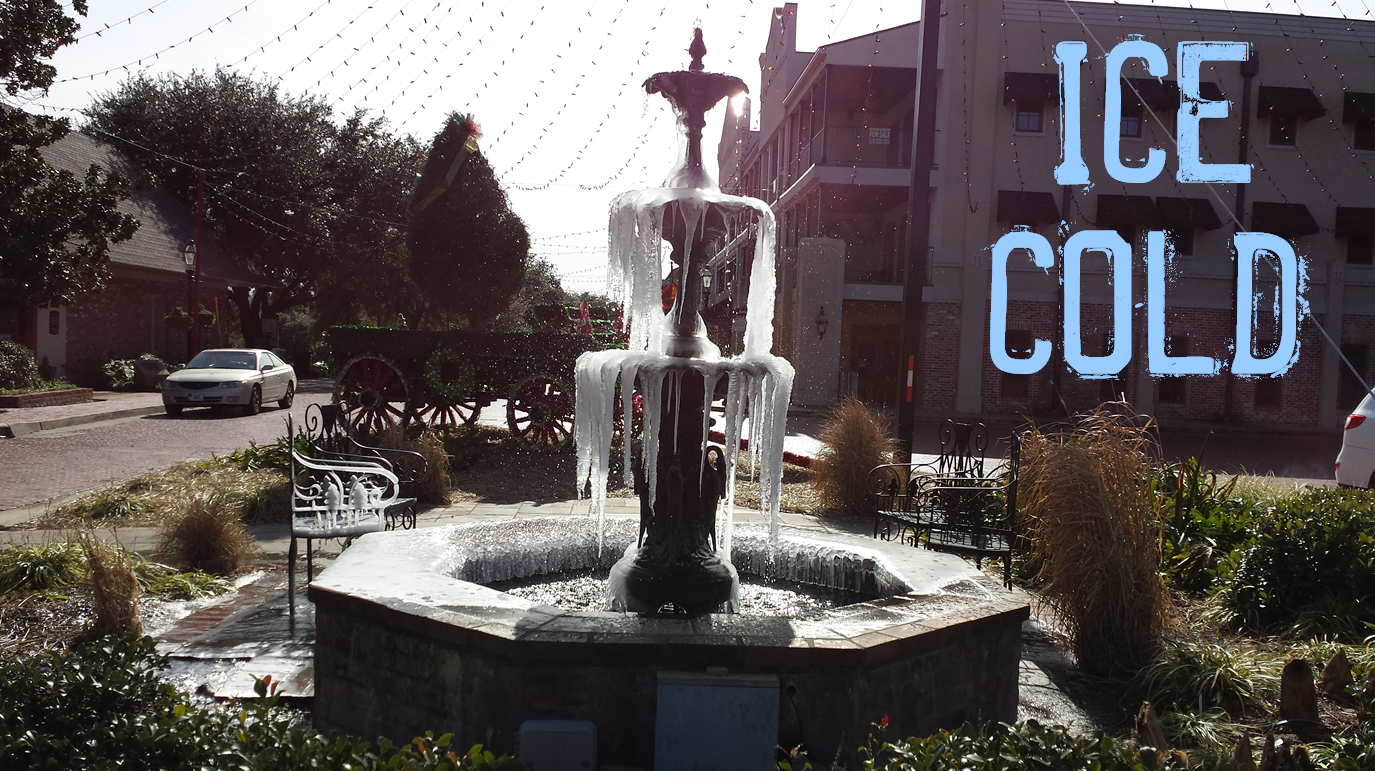
Freezing Cold

Ice Cold 2

It’s hard to believe that I took this picture shortly after noon in Louisiana.

I found the font at Font Squirrel. It’s called Misproject from Misprinted type.

Burrr…

Marketing a Book Is Like Dating

Date

The Bar

Authors dress their books up with covers and blurbs, and mingle with readers through marketing. Readers are searching for good books, checking out those covers and blurbs, looking for a good catch to take home and bundle up with.

The Pick-up Line

Trying to stand out, authors try to design fantastic covers, promote their books with special deals, or catch interest with a clever strapline. Readers want to be impressed; they won’t fall for a common one-liner. If the line does impress them, they will play hard to get.

The Blind Date

A reader who enjoyed a book sets the book up with a friend. The friend is nervous. If the book doesn’t turn out to be good, he will feel obligated to grind through it so he doesn’t let his friend down. He’s also worried that the book may be too good for him, with more vocabulary and complexity than he’s prepared to handle.

The Courtship

Authors interact with their target audience in person and online through readings, signings, seminars, presentations, blogs, fan pages, podcasts, and interviews. They brand their images over a period of months, hoping to show readers that they are serious about the relationship.

The Kiss

Finally, after weeks of branding, the reader has clicked link to view the book’s product page, read the blurb, and—oh, here it comes, the moment we’ve been waiting for—KISS!—the reader is viewing the Look Inside. It better be a good kiss. If you like it, there are hundreds of more pages where that came from. Come on, kiss this book like you’ve never kissed a book before.

The Commitment

It was a good kiss. The reader invited the book home for the evening. This is the best night ever, a moment the book will treasure for the rest of its life. It’s a dream come true.

The One-Night Stand

What happened? It started with a good kiss. The book went home with the reader. They had a great time. The next thing the book knows, it was returned. The reader is gone. How could this be?

The Dump

Once the reader got home, it discovered that while the book had a handsome face, it was really a scoundrel of a character. Beyond the Look Inside, the book turned into something awful. The book is promptly dumped, confined to sit on a shelf, watch the reader pass by a few times each day, and bear the agony of seeing the reader sit by the fireplace with other books, smiling and laughing gleefully. Life is just unbearable.

The Climax

Just what every book and reader were hoping for, the book was good enough to please the reader, who finally reached the climax of the book. The feeling is just wonderful. For a few minutes. Then the book realizes that this is the end. Well, it was good while it lasted. At least the reader left some change on the nightstand.

The Marriage

Every author dreams about the marriage: Readers who enjoy the first book so much they propose to marry the whole series. It will be a grand wedding.

The Affair

While conversing with a fan, an author learns that she is reading a book in the same genre by a popular author. How could she do a thing like that? What will people think?

The Divorce

It’s that tragic moment when the reader gives up on a series. It was a match made in Heaven. What could possibly have gone wrong?

The Proposal

I started this blog to provide free help with writing, publishing, and marketing. You can find many free articles by clicking one of the following links:

Chris McMullen, Author of A Detailed Guide to Self-Publishing with Amazon and Other Online Booksellers

Follow me at WordPress, find my author page on Facebook, or connect with me through Twitter.
Read is a Four-letter Word

If you read, write, or publish and find yourself somewhat upset, perhaps you can take a little comfort in the realization that ‘read’ is a four-letter word. (And maybe the fact that reading, writing, and publishing are far more enjoyable than many other things you could be doing, even when these activities might frustrate you a bit.)

book

isbn

note

page

read

tale

text

type

word

copy

edit

find

full

left

mark

typo

view

free

give

list

sale

sell

body

line

poem

poet

bold

caps

dash

font

stop

blog

like

link

mail

post

send

stat

byte

file

HTML

open

Word

save

size

Fire

iPad

Kobo

Lulu

Nook

Sony

There are a few notable words that have more than four letters:

criticism

defects

feedback

plagiarism

rejection

returns

reviews

Copyright © 2014 Chris McMullen

Selfless Promotion

Selfless

With millions of books to choose from, it’s necessary for most authors to promote their books in order to help readers in their target audience discover them.

We sometimes see blatant self-promotion, like going to external websites and posting, “I just published my new book, Whip It Out There. Buy it today.” You should mention your book occasionally on your own site; after all, it is your site. At other sites, this behavior is often strongly discouraged, if not against the rules.

Many of the people who come to your site already know about your book. What you really want to do is find your target audience at external sites, where nobody knows about your book. And this is exactly what you should do, only at most sites you need to let people discover your book by checking out your profile or mentioning your book in the proper context, where this is allowed and acceptable. Some sites allow a brief signature, where you can include a link to your book; where it’s common to post with a signature, you can blend in nicely, and if you make a good impression, people may check your book out.

A milder form of self-promotion is mentioning your book in context. Instead of saying, “Check out my book, In Your Face,” try to find something else you can post where mention of your book is relevant. For example, asking for opinions about your blurb gets you a little attention and helpful feedback while not coming across as a salesperson. Obviously, you can’t ask about your blurb three times a day all year. Use the creativity that you obviously have as a writer and find relevant ways to mention your book. Study the ambiance of each site first and be sure not to behave in a way that may be frowned upon.

“Self, how would I feel if I were just chillin’ with my pals online and some other author posted that?”

Before you post it, think about how it looks from the other side.

Most marketing isn’t about instant sales. When you see an advertisement on t.v., do you run right out to the store and buy the product immediately? “Sorry, dear. I know it’s 3 a.m. Saturday morning, but I just saw an advertisement for honey and I really need to get some. Could you please watch the kids?”

It’s about branding. You learn about a product enough times that you recognize it. But you don’t want to be branded as annoying. Strive to find less obtrusive ways to get discovered. Come across as a professional. Make a good impression. Brand a positive image as an author to help get your target audience interested in your book over a long period of time.

The best exposure you can get is selfless promotion—i.e. when others market on your behalf. One way you can do this is to seek honest online book reviews or arrange a blogger to interview you. However, most of this is beyond your direct control.

Imagine a reader who discovered your book online, enjoyed your book, and posted a good review for your book online without your even knowing about it. Or imagine a reader who loved your book and told all of his or her friends about it. Recommendations and word-of-mouth sales are golden. They’re also very hard to come by. If a book is truly exceptional in some way, or if the book elicits strong emotions, this is more likely. The first step is to perfect your book from cover to cover and include some wow-factors in your writing. This is quite challenging, but ask yourself this: “Will people recommend a book if it’s just so-so?”

What good books have you read lately? What are you doing to help spread the word about those amazing books? Don’t just review and recommend books because you’re hoping for the same in return. Do it because you discovered a great book and believe others would enjoy it, too. Definitely, don’t recommend books that you don’t honestly believe to be worth recommending. There are many good books out there, and they can use your support.

I see plenty of selfless promotion in the form of reviews and recommendations. It’s a great sight to see. You might notice that I recently added a couple of pages to my blog, highlighting a few books by other authors. It’s a short list, presently, but it will grow.

Brace Yourself, Here Comes the Self-Promotion

I started this blog to provide free help with writing, publishing, and marketing. You can find many free articles by clicking one of the following links:

Chris McMullen, Author of A Detailed Guide to Self-Publishing with Amazon and Other Online Booksellers

Follow me at WordPress, find my author page on Facebook, or connect with me through Twitter.

Self-Publishing Experiments

Experiment

With millions of books to choose from, why would anyone choose to buy an experiment?

If the author treats a book like it’s an experiment, the quality of the content, packaging, and marketing will reflect this. Customers will see it.

  • It’s not worth putting a fantastic cover on a book that’s an experiment.
  • It’s not worth perfecting the editing or formatting for an experiment.
  • It’s not worth crafting a most wonderful story for an experiment.
  • It’s not worth marketing an experiment.
  • The author won’t be confident in or passionate about an experiment.

So why bother making an experiment?

If you just want to know if your writing appeals to others, simply share drafts of it or join writing groups.

It’s not Necessary to Experiment First!

Why not? Because there are already millions of books on the market. Researching those, especially successful indie books, will prove far more valuable than any experiment you might do yourself.

  • Sales ranks and reviews can help you gauge which kinds of books are or aren’t popular.
  • Repeated comments in a subgenre can help you learn specific things that many readers do or don’t like.
  • Writing samples in the Look Insides can help you see what kind of writing appeals to readers.
  • Covers of bestselling indie books can help you learn how to attract your target audience and signify your subgenre.
  • Look Insides of bestselling traditionally published books can show you what a nicely formatted book should look like.
  • Product pages of bestsellers can show you how to make the most of your book’s detail page.
  • Author pages and websites of top indie authors can show you a variety of marketing possibilities.
  • A ton of free and low-cost publishing and marketing resources can help you perfect your book.

Study books that have succeeded. That’s experimental data that you have right at your fingertips.

It’s a Mistake to Experiment First!

Why? Because your first impression is very important. A big part of marketing is the author’s brand. It takes time to build credibility as an author.

If your first effort is an experiment, many shoppers who come across your book and were interested in it may remember your book or name in the future. The next time they see one of your books, even though it may be much better, they may pass on it simply from their first experience.

Success in the publishing business is difficult to come by, so start out by putting your best foot forward.

About My Blog

I started this blog to provide free help with writing, publishing, and marketing. You can find many free articles by clicking one of the following links:

Chris McMullen, Author of A Detailed Guide to Self-Publishing with Amazon and Other Online Booksellers

Follow me at WordPress, find my author page on Facebook, or connect with me through Twitter.

Happy Today! :-)

Happy Today

Why should we wait for holidays, birthdays, and special days to wish everyone a happy day? We shouldn’t.

Every day should be special. We should be happy every day.

So here’s a wish for a Happy Today.

It’s not just good for today. It’s good for every day.

Have a very Happy Today.

Because it will always be today. Even when today becomes tomorrow, you will still think it’s ‘today.’

So have a Happy Today that never ends.

Smile! 🙂

Comma Chameleon

Comma

Comma, comma, comma, chameleon.

Such a subtle separator can disguise meaning.

“Let’s eat, everyone,” sounds rather inviting.

“Let’s eat everyone,” sounds cannibalistic.

, , , , ,

Comma, comma, comma, chameleon.

Such a subtle mark can affect the pace.

“The rabbit with broken legs limped home,” sounds quick.

“The rabbit, with broken legs, limped home,” sounds slow.

, , , , ,

Comma, comma, comma, chameleon.

Such a subtle mark can hold so much power.

“My mom said her husband is crazy,” means one thing.

“My mom, said her husband, is crazy,” means another.

, , , , ,

Copyright © 2014 Chris McMullen

, , , , ,

Related articles: