The three reasons I have fallen in love with writing short stories

Here, a successful author shares how she has used short stories effectively. Series authors may be interested in the comments section, as I specifically asked how she handles short stories with her series (the answer surprised me, and the more I think about it, the more her strategy makes sense). Every author is unique, but it’s always helpful to study ideas that work for some authors.

loulocke's avatarM. Louisa Locke

stories_vol1_cover_1600x2400F-2I am the last author you would think would be writing short stories. As a writer who tends to be prolix, the short form wouldn’t seem a good match for me. I don’t write anything short––not emails, not blog posts, not books. Twitter, forget it––the most I can do is retweet those of you who are good at being succinct. I don’t even read many short stories, (except by 19th century writers like Alcott, Wharton, and James).

Yet, this spring I took time off from doing the research for Deadly Proof, the next book in my Victorian San Francisco Mystery series, to write my third and fourth short stories, which are now part of a collection, Victorian San Francisco Stories, that I just published on Kindle, and I have every intention of putting out more short stories in the coming year.

So what happened?

Dandy Detects, my…

View original post 2,356 more words

Quality vs. Profit—Is it a Choice?

Quality

Why not Both?

Jack Eason posted an interesting article recently entitled “Profit or Quality” (click the title to check it out). While that post analyzed this in the context of video games, it got me thinking about this in terms of self-publishing.

You might be wondering whether or not it’s really a choice. Shouldn’t lesser quality result in lower profits in the long-term? Shouldn’t better quality be favored in the long run?

Well… to an extent.

You could spend an outrageous amount of money publishing a book in the highest possible quality:

  • First off, how about a nice textured hardbound cover with full-color images. If the book costs over $100, you might not sell any. So much for profit! Suppose we restrict ourselves to e-books and inexpensive print-on-demand publishing.
  • Well, you could spend thousands of dollars on formatting and editing services. If you aim for the highest possible quality (not necessarily given by the most expensive service), you might not make any profit at all even if you sell a thousand books.
  • A few writers claim that you should spend years honing your craft, perhaps you should even pay good $$$ to develop the skills you need. Invest hundreds of dollars and wait a few decades and surely the quality will be better, right?

Okay, so going to great lengths to make the quality extreme might not lead to any profit at all. It might leave you considerably in the red.

Let’s look at the other extreme. Suppose you spit out a new novel per month. You’ll have a platform of dozens of books on the market in no time. You’ll always have a book in the Last 30 Days new release category, helping to give exposure to your previous books. Assuming you succeed in drawing in readers, your fan base will grow, so that when you release each book, there will be more and more people waiting for it.

But how much quality can you provide spitting out a book per month? Won’t the ideas, storyline, editing, and more suffer greatly?

The best solution probably involves some compromise:

  • Achieve the best quality you can at a reasonable cost.
  • Invest extra time to significantly improve the quality. I’m not saying to hold off publishing for years. But if a few months could greatly improve the quality, consider that your book might be available for decades. Those few extra months could greatly improve sales over those decades, and the sales of other books that you haven’t even published yet.

Each reader has expectations. Some are higher than others. The higher the quality of the book, the more likely it will exceed those expectations. When it doesn’t, that leads to no sale or no recommendation (maybe even a bad review).

Quality is important for the long-term. Exceed a reader’s expectations and you can gain valuable word-of-mouth referrals in the long run. You can build a fan base that eagerly anticipates your next book. But don’t rush that next book out for all your enthusiastic fans, or there may not be much anticipation for the next one. Once you create high expectations, you must work to deliver on the promise.

Chris McMullen

Author of A Detailed Guide to Self-Publishing with Amazon and Other Online Booksellers

  • Volume 1 on formatting and publishing
  • Volume 2 on marketability and marketing

Follow me at WordPress, find my author page on Facebook, or connect with me through Twitter.

Comments

Click here to jump to the comments section:

https://chrismcmullen.wordpress.com/2014/06/10/quality-vs-profit-is-it-a-choice/#comments

The Value of Your Book

Value Book

What’s Your Book Worth?

Your book. The idea you conceived, nurtured for months, and eventually gave birth to. The book you love and defend like it’s your baby. Thousands of words written passionately. That you slaved over. So that others might find some joy, entertainment, emotions, wisdom, or knowledge for your effort.

That book. What’s it worth?

It’s worth much more than any buyer will pay to read it.

Its value far exceeds the royalties that you will draw from it.

It’s definitely not worth any painful criticism.

So why do we writing artists suffer through months and years of labors to write books. Earning in many cases less royalty than the cost of a cup of coffee. Suffering sometimes harsh criticisms.

It’s because your book has value that extends well beyond royalties and reviews.

Your book has value as a work of art.

Your book has value to you as a complete and meaningful project. And a book is no small undertaking.

Your book has value to the niche audience who discovers it.

Art is meant to be shared, and finding your target audience, big or small, is a wonderful thing in and of itself.

Your story is a work of art. Craft it until you feel like it’s a masterpiece.

Frame it with editing, formatting, front matter, back matter, and a cover fitting the artwork.

Even your blurb and marketing are art forms. See the art in this and they become part of your passion, a hobby and not a chore.

Marketing isn’t advertising and business to the artist, it’s sharing your passion with others.

Art is the self-published author’s advantage.

We have no overhead. We’re not a business. We’re creating works of art to share with others.

Art’s value goes way beyond dollars. We create art for art’s sake. The rest is just gravy.

Copyright © 2014 Chris McMullen

Click here to jump to the comments section:

https://chrismcmullen.wordpress.com/2014/06/07/the-value-of-your-book/#comments

Morning Check-up for Artists

Writing

Imagination On. Check.

Motivation On. Check.

Quiet On. Check.

Distractions Off. Check.

Comfort Zone On. Check.

Eyes Ready. Check.

Mind Open. Check.

It’s a go.

Take a deep breath.

Creativity blasting off in 10 9 8 7 6 5 4 3 2 1 0.

Let those creative juices flow.

Copyright © 2014 Chris McMullen

How To Prepare For An Author Signing…

Some good tips here. 🙂

mandyevebarnett's avatarMandy Eve-Barnett's Blog for Readers & Writers

articlesWith any new experience on our writing journey, it is always best to prepare and gather assistance from more experienced authors and writers. Although, I have attended several author readings, this coming Saturday 7th June, will be a new venture for me. A book signing!

While my publisher, Dream Write Publishing, will be present and has organized the promotional element as well as the initial contact with the venue’s owner’s, there are still several things I can do too.

The first is to ensure I have my own ‘book signing kit’. This will comprise of several pens, book marks, visual representations of the book, which in this instance is my Rumble soft toy for Rumble’s First Scare, a mailing list sign up sheet, a pre-order sheet for my next children’s book, a copy of a child’s review of Rumble, business cards, a notepad to write down the spelling of people’s names –…

View original post 242 more words

Will he finish the book?

A great little poem for readers or authors. 🙂 To be, or not to be? It’s good motivation not to lack attention writing the middle of the book.

Children’s Categories & Marketing @ Kindle

Kindle Age

INTRODUCTION

This is a two-part post:

  1. First, I will discuss a cool new feature that Kindle Direct Publishing (KDP) just introduced to help categorize children’s Kindle books.
  2. Next, I will share an idea to help market children’s Kindle books.

AGE & GRADE LEVELS

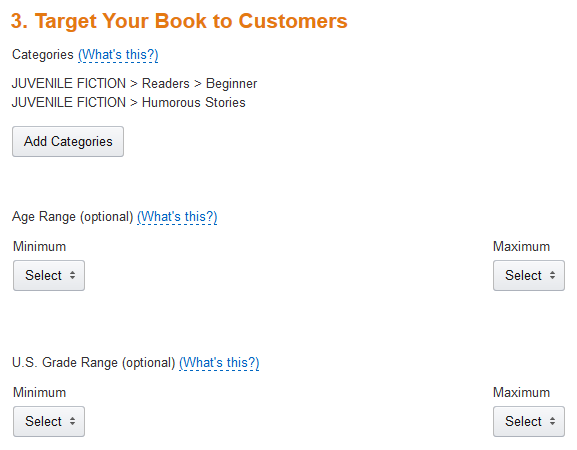
As of now, Step 3 of the KDP publishing process allows you to select an Age Range and a separate US Grade Range.

Tip: Open up your children’s, tween, and teen Kindle books on your Bookshelf and update Step 3. You’ll need to republish for this to take effect.

This will help give your juvenile book added visibility on Amazon:

  • Your book will show up when customers select one of the age group or grade level filters in Amazon search results.
  • You no longer need to waste a crucial keyword to get listed in the children’s age group categories. Tip: If you used a keyword to accomplish this in the past, you can now change that keyword to something else, if you wish.
  • These age group and grade level settings apply to the Schools and Teaching store.
  • These settings are supposed to apply to the Children’s Kindle Book stores for both Amazon.com and Amazon.co.uk.

What about CreateSpace paperbacks? Well, it wouldn’t hurt our chances if several authors suddenly made this request. Hint, hint.

KDP has a table with suggestions for the different age groups: Click here to view it.

I love these new age group and grade level options at Kindle. I’ve been hoping for this for years, and I’m probably one of many authors who’ve requested it in my interactions with KDP. It’s a great opportunity for children’s e-book authors.

MARKETING IDEA

As you may know if you follow my blog, I had the opportunity to talk to members of the Kindle Educational Team a few weeks ago.

They are hoping to see more educators and authors who would like to educate via books publish helpful educational content on Kindle. They have recently reached out to authors to hear our perspective from the publishing end. These new age group and grade level options are one step toward accomplishing this.

So here is my idea:

Education covers many topics. One subject relates to most juvenile fiction stories: English. This includes reading, reading comprehension, writing, vocabulary, grammar, and so on.

Suppose you have a collection of short stories, poems, novellas, novel, or other children’s fictional work for children, tweens, or teens. If so, there is a simple way to improve the marketability of your children’s book:

  • Create some teacher- or parent-oriented resources for your book. I’ll list a few examples below to get your brain churning.
  • You could include these in your book, or you could add a page to your book describing free educational resources available on your blog or website, which parents or teachers could use to get educational value out of your stories. The latter option has the advantage of giving readers a reason to visit your blog and follow you (plus it doesn’t make your book resemble a textbook for kids just looking to enjoy fiction).
  • Your stories are still marketable as stories, but now they are also marketable as educational resources to parents, teachers, homeschool instructors, libraries, and other educators. The free resources become an added marketing tool.

Here are a few ideas for creating educational resources to go along with your story:

  • Add vocabulary definitions and exercises relating to your content.
  • Write questions that assess reading comprehension for your story.
  • Come up with essay questions relating to your book.
  • Make creative writing questions stemming from your story or characters.
  • Create a grammar worksheet to go along with your content.
  • For historical novels, you may be able to add history lessons and exercises.
  • For science fiction novels, you might be able to come up with related science questions and exercises.
  • If your protagonist is bilingual, there is an opportunity for language lessons.
  • If you can find ways that your book relates to one or more school subjects, this gives you more opportunities.

READ TUESDAY

You may be aware that I launched an event in 2013 called Read Tuesday, which debuted in December. You can check out the website here: readtuesday.com.

Read Tuesday is a Black Friday event just for books. One big goal of the event is to help inspire reading.

In 2014, I would like to add a special page highlighting juvenile books that include educational resources (either in the book itself, or free resources that readers can find on the author’s blog or website). So if you have such a book and you’re willing to participate in Read Tuesday 2014 (which requires having your book on sale that day), in addition to listing your book in the Read Tuesday catalog, there will be a special page to showcase juvenile books with free educational resources available. I think this may be a good way for Read Tuesday to help promote reading.

Chris McMullen

Author of A Detailed Guide to Self-Publishing with Amazon and Other Online Booksellers

  • Volume 1 on formatting and publishing
  • Volume 2 on marketability and marketing

Follow me at WordPress, find my author page on Facebook, or connect with me through Twitter.

Comments

Click here to jump to the comments section:

https://chrismcmullen.wordpress.com/2014/06/03/childrens-categories-marketing-kindle/#comments

Review of Disney’s Maleficent (no Spoilers) plus Marketing Notes

Loved It

Disney’s Maleficent

I saw Maleficent with my daughter (six years old) last night. We saw it in 3D.

We both loved it. I’ll try to explain why without any spoilers (though if you read the comments below this post, I can’t guarantee that a spoiler won’t appear there).

I saw the animated Sleeping Beauty in theatres many years ago. Usually, I prefer a classic to its remake, but this time I enjoyed Maleficent much more than any other sleeping beauty story.

First, the story for Maleficent is different from any other Sleeping Beauty story that you might know. I enjoyed Maleficent‘s unique storyline. I actually like this storyline better than Disney’s animated Sleeping Beauty. It’s not just the story and characterization that has changed; even the perspective is different.

We loved the characters, especially Maleficent. Angelina Jolie pulled it off very well, in my opinion. I don’t believe you need to be an Angelina Jolie fan to enjoy this movie.

The imagery was amazing. Whether it was scenery, special effects, costumes, or motion, I enjoyed it thoroughly.

My daughter loves fairies and princesses, so the story turned out to be a real treat for her.

Sometimes I don’t like the 3D movies, but I really enjoyed this in 3D. It wouldn’t have been the same in 2D, and definitely wouldn’t have been the same in my living room.

Marketing Notes

You can learn a lot about marketing by studying what some of the professional marketers do effectively. In this case:

  • A single word in the title makes it easy to remember. This particular word is memorable, in that it’s not overused. It also fits the content to a tee. Even if you aren’t familiar with the word maleficent, you probably assume it’s similar to other words like malevolent, and so have some idea of what to expect. As a plus, the main character’s name happens to be the same, and a star actress is playing the role. The title is very important in marketing. It’s worth getting it right.
  • A striking marketing image. It follows the three-color rule with white, black, and a touch of red. There is very little red (just the lips), but it sure stands out effectively. The unique horns make it a very memorable appearance, and reinforce the title word. They didn’t make the mistake of adding red letters on black background, which would be hard to read. They didn’t make the mistake of using red text at all, which would detract from the red lips. That little touch of red is so effective by itself.
  • The previews I saw really built up my interest without giving too much away. I hate it when the preview gives too much away, and especially hate it when the only good parts of the movie are in the preview. A book’s blurb is very similar to a movie’s preview. You want to create interest without giving anything away. One of my favorite movie trailers was for Scooby Doo. That trailer looked like a preview for Batman, but wound up showing Scooby Doo as a surprise at the end of the preview. That trailer didn’t give anything away, but aroused my curiosity.
  • Of course, Disney could afford to market Maleficent on a grand scale. Spending money is easy when you have it; getting a good return on your investment isn’t. There are millions of people who have squandered money on advertising, only to discover how hard it is for advertising to pay dividends. Fortunately, Disney is also a well-established brand. But that also comes with high expectations, and the movie must deliver on those expectations or it can be squashed before it takes off. One of the great things I saw in the way of advertising was a billboard in Southern California with those distinct horns protruding out of the billboard. That sure stood out and caught attention.

Chris McMullen

Author of A Detailed Guide to Self-Publishing with Amazon and Other Online Booksellers

  • Volume 1 on formatting and publishing
  • Volume 2 on marketability and marketing

Follow me at WordPress, find my author page on Facebook, or connect with me through Twitter.

Comments

Click here to jump to the comments section:

https://chrismcmullen.wordpress.com/2014/06/02/review-of-disneys-maleficent-no-spoilers-plus-marketing-notes/#comments

Amazon’s Top Customer Reviewers

Stars

Amazon’s Top Customer Reviewers

Amazon ranks customer reviewers:

  • Click here to see the top 10,000 customer reviewers ranked in order.
  • Click here to see the Hall of Fame reviewers and their accomplishments.

The numbers are impressive. On the first page of the top reviewer rankings, I see:

  • Most have written 1000 to 2000 product reviews.
  • 10,000 to 60,000 helpful votes on their reviews.
  • 94% to 97% of the votes deemed their reviews helpful.

Amazon takes steps to help ensure fair play. For example, suppose you write 100 reviews and get your friends to vote Yes on all 100 reviews. Your friends’ votes won’t count toward your top reviewer rank. If someone votes Yes on most of your reviews, they are considered to be a Fan Voter and their votes don’t affect your reviewer rank.

Amazon Customer Review Badges

Top reviewers earn badges, which are displayed on Amazon.

Here is a list of badges that can be earned:

  • Top 1000 Reviewer. If you crack the top 1000 in review rankings, you receive a badge for it (for as long as you remain in the top 1000).
  • Top 500 Reviewer. This gives you an incentive to write more reviews once you crack the top 1000.
  • Top 50 Reviewer. It’s a large jump from 500 to 50, but puts you in elite company.
  • Top 10 Reviewer. Out of millions of reviewers, imagine being ranked in the top ten.
  • #1 Reviewer. At this moment in time, you are the very best.
  • Vine Voice. Amazon invites selected reviewers into a special program to review not-yet-released products.

Looking for Reviewers?

Many of the top reviewers allow themselves to be contacted by clicking on their Amazon handles. Click on a top reviewer’s name at Amazon and you may find an email address at the left side of their profile page. Many top reviewers make their email addresses publicly visible this way.

Why? Because they love to read books and write reviews. Books cost money. Publishers and authors want to get their new releases reviewed. So it’s a match made in Heaven. The publisher or author contacts prospective reviewers, politely asking if the reviewer is interested in receiving a free advance review copy in exchange for an honest review.

Here are some notes:

  • Browse through the reviewer’s product reviews at Amazon to see which kinds of books that reviewer likes to read. They are likely to turn you down if your book isn’t a good fit. You’re also more likely to get a critical review from someone who isn’t familiar with your subgenre, so it’s in your best interest to find reviewers who read books in your subgenre.
  • Top reviewers receive tons of requests from authors. If your book is a good fit and the nature of your request stands out in a good way, this may give you an edge. The higher their reviewer rank, the more requests they are likely to receive.
  • Be very polite. Be concise, yet provide all the pertinent info in your request. The last thing you want to do is offend someone who might actually read and review your book.
  • Don’t pester the reviewer with repeated requests, updates, etc. Make one polite request, send the free copy, and let it be. If they never review your book, let it go. (If that’s the case, you probably don’t want the review after all.)
  • What’s the best way to thank the reviewer? Vote Yes that the review is helpful. Ask your fans to vote on the review. (Some reviewers actually remove reviews if there aren’t enough helpful votes, and especially if the review draws unhelpful votes. Every vote of Yes is an incentive for the review to stay.)
  • The review may be critical. Expect an honest review. The reviewer just might not like your book. That’s the chance you take.
  • Read the critical reviews that the reviewer has left before making your request. See if any of that criticism may apply to your book.
  • If you’re a self-published author, see if the reviewer has ever reviewed other indie books, and, if so, if any are favorable.
  • When you give a free copy in exchange for an honest review, the review will not say Amazon Verified Purchase. Many of these may look suspicious.

Review Crazy

Amazon customer reviews are helpful in the sense that a large assortment of customer opinions can help shoppers decide which products may be right for them.

Unfortunately, people have abused the review system with both five-star and one-star reviews. Fortunately, Amazon has made great strides in preventing and removing suspicious five-star reviews, such as from close friends and family. However, many customers rightfully approach reviews with suspicion. Even one-star reviews, customers may suspect they were left by someone with an agenda.

An interesting phenomenon with reviews is that very often multiple reviews of the same product contradict one another.

Still, as shoppers, we do like to see an assortment of opinions, we like to decide which reviews to ignore and which to trust, and many of us have learned to check out the Look Inside before making the purchase.

Some authors have gone review crazy. If a book isn’t selling, the first thought seems to be that the book needs reviews. The reality is that if it isn’t selling, it’s probably something else:

  • The cover doesn’t depict the right subgenre or doesn’t appeal to the target audience.
  • The blurb isn’t engaging the reader’s interest and arousing the reader’s curiosity.
  • The Look Inside doesn’t look professional or doesn’t draw the reader in.
  • The book idea just doesn’t appeal to a significant audience.

If one of these reasons apply, recruiting several reviews isn’t likely to impact sales.

In fact, having several reviews on a newly published book that isn’t selling may look suspicious to customers:

  • Published 25 days ago.
  • 12 glowing reviews.
  • Sales rank 1,572,049.
  • Wait a minute: If the book hasn’t sold, how did 12 people review it? Must be friends and family.
  • (Now if the book has been out for a year, that’s different. Maybe it had sold well when it was first released.)

If many of your reviews are from top reviewers, it won’t be too hard for customers to deduce how you went about getting reviews.

Honest customer reviews can indeed be helpful. Just don’t go review crazy.

Thank You, Reviewers

Authors appreciate the time you take to provide honest feedback.

Other customers appreciate the time you take to provide honest feedback.

Whether you’re a top reviewer, or have just started leaving reviews, you are very much appreciated.

Thank You Pic

Chris McMullen

Author of A Detailed Guide to Self-Publishing with Amazon and Other Online Booksellers

  • Volume 1 on formatting and publishing
  • Volume 2 on marketability and marketing

Follow me at WordPress, find my author page on Facebook, or connect with me through Twitter.

Comments

Click here to jump to the comments section:

https://chrismcmullen.wordpress.com/2014/06/01/amazons-top-customer-reviewers/#comments