Amazon Is Attracting New Kindle Unlimited Customers This Holiday Season

Unlimited Reading

KINDLE UNLIMITED

When I visited Amazon’s home page today, there was a large advertisement to receive $40 off of a Kindle with a free six-month subscription to Kindle Unlimited.

That’s a compelling offer. It will surely create many new Kindle Unlimited customers.

It’s a temporary promotion, but it seems like a sign that Amazon may be working to bring more readers into Kindle Unlimited.

The readers will go where the authors are and the authors will go where the readers are.

Presently, there are 700,000 titles in Kindle Unlimited. It’s not all from KDP Select: There are about 100,000 books in Kindle Unlimited from smaller traditional publishers (including some popular titles, like Harry Potter).

If you love to read books, you can surely find worthwhile reads among those 100,000 titles from smaller traditional publishers or the 600,000 KDP Select titles.

There may be some indie authors pulling out of KDP Select because they aren’t happy with the $1.33 payout from October, 2014, but there are still many attractive authors and books in the program. No matter how many indies pull out, there are still 100,000 books from smaller traditional publishers (and those traditionally published books aren’t available through Amazon Prime).

The $1.33 also shows that the population of Kindle Unlimited customers is very large, considering that the KOLL Global Fund was $5,500,000.

Now Amazon is attracting new Kindle Unlimited customers this holiday season. The Kindle Unlimited readership will grow, and with free six-month subscriptions, many will use the program actively for half a year (and perhaps become hooked on it).

Here is another thing to consider: The more customers who subscribe to Kindle Unlimited, the fewer customers there are outside of Kindle Unlimited.

Authors must choose which side of the fence to stand on. It’s not an easy decision. I’m staying in KDP Select, as my sales have improved a little and my borrows are way up. Not every book is thriving in the program, but the potential is there.

Read Tuesday

Imagine a Black Friday type of event just for book lovers.

You don’t have to imagine it. It’s called Read Tuesday, and it’s free: www.readtuesday.com.

Please support the Read Tuesday Thunderclap. This will help spread awareness on the morning of Read Tuesday (December 9, 2014). It’s easy to help:

  • Visit http://thndr.it/1CkO2Bg.
  • Click Facebook, Twitter, or Tumblr and sign in.
  • Customize the message. (Optional.)
  • Agree to the terms. All that will happen is that the Thunderclap post about Read Tuesday will go out the morning of December 9.
  • (The warning message simply means that Facebook, Twitter, or Tumblr need your permission to post the Thunderclap message on December 9. This is the only post that Thunderclap will make.)

Chris McMullen

Copyright © 2014 Chris McMullen, Author of A Detailed Guide to Self-Publishing with Amazon and Other Online Booksellers

  • Volume 1 on formatting and publishing
  • Volume 2 on marketability and marketing
  • Boxed set (of 4 books for less than the price of 2) now available for Kindle

Follow me at WordPress, find my author page on Facebook, or connect with me through Twitter.

Comments

Click here to jump to the comments section:

https://chrismcmullen.wordpress.com/2014/11/26/amazon-is-attracting-new-kindle-unlimited-customers-this-holiday-season/#comments

Getting Squeezed (images on the new Author Central page at Amazon)

Squeezed

AUTHOR CENTRAL CHANGES

Have you checked out your Author Central page at Amazon recently?

The layout changed. (Well, every once in a while I see the old layout, but most of the time the new layout shows.)

If the new layout is showing, you’ll see a row of your cover images at the top, your blog or Twitter feeds below that, then your list of books.

You can view my page as an example, if you wish:

http://www.amazon.com/author/chrismcmullen

(Note the link above. Doesn’t that look better than http://www.amazon.com/Chris-McMullen/e/B002XH39DS? If you print your link on a bookmark, for example, the above format is simpler. The ‘secret’ is to log into Author Central, click Author Page, and follow the instructions where you see Author Page URL.)

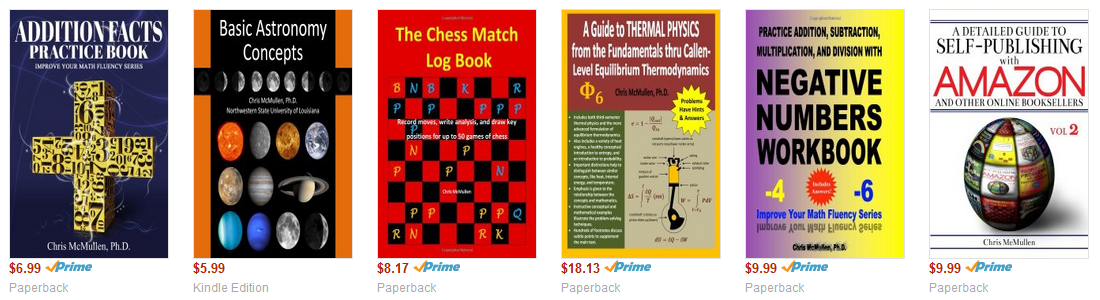
Do you see the problem with the new author page layout? Every image is the same aspect ratio. Unfortunately, not all books have the same aspect ratio. So some book covers are getting squeezed at the top of the author page. You can really see it with my astronomy book above: The actual book cover is square, and so it appears noticeably distorted at the top of my author page.

In many ways, a wide image makes for an attractive thumbnail at Amazon, but not at the top of the new author page. Also, a narrower image works better for Kindle e-books when customers shop from a Paperwhite and other devices.

So what aspect ratio works best for the top of the author page? The ‘trick’ is to right-click an image and view the image info. I did this and learned that every image is scaled to 158px × 248px, which is an aspect ratio of 1:1.57. That’s pretty close to the Kindle Fire screen size, 1:1.6. In print, 5.5″ x 8.5″ and 5″ x 8″ are near enough matches, while 6″ x 9″ isn’t bad.

If you use 5″ x 7″, this will get squeezed a bit (since it’s 1:1.4). Large print books like 8″ x 10″ and 8.5″ x 11″ get squeezed significantly (these are less than 1:1.3). Square books, like 8.5″ x 8.5″ look quite distorted. If you have a landscape boxed set, that’s a disaster (unless the only text appears on sides of a box that don’t lie in the plane of the screen, then nobody can tell).

Does it really matter? Probably not too much. This is just an issue on the author page. It doesn’t affect the product page at all. Somebody has to click on your author profile from the product page just to get to your author page. Even then, it’s only the row of books at the top of the author page—the thumbnails that appear below are fine.

Read Tuesday

Imagine a Black Friday type of event just for book lovers.

You don’t have to imagine it. It’s called Read Tuesday, and it’s free: www.readtuesday.com.

Please support the Read Tuesday Thunderclap. This will help spread awareness on the morning of Read Tuesday (December 9, 2014). It’s easy to help:

  • Visit http://thndr.it/1CkO2Bg.
  • Click Facebook, Twitter, or Tumblr and sign in.
  • Customize the message. (Optional.)
  • Agree to the terms. All that will happen is that the Thunderclap post about Read Tuesday will go out the morning of December 9.
  • (The warning message simply means that Facebook, Twitter, or Tumblr need your permission to post the Thunderclap message on December 9. This is the only post that Thunderclap will make.)

Chris McMullen

Copyright © 2014 Chris McMullen, Author of A Detailed Guide to Self-Publishing with Amazon and Other Online Booksellers

  • Volume 1 on formatting and publishing
  • Volume 2 on marketability and marketing
  • Boxed set (of 4 books for less than the price of 2) now available for Kindle

Follow me at WordPress, find my author page on Facebook, or connect with me through Twitter.

Comments

Click here to jump to the comments section:

https://chrismcmullen.wordpress.com/2014/11/20/getting-squeezed-images-on-the-new-author-central-page-at-amazon/#comments

Durned if You Do, Durned if You Don’t

fortune cookie

YOU CAN’T WIN

No matter what you do, your book will never be good enough.

Editing:

  • If you don’t get your book proofread well, the critics can be brutal.
  • But even if you iron out every spelling and grammar issue, people can still complain about editing. Show more, tell less. Language is too plain and simple. Language is too complex. The point of view changes where it shouldn’t have.
  • And even if your book is masterfully edited, you can still get a sour grapes review that claims that it’s poorly edited. For if the book just has a few reviews and one mentions editing issues, most customers will believe this at point-blank. Unfortunately, it’s often the case, so such sabotage can easily be effective. Your book is vulnerable. (But not defenseless.)
  • No matter how well-written a book is, there will still be readers who don’t appreciate the style. You can’t please everybody, so it will always be wrong to some.

Formatting:

  • If your book has formatting issues, this can deter sales.
  • You learn about justification, you master page numbering and headers, you do your best to format like traditionally published books that you see. Then critics point out how foolish you were for not hyphenating to reduce gaps in justified text, not removing widows and orphans, not having the same number of lines on every page.
  • Or you can spend big $$$ on professional formatting. Now the naysayers will tell you how little money the average self-published book (or even traditionally published book) makes. You might discover that even a most beautifully formatted book doesn’t always sell.
  • No matter how well a book is formatted, there will still be people who feel it’s wrong. Many prefer full-justified; others prefer left alignment. With a printed book, how can you please both?
  • Then there are people who have an agenda. There are book formatters who wish to drum up more business by making subtle points seem critical toward sales. There are authors who are well-versed in the subtleties of formatting who feel frustrated that poorly formatted books sometimes sell very well. There may even be traditional publishers who see a declining market share who wish to emphasize the importance of formatting and editing in order to dissuade people from buying self-published books.

Content:

  • If your book has storyline or characterization issues, this can lead to negative feedback and lack of word-of-mouth recommendations.
  • But no matter how amazing the story is, there will be some who will suggest various (and even contradictory) ways that your story could be better. You can’t please everyone.
  • If you write a single-volume fantasy novel, some will fault you for not going into more depth on the world and its rules. But if you write an epic fantasy, others will fault you for going into way too much depth.

Cover:

  • If your book cover attracts the wrong audience, that can cost you much potential traffic.
  • If your book cover doesn’t appeal to the audience, that can cost you much potential traffic.
  • If your book cover has appeal and depicts the content appropriately, critics will still penalize you for issues like choosing the wrong font, including the word “by,” using too many colors, making the background too busy, arranging your images in a collage, or countless other cover design ‘mistakes.’
  • Then if you spend good $$$ on a fantastic cover, anyone who is out to get you can simply write a review that says something like, “Since the cover is so amazing, I had high expectations for this book, BUT…” Hey, it can be an outright lie. There is no fact-checking when it comes to reviews. Everything is an opinion (even when it’s black and white).

Design:

  • If your book has an unappealing or inappropriate design, this can cost valuable sales.
  • If your book has a fairly good design, it may still suffer in subtle ways—text too close to the margin or spine, kerning not quite right on a few letter pairs.
  • You might add a decorative border to appeal to kids. Then someone will fault you for not making a different border on every page; someone else would fault you for not having matching borders; someone will fault you for not making it in color; if you make it color, someone will complain about price.
  • The cover, design, formatting, and editing are important, but let’s not forget that the story itself is the most important part. No matter how great the design is, it just takes one complaint about the story to undo all the benefits of a great design.

THE CRITICS

The problem is that there will always be critics.

The critics have the upper hand.

No matter how wonderful your book is, any critic can easily find some fault in it.

Most critics are genuine readers who just aren’t happy. No book can please all of the people who read it. People simply have varied tastes.

A few critics are frustrated writers, editors hoping to market the importance of editing so they can drum up more business, designers hoping to do the same, unethical authors hoping to elevate themselves by slamming the competition (this strategy will backfire for them, e.g. by dragging their own sales down with fewer customers-also-bought recommendations), editors of traditional publishers who feel threatened by competing titles, people who are simply jealous of the author, and even review police who simply want to bait authors to cross the line.

Remember, the vast majority of critics are genuine readers.

Most of the criticism that actually identifies something specific has merit.

Those with an agenda have the upper hand, so it’s not worth the battle.

Definitely, don’t respond to any review where the reviewer may have an agenda through a public comment.

It’s too easy for the reviewer to make the author look bad. It doesn’t matter what you say, there is a 99.999% chance that you will lose. You have a reputation to uphold. Some customers will think you’re unprofessional simply because you chose to comment on the review.

It’s easy for the reviewer to solicit an emotional or defensive response from you, which will really make you look bad.

Your comment itself lends credibility to the review. If the review didn’t have any merit, you wouldn’t need to address it, right? (I know, that’s not the way you feel about it when it happens. It can burn inside, and not go away for weeks.)

Here’s what’s very common. You think: I’ll just make one innocent comment and leave it at that. What’s the harm in that?

Here’s the problem: The reviewer will respond to your comment and ask you a question. Now you have no choice but to respond again. Suddenly, what you intended to be a single comment turns into a discussion. The last thing you want on your (quite public!) product page is a discussion with a reviewer who posted a bad review.

You can’t play the critics’ game. The critics have the ball. They have the home field advantage (even on your product page). They have control.

But you’re not helpless.

YOU CAN WIN

The first thing to realize is how much you need the critics.

You don’t just need praise. If all you have is praise for your books, that will do nothing but arouse instant suspicion.

You need balance, whether you like it or not. Customers expect it. There should be bad with the good.

The second thing to realize is that you can fight the critics by not giving in to temptation.

Show them (and more importantly, all the traffic on your product page) how professional you are by not engaging with the critics emotionally or defensively.

A third thing to realize is that your book and product page are dynamic.

You can always make a revision to the content and note this in the product description.

But you don’t want to make a revision based on every bit of criticism you receive. There may be customers who actually prefer it the way it was, who simply didn’t voice their opinions.

So the best course is to wait a few weeks and see if the criticism actually has any impact on sales. Sometimes, it actually helps sales. Often, it has no effect whatsoever. (Even when there seems to be a correlation, it often turns out to be coincidence—e.g. your book might have just come off the Last 30 Days list at the same time.)

Sometimes, you just need to add clarification to your product description.

A customer might have made a mistake, assuming your book was something that it wasn’t. If so, simply clarifying this in the product description may negate any effect of that particular review.

Another thing to realize is that things are often much better than they seem. Your book is your baby; you take the criticism quite personally. But the criticism usually isn’t directed at you; it’s directed at your book.

Not everyone has the same tastes. That reviewer is letting people with similar tastes know not to try your book. And that helps! People with dissimilar tastes may still appreciate your book.

If the criticism has merit, consider making a revision. If not, just let it go.

You also have a secret weapon: It’s called marketing.

Personal interactions can often make a huge impact with potential readers. These can have a greater impact than what some stranger says on your product page.

Personal interactions help to generate sales, help the reader approach your book with a favorable frame of mind (i.e. looking forward to it, instead of wondering if anything is wrong with it), and are more likely to result in reviews and recommendations.

PERFECTION

There is no such thing as a perfect book. Simply put, it can’t be perfect for everyone.

Sometimes, authors spend way too much time and money trying to over-perfect their books in various ways.

Here are the most important elements of any book:

  • Story appeals to the target audience.
  • Language appeals to the target audience. (Right vocabulary; flows well.)
  • Target audience can understand well without being distracted by too many hiccups.

The opposite problem—authors who don’t find and patch holes in the story, who don’t write in a way that appeals to the audience, who make many spelling or grammar mistakes, etc.—can be a huge sales deterrent. I’m not addressing the minimum effort here; I’m addressing the issue of over-perfecting.

Who needs perfect editing? An editor who reads your book. An author who writes well who reads your book. A reader who has a well-above average command of language. Others will be tolerant to various degrees as long as you meet the three points above as those points relate to them.

Who needs perfect formatting? A typographer who reads your book. An editor who reads your book. An author who has learned about formatting who reads your book. A reader who is much pickier than the average reader. Others will be tolerant to some degree. Subtle points they won’t notice any more than you did. It’s possible that they will have a nagging feeling that something isn’t quite right without knowing what that is, which may distract them from the story. It doesn’t take perfect design to avoid this; it just needs enough appeal.

Who needs perfect reviews? NOBODY! Virtually every customer who sees a stockpile of nothing but five-star praise will dismiss the book out of immediate suspicion. Customers expect varied and even wild and crazy reviews. They will see if those reviews seem relevant to them. A review that ruins your book for one customer has no impact on another customer. Rather, if they dismiss the criticism because it doesn’t matter to them, they are more likely to give your book a chance. In this way, any bad review can actually stimulate a sale.

Don’t forget who your target audience is:

  • Do you expect to sell many copies on Amazon.com? Do you want support from indie authors and their friends, family, and acquaintances?
  • Do you expect to sell most of your books through bookstores? (You need to do much research and have excellent planning for this.)

In the former case, it may be an advantage to use the free CreateSpace ISBN. If you want support from customers who support self-publishing, you want it to be clear that your book is self-published.

If you spend big $$$ trying to look professional, it might work, but it might backfire. Using your own imprint, you might lose support from millions of readers who support self-publishing. What are you gaining in return? Are you hoping to appeal to people who prefer excellent editing and typography? People who much prefer this are far more likely to read books from the big publishers, or small publishers who’ve branded an image for themselves with regard to delivering quality. They are less likely to take a chance on an unheard-of imprint. You need excellent bookstore potential, research, and planning—and you need long-term goals, like branding an image for yourself as a small publisher who delivers high quality—to make this strategy work for you.

But if you have big plans to sell to bookstores and libraries (not just hopes and dreams, but well-researched plans on how to make it happen), then professionalism can make a significant difference.

It really pays to know who your specific target audience is and what that audience will prefer.

Even if your audience supports self-publishing, they still have expectations. They’re investing money (or at least much time) to read your book. You have to deliver content and quality worthy of that investment.

HOW TO WIN

You don’t measure this through reviews. Though the first time a stranger says something nice about your book, print it out and paste it to your wall. Use it as a reminder that you’re doing something right.

You don’t measure this through sales. Though the trick to sales is to find ways to consistently grow them. If you can grow your sales annually, you can reach any goal in time.

So how do you win?

First, you win by not giving up.

You win by looking professional, even when the chips are down.

You win by writing more books.

You win by learning and growing as a writer.

You win by thriving on your strengths and by shoring up your weaknesses.

You win by caring about your readers, yourself, and your community of writers.

You win by building and growing a fan base.

You win by creating a brand for yourself as an author with a website, author page, and social media.

You win by helping fellow authors.

You win by reading other self-published books—and supporting those that meet your standards through recommendations.

You win by branding a good image for self-publishing.

You win by being part of a community of writers who thrive together.

You win by being the best you can be, and accepting that you are who you are.

You win by writing because you love to write.

You win when you can SMILE despite all the challenges that authors face.

You’re a winner! Congratulations! 🙂

Read Tuesday

Imagine a Black Friday type of event just for book lovers.

You don’t have to imagine it. It’s called Read Tuesday, and it’s free: www.readtuesday.com.

Please support the Read Tuesday Thunderclap. This will help spread awareness on the morning of Read Tuesday (December 9, 2014). It’s easy to help:

  • Visit http://thndr.it/1CkO2Bg.
  • Click Facebook, Twitter, or Tumblr and sign in.
  • Customize the message. (Optional.)
  • Agree to the terms. All that will happen is that the Thunderclap post about Read Tuesday will go out the morning of December 9.
  • (The warning message simply means that Facebook, Twitter, or Tumblr need your permission to post the Thunderclap message on December 9. This is the only post that Thunderclap will make.)

Halloween Reading

Looking for some spooky books to read this Halloween month?

https://chrismcmullen.wordpress.com/scary-books

Chris McMullen

Copyright © 2014 Chris McMullen, Author of A Detailed Guide to Self-Publishing with Amazon and Other Online Booksellers

  • Volume 1 on formatting and publishing
  • Volume 2 on marketability and marketing
  • Boxed set (of 4 books) now available for Kindle pre-order

Follow me at WordPress, find my author page on Facebook, or connect with me through Twitter.

Comments

Click here to jump to the comments section:

https://chrismcmullen.wordpress.com/2014/10/19/durned-if-you-do-durned-if-you-dont/#comments

Amazon.com Sales Rank—How Does it Work? (Research-Based)

Sales Rank

INTRODUCTION

How does Amazon sales rank work? Specifically, what factors affect the sales rank of books (or other products) at Amazon.com?

These questions will be answered in this article—as the result of years of research on this topic.

It’s easy to perform controlled experiments on Amazon.com sales rank. Here is the kind of research that went into the preparation of this article:

  • I’ve purchased hundreds of books, e-books, and other products over the course of several years on Amazon, both directly from Amazon and through third-party sellers on Amazon. It’s easy to monitor the sales rank before and after each purchase.
  • I’ve studied years of sales rank data for dozens of books that I’ve published. I’ve compared this data to royalty reporting and Nielsen Bookscan data from Author Central.
  • Since 2008, there have been cases where I was able to make firsthand observations of purchases on Amazon, in which case I could study the sales rank before and after knowing with 100% certainty when and how the purchase had been made.
  • I’ve read several articles by other researchers who have conducted experiments on Amazon sales rank.

Below is a list of various factors and how they impact sales rank. Each case is accompanied by at least one explanation for how this is known.

Toward the bottom of the list is a discussion of other factors that may or may not affect sales rank. For these factors, it’s not as easy to determine the effect.

Before we get to the list, there is an explanation of a few basic concepts associated with sales rank.

AMAZON SALES RANK

Every product on Amazon that has ever been purchased includes a sales rank on its product page.

What is sales rank? The sales rank is a number with 1 to 8 digits.

  • The better a product sales at Amazon, the lower the sales rank number. The bestselling product in a category has a sales rank of 1.
  • The worse a product sells at Amazon, the higher the sales rank number. If a product hasn’t sold for several days, its sales rank will likely be in the millions.
  • If a product has never sold on Amazon, it won’t have a sales rank.
  • Different editions of a product (like hardcover, paperback, and Kindle books) each have different sales ranks.
  • Every product page has its own sales rank.
  • Sales ranks are different in various categories. For example, books, Kindle e-books, software, and office products each have different sales ranks.
  • Books have overall ranks and also specific ranks within subcategories. Ranking #1 in books overall is much, much better than ranking #1 in a specific subcategory.

Authors, publishers, marketplace sellers, and many other people and businesses use sales rank data to help judge how well their products are selling. They also study sales ranks to help predict how well a product may sell and to help decide whether or not to sell a particular product on Amazon.

Many customers use sales ranks to help judge how popular a product is.

Sales rank also affects the visibility of products at Amazon in various ways. For example, landing on a top 100 bestseller list gives a product much added exposure. Thus, many authors, publishers, and businesses seek to understand how Amazon sales rank works in order to improve their chances of maximizing a product’s exposure on Amazon.

It’s important to understand that sales rank is dynamic:

  • Amazon sales rank changes throughout the day.
  • A book with a sales rank of 100,000 might seem like a fairly good seller, but all you really know is that the book sold in the past day or two. It might not have sold all year until you happened to look at the product page.
  • A book with a sales rank of 1,000,000 might seem like it’s not selling, but it actually could have sold within the past week and the rank has since climbed. It could have sold several copies each month all year and might just be going through a dry spell.
  • If you really want to know how well a product is selling, don’t simply look at the sales rank right now. Instead, you should add the product to your cart and monitor its sales rank over the course of a week or month. That will give you a much better indication of how well or poorly that product is selling.

Another point worth noting is that sales rank is relative to other products:

  • If you could purchase one copy of every book on Amazon in one mammoth transaction, no sales ranks would change as a result of your purchase.
  • Amazon’s overall sales fluctuate. Some days are great for sales overall, in which case a product can sell a few copies and actually drop in sales rank (i.e. the number rises). There are seasonal effects, e.g. during the holidays products must sell better than usual just to maintain their old sales ranks.
  • Sales rank can actually improve significantly without any sales at all simply because sales rank is a relative indicator and incorporates not just recent sales, but a history of sales consistency or inconsistency, too. A book with a history of selling multiple copies per day, for example, tends to remain more stable when it doesn’t sell, whereas when a book’s sales rank drops from the millions to 100,000 it begins to climb quite rapidly.
  • Sales rank can actually drop (i.e. increase in number) even though a sale was made, simply because many other books have also sold at the same time.

Following are specific factors and how they impact Amazon.com sales rank.

RECENT SALES

The single-most important factors are:

  • How much time has elapsed since the most recent sale?
  • How many sales have been made recently?

For books ranked from around 100,000 (this number is presently much larger for Kindle e-books) and upward, sales rank largely indicates how long it has been since the last sale was made—but not necessarily and not quite.

  • If a book usually sells 1 copy every X days where X > 1, then a sales rank of 100,000 (that’s for print; it’s much higher for Kindle) indicates a book that has sold recently (probably within the past day), whereas a sales rank of about 1,000,000 indicates that it’s been a few days or a week since the last sale.
  • For books that usually sell X copies per day, where X > 1, then sales rank doesn’t merely indicate how long it’s been since the last sale—it also reflects the average number of books sold per day.

However, sales stability is important, too. If a book has consistently sold multiple copies per day for a year and suddenly sells none at all, the sales rank climbs very slowly (and occasionally improves without any sales). In this case, a rank of 100,000 could mean that the book was once a consistent seller, but just hasn’t sold as well recently.

It’s not just how long it has been since the last sale. Sales frequency matters, too:

  • A book that ordinarily doesn’t sell much, but which sold very recently, will have a sales rank near 100,000 (for print)—once sales rank data is updated (which can be delayed for hours). For a book to rank in the 10,000’s or less, it must not only have sold recently, but must have sold frequently (i.e. multiple copies per day).
  • The more copies a product sells per day, on average, the better its sales rank (i.e. the lower the number).
  • Note that a book with a history of selling several copies per day can still have a very good sales rank even if it stops selling for a day or so.

How do we know?

  • Watching the ranks of hundreds of items purchased at Amazon and comparing with data regarding actual purchases. The ranks generally drop (i.e. increase in number) steadily in the absence of sales (with occasional exceptions), and improve (i.e. decrease in number) shortly after purchases are made.
  • Hundreds of other people have shared similar findings publicly.
  • This Amazon page explains that sales rank combines recent and historical sales.

SALES STABILITY

Recent sales are combined with sales stability to yield the actual sales rank.

Sales stability reflects how frequently a product has sold in the past. This includes long-term data like weeks, months, and years.

Sales rank tends to favor a number that represents a book’s consistent performance:

  • A product that has a history of selling frequently tends to climb very slowly during a period of no sales, and often improves without any sales (as other products fail to get new sales). For example, if a book has spent the past month ranked near 10,000, its rank starts climbing very slowly and any sales at all greatly help to drive its sales rank back down. However, if its sales frequency greatly diminishes over the course of several days, its old sales stability wears off and it tends to favor a new sales rank.
  • A product that has a history of not selling much has a tough time maintaining an improved sales rank once it sells. The number climbs quite rapidly until returning to its sales stability number, and then it climbs much slower. A history of frequent sales must be established to reach a new, lower sales stability number.

Some people call this predicted performance rather than sales stability. The prediction may be largely based on prior sales history, in which case the terminology really doesn’t change anything; but there may also be other hidden factors (see below). If some other factor helps Amazon predict performance, then predicted performance is indeed the better term.

How do we know?

  • Watching the ranks of hundreds of items purchased at Amazon and comparing with data regarding actual purchases. It takes multiple sales per day to achieve and maintain a sales rank in the 10,000’s or better. Books with stellar sales ranks have their ranks climb very slowly in the absence of sales, whereas a book that has recently not sold has its rank climb very rapidly after a sale.
  • Hundreds of other people have shared sales rank graphs publicly. Note the characteristic tail where sales rank tends to flatten, i.e. it approaches its sales stability as it becomes more horizontal. Hot sellers tend to fluctuate around sales stability rather than show a tail (but they do have more horizontal stretches in periods of no sales, whereas inconsistent sellers experience a sharp drop and then become more horizontal).
  • This Amazon page explains that sales rank combines recent and historical sales.

FREE BOOKS

Free e-books no longer directly affect sales rank. (They did in the good ol’ days.)

Free Kindle e-books now get a free rank, whereas paid sales get a paid sales rank. The free and paid sales ranks are independent.

So if you make your Kindle e-book free through KDP Select, those freebies do not directly affect your paid sales rank. They give you a temporary free rank instead, which will disappear when the promotion ends.

Actually, your paid sales rank will drop (the number climbs rapidly) during the freebie period. Why? Because you’re not getting any paid sales during this period.

Authors who use this tool hope that the free books given away will lead to a surge in sales after the promotion. In the best cases, this does happen, but in many cases, it doesn’t. The most successful freebies tend to involve recruiting help from popular promotional sites like BookBub or E-reader News Today or get posted on very popular (and relevant) blog sites.

However, a perma-free book or app benefits by always having a free rank. Every free ‘purchase’ improves that free rank, which helps with visibility on Amazon.

How do we know?

  • Amazon clearly has two separate ranks now—free and paid. A product ranks in one or the other.
  • I’ve run free promotions since the change. The Kindle e-book has a free rank during the promotion. Every download during the promotion improves the free rank. When the promotion ends, sales rank is much worse (i.e. a higher number) than it was prior to the promotion because there haven’t been any paid sales during the promotion.

DIFFERENT EDITIONS

Different product listings are independent from one another. For example, print sales do not directly impact Kindle sales rank or vice-versa.

Even different listings of the same edition of a book are independent. For example, if a marketplace seller creates a duplicate listing of a product, that new listing gets its own sales rank and doesn’t affect the original item (well, if a customer buys the product from the duplicate listing, it does affect the original in the sense that the sale doesn’t help the sales rank of the original listing like it should have). However, when a marketplace seller lists an item for sale new or used on the original product listing, then the sale evidently does affect the product listing for that page.

How do we know?

  • I have several books with paperback and Kindle editions linked together. The sale of one never directly affects the sales rank of the other edition.
  • Amazon has separate ranks for print books and Kindle e-books. Although both paperbacks and hardcovers are included in books, both paperback and hardcover editions have separate, unrelated sales ranks. This can be ascertained by purchasing one edition and monitoring the sales ranks of each edition before and after the purchase. However, you must be careful as another customer can make a purchase at around the same time.

RETURNS & CANCELLATIONS

If you buy a product at Amazon, its sales rank doesn’t improve immediately.

You have a window of opportunity in which to cancel the order. For Kindle, you can press a button within a few seconds if the purchase was an accidental mis-click. For other products, you can find your orders and cancel the order. When purchasing from a third-party merchant on Amazon, the merchant itself may cancel the order (it might be out of stock). Depending on how an order is placed, there may be a short or long window of opportunity for a cancellation to occur.

If the order is cancelled in this way, sales rank is unaffected by the purchase or the cancellation. It will be as if the purchase never occurred.

Returns are different. If a customer places an order for a product and then later returns the product, evidently the original purchase improves sales rank, but the return doesn’t drop sales rank rapidly back where it was.

How do we know?

  • Kindle reports sales and returns separately, so it’s possible to monitor the effect of returns on sales rank. You must actually cancel an order yourself in order to verify the effect of cancellations, as this data isn’t reported (well, this data is reported for pre-orders).
  • If you ever order a product at Amazon and find yourself in a situation where you need to cancel the order, or if you ever need to return a product to Amazon, you will be in a position to monitor the product’s sales rank. You have to be careful, however, as another customer may place and order at the same time.

USED & THIRD-PARTY SALES

It appears that both used book sales and third-party sales of new and used books do affect sales rank at Amazon.com, provided that the product is listed with the marketplace sellers on the original product page. (When a marketplace seller chooses to instead create a duplicate product listing, this creates a new sales rank for the new product page, which is completely independent of the original product listing.)

As long as this continues to be the case, it is good news for authors: Although authors and publishers don’t earn royalties for the resale of used books, and while they may receive reduced royalties through third-party sellers (e.g. through CreateSpace’s expanded distribution), if the sales of used and third-party books improve sales rank, then authors and publishers derive some small added benefit from these sales (better than nothing). Better sales rank equates to better exposure on Amazon.

(Note that a marketplace seller may have a couple of business days in which to confirm the order. It’s possible that the sales rank won’t change while the order can still be cancelled either by the purchaser or the merchant. If so, there is the potential for a lengthy delay for sales rank to change.)

How do we know?

  • This John Grisham product listing isn’t available for purchase directly from Amazon. (There may be another product listing for this title that is, but that wouldn’t affect the sales rank of this product listing.) It’s only available used or new from third-party sellers. Yesterday it had a sales rank in the 200,000’s; right now it’s in the 300,000’s. Clearly, these third-party books are selling occasionally and affecting the sales rank of this product listing.
  • I purchased used copies of books where the sales ranks were originally in the millions (in the most extreme case, it was over 6,000,000). After my purchase, the sales ranks improved to the 100,000’s.

PRIME, KINDLE UNLIMITED, MATCHBOOK

Amazon Prime borrows do affect sales rank.

All MatchBook sales improve sales rank, even if the price is free.

Kindle Unlimited downloads improve sales rank, even if the book is never read to 10%. (However, no royalty is reported unless and until the book is read to 10%.) This is good news for authors: Every Kindle Unlimited download helps in some way. Even if it’s never read to 10%, it still helps through its impact on sales rank.

How do we know?

  • I’ve borrowed many books through Amazon Prime and monitored the sales ranks before and after. In some cases, I knew the author and was able to confirm that the book hadn’t sold during that period.
  • I’ve purchased books through Kindle MatchBook, after which sales rank has improved. I tried this recently with a free MatchBook offer on a book that hadn’t sold in recent months, and this also affected paid sales rank.
  • I have Kindle Unlimited and monitor the sales ranks of books that I download through the program. I recently downloaded a Kindle e-book with sales rank in the millions, and the sales rank improved before I ever opened the book. (Note that it can take several hours for sales rank to update.)

OTHER FACTORS

It’s not as easy to tell if other factors—like frequent returns, customer complaints, list price, Amazon profit, customer reviews, browse category, and product availability—have any direct impact on sales rank or not.

One complication is that multiple factors may impact sales rank to some degree, in which case it can be hard to isolate minor factors. Note that the algorithm may include subtle effects and not just major effects; of course, major effects are much easier to observe.

Another complication is that you often see indirect effects. If you change the list price, that may affect how many customers purchase the product, making it hard to tell if the price itself impacts sales rank. If you compare two similar products with different prices, there may be some other factor involved that you don’t realize is having an effect. You can’t always tell exactly how many sales you’ve had, as there can be lengthy reporting delays. Thus, trying to discern subtle effects or to discern direct effects over indirect ones can be a challenge.

Some people think that price has no effect on sales rank; others do. You might think that if price has an effect then the impact of a $9.99 book should be 10 times the impact of a 99-cent book, so any effect should be obvious, right? No! There is no reason that the algorithm has to incorporate a direct proportionality between list price and sales rank—it could be a slight effect, making it harder to see.

I do have a few more expensive books (upwards of $25) that sell less frequently than other books, but which have better average sales ranks than books they are outselling. But there are so many other possible factors, it’s not necessarily price that explains the discrepancy. In other cases, there are books of much different prices with similar sales and similar sales ranks, for which it seems like price doesn’t have a major effect (but again, there may be other factors involved that complicate the analysis).

Here’s another thought: Maybe profit would be more important than price.

But if price or profit, or any of these other factors, have any impact at all, it’s probably a minor impact, not a major effect.

Another issue is that Amazon changes its algorithms periodically. For one, the changes might help Amazon improve profits or customer experiences. For another, changing the algorithm helps to prevent people from learning the algorithm and taking advantage. If any of these other factors do affect sales rank, Amazon would probably prefer that people not know about it.

The main factors (especially, recent sales and sales stability) are abundantly clear and easily tested.

EXCEPTIONS

Amazon itself indicates that there may be exceptions to the general sales rank rules:

  • Check out this Amazon page: Evidently, sales rank gives some idea of how well a product is selling overall, but doesn’t necessarily tell you about similar products. Wow! So we shouldn’t read too much into sales rank. There evidently are “other factors” involved. Recent sales and sales stability are the two main factors; everything else is hard to discern (and may very well seem inconsistent due to unknown factors).
  • Even Author Central, which explains that a lower number is better in terms of sales, outlines a few exceptions.

The one constant at Amazon.com is change, so what’s true today may be different tomorrow.

  • Sales rank is NOT an exact science. It does give you some idea how well or poorly a product is selling when monitored over time—that’s better than no idea! (Author rank, especially when an author sells dozens of books per day, tends to be more reliable.)
  • Sales rank fluctuates.
  • Sales rank doesn’t update immediately.
  • Sales rank can seem inconsistent at times. There may be hidden factors complicating your analysis.
  • Authors: Stop monitoring your sales ranks all the time and spend more time writing and marketing your books!

LUCKY UNDERWEAR

Indubitably, the most important factor is the color of the underwear you are wearing on any given day.

Research shows that red underwear is best for improved sales rank. Orange comes in second; black is third. Under no circumstances should you wear blue.

Don’t change your underwear on days where your top sales rank shows improvement over the previous day. Definitely, change your underwear (you can keep the same color, ideally red) on days where your top sales rank has declined.

Chris McMullen

Copyright © Chris McMullen, Author of A Detailed Guide to Self-Publishing with Amazon and Other Online Booksellers

  • Volume 1 on formatting and publishing
  • Volume 2 on marketability and marketing
  • Boxed set (of 4 books) now available

Authors: Have Your Manuscript Ready for a… Surprise?

Cover Problems Pic

AMAZON PUBLISHING

It appears that Amazon is launching a new publishing program. Look for an announcement to come in the next couple of weeks.

The reason for this article is just to give a heads-up. If you happen to have a novel in the works and this program may be of interest to you, you have a chance to get your manuscript and packaging in gear.

The terms may not (but may) interest bestselling published authors or thriving self-published authors, but may attract midlist published authors and many self-published authors.

Evidently, the program will include Amazon-featured marketing. This is likely to draw huge interest, assuming that it means more than the usual customers-also-bought lists and such. For example, if it includes featured placement or small ads, that could make an incredible difference. Amazon will have a vested interest in these books, so there is compelling reason for Amazon to include featured marketing in the offer.

You might be wondering, “How do we know about this?”

  • Amazon sent an email to select authors, notifying them about the program. The email included a link to an Amazon page, allowing authors to sign up for additional emails.
  • The Digital Reader and Publisher’s Weekly made initial announcements about this program on September 22, 2014.
  • Amazon sent a follow-up email this morning.
  • (Well, if you want to be a pessimist, you’ll ‘know’ if and when Amazon makes an official announcement.)

Update: The program is now live. It’s called Kindle Scout: https://kindlescout.amazon.com/submit.

It will begin with just the following genres:

  • romance
  • mystery
  • thriller
  • science fiction
  • fantasy

This new Amazon publishing program will be like a publishing deal for Kindle. The terms are better than many traditionally published terms, though the royalty rate isn’t as high as self-publishing with KDP.

  • $1500 advance. (Many indie authors are already excited.)
  • 50% royalties for e-books. (20% less than self-publishing, but it includes Amazon-featured marketing, which may easily make up the difference.)
  • A 45-day exclusivity period and easy rights reversions (unlike many traditional publishing contracts that make reversions difficult to come by). (There are some conditions. You’ll want to read these carefully when the program launches.)
  • Amazon only wants exclusive rights for e-books and audio in all languages. You get to keep the print rights (so you can self-publish with CreateSpace and keep 100% of your usual print royalties.)

What exactly is Amazon-featured marketing?

That’s the big question. If it included on-site advertising, that would be awesome. If it just means customers-also-bought lists and the usual benefits of publishing with KDP, then it would be a dud. (Basically, you’d be trading 20% of your royalties for a $1500 advance.)

The Digital Reader defined Amazon-featured marketing to mean enrollment in KOLL and Kindle Unlimited (well, you could get that by self-publishing!) and eligibility for targeted emails and promotions. This sounds great, except for that tricky word, “eligibility.” You’d hate to get no extra on-site publicity or featured placement at all.

Well, Amazon would have a vested interest in the success of books in this program. It seems reasonable to expect Amazon-featured marketing to be more than what’s merely automatic with KDP. I think we need to wait for the program to launch and see how it goes.

Get ready!

Here’s what you’ll need:

  • Complete manuscript. (Never before published. Or self-published, I suspect, but you can ask Amazon for clarification.)
  • 500 character (or less) book description. (Does that include spaces? Probably.)
  • One-liner (45 characters or less) to grab interest.
  • Biography and picture.

Any author who’s interested in this program (even if you’re unsure), has a chance to get ready. Advance preparation could make the difference.

If you prepare now and decide later that it’s not for you, what have you lost? Everything you prepared will still serve its purpose when you instead self-publish or traditionally publish your book.

Here’s what I recommend:

  • Finish your manuscript. This is required.
  • Perfect the first 3000 words. This part will be publicly visible. Voting will be based on this. You want to show your best stuff early, and grab attention right off the bat.
  • Get a great cover that fits your book well. This will surely make a difference in catching interest. It will make a difference in selling the book, too, if published.
  • Perfect the blurb. Don’t summarize the book. Arouse interest. Keep it short.
  • Perfect your one-liner. Observe the character counts.
  • Get ample feedback on your cover, one-liner, title, blurb, and first 3000 words.
  • Build interest in your book and create buzz. Voting is involved in the process. (Not sure how this will be regulated or applied.)
  • I’m thinking minimal front matter (just whatever the program requires, if anything). It’s about creating interest in your story and selling your idea.

Effective marketing skills will surely help. You need good packaging (cover, blurb, look inside) and the ability to create interest in your book.

There will be a brief Q&A opportunity with readers to sell your story (and the story behind you coming up with the story—you know, like all those amazing success stories you read about).

Good luck!

Chris McMullen

Copyright © 2014 Chris McMullen, Author of A Detailed Guide to Self-Publishing with Amazon and Other Online Booksellers

  • Volume 1 on formatting and publishing
  • Volume 2 on marketability and marketing

Follow me at WordPress, find my author page on Facebook, or connect with me through Twitter.

Comments

Click here to jump to the comments section:

https://chrismcmullen.wordpress.com/2014/10/02/new-amazon-publishing-program/#comments

To Pre-Order, or not to Pre-Order

Pre Order

KINDLE PRE-ORDERS

Finally, Kindle has a pre-order option.

But should you use it?

That’s a good question!

SCHEDULING PRE-ORDERS

Making a Kindle e-book available for pre-order is easy:

  • Find this option in Step 4 when you publish with KDP. This is now called the Select Your Book Release Option.
  • Choose, “Make my book available for pre-order.”
  • Select a date. You can schedule your pre-order up to 90 days in advance of the release date.
  • You must upload a draft of your completed book at the time that you schedule your pre-order.
  • In Step 6, declare whether this is your draft or your final version.
  • Enter the description, choose your categories and keywords, upload a cover and the draft of your book, choose a price, and go through all of the usual steps to publish a book with KDP.
  • Click the “Submit for pre-order” button on page 2 of the publishing process.

IMPORTANT NOTES

The deadline for uploading and submitting the final version of your book is 10 days before the release date.

  • Upload the final version of your book at least 10 days before the release date. KDP will give you the precise date.
  • Check the option in Step 6 to indicate that this is your final version. Go onto page 2 and press the button to submit your pre-order.
  • Since this is your ‘final’ version, you shouldn’t expect to be able to make any further changes until your book goes live.
  • If you fail to upload your final version by the deadline, (1) your pre-order will be cancelled, (2) Amazon will notify customers that you didn’t publish your book, and (3) you will lose your pre-order privileges for one year.

You must be releasing a new book in order to take advantage of the pre-order option. Public domain books aren’t eligible.

PRE-ORDER BENEFITS

Here are ways that books can potentially benefit from pre-orders:

  • Scheduling a pre-order gives you a product page with your cover and description (but no Look Inside) for up to 90 days prior to the release date. This gives you something to link to when you proceed to build buzz for your book’s coming release.
  • You can preview how your description looks on the actual product page prior to the book’s release. Visit Author Central to update your description.
  • Your pre-order will show in Amazon search results. This helps customers discover your pre-order, and can help you build search visibility prior to your book’s launch.
  • Your book will show up in the Coming Soon filter (which appears beside the Last 30 Days and Last 90 Days filters). This gives your book a little extra exposure.
  • If you have other books, customers who discover your pre-order may also become interested in those books.
  • If you have an existing fan base, your following may give your book some initial support through pre-order sales.
  • If you succeed in generating many pre-order sales, your book can develop a strong sales rank to help give it some early momentum.
  • The more pre-order sales you make, the more customers who will read your book shortly after its release, which helps you get early reviews from actual customers. (Note that customer reviews can’t be posted until the book goes live.)
  • Highly successful pre-orders can gain additional exposure as Hot New Releases.

More than anything else, a pre-order provides you with a tool that you can use to help create buzz for your upcoming book. But much like sales, it takes effective marketing skills to reap the benefits.

PRE-ORDER DRAWBACKS

Not everything is golden in the pre-order world:

  • Sales rank is a double-edged sword. If you don’t succeed in generating many pre-order sales, a history of slow sales may hurt your book’s visibility.
  • If you upload a draft, what happens if some unexpected event comes up and prevents you from perfecting your book before the deadline (10 days before the release date)? That would be a disaster.
  • Deadlines can be quite stressful. Are you prepared for this?
  • There is a worst-case scenario. You may have read about an author on the KDP community forum whose draft evidently went live instead of the final version of the book. That would be a nightmare.

There is a simple solution to the last three points:

  • Don’t schedule your pre-order until you already have a ‘final’ version of your book.
  • This removes all the worry from pre-orders.

SHOULD YOU PRE-ORDER?

Whether or not you should schedule a pre-order for your Kindle book depends:

  • Do you have a large fan base? If so, these fans may help you with pre-order sales.
  • Do you have amazing promotional plans for creating buzz for your book? If so, this may also help with pre-order sales.
  • Is your book already finished? If not, I suggest perfecting your book before you schedule your pre-order.
  • Are you a new author? If you don’t have reason to expect pre-order support, it may be best not to do this. A history of slow or no sales can hurt sales rank.
  • Are you mostly relying on Amazon to sell the pre-order for you? If that doesn’t happen (there is much competition, and pre-orders don’t have a Look Inside), sales rank may count against you.

HOW LONG SHOULD YOUR PRE-ORDER BE?

You can schedule your pre-order up to 90 days in advance of the release date.

But that doesn’t mean you should.

  • The longer the pre-order duration, the more pre-order sales you must drive to build and maintain a strong sales rank.
  • You need a really large fan base or very powerful promotion in order to really benefit from a long pre-order duration.
  • If you schedule a pre-order for one month and just have a few sales, it won’t give you a very good sales rank.
  • If you schedule a pre-order for 10 days and generate many sales during this period, it will give you a healthy sales rank starting out.

Personally, I feel that some authors are going about this the wrong way:

  • I see some authors making the pre-order duration 30 to 90 days for the wrong reason: to give themselves more time to perfect their books.
  • Yes, they should take all the time they need to perfect their books. But they should do this before scheduling the pre-order.
  • More sales in less time gives you a better sales rank.
  • Now if you can really drive strong pre-order sales (large fan base or killer promotion), a high frequency of early pre-orders may help you drive more pre-orders and maintain this for a longer duration.

Gee, you could come up with a temporary, introductory low price and advertise the daylights out of this. If you have effective marketing skills, you can run a successful pre-order promotion.

PAPERBACK PRE-ORDERS

If you publish a print-on-demand paperback with CreateSpace, for example, you can schedule pre-orders through Amazon Advantage.

Visit the CreateSpace community forum. There is a very helpful, detailed post on how to do this by forum member Desire Success.

Chris McMullen

Copyright © 2014 Chris McMullen, Author of A Detailed Guide to Self-Publishing with Amazon and Other Online Booksellers

  • Volume 1 on formatting and publishing
  • Volume 2 on marketability and marketing

Follow me at WordPress, find my author page on Facebook, or connect with me through Twitter.

Comments

Click here to jump to the comments section:

https://chrismcmullen.wordpress.com/2014/09/22/to-pre-order-or-not-to-pre-order/#comments

What Size Is Best for the Kindle Book Cover?


KINDLE COVER SIZE

You must choose both the size and the shape of your Kindle book cover:

  • What aspect ratio is best?
  • How many pixels should each dimension be?

ASPECT RATIO

You might think that the aspect ratio depends on the device. Not so fast! Which matters more?

  • How the cover appears among other thumbnails.
  • How the cover looks on the device itself.

Note that customers won’t even see the cover on the device until they buy the book. (And even then, the ‘start’ location will bypass the cover.)

Therefore, it seems more important to consider how the cover looks as a thumbnail.

So here is my suggestion:

  • Choose an aspect ratio that will look great as a thumbnail when customers are shopping.
  • Choose the pixel dimensions based on the device(s) that you’re targeting.

Of course, the dimensions must match the aspect ratio. The second point really means, “How many pixels should the height be?” (Once you know the aspect ratio and height, the width follows.)

THUMBNAIL

How do customers shop for Kindle books?

That’s the question that determines what aspect ratio will work best for the thumbnail.

Really, you want to ask how ‘your target audience’ will shop for Kindle books. That’s even better than knowing the general answer.

However, with most target audiences, customers shop for Kindle books a few common ways:

  • Even when customers own a Kindle device, they often prefer to browse for Kindle books at Amazon.com. It’s convenient, there are more options, you see more results on the screen, and you can send the book wirelessly to your device.
  • Many customers also browse for Kindle books on the device itself, which may be a Fire tablet or an iPad, for example. These thumbnails can be quite small, and on some devices they will show in grayscale.
  • Other customers will first see your Kindle book cover on your blog, advertised promotion, giveaway, bookmark, or other marketing tool.

What does this mean? It means that your Kindle book cover has to look good with a variety of possibilities in mind:

  • It should look great as a thumbnail at Amazon.com.
  • It should still look great as a smaller thumbnail on a Fire, iPad, iPhone, etc.
  • It should still look great as a black and white thumbnail on a Paperwhite, Kindle DX, etc.
  • It should also look great as a thumbnail on your website, in an advertisement, in a contest, on a bookmark, etc.

Actually, that’s only half the battle:

  • You want your book cover to look great all by itself.
  • You also want your book cover to be effective when it appears among several other thumbnails.

The thumbnail isn’t the only thing that matters. The full-size image matters, too.

But nobody will even check out your full-size image until the thumbnail does its job.

Once you find a design that works for your thumbnail, then you work toward perfecting the full-size image.

RESEARCH

So how do you decide what works best?

Go shopping. You don’t have to buy anything. Go window shopping:

  • Browse Kindle book covers at Amazon.com on your pc or laptop.
  • Also browse Kindle book covers on a Fire tablet. Borrow one, if necessary.
  • Also browse Kindle book covers on a black-and-white Kindle device.

Here are some important considerations (remember to look at the Kindle editions):

  • Note books where the title was very easy to read.
  • Note books where the central image really stood out.
  • Note books that had very clear titles and strong central images.
  • Note books where the cover looked great in color, but not in grayscale.
  • Note books where the cover looked great in grayscale, too.
  • What’s most common among books very similar to yours?

This will help you choose a font style and size that read well even in small thumbnails.

This will also help you choose a color scheme that creates great contrast both in color and in grayscale.

But we still have the issue of selecting the best aspect ratio.

So here are more points to consider:

  • Which aspect ratios look better to your eye? Does wider or narrower look better? (What you really want to know is, “Which looks better to your target audience?”)
  • Do wider or narrower covers seem out of place among other thumbnails?
  • Is it easier to read the title on wider or narrower thumbnails?

RECOMMENDATIONS

Let’s begin with Amazon’s recommendation.

The KDP help pages recommend an aspect ratio of 1.6 for your cover. This means that the height is 60% larger than the width.

  • This is ideal for fitting the cover in a Fire device. But no customers will see how it looks on your device until the thumbnail draws them in. So it’s more important to choose the right aspect ratio for your thumbnail than for the device.
  • On the other hand, multitudes of authors are using Amazon’s recommended 1.6 aspect ratio for their covers. So your cover may seem out of place (perhaps not in a good way) if you choose a different aspect ratio.

Amazon has recently raised its suggestion for pixel size to 4500 pixels on the longest side.

If you want an aspect ratio of 1.6 and 4500 pixels for the height, your cover should be 2813 x 4500 pixels.

Amazon will actually accept up to 10,000 pixels on the longest side, but that may be overkill.

A smaller cover may be fine, as most devices don’t have more than 2000 pixels across their screens. (Perhaps Amazon’s recommendation is partly looking toward the future.)

So 1250 x 2000 pixels or 1563 x 2500 pixels may be sufficient, at least until higher-resolution devices become much more common.

However, Amazon’s recommendation receives some criticism, such as:

  • An aspect ratio of 1.6 is very narrow.
  • It’s much narrower than most traditionally published print books, with which most readers are familiar with.
  • There is less room across on which to place your title. Wider covers make it easier to achieve a very readable title.
  • If you also publish in print, you probably can’t just use the front cover of your print book for your Kindle book if you wish to have an aspect ratio of 1.6.

Thus, other aspect ratios are also fairly popular.

An aspect ratio of 1.5 may have some merit:

  • It’s not as narrow as Amazon’s recommendation.
  • It provides a little more width for the title.
  • It matches the aspect ratio of the fairly popular 6″ x 9″ book (which is convenient if you publish a paperback of this size at CreateSpace, for example).
  • It will only be a little wider than the multitude of covers that follow Amazon’s recommendation, so it probably isn’t wide enough to seem out of place.

For an aspect ratio of 1.5, your cover could be 3000 x 4500, 1667 x 2500, or 1333 x 2000, for example.

If 1.5 doesn’t seem wide enough for you, a wider alternative is an aspect ratio of 1.33. This matches a printed 6″ x 8″ book, for example.

(Of course, inches are irrelevant to e-book cover design. What matters is the pixel count.)

An aspect ratio of 1.33 is wide enough to stand out among the popular 1.6 (and not necessarily in a good way, although to some it seems better—mostly, it may seem out of place if it’s badly outnumbered in thumbnail searches: that’s the key point, see what’s common among Kindle books very similar to yours). Going even wider than 1.33 is risky. Especially, landscape covers tend to stand out like a sore thumb.

For an aspect ratio of 1.33, your cover could be 3383 x 4500, 1880 x 2500, or 1504 x 2000.

PROMOTION

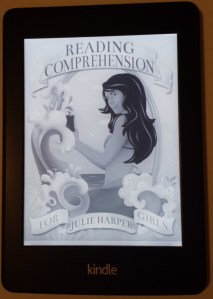
As you can see above, I used a picture of the Kindle book cover (as seen on the Paperwhite) for Julie Harper’s new release, Reading Comprehension for Girls, for this post. The cover was designed by Melissa Stevens (at theillustratedauthor.net).

It includes 48 fun short stories divided in 3 parts. Each story is followed by 4 multiple choice questions; answers can be found in the back. The print edition has 130 pages.

Chris McMullen

Copyright © 2014 Chris McMullen, Author of A Detailed Guide to Self-Publishing with Amazon and Other Online Booksellers

  • Volume 1 on formatting and publishing
  • Volume 2 on marketability and marketing

New Kindle Fire HD Kids Edition (& 4 More)

KINDLE FOR KIDS

Amazon released five new Kindles, including the new Kindle Fire HD Kids Edition.

(The other four new Kindles include a low-priced Fire, a new Fire HDX, an inexpensive Kindle with Touch, and a new Kindle Voyage said to be, “Our most advanced Kindle—passionately crafted for readers.”)

Amazon says, regarding the Fire HD Kids Edition, “If they break it, we’ll replace it. No questions asked.” It comes with a 2-year worry-free guarantee.

It’s an HD tablet with a 6″ display. It also comes with some enticing features:

  • Kid-proof case for durability. Choose blue, green, or pink.
  • Parental controls. This helps with age-appropriate content, limiting screen time, and educational goals, too.
  • One year of Amazon FreeTime Unlimited. (Not to be confused with Kindle Unlimited.) This is 5000 kid-friendly movies, books, TV shows, apps, and games from Disney, Nick Jr., Sesame Street, and more. I also see Spider-Man, Superman, Spongebob Squarepants, Curious George… It’s all good stuff.
  • Two-year worry-free guarantee.

The bad news is that it’s available for pre-order. The release date is October 21, 2014.

GOOD FOR AUTHORS

Children’s authors who have Kindle editions benefit from this, as it encourages more parents to let their children use Kindles.

Keep in mind that many kids will mostly be using Amazon FreeTime Unlimited, which does not include Kindle Unlimited.

But some will be looking for reading material outside of Amazon FreeTime Unlimited.

And as the kids get older, they may get into the habit—the Kindle reading habit. And they may gain Kindle reading time.

Some parents will also realize the value of Kindle Unlimited: A huge library of bedtime stories, reading books, homework help, etc. for $9.99 per month. This may benefit KDP Select authors.

Chris McMullen

Copyright © 2014 Chris McMullen, Author of A Detailed Guide to Self-Publishing with Amazon and Other Online Booksellers

  • Volume 1 on formatting and publishing
  • Volume 2 on marketability and marketing

Follow me at WordPress, find my author page on Facebook, or connect with me through Twitter.

Self-Publishing Expenses Gone Wild!

Editing Cloud

SELF-PUBLISHING EXPENSES

One of the major benefits of self-publishing is that you can do it (virtually) for FREE.

And, if you set a reasonable list price, the royalty rates are very high.

So with high royalties and minimal costs, if you can stimulate any sales at all, you should easily make something.

There is very little risk.

However, the number of authors who are investing big $$$ in self-publishing and who are losing big $$$ because their self-publishing expenses greatly outweigh their profits is staggering.

HOW MUCH DOES SELF-PUBLISHING COST?

It can cost next to nothing:

  • Zero set-up fees at print-on-demand indie publishing companies like CreateSpace.
  • Zero set-up fees at most major e-book publishing services like Kindle Direct Publishing, Nook, and Kobo.
  • Minimal cost to order one or more printed proofs for paperback books.

If it costs you next to nothing, you don’t have to sell many books to start making a profit.

But many authors aren’t spending next to nothing. Many are actually spending big money self-publishing their books.

  • Some are spending hundreds, like $200 to $500. This isn’t too bad, but it will take hundreds of sales just to break even. It’s a risk.
  • I’m amazed by how many spend $1000 to $5000. If they don’t sell thousands of books, it will be a bad investment. If they never sell 100 books, it will be a great loss. It’s a huge risk.
  • Can you believe that some indie authors spend more than $5000, sometimes over $10,000, publishing a single book? That boggles my mind.

INDIE PUBLISHING COSTS

One problem is that there are so many ways to invest money on self-published books.

Many authors are acquiring major expenses:

  • Cover design can cost $100 to $1000 (or more) for a custom cover. You can get one for $50 or less that’s pre-made. Or you can pay $5 and up for images and make your own cover. Or you can find free images that allow commercial use (but if you do, you really want 300 DPI, especially for a print book).
  • Professional illustrations inside the book cost additional money on top of the cover (though sometimes you can negotiate interior illustrations at a discount when purchased with the cover).
  • Editing can cost anywhere from $100 to $2000 (or more), depending on (A) the qualifications and experience of the editor, and (B) the type of editing services that you need. Simple proofreading is the least expensive option. You can even hire this from CreateSpace. If you need help with storyline suggestions, the writing itself, or formatting on top of editing, costs can grow significantly.
  • Book formatting is another major expense that one can invest in. It can be expensive. But you can also do it for free. Especially, if you plan to publish several books, you can save big $$$ by taking the time to learn and do this yourself.
  • Authors also invest in e-book conversion services. Learning to format your own books can save you money twice: once with the print edition, and again with the e-book.
  • You can also publish an audio book with the Audiobook Creation Exchange (ACX). If you write in a genre that appeals to truck drivers, for example, this can be a compelling option.
  • If you would like to have your book translated to Spanish, French, or Chinese, for example, you can pay good $$$ for translation services. Make sure the language is supported at Amazon before you spend the money! Definitely, do not rely on Google Translate to do this for you (it will be far from satisfactory to translate a book this way).
  • A variety of fees can come with designing a website (though you can get a free website at WordPress and design it yourself). You can register a domain name, pay money to avoid advertisements, upgrade for custom features, pay for web hosting, hire a web designer, or pay for a host of enticing services that many website builders offer.
  • Although much of the most effective marketing can be done by the author for free, there are many marketing expenses that one can acquire: advertising fees, press release distribution, video trailer design, bookmarks, promotional items, contest expenses, bookstore signing fees, etc. If you want to really spend big $$$ on marketing, hire a famous publicist.
  • If you publish with an imprint of your own choosing that isn’t simply your last name, you may need to register a DBA (doing business as) or starting an LLC. You can spend big money if you wish to trademark the name. (Legal Zoom can help with many legal issues, such as filing DBA’s or trademark applications.)
  • Authors can really break the bank publishing with vanity presses. You can publish for free with many self-publishing services, like CreateSpace, Kindle Direct Publishing, Nook Press, Kobo Writing Life, and Smashwords. Traditional publishers, if they accept your proposal, won’t charge you any fees (though maybe it would be worthwhile for you to hire a contract attorney once you receive a legitimate offer). Vanity presses, on the other hand, involve hefty start-up fees.

Even the little expenses can add up. The lower the cost, the easier it is spend the money, but after you pay for several of these, it can get expensive:

  • Paying for printed proofs plus shipping/handling. One proof can cost as little as about $7 if it’s short, black and white, and shipped in the United States. If it’s in color or several pages, the cost goes up, and for international authors, shipping can be quite expensive (Ingram Spark may be an attractive alternative for UK authors).
  • Some publishing services, like Ingram Spark or Lightning Source, charge setup fees.
  • Sometimes setup fees grow if you opt for additional features, like enabling additional sales channels (CreateSpace, though, now offers free Expanded Distribution).
  • It costs $35 (in the US) to register for a copyright. It’s not necessary: Your copyright starts as soon as your work exists in print, whether or not you register. But copyright registration entices many authors, as it’s one extra step toward protecting your rights, and it makes it easier to convince Amazon, for example, that you are indeed the copyright holder, should the question arise.
  • You can spend $9.99 to $575 buying ISBN‘s from Bowker (in the US), for example. (You can also get a free ISBN from CreateSpace, or a free ISBN for your e-book at Smashwords. Don’t use your CreateSpace ISBN for your e-book, and you shouldn’t use your Smashwords ISBN for Kindle, for example. You don’t need an ISBN for Kindle, though, as you’ll receive a free ASIN.) Some of these options are tempting. $9.99 at CreateSpace lets you use your own imprint. Buying in bulk with Bowker lowers your cost if you prefer the benefits of buying your own ISBN directly (or if you’re not publishing at CreateSpace). It can get really expensive if you publish several books, since each edition of your book needs a different ISBN. Then if you make major changes, you’re supposed to create a new edition with a new ISBN (perhaps not necessary with the free CreateSpace ISBN or free Kindle ASIN).
  • How about a Library of Congress Control Number (LCCN)? You can get one from CreateSpace for $25 (but be sure to do this before your proof is approved), for example. Of course, it’s hard for self-published authors to get into libraries…
  • Stocking up for a reading or signing, or to sell in person, requires purchasing several author copies in advance.

HOW MUCH SHOULD YOU INVEST?

If you invest in absolutely everything that you can invest in when self-publishing a book, you could easily spend tens of thousands of dollars. Very few books of any kind will recover such deep expenses.

Is this an expense that really makes sense? That’s a question you should ask yourself every step of the way.

You should try to lay off most of the expenses that I listed above, if at all possible.

Treat it like shopping at the grocery store on a limited budget:

  • Figure your total expense before spending any money.
  • Cross non-essential items off your list.
  • Find cheaper alternatives. (With grocery shopping, you might go with a non-branded alternative. Do the same with your publishing expenses.)
  • Set a reasonable budget. Stay within your budget no matter what.
  • Calculate how many books you must sell just to break even. If there aren’t reasonable prospects for this (do your research!), cross things off your shopping list.
  • If it’s not on your list, don’t buy it.
  • See the money-saving tips that follow. (It’s like shopping for groceries with coupons.)

Here are some money-saving tips:

  • Do all the formatting yourself. There is an abundance of free material (even on my blog) to help with this. When you need help, visit the CreateSpace or KDP community forum and politely ask a specific question. It’s amazing how often a formatting expert replies with a helpful response. Anything that you can do for free, and do reasonably well, will save you big money. Formatting will save you two ways with print and e-book editions. Extra effort spent on your first book will save you much more money in the long run when you publish several more books.
  • Do you really need a LCCN? Indie books are highly unlikely to wind up on library shelves unless you actively market for this channel and have great ideas for how to do this effectively. Throwing money out there and hoping is not a marketing strategy.
  • Market your books yourself for free. Throwing money at advertising isn’t a band-aid for marketing ignorance. The truth is, when it comes to book marketing (which doesn’t work the same as commercial advertising of brands seen on t.v., although branding is important), free and very low cost marketing done by the author tends to be far more effective than paid marketing services.
  • Many people and businesses are eager to accept your money. They definitely profit when you pay them. The more money you invest to self-publish your book, the more likely you’ll wind up in a deficit. They know your hopes and dreams (big sales, good reviews), and they know your fears (no sales, bad reviews, newbie mistakes), and they will use this effectively to sell you things that you don’t really need. Be wary.
  • Keep your expenses to a bare minimum until you have several books out. Don’t break the bank on your first book. (Yes, you want to make a great impression, but settle for making the best impression you can on a low budget. Yes, you can do this.) The more similar books you have out, the more effective marketing tends to be. Plus, if your first few books are getting some steady sales, this will boost your confidence that you can sell books (and it will give you a realistic guide for how much of your expense you can recover).
  • Most expenses can wait until you start making a profit (but not editing, as that will get you some bad reviews). Don’t bother with an audio book or translation, for example, until you’ve earned enough royalties to pay for these services without taking a net loss.
  • Start out with a free WordPress website. Don’t upgrade or pay for any fees until you’re making a profit from your book royalties, though you can grab your domain name in the initial stages, if it’s available.
  • Keep your business expenses to a minimum. In the beginning, you have no idea how many sales you will have. You can register for a DBA if you plan to publish many books, but LLC, trademark , or other expenses can wait until you see how sales are going (though if you want legal advice, you should consult with an attorney).
  • If you know people with great language skills, you may be able to recruit them to help with proofreading (perhaps for a reasonable fee). Especially, if they enjoy your writing, it can be a win-win situation. But don’t be a lazy writer (worrying about mistakes later: the fewer mistakes there are, the easier it will be to eliminate all but a few) and don’t rely on others to catch your mistakes (they are your responsibility). Use text-to-speech to listen to your book: It will help you catch mistakes that you don’t “see.”

WHAT SERVICES DO YOU NEED?

There are only two big expenses that I would recommend considering when you’re just starting out. Most other expenses can wait until you see how things are going.

Don’t dig yourself into a hole. Wait until you’re making a profit, then consider investing some of your profits. This way, you won’t suffer a loss.

These two services can make a huge difference in some cases, and therefore they are well worth considering:

  1. Cover design. It’s critical for marketing to have a cover that (A) appeals to your readers and (B) clearly signifies the precise genre or subject. If you can achieve these two goals yourself, that’s great. If you’re a nonfiction author, making the title clear (and relevant) in the thumbnail is more important than the picture, and thus it’s easier for nonfiction authors to design fairly effective covers by themselves. Most fiction authors who don’t have graphic design skills really need to spend $100 to $300 on a highly effective cover. But if the book is lousy, a great cover won’t sell it. If you have a great novel and don’t excel at graphic arts, then I do recommend finding an artist who can deliver a fantastic cover at a reasonable price.
  2. Editing. Most authors need to pay $50 to $200 for basic proofreading (and they need to do the research to find a proofreader who can do this job quite well). Those mistakes can deter your sales. The last thing you want is a review to complain about mistakes and to have a Look Inside that confirms what the review says. There are writers with excellent language skills, but even they often miss mistakes in their own writing because they read what they intended instead of what’s actually there. Text-to-speech can help to some degree. Use Word’s spellcheck to catch obvious mistakes, but don’t rely on it (there are many mistakes that it will miss). You definitely need additional pairs of eyes that can reliably help you out. Editors might convince you that it’s worth spending $500 to $2000, especially if you need storyline help, better character development, or serious writing help. But it’s a tough call. That’s a huge investment, and many books won’t make that $500 back. When you’re starting out, you really need to save where you can and invest wisely.

WISE INVESTMENTS

You may have heard that it takes money to make money, but what you might not have heard is that many authors are spending more money than they will ever earn from their royalties. By the way, this includes traditional authors, too.

Be smart with your money. Any investment is a risk. Wait until you’re making a profit, then investing some of the profits allows you to experiment with services without suffering a loss.

Be patient. Think long-term. Wait until you have several books out and history of sales to judge by before investing good money to self-publish a new book.

Do your research before investing money on a service. Check out the designer’s portfolio. Contact authors who’ve used their services and discuss their experience. Ask for a free sample (e.g. edit one chapter of your book), and consult help judging the quality. Do a cover reveal at various stages of the design. Seek brutal feedback on your writing and cover in the early stages. Ask questions before purchasing the service. Study your contract.

Remember that throwing money out there and hoping is not a marketing strategy.

Chris McMullen

Copyright © 2014 Chris McMullen, Author of A Detailed Guide to Self-Publishing with Amazon and Other Online Booksellers

  • Volume 1 on formatting and publishing
  • Volume 2 on marketability and marketing

Follow me at WordPress, find my author page on Facebook, or connect with me through Twitter.

Comments

Click here to jump to the comments section:

https://chrismcmullen.wordpress.com/2014/09/13/self-publishing-expenses-gone-wild/#comments

Kindle for Kids Just Got Better!

Kids BooksKDP FOR KIDS

Amazon just announced the new KDP Kids website:

  • Visit Amazon’s PR page, http://amazon.com/pr, to read Amazon’s press release about KDP Kids and the Kindle Kids’ Books Creator tool.
  • Visit the new KDP Kids website, https://kdp.amazon.com/kids, to explore the new program and to check out the new Kindle Kids’ Books Creator.

Or keep reading here and I’ll introduce you to them. I might even mention a few things that you can’t find through the above links. 😉

KINDLE KIDS’ BOOK CREATOR

The main thing that I see so far is the new Kindle Kids’ Book Creator tool.

This tool is designed to help children’s authors prepare illustrated books for Kindle.

There are some very convenient, cool features:

  • You can upload a multi-page PDF file. Usually, PDF’s don’t convert well to Kindle, but this is different. This tool was designed to convert children’s paperback PDF files to Kindle-friendly files.
  • Kindle text pop-ups are designed to make the text more readable across all available devices (Kindle Fire tablets, iPads, and cell phones).
  • In addition to PDF, you can upload JPEG, TIFF, PNG, and PPM files. Most of these formats are to upload images.
  • Basically, you can add images, add text, and make the text interactive through pop-ups.
  • The idea was to simplify children’s e-book formatting for Kindle. Rather than work with HTML or CSS, you just conveniently add images and text.
  • You can specify facing pages to improve readability. For example, sometimes a print book is designed so that two facing pages create one larger image.

The Kindle Kids’ Book Creator is available for Windows and Mac. Check to make sure that your computer meets the system requirements.

  • Visit the KDP Kids website (I gave the link above).
  • Click the Get Started button.
  • You can download the tool here, or you can click the Learn More link. This link gives you additional options (e.g. downloading without the previewer) and also includes FAQ’s.

MARKETING POTENTIAL

It’s not just good news for authors.

This is great news for parents, children, and educators, too.

KDP Kids solves the main problem:

  • Authors and publishers have struggled to make illustrated children’s books work well with Kindle. In the past, this either meant not making a Kindle edition at all, or not achieving optimal formatting. Now it’s much easier to properly format an illustrated children’s book, so there will soon be many quality illustrated children’s books on the market. This is your chance to ride the wave! Yes, the key word was quality (which includes editing). It’s not just about the visual design, but KDP authors now have an easy means to make the book interactive through pop-up text.
  • Many parents and educators have preferred print editions for the same reason: It’s been a challenge to find a selection of properly formatted children’s books. Now that it’s easier to make the images and text work better together, with interactive pop-up text, there will soon be many quality, interactive illustrated children’s books on Kindle and the reading experience will be much improved.

Children’s authors can help themselves by advertising these benefits to parents and educators. Show them how KDP Kids will benefit their kids. It’s a chance for you to advertise something other than your book directly, while still branding your image as an author. That is, you can get publicity through this without blatant self-promotion. That’s a nice marketing opportunity.

Let’s take this a step further: Kindle Unlimited is an amazing value for parents. Children get unlimited reading of 600,000 eligible Kindle Unlimited books for $9.99 per month:

  • bedtime stories
  • chapter books
  • early readers
  • homework help

Kindle Unlimited is like having an immense library at your fingertips, with no late fees. You can borrow up to 10 books at a time.

Check out A.J. Cosmo’s author picture on the KDP Kids page. That’s pretty cool, and shows you how even your author photo can do positive marketing. (But if everyone copies the same idea, it will cease to be effective. I’m not saying to copy this idea. I’m saying to let this idea inspire your own creativity.)

NOT JUST FOR CHILDREN

I expect to see new tools on the way, such as a textbook-friendly option for nonfiction.

KDP Kids is just one of 8 new pages that KDP has created. For example, there is KDP Non-fiction: https://kdp.amazon.com/non-fiction. At the bottom of the KDP Non-fiction page, you can find out what the other 6 new pages are.

Kindle is striving to make it easy (and FREE!) for authors to convert their books (even complex ones with images) to Kindle format, and to make it easy and convenient to achieve quality formatting.

The new Kindle Kids’ Books Creator is a giant leap in this direction. I expect to see more coming soon.

QUESTIONS

I received two emails this afternoon regarding KDP Kids. One was the automated announcement; the other was a personal email. I responded to the personal email and received a very quick, polite response. So I replied to that with some technical questions to try and clarify some important points that didn’t seem clear from the press release or FAQ’s. If any of my questions get answered, I’ll post that information on my blog.

I will also be testing this new tool out. If I discover anything valuable, I’ll be happy to share my ‘secrets’ on my blog, too.

So I may have another post or two about KDP Kids later this week.

Chris McMullen

Copyright © 2014 Chris McMullen, Author of A Detailed Guide to Self-Publishing with Amazon and Other Online Booksellers

  • Volume 1 on formatting and publishing
  • Volume 2 on marketability and marketing

Follow me at WordPress, find my author page on Facebook, or connect with me through Twitter.

Comments

Click here to jump to the comments section:

https://chrismcmullen.wordpress.com/2014/09/04/kindle-for-kids-just-got-better/#comments