Short Stories & Kindle Unlimited: The good, the bad, and the whacko

Short

INTRODUCTION

I will make two points in this article:

  1. Don’t sweat the myth that Kindle Unlimited promotes shorter works. It doesn’t.
  2. There is an opportunity to market shorter works through Kindle Unlimited. But it won’t be easy.

If you have short stories that you want to market on Kindle, the second point will present ideas for how to do this effectively.

However, as the first point will stress, Kindle Unlimited won’t open the door for the get-rich-quickly-through-short-works bandwagon.

I’ll explain why I believe that Kindle Unlimited doesn’t actually favor short fiction, while at the same time showing that it is possible to market short stories.

It’s not really contradictory: The key is that selling shorter works is neither easy, automatic, nor obvious. This explains why most short pieces won’t take off, even though it will be possible to market them effectively.

SHORTER BOOKS, BIGGER PROBLEMS

A big myth going around presently is that Kindle Unlimited favors shorter books.

The underlying idea seems to be that it’s easier for customers to reach 10% of shorter books, and 10% is the critical number for getting paid for Kindle Unlimited downloads. (Need an introduction to Kindle Unlimited? Click here.)

Customers could easily get 30% through a short story before realizing that they don’t actually want to finish it, but for a 200,000-word book, they must read 20,000 words before the author will get paid.

But here’s the thing: All books aren’t created equal. There isn’t equal likelihood of customers downloading shorter books and longer ones. This is where most short books are greatly disadvantaged.

Here are several hurdles that authors must overcome in order to succeed in the short reads market with Kindle Unlimited customers:

  • Kindle Unlimited customers tend to be avid readers. It costs $9.99 per month, which amounts to $120 per year, to subscribe to Kindle Unlimited. This will attract avid readers, who will easily get their money’s worth. Spending $10 per month to read short stories won’t seem like a good value to many customers.
  • Avid readers tend to be smart book shoppers. They aren’t likely to be fooled by authors trying to game the system. They are likely to consider the value of books when they shop. Page count will be a factor. So will price.
  • Kindle Unlimited customers may prefer to download higher-priced e-books. It takes ten 99-cent e-books just to get your $9.99’s worth for the month, but if you download five $6.99 e-books, you get a $35 value. Short books are likely to be priced at 99 cents. Simply raising the price of a short story to $5.99 won’t work: Customers will see a large price on little content… and… remember, avid readers are smart book shoppers.
  • Shorter books require even better writing. A few mistakes in a 300-page novel: no problem. One mistake in a 20-page short story: ouch! It’s not just the mistakes, but the mechanics of the writing, the flow of the story, the characterization, the plot, a satisfying ending… the idea has to be fantastic. When you write 100,000 words, you can have a few weaknesses provided that your strengths make the bulk of the book intriguing and enjoyable. In a short work, mistakes of any sort really stand out. The challenge of writing an effective blurb shows how much harder it can be to write much less and do it very well.
  • Writing that works for short stories is different from the kind of writing that works for novels. So if you simply produce a very short version of novels that you’re familiar with, it probably won’t work. You have to research which kinds of short works sell and come to understand how they are effective. (Now the devil’s advocate will say that all writers should try writing short stories—despite the fact that they might be much harder to sell, in general—because learning how to write a short piece well can be highly instructive for writers. Write a short story for what you can gain from it in the long run.)
  • Although readers could take a chance on a short story since little commitment and investment is involved, it’s also true that readers may be pickier when choosing which short stories to read. There certainly are enough short stories out there to choose from. One story doesn’t satisfy a reader for long. What’s the reward for liking the short story? Will there be another 200,000 words worth of writing to enjoy by the same author? You see, when you find a novel that you like, if the author has a few other novels, the reward is a lot more where that came from. If you just have a dozen short stories out, a reader could blitz through the whole collection in a day; you aren’t offering a huge supply of reading material as a potential reward if the reader likes your style.
  • There is much competition from free and low-priced stories. Why should people read your short stories when they can get the entire Sherlock Holmes collection for 99 cents or free? There are many classic short story collections out there at great prices. This comes back to my last point: If you like Sherlock Holmes, or any other classic short work, there is a ton of similar material to satiate your craving for it. If you like a short story by a modern author, often there are just a few more short stories—not enough to satisfy a reader for long.
  • Visibility is a huge issue. Suppose, for example, you want to write a short romance story, hoping to take advantage of the huge romance market. Do you think Amazon wants your short story to show up among hundreds of popular novels when customers search for romance? That could create confusion. So instead your short story should be listed among Short Reads or short story collections. 99% of romance readers will instead be browsing the romance category, looking for novels. There is a marketing challenge here: You’re not just selling a book to romance customers, you’re selling a short story specifically to the very few romance readers who want to read a short story. There is a market for that, just not nearly as wide as the romance novel market.
  • Another marketing challenge is the Look Inside. The shorter your ‘book’ (if you can call it that in this case), the shorter the Look Inside. The Look Inside is a valuable sales tool. A short story has a very short Look Inside. There may easily not be enough there to catch the reader’s interest. You could just give the title, author name, and start the story, moving the copyright notice to the end, but you still need the Look Inside (10%) to be long enough to sell the book.
  • Effective marketing is more costly and time-consuming for a series of short works. It’s fairly affordable to hire out quality cover design and editing for a full-length novel, but can be quite expensive to buy several covers for short pieces or have several short works edited.
  • For those hoping to game the system with short works, customer reviews will be an equalizer. Especially, if they are hoping to benefit from Kindle Unlimited, as avid readers tend to be smart book shoppers.
  • Another equalizer is experience. Customers don’t have to get ‘burned’ too many times to become wiser shoppers. Time favors quality and good value.
  • Even if short works do gain traction, as soon as it becomes popular and fashionable, the market will be flooded with short works. (This really doesn’t affect other authors, as the cream rises to the top. It’s always easy to find books that have achieved success; the not-so-good stuff really isn’t in the way—it falls to the bottom, out of the way.) The thing is, the flood will make it ineffective for authors hoping to generate high rewards with little effort, which means the flood won’t last. Those who succeed through quality writing, satisfying a niche audience, will continue to thrive—hard work, good ideas, and effective marketing will always help such authors thrive.

There are different kinds of short books. Let’s do authors a favor and not generalize them. Some authors slap something short together quickly, hoping to get rich. Other writers craft short pieces with masterful storytelling. These are the two extremes, then there is much in the middle. We would do a great disservice to masterful storytellers who specialize in short fiction by saying bad things about all short works.

A few of my points above specifically address the gamers, but the rest are hurdles that all short works authors must overcome in order to thrive in the short reads market.

BOOK CHOPPING

Okay, there is another extreme that I should address: book chopping. Again, I can’t imagine this being effective, and I will explain why.

Here is what I mean by book chopping: An author takes a regular-length novel and divides it up into smaller chunks (as short as a chapter, perhaps, or it could just be a few parts).

The idea behind this ‘strategy’ is that Kindle Unlimited customers can download several books without paying an extra penny, while the author earns a royalty every time a customer reads 10% of one of his or her books.

So, you could sell a novel and earn $1.80 or so for one download, or you could split that same novel into 5 parts, earning $9 from every customer who finishes the novel. Why stop there? Split it into 20 parts and you make $36 for that single book, right?

Except… Kindle Unlimited customers aren’t likely to reward this behavior, for the many reasons listed above.

On top of that, you have several ‘chapters’ cluttering up your Kindle, and you can only store 10 Kindle Unlimited downloads at a time. Suppose you’re reading Chapter 32 and would like to go back to Chapter 4 to refresh your memory of something that happened earlier. INCONVENIENCE doesn’t sell books!

Sure, some unscrupulous authors might find a way to abuse the system in the short run with this, but (A) they won’t find substantial or long-term success by chopping books and (B) Amazon tends to learn how to prevent authors from taking advantage or catch and provide a fit punishment for those who game the system. It’s not going to work to achieve anything significant, and even for those who are so unscrupulous, the benefits definitely don’t outweigh the risk.

Series are an exception. When each volume of a work reaches a natural division, and where each volume provides a complete, satisfying reading experience, then it’s not a chopped book—it’s a series. Many customers appreciate series, and series authors often do well. You can be a successful series authors, and marketing a series has many advantages. It’s even possible to develop and market a series of short pieces, but this won’t be a chopped novel—each piece will be effective by itself.

MARKETING SHORT WORKS

It is possible to succeed with short fiction or nonfiction pieces.

It’s not easy. You have to overcome the many challenges that I’ve outlined above.

It will take hard work and effective marketing. Find ways to use hard work and brain power to overcome these challenges, and you can stand out from the crowd and succeed with short pieces.

Following are some ideas to help you with this.

  • You need to cultivate a culture for your series of short works. You need to play an angle that gives your short reads an edge. You need to find a concise way to announce this clear and up front, e.g. in a subtitle, through a strap line, as a cover byline, in your blurb, with a slogan, on all of your marketing materials, etc. It’s the card you have to play. Take full advantage of it. Sometimes, it’s not enough to fill a need: You have to show people that they have a need, and you have what they didn’t know they needed. See my next bullet for some specific suggestions. But, whatever angle you play, focus on fostering a culture. This is the key to long-term success.
  • Here are some possible angles. Commuter fiction—read on a plane, subway, or train: Market to commuters, show how your series is tailored for this. Lunchtime reading—have some free time at lunch, but can’t really go anywhere to enjoy it. Morning inspiration—short motivating reads to help people get their days started on the right foot. Bedtime reading—a leisurely way to wind down for a good night’s sleep. People aren’t going to think of the angle for you. You need to find the angle that suits your short works best, and make this point abundantly clear. Don’t sell the book: Sell the benefit.
  • You can get good visibility through wise choices for your categories and keywords. The problem is that you only get to choose 2 categories and 7 keywords, so you must do some research and choose wisely. Find short works similar to yours selling well on Amazon and see which categories they are listed under, and see which keyword searches they show up in. The most relevant category may be Kindle Short Reads (click here) at Amazon.com, but this category is not available through the publisher’s choice (see here); yet there are 700,000 Kindle e-books in this category (with 250,000 in KDP Select), so although it’s said to be ‘restricted,’ evidently it’s easy (or automatic) to get in just by having your book the proper length.
  • Check out the Kindle Short Reads page, as it provides a useful guide for how long it takes to read how many pages. You need to know this. If you’re selling your book as commuter fiction or lunchtime fiction, for example, you need a reliable estimate for how long it will take to read your book. This number is valuable. “Have 30 minutes to read on your lunch or on a train ride? This 15-page book will hit the spot.”
  • Research a couple of specific keywords that may be relevant for your short work. Start typing in the search field at Amazon and it will show you popular matches. You want matches that are both popular and specific to your book; that helps you gain visibility (it doesn’t help to be the last book in a search with many results). Note that popularity varies whether you search in all departments, books, Kindle, Short Reads, or a specific category: So test them all out. Note that “commuter fiction,” for example, doesn’t even pull up a match presently, so don’t waste your keyword with things like this that are never searched for. “Short reads,” on the other hand, is a popular search (with 1250 results, though, so you need to be high up on that list).
  • You want to create a series of short works that stand out and are easy to find. You could put “commuter fiction,” “lunchtime fiction,” “Lisa’s shorts,” “inspirational stories,” or something in a subtitle or series title (though you have to number series with Kindle) or in parentheses, making it easy to find your brand—while also declaring it a short work. If the subtitle or parenthetical note, which will be visible in search results, also emphasizes the advantage of your book’s length (e.g. Commuter Fiction), even better.
  • The covers of your series need to send a clear, unique brand. Have a dozen short stories? You want them all to look uniform. You want them all to be very easy to find. A customer sees any of your short books and immediately recognizes the series. Branding is vital. You want new customers to see that you have a wealth of similar books, i.e. the reward for trying you out and liking your writing is much more where that came from. You want old customers to easily find your other pieces. An appealing (to your target audience) visual brand that creates a unique signature, that’s what you want.
  • Write several similar short books. You’re not likely to sell a ton of short books if you only write one or a few; one-hit wonders aren’t likely in short fiction. If you succeed in hooking some customers on the benefits of your short works, where you really stand to benefit is when you get customers to buy several of your books. It also shows new customers that you’re a serious author, and that there is plenty of reading material similar to any of the short pieces that you offer.
  • Once you succeed in growing a fan base, you want timely releases. They’re short, so you can write, say, one a month. (Say, you spend a month writing. You pass it onto your editor, getting it back weeks later. You also wait for your cover designer. It might take a few months before it’s publish-ready. But once the train gets started, you can have one to publish every month.) You want to publish regularly, so fans start to look forward to the 15th of every month (or whenever, but they know when to expect it). An advantage of releasing a short piece in 30-day intervals is that you always have a book in the Last 30 Days new release category.
  • Amazon tends to help authors who (scrupulously) help themselves. Effective premarketing and marketing can pay big dividends, not just in immediate sales. Another factor on your side is word-of-mouth. Learn the craft and produce quality short reads, and it can lead to long-term success.
  • Look for marketing groups, e.g. in Facebook or at Goodreads. Some groups will correspond to your genre, e.g. fantasy or romance. Also look for groups dedicated to short reads (heck, you could start a group). If you’re using Kindle Unlimited, look for groups associated with this, too.
  • Make one short read free. You should plan to publish dozens of similar books, so, really, why can’t you afford to make one good one permanently free? The freebie won’t be in KDP Select. Publish it on Kobo, Smashwords, etc. At Kobo and Smashwords, you can make it free, and then you (or customers) can notify Amazon of the lower price, politely requesting a price match. The hope is that your freebie will encourage many readers to try out your other stories. Remember, your work has to be good enough to make readers want more of the same. Making junk free isn’t helping anybody.
  • Educate your audience. Show them the benefits of Kindle Unlimited, e.g. how for $9.99 per month they can read your series of dozens of books without paying an extra penny. Show them how to find short reads (include the link to the Kindle Short Reads category). Explain how they might benefit from short reads, e.g. during commutes or lunchtime. Of course, you mention your series at the end of your marketing endeavor. If you’re promoting commuter or lunch fiction, remind your readers to stock up on the weekends, so they don’t waste precious time during their commutes or lunch breaks just searching for the next read.

Chris McMullen

Copyright © 2014 Chris McMullen, Author of A Detailed Guide to Self-Publishing with Amazon and Other Online Booksellers

  • Volume 1 on formatting and publishing
  • Volume 2 on marketability and marketing

Follow me at WordPress, find my author page on Facebook, or connect with me through Twitter.

Comments

Click here to jump to the comments section:

https://chrismcmullen.wordpress.com/2014/08/18/short-stories-kindle-unlimited-the-good-the-bad-and-the-whacko/#comments

#Free #ebook w/ #KindleUnlimited (**New** Twitter Amazon Hashtags for Kindle Unlimited) #AmazonCart

Kindle Unlimited Hashtags

Amazon recently launched Kindle Unlimited, a subscription service where customers can access 600,000 titles (including all 500,000 KDP Select tiles plus 100,000 more from small presses, with some popular series like Harry Potter in the mix) for $9.99 per month. A customer can borrow up to 10 books on the device (which doesn’t have to be a Kindle) before needing to return one to make room for another. Authors receive a royalty in the form of a KDP Select borrow for each Kindle Unlimited download after the customer passes the 10% mark. You can read more about Kindle Unlimited by clicking here.

Like it or hate it, neither praising nor complaining are marketing strategies. If you enroll in KDP Select, you want to find marketing strategies that help you benefit from the program; if you opt out of KDP Select, the presence of Kindle Unlimited still impacts how to market your book effectively. Adapting to change and finding effective marketing strategies are proactive ways to reap benefits while others idly watch, wait, and remark.

For example, you could be using hashtags to help with your Twitter marketing. If you have already built a large fan base and release a new book, Twitter can help with that, but some authors use Twitter effectively to do far more than that. For one, you can use hashtags effectively. For another, if you become an active, appreciated member of a Twitter network, you can garner much support for your occasional promotions in the form of retweets, for example.

Here are some hashtags that you might be using to market your KDP Select e-books in the Kindle Unlimited era:

  • Hashtag #KindleUnlimited. Make it easy for Kindle Unlimited customers to see that they can get your Kindle e-book for free.
  • Hashtag #Free. Like the example I made with the title of this article, you can combine these hashtags (#Free with #Kindle Unlimited). You might also include Reg. $5.99 (or whatever the list price is).
  • Hashtag #AmazonCart. This new feature helps Twitter customers quickly add your Kindle e-book to their carts to buy later, and offers you the ability to monitor the effectiveness of your promotional tweets. Click here to learn more.

You don’t want to spam your followers to death, but if you learn to use Twitter effectively, build a following, and become a respected member of your network, it is possible to use Twitter effectively to promote your e-book.

Chris McMullen

Copyright © 2014 Chris McMullen, Author of A Detailed Guide to Self-Publishing with Amazon and Other Online Booksellers

  • Volume 1 on formatting and publishing
  • Volume 2 on marketability and marketing

Follow me at WordPress, find my author page on Facebook, or connect with me through Twitter.

Comments

Click here to jump to the comments section:

https://chrismcmullen.wordpress.com/2014/07/23/free-ebook-w-kindleunlimited-new-twitter-amazon-hashtags-for-kindle-unlimited/#comments

One-Word Reviews at Amazon Now?

Reviews 1 Word

I saw a one-word review at Amazon today. So I’m guessing the 20-word minimum has been removed.

You might recall a couple of months ago that Amazon was testing out both ratings and reviews on print books. Those ratings disappeared after a few weeks, so perhaps the compromise was to remove the minimum word count.

The review forms have changed (but there is a tiny ‘here’ link below them that you can click if you prefer the old way).

My guess is that Amazon is trying to encourage more genuine customers to leave reviews. So now there is no ‘imposing’ 20-word minimum.

(In reality, what had been preventing a customer from writing the same word 20 times consecutively?)

We’re short on time now, so give me a one-word summary of the last book you read. 😉

Children’s Categories & Marketing @ Kindle

Kindle Age

INTRODUCTION

This is a two-part post:

  1. First, I will discuss a cool new feature that Kindle Direct Publishing (KDP) just introduced to help categorize children’s Kindle books.
  2. Next, I will share an idea to help market children’s Kindle books.

AGE & GRADE LEVELS

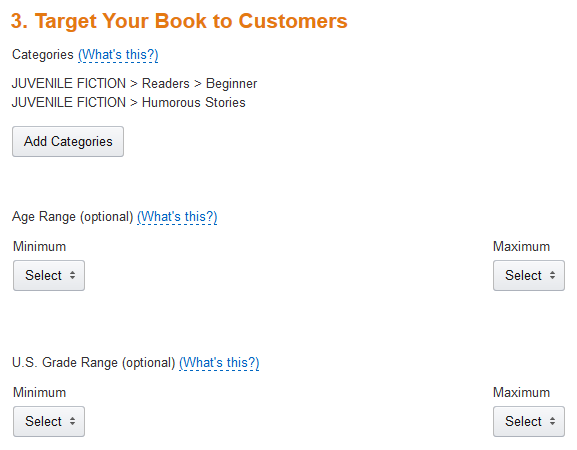
As of now, Step 3 of the KDP publishing process allows you to select an Age Range and a separate US Grade Range.

Tip: Open up your children’s, tween, and teen Kindle books on your Bookshelf and update Step 3. You’ll need to republish for this to take effect.

This will help give your juvenile book added visibility on Amazon:

  • Your book will show up when customers select one of the age group or grade level filters in Amazon search results.
  • You no longer need to waste a crucial keyword to get listed in the children’s age group categories. Tip: If you used a keyword to accomplish this in the past, you can now change that keyword to something else, if you wish.
  • These age group and grade level settings apply to the Schools and Teaching store.
  • These settings are supposed to apply to the Children’s Kindle Book stores for both Amazon.com and Amazon.co.uk.

What about CreateSpace paperbacks? Well, it wouldn’t hurt our chances if several authors suddenly made this request. Hint, hint.

KDP has a table with suggestions for the different age groups: Click here to view it.

I love these new age group and grade level options at Kindle. I’ve been hoping for this for years, and I’m probably one of many authors who’ve requested it in my interactions with KDP. It’s a great opportunity for children’s e-book authors.

MARKETING IDEA

As you may know if you follow my blog, I had the opportunity to talk to members of the Kindle Educational Team a few weeks ago.

They are hoping to see more educators and authors who would like to educate via books publish helpful educational content on Kindle. They have recently reached out to authors to hear our perspective from the publishing end. These new age group and grade level options are one step toward accomplishing this.

So here is my idea:

Education covers many topics. One subject relates to most juvenile fiction stories: English. This includes reading, reading comprehension, writing, vocabulary, grammar, and so on.

Suppose you have a collection of short stories, poems, novellas, novel, or other children’s fictional work for children, tweens, or teens. If so, there is a simple way to improve the marketability of your children’s book:

  • Create some teacher- or parent-oriented resources for your book. I’ll list a few examples below to get your brain churning.
  • You could include these in your book, or you could add a page to your book describing free educational resources available on your blog or website, which parents or teachers could use to get educational value out of your stories. The latter option has the advantage of giving readers a reason to visit your blog and follow you (plus it doesn’t make your book resemble a textbook for kids just looking to enjoy fiction).
  • Your stories are still marketable as stories, but now they are also marketable as educational resources to parents, teachers, homeschool instructors, libraries, and other educators. The free resources become an added marketing tool.

Here are a few ideas for creating educational resources to go along with your story:

  • Add vocabulary definitions and exercises relating to your content.
  • Write questions that assess reading comprehension for your story.
  • Come up with essay questions relating to your book.
  • Make creative writing questions stemming from your story or characters.
  • Create a grammar worksheet to go along with your content.
  • For historical novels, you may be able to add history lessons and exercises.
  • For science fiction novels, you might be able to come up with related science questions and exercises.
  • If your protagonist is bilingual, there is an opportunity for language lessons.
  • If you can find ways that your book relates to one or more school subjects, this gives you more opportunities.

READ TUESDAY

You may be aware that I launched an event in 2013 called Read Tuesday, which debuted in December. You can check out the website here: readtuesday.com.

Read Tuesday is a Black Friday event just for books. One big goal of the event is to help inspire reading.

In 2014, I would like to add a special page highlighting juvenile books that include educational resources (either in the book itself, or free resources that readers can find on the author’s blog or website). So if you have such a book and you’re willing to participate in Read Tuesday 2014 (which requires having your book on sale that day), in addition to listing your book in the Read Tuesday catalog, there will be a special page to showcase juvenile books with free educational resources available. I think this may be a good way for Read Tuesday to help promote reading.

Chris McMullen

Author of A Detailed Guide to Self-Publishing with Amazon and Other Online Booksellers

  • Volume 1 on formatting and publishing
  • Volume 2 on marketability and marketing

Follow me at WordPress, find my author page on Facebook, or connect with me through Twitter.

Comments

Click here to jump to the comments section:
https://chrismcmullen.wordpress.com/2014/06/03/childrens-categories-marketing-kindle/#comments

Amazon’s Top Customer Reviewers

Stars

Amazon’s Top Customer Reviewers

Amazon ranks customer reviewers:

  • Click here to see the top 10,000 customer reviewers ranked in order.
  • Click here to see the Hall of Fame reviewers and their accomplishments.

The numbers are impressive. On the first page of the top reviewer rankings, I see:

  • Most have written 1000 to 2000 product reviews.
  • 10,000 to 60,000 helpful votes on their reviews.
  • 94% to 97% of the votes deemed their reviews helpful.

Amazon takes steps to help ensure fair play. For example, suppose you write 100 reviews and get your friends to vote Yes on all 100 reviews. Your friends’ votes won’t count toward your top reviewer rank. If someone votes Yes on most of your reviews, they are considered to be a Fan Voter and their votes don’t affect your reviewer rank.

Amazon Customer Review Badges

Top reviewers earn badges, which are displayed on Amazon.

Here is a list of badges that can be earned:

  • Top 1000 Reviewer. If you crack the top 1000 in review rankings, you receive a badge for it (for as long as you remain in the top 1000).
  • Top 500 Reviewer. This gives you an incentive to write more reviews once you crack the top 1000.
  • Top 50 Reviewer. It’s a large jump from 500 to 50, but puts you in elite company.
  • Top 10 Reviewer. Out of millions of reviewers, imagine being ranked in the top ten.
  • #1 Reviewer. At this moment in time, you are the very best.
  • Vine Voice. Amazon invites selected reviewers into a special program to review not-yet-released products.

Looking for Reviewers?

Many of the top reviewers allow themselves to be contacted by clicking on their Amazon handles. Click on a top reviewer’s name at Amazon and you may find an email address at the left side of their profile page. Many top reviewers make their email addresses publicly visible this way.

Why? Because they love to read books and write reviews. Books cost money. Publishers and authors want to get their new releases reviewed. So it’s a match made in Heaven. The publisher or author contacts prospective reviewers, politely asking if the reviewer is interested in receiving a free advance review copy in exchange for an honest review.

Here are some notes:

  • Browse through the reviewer’s product reviews at Amazon to see which kinds of books that reviewer likes to read. They are likely to turn you down if your book isn’t a good fit. You’re also more likely to get a critical review from someone who isn’t familiar with your subgenre, so it’s in your best interest to find reviewers who read books in your subgenre.
  • Top reviewers receive tons of requests from authors. If your book is a good fit and the nature of your request stands out in a good way, this may give you an edge. The higher their reviewer rank, the more requests they are likely to receive.
  • Be very polite. Be concise, yet provide all the pertinent info in your request. The last thing you want to do is offend someone who might actually read and review your book.
  • Don’t pester the reviewer with repeated requests, updates, etc. Make one polite request, send the free copy, and let it be. If they never review your book, let it go. (If that’s the case, you probably don’t want the review after all.)
  • What’s the best way to thank the reviewer? Vote Yes that the review is helpful. Ask your fans to vote on the review. (Some reviewers actually remove reviews if there aren’t enough helpful votes, and especially if the review draws unhelpful votes. Every vote of Yes is an incentive for the review to stay.)
  • The review may be critical. Expect an honest review. The reviewer just might not like your book. That’s the chance you take.
  • Read the critical reviews that the reviewer has left before making your request. See if any of that criticism may apply to your book.
  • If you’re a self-published author, see if the reviewer has ever reviewed other indie books, and, if so, if any are favorable.
  • When you give a free copy in exchange for an honest review, the review will not say Amazon Verified Purchase. Many of these may look suspicious.

Review Crazy

Amazon customer reviews are helpful in the sense that a large assortment of customer opinions can help shoppers decide which products may be right for them.

Unfortunately, people have abused the review system with both five-star and one-star reviews. Fortunately, Amazon has made great strides in preventing and removing suspicious five-star reviews, such as from close friends and family. However, many customers rightfully approach reviews with suspicion. Even one-star reviews, customers may suspect they were left by someone with an agenda.

An interesting phenomenon with reviews is that very often multiple reviews of the same product contradict one another.

Still, as shoppers, we do like to see an assortment of opinions, we like to decide which reviews to ignore and which to trust, and many of us have learned to check out the Look Inside before making the purchase.

Some authors have gone review crazy. If a book isn’t selling, the first thought seems to be that the book needs reviews. The reality is that if it isn’t selling, it’s probably something else:

  • The cover doesn’t depict the right subgenre or doesn’t appeal to the target audience.
  • The blurb isn’t engaging the reader’s interest and arousing the reader’s curiosity.
  • The Look Inside doesn’t look professional or doesn’t draw the reader in.
  • The book idea just doesn’t appeal to a significant audience.

If one of these reasons apply, recruiting several reviews isn’t likely to impact sales.

In fact, having several reviews on a newly published book that isn’t selling may look suspicious to customers:

  • Published 25 days ago.
  • 12 glowing reviews.
  • Sales rank 1,572,049.
  • Wait a minute: If the book hasn’t sold, how did 12 people review it? Must be friends and family.
  • (Now if the book has been out for a year, that’s different. Maybe it had sold well when it was first released.)

If many of your reviews are from top reviewers, it won’t be too hard for customers to deduce how you went about getting reviews.

Honest customer reviews can indeed be helpful. Just don’t go review crazy.

Thank You, Reviewers

Authors appreciate the time you take to provide honest feedback.

Other customers appreciate the time you take to provide honest feedback.

Whether you’re a top reviewer, or have just started leaving reviews, you are very much appreciated.

Thank You Pic

Chris McMullen

Author of A Detailed Guide to Self-Publishing with Amazon and Other Online Booksellers

  • Volume 1 on formatting and publishing
  • Volume 2 on marketability and marketing

Follow me at WordPress, find my author page on Facebook, or connect with me through Twitter.

Comments

Click here to jump to the comments section:

https://chrismcmullen.wordpress.com/2014/06/01/amazons-top-customer-reviewers/#comments

Amazon: Experimenting with Review Changes..?

Amazon Review Changes

If you’ve shopped for Kindle e-books recently on Amazon.com or Amazon.co.uk, you may have noticed some changes to the way that search results are displayed.

Or maybe not. Not all shoppers have been affected.

Apparently, Amazon is testing something out with many customers, but not all customers. That would make sense, actually. Then Amazon would have data for two groups: a control group, shopping like normal, and an experimental group, experiencing the changes.

What’s going on?

This doesn’t apply to everybody. Many customers are observing the following:

The review tally and average star rating are not showing up next to Kindle e-books in search results for many (but not all) customers.

Just to be clear:

  • Reviews are showing, but only on the product page. Normally, you see the total number of reviews and average star rating before reaching the product page, but for those who are experiencing the change, you don’t see any review information until reaching the product page.
  • Print books are not affected. Only Kindle e-books are affected (and only for some customers).
  • Some customers who aren’t seeing the review info in search results were able to switch web browsers (e.g. from Internet Explorer to Mozilla FireFox) and then see the review info. The browser switches haven’t been consistent (e.g. for one person, going from Explorer to FireFox works, but for another, it’s FireFox to Explorer that does the trick). Some customers report that no browser changes resolved the issue.
  • The test applies to shopping for Kindle e-books on Amazon.com or Amazon.co.uk. (There are other ways to shop for Kindle e-books, such as right on the device. Most people shop for Kindle e-books from Amazon’s home page.)

The way we “know” this (of course, only Amazon “knows” for sure) is from various customers (including myself) observing this firsthand, and some authors (this time, myself excluded) contacting Amazon to inquire about this and receiving similar responses.

Will the World End?

Predicting the end of the world doesn’t come with many rewards. Whether you’re right or wrong, either way you seem to lose.

Right now, it’s evidently just a test.

Here is my pure speculation. I don’t have any evidence of the following; I just tried to reach a logical conclusion from what data I have. It might be like watching a news story break out: You hear eight theories for what happened, some of which seem reasonable, and they all turn out to be wrong. But sometimes it’s still fun to play along.

  • Amazon is probably looking at (A) sales data between the control group and experimental group and (B) any impact the changes may have on creating a positive shopping experience.
  • A positive shopping experience may include data on returns, review activity, customer complaints, and average review ratings, for example. Maybe they are also listening to publisher feedback.
  • If the changes lead to (A) increased profit or (B) improved shopping experience without any decrease in profit, it would seem logical for the changes to become permanent.
  • If the changes instead result in a decrease in profit or adversely affect the shopping experience, this will probably be a temporary change and things will soon return to the way they were.
  • It could be a long delay. It might take time for affected customers to get accustomed to the change before they return to their usual buying habits.

What’s going to happen? Would you like to call heads or tails?

I’m interested in the outcome, but I don’t feel strongly one way or the other, either as a customer or as an author.

I sort of like browsing through titles and thumbnails without that review tally in search results. I sort of feel that it may (at least, in principle) encourage authors to worry more about writing and marketing and much less about reviews (but in practice…). I believe there could be a few small benefits. But again, I don’t feel strongly about it. Either way, I won’t lose sleep over this.

Some books may benefit from the changes. Some books may be hurt by the changes. Probably, it will balance out to a large extent. If the changes persist, it probably means that it’s helping more books than it’s hurting.

Sales do fluctuate for all books. So any author whose books are presently on the downward part of a typical fluctuation are presently pulling out their hair. It might be pure coincidence that their sales are down, but if they noticed these review changes, they will surely blame the reviews. But those authors whose books are presently on an upward swing will be thinking that evidently the changes are helping them out. One author isn’t a good statistical sample. Even a handful is not a sufficient indicator.

Personally, I don’t expect things to change much if the changes are here to stay. Right now, you still see the reviews on the product pages, so it’s not like reviews have vanished; you just have to get to the product page before you see them.

Maybe some books that are getting clicked frequently because their ratings are really high won’t be clicked quite as frequently. Maybe some books that aren’t getting clicked as much now because the review ratings are really low will get a few more clicks. Maybe not.

Constant Change

There is only one constant in the publishing business: change.

Several months ago, Amazon eliminated the 4-for-3 program for print books. I expected that to hurt sales, but my paperback sales actually improved significantly after that. Perhaps it’s because Amazon started discounting CreateSpace paperbacks more after discontinuing the 4-for-3 program. Or maybe my sales were about to rise for other factors, such as new releases and marketing. It’s a complicated analysis.

Amazon changed the FREE Super Saver shipping price and the fee for Amazon Prime, but these don’t seem to have affected my sales.

Here are a couple of things to consider:

  • The change is fair because it affects all Kindle e-books. It’s not like they just did it to your e-book, but left all others like they were.
  • People still want to read Kindle e-books. Your book is still available. Customers are still shopping for books.
  • Reviews generally have much less impact than authors realize. Sometimes a negative review improves sales, sometimes a positive review deters sales, very often reviews don’t affect sales at all, and when sales do change, it might very well be because of some other hidden factor and a review just coincidentally showed up at the same time.

Don’t worry. Be happy. Just read and write more books.

You can’t change the change.

It may not change at all.

If it does, don’t sweat it.

There are probably more important things that you should be doing right now than worrying about this. 🙂

Publishing Resources

I started this blog to provide free help with writing, publishing, and marketing. You can find many free articles on publishing and marketing by clicking one of the following links:

Chris McMullen, Author of A Detailed Guide to Self-Publishing with Amazon and Other Online Booksellers

Follow me at WordPress, find my author page on Facebook, or connect with me through Twitter.

Amazon Sales Rank—Why Does It Matter to Customers?

Rank

Obviously, sales rank is important to Amazon. It makes sense to showcase products that are more likely to sell, and those that have been selling frequently have a proven track record. Sales rank factors into bestseller lists, ordering of search results (to some extent), visibility with special features, etc.

Sales rank is also important to authors and publishers. It helps to show how the book is selling.

Perhaps the strange thing is how important sales rank is to customers.

Popularity

Do people like to buy what’s popular? Aren’t there people with their own sense of style, who want something nice of their own that few other people are enjoying? Some clothes are highly popular, yet you still see a large percentage of people who are uniquely attired.

A few times in the past five years Amazon’s sales rank has been down for several hours to a few days. Sales tend to drop off during this period. Usually, no sales rank means that book has never sold. Suddenly, books that usually sell a few copies per day stop selling while the sales rank feature is temporarily disabled. Why? Because having no sales rank versus a rank of 30,000 can have a significant impact on a buying decision.

It’s like many customers are thinking, “If it’s not good enough for everyone else, it’s not good enough for me, either.” This seems to be a prevalent opinion in the well-educated, well-read world, at least as it applies to book-buying decisions.

There are a few customers who will take a chance on a book with a sales rank in the millions, but not many, and certainly not enough to go around for the millions of books that have received this fate.

Not a Constant

It’s funny when a book that spends most of its time with a sales rank in the millions suddenly sells, and sometimes sells a few more copies that same day. The only thing that has changed recently is the sales rank.

However, while a sale does drop the sales rank considerably—it can drop down to 100,000 from the millions—very often it doesn’t spark more sales. That’s because sales rank combines sales from the past day, week, and month. When a book that rarely sells suddenly sells, its sales rank drops down near 100,000, but rises very quickly. There is a narrow window of opportunity for customers to discover the book with that low sales rank before it returns to its home country.

In contrast, when a book that normally sells every day stops selling for a while, its sales rank climbs much more slowly.

In this way, the deck has been stacked. Hot sellers have a distinct advantage; slow sellers are inherently disadvantaged.

Fairness

This does make sense in many ways. If a book truly is lousy, its sales rank should skyrocket and that book should become less visible.

In other ways, it can seem unfair. There are tens of millions of books on Amazon. It’s absurd to think that only 100,000 are good and 30,000,000 are lousy.

What about books with a very tiny audience? Even if the book is excellent, sales are limited.

How about books that don’t fall into any standard categories? Even if the book is wonderful, it’s hard to find.

There are a number of reasons that a book can be very good, yet not sell well.

Unfortunately, there are also many books that don’t provide a good customer experience: ridiculously short (just a few pages), very poorly written, major formatting issues, etc.

For many customers, the simple solution is to buy books with a track record of selling well—i.e. look for a low sales rank.

Indeed, many customers only shop bestseller lists.

This gives big publishers and popular authors a distinct advantage. A large preexisting fan base gives rise to many early sales. At the same time, these books have a history of providing customers with good reading experiences, so this advantage has been earned.

The new author who throws a book out there has a distinct disadvantage. It takes time to get discovered and by the time a few readers have tried it and found it to be very good, the history of slow sales makes it a challenge for the sales rank to rebound.

Premarketing

Many publishers and authors do premarketing—sending out review copies, creating buzz, going on blog tours—hoping to stimulate early sales, knowing how much this can impact the fate of a book.

Abuse

A few people may try to abuse the sales rank factor, but probably in many cases to no avail. For example, Amazon could easily track authors who buy several copies of their own books and factor this into sales rank (if it’s not already done, it could change). If a lousy book does manage to acquire a low sales rank number, the Look Inside and reviews are likely to expose it for what it really is.

Opportunity

You can look at sales rank as a hurdle, in the sense that it takes sales to get sales.

Or you can look at sales rank as an opportunity.

Self-published books aren’t penalized compared to traditionally published books and popular authors. Any book that sells well improves its visibility. A self-published book that sells 20 copies today will compete in visibility with a traditionally published book that sells 20 copies per day.

Daily sales matter much more than weekly or monthly sales. Monthly sales determines how slowly or rapidly sales rank climbs when a book isn’t selling. When a book is selling, it is daily sales that matters.

This means that a traditionally published book that’s sold thousands of copies in the past still needs to sell copies today to compete with a newly released self-published book. In this way, the playing field is surprisingly level.

Sales rank tends to reward books that help themselves. If you write a highly marketable book, have a cover that attracts your target audience, write an effective blurb, have an engaging Look Inside, and the book generally pleases an audience, all this is on your side: It will help your book get discovered and sell when it gets discovered. Every sale helps your sales rank.

If you also do effective marketing, every sale helps even more. The more sales you stimulate through good content and effective marketing, the more sales rank helps you rather than hurts you.

This is why there are many indie authors achieving some measure of success. The opportunity is yours, too.

Reviews

Another way that sales rank matters to customers has to do with reviews.

Many customers look at the number of reviews and the sales rank.

If a book has several reviews, but a large number in the sales rank, the customer may be suspicious. How did the book get so many reviews without selling?

Of course, there may be a simple explanation:

  • Sales rank isn’t a constant. Perhaps the book was a hot seller when it first came out, but has now saturated the market.
  • Maybe the author has done some effective, temporary promotions in the past. A freebie can give out thousands of copies of the book without directly improving sales rank.
  • Advance review copies may have helped to get some early reviews.
  • The book may have been out for several years and sold thousands of copies, but just doesn’t have a great sales rank presently. Checking the publication date can help with this point.

But many customers will wonder if there is another simple explanation:

  • Were the reviews posted by close friends and family members?

Regardless of the actual reason, this perception can limit the sales of a book that has good reviews, but not a sales rank to match.

A Problem for Amazon?

There is one way that Amazon may be shooting itself in the foot with sales rank: It may be limiting growth to some extent. Five years ago, if a paperback book sold, its sales rank dropped down to about 50,000. Now, this number can be closer to 200,000, depending on the season. Why? Because there are more books, and more books that are selling about one copy per day on average or better. The change is even more extreme with Kindle.

The more books that sell well, the more books there are with higher sales rank numbers that are selling better than they seem.

In previous years, a Kindle book with a sales rank of 350,000 wasn’t selling at all. Now, it’s selling occasionally, and 1,000,000 is not selling at all.

The numbers are changing, but the perception doesn’t change with it. People still look at that Kindle book with a sales rank of 350,000 and think, “That book never sells.”

If there are now 200,000 books selling about one book per day on average, it will be hard for the number of books selling about one book per day on average to climb up to 1,000,000 because of this perception. If Amazon wants to have more books selling at least once a day, sales rank is working against this. Amazon wants to sell more books overall. It may be hard to increase the frequency of top sellers. It might not be as hard to “double the tail,” i.e. double the sales frequency of books at the bottom, without disturbing sales at the top.

The Good Old Days

When you stand in a bookstore, you have no idea which books are selling well.

(Okay, the bestseller lists and books that indicate bestseller status on the cover are a couple of exceptions.)

For the most part, when you stand in an aisle looking at a shelf, you have no idea which books have sold recently and which haven’t.

(Okay, if you’re a frequent customer, maybe you can remember the contents of the shelf well.)

You do see several copies of a few books, and only one copy of most books. If there are several copies, is that because it’s a hot seller? Or are there so many copies left because it hasn’t been selling?

Imagine if you saw the sales rank on every book. You pick up a book, see the number 462,165 on it. You drop it like a hot potato. You better go wash your hands with soap and warm water.

Gosh, ten years ago I used to pick a book based on the cover, spine, back cover blurb, and especially how the first chapter began. There was no sales rank. There were no customer reviews (unless you want to count glowing quotes on the first page and back cover).

You

How do you shop for books? Is sales rank important to you?

If you feel that sales rank should be important to customers, you can market this perception to others.

If you feel that sales rank shouldn’t be so important, you can market this perception.

You have the chance to discuss sales rank with others and to debate (professionally and tactfully) the pros and cons of factoring this into a purchase decision.

Publishing Resources

I started this blog to provide free help with writing, publishing, and marketing. You can find many free articles on publishing and marketing by clicking one of the following links:

Chris McMullen, Author of A Detailed Guide to Self-Publishing with Amazon and Other Online Booksellers

Follow me at WordPress, find my author page on Facebook, or connect with me through Twitter.

Kindle e-book Prices and Royalties

Prices

What Is the Best Kindle Price?

That’s the million-dollar question. The answer also varies from book to book.

A recent article from TechCrunch points out that the $9-10 price range is the most profitable list price for e-books in the United States, evaluating sales data for all books—i.e. it includes both traditionally and indie published e-books. Click here to check it. It’s short and makes some informative points for both US and UK pricing.

However, the article doesn’t make a few points that may be particularly significant for indie authors:

  • Thousands of traditionally published e-books are priced at $9.99 and sell frequently because the authors are quite popular. Think about it: If a hardcover is selling dozens of copies per day at $35 or if a trade paperback is selling frequently at $25, then $9.99 is an enticing e-book price.
  • Many e-books that would be priced between $10 and $20 are selling at $9.99 because the publisher actually makes a greater royalty with a $9.99 list price. Kindle offers a 70% royalty on books with a list price of $9.99, so the royalty on a $9.99 e-book can be as high as $6.99 (it will be somewhat lower due to the 15 cents per Mb delivery fee). A Kindle e-book priced at $19.99 draws the same royalty of $6.99 because the royalty rate is 35%. Think about it: Would you rather sell your book at $9.99 or $19.99 if either way the royalty will be $6.99? Therefore, the $9-$10 price range is selling many, many more e-books than other price ranges above and below this—it’s kind of like ten price ranges in the same slot.
  • Technical nonfiction—especially, textbooks—tends to sell for higher prices.

I’m not advocating cheap e-book prices. I’m just warning that e-book prices of $7.99 to $9.99 might not turn out to be as profitable as this article might suggest for newbie fiction authors.

Low Prices

The article also shows that many e-books sell at low prices. One reason is that there are tens of thousands of books selling for free, 99 cents, $1.99, and $2.99. These are very popular price points, especially among indie authors. New authors often feel that they have a better chance to get discovered with a more enticing price. Others use this strategically, hoping that readers will get hooked and check out the author’s other books.

There is something important to note about low prices:

  • Kindle e-books priced 99 cents to $2.98 earn a 35% royalty. A 99-cent e-book earns a royalty of 34 cents and a $1.99 e-book earns a royalty of 69 cents.
  • A Kindle e-book priced at $2.99 which qualifies (public domain books, for example, do not) for the 70% royalty and has a small delivery fee earn royalties of up to $2.09.
  • In this case, you would have to sell 6 times as many e-books at 99 cents as you would at $2.99 or you’re losing profits.
  • Similarly, you would have to sell 3 times as many e-books at $1.99 as you would at $2.99 just to break even.
  • Amazon seems to have made recent changes to the sales rank algorithm to factor in list price. This would make sense, as Amazon would prefer to sell 100 books at $2.99 than 100 books at 99 cents.
  • Books enrolled in KDP Select can benefit from Countdown Deals. Books priced under $2.99 aren’t eligible for Countdown Deals.

Perception

Most authors expect to sell more books at lower prices and fewer books at higher prices, but it doesn’t always work out that way. Many customers believe that you get what you pay for, and this perception affects the economics of e-book sales. Even if you do sell more e-books at a lower price, you might make more profit at a higher price (since you draw less royalty per sale at the lower price).

Some authors have actually raised their prices from $1.99 to $299 or $2.99 to $3.99, for example, and started selling books at a higher frequency. This doesn’t happen for all books, but it does happen for some.

It depends in part on the value that your book provides, how it appeals to the target audience, and on the buying habits of your specific subgenre or subcategory.

There are many customers who have been disappointed with e-books that they purchased for 99 cents to $2.99, who now shop for e-books priced from $3.99 to $6.99.

Another factor is marketing. If you market your book effectively and reach potential readers on a personal level, they may be willing to spend more money on your book.

Suggestions

Here are some things to consider when deciding on the price of your Kindle e-book:

  • Research books that are very similar to yours, including top sellers. Buyers will know what the typical price range is. If your book seems underpriced, they might wonder what’s wrong with it, and if it seems overpriced, it might not seem to be worth the money.
  • Consider the length of your e-book and the value it provides. Customers like to feel that they are receiving good value for their money.
  • Most e-book buyers want to save at least 50% off the print price.
  • Some buyers will also purchase both print and e-book editions through MatchBook. If you use MatchBook, set your list price high enough that the MatchBook price may seem like a compelling option.
  • A boxed set may help to create the perception of value. The $5.99 to $9.99 price point may be more profitable for a boxed set than for a single volume by a new fiction author. Ideally, the individual volumes would be priced so as to help the boxed set seem like a good value.
  • Technical nonfiction books that provide significant content are generally worth more to buyers.
  • If you succeed in selling multiple print books per day priced $20 or higher, you have much better prospects for selling e-books at a $9.99 list price.
  • Authors who will be signing up for Kindle Select have an incentive to price their e-books between $2.99 and $9.99 in order to take advantage of the Kindle Countdown Deal. This allows you to create a short-term sale to help stimulate sales.
  • Amazon’s algorithm for sales rank may currently factor in the list price. Only Amazon knows for sure, but some authors have expressed recently that this seems to be the case now, and this is consistent with my observations, too.
  • If you have several similar books for sale, a compelling price on one book may help to generate interest in your other books.
  • If you have a series, offering the first book cheap may help to hook readers in the series.
  • How professional does the book look, in terms of both content and formatting? A higher price does command higher expectations.
  • What is the demand for your book? If the content is very specialized, this may warrant a somewhat higher price.
  • What are your specific objectives? Is your goal to draw the most royalty? Is your goal to maximize your readership? Is your goal to get on a bestseller list? When a higher price may draw a greater net profit, if you’re more focused on sales than royalties, then a lower price may fit your objectives better.

Publishing Resources

I started this blog to provide free help with writing, publishing, and marketing. You can find many free articles on publishing and marketing by clicking one of the following links:

Chris McMullen, Author of A Detailed Guide to Self-Publishing with Amazon and Other Online Booksellers

Follow me at WordPress, find my author page on Facebook, or connect with me through Twitter.

Which Should Come First—Kindle or Paperback?

First

Unless you have a book where Kindle formatting is impractical, you should make both Kindle and paperback editions of your book.

Benefits of the Kindle Edition

  • You can make the Kindle edition much more affordable. If your price is $2.99 or higher, you can still draw a high royalty (70% minus delivery costs).
  • Many customers only read e-books.
  • It’s much cheaper for you to send out review copies.
  • There is no extra charge for color.

One reason not to create an e-book is if you have a book where this is impractical, such as a workbook where the reader needs to write down answers.

You should also consider publishing your e-book with Nook, Smashwords, Kobo, etc. The only reason not to do so if you feel that the benefits of enrolling in KDP Select outweigh the benefits of having your e-book available with several e-book retailers.

Benefits of the Paperback Edition

  • Some customers prefer to read print books.
  • Amazon will show your Kindle edition as a percentage off compared to the paperback edition (once the two editions are linked together).
  • Kindle’s new MatchBook program encourages the sale of both editions.
  • It’s convenient to edit your writing with the printed proof.
  • You get to experience the incredible joy of holding your baby in your hands.
  • Local bookstores and other retailers might be willing to stock your book. If nothing else, your friends and family will believe you really are an author.

Which Should You Publish First?

Once you decide to make both Kindle and paperback editions, you must decide which edition to publish first.

Most authors simply publish each edition as soon as it’s ready. Some authors prefer to format e-books and have the Kindle edition ready first; others love the art of formatting pages and have the paperback edition ready first.

That’s not necessarily the best course. Suppose you had both editions prepared, but neither was published yet. What’s the best thing to do? Should you release them simultaneously? Or is there a reason to publish one edition first?

Some authors who plan this—rather than simply first publish whatever happens to be ready first—choose to arrange preorders for the paperback edition using Amazon Advantage. They use preorders as part of their strategy for building buzz for the book’s release, and to help foster a strong sales rank and prospects for early reviews when the book is released. They then release the Kindle edition when the paperback goes live.

Once you have both Kindle and paperback editions available, you can have them linked. This creates an interesting possibility that was recently mentioned in the CreateSpace community forum: If your Kindle edition is available for sale now and linked to a paperback edition that’s on preorder, any reviews left by Kindle customers should, theoretically, show on your paperback’s product page, since the reviews are linked together. (Paperback customers can’t review the paperback edition until it goes live.)

There are two good reasons not to release both editions simultaneously:

  1. You gain visibility by having a book in the Last 30 Days and Last 90 Days categories on Amazon. This is based on your publication date. (Tip: Don’t enter any publication date at CreateSpace. That way, your book’s publication date will be the day you click Approve Proof. This maximizes your book’s visibility with the new release search filters.) Release one book 90 days prior to the other and you get 180 days of new release visibility out of one book.
  2. You have the opportunity to create double-buzz. Build buzz for one edition. Then a month after its debut, you have two months to build buzz for the other edition if it’s going live 90 days after the first.

You could release the Kindle edition first. At the same time, setup preorders for the paperback edition. Arrange the paperback edition to go live 90 days after the release of the Kindle edition. Make the publication date of the paperback edition when it goes live, so you get a total of 180 days visibility in the Last 90 Days category.

If you’re one of those authors who can publish two books per year, you can use this method to always have a book listed under Last 90 Days.

Publishing Resources

I started this blog to provide free help with writing, publishing, and marketing. You can find many free articles by clicking one of the following links:

Chris McMullen, Author of A Detailed Guide to Self-Publishing with Amazon and Other Online Booksellers

Follow me at WordPress, find my author page on Facebook, or connect with me through Twitter.