Preparing to Launch Read Tuesday

Read Tuesday

In case you haven’t heard yet, the idea behind Red Tuesday is for authors to get together and provide a book-oriented version of Black Friday and Cyber Monday. You can learn more about the idea here:

https://chrismcmullen.wordpress.com/2013/09/21/red_tuesday_idea_for_boosting_book_sales/

As you may know, we’ve been making several preparations for launching the Read Tuesday event:

  • We have an artist who is working on a logo and images of assorted sizes, like various headers and portrait sizes, with and without text.
  • We have a website, http://www.readtuesday.com, but it’s presently empty. We’re making content for the website so that readers, authors, indie bookstores, and small publishers will be able to find helpful information about Read Tuesday.
  • We’re creating forms that can be completed easily and conveniently online, which will help to compile handy information, like a list of participating authors, catalog data for participating books, a list of participating bookstores, or a sign-up for an email newsletter. Presently, we’re testing out Google Docs to see how those forms work from both ends.
  • We have a Twitter account and Facebook page, but, like the website, they aren’t up and running yet. We’re working to get all of these pages ready before we launch. (It’s pretty cool when you Follow a huge company like Amazon and they Follow you back – even if it was automatic, it’s still pretty cool.) If you want, you could find us and follow us, but there isn’t anything there to follow yet. As soon as these pages are up and running, we will share them with you.
  • We’re looking to add accounts at LinkedIn, PInterest, and more. If you have other suggestions, please feel free to share them.
  • We’re putting together a promotional strategy to try to make Read Tuesday a success. We’ll definitely need your help. You can help create buzz. You can show your participation by filling out the forms (once they’re ready). You can participate with your books. You will be able to use the Read Tuesday images (once they’re ready) to help promote your own books while simultaneously helping to create buzz for Read Tuesday.
  • We’re considering a little low-cost advertising. If you have special requests, feel free to share them. Funding is limited, but we will give expressed ideas consideration.
  • We already have several ideas for how to spread awareness for Read Tuesday. We’ll begin sharing these ideas as soon as the website is up and running. Again, if you have any ideas that you’d like to share, please feel encouraged to do so.
  • We’ve only had a couple of suggestions in the way of slogans or marketing text. More suggestions would be welcome.
  • Would there be any interest in flyers, bookmarks, business cards, brochures, or other printed marketing materials? If so, we could make a file for a flyer, for example, and anyone who is interested could print them. We’re not going to sell promotional materials; but if there is interest, we can make files so that anyone who is interested can order their own (from a supplier of your choice). You just have to express your interest.
  • We need ideas for things to include in an email newsletter for Read Tuesday. If you come up with an idea for an article that may be relevant, contributions will be considered. We’ll consider contributions for content on the website as well as for a newsletter.
  • We’re lacking in the video department. Suggestions, ideas, volunteers, etc. would be quite welcome. If you make your own Read Tuesday trailer, for example, you can feature your own books in the video, promoting your own books and Read Tuesday together. Hint, hint. (Once they are ready, you’ll be able to use the Read Tuesday images with this.)

It’s taking time to get all of this ready. We’d like to launch Read Tuesday all at once. So right now, we’re thinking of launching Read Tuesday – the website, social media, sign-up forms, making the images available, etc. – the week of October 6 (on the 6th or even before, if possible, but at least some time that week).

Remember, Read Tuesday is scheduled for Tuesday, December 10. This gives us two full months to get as much participation and to create as much buzz as possible. (Then we’ll have 12 months before the next Read Tuesday – and a little experience – to make the next one even better. Don’t forget about White Wednesday – or maybe the name will change; but we want this to be a “secret” until Read Tuesday is over.)

Can you think of anything else that we should add to the list above?

Read Tuesday isn’t a person. It’s not a business. It’s not a program. It’s not really even an organization. It’s an idea. It’s an event. It largely consists of a great number of independent authors getting together to bring a huge sales event to people who enjoy reading (and gifting) books.

This means you are just as important to Read Tuesday as anyone else. So, Mr. or Mrs. Important Read Tuesday Participant, please feel free to share your Big ideas. 🙂

Chris McMullen, author of A Detailed Guide to Self-Publishing with Amazon and Other Online Booksellers, Vol. 1 (formatting/publishing) and Vol. 2 (packaging/marketing)

What would you like to see on our Read Tuesday website?

Read Tuesday

As it may help anyone who participates on Read Tuesday, I would like you to think of the Read Tuesday website as our website, rather than my website. So I encourage your suggestions, comments, ideas, concerns, feedback, etc. 🙂

Reminder: The Read Tuesday concept is our effort to provide readers with a Black Friday or Cyber Monday type of sales event specifically for books. You can learn more about it through the link below.

https://chrismcmullen.wordpress.com/2013/09/21/red_tuesday_idea_for_boosting_book_sales/

I’ll list some of my thoughts here, and invite you to add yours in the comments section.

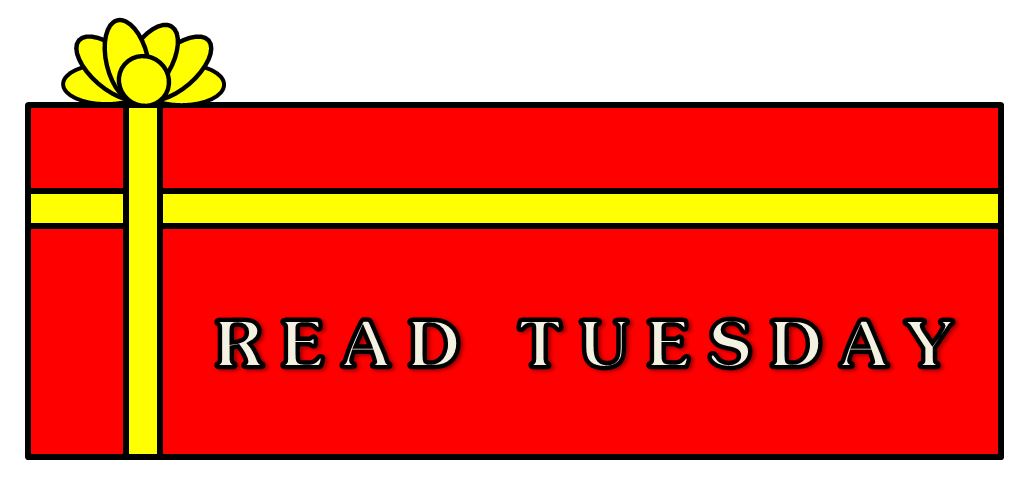
  • The Read Tuesday banner, once it is ready.
  • A description of the Read Tuesday concept.
  • A separate list of quotes from authors and readers who are looking forward to the event. If you’d like to contribute, all you need to do is give me your quote, whether you’re speaking as an author or reader, how you’d like your name or nickname to appear, what I should put for your location (or leave blank, if you wish), and if you would like me to include, say, your author website. You can contact me by email from my about me page, or leave a comment (whatever you prefer). I intend to sprinkle some throughout the website, and have one page dedicated to it if there are enough.
  • A Like button for Facebook, a Follow button for Twitter, etc. once those pages are setup.
  • A page with information for readers and a page with information for prospective authors.
  • Contact info.

Can you think of other content? What other kinds of images? Other types of pages?

If you have any requests for the style or structure of the website, those suggestions are encouraged, too.

I could try to make a page of participating authors, with names and maybe photos. But if the list gets really long…

I could also try to make a catalog of participating books (perhaps not to be released until closer to the event date). But again, if it gets very long… If anyone can think of a way to make it very easy to add and update, please turn on the lights. 🙂

Of course, all authors can promote their own books through the Read Tuesday event by mentioning their own books while simultaneously spreading word of the program. Similarly, authors can get together in groups (by subgenre, for example, but not necessarily) and make sub-catalogs, featuring their books that will be in the program. Such smaller catalogs could prove more beneficial than a master catalog.

Moody Sales

Moody PicAh, the beginning of the month;

Such a pleasant time for sales.

You can hear the buzz of customers

And the chirruping of registers.


Nothing tops the rush hour,

When sales are just ecstatic.

The lines are seemingly endless,

The products quickly vanish.


But then it slows down so much;

Sales shed tears from their sadness.

Where did everybody go?

Why have you all abandoned us?


Sales always wonder if the end has come

During extensive periods of loneliness.

Is that the end of life as they know it?

Will they never feel energized again?


When sales rebound, they jump for joy;

Happier than ever, they smile quite broadly.

They knew the buyers would return.

The experience is so rejuvenating.


Then that time of the month comes;

Inevitable, yet sales dread it so.

Those few days where sales are dismal.

You can count on it like clockwork.


Copyright (c) 2013 Chris McMullen

Read Tuesday: Have Website, Need Slogan

Read Tuesday

I changed it to Read Tuesday because http://www.readtuesday.com was available. I also purchased the domain so we now have a website for it. Don’t rush over there; it’s empty as of yet. 🙂

I asked an artist to work on the images. But it’s still not too late to share your ideas and help shape things. We’ll include “Read Tuesday” and the date (December 10, 2013) with the images. I’d like a set of images that include a slogan of sorts. TamrahJo provided a suggestion for some text. Does anyone else have ideas? We could really use slogan, phrase, or other short text ideas.

Regarding the catalog idea, I’m thinking we may not want to release it, if we make one, until much closer to the event date. Just like stores don’t want you to know exactly what will be on sale and for how much too far in advance.

There is an opportunity for someone who loves Twitter or Facebook to take one of these on or get involved with it. If you run one of these, you can have your name on the about me section, and you have the opportunity to interact with people through the Red Tuesday concept. I’ll do it if needed, but I know some of you have a knack for these, so I’ll give you the chance. I have other ideas beyond social media, but Twitter and Facebook pages are probably something we want to get up and running very soon.

Once we have the images ready to go, we’ll want to build buzz for it and start promoting it. Remember, if you write a post or article about Read Tuesday, you’re able to promote your own book while promoting the program simultaneously (at a minimum, you’re going to mention that your own book, Whatever the Title Is, will be in the program, and your audience may look forward to it).

You have a chance to help shape this event. If you have ideas, you are encouraged to share them. Ideas are greatly appreciated. 🙂

Red Tuesday: Initial Brainstorm

Red Tuesday Pic

The idea behind Red Tuesday is for authors to get together and provide a book-oriented version of Black Friday and Cyber Monday. You can learn more about the idea here:

https://chrismcmullen.wordpress.com/2013/09/21/red_tuesday_idea_for_boosting_book_sales/

The purpose of this post is to brainstorm the ideas that we’ll need to get started. Most of this should be done in the comments section below. We’ll need more brainstorming sessions as we go. Here we should focus on just getting things underway.

Red Tuesday is an opportunity for otherwise ‘independent’ authors (we largely behave this way when we sit down to write and when we market, even those of us who are traditionally published) to organize together and form something special – without, hopefully, too much more work than we would do just to have our own separate promotions. Here at WordPress, there is a strong sense of community among authors and artists. If we participate and harness this community feeling, we may all benefit from Red Tuesday.

It’s not about one person succeeding from the work of many others, and it’s not about one person being in charge. It’s about several people collaborating together. The beauty of the marketing involved is that every author can promote his or her own books while simultaneously promoting Red Tuesday.

BRANDING IMAGE: We want to brand the concept of Red Tuesday. Therefore, we need an image that we can use to help brand this visually. We want to include this image on all of our marketing materials for Red Tuesday. The more people see this image, the better.

We want to use the same image over and over, but we’ll need it to come in a few different forms. We’ll need a couple of headers for blogs or social media, an image to insert into our posts, a sidebar image, a thumbnail image, a logo, and anything else we think of. Essentially, we’ll need a variation of the same image in various aspect ratios.

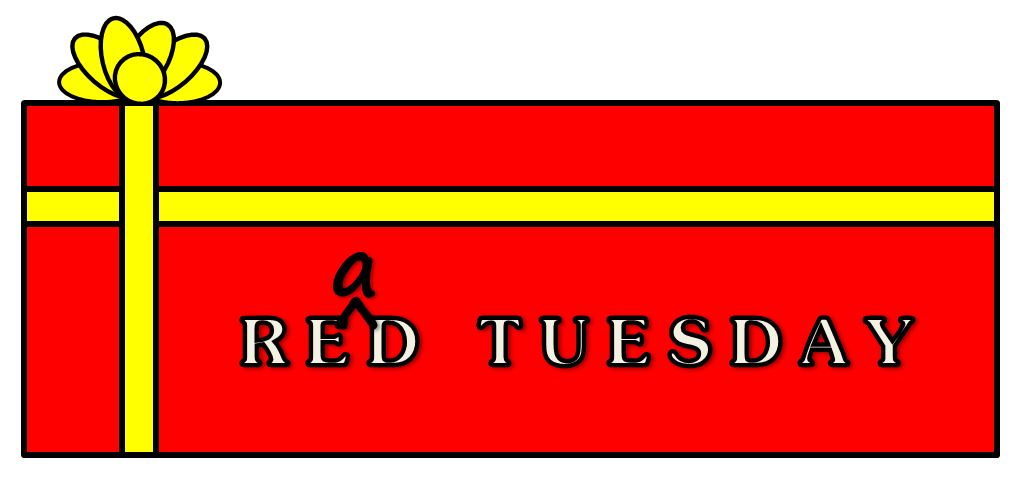
TamrahJo drafted a good concept (see below). It will be easy to produce the image in a variety of shapes and sizes, it’s really suggestive about the idea of gifting books, it matches the color of the event (red), it fits with the holiday theme, and it has a cute play on the color and verb homophones. I made a similar image for this post (above).

http://wp.me/aZNrI-WF

What we need is an improvement on our efforts (or a better idea, if anyone has one). If you can make a better present, bow, font, etc.

Whatever image we use, we will need permission for every author who participates to use the image for their Red Tuesday marketing (except for possibly putting in a restriction to prevent anyone from abusing the idea). This means that any images or text used must grant this permission, also.

Again, we’ll need the images to come in an assortment of sizes, suitable for various purposes. It may also be desirable for some of the images to include text (a slogan, for example), but others to exclude it.

BRANDING TEXT: We’ll need a slogan, catch-phrase, strapline, marketing line, blurb, and/or whatever other short text may be useful to help us brand the concept of Red Tuesday successfully. Again, we’ll need permission for every participating author to use the ideas that we decide to go with. TamrahJo included a suggestion for some text in the draft of the branding image (along with font effects).

WEBSITE: Unfortunately, it appears that the ‘redtuesday’ domain has already been taken as a .com site. We could throw in a hyphen, but then anyone who misses the little hyphen will go elsewhere. Perhaps we could add the word ‘books’ to the end of it.

We should have one website setup that’s geared to tell customers all about Red Tuesday. This is a link that we’d want to include with all of our promotional materials.

I don’t mind springing for the domain name. I could put together something basic, or add basic materials that others prepare. But if there are any volunteers with web skills, maybe that could lead to something better. I guess we could start with a WordPress template, or I could get something from GoDaddy, for example.

To begin with, we want to include our Red Tuesday branding image and a description of the program. What else could we put here?

Perhaps catalogs (including subcatalogs) listing books by genre (or subgenre) that will be discounted on Red Tuesday. (We could also highlight a few books that have very deep discounts – good examples that may help to draw interest.) Depending on how many books wind up in the program, this could be an extensive catalog. We want to make it easy for customers to sort through it, appealing to look at, and easy to update as new authors join in. If there is an easy way to do this, maybe where authors can add their own books yet the formatting still looks nice, it would be nice to find it. It will probably take some volunteer efforts to put this together, but hopefully we can think of some automated services to help do much of the work…

Maybe an extensive catalog isn’t worth the effort. Being buried in a long list – if the list becomes long – probably isn’t the most helpful marketing tool. What will be helpful is when authors individually promote their own books while simultaneously promoting Red Tuesday.

(We could also have a humble page that gives credit to any volunteers who provide valuable services.)

What else should we have on the website? For now, we just want to get it started with the minimum, and we can add to it as we go along.

We want a different hub to direct interested authors rather than the website designed for customers (though some authors, like me, will be shopping for books on Red Tuesday, too). Our blogs can help with this. Remember, you’re welcome to create your own posts about Red Tuesday (reblogging isn’t the only way to spread the word, though you’re also welcome to reblog Red Tuesday posts).

MORE: There are other things we’ll need soon, but these are a few things that we’ll need right away. Can you think of anything else that we’ll need immediately? If so, please bring these up in the comments.

COMMUNITY: Through our involvement in Red Tuesday, we can be part of something much bigger than ourselves. The magic word is participation. Please share and discuss your ideas in the comments section below. Brainstorming isn’t about one person coming up with ideas, but about many people bouncing ideas off of one another and discussing them to see where it leads.

Chris McMullen, author of A Detailed Guide to Self-Publishing with Amazon and Other Online Booksellers, Vol. 1 (formatting/publishing) and Vol. 2 (packaging/marketing)
Red Tuesday: Idea for Boosting * Your * 4th Quarter Book Sales

Fourth Quarter Pic

This idea came to me this morning. It has the potential to help you sell many books in the fourth quarter. It’s a simple idea; it’s free; and it will be easy. It just involves a little marketing, but, as you know, marketing is exactly the kind of work that can move books.

I’m not talking about marketing for a few sales. I see potential for a great deal of exposure.

THE PROBLEM: Black Friday and Cyber Monday are huge days for holiday shopping among retailers. However, booksellers probably won’t reduce the price of your book any more than usual, they probably won’t advertise your book as part of the sale, and you might even sell fewer books than normal because all of the customers are too busy buying electronics, toys, tools, and clothing.

You can discount your book significantly on these days and promote your sale to help stimulate some traffic during this time, but it probably won’t be any more effective than promoting your book this way on any other day of the year. In fact, it may be better to do this on some other day where you’re readers aren’t too busy shopping for other items.

THE IDEA: Thousands of authors participate in special one-day pricing of incredible discounts. We’ll call it Red Tuesday (a homophone with the past tense of what you do with a book). Actually, we’ll do it again just after Christmas, when everyone just got a new e-reader and still has holiday money to spend. We’ll call this one White Thursday (a play on “write,” perhaps).

It’s simple, really: Each author promotes his or her own discount while simultaneously promoting the huge event. You don’t do any more work than normal, but by being part of a huge group of authors involved in this, you can gain the enhanced publicity of the event as a whole.

For example, you would write, “Title of My Book will be 80% off as part of the Super Incredible Red Tuesday Extravaganza.” Take a moment to briefly describe what Red Tuesday is all about in addition to promoting your book. Link to the event page as well as to your book. Think of all the content you could post on your blog and social media regarding Red Tuesday, where you will also mention your own book’s participation in the event. Red Tuesday helps you with your marketing.

One author is really tiny. Together as a community, we can thrive.

All we need to do is spread the word and get super-mega-incredible participation among authors.

If we can get significant participation, it will open up many marketing opportunities that may otherwise elude us. Imagine the growth and buzz building up so large that the media takes notice. I have a list of other ideas below, and more will come. Together, we can help Red Tuesday go viral.

ELIGIBILITY: You just need to be an author who is willing to significantly discount your book on Red Tuesday and/or White Thursday. All authors are welcome, regardless of how you published, what you write, etc. (You don’t have to worry about your book being listed in an electronic catalog with an adult content book because we could always make separate catalogs for different kinds of books. At this point, there is no guarantee that there will be a catalog; that’s just one of the ideas below.)

If your book is already 99 cents, pretty much the only way to discount it is to make it free. However, many authors might want to just drop their prices, but not make them free. Why not allow for both? Any catalogs could easily come in separate editions for discounted titles and freebies. We could also feature the deepest discounts at the top to help catch interest in the program.

I have several e-books priced between $2.99 to $5.99. I’m thinking to drop all of the prices to 99 cents (except where the file size is so large that it prevents the e-book from being priced this low).

I also sell several paperbacks. These could be reduced, too. Or I could make a significant percent-off discount code for my CreateSpace eStore. Or I could sell them from my website at 50% off and take payments through PayPal.

The important thing is to make the book on sale during the promotion for a significant discount.

EXPRESS YOUR INTEREST: If you’re interested in this, please post a comment below to let us know. If there doesn’t appear to be interest, this idea will just slowly die out. The idea can only succeed through your participation. Please share the idea to help spread the news, so that we can find more authors who are willing to participate.

If there is plenty of initial interest, then we’ll move onto the next step and Red Tuesday may become a reality and a success.

We’re still in the planning stages. So if you have ideas, suggestions, comments, or concerns, this is a good time to express them. Nothing is set in stone yet.

There is no cost. You’re only commitment is to significantly lower your price for Red Tuesday and/or White Thursday. Any other work will strictly be voluntary. It would be wise for you to promote your discount and the event in order to help you get the most out of it.

MORE INFORMATION: As long as there continues to be significant interest, I’ll post information about Red Tuesday here on my blog. Please feel free to help spread the news – directly, by reblogging, or by creating your own posts about Red Tuesday.

If there is significant interest, I’ll send out a sign-up post on my blog, whereby authors can sign up. If you have a better idea for how to get authors to sign up besides just using the comments section of a sign-up post, please share your idea.

If several authors sign up, I will put up regular posts with information, ideas, suggestions, etc. here on my blog. Again, feel free to help spread this information.

DATES: In 2013, Black Friday is November 29 and Cyber Monday is December 2. Everyone is now exhausted from shopping. So my thought is to wait until Tuesday, December 10 to celebrate Red Tuesday. Then we’ll have White Thursday on January 3. (I liked White Wednesday better, but it falls on January 2, just a day after New Year’s.)

IDEAS: First we need to brand the concept of Red Tuesday. We’ll want to have a small number of images that we can all use with our blog posts and other Red Tuesday promotions. I can announce a contest to submit images for consideration. Then we’ll use the winning image to brand our image. Everyone should use this image with all of their Red Tuesday promotional materials.

We’ll also want to brand White Thursday (which will come about a month later). But we want White Thursday to be a surprise. We don’t want readers skipping Red Tuesday, knowing that White Thursday will come later. We want to generate huge exposure twice, not once. We’ll need a different image for White Thursday.

Some kind of catchy slogan, jingle, strapline, or something of this sort would be nice, too. I can solicit suggestions in a separate post.

Soon we’ll need to build a great deal of buzz and generate plenty of author participation. We can post and reblog about Red Tuesday to spread the word. Assuming this takes off, I’ll make a post in a couple of days with more ideas of how to help create buzz for this special day.

If we succeed in creating ample buzz for Red Tuesday, this may create additional marketing opportunities. Write an article about it and try to publish it in a relevant high-traffic zone. (Your article won’t go to waste because you can always post it to your bog if it doesn’t get used anywhere else.) We can try to get writers with a large following to write about Red Tuesday, and we can aim for a little media attention.

We can make a webpage specifically for the Red Tuesday event and everyone can link to it in all of their posts. If we’re able to make any electronic catalogs of books (volunteers can make this possible), we’ll post them on the event page and circulate them in others, too.

If many authors do a few small things in the way of promoting Red Tuesday, it will really add up. We all have different areas of expertise. If you’re a video whiz, for example, you can post a trailer on YouTube about Red Tuesday, and the rest of us can help get people to check it out. Remember, any marketing that you do voluntarily to promote Red Tuesday will also help you with your own book as a part of your promotion.

As we approach Red Tuesday, our marketing campaign should go nuts. Everyone should be posting and promoting in anticipation, and especially on Red Tuesday itself.

It’s very important to reduce your price in time, allowing for probable delays (which can be several hours or more – and may be longer if there is widespread participation) to get your book’s price reduced in time for the big event. Better early than late.

GREAT FOR READERS: Red Tuesday doesn’t just have the potential to benefit authors. It can greatly benefit readers, too. Red Tuesday would be a great day to stock up on books by all your favorite participating authors. It’s also a great day to buy books as gifts. There is ample reason for authors and readers alike to spread the word and make Red Tuesday a huge hit.

Sure, some readers will see Red Tuesday coming and try to hold off of buying books until Red Tuesday comes around. There will still be readers buying books before then. If your sales rank does slide somewhat going into Red Tuesday, just think what a potential avalanche of sales on Red Tuesday could do for it. The better you promote your discount and Red Tuesday and the more marketable your book, the better your chances of having a successful Red Tuesday.

NO GUARANTEES: There is no guarantee that this will improve your exposure or increase your sales. However, if participation is widespread, there is much potential for numerous authors to receive a marked boost in both exposure and sales. The more marketable your book (i.e. good content, appealing cover, effective blurb, well-formatted and -edited, attractive storyline and characterization, and good readability), the better the prospects for you to benefit from the promotion. Also, the more active participation we receive and the more effective we are, collectively, at marketing the event, the better the chances of success.

FINAL WORD: Ideas, comments, suggestions, and concerns are not only welcome, they are strongly encouraged. 🙂

We can be part of something much bigger than ourselves. The magic word is participation.

Chris McMullen, author of A Detailed Guide to Self-Publishing with Amazon and Other Online Booksellers, Vol. 1 (formatting/publishing) and Vol. 2 (packaging/marketing)
Online Marketing: Feel like a Dog Chasing its Tail?

Marketing Net Pic

Joe published a book. Sales are slow. He learns that he needs to market the book.

He develops a blog. It starts out small and grows slowly. Even the blog needs to be promoted.

Joe joins Facebook and Twitter. His experience there is much like his blog.

He makes a website for his book. That entails SEO optimization.

Joe includes links to his social media sites, author website, and book from his blog.

He links to his social media sites, book, and blog from his author website.

He adds a fan page to his book to help drive traffic to his blog, social media sites, and author website.

Wait a minute. Joe wants his online marketing to drive traffic to his book, but he’s using his readers to promote his websites. Huh?

Here’s what it looks like to Joe:

  • A drives traffic to B, C, D, and E.
  • B drives traffic to A, C, D, and E.
  • C drives traffic to A, B, D, and E.
  • D drives traffic to A, B, C, and E.
  • E drives traffic to A, B, C, and D.

That’s great except for one little detail: There wasn’t a source of traffic anywhere to begin with!

Are we just driving around in circles? Where does the traffic come from? Are all of Joe’s followers other authors trying to market their own books?

These are natural things to wonder when you first explore online marketing.

The author who is wondering such things might wish to be aware of the following points:

  • It would have been helpful for Joe to do some effective premarketing.1
  • Joe wants a simple, easy, magical source of traffic. In reality, marketing requires work, patience, and wisdom.
  • A ton of instant sales would be really nice, but this is really difficult to come by for a new author on the first book. A gradual increase in sales is more realistic and can become significant over a long period of time.
  • Marketability2 is as important as the marketing. Any problems with the content, cover, blurb, writing, editing, or formatting can render the marketing ineffective.
  • Local offline marketing can be quite effective for many new authors, and this can help stimulate the online marketing.

Think of your combined marketing efforts as an ever-expanding marketing net.

If your online content is designed well, someone in your target audience who wanders into your marketing net is likely to check out one or more other components of your online platform: your blog, your social media sites, your author website, your book website, your fan page, your book’s product page, your author page, etc.

The larger your net, the more opportunities there are for potential people in your target audience to wander into it. Having content that attracts your target audience helps greatly.

It takes time to build your marketing net. It takes time for your target audience to discover your net. It takes time for your following to grow. It takes motivation, diligence, and patience.

It’s not about money. It’s about helping your target audience find a product that they’re likely to be interested in. It’s about blogging because you have ideas to share. It’s about writing because you have a strong passion for it. It’s about marketing because you have a passion to share your work.

It’s about gaining exposure for your work.

Following are some specific things that you can do to help stimulate traffic.

For example, a temporary, infrequent reduction in price or freebie can help with exposure. For this to be most effective, you must build a modest following first (one benefit of premarketing). This greatly helps you spread the word through your marketing net. Price doesn’t generate interest. Creating the perception of value and spreading the word generates interest. You have to promote a sale for the discount to draw readers in.

An advertisement that reaches a large percentage of your target audience can help promote short-term interest and increase your exposure. Don’t focus solely on the initial return. Consider what the potential exposure, if promoted effectively, may do in the long run. It’s very important for an advertisement to reach your specific target audience3 and for your book to be highly marketable for it to pay off. Keep the investment low because there is no guarantee that it will pay quick dividends. Do a cost-benefit analysis.4

Having multiple books or a series also widens your net. This offers previous readers an opportunity to get more (provided that your previous content was good enough to warrant it).

Local offline marketing can be a valuable resource. Meeting people in person allows you to show your personality and charm them. Being able to meet an author in person is a treat. See if small, local, indie bookstores or other stores that sell books have any interest in your book. Perhaps a school or library would be interested in a reading. Find out where your target audience is likely to be and make an effort to meet and interact with them. A small, local paper may have column inches to fill with a local story about you or your book.

Effective premarketing can lend early sales to start out with a strong sales rank and may also earn early reviews. It also enables you to build your following prior to the launch of your book.

Getting a blog review, interview, and especially publishing an article relevant for your target audience in a high-traffic area can help draw in readers.

Related Posts:

1. Premarketing Ideas:

https://chrismcmullen.wordpress.com/2013/03/23/marketing-isnt-an-afterthought/

2. Marketability:

https://chrismcmullen.wordpress.com/2013/09/10/marketing-why-isnt-it-working/

3. Target audience:

https://chrismcmullen.wordpress.com/2013/09/15/target-your-audience/

4. Cost-benefit analysis:

https://chrismcmullen.wordpress.com/2013/04/16/cost-benefit-analysis-for-marketing-books/

Want More? To find more posts about marketing and publishing, click on one of the links in the Index on the sidebar to the right. Choose Cover Design, Blurb, Formatting/Editing, Marketing, Writing, or Publishing.

Chris McMullen, author of A Detailed Guide to Self-Publishing with Amazon and Other Online Booksellers, Vol. 1 (formatting/publishing) and Vol. 2 (packaging/marketing)

Chef Writer

This writer is just like a chef.


He doesn’t use just the same ingredients as everyone else:

His stock is fresher and more extensive, with a secret stash;

It includes a wider vocabulary, many special phrases,

And plenty of combinations with which to spice it up.


The writing doesn’t taste bland to the reader:

He chooses each word with thought and care,

Causing the words to flow just as he pleases;

Smoothly for the most part. Pause. Here. And. There.


He avoids common foods that often pose problems:

Declining an adverb when a precise verb will do,

Not telling the reader, if showing would be better,

But simply telling when showing would be a distraction.


Many former customers have acquired his taste:

They ask for him by name, only eat off his menu,

Follow him if he switches to a new restaurant,

And know they will love it before they even taste it.


Chris McMullen, author of A Detailed Guide to Self-Publishing with Amazon and Other Online Booksellers, Vol. 1 (formatting/publishing) and Vol. 2 (packaging/marketing)

Can a Book have too Many Buying Options?

Options Pic

Once you decide to buy a book, you have several decisions to make:

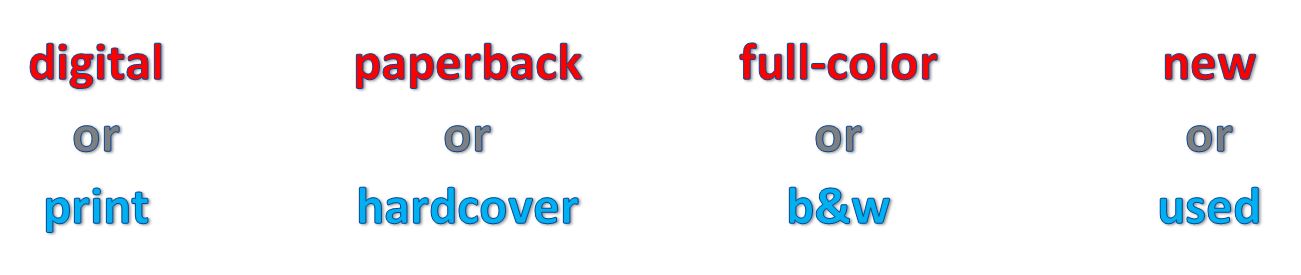
  • online or in store
  • which bookseller
  • digital or print
  • if print: paperback, hardcover, spiralbound, etc.
  • if print: color vs. black and white
  • new or used
  • if new: direct from the bookseller or from a third party
  • if third-party: which third-party seller to choose from
  • if third-party: signed by the author or not
  • if used: collectible or not
  • which edition to buy
  • if out of stock: whether to order it or not
  • if in-store: whether to add a bookmark
  • if online: whether to add other books
  • cash, check, credit card, or debit card
  • if card: credit or debit
  • if credit: Visa, Mastercard, Discover, American Express, etc.
  • if credit or debit card: which bank
  • “Would you like to open a new credit card for this purchase?”
  • At least you usually don’t have to decide between paper and plastic anymore. 🙂

Options are a good thing, right? The more options there are, the better chance you have of getting what you want.

But from a selling perspective, having more options available presents a problem.

The benefit is that additional options may bring additional customers, since some customers may not buy the product at all if the option they want isn’t there.

The disadvantage is that additional options increase the chances of buyer indecision. Some customers walk away from a sale because of buyer indecision.

Suppose, for example, that you’re buying shoes. If there is only one type of shoe that you like and you can only pay cash, you will either take it or leave it. If you like the shoe enough and have the cash on hand, you won’t be worried about other options.

But what if the shoe comes in two colors – pink and blue? Maybe you like them both, but insist on only buying one pair. Now you must decide which one you like better. You might do something else in the meantime, giving yourself time to think it over – while also giving the impulse to shop time to cool off, so you might not buy any shoes at all. Or maybe you decide you like pink best, only to discover that pink is out of stock, but you refuse to buy blue because your heart was set on pink.

Back to books, the question the author or publisher has to ask is whether or not additional options will improve sales by attracting extra customers more than they will deter sales through buyer indecision.

Impulse shopping also plays into this. Extra buying decisions increase the duration of the buying process. The longer it takes, the more likely the sale will be interrupted and the more likely the impulse to buy will wear off before the sale is over.

The option to make both paperback and e-book is probably worthwhile for most books that can be formatted well both ways. For a book that sells predominantly as an e-book, the presence of the paperback still presents many benefits:

  • The e-book price shows as a discount off the paperback list price.
  • You can catch some mistakes when editing a paperback that you miss when editing an e-book.
  • You’re eligible for Kindle’s new MatchBook program.
  • Paperbacks come in handy for readings, signings, review copies, etc.
  • It helps to convince some people that you’re a ‘real’ author.

Some other options, however, may not be worth doing.

Suppose your book would look great in color. When you go to publish the paperback, you may find that the book would be much cheaper in black and white. This tempts you to publish the book both in color and in black and white editions. The problem with this is that the buyer is faced with a decision: Save money with black and white, or enjoy the book in color.

If the book really needs to be in color, don’t make a black and white edition; but if it would be just fine in black and white, don’t make a color edition. Or if you do make a color edition, make it a special edition that you sell directly or give away in a contest; but don’t add it to your product page. (I have the experience of publishing a book both ways, and if I could do it over, I would just choose one way.)

You face a similar dilemma with hardcover and paperback.

There are two more important points about creating different editions of a book. One is sales rank. Each edition of the book has a separate sales rank. When the book is only available in one edition, every purchase helps the same sales rank.

The other point has to do with customer books reviews. If one edition is more likely to generate negative reviews, that option can adversely affect the other editions – if the different editions are all linked together on the same product page.

Chris McMullen, author of A Detailed Guide to Self-Publishing with Amazon and Other Online Booksellers, Vol. 1 (formatting/publishing) and Vol. 2 (packaging/marketing)
Creativity: Good or Bad for Books?

Imagination is a good thing, right? I believe so.

It’s good to be creative as a writer, isn’t it? No argument from me there.

So books should show originality, don’t you think? Got my vote.

Nonetheless, here comes a great big BUT!

(Those who can spell realize I’m not talking about anatomy.)

Just to be clear, I’m not going to argue against creativity. I’m in favor of it.

Consider this: Does the bookselling industry discourage certain types of creative storytelling, rather than rewarding it?

Here are some examples of what I mean:

  • Suppose you write something so different that you’re breaking ground with a brand new genre. It doesn’t stand a chance of getting browse category visibility. How will readers discover it? The book is inherently disadvantaged.
  • Readers have an expectation for what to expect in terms of storyline, characterization, etc. in any given genre. The author who deviates from these expectations risks negative reviews for being creative.
  • How do romance readers react when the ending doesn’t turn out to be happy? Is there a significant readership for specific types of unhappy endings in this genre? There are some types of originality that many readers aren’t willing to support.
  • Even creativity in cover design has a significant potential downside. Many readers judge their interest in a book based on a cover. They are familiar with how the books they tend to read tend to look. If a book doesn’t look like it belongs to their genre, they might not check it out.

Do readers want to read the same types of books every time? I don’t.

First, I’m not saying that all forms of creativity pose problems. Some don’t, but others do.

If you want to write a romance, for example, there are already a variety of popular ways to go about it. First, there are subgenres, like contemporary or historical. If you choose a subgenre, there is plenty of room to follow a model while still being very creative. You don’t even necessarily need to follow a particular model. Yet there are some features that are high-risk to change – like taking away the happy ending, or giving the protagonist certain types of flaws.

The point is that while there are endless possibilities that do work, there are limits to it – i.e. there are some features that can hinder sales significantly if changed.

And something completely different is especially challenging to sell.

The problem of a new category is tough for the author or publisher to work around. But it can be done. We have genres now that we didn’t have in the past. So it is possible to breakthrough with something quite unique. Statistically, however, there have been many people with ideas for new types of books, but the ideas that actually opened the door for a new genre have been very rare in comparison.

It would be easy to solve this problem. Suppose, for example, that Amazon created a new book category called “Fresh and Exciting” or “Out of this World.” Don’t you think readers would check it out? Wouldn’t it also attract authors? It could be a very popular category. It has potential.

(Sure, there would be some not-so-good books in there. But you can find such books in all categories. When they don’t sell, they fall to the bottom, out of the way, where they aren’t harming anyone. And some of the books at the bottom are fairly good, but just not selling for whatever reason, and some readers will be happy to find them.)

Right now, the closest thing is “Other.” The name is important. It’s just not the same. “Other” suggests that the book just doesn’t belong.

But as it is, the bookselling industry seems to discourage, rather than reward, such innovation on the part of the author.

Writing a book that’s appealing to readers is important for sales. With the modern self-publishing revolution, every author has ample room to exercise creativity. However, if readers don’t respond well to the originality, the book won’t sell.

Even if many readers do appreciate the originality, some readers who don’t may inhibit sales through negative reviews.

So it’s not just the booksellers, like Amazon or Barnes & Noble. It’s the readers, too. Even if the book does have significant appeal, those readers who don’t like the change can influence sales through reviews.

Then there are agents and editors, who are looking for books that are highly marketable. They may be reluctant to take a chance on too much novelty. It would seem easier for a big publisher to attract readers with something fresh; but it’s also a risk.

Shouldn’t the system encourage innovation, particularly if the book is very well done?

How about you? Do you search for highly original books? Have you read anything that’s really clever and different lately? Do you reward originality in your reviews, or criticize the author for the deviation? Do you help spread the word when you find something very creative and also enjoyable to read?

(I have: For example, Reapers, Inc. by Dave Hunter. I thought the concept was cool; even the cover seemed different in a good way.)

We read books. We are part of the readership. From our end, the best we can do is help to promote original thought and encourage it through positive reviews.

Imagine H.G. Wells writing The Invisible Man, Jonathan Swift writing Gulliver’s Travels, or Mary Shelley writing Frankenstein. Or imagine trying to write realism when romanticism was popular.

We have a very healthy variety of books today. Yet what are your prospects for setting the trend with something totally new?

If you haven’t already seen it, you should check out Misha Burnett’s clever idea for a new writing software package (his irony should be obvious, but I’ll mention it, just in case):

http://mishaburnett.wordpress.com/2013/09/16/new-software/

Chris McMullen, author of A Detailed Guide to Self-Publishing with Amazon and Other Online Booksellers, Vol. 1 (formatting/publishing) and Vol. 2 (packaging/marketing)