Goofy Branding

I took my daughter to Disneyland a couple of weeks ago, and the experience got me thinking about branding.

My daughter loves Mickey Mouse and Cinderella. These are the big stars, the main brands. How can the small guys compete with the big names? I’ll get to this question if you have some patience.

We saw Mickey Mouse a couple of years ago. We waited in a very long line in Toontown to meet him. It was a great experience; we got good photos and everyone was very nice. But it was such a long line, and once you get your turn it’s time to rush a new group in.

One year, we accidentally entered a line to meet Tinkerbell. After several minutes and scarcely moving forward, we finally realized the long line wasn’t for a ride and got out of it. This year, there was what looked like a reasonable line to meet Cinderella and other Disney princesses. However, in several minutes we hardly moved at all. Fortunately, my daughter decided that her time would be better spent waiting to go on a ride.

On our way to eat lunch, we saw Tiana. There were only a few other girls in line to see her. My daughter got to see her very quickly. I was really impressed that Tiana sat down to get down to my daughter’s level. She spent good time with her, we got great pictures, and my daughter felt very special to get such personal attention from a princess. Tiana moved way up on my daughter’s list of favorite characters (and mine, too).

We got to see several characters during the parade. Goofy came over and patted my daughter on the head during the parade. He scored major points with us from this simple wow-factor.

This reminds me, if you want to see Donald Duck, Goofy, or Pluto in Toontown, you can very often do so with a very short line. You also see them at other parts of the park from time to time, and they are usually very accessible.

What struck me is that the small guys can compete with the big names. Personal attention, little personal touches, a simple wow-factor – these kinds of things can make a huge, lasting impression.

If you’re one of the small guys (like me), striving to brand your own image, personal interaction is something you can use to help stand apart. Branding is about getting people to remember your name (or the name of your product or business), getting recognized, getting associated with some quality, and the potential for word-of-mouth referrals. Personal interactions with members of your target audience can help to achieve this.

Are you just selling a product? Or are you selling an experience?

Have you ever bought a product from someone where without that interaction you never would have bought that product? Maybe you happened to walk by a shop and noticed it. If it had been a vending machine, you never would have put money into it. But after a nice experience with a sales associate, you made the purchase. Not because the salesperson twisted your arm, but you enjoyed the personal interaction. Has this ever happened to you?

Chris McMullen, self-published author of A Detailed Guide to Self-Publishing with Amazon and Other Online Booksellers
Free Books with Goodreads Giveaways

One way for authors to help create some buzz for their upcoming or newly released books is through the Goodreads giveaway program.

It’s also an opportunity for readers to potentially receive free books that interest them.

http://www.goodreads.com/

You have to have a physical book in order to enter it into the giveaway program. You can make a paperback through CreateSpace, for example. You must supply both the books and pay the shipping and handling. Package your books carefully and spring for delivery confirmation (so you can show, if needed, that you did fulfill your end of the bargain).

If you elect to enter the program, be sure to read the terms and conditions (you can find them from your author dashboard at Goodreads).

You can give just one copy away, but if you’re hoping to receive some reviews, it’s probably worth giving away 5 to 10 copies. Let your giveaway run for about a month to help generate some interest in your book.

Winners are encouraged to leave reviews, but reviews aren’t guaranteed. Reviews may be good, bad, or neutral. Authors may hope that reviewers will be in a good mood because they received a free book, and most will probably appreciate winning the contest, but of course all reviews won’t always be good. They may be more likely to post the review on Goodreads than Amazon, but some people are likely to do both. Keep in mind that if they do post the review on Amazon, it won’t show as a verified purchase (although, with Amazon owning Goodreads now, it seems like they could do this if they wanted – it sure would be a nice feature).

I’m presently trying this out. I entered volume 2 of my self-publishing book into the giveaway. There are 10 copies available (and so far, only 43 people have entered the giveaway – thus, presently the odds are very good). If you enter the giveaway, but don’t win one of the free books, contact me after the giveaway ends if you’d still like a free book (assuming I don’t receive hundreds of requests – I wish I had that kind of popularity, but I don’t – I’ll be happy to oblige).

http://www.goodreads.com/book/show/17863881-a-detailed-guide-to-self-publishing-with-amazon-and-other-online-booksel

Check out other books that are enrolled in the giveaway program.

http://www.goodreads.com/giveaway

Click on a tag to narrow the search results, or use the search field (just above the list of tags) to enter a tag that interests you.

Here is a short sample of giveaways:

Amaze Every Customer Every Time

Shep Hyken

http://www.goodreads.com/book/show/17723505-amaze-every-customer-every-time

Cursive Handwriting Workbook for Girls

Julie Harper

http://www.goodreads.com/book/show/18233806-cursive-handwriting-workbook-for-girls

The Magdalene Mystery

Christine Sunderland

http://www.goodreads.com/book/show/18128152-the-magdalene-mystery

I Was a Teenage Mad Scientist

Derek J. Goodman

http://www.goodreads.com/book/show/18196669-i-was-a-teenage-mad-scientist

Bankrupting Physics

Alexander Unzicker and Sheilla Jones

http://www.goodreads.com/book/show/16059515-bankrupting-physics

One thing I noticed as I searched through the giveaways was that some of the descriptions state that they are for Advance Review Copies, Autographed Copies, or Signed Copies, for example. In my giveaway, I’m just giving away an ordinary copy.

Chris McMullen, self-published author of A Detailed Guide to Self-Publishing with Amazon and Other Online Booksellers

Authors, What Are Your Writing Superstitions?

I’m very curious about this.

If you’re a writer and you have any superstitions, quirks, or rituals that relate to writing, please take a moment to share them.

Or if you know a writer with such habits, please share them.

Let me suggest a few examples for you to consider while think about this:

  • Do you check every chapter to make sure that it doesn’t have 13 pages?
  • Do you refuse to wash your underwear until the book is finished? (Well, that might explain why writing tends to be such a solitary experience…)
  • Do you read your horoscope before you decide to write that day?
  • Do you use a Ouija board to help get book ideas?
  • Do you insist on ending every book on page 451 (hoping that sales will be ‘on fire,’ in degrees Fahrenheit)?
  • Do you walk precisely one mile on the treadmill for every page you write?

Well, then, what do you do?

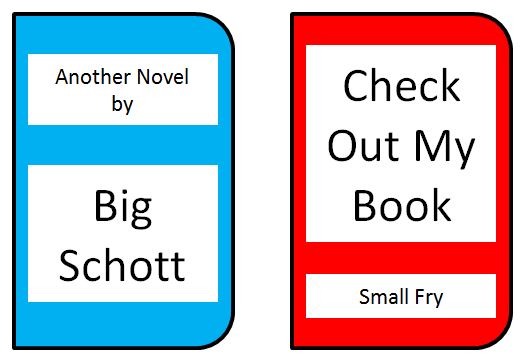
Challenging How Big the Author’s Name Should Be

Name Pic

The consensus among critics is that the author’s name should be relatively small (compared to the title) unless you’re famous.

Why? There are two popular reasons for this:

  1. The marketing view says that if the author’s name appears too large on the cover, it will distract the shopper’s attention from more important keywords in the title. If you’re famous, then it’s important to throw your name out there because your name has sales value.
  2. The critical view feels that the author’s name should take on a humble role on the cover (i.e. out of the way) if the author doesn’t have name recognition.

But is this correct?

Maybe not.

There are a couple of reasons to reconsider this point:

  1. Do you primarily expect to sell books to family, friends, acquaintances, coworkers, social media followers, and people you interact with personally through marketing? If so, then you do have name recognition with your target audience. Make your name larger for their benefit and disregard the potential critics. Why not?
  2. Are you branding your name in your marketing efforts? If you are effective at this, then you want your name to be easily visible (but perhaps not dominating) on the thumbnail image of your cover. Potential customers who recognize your name from your marketing endeavors who see your name in the thumbnail may check out your book.
  3. Part of marketing is about creating a perception. If you’re thinking big, then you want to create a big name for yourself. If you’re going all out to try to make it big, then starting out with a big name on your cover might be a good fit. Make that big name for yourself and prove the cover critics wrong.
  4. If you’re a nonfiction author with a title (Dr., Ph.D., M.D., etc.), you may want your qualifications to be visible in the thumbnail image. However, if you don’t have a relevant title and aren’t well-known in your field, it may be better to place emphasis on a few important keywords instead of your name.

What is your personality? What fits you? A big name? A small name?

Chris McMullen, self-published author of A Detailed Guide to Self-Publishing with Amazon

How to Change the Publication Date at CreateSpace…

(I intended to include this in my previous post. Better late than never?)

First, note that once you click Approve Proof, it is no longer possible to change the publication date.

As mentioned in my previous post, after you enter the title information, much time can pass before you approve your proof (from making revisions). So if you enter the publication date as ‘today’ when you enter the title information, by the time you approve your proof, this date can be a few weeks old. The problem with this is that you would then have very little time in the ‘Last 30 Days’ section.

At CreateSpace, when you enter the title information, if you click on the ‘What’s This?’ link, you’ll see that you don’t actually have to enter any date at all. Just leave this field blank and CreateSpace will automatically set the publication date to the day when you first click the Approve Proof button. This gives you approximately 30 days on the ‘Last 30 Days’ list (since it may take a day or more for your book to show up at Amazon).

If you didn’t know this and entered an actual date in the title information, when you go to the title section, you may find that everything appears to be ‘locked.’ If so, contact CreateSpace and explain the situation. Make it clear that you have not clicked Approve Proof (even in the past) for this title, and ask CreateSpace if they could please reset the date for you.

Publishing Tip: Change the Publication Date

If you hope to sell many books online through discovery in search results, the publication date is very important.

Why?

At Amazon, customers can filter search results by clicking the ‘Last 30 Days’ or ‘Last 90 Days’ new release links. These filters give your book a window of opportunity. Customers looking for new releases in their favorite genres may discover your book this way.

Now consider the following scenario.

You go through the entire publishing process. You set the publication date to be today’s date, since it won’t let you enter a date in the future. Then you discover one or more typos in the proof. After correcting those, there is suddenly a problem with the cover. When you fix the cover, you find more typos. A few weeks later everything seems to be just fine. So you click the magic button to approve your proof.

Oops!

You forgot to update the publication date. Your book won’t be listed in the ‘Last 30 Days’ results for an entire month. If it took three weeks to fix all of those problems, your book will only appear in the ‘Last 30 Days’ results for about a week.

Unless you remember to change the publication date before you publish.

If you’re debating whether to enter the publication date as ‘today’ or some date in the past, there is a distinct advantage to using ‘today.’ If the book you are publishing now is a new edition, for example, then why not give this edition a new publication date?

When you explore the ‘Last 30 Days’ and ‘Last 90 Days’ filters, you may also notice a ‘Coming Soon’ filter.

How do you get your book listed under ‘Coming Soon’?

First, you have to publish a paperback or hardcover. You won’t be able to do this if you publish exclusively an e-book edition.

Next, you must learn how to setup preorders at Amazon Advantage. There are some very helpful discussions on this very topic at the CreateSpace community forum. Check them out.

Chris McMullen, self-published author of A Detailed Guide to Self-Publishing with Amazon

Thank You, Reviewers

Thank You Pic

Thank you, Readers

For taking the time to review books,

To express what you enjoyed,

To suggest what could be better.


Thank you, Shoppers

For reading customer book reviews,

For trying to sort out which comments are helpful,

For comparing feedback to the Look Inside.


Thank you, Customers

For not being afraid to share your feedback,

Despite the few who don’t handle criticism well,

For realizing that most authors aren’t this way.


Thank you, Bloggers

For investing so much time to read many books,

For posting book reviews on your blogs,

For helping out so many authors.


Thank you, Authors

For not reviewing your own books,

For not blasting the competition,

For not lashing out at reviewers.


Thank you, Everyone

Who has taken time to post a review,

Who hasn’t abused the review guidelines,

Who supports the wonderful world of books.


We need you,

Readers, Customers, Bloggers, Reviewers.

We would be nowhere without you.

Thank you so much.


Chris McMullen

Wow, What an Amazing Book!

If you’re an author, don’t you wish you were reading a post entitled, “Wow, What an Amazing Book,” that was about your book? Don’t you wish people were telling this to their friends, family, acquaintances, and coworkers? Don’t you wish the reviews were saying this? Don’t you wish readers were contacting you to tell you this?

(Well, of course, you want more than this. You want them to explain why it’s amazing, not just say that it’s amazing. But that’s not the point of this article.)

There are tens of millions of books out there. People aren’t going to think that they’re all amazing. Amazing is relative. To amaze people, your book must do something much better.

Only the top couple hundred thousand books sell once a day or more on average.

There are two ways to have a top-selling book: (1) Market your book effectively and (2) write an amazing book.

It’s important to realize that these points go together. People won’t realize how amazing your book is if they don’t discover it. And no matter how well you market your book, if the book isn’t good, it won’t matter much.

If you take the extra time and effort to make your book amazing in some way, this should help give you some motivation and confidence in your marketing.

What makes a book amazing?

What will cause readers to slam your book on the table and dance around, thinking, “Wow! That was unbelievable! Where can I get more of that?”

Let’s begin with what won’t make your book amazing:

  • It won’t be amazing simply because you hope people will be amazed by it. (You need to work for it, not just hope for it.)
  • It won’t be amazing just because your name is on the book, and you think you’re amazing. (You probably are amazing, but people won’t judge your book by judging you.)
  • It won’t be amazing merely because you completed the monumental task of writing and publishing a book. (This is worthy of my applause, but isn’t enough to impress readers.)
  • It won’t be amazing only because you have a talent for writing. (There are millions of talented writers. You need to stand above the crowd.)
  • It won’t be amazing solely because you put much effort into preparing a very good book. (This is what readers expect. To amaze readers, you must go beyond their expectations.)

Self-publishing isn’t a lottery. In a lottery, every ticket has an equal chance of winning. In publishing, some books are simply better than others. (Furthermore, some books have a wider audience than others, some books are packaged better to help the audience find them, and some books are marketed more effectively than others.)

So how can a book amaze readers?

  • Highly creative problem-solving. For example, the protagonist gets in a jam, the readers think there is no possible way out, and the author does something creative to get the protagonist out of it. The bigger challenge is pulling this off in a way that satisfies readers. You don’t want them thinking that it’s unrealistic or broke the rules of the game, for example.
  • Incredible characterization. This includes heroes and supporting characters that people will fall in love with, but also includes villains. Think about characters that amaze you and especially why they amaze you, and how you can achieve this effect in your own writing.
  • Crowd pleaser. Study the kinds of things in books and movies that tend to please crowds. The better you understand people – especially, your target audience – the greater your chances for amazing them with your book.
  • Impressive formatting. I don’t mean avoiding formatting mistakes or knowing about things like widows, orphans, and rivers. Good formatting is expected, not amazing. Maybe the book is beautifully decorated with little professional touches that fit the theme of the book and don’t distract the reader. Impressive formatting (combined with good editing) helps to put the reader in a good mood. If people know you’re self-published through your marketing efforts, yet your book looks highly professional, they will be amazed that you’ve produced something beyond their expectations.
  • Unique and creative in a pleasing way. If you write a romance that’s very similar to countless other romance novels, that’s not going to amaze anyone; it may please many readers, but this meets their expectations, rather than exceeding them. Do you want people saying, “That’s another good book,” or, “That book is incredible”? But let me warn you that this is both challenging and risky. Much of the time, novelties displease readers. They won’t be amazed by anything that’s different. You have to really know your audience well (focus or writing groups may help). Will people love this change, or will they hate it? If you have a gift for answering this question correctly, you can write an amazing book that will sell well. (Warning: Something new that doesn’t fit into a well-defined genre or that doesn’t have a significant audience will be a very hard sell.)
  • Eye-catching cover that clearly identifies the genre and content. This helps to attract your target audience, create interest in your book, and put them in a good mood every time they see your cover. You don’t want the cover to be the only impressive feature of your book, but if your book amazes readers in other ways, a great cover can really pay off.
  • Make their dreams come true. First, you have to know your audience. Many teenagers, for example, wish they suddenly discovered that they had special powers and that their lives had much more meaning. There are many books that fill this need, however, so you must pull it off in an amazing way.
  • Do something better. Research similar books. Can you make a book like those, only do something much better? It’s not easy. In nonfiction, there are many books written by renowned experts. But maybe you can explain things more clearly in layman’s terms. In fiction or nonfiction, if you can find a way to do something better, this may amaze readers.

The more your book seems amazing to readers, the much greater your prospects for the most valuable sales of all – word of mouth referrals.

Your book has to have the goods, not just the advertising. If you advertise that it’s better in some way, but it doesn’t live up to the expectations that you create, readers are likely to be frustrated and disappointed. You want a book that delivers beyond the readers’ expectations. This will amaze readers and lead to referrals and good reviews.

Think of how you can put a wow-factor in your book.

Chris McMullen, self-published author of A Detailed Guide to Self-Publishing with Amazon

Dealing with Writing Stress

It’s amazing how much anxiety authors tend to experience:

  • Trying to reach daily writing goals.
  • Wondering if the book will ever get finished.
  • Hoping that people like it.
  • Doubting whether it will sell.
  • Learning how to format.
  • The frustrations of the publishing process itself.
  • Searching for professional help.
  • Monitoring sales reports.
  • Waiting for reviews.
  • Receiving critical feedback.
  • Cyberbullying.
  • The scary world of marketing.
  • Deadlines (often self-imposed).

(So you want to be an author, huh?)

Authors can manage this anxiety.

One trick is to not let yourself get frustrated over things that are beyond your control. You just have to let those things go. First you have to realize that you just can’t do anything about them. The only thing you can do is get upset, and that doesn’t help at all.

You can’t control what other people say or do.

(No doubt, if you could, that universe would be incredibly boring to live in.)

You can do your best. If you do, this knowledge should provide its own satisfaction. Remind yourself of this.

Your behavior can also limit your anxiety.

If you frequently monitor your sales reports and product pages (looking for reviews), emails, blog activity, etc., you’re more likely to be disappointed.

Suppose for example you sell an average of 4 books per day. This means that you sell an average of 1 book every 6 hours. If you check your sales report every hour, 83% of the time you will be disappointed.

I know, when you see that sale, it gives you a temporary euphoria. But being disappointed by no sales most of the time isn’t worth it.

If you sell 4 books per day, just check your sales report once a day, and most of the time you will be happy to see some activity.

Try to wait long enough to see at least 10 sales, and don’t monitor your reports more frequently than that.

When you receive critical feedback, try to stay offline for a couple of days and engage in healthy activities. Keep your mind busy with those. Then see if the criticism offers something that you can use to improve. If so, use it and consider the matter settled. If not, discard it and forget about it.

Diet and exercise are highly important for writers.

We don’t get much exercise while writing. Think about that. We sometime keep irregular hours, staying up overnight to finish our thoughts. We sometimes don’t eat well – taking whatever is convenient – and eat in a rush.

Lack of exercise, poor diet, and especially anxiety can lead to stomach aches, irritable bowel syndrome, depression, and a host of other serious problems.

Exercise is a great way to help your mind deal with stress, besides being something that your body needs. Walk (but don’t pace), jog, ride a bike, play tennis, or go golfing, for example. If you can’t leave the house, buy an elliptical or treadmill and make like a hamster.

Balance. The more you check your sales reports and read reviews, the more you should exercise.

Avoid nervous habits like biting your nails.

Writing should be fun.

It is. Remember that.

We tend to make it far more stressful and less fun than it really is.

Focus on enjoying the art of writing. It may help to think of something far worse that you could be doing instead. A little perspective never hurts. 🙂

And here is something I’ve said before: Don’t compare yourself to others. Instead, compare yourself to your former self.

Chris McMullen, self-published author of A Detailed Guide to Self-Publishing with Amazon

A Model for Pricing Books

Pick two.

If you want to go out to eat, the best you can hope for is two out of three.

The three options are:

  • Quality
  • Service
  • Price

If you want top quality – i.e. excellent taste, fresh food, amazing cleanliness, incredible ambiance, superb view – and awesome service – i.e. friendly greeting, quick seating, fantastic personality, everything you want just when you want it – then you should expect to pay for it.

It’s not reasonable to expect perfect quality, perfect service, and super low prices.

So if you want low prices, you should expect to sacrifice either quality or service to some extent.

Pick two. If you can get two of the three, that’s very good.

Sometimes you only get one. When it’s really bad, you strike out.

The ‘pick two’ idea has been around for some time. It’s worth considering when pricing books.

The first step regarding price is to try to find other books that are very similar to what you’re selling. Customers will be comparing your book to other books like yours when they shop.

Now the question is whether you should be at the high end or low end of this price range – or somewhere in between.

Don’t assume that you need to be at the bottom end of this price range in order to sell books. Don’t assume that you can’t compete with top selling authors or big publishers.

It’s intuitive to most people that a lower price should lead to more sales. It seems like a basic law of economics, right? But it often doesn’t work out that way.

One major reason is that so many people believe that you get what you pay for. Another issue is that several buyers have some experience with poor quality.

Thus, there are cases of authors selling fewer books after lowering the price or actually selling more books after raising the price. It doesn’t always work out this way, but sometimes it does.

Price doesn’t drive sales.

Look at it as two out of three. Price is only one factor.

Quality and service are two other factors.

If you have a high-quality book, setting the price at the low end of the range for similar books may be a problem. People who are looking for better quality may not be browsing the low end of the price range. Where are the readers who are thinking, “Nah, I don’t want quality”? Readers who’ve had a poor experience at the low end of the price range may be exploring somewhat higher prices, hoping to get something better.

Quality doesn’t just mean one thing. It includes good editing, good writing style, good formatting, good characterization, good plot, ease of understanding, entertaining, creativity, professional touches, evoking strong feelings, etc. It also includes a great cover, great blurb, and great Look Inside – since these features help readers judge quality when they’re about to make a purchase.

Then there is also service. For authors, this comes through marketing.

Marketing drives sales. Price doesn’t drive sales. Price may deter sales, if too low or too high. But price doesn’t create sales. Quality and service (i.e. marketing) help to stimulate book sales.

Marketing can be a service. For one, marketing helps bring the book to the customer, whereas it’s such a challenge to find the right book through a search.

A good review online or at a blog from a credible source helps customers find a book in a genre that they read, which may potentially be high in quality. That’s two out of three already, so the price shouldn’t be at the bottom end of the spectrum.

Personal interaction helps to sell books. Interact with the target audience in person. That’s a service that the author provides to the reader.

Readings and signings are services, too.

If you have a quality book and you market effectively, your book shouldn’t be at the bottom end of the price range.

If your book is at the bottom end of the price range, shoppers may be wondering what the book may be lacking. If it’s not lacking anything, it should be worth paying for.

If a cup of coffee made in less than a minute can sell for three bucks, a book that reflects months of hard work should be worth more than that. 🙂

One last word about price. Just having a low price doesn’t suggest a great deal. It suggests that quality is lacking.

But having a sale may stimulate sales. If the price is normally higher, a temporary reduction in price may have this effect. Not from the random customer who just discovered the book – this customer doesn’t know that the price is usually higher. You have to promote a sale for this to work.

Promotion is a form of marketing. As long as you’re going to the trouble to spread the word about your book, you might want to earn a higher royalty for your effort.

A sale can be useful if the copies sold at the promotional price are likely to draw in additional sales. Promoting the first book in a series or discounting an omnibus may have such an effect, especially when the first book is very good at compelling readers to want more (this isn’t the case with all series).

A sale is also more effective when it’s not too frequent. Otherwise, people will just wait for the sale, and it will be hard to sell books in between sales.

Finally, you want your promotion to be targeted at new customers. If you’re advertising your sale to people who’ve already bought your book, you’re not reaching new customers – instead, you might be frustrating buyers who’ve paid more.

Chris McMullen, self-published author of A Detailed Guide to Self-Publishing with Amazon