Book Reading or Signing: Is It Worth the Effort?

The best way to answer this question is from a cost-benefit analysis.

You have to be careful with this. You might get the answer wrong if you only consider the financial costs and benefits. There are some indirect costs and benefits that are important to consider, too.

With this in mind, I will try to demonstrate how every author can benefit from doing at least one reading or signing, but that most authors shouldn’t hold multiple events.

Costs include:

  • Transportation: Gas and wear and tear on your car getting to and from the event, airline tickets, hotel stays, food expenses that you wouldn’t have otherwise incurred (if you’re out of town), etc. If it’s a local event, it should just be gas and mileage.
  • Stocking titles: Ordering paperbacks or hardcovers (don’t forget to include shipping and handling from the publisher to you) to stock up for the event.
  • Materials: You may be able to keep this free, but it could include a nice pen, a sign with your name on it, bookmarks to put in the books, business cards, jump drive (to load the files onto a computer supplied by the venue, for example), and anything else that you may need to buy in order to hold the event.
  • Venue fees: I suggest trying to avoid this, if possible. If the local bookstore is charging a hefty fee, it may be a way of trying to discourage indie authors from doing this. (However, if you’re holding a conference and planning to sell tickets to the conference, for example, then paying a venue fee may be worthwhile.) If you’re having trouble finding a venue, what prevents you from doing a reading at a public park? Maybe a coffee shop would host it with the prospects of selling coffee to your audience. Where there is a will and some creativity, there is a way. For example, if you have a zombie book, setup a zombie race, then do a zombie reading at a campfire.
  • Miscellaneous financial expenses. For example, you might want to get setup with PayPal to accept non-cash payments, in which case you must account for transaction fees. You might make a special trip to the bank to get plenty of change for cash payments, too (there is more gas and mileage, unless you plan ahead and get this during a routine trip to the bank).
  • Time and effort: These are costs, too! Your time is worth money. It is possible to spend just a little time finding a possible venue, setting it up, promoting the event, attending the event, and getting there and back. If so, then there may not be much time and effort involved. But if you’re spending many hours on this, don’t forget to consider time and effort as part of the total cost.
  • Money and effort that you put into promoting and populating your event. Running an advertisement costs money. If you’ve already built up a very large following in the location of your event, it should be easy to share the news and gather an audience. If you’re a new author or don’t yet have a very large following, it may be difficult to get an audience (it’s not impossible, though: First, you can get friends, family, acquaintances, and coworkers to help populate the event; you can also be creative, and put Zombie Race flyers, for example, all over town where your target audience is likely to see them). Either way, you can populate an event with little cost to you. In fact, advertising to generate a following probably won’t pay off.

Benefits include:

  • Immediate direct sales of physical copies or e-books (come prepared to transfer a .mobi file right onto a Kindle, or a PDF right onto a laptop; and you can even find an electronic tool for signings). If you already counted your purchased author copies as a cost, then figure the total sale price as a benefit.
  • Leftover author copies may not be a sunk cost. You might be able to reuse them at a future event, supply them to a bookstore, send them to the media as part of a press release package, or sell them in person. If so, the leftover copies do provide you some value.
  • You may sell future copies from bookmarks, business cards, and other promotional materials that you passed out. Someone who didn’t buy a copy at your event may go home and buy a copy later.
  • A very important factor is referrals that you generate during your signing, which may not have come otherwise. This is difficult to predict and still difficult to gauge months later. How much do you believe in your book? Is the material so good that it’s likely to generate referrals, and is the packaging so good that it’s likely to generate sales from those referrals. Another issue is that it can take many months for branding and referrals to pay off. Unfortunately, many referrals don’t pay instant dividends. But those future sales are important benefits. They count, too.
  • Any promotion that you do to spread awareness of the event also helps with your overall marketing and branding efforts. It’s not easy to judge what effect this may have, if any, on your sales, but it has the potential to improve sales a little.
  • Suppose you want to tour the country in your r.v., or suppose that you’d like to visit the Statue of Liberty with your family, for example. The trip itself may have many benefits. If so, you might be willing to invest in the trip simply from a vacation perspective. This could have a large benefit to you or your family, personally, which may offset the financial business cost to some degree. If you would take the trip anyway, but are thinking about holding the event while you’re there, then the costs and benefits of the trip may cancel one another out, more or less.
  • There may be some tax benefits. You get to subtract your business expenses when you prepare your tax forms (see an accountant or attorney to be sure).
  • Here is an important benefit that may make it worthwhile to hold the event once, even if otherwise the cost-benefit analysis would suggest not to do it: Think how your AuthorCentral page, fan page, blog, social media, and any other websites will look. First, you can put the event on your schedule, announcing that you’ll be holding the event. Afterward, you should post a picture of yourself at the event (showing a professional-looking, well-attended event in the background). You can even post a video on YouTube (and link to that from your blog and elsewhere). Will it improve your author image? If so, it may help with the image that you brand.
  • The experience of holding the event itself has value, especially the first event. This counts, too.
  • You get to interact with some of your readers and potential readers. This by itself provides some value to you. In addition, readers are more likely to buy your books when they meet you in person, interact with you, and enjoy the interaction. This also improves the prospects for sales, reviews, and referrals (of course, if the book doesn’t look professional or isn’t well-packaged, the event seems unprofessional, or you make a poor impression, then all of this will be negated; you have to judge all of these things, too, in order to properly weigh the costs and benefits).

Why should every author do (at least) one reading or signing?

See the last three points above. If the costs seem to outweigh the benefits financially, you should still strive to put together a low-cost event, populate the event as best you can, and aim for the benefits that these last three points have to offer. If you get a few sales and referrals, too, great; but focus on the last three points.

You can keep the costs down by finding a free local venue (like a picnic in the park), only holding one event, not spending money on advertisements or promotions, limiting the stock to just a few copies (or going e-book only), not spending too much time on setup, using only materials that you have handy, etc. If you want to, you can definitely keep it affordable. If you’re a new author or have very little local following, and if you have friends, family, acquaintances, or coworkers to support you, you can at least put a small group together. This still gives you the chance to announce the book on your blog and author page and to post photos of the event afterward (do your best to make it look professional in the photo – you signing a book with a couple of people in line is fine). If you get a few readers you don’t know to attend, you sell any copies, or get any referrals, that’s gravy.

Who should do multiple readings and signings, and who should only do one?

You shouldn’t invest much time and money on a reading or signing, and you shouldn’t hold multiple events unless and until you have a very large following in the area.

A new author should just hold one low-cost event and shouldn’t expect outside attendance (i.e. beyond what you can put together with people you know). Any other author who doesn’t have a significant following in the area should do the same.

Your blog following consists of people from around the world. Very few are likely to live in any given city (well, if you have friends, family, and acquaintances on your blog or if your followers gravitated toward you because of your common roots, these might be exceptions). You can’t look at your total number of followers either: How many people are likely to view one post? If about 10 people view a post, and these 10 people live all over the world, you can’t expect your blog following to generate an audience at your event.

If you’re only selling 10 copies per day at Amazon, most of the customers won’t even check out your author page, and if they do, most live all over the US. So you can’t expect random customers to populate your event.

If you have a fan page with thousands of fans signed up, that could be significant. If you’ve sold thousands of books, that may help you to generate an audience at your event. If you’re a celebrity of sorts, you may have a significant following on FaceBook and Twitter. In these cases, it could pay off to go on a tour, especially when you release a new book. But in these cases, you’re probably already a very well-established author.

If you have a strong local following, that’s significant, too. In this case, multiple events in your region may be worthwhile. This is one way that a new author can benefit from multiple events.

Chris McMullen, self-published author of A Detailed Guide to Self-Publishing with Amazon and Other Online Booksellers, Vol. 1 (formatting/publishing) and Vol. 2 (packaging/marketing)

The Squeaky Wheel Poem (+ Marketing Afterword)

Squeaky Pic

As the horses galloped along,

The wheels went ‘round and ‘round,

And the wagon rolled steadily onward.


When the left front wheel squeaked,

The driver halted the horses,

And pampered the wheel with oil.


The horses galloped along again,

The wagon rolled forward again,

And the driver enjoyed the ride.


The left front wheel squeaked again,

Everything came to a stop again,

And the wheel was pampered some more.


The other wheels became jealous;

They worked just as hard.

Where was the reward for not complaining?


So the right front wheel began to wobble,

Demanding attention of its own,

And the driver tightened its screws.


A competition ensued:

The left front wheel squeaked,

While the right front wheel wobbled.


Soon, the right front wheel wobbled

More than the left front wheel squeaked.

It had succeeded in hogging all the attention.


Until one time the driver did something new:

He replaced the right front wheel with a spare wheel.

The old wheel was abandoned on the wayside.


At first the left front wheel smiled smugly.

Then when it was time to squeak again,

It had second thoughts about it.


But what about those poor rear wheels,

Who worked no less hard than the front wheel,

Yet demanded and received no attention at all?


Marketing Afterword

At first, it kind of seems unfair, doesn’t it?

Ideally, if you are shopping for a product, you would like for them all to be equally visible, with the better product priced a bit more and the worse product priced a bit worse. Then you would decide what you are willing to pay versus what quality you would like. But that’s not the way it works, is it?

You can’t just make an excellent product at a good price and expect everyone to show up at your warehouse the next day. How do people know that you have a product? How do people know that the product is excellent? How do people know that the price is good? They won’t just by being psychic.

The first step is to make the product visible. Every company wants their product in stores where their target audience shops. They all want their products to stand out – put it on the endcap, in the advertisement, etc. Of course, they can’t all be equally visible. Just getting into the store is a big step.

The second step lies in the packaging. The packaging should first clearly show the customer what kind of product it is, then when the customer finds the product, the packaging should stand out from other products like it. It should look professional. It will describe itself in a way that helps to sell it.

Another step is getting people to try the product. If they like it, they may recommend it to others. This begins with a focus group when it’s being produced. Then you need to sell it to stores, get people or businesses to review it, and give away samples or coupons to help get initial customers.

In the end, the more expensive product isn’t necessarily the best product. Packaging and marketing are involved in the equation, too. The perception may be more important than the actual quality, to an extent.

Here is a concept that relates to the squeaky wheel: A company that has an excellent product should, theoretically, invest more time, effort, and money into the marketing. (It doesn’t always work out that way, but the notion does affect purchasing decisions.)

Companies are trying to help their target audience find their products. This is the idea behind marketing.

The company that doesn’t squeak can still sell products, but in this case it’s relying strongly on packaging and referrals.

The less visible the product (like many books), the more important the referrals and marketing.

The company that squeaks is likely to get more initial attention. Unless, of course, it squeaks so much that potential customers tune it out (like tweeting several times every day, “Please buy my product”).

Let me cast this in a different form specifically for authors. You’re not really just a writer. You’re not really a salesman either. People aren’t buying your book for the paper and ink. They’re buying your book for the ideas. You’re selling the ideas (story, entertainment, information, etc.).

The ideas that you’re selling are not just in your book. Squeak your ideas to help sell the ideas in your book. For example, provide related content outside of your book (e.g. in articles), preferably where it will be visible to your target audience. Then your book is simply a way for the audience to find more ideas like it.

If the wheel squeaks and the driver finds a quarter next to the wheel every time it squeaks, the driver is likely to look for a store where he can buy more wheels like that one. You don’t want to give away quarters, but you do want to provide some valuable content to help your target audience find your product.

Chris McMullen, self-published author of A Detailed Guide to Self-Publishing with Amazon and Other Online Booksellers

Selling Books Directly – How to Do It and Why You Should

Books

Some authors are highly successful with direct sales – i.e. copies they sell personally – as well as getting local booksellers to stock their books. There are a few simple things that anyone can do that would help with direct sales. You don’t have to be a car salesman to effectively move your books. We’ll return to this point shortly.

First, there are several benefits from selling directly:

  • Author copies are very reasonable for paperback books from CreateSpace, which allows you to discount the book and still make a significant royalty. Any discount you offer from the list price works as an incentive – like being on sale – for readers to buy your book.
  • You may sell some books to customers who wouldn’t have bought the book otherwise. This widens your exposure. The more people who read your book, the better your prospects for reviews and word-of-mouth sales.
  • People often buy on impulse. Once that moment has passed, you may have lost your chance. If you tell someone about your book, by the time they get home and log onto the computer, they might change their mind or forget about it. When you sell directly, you can avoid this delay.
  • Selling directly is a very personal form of marketing, and you combine the marketing and selling into a single step. Readers often enjoy the chance to meet and interact with the author, and this improves the chances for them to buy your book. You have the chance to charm them.
  • Nobody is as passionate about your book as you are. Therefore, you are your own best salesman. There is no salesman at all when customers shop online. When you sell directly, you have the opportunity to let your passion show through. (Instead, if you don’t show much interest in your own book, it will be difficult for readers to imagine enjoying your book.)
  • Holding a book in your hands is different from viewing the cover, blurb, and Look Inside online. A professional looking paperback or hardcover book can make a positive impression. People do buy books because they seem interesting (that’s why they have books lying around the house that they’ve never even opened, but intend to read someday).

Don’t view yourself as a salesperson. Think of it as marketing. You’re the author. Let your passion for your work show naturally (don’t overdo it). You’re trying to help people in your target audience discover your book, and by offering a discount (if you choose to do this – and check if you’re beating Amazon’s price, since that may be discounted, too), you’re helping them save money.

Here are some tips for selling books directly:

  • Put the book in the customer’s hands. Be discreet about this, and be insistent. Your goal is to get the book in the customer’s hands and keep it there. When the customer tries to hand the book back to you, you want to have your hands full or busy or to be positioned in such a way that the customer won’t simply hand you the book in return. But you have to be natural and smooth. If the customer succeeds in returning the book (setting it on a table, for example), at some point you want to naturally pick it up and try to put it back in the customer’s hands. If the customer gets the book out of his or her hands, the customer is more likely to walk away without buying it.
  • Offer to sign the book for the customer. This is a way that you can create a perception of added value to the product. It’s another incentive for the customer to make the purchase. If you succeed in getting the customer to hold onto the book, after the sale is made, get out a pen and ask the customer how he or she would like the book to be signed. Once the transaction is complete, you don’t have to worry about the customer letting go of the book temporarily. Don’t mention signing the book too early – you might be able to use it to help close the deal later.
  • Smile. Be confident (it’s very important that you appear to believe in your book – otherwise, why should the customer?). Be courteous. Let your passion show through naturally. Talking about some aspect of the book you love is a great way to take your mind off your nervousness and quench those butterflies. Let a little creativity show. Charm helps.
  • You can have too few books, but not too many. Keep a stack of nicely packaged books in the trunk of your car (well, maybe not in extreme heat or humidity). Whenever your book comes up in the topic of conversation, you want to have a copy handy. Being out of stock is a good way to lose sales.
  • Format your book so that the cover and interior look professional. The more professional your book appears and the more the cover fits the genre, the better your chances of making the sale.
  • Strive to have the voice of a confident author and not the voice of a desperate salesperson. If you don’t want to feel like a salesperson, the first step is to realize that you aren’t really a salesperson and shouldn’t feel that way. You’re the author. People have the chance to meet the author in person and get a signed copy.
  • Don’t be a pressure salesperson. Create a relaxed ambiance.
  • Very often, the customer wants to buy a product, but is kind of stuck in limbo. If you see this hesitation, that’s the moment you’re waiting for to say the magic words. Maybe they are, “How would you like me to sign this?” Don’t ask, “Would you like to buy this book?” If it’s a yes-no question, you give the customer a chance to say, “Not today.”
  • Every salesperson understands the value of add-ons. “Would you like a bookmark to go with that?” (Bookmarks are also helpful marketing tools, especially since they may actually get used by readers.) “Your daughter might enjoy this children’s book I’ve written.”
  • If your list price is $12.95, consider selling it for $10 in person. Round numbers make it easy for customers to pay and help relieve the issue of making change. Come prepared with denominations that you may need to make change. At a large event, you want to be setup with PayPal on a laptop, for example.
  • Offer a discount for buying multiple books. For example, $8 each or $20 for the trilogy. (Look at your cost – don’t forget shipping you pay to get the books – and potential royalties first – don’t just make up numbers.)

You don’t have to sell just paperback or hardcover in person. You can sell an e-book directly, too. Transfer the file directly. Once you figure out how to transfer the file successfully a couple of times, you’ll have the confidence to pull this off at the point-of-sale.

Where and how should you be selling your books directly?

  • Readings and signings. You can’t set these up if you don’t try. Try to be professional. Prepare a press release kit. Some managers are just trying to gauge whether you’re an amateur or a professional. If you’re not having luck with bookstores, look elsewhere: local stores (antique stores, perhaps) that sell books, coffee shops that might like to sell some coffee to anyone who shows up, have a picnic at the park – be creative (arrange a zombie race and have your signing at the end of it). Work to populate these events so you don’t wind up with zero audience. Schedule your event on your AuthorCentral page, then add a photo of it there afterward.
  • Anyone you interact with who shows interest in your book. Remember to always have a stack of neatly packaged books nearby (e.g. in the trunk of your car). Print out a nice looking coupon with a discount code and your CreateSpace eStore in case you don’t have a book handy, or at least have a business card or bookmark with your website on it. However, you’re more likely to sell a book that you have handy than get a sale later from a website.
  • Booksellers. Not just bookstores and libraries. You may have better success in local shops that sell a few books. Start small and try to work your way up; you’ll gain experience with each attempt. A press release kit may come in handy. You prefer to sell copies directly (they’ll want a hefty discount, which should be okay since author copies are low cost), but they may prefer to do consignment (this gives them less incentive to sell, and your copies may be bruised or lost – plus what happens if the store goes out of business?). Consignment is better than nothing; there is a little risk, but all investments carry risk. They can order your books from Ingram or CreateSpace Direct, but selling your author copies may be the best option.
  • Seminars. Whenever you give a presentation, you want to have a table stacked with books when it’s over. You can arrange a workshop where you teach some valuable skill that relates to your book, you may get invited to give a seminar, you might volunteer to teach a skill at a senior center, etc. Where there is a will, there is a way.
  • Relevant stores. For example, if you wrote a grammar workbook, look for teacher supply stores, educational stores, and any other stores that sell workbooks. Schools may also have an interest. Look for home school teachers, too. Look online, too. For example, for workbooks, there is a website called Teachers Pay Teachers. If you didn’t write a workbook, think about what other kinds of stores sell such books. Try going to the store in person, first. If you contact them by mail, you want to prepare professional documents like those in a press release kit.

When people look on your AuthorCentral page or blog and see that you’ve been giving seminars on this topic or have a schedule for signings and readings, it looks impressive. It’s the sign of a serious author.

The more people in your target audience you interact with, the more people who may buy your book and the better the prospects for reviews and referrals. So the more people you meet through direct sales avenues, the better.

Plus, when you look at what makes people buy books, personal interactions is one of the main factors that applies to authors who don’t have big names. The other big factors include being on the bestseller list, referrals, and top search results. The most accessible factor for most authors is personal interactions. You have to aim for this (and if you succeed, it may help your book benefit from the other factors).

People like to buy books from authors they’ve met and interacted with where they enjoyed the interaction. By trying to sell books directly, you have a chance to make a big impact.

People you interact with personally are not just more likely to buy your book, they are also more likely to review it and refer it to friends. So you have every reason to try to meet people in your target audience and try to interact with them. You can do it. 🙂

Chris McMullen, self-published author of A Detailed Guide to Self-Publishing with Amazon and Other Online Booksellers

Hear Indies Roar!

You don’t have to listen closely. The roar can be heard throughout the world of books: The roar of the indies.

The best indie books have many wonderful benefits:

  • Many fictional works are designed around e-readers. The paragraphs are shorter so as not to overwhelm the reader, the story is designed to grab attention right away and keep it so that there is an action-packed flow, and the language is geared toward the audience. Not all indie books are like this, but many top-selling indie e-books are.
  • Traditional publishers have applied a different philosophy for years. Their editors sometimes screen great storytelling or great writing for various reasons. The audience may be too specialized. The author’s qualifications may not look impressive on paper. The proposal may not have followed standard guidelines. Etc. Now such stories have the opportunity to be shared. Not all writing screened by publishers is good writing, but some great indie stories wouldn’t have been published without e-books and print-on-demand.
  • Editors sometimes revise good writing for various reasons. Perhaps it would offend a few readers. Perhaps it doesn’t agree with the editor’s sense of style. All writing needs some degree of editing, and traditional publishers fill a demand for reading material that meets a high editing standard. However, it’s also nice to read material as the author intended it, without revising it to save our eyes from possible offense and without corrupting the author’s unique style. Some indie books have also been through several rounds of editing, but with the author having the final say. Well-written indie books have some merit this way.
  • An idea may actually be too creative for a traditional publisher to take a chance on it. As a result, you can find some incredibly creative self-published books that are actually quite good. They may not be easy to find, but if you can find the gems, they are worth the search.
  • Time-sensitive material can reach the audience very quickly when it is self-published. Traditionally published writing can take dozens of months to reach the market.

My next point, I believe, is really huge and sometimes overlooked. In fact, I would say it’s often turned against indies, when it should be the other way around.

Indie authors will often give you personal attention:

  • Some traditional publishers and their editors strive to market a bad image for indies with statements like, “You’d never see Stephen King commenting on his own reviews,” and pointing out instances where indie authors don’t handle criticism well. They do have a valid point here, but there are many successful indie authors who behave quite professionally. Plus, indie authors often do some things that big-name authors can’t or won’t do, which may be beneficial to readers.
  • It’s often easier to get in touch with indie authors, they can give you more time in personal interactions, they are likely to place higher value on helpful feedback, etc. Being smaller-scale authors, they simply have more time and one customer makes a much bigger difference to the indie than to the big-name traditional author. This has some advantages. Many indie authors are happy to meet their readers and will strive to make each reader feel special. The top indie authors are likely to give you the benefits without the disadvantages. A few rotten eggs in one restaurant shouldn’t spoil dessert in every restaurant.

Some indie authors have made big names for themselves:

  • Have you heard of Amanda Hocking, E. L. James, or Hugh Howey, for example? If not, check out their stories. There are several highly successful indie authors.
  • More and more traditionally published authors are switching over to self-publishing. Why not? Once they have already made names for themselves, why not reap the benefits of self-publishing? A small-time traditionally published author might run into a few roadblocks with bookstores or the media, for example; but if you have a name like J. K. Rowling and self-publish (and make your popular name well-known if adopting a different one), a bookstore manager or journalist would have to be really foolish not to roll out the red carpet.

Many indie authors are working very hard to help you find books that are likely to be relevant to you:

  • It’s really challenging to discover good new books – there are just too many books out there (even within traditional publishing). The traditionally published author who receives a big advance may not feel nearly as motivated as the self-published author who isn’t selling any books without actively marketing. As a result, indies are working hard to find members of their target audience, bloggers in their target audience who may review their books, etc. They are trying to deliver good books to you. Not everyone goes about this the right way, but there are successful indie authors who are striving to unobtrusively help you find good books to read.

Indies have a huge community:

  • There are hundreds of thousands of indie authors. Add to this number their relatives, friends, acquaintances, and coworkers. You don’t need a calculator to see that there is overwhelming support for self-published authors. The number of books combined with the number of people in this immediate support group leads to an astronomical number of sales. A single small-time indie author may not provide much business, but overall the amount of business is staggering. Indie-friendly companies like Amazon, Kobo, Smashwords, CreateSpace, Lulu, and Ingram Spark are reaping many benefits.
  • There is a huge support group for indie authors. This starts with ample free help with tips on writing, editing, marketing, formatting, cover design, etc. There are numerous discussions in community forums for indie authors to interact with one another. There are wonderful support groups on blogs and social media.
  • Many indie authors read and review indie books. Since there are so many indie authors, this leads to many sales and reviews from within the indie community itself. Add to this their friends, family, and acquaintances, and you can see that many readers support the self-publishing concept. (I’m not talking about friends reviewing the book of an author, which Amazon is doing a great job of minimizing. I’m talking about an author and his or her friends and family reviewing books of unknown indie authors, simply because they support the indie concept.)

When you take the time to search through the haystack, every gem that you discover provides you with an incredibly wonderful feeling.

Just because there are some indie books out there that seem to have lousy covers, lousy grammar, lousy spelling, lousy formatting, lousy stories, lousy writing, or appear to have just been slapped together quickly with the hope of earning a few bucks, this shouldn’t detract from the many indie authors who have great writing skills, took the time to edit and format carefully, thought of great stories, produced fantastic covers, and otherwise published wonderful books. (Personally, I’m not in favor of calling anyone’s hard work and passion lousy.)

Let those who have done well define the world of indie books, not those who are deemed to have done poorly. The most successful indie authors show the true potential of self-publishing. Let’s focus on this.

We can do our best, we can try to help others, but we can’t be responsible for every other author out there. Should we not judge each author individually, rather than create a stereotype for all indies?

It takes much courage for a great writer to pursue self-publishing. There are also many benefits to reap for doing so successfully. And those who do succeed help to open doors for the rest.

Let me make it clear that I have nothing against traditional publishers or traditionally published authors. They provide helpful products and services. We need them.

My point is that many indie authors are also providing helpful products and services, and we need them, too.

I read both traditionally published books and self-published books. I enjoy both, and for different reasons.

Both self-publishing and traditional publishing are very large entities. The indie roar is growing, and is no longer being drowned out by the traditional roar.

Chris McMullen, self-published author of A Detailed Guide to Self-Publishing with Amazon and Other Online Booksellers

Goofy Branding

I took my daughter to Disneyland a couple of weeks ago, and the experience got me thinking about branding.

My daughter loves Mickey Mouse and Cinderella. These are the big stars, the main brands. How can the small guys compete with the big names? I’ll get to this question if you have some patience.

We saw Mickey Mouse a couple of years ago. We waited in a very long line in Toontown to meet him. It was a great experience; we got good photos and everyone was very nice. But it was such a long line, and once you get your turn it’s time to rush a new group in.

One year, we accidentally entered a line to meet Tinkerbell. After several minutes and scarcely moving forward, we finally realized the long line wasn’t for a ride and got out of it. This year, there was what looked like a reasonable line to meet Cinderella and other Disney princesses. However, in several minutes we hardly moved at all. Fortunately, my daughter decided that her time would be better spent waiting to go on a ride.

On our way to eat lunch, we saw Tiana. There were only a few other girls in line to see her. My daughter got to see her very quickly. I was really impressed that Tiana sat down to get down to my daughter’s level. She spent good time with her, we got great pictures, and my daughter felt very special to get such personal attention from a princess. Tiana moved way up on my daughter’s list of favorite characters (and mine, too).

We got to see several characters during the parade. Goofy came over and patted my daughter on the head during the parade. He scored major points with us from this simple wow-factor.

This reminds me, if you want to see Donald Duck, Goofy, or Pluto in Toontown, you can very often do so with a very short line. You also see them at other parts of the park from time to time, and they are usually very accessible.

What struck me is that the small guys can compete with the big names. Personal attention, little personal touches, a simple wow-factor – these kinds of things can make a huge, lasting impression.

If you’re one of the small guys (like me), striving to brand your own image, personal interaction is something you can use to help stand apart. Branding is about getting people to remember your name (or the name of your product or business), getting recognized, getting associated with some quality, and the potential for word-of-mouth referrals. Personal interactions with members of your target audience can help to achieve this.

Are you just selling a product? Or are you selling an experience?

Have you ever bought a product from someone where without that interaction you never would have bought that product? Maybe you happened to walk by a shop and noticed it. If it had been a vending machine, you never would have put money into it. But after a nice experience with a sales associate, you made the purchase. Not because the salesperson twisted your arm, but you enjoyed the personal interaction. Has this ever happened to you?

Chris McMullen, self-published author of A Detailed Guide to Self-Publishing with Amazon and Other Online Booksellers

Free Books with Goodreads Giveaways

One way for authors to help create some buzz for their upcoming or newly released books is through the Goodreads giveaway program.

It’s also an opportunity for readers to potentially receive free books that interest them.

http://www.goodreads.com/

You have to have a physical book in order to enter it into the giveaway program. You can make a paperback through CreateSpace, for example. You must supply both the books and pay the shipping and handling. Package your books carefully and spring for delivery confirmation (so you can show, if needed, that you did fulfill your end of the bargain).

If you elect to enter the program, be sure to read the terms and conditions (you can find them from your author dashboard at Goodreads).

You can give just one copy away, but if you’re hoping to receive some reviews, it’s probably worth giving away 5 to 10 copies. Let your giveaway run for about a month to help generate some interest in your book.

Winners are encouraged to leave reviews, but reviews aren’t guaranteed. Reviews may be good, bad, or neutral. Authors may hope that reviewers will be in a good mood because they received a free book, and most will probably appreciate winning the contest, but of course all reviews won’t always be good. They may be more likely to post the review on Goodreads than Amazon, but some people are likely to do both. Keep in mind that if they do post the review on Amazon, it won’t show as a verified purchase (although, with Amazon owning Goodreads now, it seems like they could do this if they wanted – it sure would be a nice feature).

I’m presently trying this out. I entered volume 2 of my self-publishing book into the giveaway. There are 10 copies available (and so far, only 43 people have entered the giveaway – thus, presently the odds are very good). If you enter the giveaway, but don’t win one of the free books, contact me after the giveaway ends if you’d still like a free book (assuming I don’t receive hundreds of requests – I wish I had that kind of popularity, but I don’t – I’ll be happy to oblige).

http://www.goodreads.com/book/show/17863881-a-detailed-guide-to-self-publishing-with-amazon-and-other-online-booksel

Check out other books that are enrolled in the giveaway program.

http://www.goodreads.com/giveaway

Click on a tag to narrow the search results, or use the search field (just above the list of tags) to enter a tag that interests you.

Here is a short sample of giveaways:

Amaze Every Customer Every Time

Shep Hyken

http://www.goodreads.com/book/show/17723505-amaze-every-customer-every-time

Cursive Handwriting Workbook for Girls

Julie Harper

http://www.goodreads.com/book/show/18233806-cursive-handwriting-workbook-for-girls

The Magdalene Mystery

Christine Sunderland

http://www.goodreads.com/book/show/18128152-the-magdalene-mystery

I Was a Teenage Mad Scientist

Derek J. Goodman

http://www.goodreads.com/book/show/18196669-i-was-a-teenage-mad-scientist

Bankrupting Physics

Alexander Unzicker and Sheilla Jones

http://www.goodreads.com/book/show/16059515-bankrupting-physics

One thing I noticed as I searched through the giveaways was that some of the descriptions state that they are for Advance Review Copies, Autographed Copies, or Signed Copies, for example. In my giveaway, I’m just giving away an ordinary copy.

Chris McMullen, self-published author of A Detailed Guide to Self-Publishing with Amazon and Other Online Booksellers

Challenging How Big the Author’s Name Should Be

Name Pic

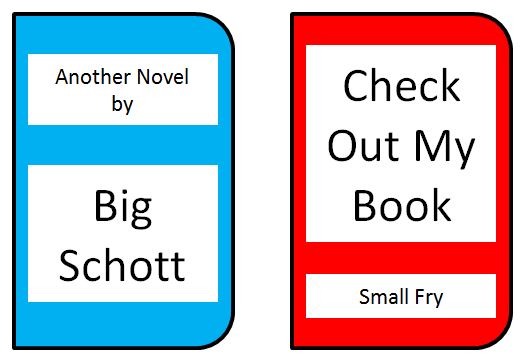
The consensus among critics is that the author’s name should be relatively small (compared to the title) unless you’re famous.

Why? There are two popular reasons for this:

  1. The marketing view says that if the author’s name appears too large on the cover, it will distract the shopper’s attention from more important keywords in the title. If you’re famous, then it’s important to throw your name out there because your name has sales value.
  2. The critical view feels that the author’s name should take on a humble role on the cover (i.e. out of the way) if the author doesn’t have name recognition.

But is this correct?

Maybe not.

There are a couple of reasons to reconsider this point:

  1. Do you primarily expect to sell books to family, friends, acquaintances, coworkers, social media followers, and people you interact with personally through marketing? If so, then you do have name recognition with your target audience. Make your name larger for their benefit and disregard the potential critics. Why not?
  2. Are you branding your name in your marketing efforts? If you are effective at this, then you want your name to be easily visible (but perhaps not dominating) on the thumbnail image of your cover. Potential customers who recognize your name from your marketing endeavors who see your name in the thumbnail may check out your book.
  3. Part of marketing is about creating a perception. If you’re thinking big, then you want to create a big name for yourself. If you’re going all out to try to make it big, then starting out with a big name on your cover might be a good fit. Make that big name for yourself and prove the cover critics wrong.
  4. If you’re a nonfiction author with a title (Dr., Ph.D., M.D., etc.), you may want your qualifications to be visible in the thumbnail image. However, if you don’t have a relevant title and aren’t well-known in your field, it may be better to place emphasis on a few important keywords instead of your name.

What is your personality? What fits you? A big name? A small name?

Chris McMullen, self-published author of A Detailed Guide to Self-Publishing with Amazon

How to Change the Publication Date at CreateSpace…

(I intended to include this in my previous post. Better late than never?)

First, note that once you click Approve Proof, it is no longer possible to change the publication date.

As mentioned in my previous post, after you enter the title information, much time can pass before you approve your proof (from making revisions). So if you enter the publication date as ‘today’ when you enter the title information, by the time you approve your proof, this date can be a few weeks old. The problem with this is that you would then have very little time in the ‘Last 30 Days’ section.

At CreateSpace, when you enter the title information, if you click on the ‘What’s This?’ link, you’ll see that you don’t actually have to enter any date at all. Just leave this field blank and CreateSpace will automatically set the publication date to the day when you first click the Approve Proof button. This gives you approximately 30 days on the ‘Last 30 Days’ list (since it may take a day or more for your book to show up at Amazon).

If you didn’t know this and entered an actual date in the title information, when you go to the title section, you may find that everything appears to be ‘locked.’ If so, contact CreateSpace and explain the situation. Make it clear that you have not clicked Approve Proof (even in the past) for this title, and ask CreateSpace if they could please reset the date for you.

Publishing Tip: Change the Publication Date

If you hope to sell many books online through discovery in search results, the publication date is very important.

Why?

At Amazon, customers can filter search results by clicking the ‘Last 30 Days’ or ‘Last 90 Days’ new release links. These filters give your book a window of opportunity. Customers looking for new releases in their favorite genres may discover your book this way.

Now consider the following scenario.

You go through the entire publishing process. You set the publication date to be today’s date, since it won’t let you enter a date in the future. Then you discover one or more typos in the proof. After correcting those, there is suddenly a problem with the cover. When you fix the cover, you find more typos. A few weeks later everything seems to be just fine. So you click the magic button to approve your proof.

Oops!

You forgot to update the publication date. Your book won’t be listed in the ‘Last 30 Days’ results for an entire month. If it took three weeks to fix all of those problems, your book will only appear in the ‘Last 30 Days’ results for about a week.

Unless you remember to change the publication date before you publish.

If you’re debating whether to enter the publication date as ‘today’ or some date in the past, there is a distinct advantage to using ‘today.’ If the book you are publishing now is a new edition, for example, then why not give this edition a new publication date?

When you explore the ‘Last 30 Days’ and ‘Last 90 Days’ filters, you may also notice a ‘Coming Soon’ filter.

How do you get your book listed under ‘Coming Soon’?

First, you have to publish a paperback or hardcover. You won’t be able to do this if you publish exclusively an e-book edition.

Next, you must learn how to setup preorders at Amazon Advantage. There are some very helpful discussions on this very topic at the CreateSpace community forum. Check them out.

Chris McMullen, self-published author of A Detailed Guide to Self-Publishing with Amazon

Thank You, Reviewers

Thank You Pic

Thank you, Readers

For taking the time to review books,

To express what you enjoyed,

To suggest what could be better.


Thank you, Shoppers

For reading customer book reviews,

For trying to sort out which comments are helpful,

For comparing feedback to the Look Inside.


Thank you, Customers

For not being afraid to share your feedback,

Despite the few who don’t handle criticism well,

For realizing that most authors aren’t this way.


Thank you, Bloggers

For investing so much time to read many books,

For posting book reviews on your blogs,

For helping out so many authors.


Thank you, Authors

For not reviewing your own books,

For not blasting the competition,

For not lashing out at reviewers.


Thank you, Everyone

Who has taken time to post a review,

Who hasn’t abused the review guidelines,

Who supports the wonderful world of books.


We need you,

Readers, Customers, Bloggers, Reviewers.

We would be nowhere without you.

Thank you so much.


Chris McMullen