Book Marketing: The Power of Perception

Perception is a very powerful marketing tool. Are you using it to your advantage?

Think about a moment where you’ve just heard about a new product. Perhaps a friend told you about it. Maybe you heard about it on the radio. You might have seen it in a store.

You probably didn’t use the product first and then form an opinion of it. Nope. Most likely, you developed an immediate perception about the product. You might investigate the product further before making the purchase, but that first impression is very important. If you had a poor impression, you may not even consider the product again. If it made an excellent impression, you tend to look for things that reinforce this – i.e. you see it in a better light.

Don’t just try to brand the book’s title or your name. Strive to brand a perception about your book.

The first step is to think about how you want your book to be perceived. It must be something that most readers will agree with once they read the book; otherwise, marketing the perception will be ineffective in the long run. In what way is your book distinguished, which will appeal to readers?

Here are some dos:

  • Keep it simple. People can remember a few words; a long sentence will likely be forgotten. One to three words that paint the perception can be branded effectively.
  • The perception should be highly relevant to the target audience. This way, the branding helps to attract the readers who are most likely to want the book.
  • Think about the selling points of your book, but just pick one. What distinguishing feature might appeal to customers?
  • If a popular book helps to paint the perception efficiently, you may be able to do this in a positive, tactful way – e.g. “like Harry Potter in space” (notice that it doesn’t say anything negative about the other book). Only try this if there is another book that’s a great fit to help you quickly paint the proper perception, and if the book is also well-known.

Now for a few don’ts:

  • The perception must be accurate, otherwise it will backfire. You don’t want readers expecting one thing, when in fact they will get another.
  • It can’t be “the best book ever.” This doesn’t say anything specific about the book, so it won’t attract the target audience. It also tends to generate the negative reaction, “Yeah, right!”
  • Don’t try to top popular books or movies, like “better than Star Wars,” or “the best mystery ever.” If the expectations don’t seem reasonable, buyers won’t invest in the book. Definitely, don’t put anyone’s favorite books or movies down. If you try to advertise that your book is better, it will create a mindset among some readers to try to prove you wrong.
  • Limit yourself to one quick phrase. Don’t try to market two or more perceptions. It’s much easier to brand one simple perception.

There are many possibilities: audience specific (a clean romance), a distinguished character (Gollum or Darth Vader), an attractive idea (a children’s series that teaches decision-making skills), a unique feature (like the twist-a-plot idea), a cool concept (imagine what it would be like to…), an improvement (a workbook and textbook integrated into one), or even exceptional preparation (“Judy spent three years doing the research for this book,” or “Bob had three different editors work on the manuscript” – but note that these two examples don’t attract a specific audience)… and the list goes on.

How do you paint the perception?

  • It helps if a glance at the cover reinforces the perception that you’re trying to paint.
  • Similarly, the title, blurb, and Look Inside need to reinforce this perception.
  • Mention it with your title on all of your online and offline marketing materials: end of posts, just after your book link, social media, bookmarks, advertising, press release kit, etc.
  • Use your phrase (it’s a strapline) in your personal marketing endeavors – mention it at readings, signings, interviews, blog tours, conversations, presentations, and whenever you have the opportunity to discuss your book.
  • Strive to paint this perception when trying to generate buzz for an upcoming book.
  • When you enlist others to help with your marketing – e.g. to create buzz or to help spread the word for a promotion – see if this perception can be included.

Perception is a difficult thing for a lone author to judge. External input is valuable for trying to make such predictions. Ask people what they perceive about your book? Run the perception that you’d like to paint by them and see how they react to it.

Some things are beyond your control. This includes reviews, recommendations, and referrals – which can be good or bad. You can get lucky and a complete stranger who enjoys your book may spread the word to many others, and you can get unlucky and someone can strive to paint a negative perception. You can’t control this. But there are a couple of things that you can do:

  • The better your book and the more effective your marketing, the more reviews, referrals, and recommendations you will get. The more you receive, the less effect the negatives will have and the more likely you are to have some helpful advocates among your fans.
  • Be wise, courteous, respectful, and professional in your interactions with readers, blog reviewers, sending out advance review copies, and all of your public relations.

Chris McMullen, author of A Detailed Guide to Self-Publishing with Amazon and Other Online Booksellers, Vol. 1 (formatting/publishing) and Vol. 2 (packaging/marketing)

What Writers Can Learn from Reading

Reading is a valuable hobby for the writer, as it provides numerous benefits:

  • Periodic reading of classics can help improve writing skills. Grammar, proper word choice, structure, and word flow tend to come a little more naturally. The current read may unconsciously influence the writer’s style a little, but the pros probably outweigh the cons. My dad (with a literature degree) knew someone who couldn’t pass an English test. After my dad recommended that he read some classics, instead of study guides, he actually passed the test next time. This may be an exceptional case, but there are many who advocate the benefits that reading classics has to offer.
  • Reading top sellers in the genre can be a valuable form of research. Think about how the book became popular – especially, if the author didn’t have a big name when the book was first published. Study the storyline, characterization, writing style, organization, and anything that might attract readers. Strive to find out what made the book successful. Don’t copy the same ideas; readers may not respond well to this. Rather, try to find general ideas that can be applied to your own writing, without doing exactly the same thing. For example, don’t create similar characters; instead, discover how the author made those characters so memorable, and learn how to apply it to make your own unique characters just as memorable. Consider what the book doesn’t do. This is important because some of the things that top sellers don’t do may have a tendency to deter sales. Each genre has some unspoken rules that can significantly affect sales and reviews.
  • A writer can see what the latest trends are, especially in the author’s genre. Following the trends may or may not be the best thing, but it’s important to be aware of what’s going on. The expectations of the target audience always merit consideration. If a new release is significantly different than most other new releases, for example, it might be desirable to make this clear in the blurb; maybe it will be a good thing, and maybe not, but readers are more likely not to be upset this way. If for no other reason, a fan might ask an author why he or she didn’t follow a popular trend. The author will look a little foolish if he or she is unaware of the trend.
  • Practice thinking from the reader’s perspective. An author writes a book from his or her own perspective. However, the reader’s perspective (more precisely, the general reaction from the target audience) is ultimately much more valuable to the book’s marketability than the writer’s perspective. Think about what’s important to you when you’re buying and reading books. Try to wear your reading shoes when you analyze your story, writing, characterization, style, formatting, cover, blurb, and even your marketing. The more you read, the more you can relate to this perspective, and the better your chances of looking at your own book critically. It’s no substitute for the valuable resource of external opinions, but it will prove valuable, since ultimately you have to make decisions about your book even if you do receive input or help.
  • See first-hand that even the most popular authors receive criticism. No book pleases every reader. Books with hundreds of reviews have some awful ones, even if the average star rating is very high. Seeing this for yourself may help you better learn to deal with criticism.
  • Become more familiar with the buying process. This can help you with your own marketing. How do you buy books? What keywords do you use in online searches? Do you browse thumbnails? Do covers play an important role when you shop? What effect does the blurb have on you? What kinds of covers appeal to you? Study the blurbs that sell books to you to learn what they did successfully. Do you check out the Look Inside? If so, what do you look for? What price range do you look for? Which reviews tend to influence you? Do you review books? What kinds of marketing tend to influence you? Explore the author’s marketing pages and try to learn some tricks of the trade. There is much that can be learned from the buying process.

Chris McMullen, author of A Detailed Guide to Self-Publishing with Amazon and Other Online Booksellers, Vol. 1 (formatting/publishing) and Vol. 2 (packaging/marketing)
Which Part of the Book Is Best?

Book Play Pic

COVER: I’m the best. Without me, they wouldn’t even check the book out.

STORY: Cover, you’re just the good looks. I’m the brains.

BLURB: Nobody will see your brains until I convince them to look inside.

PRICE: They won’t see how the story turns out until I show them what a great value the book is.

FORMATTING: My excellent design is what makes it such a great value.

CHARACTERIZATION: The memorable characters generate future sales through reviews, recommendations, and referrals. I draw out the reader’s emotions.

EDITING: Those would be bad reviews if not for me!

MARKETING: I created the buzz for this book, and I generated sales and reviews.

COPYRIGHT: You’re all wrong. I’m best.

BLURB: How the deuce are you best? Nobody even reads the stinkin’ copyright page.

Everyone but Copyright laughs.

COPYRIGHT: If not for my copyright statement, everyone would be getting this book for free. And if not for my fictional works disclaimer, we’d be getting our rear ends sued. That’s how!

STORY and CHARACTERIZATION: Get rid of us, and nobody would want the book for free. You wouldn’t be able to pay people to take the book.

CHARACTERIZATION: Besides, there isn’t anyone – living or not – fantastic enough to be confused with a character in this book.

EDITING: You weren’t so fantastic in the first draft.

COVER: I could have sold that first draft.

MARKETING: No, I could have sold it.

STORY: Only because the story is so amazing.

COVER: Who’s going to read the story if nobody checks out the book? Huh? Answer me that.

MARKETING: Not to worry. I have it covered.

COVER: Really? What if I were the ugliest cover anyone ever laid eyes on? Or what if I looked like a perfect cover for a completely different genre? Would you still sell me then? Huh?

STORY: Readers would rather have a great story than a great cover.

COVER: But they will judge how good the story will be based on how great I look. The truth hurts, doesn’t it?

BLURB: Even if the cover is amazing, they won’t check out the book until I capture their interest.

FORMATTING and EDITING: And they would shut the book quickly if not for us.

STORY: Or if I didn’t engage the reader right off the bat. Look, Cover and Blurb, you only have to engage the reader’s interest for a few seconds. I have to entertain the reader for several hours straight.

VOICE: I have you all beat.

PRICE: Who are you?

AUTHOR PAGE: I’m the about the author section.

Everybody but Author Page laughs.

STORY: Nobody even gets to the about the author section until the book is finished. How can you be the best?

AUTHOR PAGE: Because without the author, this book wouldn’t even exist in the first place.

FORMATTING: You’re not the author. You’re just a page about the author.

AUTHOR PAGE: I also generate future sales by sending fans to the blog, social media pages, and fan page.

MARKETING: You can thank yours truly for those pages.

COVER: Much of that marketing features a picture of me. My image makes the book marketable. I’m the brand.

CLIMAX: Excuse me.

BLURB: Yes…?

CLIMAX: I’m what every reader wants. They yearn for me. They read hundreds of pages just to get me. The closer they get, the more they want it. I give them everything their hearts desire. Any reader will tell you that I’m the best part of the book.

STORY: You!? You’re not even a whole page. They read me for several hours, and you just for a few seconds. Why, if not for me, they would never reach the climax.

ENDING: It’s not the climax they’re after. It’s the ending. They want happiness. They want all the loose ends to be tied. I make the readers happy. I make them come back for more in the sequel. I make them recommend the book to others.

COVER: Look! Someone’s coming.

BLURB: Places, everyone!

INTRODUCTION: It’s so nice to meet you.

Chris McMullen, author of A Detailed Guide to Self-Publishing with Amazon and Other Online Booksellers, Vol. 1 (formatting/publishing) and Vol. 2 (packaging/marketing)
The Writer’s Enemy

Authors share a common enemy.

This evil entity can affect every aspect of a book, from the writing to the marketing.

It starts out as just a tiny presence, seemingly innocuous.

Then it grows gradually.

Before the writer realizes it, this enemy becomes ominous.

It creates delays in the writing… hinders investment in cover design and editing… and destroys marketing effectiveness.

What is this evil monster?

It’s doubt.

When you doubt that readers will enjoy the story, it’s really hard to finish it… to put a full effort into it… to edit it well… to invest in a nice cover… to market the book diligently.

When you doubt your ability to market the book, you inhibit your own marketing efforts. Your lack of confidence shows through, creating doubt in the buyer’s mind. If you don’t believe in your book, why should customers?

Believe in your book to keep yourself motivated. Motivated to write, and motivated to market.

Become confident in your ability to write and market. Let your confidence show through. Let your passion for your writing show through in your marketing.

But don’t overdo it. Overconfidence can be a sales killer, and can make it difficult to handle criticism.

A little doubt can serve a useful purpose. But balance it with confidence so it doesn’t grow.

A little doubt can make you research the idea to see if it’s worth pursuing. A little doubt can make you consider an alternative. Make an informed decision and then be confident with it. A little doubt can make you edit yet again. A little doubt can make you compare your cover to those of top sellers. A little doubt can make you research other marketing ideas, just in case there is something better that you might be doing.

If you need to become more confident, you can try to build confidence in steps. A little feedback can help. Start with people who are likely to be supportive, and whose advice is likely to be helpful. Widen your audience, in steps, until you gain the confidence you need. Learn how to deal with criticism. Take a break after you receive it. Consider it another day. If it has merit and is something you are willing to do, implement it; if not, let it go. Be confident with your decision.

Chris McMullen, author of A Detailed Guide to Self-Publishing with Amazon and Other Online Booksellers, Vol. 1 (formatting/publishing) and Vol. 2 (packaging/marketing)

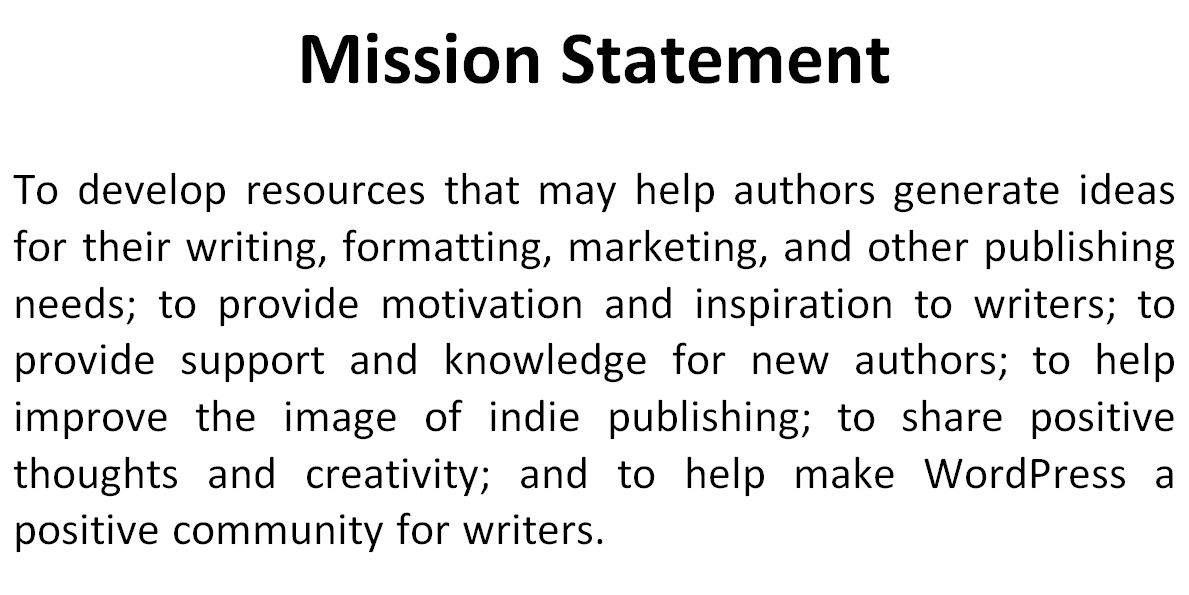
Authors: How about a Mission Statement?

Mission Statement Pic

Companies have mission statements. It’s a short paragraph that says what the company is all about.

Writing is a business. Even if you write for the love of writing, as most writers do, selling books is still a business activity.

So should an author have a mission statement?

Here are a few possible benefits:

  • Seeing and reading it every once in a while can help you focus on your main goals. What really drives you to write? It can help keep you from losing sight of this.
  • You can use it as a motivator. A few aspects of the writing business can occasionally discourage an author. When you’re feeling down, read your mission statement to remind yourself of some pros that may outweigh any cons.
  • Show that you’re human. Fans and potential customers who see your mission statement might notice your passion for what you do – i.e. it’s not about the money. They might see what really drives you.

Search for mission statements that companies write to get a feel for what a mission statement looks like and to help generate some ideas. Obviously, don’t plagiarize their mission statements; write your own statement in your own unique words. Just browse their mission statements to see some options and to get a feel for it.

Think about what really drives you to write. What are you really striving to accomplish through your writing?

What do you do with your mission statement after you write one?

  • At the very least, keep it handy – someplace where you will see it occasionally to remind yourself what your writing is all about.
  • You could add it to your website(s).
  • Should you include it in your books? You can. You could put it in your copyright page, about the author page, or anywhere else – it’s your book. Realize that including the words “Mission Statement” is optional. You probably don’t see mission statements explicitly declared in books unless the publisher chooses to include it somewhere. However, there are many authors or publishers who somewhere in the front or back matter do make some note that could very well be part of a mission statement.

If you publish with your own imprint, so that you look like a real publisher, then you can include a mission statement for the publisher – instead of the author.

Chris McMullen, author of A Detailed Guide to Self-Publishing with Amazon and Other Online Booksellers, Vol. 1 (formatting/publishing) and Vol. 2 (packaging/marketing)

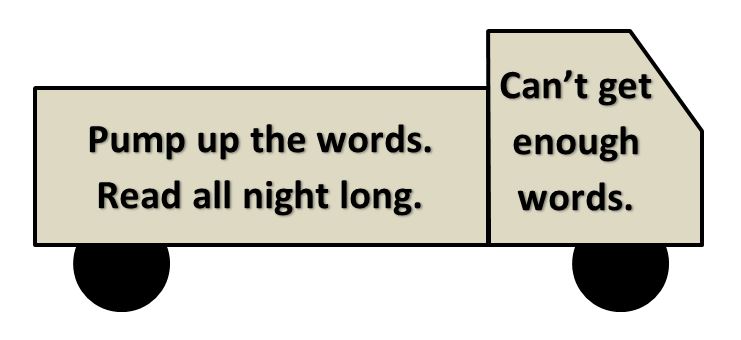
Low Reader

Low Reader


Low Reader Pic


Driving through town in my bookmobile,

With pages of graffiti on the sides,

Telling my story for all to read.


Pump up the words!

Pump up the words!


Big display screen on the back window,

Flashing words in very large letters,

Helping to spread literacy.


How slow can you go?

How slow can you go?


Crawling through town at a snail’s pace,

So everyone can read my bookmobile,

Before the words pass out of sight.


Read all night long.

Read all night long.


The graffiti glows in the dark,

Allowing people to read anytime,

Lighting up the night with words.


Can’t get enough words!

Can’t get enough words!


(c) 2013 Chris McMullen

Marketing: “Why Isn’t It Working?”

Almost all authors love to write. This makes writing the book the easy part.

When authors finish their books, they are often surprised to learn that there is much more work to do. Marketing tends to come as the greatest surprise. Marketing is the hard part.

Marketing is a challenge to most authors, and most authors don’t share the same passion for marketing that they do for writing.

New authors ask two very common questions about sales. The first is, “Why isn’t my book selling?” The answer to this, of course, largely involves marketing. (The other part of the answer involves the book itself – good idea, well-written, well thought-out, nicely formatted, etc. Well, you could lump these things into marketability.)

The second question is, “I’m marketing like crazy. Why isn’t it working?”

Following are several factors that impact marketing effectiveness.

(1) Is the book worth reading? Is the idea good enough to sell (both the big picture and the details)? Is the book readable, both in terms of storyline and characterization (for fiction) or content (for nonfiction), and the writing (style, flow, punctuation, grammar, and spelling) itself?

If the book isn’t worth reading (to the vast majority of the target audience), marketing should be a waste of time. Writing groups, focus groups, and good editors can help to gauge this. If the book isn’t worth reading, presently, it may still have the potential to reach this point. In this case, the first step of marketing is to make the book marketable.

(2) Is there an audience for this book? It doesn’t have to be a huge audience; it’s possible to succeed in reaching a niche audience. But there has to be an audience for the book. An idea that people just won’t or don’t read is very tough to sell. Writing and focus groups can help to judge this, as can researching what is already on the market and how well it does or doesn’t sell.

It’s not necessary to write to the widest possible audience, but the writing must address an actual audience.

A common mistake is to combine multiple genres together, hoping that this will widen the audience. Unfortunately, this tends to narrow the audience. The author is thinking, “Anyone who likes science fiction, mystery, or westerns may buy this book. That triples the audience.” What most readers are thinking is something along the lines of, “I was looking for a western, but I really didn’t want to read science fiction.”

If there isn’t an audience for the book, marketing won’t help. Before invest time in marketing, ensure that the book is worth marketing. The ideal time to research this is prior to writing the book.

For an author who isn’t sure, trying may be better than nothing; but if marketing doesn’t help, this could be the reason.

(3) Will the packaging attract the target audience? The cover, title, blurb, categories, and Look Inside must make it clear what to expect. Otherwise, the marketing will attract an audience that doesn’t buy the book. Marketing can’t help if the people who check out the book don’t buy it.

A very common mistake is a target audience mismatch. The cover might attract romance readers, who check out the book and decide it’s really a mystery, for example (or the cover might attract contemporary romance readers, when it’s really a historical romance – just as bad).

The cover has to clearly fit the genre. This is incredibly important, yet it’s also very common. If the cover doesn’t clearly fit the genre, it won’t attract the right audience. It shouldn’t just fit the genre, it should fit the precise subgenre. Research top-selling books in the subgenre to see what readers in the target audience are looking for when they browse for books.

The cover must not only fit the genre, it must also be appealing. It needs to attract the target audience. Furthermore, it must look professional (not just appealing) – it has to look like it’s worth buying. It should look like much effort was put into the book.

The title, blurb, categories, and Look Inside all need to send a unified message. If most of these scream that the book is a mystery, but one makes it look like the book is fantasy, for example, this will confuse the buyer. Confused buyers don’t make purchases.

(4) Will the blurb and Look Inside close the deal? While the cover and title must attract the target audience, the blurb and Look Inside must convince the shopper to buy now. The blurb and Look Inside are the only salespeople at the point of sale for online shopping. Marketing doesn’t help when the blurb and Look Inside don’t generate sales from the lookie-lous.

Excellent marketing can direct traffic to the book’s product page. An excellent blurb and Look Inside increase the percentage of sales that result from these window shoppers. Both points are critical to success (i.e. getting people to check it out and closing the deal).

A blurb is not a synopsis. A synopsis gives away too much plot. Readers who feel that they know what will happen don’t feel compelled to buy the book. A great blurb doesn’t give much away, but does succeed in drawing in the reader’s curiosity. A good blurb doesn’t start out slow and build up because most shoppers won’t exercise enough patience to read past the slow part. (Why should they? They have hundreds of books to check out. If the blurb bores them, that doesn’t bode well for the book.) The style, flow, and readability of the blurb are also very important. For fiction, it’s better to err on the side of a shorter blurb. For nonfiction, any relevant qualifications are helpful.

Don’t forget critical details, like the target age group for children’s books (research this – omitting it doesn’t boost sales by widening the audience, it reduces them by introducing doubt). What would the reader like to know that would help generate the sale? (If it’s not likely to help the sale, don’t include it.)

Wise customers check out the Look Inside before investing in a book. The Look Inside can easily make or break the deal. If it doesn’t make the deal, it’s killing the book’s marketability.

The Look Inside must look professional (formatting, writing, front matter, etc.). The customer is about to spend money – but not if it doesn’t look worth buying.

The beginning must grab the customer’s attention and run with it. Make the customer curious. Let the action begin. The words should flow well. If the reader gets drawn into the story, the book will sell.

Readers will buy books with slow beginnings, lengthy forewords, and excess front matter when they are already familiar with the author – i.e. they know from experience that the book will be worth reading.

Most readers will not buy books with slow starts from unknown authors. It’s a big risk to take. There are so many books to choose from, why not pick one that’s more likely to reward the buyer? If the Look Inside doesn’t impress the reader, it doesn’t bode well for the rest of the book. Put the best stuff here.

Sales killers also include frequent spelling, grammar, or punctuation mistakes, poor sentence structure, writing that doesn’t flow well, point of view problems, or unappealing writing style, for example, in the Look Inside. Don’t let the Look Inside kill sales; make it generate sales. This is critical, as it can make the difference between few or many sales. Marketing won’t make up for mistakes in the Look Inside.

(5) Is the book worth recommending? If the book isn’t worth recommending, it will struggle to generate customer reviews, bloggers may be reluctant to review it, the media won’t want to touch it, and any reviews that it does get might explain why it wasn’t worth recommending. A book that isn’t worth recommending isn’t worth marketing. (Marketing is basically the author’s – tactful, if done well – way of recommending it, right?)

The most valuable sales of all are word-of-mouth sales from customers to their family members, friends, acquaintances, and coworkers (not the author’s friends – the customer’s friends). Such sales are very difficult to come by, yet can have a major impact on the book’s success (or lack thereof).

Customer book reviews, blogging reviews, social media shares, and so on can also have a significant impact on a book’s success.

What makes a book worth recommending? It must be highly readable. The storyline (or nonfiction content) must appeal to the target audience. The characterization must be excellent. It must be professional from cover to cover (otherwise, it reflects poorly on the reader to recommend it). If the book moves the reader emotionally (in a positive way), that’s a huge plus.

Comment: The first five points are critical toward marketing success, but so far there hasn’t been any mention of actual marketing techniques. The marketing strategies themselves are not the only things that strongly affect marketing effectiveness. The product’s marketability is equally important.

(6) Are you using social media effectively? The proper use of Twitter, Facebook, and other social media sites is counterintuitive to many authors.

Advertising to the effect of, “Buy this book for…,” on social media is ineffective for most authors. Even just announcing, “I wrote a book called…,” may be ineffective.

People who check their social media accounts are bombarded with numerous messages because they have several acquaintances and also follow their favorite celebrities. So they will visually filter through it.

What will they filter out? Anything that looks like an advertisement! People don’t like advertisements. Do they come home, looking forward to which commercials are on t.v.? Do they like it when commercials interrupt songs on the radio? Do they like pop-up windows that advertise products? NO!

People tend to tune out posts that look like advertisements. They also tend to tune out authors who post repeatedly about their books, even if they aren’t advertisements.

Social media and blogging aren’t about generating many instant sales from people who see advertisements. They are about branding an image (professionally), letting people discover the author’s book, providing content that will gradually draw in the target audience, interacting with other authors and fans, making connections, and widening the author’s exposure gradually.

Think discovery rather than overt advertising. If a man walks into a room and says, “Hey! I just wrote a mystery. You should buy it,” people probably won’t. (Does it seem like the kind of thing a professional author would do?)

If instead a man walks into a room, interacts with people, and makes a good impression, eventually someone will ask what he does for a living. When they discover that he’s an author, rather than having this information thrust upon them, they are far more likely to check his book out.

The same concept can be applied online. Consider an author who is on a website that’s a good fit for the target audience. If the author makes a good impression, people are more likely to click on the author’s profile and discover the author’s book (along with the fact that the person is an author).

The first step with social media is to become an active (but not overactive!), welcome participant in a setting where many people in the target audience can be reached. Ideally, this should start one or more years prior to publishing. When an author suddenly shows up just to market the book, it doesn’t make a good impression.

See how other authors use the social media site successfully before starting to use it as a marketing tool. Also study how some authors misuse it. Learn about hashtags before using them at Twitter. Find author fanpages at Facebook to get ideas for making one.

A personal Facebook account (this isn’t a fanpage) can help to create a little buzz and possibly get an early boost from friends, family, acquaintances, and coworkers – but if they aren’t in the target audience, don’t expect too much help here.

Once a fanpage has grown, it can help to create buzz for a new book. It must provide valuable content in order to draw the audience in the first place. The website for it should be visible in the author’s books. An email group can serve a similar purpose – but people won’t subscribe to advertisements.

Fewer than 10% of the posts on social media should be geared toward promoting the book directly. This reduces the chances of being tuned out.

Remember, building connections and interacting with other authors and fans is a very important part of social media.

For example, most bloggers are bombarded with numerous review requests. Suppose an author has already made a connection with a blogger in the target audience who sometimes reviews books. They have been mutual followers and actively communicating for months. Will this author have an edge when it comes to making a polite review request (that follows the blogger’s posted instructions)? The author may have even already reviewed the other blogger’s book.

(7) Are you blogging effectively? Effective use of blogging shares many common traits with effective use of social media. It’s largely about connections and interactions, and not about direct advertising or immediate sales.

But blogging does have a different feel. When blogging, authors tend to provide more content, which has many benefits. It provides extra writing practice. Extra practice means a chance to find a voice and a style, to try out new forms of writing, or to develop a character. (But lengthy fiction may have trouble finding an audience in the blogging world.)

There are more benefits than just practice. A popular post may be searched for and discovered through a search engine. Writing a post can help relieve stress or receive needed support. The sense of community can make this a place of comfort for the author.

A blog can gradually draw in members of the target audience by providing valuable content. Excellent content may not get many views at first. It takes quality and time, which means care and patience from the author. Don’t give up.

Since blogging is a writing sample, punctuation, spelling, grammar, style, etc. are important. Mistakes can deter potential buyers or followers.

It’s also important to appear professional: People who discover the blog are potential customers. Unprofessional behavior can deter sales.

(8) Are you branding successfully? Successful branding is very important part of an effective marketing campaign. Most marketing efforts’ dominant effect is branding.

A big part of social media and blogging is to help with an author’s branding. Although it may not result in immediate sales, and the connection between the sales and the social media may not be obvious, successful branding is very important.

All of an author’s exposure (not just social media and blogging) contribute to the author’s branding.

The brand is one or more of the following: the book, the book cover, the author’s name, the author’s photo, a distinctive character (like Sherlock Holmes), the title, the series title, etc.

Commercials don’t succeed because people see a product on t.v. and immediately run out to the store. Rather, they succeed through branding. When people buy paper towels, they usually go with a brand they’ve heard of before. That’s branding.

The more the target audience sees a book (and associates positive qualities with the book’s brand), the more likely audience members are to recognize the book.

When a customer is shopping for a book in that genre, if the customer sees the book and recognizes it, it’s due to branding. The customer thinks, “I remember seeing this before and it seemed interesting at the time.” Branding helps to sell books.

As the brand becomes more well-known, it becomes better than just recognition. Perhaps a customer has bought one book and loved it. Now the customer searches for the author’s name. This is a higher level of branding.

Maybe a customer has seen this author’s name on several books in the genre. The author is looking increasingly well-known through branding.

Successful branding doesn’t bring instant sales, but it brings very important sales. Branding requires patience. A customer might see the book today, three months from now, and six months from now. After that, it might be weeks before the customer is shopping for a book in that genre. Then several months after first seeing the book, it may generate a sale.

This is why marketing requires patience. It can take one to two years of active, diligent marketing for the efforts to really pay off. (Even then, points one thru five are critical.) Once branding starts to pay dividends, word-of-mouth sales can really grow (assuming the book is likely to generate them).

Branding is also about exposure. If a book meets the first five points above, then the more people who discover and read the book, the more people are likely to refer it to others.

Freebies can generate exposure. But if the freebie doesn’t satisfy the first five points above, it probably won’t help. Also, price doesn’t sell books. Just making it free may not result in many actual readers (although it may result in many downloads – though this isn’t even guaranteed – many don’t result in actual reads).

To get actual readers, the author must successfully promote the freebie (that’s where part of the 10% of the social media or blog posts can be helpful; a little advertising may have potential, or sites that list freebies may help). Promoting a temporary sale rather than a freebie can also generate exposure.

(9) Did you wait too long to begin marketing? Marketing begins with pre-marketing – i.e. marketing strategies employed before the book is ever released.

Start out by creating buzz for the book. Build a following before publishing. Occasionally let fans and acquaintances know how the book is progressing – to try to create interest. A focus group among fans or potential fans can help with this. Do a cover reveal. Ask for input on the cover and title (separately) – this gives you useful feedback while creating buzz, too.

Strive to generate sales right out of the box. Get the book to reviewers months in advance of its release to help time blogging, media, or other reviews with the book’s debut. Setup preorders for a paperback with Amazon Advantage. Throw a book launch party. Do an advance reading (build a local following first and promote this effectively). Send out advance review copies to people in the target audience.

As with much of life and marketing, where there is a will, there is a way. Some creativity can help, too – not just generating interest, but getting motivated. (Example: Arrange and promote a zombie race, then follow it with a reading – if marketing a zombie book, of course.)

(10) Are you reaching your target audience? Blind marketing won’t net many sales. Yet there are authors who promote their books in front of audiences that don’t primarily consist of their target audience. This tends to make such marketing ineffective.

The target audience isn’t anyone with eyes. Think long and hard about who the target audience is. Specifically, where can these people be found? Meet and interact with the target audience in person and online. Direct branding efforts toward the target audience. Post content online that is likely to attract the target audience.

If only a small percentage of the people who see the branding efforts are in the target audience, this severely limits the potential of the branding.

The target audience is a specific group of people who are most likely to buy the book when it is discovered. Gear all marketing toward this specific audience. Strive to build a following among this audience.

Interacting personally among the target audience, making a good impression, charming them, and letting them discover the book (rather than overtly advertising it) significantly improves the prospects for sales, reviews, and recommendations. Making a concerted effort to find the target audience (and look and feel like the author belongs there – instead of seeming like the author is just there to sell a book) in person (online counts, too, but in person is the best) can be a very valuable tool.

People like to buy books by authors they have actually met, especially when they feel that the author is a professional and they enjoyed the interaction. This valuable resource is available to every author.

(11) Do the benefits outweigh the costs? Before investing money or time (that’s valuable, too!) in advertising or any other form of marketing, consider both the benefits and the costs. Realize that some of the benefits, like branding, may be quite valuable, even though they may not pay immediate dividends (or may be difficult to predict).

Paid advertising often isn’t cost-effective with regard to book sales. There may be an exception when investing to promote a temporary sale, for example, with wide visibility among the target audience.

Long-term branding is more likely to pay off than advertising efforts intended to generate immediate sales.

(12) Are you impatient, or looking for a shortcut? Marketing is work, and it requires patience.

Marketing isn’t about a finding a shortcut. It’s not about instant sales. It’s not just about making money (authors who feel this way betray their marketing efforts – prospective customers see right through them).

Marketing is about building and establishing a brand, growing a following and fan base, and interacting with other authors and fans. It takes wisdom, commitment, effort, patience, and belief.

Good things can come in time to those who earn them and wait.

Another important marketing point is future works: It’s not just about one book. The first book attracts notice and slowly develops an author’s reputation. Subsequent books market to the existing fan base in addition to new customers. Multiple books allow for add-on sales.

A readership can grow significantly over the course of time, especially as the author writes more books. Some marketing strategies – like generating buzz or a book signing – become easier once a readership has formed.

Don’t think big money, quickly, with little work. Think long-term success.

But writing subsequent books is not a substitute for marketing. Many authors get frustrated with marketing and avoid it, concentrating on what they like better – writing. However, selling a set of books successfully still requires effective marketing. Books don’t sell themselves. It takes marketing to get people to read books.

(13) Are you properly motivated, passionate, and genuine? It’s unrealistic to expect anyone else to buy a book if the author doesn’t believe in it. The author must convince himself or herself that the book is worth buying before trying to sell it to others. If the book is worth reading, it’s worth marketing.

The author who is passionate about the book must translate this passion into the marketing. It’s not about being a salesman (coming across like one may very well backfire!). It’s about helping the target audience discover a book that’s a good fit.

It’s about sharing. Think of marketing as helping to share a book that’s worth reading. It’s about sharing it with the target audience.

People can see through half-hearted attempts. Think about marketing until understanding it in terms that make it seem very much worth doing. To help people find a book that they will enjoy.

Get motivated to market the book. Make a concerted effort. Make a long-term commitment to marketing (it’s okay to abandon one thing that doesn’t seem to be working to explore another form of marketing – but realize that many forms of marketing don’t pay quick dividends).

Consider This: A few extra weeks or months spent improving the marketability (cover, blurb, Look Inside, editing, formatting, etc.) of a book that has great potential (this part is very important) could pay huge dividends long-term.

If the book hits the market a few months sooner, it starts to generate sales sooner. But if the book would generate a higher frequency of sales by waiting a few months, it may generate many more sales in the long run. It’s not just a matter of how many more books may be sold in one month. For how many years will this book be on the market? How many other books will be available (since the success of one book may improve the sales of the others)?

Does the book have enough potential to warrant the extra work or expense? That’s the million-dollar question. To some extent, research can help.

Do you have enough motivation to market your book effectively and diligently over a long period (and to pre-market your book, too)? The commitment is very important.

How much do you believe in your book? If you really believe in it, why not go all out? In the worst case, you won’t have doubts about whether or not you should have put more effort into its marketability.

4,000 Words: Wow. This post is as long as many short stories. I suppose I could have published it as an e-book. But I think it looks better here on my blog. 🙂

Chris McMullen, author of A Detailed Guide to Self-Publishing with Amazon and Other Online Booksellers, Vol. 1 (formatting/publishing) and Vol. 2 (packaging/marketing)

Amazon Customer Book Reviews: Recent Improvements (?)

Have you noticed a few subtle changes, recently, to Amazon customer book reviews? Find any book on Amazon with several reviews and look closely.

First, let me back up a little, time-wise. On the product page, customer reviews show in two columns. The wider left column shows the top-rated customer reviews in full, while the narrower right column shows the first sentence (or so) of the most recent reviews, with the newest reviews at the top.

This has changed somewhat.

Until several months ago, Amazon used to only show the three top-voted customer reviews at the left. Now, more reviews show up in full at the left; the exact number depends on how many reviews there are all together. This was a nice improvement that many authors and customers had requested.

Another change that occurred several months ago was the inclusion of a few selected excerpts just above the review section. Until very recently, these quotes appeared one above the other in a list, and included a note of how many other customers made similar statements.

Very recently, this changed for one of my books. The excerpts now appear in callouts, and it no longer shows the number of customers who made similar remarks. If you click on one of the three callouts, Amazon takes you straight to that review.

Another of my books has the old list system instead of the callouts, and still shows the number of similar remarks. Maybe they are testing the callout system with selected books, maybe it will take time to change this for all books, or maybe only select books will feature the callouts.

Anyway, there is an interesting issue with the two-column format with more than three full-length reviews showing at the left. For any book that receives a bad review, this comment always carries weight while it’s the most recent review since it shows up at the top of the reviews in the right column. When eventually a good review comes in, it appears above the old bad review.

Unless… customers vote on the new good review, moving it over to the list at the left. Then the bad review reclaims its position at the top of the right column. When there were only three full-length reviews at the left, it wasn’t easy for a new good review to become popular enough to move onto that exclusive list. But now there may be several reviews on the left, so it’s easier for a review to make the transition.

It’s a rather subtle point, and probably not worth much consideration. I just thought it was interesting.

Another change that occurred several months back is what happens when you click the link to see all of the customer book reviews for a given book. Presently, it shows the top-rated favorable review and the top-rated critical review. In the old days, all of the critical reviews (or all of the favorable reviews) could potentially be buried at the bottom of the list, depending on the circumstances. This feature helps to show some balance. Customers are probably trying to weigh the pros versus the cons, so this may be helpful.

What I like most about the recent changes is that Amazon is evidently constantly assessing their customer review program and striving to improve it. The steps may be small, and it may not seem like an improvement to everybody, but I appreciate the effort – both as an author and a reader.

Amazon has made very significant changes in the past. One of the most notable occurred a few years ago when Amazon altered its program to help block suspected shill, sham, and household family member reviews. This change was implemented when they removed thousands (probably, millions) of suspicious reviews. The revision wasn’t perfect, I’m sure; there are probably a few still out there that didn’t meet the criteria of the program, and there were probably a few removed that should have stood. However, this was a significant change to improve the customer review system, and it appears to have made a marked difference.

Have you seen any other changes recently? What are your thoughts?

Who knows what will come in the future? Since Amazon is making periodic changes, we have reason to hope that it will continue to get better.

Chris McMullen, author of A Detailed Guide to Self-Publishing with Amazon and Other Online Booksellers, Vol. 1 (formatting/publishing) and Vol. 2 (packaging/marketing)

Has a Book Ever Made You. . .?

Emotion Pic


Have you ever read a book that made you fall in love with a character?

It succeeded in arousing your passion.

Have you ever read a book that made you yearn for a better place?

It succeeded in creating a better world.

Have you ever read a book that made you feel warm and fuzzy inside?

It succeeded in giving you happiness.

Have you ever read a book that you used to decorate your coffee table?

It succeeded in catching your interest.

Have you ever read a book that taught you how to do something?

It succeeded in passing along knowledge.

Have you ever read a book that couldn’t put down until it was finished?

It succeeded in holding your attention.

Have you ever read a book that made you laugh out loud in public?

It succeeded in providing entertainment.

Have you ever read a book that made you cry?

It succeeded in stirring your emotions.

Have you ever read a book that caused you to reach out to the author?

It succeeded in getting your concern.

Have you ever read a book that made you act toward a noble and worthy cause?

It succeeded in improving the world.


What great thing has a book done for you?

Readability: So Very Important

Imagine that a t.v. series of 24 one-hour episodes has your interest. It’s a big commitment. Once you try it out, whether or not you continue watching the series depends very much on its ‘watch-ability.’

If you watch a lousy movie, you might just sit through it since it’s just a couple of hours long. But you probably wouldn’t persevere through a 24-hour t.v. series if it wasn’t highly watch-able.

What makes a movie watch-able?

  • Acting that isn’t lifeless, but also isn’t overdramatic for the style of show. You might not even notice good acting, but you definitely notice when it doesn’t suit you. You like to feel that the actor or actress is a perfect fit for the part. The characterization must be good, too.
  • The right pace for the genre. Action should keep a fast pace; suspense may have slow points. If the audience expects the movie to be action-packed, for example, the moviegoers will become restless if it isn’t.
  • Good storyline to engage the audience. It shouldn’t be too predictable, yet shouldn’t upset the moviegoers either. The plot should be easy to follow and should make sense to the audience.
  • Entertainment. The movie must suit the audience who shows up, which means packaging and marketing to attract the right audience. The audience must enjoy the movie.
  • Looks realistic. I was watching a horror movie once, where about halfway through almost everyone in the theatre burst out laughing at the special effects. The girl was supposed to look possessed, but it just wasn’t pulled off right; it produced laughter instead of dread. Very often, the special effects are amazing, but when they aren’t, it makes a huge difference.
  • Excellent cinematography and sound effects. Try to make your own movie and you may discover some of the possible problems. It’s amazing how incredible the audio and visual tends to turn out. Normally it’s so good that we just take it for granted. It is very important, however, because if this turned out lousy, it would kill the viewership. Imagine if a movie cut into scenes at the wrong moment, filmed scenes from a poor angle, or didn’t have the lighting right, for example. There are many ways to mess up a great movie through amateur filming mistakes.

If any of these points doesn’t suit you, would you commit to watching a t.v. series of 24 one-hour episodes? That would be silly, wouldn’t it?

Reading a book requires the same level of commitment. A book must be highly readable to make that commitment worthwhile.

If a movie lacks any of the points above, would you recommend that others watch it? Similarly, a book needs a high level of readability to generate valuable word-of-mouth recommendations.

Here are some factors which make books readable:

  • The words flow smoothly, except perhaps in rare situations where a little stumbling may be relevant to the story. Like. This. You have to know your target audience. Use suitable language for your audience. Most people want an easy read, where the words flow nicely for them and they understand quickly. There are people who do want a more challenging read, but they may not comprise a large part of your target audience. If you just write the book any way you please, you might discover that the audience it suits turns out to be really tiny. Writing and focus groups can help you gauge such things in advance.
  • The length of the sentences, paragraphs, and chapters are important, too. Some readers get overwhelmed if many paragraphs exceed the viewable region of the device (which may be a cell phone) or if the chapters are too long. Again, this depends very much on your target audience. The sentences should vary in length and structure, but in a way that the words flow smoothly when they are read.
  • Every spelling and grammatical mistake that a reader notices is like a little hiccup. Such hiccups must be rare or they quickly make the book difficult to read. Another kind of hiccup is repetition of words; variety is the spice of writing. (There may be a few exceptions. For example, some authors prefer “says” for just about all dialog, but not all agree on this point.)
  • Good writing tends to show rather than tell where it makes sense to do this, and tell rather than show otherwise. You don’t want to interrupt the action to show some minor point that could be simply told, but you do want to show many main points rather than tell them.
  • The storyline must engage the audience, not be too predictable, not upset the target audience, be easy to follow, and make sense to the audience.
  • The audience needs to love the characterization.
  • Just like movies, the pace needs to be just right for the genre, the story must feel plausible, the audience needs to enjoy the storyline, and the audience needs to be engaged throughout. The packaging and marketing must attract the right audience for the book.

People do read Thomas Pynchon and Franz Kafka, whose books are not too readable for many people. I do, and I love their writing. People do read classics, both the readable ones and the challenging ones. However, it’s really difficult to write a modern classic and find a significant audience for it. If you want to write with Pulitzer Prize style, the wiser route may be to first develop an audience and reputation writing at this level as a journalist.

Writing mistakes are like cinematography mistakes – they can kill sales. Both books and movies must flow smoothly.

It’s hard to walk out of a theatre when the movie watch-ability is fantastic, and it’s hard to put down a book when the readability is fantastic. When it’s lousy, many people may walk out of the theatre or stop reading the book.

There’s more to a good book or movie than just having a great idea. The way the story is told is at least as important.

Chris McMullen, author of A Detailed Guide to Self-Publishing with Amazon and Other Online Booksellers, Vol. 1 (formatting/publishing) and Vol. 2 (packaging/marketing)