Bird Food for Writing Thoughts

Bird Food

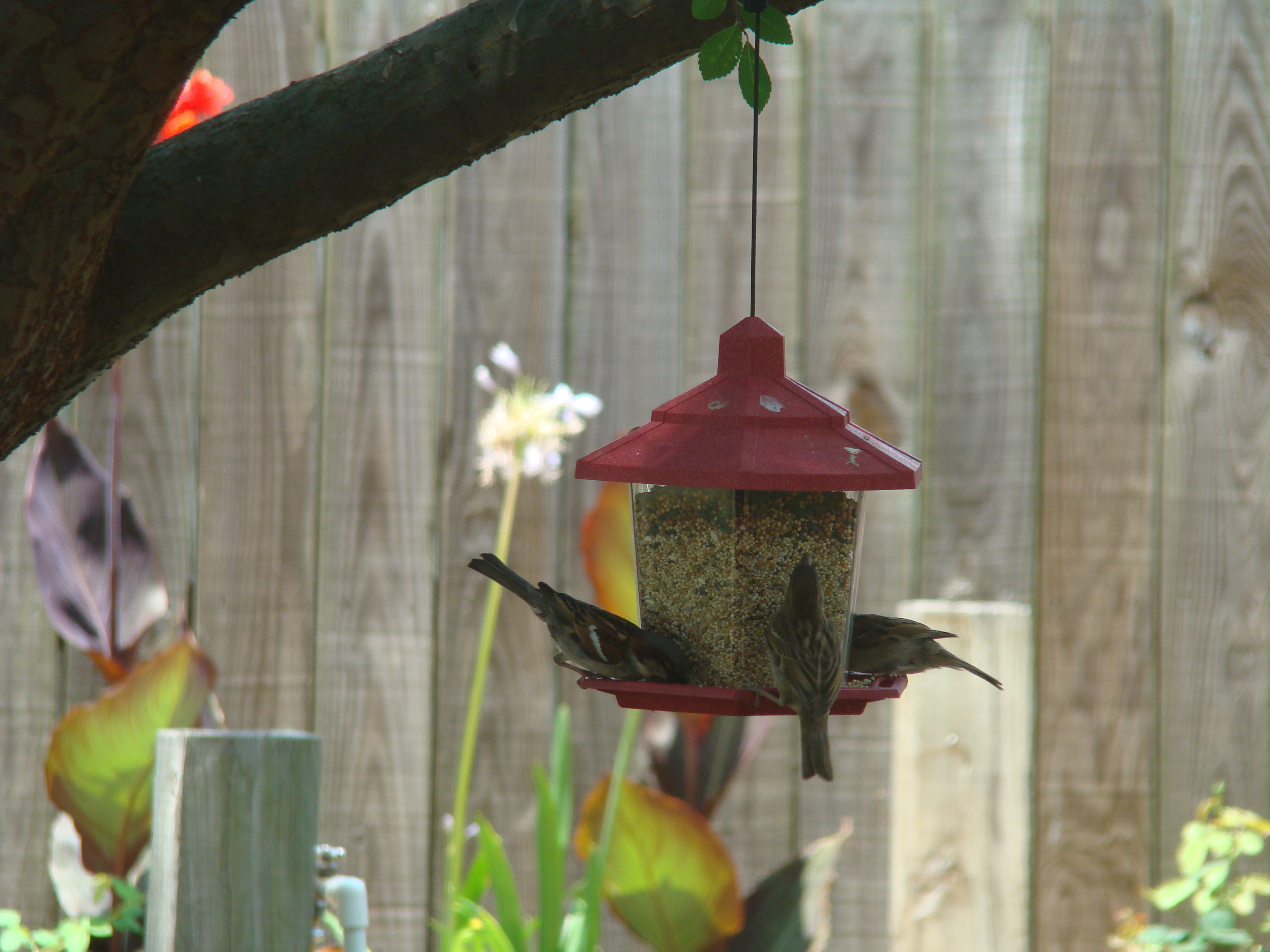
We bought two bird feeders, filled them up with bird feed, and hung them from branches.

The birds knew what to do.

It was amazing. It didn’t take long before it looked like a Bird-Mart Supercenter. There were more birds than I could imagine sitting on the rim of the bird feeder. A few more birds would hover around the edge. A couple of birds would fall off and be replaced before they could recover. Another bird sat on the top. Other birds sat on nearby branches or the fence top, waiting their turn.

After a while, birds found spilled bird feed on the ground. Eventually, there were more birds underneath the bird feeder than there were above it. This may not have been the wisest course of action, considering that the birds above were neither potty-trained nor did they wear diapers. But perhaps eating was more important.

Perhaps birds recognize bird feeders. Maybe a small gathering of birds suggests there is food and attracts others. However it worked, news spread quickly.

It seems that some birds also knew how to signal for danger. Every once in a while, all of the birds that were eating would suddenly fly away, except for one bird who came in to eat. Perhaps that was the bird who cried wolf.

A huge block of bird feed quickly disappeared. We enjoyed having the birds visit, but if we feed them every day, we might be spending more money on bird feed that we spend on our own food. So we decided just to attract the birds on the weekend.

So what does this have to do with writing?

Tweet tweet. Chirp chirp. H-o-o-t . . . h-o-o-t.

The sounds. Pleasant sounds from happy birds. Not waking to an annoying beep beep beep. A sweet melody from nature.

And a beautiful sight of birds in the yard. Most of the birds of a single feather, but some other feathers mixed together, too. An occasional red or blue feather among black and brown feathers.

Busy birds. Pecking away. Flying. Walking. Chirping.

Wonderful sights and sounds.

It was bird food for a writer’s thoughts. What a wonderful way to write.

Sometimes noises are distracting. And there is usually noise in this house. A little girl who plays nonstop. A television that is often on. Weedwackers and lawnmowers outside. Noises are common here.

So writing amid pleasant sounds was a refreshing change.

The art of writing isn’t as simple as sitting down and spitting out ideas in the form of words strung together.

Somebody who suddenly decides to try writing first thinks, “Where will I write?” You need a comfortable place to do this. An office. A man-cave. A girl-cave. Some kind of writing retreat.

This chair is too short. That chair is too soft.

This monitor is too small. That monitor is too dim.

Just the right chair, just the right keyboard, just the right mouse, just the right monitor. Even a mousepad on which to rest the wrist.

Spend a few hours writing on someone else’s computer at someone else’s desk. You might wonder how you could possibly write there at all. Or you might go home and wonder how you’ve ever been able to write there.

When there are distractions, silence is golden but seldom heard. When it is silent, some sounds are needed, like birds chirping or music. When the birds are out, it’s such a wonderful day outside, why stay inside and write?

Starting is the hard part. Once we settle in and begin writing, we become less fickle. We really get into the writing. We wake up at one in the morning to write some more. We write when we’re sick. We write in a motel room on a laptop with a slow internet connection. We write on the subway.

We write anywhere we can with whatever distractions there may be.

Our muses would have it no other way.

Then a day comes when you’re back in your comfortable writing spot, the birds are chirping, and you just want to sit in your desk chair and enjoy the pleasant writing conditions, casually writing.

Chris McMullen, self-published author of A Detailed Guide to Self-Publishing with Amazon and Other Online Booksellers

The Importance of Color in Cover Design

Colors

First of all, some colors complement one another well while some colors clash.

For example, blue and yellow usually provide nice contrast next to one another, but orange and red beside one another are hard to distinguish.

Text absolutely needs to contrast well with anything that is behind it. When text clashes with any part of the background, the result is illegible, especially in the thumbnail. For example, imagine navy blue text on a brown background.

Colors that don’t contrast well can appear beside one another in images, but not when one part of the image needs to stand out against an adjacent part. For example, if a girl is eating a red apple, the apple should clearly stand out, so there shouldn’t be colors that clash with red adjacent to the apple.

Two exceptions are color blends, like a gradient from pink to red, or accents. Blends and accents can have colors that don’t contrast near one another. A fiery picture may include blends of red and orange, for example.

Bear in mind that there are differences in hues, tints, shades, and tones. Not all reds look the same. So while red often contrasts well with black, there are many variations of red and black that don’t contrast well. A dark red doesn’t contrast well with black, for example. Will purple and pink contrast well? It all depends on which purple and which pink you’re talking about.

Color Chart

Another issue is how many colors to use. A good rule of thumb is to use three main colors. If the central image is a photo with several colors, the three-color rule might not seem feasible, but often the photo will have two or three main colors. If there is a main image, the other colors need to coordinate well with this.

Three colors won’t all contrast well with one another. The primary and secondary colors should provide excellent contrast, while the third color should be an accent that complements either the primary or secondary color. Different tints and shades of these three colors can be used when the design requires additional colors.

Black, white, and red can work well with one another. But, again, it all depends on which hues, tints, shades, and tones are used. Many other combinations can work well, if done right, like purple, yellow, and pink. There are several free design programs available online that help you choose sets of colors and see how well they work together.

How much of each color should you use? Another good rule of thumb is 60% for the primary, 30% for the secondary, and 10% for the accent.

It’s not just a matter of finding three colors that work well together.

For one, the use of color helps readers who are browsing through thumbnails find the types of books that they are looking for. Red is more likely to attract romance readers, for example. Pink is common among feminine books. A cover is ineffective when it attracts the wrong audience.

Browse the top-selling books similar to yours to see what color schemes are popular in that genre. This is what those readers are accustomed to seeing. While you’re there, see how many of those books followed these ‘rules.’

Color is not just aesthetic, it’s powerful. Colors evoke emotion.

For example, blue symbolizes trust, so many financial books feature a deep blue, while yellow is associated with happiness or intellect. Use colors that fit the content.

Colors can even have specific effects. When red is used against a background that it contrasts well with, it may help stand out and call attention to the book. Green is a relaxing color. Use blue for knowledge, white for simplicity, purple for luxury, gold for prestige, and navy blue for cheap.

Bright thumbnails tend to stand out better in search results. Yellows and oranges work well as highlighters against dark backgrounds.

Check that your color scheme agrees with the audience that you’re trying to attract. Don’t use pink or yellow for masculinity, for example.

Color Emotions

Note that there is also a difference between the cmyk (cyan, magenta, yellow, black) color subtraction scheme used to print a cover and the rgb (reg, green, blue) color addition scheme used to produce an image on the monitor. If you’re designing a paperback cover, the printed cover will probably look significantly darker than what you see on the monitor, and colors that work well on the screen may not look well in print. Out-of-gamut colors are likely to look much different. Solid regions of one color may not look smooth. The best thing is to print a few tests before putting too much effort and commitment into the cover (keeping in mind that any single printing may suffer from possible variations, as 100 printed covers won’t all look identical).

Publishing Resources

I started this blog to provide free help with writing, publishing, and marketing. You can find many free articles on publishing and marketing by clicking one of the following links:

Chris McMullen, Author of A Detailed Guide to Self-Publishing with Amazon and Other Online Booksellers

Follow me at WordPress, find my author page on Facebook, or connect with me through Twitter.

The Author’s Mighty Pen: The Power of Writing

Mighty Author Pic

Behold an example of the power of words:

This sentence commands you to read it.

Once you read it, there’s no use denying it. You can’t get any sort of acknowledgment that you didn’t read it.

Words are mighty.

The writer is a creator, of sorts. Creating a brand new world. Perhaps, intending a better world. Or maybe a scarier world. But the author may also create a vision of the real world.

Through words, authors have the power to:

  • evoke strong emotions from readers (crying, laughter, pity).
  • make people read fast (suspenseful page turner).
  • provoke action (letters to Congress, a call to arms, buy a DVD that’s on sale).
  • teach (textbooks, how-to guides, training manuals).
  • report news (headlines, articles, research).
  • create ideals (socialism, non-violence, freedom).
  • entertain (fiction, puzzles, cookbooks).
  • inspire (biography, motivational, children’s social situations).
  • provide leadership (by example, through characters in stories).
  • record history (textbooks, biographies, memoirs).
  • and much, much more can come just by stringing words together in the right fashion.

Just like Peter Parker, writers have a great responsibility with this power. 🙂 (I’ll just let you think about this, and spare you a lecture on it.)

But we know from everyday experience that it’s not just the words that matter:

In person, it’s often not what you say, but how you say it.

Facial expressions, gestures, tone, and context influence interpretation. This is a challenge for the author.

Well, we can add a few features, if we want. But the same effect can often be conveyed just as effectively, if not more so, with ‘naked’ words.

A sentence printed on a sheet of paper can be interpreted many ways. It can be read with different tones, stress can be placed on different syllables, and accents can vary.

When the same sentence is said aloud a certain way, this aids with interpretation.

Authors can leave expressions open to interpretation, or they can use additional words to help elicit a particular emotion, or they can allow context to help. They can tell the reader, or they can use words to show the reader.

They can add utterly useless words. Yet each and every word serves a purpose.

They can create new phrases. Yet even trite expressions can be used effectively.

A painting may be worth a thousand words. But the writer is an artist, too, and can paint a vivid picture just using words.

Words.

You can eat without them. You can sleep without them. You can find shelter without them. You can find comfort without them. You can make friends without them. You can reproduce without them.

If we had to, we could live without words. But could you imagine such a life?

Once you learn to read, words affect you the rest of your life. If you see a sign, you must make a concerted effort not to read it. Words have such power over us. They influence our emotions, our actions.

And we use them. They give us power.

Imagine trying to do everything you’ve done in your life without them.

Go an entire day without words. Don’t say one. Don’t write one. Don’t hear one. Don’t even think one. Good luck with that. 🙂

Words. Some silly. Some simple. Some pulchritudinous. Some serious. Some not. Some visual. Some abstract.

For writing to have influence, it has to be read. So authors use words in their marketing, too. To help others find writing that may interest them.

Love words. Read words. Enjoy words. Write words. Appreciate words. Learn words. Teach words. Respect words.

Words are mightier than the sword.

Words are more powerful than money.

Words can be used to form friendships.

Words can be used to ease tensions.

Words can incite rebellion.

Words can bring peace.

What can’t words do?

If you can experience it, you can express it with words.

Even if it can’t be done in reality, it can be done in words.

We live in a world that revolves around words.

Chris McMullen, self-published author of A Detailed Guide to Self-Publishing with Amazon and Other Online Booksellers

How to Use the Chapter Names as Even-Page Headers in Microsoft Word

Headers

Most traditionally published books have page headers running along the top of every page (don’t confuse headers with headings; at the beginning of every section is a heading, while at the top of each page is a header).

When the author is famous, the author’s name is likely to appear on the page header. For the rest of us, it’s probably more useful to put other information here.

Many books put the chapter name on the even-numbered pages and the book title on the odd-numbered pages.

Before you get started, save your file (in two or more places, like on your jump drive and email, in case one file becomes corrupt), then save it again with a different filename. This way, you’ll have a backup of the original, just in case. A file can be messy without you realizing it and become corrupt when working with the page headers, so having a backup of the original may turn out to be valuable.

There is a trick to using different header text in each chapter of the book. It’s the same trick that’s needed to use Roman numerals and Arabic page numbers in the same file. You can find a thorough, step-by-step tutorial with screenshots by clicking here.

The main idea is to use a Next Page section break for each section or chapter where you would like the header to be different. Don’t insert an ordinary page break; going to Insert and selecting Page Break or going to Page Layout and choosing Page won’t work.

Instead, go to Page Layout and select Next Page to make the page break in a way that will tell Word that a new section is beginning.

(In Word 2003 and earlier, the menu options are somewhat different, but the main ideas are still the same. I’ll describe how to use Word 2010 for Windows, specifically, which is similar to Word 2007 and onward.)

Remove ordinary page breaks and recreate them using Next Page anywhere a new chapter is starting (or anywhere else you wish to have different header text, including no header at all, such as front and back matter).

Start at the beginning of the document and edit the headers from the first page onward. If you don’t have page headers yet, add them from the Insert menu.

Place your cursor in the header area. Check the box for different first page if you wish to have a different header in the first page of the section. It’s common, for example, for the first page of each chapter and some pages of the front matter to have no header at all.

Check the box for different odd and even pages to allow the header text of odd-numbered and even-numbered pages to be different. It’s common to have the book title on odd-numbered pages and the chapter name on even-numbered pages.

The first section should be fairly easy, especially if you didn’t already have headers in place to begin with.

When you get to the second section, where you want the headers to be different, place your cursor in the header area and look for the ‘magic’ Link to Previous button. When you click this, the Same As Previous flag will disappear. This allows you to create a new header in this section (instead of copying the header from the previous section; more precisely, to avoid having the previous section change as you type the new header).

You needed those Next Page section breaks (instead of ordinary page breaks) to tell Word where each new section begins.

Remember to start at the beginning and work your way forward one section at a time. After you adjust a new section to your satisfaction, go back and ensure that the previous sections are still correct. If not, be thankful for that handy Undo button.

If your file is messy (it won’t look messy to you on the screen if it is), sometimes Word seems to be a little fussy about the page headers. If Word seems uncooperative, try undoing everything you did in the new section. Then remove the section break at the beginning of the new section, and reinsert it. See if that helps.

Sometimes you can play with it and persistence will pay off.

If you have a richly formatted book, or if the file is otherwise messy (again, without your knowledge), occasionally persistence makes the file even messier or it can become corrupt. (If you saved all of the section breaks and headers until your file was otherwise complete and went section by section systematically through the book, it may help to avoid these troubles.)

One solution to a corrupt file is reverting back to the original you saved as a backup prior to adjusting the headers.

A messy file can be cleaned up by stripping out the formatting. For example, copy and paste everything into Notepad and then copy and paste it into a new Word document. This is not a good option for a file that has numerous pictures, equations, bullets, instances of italics, or other formatting. And if the file mostly contained plain text, it was less likely to get so messy in the first place.

Opening the backup and trying the headers again may be worth the hassle (and far less hassle than stripping out the formatting for a richly formatted book), and it may work out better the second time.

In the worst-case scenario that you just can’t get the headers to cooperate, the simple way around this when your ultimate goal is to create a PDF file is to break your Word document up into smaller files (e.g. one file for each chapter, provided that the chapter count is reasonable). Then it will be easy to make different headers for each chapter.

In this case, you’ll have to manually start the page numbering from the previous chapter by inspection. If you make any revisions to your book, you’ll have to update the page numbering.

If you split the Word file into separate files, you’ll need a Word to PDF converter that allows you to compile separate PDF files together. With the number of free PDF converters available online, there is a good chance you can find one that fits your needs that has this option (but beware of possible viruses or spyware anytime you download programs from the internet).

Many books have been prepared in Word as a single file that have different headers for each chapter. Chances are that you’ll be able to do this in Word with your book, too, without having to resort to any drastic measures.

Publishing Resources

I started this blog to provide free help with writing, publishing, and marketing. You can find many free articles on publishing and marketing by clicking one of the following links:

Chris McMullen, Author of A Detailed Guide to Self-Publishing with Amazon and Other Online Booksellers

Follow me at WordPress, find my author page on Facebook, or connect with me through Twitter.

How Would You Improve Amazon?

Imagine you suddenly have the job of Jeff Bezos, CEO of Amazon. Well, even then, you couldn’t do anything you wanted.

So let’s go a step further and grab a magic wand. That’s better. Now you can do anything. Wave your wand a couple of times to test it out.

If you could do it, what would you change at Amazon in order to improve it?

Don’t be selfish here. Don’t just think about bad reviews that you’d like to make vanish or advertisements for your book if you’re an author, or how to make products free for you as a consumer.

I’m not asking how you would make Amazon better for you alone. I’m asking how you would make Amazon better for everyone.

Not just customers. Giving everything away for free would greatly benefit the customers. For a few days, until the company went bankrupt. If you want Amazon to benefit customers in the long run, you must balance what’s best for both the consumers and the business.

Okay. Spend a few moments in fantasy land. Do absolutely anything to Amazon that you want with your magic wand. Then when you return to reality, think about changes that may be beneficial to all.

What would you like to change?

(1) The Amazon Customer Review System

Almost everyone who is familiar with customer reviews on Amazon can write down a few things that they don’t like about them.

Not everyone is in agreement on what should be changed, though. Authors, readers, product owners, editors, publishers. There are some conflicting perspectives here. Even just among customers.

If there is one feature of reviews that we can all agree on, perhaps it’s spitefulness. Some reviews are downright nasty. There are reviews that slander the author, but don’t even mention the book.

You’d think that Amazon would remove such spiteful reviews, right? It even says right there in the terms and conditions that spite is not allowed. But when spiteful reviews are reported – by the author or even a customer – much of the time Amazon simply responds to say that they understand your concern, but this review doesn’t violate the terms and conditions.

Huh?

Evidently, a reviewer must be blatantly spiteful in order to warrant removal of the review.

How is this in Amazon’s best interest? That spitefulness is very negative. Wouldn’t Amazon create a more positive ambiance by removing that spite? By not removing it, they’re actually encouraging such behavior.

Would customers prefer to see the spite remain or be removed? Does such spitefulness help to brand Amazon’s image with a negative shopping environment? How does this help buyers determine which product to buy? How does it help Amazon sell products?

Maybe you can think of some reason to keep it.

I’ll suggest a couple of possibilities. For one, the spiteful reviews are mostly one and two star reviews. If you wave your magic wand and delete all of the spiteful reviews, millions of one and two star reviews will suddenly vanish. Some products, which only have a few reviews, will suddenly seem better liked than they actually are. The customer who loathed a product so much that he was very spiteful when he wrote the review did cast a vote when he gave it one star. Maybe Amazon wants to retain those votes of one or two stars associated with the spiteful reviews (perhaps there is a reason for this).

If Amazon would like to preserve the one star vote, it could be done while still removing the spite. Just edit out (or delete) the spiteful comments instead of the entire review.

Now we run into another possibility. Manpower. Amazon doesn’t have one of those magic wands to wave and quickly zap away all of the spite.

Remember, we’re not thinking of how to improve Amazon just for customers. We want to find changes that will improve Amazon for everyone. That means not going out of business.

How much would it cost Amazon to monitor the customer review system more closely than they already do? That’s what it would take to deal with spitefulness. Let alone other issues with reviews.

With the advent of self-publishing, there are presently hundreds of thousands of authors who feel that they have a bad review that should be removed for one reason or another. Some have multiple books and numerous reviews that they feel strongly about. Add to this number the legitimate reviews that clearly aren’t violations that some authors would also request to be removed.

Amazon already receives a staggering number of requests from authors for reviews to be removed. This occurs with the current policy in place. That is, it’s well-known that Amazon very rarely removes customer reviews, even when they’re fairly spiteful. Yet, they still receive a ton of requests every day.

Imagine how many, many, many, many, let’s add a few more many’s just for effect (but it may be realistic) more requests Amazon would receive if instead it were well-known that Amazon would remove a review if it were just mildly spiteful. Even if the requests didn’t crash the server, the manpower it would take to attend to these requests would be incredible.

Every day, there are numerous posts online on blogs, community forums, and elsewhere describing unfair customer reviews at Amazon. Bear in mind that the majority of authors don’t write posts about bad reviews because doing so would hurt their own author image and would help brand the image of self-publishing as unprofessional.

Have you ever seen an author get in a long debate with a reviewer using the comment system? It’s very unprofessional, but that’s not the point. My point is that, unfortunately, some authors tend to get highly emotional about reviews and find it difficult to stop arguing about them.

So just imagine those authors communicating with Amazon. They request to have a bad review removed. Amazon says no. They respond to Amazon in a long email. This would go back and forth for an eternity, just like they do in the comments, right?

Nope. Amazon learned not to waste resources on possibly endless communications. Amazon tells the author on their second response that they won’t be able to investigate the matter any further. That is, if the author sends a subsequent request, it will be ignored.

Consider that Amazon has this action in place. It suggests that manpower is already an issue. So is it worth the possible investment to deal with spite? Maybe this is one reason that it hasn’t already been done.

Maybe you can think of a way to deal with spite affordably. Perhaps there is a way.

(Amazon already responds to the request to say that they’ve looked at the review, and understand your concerns, but can’t remove the review. How much more work would it be to remove it? A lot. Because word would spread and the requests would pile up immensely.)

What about other changes to the customer review system?

We could eliminate shill reviews and sock puppets. That is, generating fake reviews to make a product seem better than it actually is. Actually, Amazon has already made this change to some extent. Amazon automatically blocks a very large number of reviews and has removed thousands – perhaps millions – of such reviews. This change was affordable, as a computer program could check for correlations between IP addresses and other information in their database between accounts. It may have removed some legitimate reviews, too, but overall the customer experience has been tremendously improved.

But there is still some review abuse, especially negative reviews that arise from jealousy of some sort (rival authors, ex-boyfriends). Can you think of a way to eliminate this?

A common suggestion is to require all reviews to be Amazon Verified Purchases. Why isn’t this done already? There may be reasons for it.

First of all, there are already millions of reviews that are unverified. Would you like to remove all of those? Perhaps those could be left there, and just impose this on new ones. There are still other issues.

Publishers send out a large number of advance review copies. Publishers provide big business for Amazon. It’s probably not good business for Amazon to prevent the recipients of advance review copies from reviewing books on Amazon, as they would all show as unverified purchases.

What about customers who buy the product elsewhere? A bestselling book might sell many more copies in bookstores than on Amazon. Bestselling authors – and Amazon, too – want all of those customers to be eligible to review the books on Amazon.

What about eBooks? Well, customers don’t have to use Kindle to read eBooks, but Amazon still allows them to post reviews. They can be gifted and lent, too.

But maybe there is one aspect of this that most of us would agree on. Amazon has made it clear that customers can review products even if they’ve never seen or used them.

What?

Does this seem crazy to you? Imagine that you invented a machine and one of the first customers left a review saying, “I didn’t buy this, but just looking at it I can tell it wouldn’t work.” Okay, nobody who reads the review is going to take it seriously, but it does affect the average star value.

When a customer clearly states in the review that he or she hasn’t read the book or used the product, maybe those reviews could be removed. Wouldn’t this be a small improvement?

Amazon’s customer review system isn’t perfect, but it is pretty effective at soliciting opinions, and it does provide shoppers with diverse information that they can consider. Most of us may agree that it’s better than no reviews at all.

There may be other ways to improve the system. Remember, cost is a factor. You might want to hire external companies to leave neutral reviews instead of customer reviews, but with tens of millions of products, is that feasible?

I have a few suggestions. I’ve heard a few others express similar ideas. Maybe you have some other ideas that haven’t been addressed.

When you finish reading an eBook on Kindle, why can’t you type your review right then and there? Wouldn’t that be convenient? Why can’t you click on the book on the device and find a quick and easy place to post the review? I have the Kindle in front of me. I’m in the mood to review the book. It’s on my mind. But I must be inconvenienced to login to Amazon, which I would rather do on my pc. How many customers were ready to leave a review, but decided against it out of inconvenience?

I’ve typed reviews and stopped when I saw the preview, thinking I was done. I wonder how many other customers haven’t finished the review process, not realizing that they had to check the preview and approve it? Oops! Or maybe they rated it when they reached the end of a Kindle eBook, thinking that was a review? There may be a little room for improvement here.

How about separating the rating from the reviews? That is, let customers rate the book without reviewing it, like they can do at Goodreads. Some customers can put a number on a book, but feel uncomfortable describing it in words (including reaching the minimum word count).

If you want to drastically increase the frequency of customer reviews, offer a penny for every review. Or make it a nickel, dime, or a percent if you really want to see tons of reviews on Amazon. I bet many authors wouldn’t mind this being subtracted from their royalties to help encourage more reviews. But the discount (off a future purchase, perhaps) might inspire more sales.

(2) Self-Publishing Quality Control

First, let me say that I put this here because it’s a popular issue, not because I personally am in favor of this. I’ll try to show the pros and cons, and you can decide for yourself. Or maybe you will think of better ideas that I’ve left out.

If you could wave a magic wand to remove every book that doesn’t meet a minimum degree of editing, formatting, and writing, would you do it? As long as it’s a magic wand, rather than removing these books, maybe you could just make them magically look more professional.

But we can’t fix them with magic. It would take an insane amount of manpower to format and edit them. It would take an insane amount of manpower just to screen them. So just hiring a very large editing team isn’t feasible.

Amazon could charge a publishing fee to cover the cost. Some people would be in favor of this. But many people would also be against it. Currently, Amazon is free. Amazon has done an amazing thing, opening the doors of publishing to everybody. Amazon has an abundance of support from the self-publishing community for this. These authors – and their family, friends, and acquaintances – don’t just write books, most of them read books, too. Imposing an inhibitive fee may not be good for business in the grand scheme of things.

Even an optional fee has an issue. By being free, Amazon is differentiated from vanity presses.

Free publishing gives Amazon an unbelievable selection.

There are some books with formatting, editing, writing, and even storyline issues. These books are a problem for customers and also adversely affect the image of Kindle, Amazon, and self-publishing.

But how bad is the problem? I don’t mean this as a percentage of books. I mean that most customers check out the description, reviews, and Look Inside and generally are able to avoid such books. Those who don’t are apt to learn to do this through experience. These books tend to have lousy sales ranks. So are they selling enough to be so concerned about? Perhaps a few years ago when Kindle and self-publishing were newer, more customers were coming across such books. Perhaps it was a bigger problem before Amazon’s program started removing and blocking most of the shill reviews and sock puppets. Perhaps it’s not such a problem now. Especially, in terms of cost-benefit analysis. Or maybe you have a better suggestion.

Self-published authors have a strong incentive to improve their books as much as possible, as this will greatly improve their chances of success.

Also, customers can report formatting issues. This helps Amazon catch some of the more serious problems. They actually suspend sales of eBooks until the issues are resolved.

(3) Order of Search Results and Categories

This might be something to consider. Most book categories have thousands of books even in the final subcategory, yet only a dozen books show on the page. If you type a search, you sometimes receive interesting results. Obviously, Amazon wants to order the search results based on what consumers are most likely to buy as well as what is likely to please the customer. But it seems like there could be a better way to sort through tens of millions of products to find what you’re looking for. And there may be ways for people to abuse the system (i.e. to get their products to show higher in the search without merit). Fortunately, Amazon doesn’t publish their algorithm, and may revise it, which makes it harder to abuse.

Amazon is probably considering this on an ongoing basis. Categories have changed over the years, and they have probably revised the program which determines the order of search results. They have also added filters, like “most reviews,” so you can see which books have been reviewed most (whereas searching by the highest customer review would put a book with a single five star review ahead of a book that has hundreds of reviews that are mostly five stars); that’s a small improvement. Can you think of other ways to improve this?

(4) Other Changes

I selected a few popular topics to discuss. Maybe you can think of other areas where Amazon could be improved.

Some of the changes I’ve mentioned I have suggested to Amazon (not all at once). Feel free to send your own suggestions to Amazon. The more times Amazon receives the same suggestion, the more likely they are to realize that there is a demand for it. They claim to welcome feedback, and that customer feedback is invaluable. So apparently this is encouraged.

Chris McMullen, Author of A Detailed Guide to Self-Publishing with Amazon and Other Online Booksellers

How to Save Memory on Repeated Pictures in a Kindle eBook

Border Thin JPEG

Border Thin JPEG

Border Thin JPEG

There are a few advantages of minimizing the file size of an eBook:

  • The minimum Kindle price depends on the converted .mobi file size (available on the second page of publishing with Kindle Direct Publishing). The list price can only be 99 cents to $1.98 if the file size is under 3 MB and between $1.99 and $2.98 if the file size is between 3 MB and 10 MB. Authors intending to price their books under $2.99 (for which the royalty will be 35%) need to be aware of these limits.
  • Each eBook publisher has a maximum file size. For example, Amazon’s Kindle is 50 MB, Sony’s Reader is 5 MB. If a file is a little above these limits, reducing the file size allows it to be published as a single volume.
  • The eBook takes up room on the customer’s device. Some customers may be reluctant to buy eBooks with larger file sizes. Large files also take longer to download, especially on older devices. Depending upon the formatting, they might also be more susceptible to file problems.

Books with images tend to have larger file sizes. Compressing the images is the simplest way to reduce file size.

https://chrismcmullen.wordpress.com/2013/04/08/fighting-words-picture-compression/

For Kindle, gray lines tend to show on one or more edges of the pictures when using Microsoft Word unless the file is saved as web page, filtered. After doing this, find the file in the saved folder, right-click the file, choose Send To, and select Compressed (Zipped) Folder. Then find the folder of picture files with the same filename and copy/paste it into the zipped folder. Upload this zipped folder to KDP. This should remove those gray lines.

(When using Word, insert the picture using Insert > Picture and select the file. Then right-click the picture, choose Size, and change Width to 100%. If the picture doesn’t fit on the screen, don’t worry – it will fit on the device, which you can check in the preview. Place each picture on its own line and wrapped In Line With Text.)

If pictures are repeated in a Microsoft Word file, this wastes memory. Suppose, for example, a book features a decorative page border. A one-a-day book (of quotations, for example) might stand out by featuring a visually appealing wide, short border. But even if the picture size is small, with 365 such images, the overall file size may be significant. As another example, consider a book of shuffled flashcards, where there are several copies of each picture.

There is a simple way to avoid adding to the overall file size when pictures are repeated:

  • First, don’t copy/paste the image in Word. Just insert each different picture once. Where you want to insert a copy of a picture, put a short note, like PIC14. Then later on you can use find and replace.
  • Next, open the filtered webpage (described in a previous paragraph) before making the compressed (zipped) folder in Notepad. Don’t edit this file in Word because Word will probably mess up the HTML.
  • Don’t worry, you don’t need to know any HTML or programming.
  • Find the actual pictures in the HTML file. The code will look something like this:

<h1><img border=0 width=1116 height=153 src=”filename_files/image005.jpg”></h1>

  • The actual code may look different. It may have <p> tags instead of <h1> tags and it may have other statements not shown here.
  • If there is a statement like id=”Picture 19″, remove it. This is superfluous. But if you copy/paste the picture code with the id number, then the same id number will be used twice. Avoid this problem by removing it.
  • Copy the code for your picture, from <h1> to </h1> (or <p> to </p>).
  • Use find and replace to change things like PIC14 (which you should have placed on its own line) to the code for the actual picture. You should have something like <h1>PIC14</h1> (or with <p>’s).
  • Repeat this process for any other pictures that are repeated.
  • Preview your eBook carefully before you publish. If you make any mistakes, this is your opportunity to catch them before your customers do. 🙂

Chris McMullen, self-published author of A Detailed Guide to Self-Publishing with Amazon and Other Online Booksellers

Positive Visualization for Authors

Positive Pic

First of all, a positive attitude and outlook can significantly impact the future success of a book.

How so?

The positive author is confident and patient. The worried author is much more apt to impatiently act out of fear, which can quickly brand an author as unprofessional. An author who lacks confidence is also less likely to be motivated to polish the book to perfection and to invest time in marketing.

Positive emotions also affect personal marketing efforts. Confidence or the lack thereof shows. Passion attracts buyers. Concern about an author’s own writing deters sales.

Don’t simply try to trick yourself into being confident. Build confidence.

  • Research books in the genre in order to convince yourself that there is an audience for your idea.
  • Join a writing group if you need to develop confidence in your writing; and realize that criticism will help you improve your writing, which will help you become confident in the long run, if not sooner, provided that you simply approach it with the right mindset.
  • Solicit feedback about your cover, story, blurb, blog, social media, and so on so that you gain confidence in everything you do to succeed as an author.

Positive visualization can also help you perfect your book and succeed in marketing:

  • Visualize the kind of book that will succeed.
  • How do you want to succeed? If sales are important, visualize a book that will attract a large audience. Research top selling books in a genre that fits you well to see what tends to attract a large established audience. If something else is more important, visualize your book toward that end.
  • Work diligently to produce a book that meets these criteria. Visualize the content, storyline, characterization, writing style, writing techniques, grammar, and formatting that will appeal to your audience. Research or seek help in areas where you lack confidence.
  • Be positive that if you patiently work to perfect your book, it will pay off.
  • Receive feedback at various stages of your writing to help with your visualization, confidence, and to help build buzz for the coming book.
  • Visualize packaging that will attract your target audience. The cover, title, blurb, and opening chapter must send a unified message, be free of mistakes, and be attractive to your audience.
  • Solicit feedback on all areas of the packaging, especially from strangers in your target audience who are likely to provide honest comments.
  • Incorporate the feedback into your visualization, and not just that feedback that matches your own preferences. You want to balance establishing your own sense of style while also meeting the needs of your readers. The more important sales are to you, the more important it is to see what’s popular among your readers.
  • Visualize early sales and reviews of your book. Now work diligently to try to achieve this. Pursue premarketing by sending out advance review copies, trying to create buzz, getting your social media and blog together prior to publishing, contacting bloggers and websites related to your target audience about possible reviews on their sites, and beginning your marketing efforts months before your book is released.
  • Visualize good reviews. Think of what features of your book may stand out to readers. Polish your book to help the best features stand out. Imagine possible criticism that your book may receive. Improve your book to help minimize the chances for this.
  • Exercise patience. Sales may be slow at first. Market your book diligently. Don’t give up. It can take months for marketing efforts to really build up. It takes time for people to discover your book, read your book, and spread word about your book. Perfect your book to increase the chances of word-of-mouth sales. Market your book to help people in your target audience discover your book (but not through self-promotion). Work to brand a positive image as an author.
  • Be patient with reviews, too. Reviews can come very slowly. One or more reviews may be negative. It takes time to earn several reviews. Realize that an occasional critical review helps to achieve balance and may actually improve sales. (Nobody wants a bad review, and we get enough without having to try to get them, but occasionally they help, especially if they only come rarely and are offset by several good reviews.) If you get a bad review, don’t act on it. Be patient and see how things evolve. Do read it to see if there is any merit in any ideas that may help you to improve the book. Continue your marketing efforts, as more sales are the best way to earn more reviews. Remember, it can take hundreds of sales per review, depending on the type of book, good luck, and the nature of your marketing.
  • If sales or reviews become a problem at some point, visualize a favorable turnaround. Work on your marketing, reconsider your marketing techniques, strive to reach new readers, consider doing a promotion and marketing it, revise the book or packaging if needed, solicit more feedback, consider hiring editing or cover design help, and visualize improved sales and reviews.
  • Interact with other authors. Find things that other authors are doing well and visualize yourself doing those things well, too. Discover what works for others and see which of those things work for you. Learn new ideas and consider incorporating them into your visualization.
  • Imagine yourself as a potential reader in the target audience. Visualize what promotional efforts or marketing tools might work to catch your interest in the book. Imagine seeing the cover, title, and blurb for the first time. What would hook you as a buyer? How does your author page seem from this point of view?
  • Visualize marketing success. What can you see yourself doing to help stimulate sales? Research marketing techniques. Motivate yourself to learn about marketing and carry out many different ideas. Visualize your book’s success and work toward it.
  • Write your next book. Imagine readers liking one book and hoping to find your other books.

Good luck with your book. Try to stay positive, patient, and confident. You can do it. 🙂

Chris McMullen, coauthor of Negative/Positive Antonym Word Scrambles Book: A fun way to practice turning negative thoughts into positive ones

BookCoverImage Antonym

Need Your Help: How Do You Describe Facial Expressions in Fiction?

So I recently posted about the importance of facial expressions for authors. Today, I received a comment about facial expressions in fiction. It was a good question: How do you do this effectively?

I’m curious about this, too, so I posted this question here. I know there are several great fiction writers out there, so I’m hoping some of you will share your ideas about this.

We can just say that the girl looked happy. But show is often preferred over tell, right? There are also other ways to show that she was happy (e.g. she was jumping up and down, waving her arms wildly, when she saw me get out of the bus), but suppose we wish to describe facial expressions (not necessarily happy ones). Who has some good advice for how to do this?

How about describing faces, period. I’ve read some books where a face was described as “angular,” for example. I didn’t have any idea what that meant, so I really had trouble visualizing the character. If you have suggestions for how to describe a face in clear terms that will aid in visualization, with or without facial expressions, please share your ideas.

Thank you.

The funny thing about this blog is that when I ask for comments, very often there aren’t any, but when I don’t, sometimes there are plenty. Perhaps today will be an exception to the rule. 🙂

The Importance of Facial Expressions for Authors

Facial Expression

There are a few ways that facial expressions are very valuable tools for authors:

  1. People pictured on the book cover.
  2. Author photos online and in the book.
  3. Interacting with people in the target audience.

Body gestures go hand-in-hand with the facial expression, even in still photos.

(1) Book Covers

A simple, subtle thing like a facial expression can make the difference between an amazing cover that attracts attention and a lousy cover that gets passed by. I’ve seen covers with eye-catching colors, amazing imagery, interesting fonts, and did everything right except for the facial expression. Unfortunately, the facial expression can be quite influential.

Would the following facial expressions compel you to buy a book that you discovered?

  • Blank expressions make prospective buyers feel dull and lifeless. Is that what the book will be like?
  • Lack of emotion makes the model seem bored. The model wasn’t too interested in the book, huh?
  • If the displayed emotion doesn’t fit the theme, it can have an adverse impact on sales.
  • If you want to design an awful cover, just photograph somebody who is yawning. (Unless perhaps you’re selling a book that relates to boredom…)

The right facial expression can put the potential reader in a good mood. Many shoppers are impulsive to the point that the right facial expression can actually help to inspire sales; whereas the wrong expression can greatly deter sales. Even an expression that usually puts people in a good mood is poorly suited if the writing is horror. Everything has to fit.

The expression has to match the content. For example, a model would have a different expression for historical romance than romantic comedy.

Remember, gestures are just as important as facial expressions. The pose has to look realistic. It shouldn’t look like the model is posing for a family picture. For an action book, it should look like an action shot; but it has to look real. The pose has to fit the genre; an action shot won’t look appropriate on many other kinds of books.

Study the facial expressions, poses, and gestures of the models on top selling books in the genre that have highly attractive covers. Get plenty of honest feedback about the cover prior to publishing.

The answer is not that three-letter word. There may be plenty of magazines and other items selling that three-letter word effectively. But if the book isn’t erotica or doesn’t include such scenes, it’s not really selling that three-letter word. Instead, this sort of appeal on the wrong book can create buyer confusion, which deters sales. Very often, it is overdone on a book where the audience really isn’t look for it, and it doesn’t have the intended effect. (There is also possible embarrassment if someone else sees what they are currently reading.)

Think about this: If a girl is dressed up like a barbarian in combat, does it look better if she is smiling flirtatiously at the audience or if she looks like she is focused on the battle? Should she have bright red lipstick on her lips and a clean face, or should she appear battle-scarred?

(2) Author Photos

Many authors include their photos on their books’ Amazon detail pages. They may also appear on their blogs, social media sites, and an About the Author section inside the book itself.

Just like front cover characters, the facial expression and gestures are important on the author’s photo. These help convey whether or not the author should be taken seriously, and seems like someone who could write such a book. A professional looking author photo helps to send the message that the author is, in fact, professional. The photo can convey a sense of personality, but only if it fits the kind of writing that the author sells.

Would you feel compelled to buy a book from an author who looks bored or disinterested?

(3) Personal Interaction

Potential readers can meet authors at book readings and signings. Anytime authors interact with people who might read their books, their facial expressions and gestures can influence sales.

When people from the target audience sense an author’s passion, knowledgeability, devotion, preparation, and genuine interest in them (i.e. they feel special), such things impact sales.

Just like great characters can sell books, authors’ personalities can also help to encourage or discourage sales. The personality also needs to fit the writing.

Imagine an actor or actress who is so passionate about a part that he or she is playing that it carries over to his or her interactions with friends, family, and acquaintances. Similarly, an author’s passion for his or her own book can carry over this way, showing through facial expressions and gestures.

Chris McMullen, self-published author of A Detailed Guide to Self-Publishing with Amazon and Other Online Booksellers

Why We Should Love Self-Published Authors

Love Indies Pic

There are many reasons to be thankful for self-published authors.

Unfortunately, some people – most notably, some discussion forums – like to stress the features of the worst indie books. But the worst books don’t define self-publishing; the best books do. Many more people are reading the best indie books because they sell much more frequently than the worst books.

Perhaps if we focus on the benefits of self-published books, and spend some time marketing features that make the best indie books stand out, this will help to improve the image of self-publishing and help to offset some of the negative marketing out there.

(Any self-published authors who may be advertising negative aspects of self-published books are actually hurting their own marketing efforts. If you sell eBooks, for example, but spend time convincing others that most eBooks are awful, then you’re telling people not to invest in eReaders and to buy just traditionally published books. How will this affect your very own sales?)

You can choose to focus on the number of self-published books that need editing and better covers. You can focus on how awful the worst books are. You can focus on the bad behavior of a few indie authors. But why? It’s a choice.

Especially, if you’re an indie author, you should help to show others that there are some quality indie books out there. Marketing positive features of indie books helps your own marketing efforts.

The worst books are very rarely selling. Any sensible buyer will avoid books that have features that they don’t like. So why worry about the worst books?

Why not focus on the best indie books that are selling frequently.

Okay, maybe there are a few indie books that are selling very well, which maybe shouldn’t be. But who are we to judge? If they are selling well, they must be appealing to some buyers, right? All books that please one set of readers are detested by other readers. I bet we can all list some extremely popular, traditionally published books that we detest and explain what’s wrong with them. Obviously, thousands of other people loved them.

So why should be thankful for self-published books?

  • They give us something different to read. Something different from the kinds of books that traditional publishers are accustomed to publishing. Traditional publishers usually don’t like to publish material that is too different.
  • We can read books that were driven by creative writers who were driven by passion, writing with the freedom to write as they choose. Self-published authors didn’t have to follow a business model in order to get published. Traditional publishers are businesses that want to publish books that are most likely to sell.
  • It can be a far more personal experience. Indie authors sell many books through personal marketing efforts. Therefore, many of the readers have actually met and interacted with the author. You’re much more likely to know a self-published author than a traditionally published author. Chances are that you already know several. This allows us to read books by authors we already know. Since they are more likely to have a small readership, they are more likely to give you personal attention should you wish to meet and interact with them.
  • The very, very best self-published books are really quite amazing. For example, there are some highly stunning covers. Traditional publishers tend to have good covers; most will sell well just by being good. Many self-published authors seek incredible, eye-popping covers to help get their books noticed. As a result, there are some fantastic self-published covers out there. There are great traditionally published covers, too, but most of my all-time favorites have been self-published.
  • Self-published authors took a risk for our benefit. Most self-published books only benefit a small number of readers. Authors have better prospects for having their books stocked on the shelves of chain bookstores through traditional publishing. The next time you discover a gem that was self-published, take a moment to appreciate the risk that the author took to make this book available to you.
  • Who doesn’t enjoy the experience of discovering a diamond in the rough? People like to go to flea markets and yard sales hoping to uncover something incredible. There are also many readers (like myself) who love to browse through self-published books, hoping to discover an as-of-yet unnoticed masterpiece.
  • If you read a self-published book, consider how much time has been put into it. First of all, the author probably has a full-time career (but not as a writer), and put this book together as a hobby during spare time. Next, the author didn’t just write the book, but proofread the book, designed the cover, marketed the book, and so on. The author may have even invested a large sum of money for help with editing, illustrations, eBook conversion, or other services. Most successful indie books had much time, blood, and sweat put into them. Even when one component may be lacking (e.g. cover design), a great deal of time and effort may have been put into the rest (especially, preparing the storyline and choosing words with care). You can see the best parts of the book or the worst parts of the book; it’s a choice.
  • Many self-published books fill a need for a niche audience, or for a useful nonfiction topic that traditional publishers wouldn’t invest in. The next time you read a book written for a specialized audience, or the next time you search for a book on an unpopular nonfiction topic, if a self-published book fills your need, take a moment to appreciate that such a book even exists.

There are millions of people who have self-published a book. There are many more indie authors than traditionally published authors. Most of us know many indie authors – family members, friends, acquaintances, but also people who had been strangers until we discovered their books. Most of us have good reasons for supporting the self-publishing industry.

I’m not saying that we shouldn’t support traditional publishing. They provide a great service, too. Especially, if you’re looking for popular books, traditional publishers help to deliver well-written, well-edited books, help us find such books easily among millions of books on the market, and support valuable businesses like brick and mortar bookstores and libraries.

What I am saying is that we should support self-published authors in addition to traditional publishing. In this case, we don’t have to make a choice. Both are quite valuable.

Chris McMullen, self-published author of A Detailed Guide to Self-Publishing with Amazon and Other Online Booksellers