Kindle Unlimited Pages Read & Global Fund Trends from July, 2015 thru December, 2015

KU Trends Jan 2016 GF PR

KINDLE UNLIMITED FOR DECEMBER, 2015

First, let’s look at the Kindle Unlimited payments for December, 2015. Then we’ll look at trends for the past six months.

What did Kindle Unlimited pay for pages read in December of 2015?

Kindle Unlimited paid $0.00461 per KENP page read in the United States in December, 2015. That’s a 6.3% drop compared to $0.00492 per page in November.

However, this was compensated as…

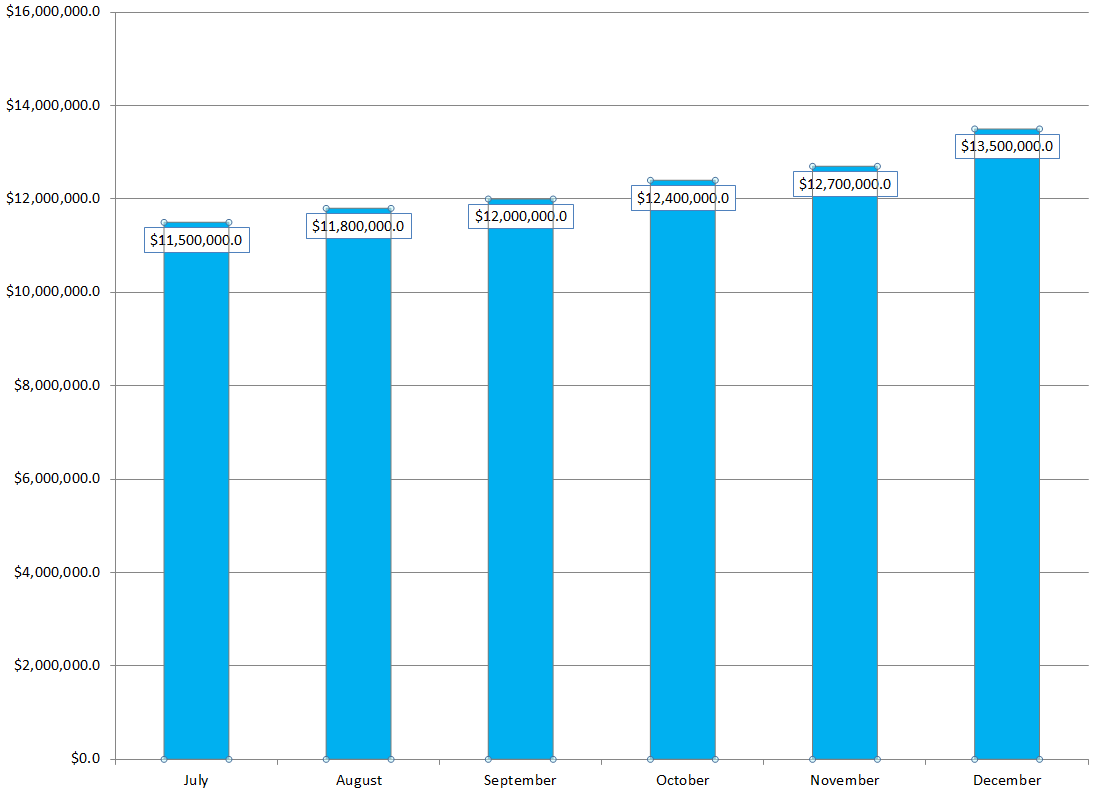
The KDP Select Global Fund was $13.5M for December, 2015. That’s a 6.3% increase.

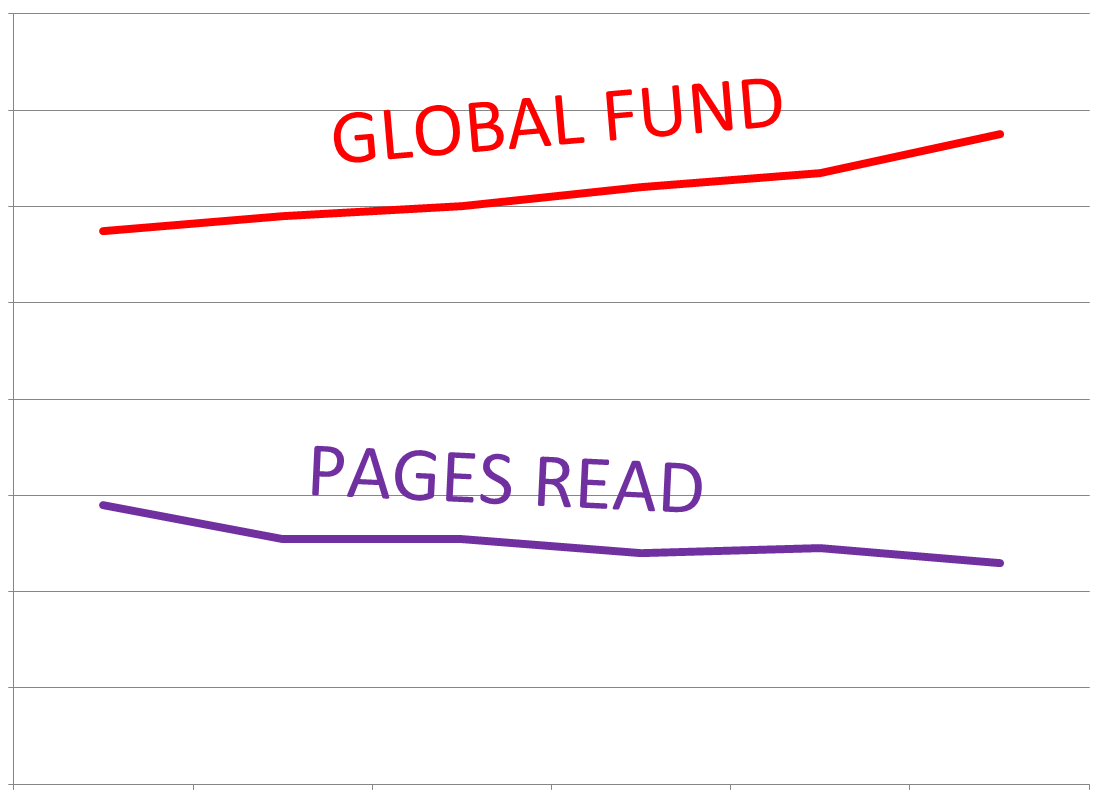
The KENP pages read continue to drop somewhat, while the KDP Select Global Fund continues to increase significantly.

This suggests that:

  • More readers are joining Kindle Unlimited and/or on average they are reading more pages.
  • More books are having more pages read each month, on average.
  • Kindle Unlimited is continually increasing its share of the total e-book market.
  • But while Kindle Unlimited readers and pages read are on the rise, they payment per page has been dropping.

The holiday season may have impacted both the payment for pages read and the KDP Global Select Fund.

According to a December 1 press release, Amazon had a record Black Friday weekend for the sale of Amazon devices, over 3 times the previous year. Amazon had several new devices out and really pushed them.

So perhaps Kindle Unlimited subscriptions and pages read were both pushed upward considerably during December, and if so, perhaps the payment for pages read will settle down a little in the near future.

Another important figure to keep in mind is that over 40,000 books are added to Kindle Unlimited each month. There are now approximately 1.2M books in Kindle Unlimited.

More books means greater selection, which may help to attract more customers. (Indeed, the Global Fund trends suggest this is happening.)

The competition probably helps more than it hurts, e.g. through customers-also-bought lists. When customers finish one Kindle Unlimited book that they enjoy, they tend to search for another like it.

KINDLE UNLIMITED BREAKDOWN BY COUNTRY

Here is a breakdown of how much Kindle Unlimited paid per page read in various countries:

  • United States: $0.00461 per page (US dollars). That’s a drop of 6.3% from November’s payment of $0.00492.
  • United Kingdom: £0.00306 per page (British pounds). That’s also a drop of 6.4% from November’s £0.00327.
  • Germany: €0.00389 per page (Euro). That’s a drop of 8.5% from November’s €0.00425.
  • France: €0.00429 per page (Euro). That’s a drop of 6.3% from November’s €0.00458.
  • India: ₹0.1008 per page (Indian rupees). That’s a drop of 6.2% from November’s ₹0.1075.

It pretty consistently dropped about 6.3%.

KINDLE UNLIMITED PAGES READ TRENDS JULY THRU DECEMBER, 2015

The following graph and table show the trends in Kindle Unlimited payments for KENP pages read from July, 2015 thru December, 2015.

KU Trends Jan 2016 PR

  • $0.0058 per page in July, 2015
  • $0.0051 per page in August, 2015
  • $0.0051 per page in September, 2015
  • $0.0048 per page in October, 2015
  • $0.0049 per page in November, 2015
  • $0.0046 per page in December, 2015

KDP GLOBAL SELECT FUND JULY THRU DECEMBER, 2015

The following graph and table show the trends in the KDP Select Global Fund from July, 2015 thru December, 2015.

KU Trends Jan 2016 GF

  • $11.5M in July, 2015
  • $11.8M in August, 2015
  • $12.0M in September, 2015
  • $12.4M in October, 2015
  • $12.7M in November, 2015
  • $13.5M in December, 2015

Write happy, be happy. 🙂

Chris McMullen

Copyright © 2016

Chris McMullen, Author of A Detailed Guide to Self-Publishing with Amazon and Other Online Booksellers

Click here to view my Goodreads author page.

  • Volume 1 on formatting and publishing
  • Volume 2 on marketability and marketing
  • 4-in-1 Boxed set includes both volumes and more
  • Kindle Formatting Magic (coming soon)

Follow me at WordPress, find my author page on Facebook, or connect with me through Twitter.

Comments

Click here to jump to the comments section.

Kindle Unlimited: Global Fund Stability and Marketplace Changes

Image from ShutterStock.

Image from ShutterStock.

KINDLE UNLIMITED UPDATE

Amazon announced that the KDP Select global fund for November, 2015 will be at least $12M.

It has consistently been $11M or more since May, 2015.

So this shows some nice stability.

Under the original Kindle Unlimited scheme, critics used to comment on how Amazon would low-ball the KDP Select global fund, promising around $3M at the beginning of the month, and then providing a much larger fund after the month’s end. Some tried to argue that Amazon was taking a loss because they raised the fund much higher than their initial projection.

When the new Kindle Unlimited unrolled this summer, critics revised their argument, saying that just because Amazon is offering $11M or more up front doesn’t mean they will continue to do this. Maybe it would drop down much lower later on, or maybe after a brief welcoming period, they would revert back to their old habits.

Yet from May thru November, the KDP Select global fund has held steady from $11M to $12M.

This stability is nice, and I haven’t heard such arguments from the critics recently.

Maybe the proponents for the new Kindle Unlimited who argued that the new system is more viable than the old system were right. Maybe it is more viable for Amazon financially, maybe it has added stability.

Whatever the reason, the global fund has held steady for 7 straight months.

The payment for pages read has dropped to just over $0.005 per page. There was a significant drop after the first month of the new Kindle Unlimited program, but that last two months held steady.

A new variable to the KDP Select global fund and to the KENP pages read is the added marketplaces offering Kindle Unlimited.

For example, Kindle Unlimited recently launched to India.

Whereas it costs $9.99 per month to subscribe to Kindle Unlimited in the US, the local India subscription price is the equivalent of $3.00.

This could significantly impact the payment for KENP pages read, and it probably will for October, 2015.

However, Amazon announced that they would revise their one-size-fits-all plan for pages read beginning in November, 2015.

The payments for pages read in each marketplace will take into account differences in local marketplaces. This should help to stabilize the payment per page.

However, there may be a drop for October, 2015 (we’ll find out on November 15), where this wasn’t yet factored into the payment for pages read.

The best news to me was this statement from Amazon KDP:

“Our long-term goal, as always, is to build a service that rewards authors for their valuable work, attracts readers around the world, and encourages them to read more and more often.”

Of course, it’s difficult to balance the rewards for authors with the other goals of attracting readers and getting them to read more.

But I believe this is a great long-term goal, and I do feel that in a number of ways Kindle Unlimited has helped with this goals.

Write happy, be happy. 🙂

Chris McMullen

Copyright © 2015

Chris McMullen, Author of A Detailed Guide to Self-Publishing with Amazon and Other Online Booksellers

Click here to view my Goodreads author page.

  • Volume 1 on formatting and publishing
  • Volume 2 on marketability and marketing
  • 4-in-1 Boxed set includes both volumes and more
  • Kindle Formatting Magic (coming soon)

Follow me at WordPress, find my author page on Facebook, or connect with me through Twitter.

Comments

Click here to jump to the comments section.

You Can Extend the Deadline for AMS ads via KDP

Image from ShutterStock.

Image from ShutterStock.

AMS AD DEADLINE

When you create an advertisement for KDP Select books via AMS, you must choose an end date.

The end date must be within the next 6 months.

But suppose you have a successful advertisement running, but when the deadline approaches, you don’t want to stop your AMS ad campaign.

Especially, if you spent several hours handpicking books to target, and your ad is doing well; you don’t want to have to do that research again, and you might not choose such a good list next time.

Fortunately, you can extend the deadline of your KDP ad.

Extend the deadline before the ad runs its course.

When the deadline is near, simply view your AMS ad report.

Click the Edit button next to your ad.

Revise the end date. It will let you choose a date up to six months from today.

Click save.

Return to your ad report, just to check that the end date has properly updated.

When the new deadline comes up, you can repeat the process, if you want.

A FEW TIPS

The real trick is getting the AMS ad to work well enough that you actually want to extend the deadline when the time comes.

So here are a few tips:

  • Don’t overbid. Most authors can’t afford to spend 50 cents or more per click. Start out very low. Wait three days (or more) because ad report data can be significantly delayed (if it seems like nothing’s happening, wait 3 days to find out if indeed nothing is happening, or if you’ve already spent a lot of money that just hasn’t posted to your report yet because of delays). If nothing happens after a few days, raise your bid just a little. Then wait a few more days. This strategy gets you affordable clicks. It won’t drive a ton of daily traffic to your book, but it will help you generate some interest without overspending. Time is on your side. Take what you can afford to get, even if it comes very slowly. Too many authors bid much higher than they should, blowing their budgets before they realize it with little to show for it. I have several ads that perform well, with very low bids, even though it may take weeks for them to deliver significant results. Personally, I prefer to be patient and get a good return on my investment.
  • Test it out. I ran a few dozen tests in the first couple of months before I learned the most effective ways to make these ads work for my books. You’re not obligated to spend the entire $100 budget. You can pause or terminate your ad at any time. (But if you bid high, you can blow your budget without realizing it because there can be significant delays.) So you can try an ad over a short period, then cancel it and start a new ad. Maybe you try changing your targeting list, or maybe you try a different catch phrase. Some trial and error can help you learn more effective ways to use this advertising tool.
  • Close the deal. If your sales to clicks ratio is 3% or less, this suggests that you could improve (A) your targeting or (B) your product page. Is your product page closing the deal as well as it could? Does the cover properly suggest what to expect? Does it achieve this goal in the tiny ad thumbnail, too? Does the book description arouse interest and curiosity without giving away too much? Does the Look Inside grab the reader right away? Does everything look professional? The great thing about AMS is that you can test out the performance of your product page. You can get two weeks of data, then revise your book description, get another two weeks of data, and compare. Did changing the product page actually make a difference, for better or for worse? Your AMS ad report can be a tool to help you perfect your product page. A closing rate of around 5% is reasonable achieve; a closing rate of 10% or more is rare, but it can be done. A closing rate of 1% or less isn’t good, but it happens.

Write happy, be happy. 🙂

Chris McMullen

Copyright © 2015

Chris McMullen, Author of A Detailed Guide to Self-Publishing with Amazon and Other Online Booksellers

Click here to view my Goodreads author page.

  • Volume 1 on formatting and publishing
  • Volume 2 on marketability and marketing
  • 4-in-1 Boxed set includes both volumes and more
  • Kindle Formatting Magic (coming soon)

Follow me at WordPress, find my author page on Facebook, or connect with me through Twitter.

Comments

Click here to jump to the comments section.

KDP’s AMS Advertising now offers Subcategories… Finally

Image from ShutterStock.

Image from ShutterStock.

ADVERTISING IMPROVEMENT WITH AMS AT KDP

Kindle books enrolled in KDP Select can be advertised on Amazon via AMS through KDP.

There have always been two targeting choices:

  • product targeting. Select specific products to target.
  • interest targeting. Select a category to target.

Until now, the category choices for interest targeting were very broad.

But now, after you select a category, you can select a subcategory.

Some of the subcategories are still themselves quite broad.

  • For example, for a math or science book, I must choose the category called Other.
  • Then the appropriate subcategory is Math and Science. But that includes very many different subjects.
  • It would be better if the subcategories were further divided. For example, I might choose astronomy, if available.

However, it is an improvement. Interest targeting is better now. It’s a nice step in the right direction.

If you want more precise targeting, the obvious solution is to choose product targeting instead.

KINDLE ADVERTISING TIPS

  • I used to recommend product targeting. I still favor that, but I just tested out the refined interest targeting so that I can compare. It has some merit.
  • Set the end date as far in advance as possible. It lets you go about six months ahead.
  • Choose to display your ad as quickly as possible. Generally, it’s not easy to make impressions unless you overbid. This option helps if you bid reasonably.
  • Make a catchy headline that’s likely to help create interest in your book, and which is quite relevant for your content.
  • Bid low to begin with. It’s okay to underbid.
  • Wait 3 days before raising your bid. Sometimes reporting is significantly delayed. See how it’s going before you ‘fix’ it.
  • Try expanding your targeting before raising your bid to see if that helps make more impressions.
  • If you do raise your bid, just raise it a little. And wait 3 more days before raising it again.
  • You’re not obligated to invest the whole $100. You can pause or terminate your ad at any time.

With my strategy, I have several affordable bids. Sometimes, I’m able to generate 100,000 to 400,000 impressions in one month with less than $10 spent. I have multiple ads where I spent about $12 to generate $24 in sales (at 70% royalty).

I observe some nice indirect effects on similar books and on my print books. (I tend to sell more print books to begin with, so that makes sense for my books.)

Write happy, be happy. 🙂

Chris McMullen

Copyright © 2015

Chris McMullen, Author of A Detailed Guide to Self-Publishing with Amazon and Other Online Booksellers

  • Volume 1 on formatting and publishing
  • Volume 2 on marketability and marketing
  • 4-in-1 Boxed set includes both volumes and more
  • Kindle Formatting Magic (coming soon)

Follow me at WordPress, find my author page on Facebook, or connect with me through Twitter.

Comments

Click here to jump to the comments section.

Lending & Borrowing mean different things at Amazon

Image from ShutterStock.

Image from ShutterStock.

LENDING ≠ BORROWING

Amazon has two completely unrelated Kindle programs which use similar words.

  • borrowing: readers can borrow Kindle e-books through Amazon Prime or Kindle Unlimited.
  • lending: the Kindle Book Lending program allows customers to lend one book to someone else for up to 14 days.

These two programs have absolutely nothing to do with one another.

To make matters potentially more confusing, Amazon uses the word lending in KOLL: Kindle Owners’ Lending Library. In this abbreviation, ‘lending’ does actually refer to Kindle Unlimited and Amazon Prime. But in Kindle Book Lending, the word ‘lending’ means something entirely different.

Both options—borrowing as it relates to Kindle Unlimited and lending as it relates to Kindle Book Lending—appear in different places when you publish an e-book with KDP (Kindle Direct Publishing).

  • The top of the first page of the publishing process has the option to enroll in KDP Select. This includes your book in Kindle Unlimited and Amazon Prime (which are two separate programs).
  • The bottom of the second page of the publishing process has the option to participate in Kindle Book Lending. This has nothing to do with Kindle Unlimited (or Amazon Prime).

KINDLE BOOK LENDING

This allows a customer to lend the Kindle e-book to one friend or family member for up to 14 days:

  • Each customer can only lend the e-book one time only.
  • The original customer can’t read the book until it’s returned.
  • It can only be loaned for up to 14 days.

Authors have no control over this if they choose the 70% royalty option.

If authors choose the 35% royalty option, then can choose to opt out of Kindle Book Lending.

Since each customer can only loan the e-book to a single person, any possible loss through lending is severely limited.

The Kindle Book Lending option doesn’t affect Kindle Unlimited or Amazon Prime in any way.

KINDLE UNLIMITED

Customers can subscribe to Kindle Unlimited for $9.99 per month in the US (the fee is different in the UK).

A monthly subscription to Kindle Unlimited entitles customers to borrow as many Kindle Unlimited e-books as they would like.

Not all e-books participate in Kindle Unlimited. All KDP Select books are included in Kindle Unlimited, plus about 100,000 traditionally published books.

Approximately 1,000,000 of over 3,000,000 Kindle e-books are included in Kindle Unlimited.

Customers can borrow up to 10 books at a time. After that, the customer must return one of the 10 books before borrowing another.

Kindle Unlimited is unrelated to Amazon Prime.

(While Kindle Unlimited now pays authors by the page, customers are not charged by the page. Customers pay $9.99 per month and can then read as many pages of Kindle Unlimited e-books as they would like with no additional charge.)

AMAZON PRIME

Customers pay an annual fee to join Amazon Prime.

Amazon Prime offers many benefits, such as free two-day shipping of many eligible products, instant streaming of Amazon Prime videos, and borrowing up to one Kindle e-book per month.

There are about 100,000 Kindle e-books which are available to Kindle Unlimited customers, which are not available for Amazon Prime customers.

Unlike Kindle Unlimited, Amazon Prime customers can only borrow one Kindle e-book per month.

Customers must browse for Amazon Prime e-books using a Kindle device registered to the Prime account. (Before Kindle Unlimited, Amazon Prime customers could shop for Kindle e-books from their pc, mac, or laptop, but now they must shop for Amazon Prime books using a registered Kindle device.)

(In contrast, you don’t need to own a Kindle device to use Kindle Unlimited.)

Write happy, be happy. 🙂

Chris McMullen

Copyright © 2015

Chris McMullen, Author of A Detailed Guide to Self-Publishing with Amazon and Other Online Booksellers

  • Volume 1 on formatting and publishing
  • Volume 2 on marketability and marketing
  • 4-in-1 Boxed set includes both volumes and more

  • Kindle Formatting Magic (coming soon)

Follow me at WordPress, find my author page on Facebook, or connect with me through Twitter.

Comments

Click here to jump to the comments section:

https://chrismcmullen.wordpress.com/2015/06/26/lending-borrowing-mean-different-things-at-amazon/#comments

* Kindle Unlimited is on FIRE *

Images from ShutterStock.

Images from ShutterStock.

KINDLE UNLIMITED IMPROVEMENTS

Kindle Unlimited has me excited:

  • Amazon is implementing major improvements (depending on your perspective) to how the program works for authors.
  • The KDP Select Global Fund continues to grow. The current amount and Amazon’s projections for the next two months are looking nice.
  • Amazon released some favorable news about how Kindle Unlimited is doing so far in 2015.

CHANGES TO HOW KINDLE UNLIMITED PAYS AUTHORS

Amazon is changing how authors are paid for Kindle Unlimited borrows.

The new policy goes into effect July 1, 2015. June, which is already underway, won’t be affected by these changes.

How is Kindle Unlimited policy changing?

  • Authors will now be paid based on the total number of pages read through Kindle Unlimited (evidently, Amazon Prime, too).
  • Authors will not be paid based on the total number of borrows.
  • The magic 10% mark will become irrelevant.
  • Beginning July 1, every book will have a Kindle Edition Normalized Page Count (KENPC), which may differ from the estimated page count that you see on your Amazon product page.
  • The KENPC will be used to count how many pages a Kindle Unlimited customer reads. It will count from the start reading location when the customer opens the book.
  • The KDP Select Global Fund for the month will be divided by the total number pages read through the Kindle Unlimited program.
  • Every book enrolled in Kindle Unlimited will be paid based on this ratio.
  • You can see an example here, worked out by Amazon. (The numbers are probably not quite realistic.)
  • All-Star books and KDP Select authors will be awarded based on the total number of pages read through Kindle Unlimited.

Of course, this has no bearing on ordinary sales, only books borrows through Kindle Unlimited and Amazon Prime.

What does this mean?

  • If one customer reads a 10-page short story and another customer reads a 500-page novel completely, they no longer pay equal royalties through Kindle Unlimited. In my example, the 500-page novel will receive 50 times as much royalty as the 10-page story.
  • If a customer only reads 5 pages of your book, you get paid based on 5 pages, not based on the total length of your book.
  • You no longer have to worry about customers reaching the magic 10% mark. Well, you do have to worry about how many pages they read.
  • List price doesn’t factor into it. It doesn’t matter whether your list price is 99 cents or $9.99; it only matters how much the customer reads when borrowing through Kindle Unlimited.
  • Short books no longer have an advantage by getting customers to reach the 10% mark sooner (since the 10% mark no longer matters).
  • Authors of short books are likely to see a huge drop in their Kindle Unlimited royalties.
  • Authors of very long books for which customers tend to read most of the book are likely to see a huge improvement in their Kindle Unlimited royalties.
  • A page is a page is a page. Quality only factors into it insofar as it entices the customer to keep reading more pages. All pages (as determined through KENPC) pay the same in Kindle Unlimited.

THE KDP SELECT GLOBAL FUND

KOLL borrows paid $1.35 for May, 2015, which is right on target for how KOLL has paid in 2015.

However, moving forward, this really doesn’t matter. Starting in July 2015, KOLL will pay by the number of pages read through Kindle Unlimited, and so the payout will change dramatically.

But there is good news!

  • While the KOLL borrow didn’t change much, the KDP Select Global Fund continues to grow.
  • Amazon added a whopping $7.8 million to the $3 KDP Select Global Fund, bringing the payout to $10.8 million for May, 2015.
  • Amazon projects a KDP Select Global Fund in excess of $11 million for both July and August (when the new program terms take effect).
  • That huge $11,000,000 payout for July and August will be divided up based on page count, not the number of books borrowed.

MORE GOOD NEWS ABOUT KINDLE UNLIMITED

And that’s not all!

  • Guess how much KDP Select authors are making just from their Kindle Unlimited borrows for the first half of 2015? $60,000,000! That’s huge. KDP Select is a very significant share of the e-book market. (If you read any reports of how e-book sales are down, look closely to see if they are ignoring Kindle Unlimited. They shouldn’t be, but some companies like to do just that.)
  • Total royalties of KDP Select authors are approximately double compared to last year. Kindle Unlimited continues to grow.
  • Each month, at least 95% of the KDP Select books enrolled in Kindle Unlimited renew their enrollment. (I can confirm this independently, as I’ve checked on it myself.)

Kindle Unlimited isn’t for every book, and it requires giving up exclusivity, but it’s looking better and better. All of my books are enrolled in Kindle Unlimited. I’m a Kindle Unlimited subscriber myself and read several full-length novels per month.

Write happy, be happy. 🙂

Chris McMullen

Copyright © 2015

Chris McMullen, Author of A Detailed Guide to Self-Publishing with Amazon and Other Online Booksellers

  • Volume 1 on formatting and publishing
  • Volume 2 on marketability and marketing
  • 4-in-1 Boxed set includes both volumes and more
  • Kindle Formatting Magic (coming soon)

Follow me at WordPress, find my author page on Facebook, or connect with me through Twitter.

Notifying Kindle Customers of Updates (Has Changed)

Image from ShutterStock

Image from ShutterStock

NOTIFYING KINDLE CUSTOMERS OF UPDATES

It happens. After you publish a book, you think of a way to improve it. Or you find a typo. Or you view it on a friend’s device and discover a formatting problem. Or a customer notifies you of an issue. Or a customer suggests something in a review that never occurred to you. Or the content of a nonfiction book becomes out-of-date.

For some reason or another, you need to update your Kindle e-book.

That’s the easy part: Simply visit your bookshelf at KDP (Kindle Direct Publishing), upload a new content file, preview your book carefully on each device, and publish the revision.

Your old book remains available for sale until the new one goes live, usually within 12 to 24 hours in the US. (If you don’t want the original to remain available in the interim period, simply unpublish the book from your KDP bookshelf.)

Naturally, you want all of your customers to receive your updated edition. You’d also like to notify your customers that a new edition is available.

That’s the hard part.

It’s never been ‘easy,’ but KDP’s policy on notifying Kindle customers of updates has actually changed.

Their policy is clearly customer-oriented, and that’s a good thing.

But it’s not customer-oriented in a way that’s intuitive to most authors. Authors are focused on how their Kindle e-book has improved, and so they tend to focus on how customers would appreciate having the new Kindle edition (or at least knowing that the new edition is available).

However, in many cases, that would actually be less customer-oriented.

Why? Because there is something else to consider.

Many readers:

  • highlight passages in their Kindle e-books
  • place bookmarks in their Kindle e-books
  • record notes in their Kindle e-books

Imagine customers who have spent hours not only reading your e-book, but highlighting, bookmarking, and taking notes in your e-book.

Those customers may become quite frustrated to lose all that hard work simply because your new edition overrides their original.

Therefore, Amazon must weigh the significance of your update and how customers might benefit from that against the possible loss of highlights, bookmarks, and notes.

The result is that KDP now only sends out automatic updates to Kindle customers when the update corrects serious readability issues, such as:

  • overlapping text
  • cutoff images

If the update does not correct a severe readability issue, KDP won’t issue an automatic update for your e-book.

(It’s true that customers can turn updates on or off, but not all customers take the time to do it or know how.)

KDP will ask you to describe the errors, and may ask you to provide the location numbers of the errors (you can read your book on a Kindle device or in the Kindle previewer to find the location numbers).

KDP will examine the errors to determine whether or not they hamper readability severely enough to warrant an update:

  • For destructive or critical errors (as deemed by KDP) replaced by major corrections, KDP will email current customers to let them know that an update exists and provide directions for how to obtain the updated Kindle e-book.
  • For distracting errors (as determined by KDP) replaced by minor corrections, current customers won’t be notified and updates will only be made available to customers who don’t yet own the book.
  • If KDP discovers critical errors that still need to be replaced, they will remove your book from sale until you correct those issues.

Of course, the best thing is to avoid needing an update, but it’s not always possible. Especially, in nonfiction, you can’t always future proof your book because information, technology, and trends are often dynamic.

For books where KDP chooses not to notify customers of updates, the next best thing is to let your following know on your blog, through social media, or via an email newsletter.

In addition to including information about how to follow you in an about the author section of your book, provide a compelling reason for readers to do this (e.g. a free relevant PDF file of something your audience is likely to want, or to learn about possible short-term promotional savings on your future books).

But you also have to balance publicly announcing that you made a mistake versus helping your current readers receive your updates (by contacting KDP to request that the updated edition be sent to their device, or perhaps you could send a copy of your book). If you have an email newsletter where the contact list consists predominantly of people who have purchased your book, then there is less concern about publicizing your mistakes; but if you post on your blog or social media about a mistake, then your mistake receives much exposure (and if you feed your blog or tweets into your Author Central page, current shoppers may see it).

Write happy, be happy. 🙂

Chris McMullen

Copyright © 2015

Chris McMullen, Author of A Detailed Guide to Self-Publishing with Amazon and Other Online Booksellers

  • Volume 1 on formatting and publishing
  • Volume 2 on marketability and marketing
  • 4-in-1 Boxed set includes both volumes and more
  • Kindle Formatting Magic (coming soon)

Follow me at WordPress, find my author page on Facebook, or connect with me through Twitter.

Comments

Click here to jump to the comments section:

https://chrismcmullen.wordpress.com/2015/05/23/notifying-kindle-customers-of-updates-has-changed/#comments

Advertising on Amazon with AMS via KDP: Research, Experience, & Tips

Advertising Research

Images from ShutterStock


ADVERTISING BOOKS WITH AMS

KDP now lets indie authors advertise their KDP Select books directly on Amazon.com through AMS (Amazon Marketing Services).

I’ve now placed 36 different ads through AMS on over a dozen books in multiple author names, with different targeting and bids from 2 cents to $1.01 per click. So I have quite a bit of firsthand experience with this. Although I publish nonfiction, I’ve also discussed AMS with several fiction authors who have used it—including some who love it, some who hate it, and more with mixed feelings. Many of these authors have shared their AMS numbers.

EASY MONEY, HUH?

Well, not ‘easy.’

Marketing books is never easy. But advertising books on Amazon through AMS, like other marketing tools, has potential; the trick is learning how to use the tool effectively, and whether or not this tool is a good fit for you and your books.

BENEFITS OF ADVERTISING WITH AMS

  • Prime real estate. Your ad shows directly on Amazon product pages, where customers are already shopping for books. You’re not trying to make people leave one site to visit another.
  • Optional product targeting. You can hand-pick specific books (and even movies and other products, if applicable) to target. This allows you to tailor your targeting to your unique book.
  • Budget-friendly. Although you must set an advertising budget of at least $100, you’re not committed to spend one penny. You can pause or terminate your AMS ad campaign at any time. (However, the ad report does not show in real-time, so when you pause your campaign, the expenses may be higher than you realize. If you bid low, this won’t be an issue, but if you bid very high, you can be out of budget before you realize it.)
  • Free impressions. You only pay for clicks. If 2,000 people see your ad, but nobody clicks on the ad, you don’t pay a penny.
  • Product page data. The AMS ad report shows impressions, clicks, detail page views, and sales generated through the ads. This lets you see what percentage of traffic to your product page actually buys your book. Even in the worst case that your ad is an utter failure, learning your sales-to-clicks ratio can help you assess the effectiveness (or lack thereof) of your book’s product page at selling your book to your target audience.
  • Improving. AMS at KDP is improving. For example, you can now enter a phrase designed to catch interest and at least one of the possible ad locations shows this as an orange headline directly above your ad.

CHALLENGES YOU MUST OVERCOME

  • Competition. Many other authors bid high (often, much higher than they should), which can make it challenging to get impressions with an affordable bid, especially in competitive genres. However, there are ways to deal with this (like wise targeting).
  • Tiny thumbnail. The ads show a tiny image of your cover thumbnail. The ads come in a few different sizes, but many book covers are difficult to make out in the ads. (Obviously, if you design a cover that stands out well and is easy to read at this tiny size—possible, as I’ve seen it done—you have a distinct advantage.) So although impressions are free (you only pay for clicks), possible branding benefits from those impressions are somewhat limited.
  • Click-throughs. The CTR (click-through rate) can vary considerably from one book to another, but often it’s in the ballpark of 0.1%. That is, for every 1000 times your ad displays, 1 person will click on your ad. This isn’t really a downside though, since you only pay for clicks; impressions where the customer ignored your ad don’t cost you a penny.
  • Closing rate. The closing rate and your average CPC show whether or not your ad is a success or failure. The closing rate is your sales-to-click ratio. The books with the most marketable product pages and wise targeting can achieve a closing rate of 10% or better, but some books achieve a much lower closing rate.
  • Not real time. The ads do not show in real time; there are often delays of several hours (or more). So you must be patient and wise. Too many authors conclude prematurely that nothing is happening, so what do they do? They raise their bids to make something happen. That’s a great way to lose money fast.
  • Targeting. Take time to target wisely. This is one thing you have much control over, but you have to take the time to do the research. And when things don’t seem to be working, this is one area you can try to improve. The more frequently your ad shows to customers who are likely to be interested in your book, the better your chances of achieving a better closing rate.
  • Stoppage. Your AMS can actually be stopped due to low relevance by Amazon. Low relevance is either a sign of poor targeting, or a product page that has room for improvement (cover, blurb, Look Inside, even the book idea comes into play here). Your ad is likely to be stopped due to low relevance if your CTR is well under 0.1%. If only 1 out of 3000 people who see your ad click on it, there is a good chance that your ad will be stopped. If your ad is stopped, you can create a new ad, but be sure to strive for more relevant targeting.

RESEARCH & EXPERIENCE WITH AMS

I placed my first ad through AMS on January 29, 2015, shortly after the program was launched at KDP. I have now placed 36 different ads through AMS on several different books under a few different author names.

In February and early March, I had bid too high (upwards of $1 per click). But my primary goal was to get valuable data, even if that meant cutting into my ROI.

Most of my early ads were making many impressions (as many as 461,673 impressions). I received as many as 661 clicks (on an ad with 108,689 impressions). Most of my CTR’s (click-through rates) were in the neighborhood of 0.1% (1 in 1000), though I had a few above 0.5%, but also a few below 0.05%. But the CTR really doesn’t matter, since you only pay for clicks. (Well, it does matter now: If your CTR is well below 0.1%, there is a good chance that your ad will be stopped for low relevance.) From my numbers and stats that other authors have shared, 0.05% (1 in 2000) to 0.5% (1 in 200) is typical; if your CTR is below this, you can probably improve it through targeting (well, your cover matters, too).

I had a few ads with a closing rate (sales to clicks) of 10% or more, but most of my ads had closing rates below 10%. I had some closing rates of just a few percent. This stat is very important, as it determines how much you can afford to bid and whether or not your short-term ROI (return on investment) is worthwhile. With a variety of books, success rates, and targeting strategies, I’ve learned some ways to help improve my closing rates (reflected in my more recent ads). I’ve met a few other authors who achieved closing rates above 10%, but many more authors with closing rates closer to 5% or less.

I’ve placed 12 new ads since April 19, 2015, with wiser bids and targeting, based on my prior experience. The new ads are much more successful in terms of short-term ROI. I now have more ads where the short-term royalties exceed the amount spent on the ad. I also have some slower-running ads that are getting very cheap exposure. For example, I have one ad that’s been running for 31 days, which has cost me a total of $2.16, but has generated 177,537 impressions, 73 clicks, and already returned over $4 in royalties. That’s not much in terms of sales for a whole month of advertising, but look, that’s not bad for having invested a whole two dollars. I have some ads generating activity with as little as 2-cent bids. A low bid may not make many impressions (though occasionally it does), but it’s also more likely to earn a short-term return rather than a loss (and if it earns a loss, imagine how much you would have lost bidding high).

Another thing that I’ve seen are indirect benefits. Many other authors have seen similar indirect benefits. Several authors have seen an increase in borrows. A couple authors reported an increase in borrows, then a decrease in both sales and borrows when the ad stopped, and a return when a new ad was run. A few series authors have reported improvement in other books in the series. But not all authors have seen such improvements; indirect benefits are not guaranteed.

I sell about 9 paperbacks for every Kindle e-book, overall (I have a few books where it’s the other way around). When I ran my ads in February and early March, I saw a substantial increase in related paperback books. I toned down my advertising significantly in late March and early April (I had been bidding upwards of $1 per click; I stopped some of my ads, and lowered my bids in others). My paperback sales declined. Around April 19, I placed several new ads (remember, the ads are for Kindle e-books), but with lower bids, and I’ve seen sales of paperback books improve again.

I’ve tried a variety of targeting strategies. I only used category targeting for a couple of ads, and didn’t generate many impressions that way. The problem is that every other book with the same targeting category is competing for the exact same list of books. Product targeting seems to give you an edge, even when all of the books on your list seem to fit into the same broad category. But product targeting also lets you select specific books outside your genre or category, and even other kinds of products, like movies. I’ve tried compiling narrow lists of 50 books, long lists with 1000 books, books of very popular and very similar products, movies and other products likely to interest my target audience, and lists of books that aren’t too popular and which are more likely to appeal to an indie audience. There are a lot of possibilities when it comes to targeting.

If you select fewer than 50 products, it will be tough to make impressions (unless you pick some hugely popular products, even then, you have to outbid others). If you target movies or other products likely to interest your target audience, but they only interest a small fraction of your audience, this can greatly diminish your CTR, putting you in danger of low relevance (so your ad may be stopped), especially if those movies or other products are hot items. You really have to judge your target audience well to make the most of your targeting (you can go back and change product targeting; but if you select category targeting, the only way to change it is to pause your ad and start a new one). If you target books where the readers are more likely to actually purchase your book once they reach your product page, this can help your conversion rate. It pays to spend extra time contemplating the probable habits and interests of much of your target audience (and it may take some trial and error).

But you probably don’t care so much about my experience, as what I’ve learned from it. So let me move onto tips and suggestions, based on my experience with AMS.

TIPS & SUGGESTIONS FOR USING AMS

  • Create a short catch-phrase likely to interest your target audience (and sound relevant to the subgenre, subcategory or content) to use for your headline. Don’t simply copy your title into the headline. This shows above your ad (when the headline displays).
  • Click the option to display your ad as quickly as possible (don’t let Amazon spread it out evenly). Unless you’re overbidding, it’s hard to make impressions, so get as many as you can.
  • Change the month of the end date. Set the end date as far into the future as the system will let you (several months). You can end it anytime manually.
  • Choose product targeting instead of interest targeting. Check the box to include similar products.
  • Devote some time to research books (and perhaps other products, like movies) to target. Think about whether the majority of the target audience for those books (or products) is likely to be interested in your book. Browse for similar books and products on Amazon before you start working on your ad campaign so that you have ideas ready. Select a minimum of 50 books, perhaps several hundred is better, but it really depends on your book and audience.
  • Some of the books you target need to be popular enough for your ad to show enough times to make impressions. Some need to be not too popular, otherwise you’ll be consistently outbid (or you’ll be overpaying). Select several less popular books too, as there may be less competition for those ads.
  • Enter specific keywords, even key-phrases, highly relevant to your book, in order to help find more books like yours. Try a variety of keywords and phrases, but remember that relevance is key.
  • Relevance matters when targeting, not only to get the most out of your ad (you want it to sell once you get traffic), but also to prevent your ad from being stopped.
  • Bid low to begin with. You can always raise your bid later. If you do, only raise it a little at a time.
  • Don’t raisee your bid more than once in a 48-hour period (better yet, wait at least 1 week). Stats don’t show in real time, but can actually be delayed by several hours (even more than a day). Don’t let your impatience squander your money.
  • Be patient. What’s the hurry? Why pay $1 to spend your money fast, possibly with little to show for it? Let your ad run for weeks, or even months, if necessary. The most common way to lose money with AMS is to bid too high too fast.
  • Remember that there are many other authors, and their bids and targeting change over time. So if you aren’t getting many impressions now, a few weeks from now when other ads run out, you might get more. Sometimes, simply waiting out higher bidders can help you generate impressions at a lower cost.
  • Remember that you can go back and change product targeting. Try to find wiser ways to target effectively before yielding to the temptation to raise your bid.
  • Keep an eye on your ad report. You can lose a lot of money fast if you’re not careful. Out of the blue, an ad that had been going slow can start getting several clicks. If you’re spending tens of dollars, but not generating sales, stop your ad before you lose more money. Try to improve your ad before running it again.
  • Look at your short-term ROI (return on investment). Compare your royalties (the report shows sales instead; you have to figure this out) to the money spent so far. If you’re losing money (more than you wish to risk), pause the ad. You can try changing your targeting. Try bidding less. Something isn’t working, so either stop the ad or try to improve it. (Or if it’s only a small loss, maybe indirect or long-term benefits will offset this; that’s a tough decision that you have to make.)
  • If your closing rate (# of sales divided by # of clicks) times your royalty exceeds your average CPC, your ad is making money; if not, your ad is losing money short-term. Example: 100 clicks, 8 sales, royalty $2.10, average CPC is 15 cents. Divide 8 sales by 100 clicks to get 0.08. Multiply 0.08 by $2.10 to get $0.168. This exceeds the average CPC of $0.15, so this ad is yielding a short-term ROI (so any indirect or long-term benefits will be gravy).
  • Bidding much less can improve your short-term ROI. If you’re losing significant money short-term, first try lowering your bid significantly. Your impressions, clicks, and sales rates may go down, too, but your short-term ROI is likely to be better. It’s better to make a small profit at a slow rate, than to lose money at a fast rate. Only bid what you can afford to bid.
  • The alternative to lowering your bid is improved targeting (or improving your product page and Look Inside). In some cases, it may take a combination of a lower bid and improved targeting. And we know that not every book can be saved, so the same is true with ads. Sometimes, it’s just not in the cards.
  • If your CTR (clicks divided by impressions) is less than 0.05% (1 in 2000), your ad is in greater danger of being stopped due to low relevance. Try changing your product targeting. (If it does get stopped, you can start a new ad, but again you’ll want to try to improve your product targeting.)
  • If you plan on using this in the future, when designing your next cover, strive for a layout and color scheme that will catch attention even at this tiny ad thumbnail size (and still look good as a regular thumbnail and also full-size).
  • You’re not obligated to spend your whole ad campaign budget. You can pause or terminate your ad at any time.
  • Imagine you’re at a casino. If you’re having bad luck, get out fast! Walking away when you’ve lost $15 is a lot better than losing $100.
  • Don’t place ads for multiple books simultaneously, unless you can do so with significantly different targeting.
  • If you have multiple books or plan to run multiple ads, change the name of your ad campaign to help you remember which book the ad is for. The default names aren’t helpful at all.
  • Create an ad with limited, focused targeting. After getting appreciable data, stop the ad. Start a new ad with different, but still limited, focused targeting. Compare your results. You can learn a lot with brief controlled experiments like this.

Write happy, be happy. 🙂

Chris McMullen

Copyright © 2015

Chris McMullen, Author of A Detailed Guide to Self-Publishing with Amazon and Other Online Booksellers

  • Volume 1 on formatting and publishing
  • Volume 2 on marketability and marketing
  • 4-in-1 Boxed set includes both volumes and more
  • Kindle Formatting Magic (coming soon)

Follow me at WordPress, find my author page on Facebook, or connect with me through Twitter.

Comments

Click here to jump to the comments section:

https://chrismcmullen.wordpress.com/2015/05/20/advertising-on-amazon-with-ams-via-kdp-research-experience/#comments

Advertising on Amazon w/ AMS via KDP—Is it Worth it?

Images from Shutterstock

Images from Shutterstock

MY EXPERIENCE WITH ADVERTISING ON AMAZON

The new option for KDP Select authors to advertise their Kindle e-books with Amazon Marketing Services (AMS) is intriguing.

I have now run 14 different ads through AMS. I’ve also studied the results that several other authors have posted.

Today, I’m sharing some of my preliminary results and offering my thoughts on this critical question:

IS IT WORTH IT?

I’ll also mention a couple of alternative uses of this tool.

CONTENTS

  1. Initial Return on Investment
  2. Estimating Short-term ROI
  3. Your Safe CPC Bid
  4. Advertising Results
  5. Possible Side Benefits
  6. Long-term ROI
  7. Countdown Deals and Freebies
  8. Creative Uses of Book Advertisements

1. INITIAL RETURN ON INVESTMENT

The short-term return on investment (ROI) depends on these factors:

  • your average cost-per-click (CPC) bid
  • the royalty you earn for each sale
  • your sales-per-click (SPC) conversion rate
  • possible side benefits, like selling similar books, like selling print copies, or like getting more Kindle Unlimited downloads

You already know your royalty when you place your ad.

You can cap your average CPC by setting a modest bid.

But you won’t know your SPC conversion rate until you’ve invested money in an ad.

From running 14 different ads, I see firsthand that it’s reasonable to attain an SPC conversion rate of 4 to 10%.

A few other authors, including one who shared a screenshot, have shown that it’s possible to achieve an SPC of 10 to 20%. My feeling is that 20% will be quite rare.

On the other side, I’ve seen data for SPC’s of 1% or less.

Your SPC conversion rate depends on:

  • how well your product page (cover, blurb, Look Inside, reviews) sells your book
  • how well you target your advertisement to your specific audience
  • how well what your ad conveys (visually in the tiny thumbnail, along with the first words of the title) matches what shoppers discover on your product page
  • whether or not there is an audience for your book

The third point can have a huge impact. If customers glance at your tiny thumbnail and expect one thing, but find something different on your product page, this will kill your SPC.

The second point you can control through a wise choice of product targeting (not necessarily books). What matters most for your SPC is how well the target audiences of the selected products fit your book. But you must weigh this with how frequently you wish to make impressions: If the targeting is too precise, your ad might struggle to get impressions.

2. ESTIMATING SHORT-TERM ROI

There is a formula to calculate your short-term ROI:

(s.t ROI %) = (royalty) x (SPC %) / (ave. CPC)

EXAMPLE 1: Your book earns a royalty of $4.20. Your average CPC bid is 25 cents. Your SPC is 5%.

Your short-term ROI = $4.20 x 5% / $0.25 = 84%.

This example has a high royalty, a modest bid, and a decent SPC.

EXAMPLE 2: Your book earns a royalty of $2.10. Your average CPC bid is 25 cents. Your SPC is 5%.

Your short-term ROI = $2.10 x 5% / $0.25 = 42%.

If you earn a lower royalty, you either need to have a high SPC or bid lower to make up for it.

EXAMPLE 3: Your book earns a royalty of 34 cents. Your average CPC bid is 10 cents. Your SPC is 10%.

Your short-term ROI = $0.34 x 10% / $0.10 = 34%.

Here we have an excellent SPC and a lower bid, but that 34-cent royalty is the killer.

The lower your royalty or the lower your SPC, the lower you should bid.

3. YOUR SAFE CPC BID

Let’s spin this formula around and look at it from another angle:

(safe CPC bid) = (royalty) x (SPC %) / 100%

This tells you the maximum CPC bid you should place if you want your short-term ROI to break even. You need to have some prior experience to properly estimate your SPC %.

EXAMPLE 4: Your book earns a royalty of $2.10. Your SPC is 5%.

Your safe CPC bid = $2.10 x 5% / 100% = $0.105

In this example, a bid of 10 cents is safe (provided that your SPC turns out to be what you expect).

Not getting enough impressions? So what. With a safe CPC, you’re not losing anything (again, assuming your SPC is reliable; that’s a big IF, but you can monitor your ad and pause or terminate it at any time). This basically works out to free publicity, with possible long-term benefits.

4. ADVERTISING RESULTS

I’m not going to bore you with complete data from all 14 of my ads. I’ll share what I believe may be helpful.

My original ads had click-through-rates (ctr) of about 0.1% to 0.2%. After becoming more experienced with product targeting, my most recent ads have ctr’s of 0.4% to 0.9%. My last two ads are 0.85% and 0.90%.

The ctr doesn’t matter directly, since you pay for clicks, not impressions. Your impressions are free. However, better targeting will make your ad more cost-effective, so your ability to improve your ctr is one step toward getting the most out of your ad. It’s not uncommon for online advertising to yield a ctr of 0.1%. Most of my ads have done much better than 0.1%. That’s a plus for AMS, though of course it will vary by genre and by book. Not all books will achieve a ctr higher than 0.1%. But the potential is clearly there.

Several of my ads have a sales-to-clicks (SPC) ratio of 4%. My highest is 11%. I’ve heard from a few other authors who’ve done better (upwards of 20%); one shared a screenshot. I’ve also heard from authors who’ve done worse (1% or lower). SPC conversion rate is highly sensitive to targeting and packaging. Some books won’t get 1%. But 4% to 10% (or more) is attainable.

One reason my SPC may be under 10% is that my books tend to sell more often in print than in Kindle, and my print sales actually improved during the ad. Thus my short-term ROI may be better than it seems.

My recent average CPC bids have ranged from 25 to 35 cents. A week or more ago, these were around 50 cents. I’ve heard from other authors who also see their average CPC’s coming down. The value does depend strongly on genre or subject, as well as targeting. But in general, it seems to be coming down. This is expected, as there was a bidding frenzy in the early weeks, and it’s probably fizzled out to some extent. The bids may continue to come down, a nice reward for those who have exercised patience.

Remember, Amazon’s recommended CPC bid is 5 cents. I predict a day will come when that 5-cent bid can generate a decent impression rate, or at least a 10-cent bid.

Here are the numbers for a couple of my most recent ads (for educational books; one is in a pen name, yet the CPC and SPC are very similar):

  • 21,365 impressions / 181 clicks / $0.28 average CPC bid / 7 sales / 0.85% ctr / 3.87% SPC
  • 47,499 impressions / 174 clicks / $0.35 average CPC bid / 7 sales / 0.37% ctr / 4.02% SPC

One of these books sells for $5.99, so the short-term ROI is around 60%. The other sells for $2.99, so the short-term ROI is around 30%.

But maybe I just bid too high. If my average CPC bid had been 15 cents, my ROI’s would have been much higher (assuming I could achieve similar results with a lower bid).

However, I observed some strong side benefits during the ad campaigns, which I discuss next. My short-term ROI would actually exceed 100% if these factors are attributed to the ads.

5. POSSIBLE SIDE BENEFITS

Print Sales

One of my books, which ordinarily sells better in print than Kindle, saw paperback sales double during the month of February. This wasn’t just double January, but double months from 2014, too.

When I first started running KDP ad campaigns, I saw a bump in print sales of a few of the advertised books. Only one saw print sales double, but a few saw them improve.

I don’t think it will be typical of advertised books to sell more in print. This clearly favors books that ordinarily sell more often in print.

Similar Books

Another thing that I noticed was that for several advertised books, similar books saw an increase in sales.

In the best case, I saw sales of a closely related title double in February compared to previous months. This was the most extreme case, but I saw significant improvement in many titles where a similar book had been advertised.

If these two factors are due to the ads, then my short-term ROI’s on these ads actually exceed 100%. I need more data to be sure, but it’s encouraging.

Series

I don’t have a sequential series like many fiction authors have, but I have interacted with series authors who have seen sequential volumes sell much better after advertising the first in the series.

It helps to already have a measure of your progression ratios. For example, R2 = Vol. 2 sales / Vol. 1 sales, R3 = Vol. 3 sales / Vol. 2 sales, and so on.

Suppose R2 = 50%, R3 = 40%, and R4 = 25%. Then for every 100 copies of Volume 1 you sell, you should expect to sell 50 copies of Volume 2, 20 copies of Volume 3, and 5 copies of Volume 4. (For example, 100 x R2 x R3 x R4 tells you how many copies of Volume 4 you should sell, on average, for every 100 sales of Volume 1.)

If you have good measures of your R’s, you can actually calculate how much you can afford to lose advertising Volume 1 and still come out ahead overall. (If you’re thinking about making Volume 1 perma-free, there is a similar calculation that you’d like to apply.)

Kindle Unlimited

Another possible side benefit is that the ad might result in more Kindle Unlimited downloads. (Your book must be enrolled in KDP Select in order to be eligible for an AMS ad campaign.)

This helps your sales rank, and if they are read to 10%, they also show up as borrows.

6. LONG-TERM ROI

Even if your short-term ROI is a loss, your book advertisement may still be profitable.

It’s harder to predict and measure long-term benefits. If you can break even short-term, or at least only suffer a small percentage loss, then you have good prospects for reaping long-term rewards. If you suffer a large short-term loss, then you’re putting pressure on those long-term benefits just to break even.

However, there may be situations where you have other goals, like just getting readers as a new author, branding an image, going all out for a hot promotion, supplementing other marketing, etc. In those cases, it may be worth a short-term loss for possible long-term gain.

Possible long-term benefits include:

  • creating brand recognition (this is how advertising really works: people tend to buy products they recognize; most people don’t run out to the store when they see an ad, but after enough repetition, months later they tend to favor a product they’ve heard of before)
  • future sales from readers who want to read more of your work
  • improved exposure through sales spurts, customers-also-bought list expansion, improved sales rank, etc.

If you’re taking a big short-term loss, this can get stressful. It’s hard to count on possible benefits. You hope to see actual sales.

It may be easier if you currently earn good monthly royalties. If you only invest a small percentage of your average monthly royalties on paid advertising, this lessens the impact of your advertising risk. When you’re a new author investing more than you’re initially making, the risk seems much more significant.

7. COUNTDOWN DEALS AND FREEBIES

An interesting possibility is running an AMS advertisement to help promote a Countdown Deal or KDP Select free promo.

Two downsides of the freebie are that you don’t earn any royalties during the promo and “sales” won’t show on your KDP ad report, so you won’t know if any of your “sales” came from the ad or not.

However, it’s not uncommon for authors to pay for advertising to help promote their freebies. For example, this is common with BookBub. So for those who already do this, running a KDP ad for a freebie is just another possible way to bring exposure to freebies. Obviously, your immediate ROI will be 0%. This is a big risk, but a possible way to bring exposure.

Freebies and Countdown Deals are sort of hit or miss. I tried a couple of Countdown Deals coupled with advertisements. I didn’t do any external promotion. (That’s not recommended; I was just testing this out.)

Two of my advertised Countdown Deals turned out to be duds; just slight improvements to sales when advertised at regular price. But one of my advertised Countdown Deals was extraordinary, bringing 20 times as many sales during this week compared to advertising at regular price. In this case, the added sales easily made up for the lower royalty of the promotional price.

Why did two show a slight increase and the other explode? Great question! I think it helps to get lucky; a few initial sales help to get the ball rolling. Once sales rank takes off, if it does, things can really get rolling with an advertised hot promotion.

But if the ball doesn’t get rolling, your promotion just sits there and fizzles out before it starts.

So my recommendation is to market your promotion externally, and just use AMS as one of multiple means of bringing exposure to your promotion. Use BookBub, E-reader News Today, Book Gorilla, or other means of externally bringing attention to your promotion, and consider combining AMS with this. (Or advertise externally and then at regular price, just after the ad finished, perhaps AMS can help you capitalize on some added sales at regular price.)

CREATIVE USES OF BOOK ADVERTISEMENTS

Measure Your Book’s Marketability

I recommend running an ad just to measure your SPC conversion rate. Divide your sales by your clicks. If this is about 1% or less, it suggests that your product page (or targeting) have substantial room for improvement. It could be the cover, blurb, Look Inside, or book idea, for example. If your SPC is 10% or higher, it shows that your book has great potential for sales, and should motivate you to work hard at your marketing, knowing that you have good prospects for selling books if you can just drive (relevant) traffic to your product page. When only 1 out of 100 customers who reach your product page buys your book, it’s a lot harder to be motivated to market.

Test the Market

I saw another author run two short-term ads with very specific targeting in order to gauge the popularity of similar, but different products. The author was deciding between two book ideas. This was a creative way to use these ads.

Chris McMullen

Copyright © 2015

Chris McMullen, Author of A Detailed Guide to Self-Publishing with Amazon and Other Online Booksellers

  • Volume 1 on formatting and publishing
  • Volume 2 on marketability and marketing
  • 4-in-1 Boxed set includes both volumes and more

What Size Is Best for the Kindle Book Cover?


KINDLE COVER SIZE

You must choose both the size and the shape of your Kindle book cover:

  • What aspect ratio is best?
  • How many pixels should each dimension be?

ASPECT RATIO

You might think that the aspect ratio depends on the device. Not so fast! Which matters more?

  • How the cover appears among other thumbnails.
  • How the cover looks on the device itself.

Note that customers won’t even see the cover on the device until they buy the book. (And even then, the ‘start’ location will bypass the cover.)

Therefore, it seems more important to consider how the cover looks as a thumbnail.

So here is my suggestion:

  • Choose an aspect ratio that will look great as a thumbnail when customers are shopping.
  • Choose the pixel dimensions based on the device(s) that you’re targeting.

Of course, the dimensions must match the aspect ratio. The second point really means, “How many pixels should the height be?” (Once you know the aspect ratio and height, the width follows.)

THUMBNAIL

How do customers shop for Kindle books?

That’s the question that determines what aspect ratio will work best for the thumbnail.

Really, you want to ask how ‘your target audience’ will shop for Kindle books. That’s even better than knowing the general answer.

However, with most target audiences, customers shop for Kindle books a few common ways:

  • Even when customers own a Kindle device, they often prefer to browse for Kindle books at Amazon.com. It’s convenient, there are more options, you see more results on the screen, and you can send the book wirelessly to your device.
  • Many customers also browse for Kindle books on the device itself, which may be a Fire tablet or an iPad, for example. These thumbnails can be quite small, and on some devices they will show in grayscale.
  • Other customers will first see your Kindle book cover on your blog, advertised promotion, giveaway, bookmark, or other marketing tool.

What does this mean? It means that your Kindle book cover has to look good with a variety of possibilities in mind:

  • It should look great as a thumbnail at Amazon.com.
  • It should still look great as a smaller thumbnail on a Fire, iPad, iPhone, etc.
  • It should still look great as a black and white thumbnail on a Paperwhite, Kindle DX, etc.
  • It should also look great as a thumbnail on your website, in an advertisement, in a contest, on a bookmark, etc.

Actually, that’s only half the battle:

  • You want your book cover to look great all by itself.
  • You also want your book cover to be effective when it appears among several other thumbnails.

The thumbnail isn’t the only thing that matters. The full-size image matters, too.

But nobody will even check out your full-size image until the thumbnail does its job.

Once you find a design that works for your thumbnail, then you work toward perfecting the full-size image.

RESEARCH

So how do you decide what works best?

Go shopping. You don’t have to buy anything. Go window shopping:

  • Browse Kindle book covers at Amazon.com on your pc or laptop.
  • Also browse Kindle book covers on a Fire tablet. Borrow one, if necessary.
  • Also browse Kindle book covers on a black-and-white Kindle device.

Here are some important considerations (remember to look at the Kindle editions):

  • Note books where the title was very easy to read.
  • Note books where the central image really stood out.
  • Note books that had very clear titles and strong central images.
  • Note books where the cover looked great in color, but not in grayscale.
  • Note books where the cover looked great in grayscale, too.
  • What’s most common among books very similar to yours?

This will help you choose a font style and size that read well even in small thumbnails.

This will also help you choose a color scheme that creates great contrast both in color and in grayscale.

But we still have the issue of selecting the best aspect ratio.

So here are more points to consider:

  • Which aspect ratios look better to your eye? Does wider or narrower look better? (What you really want to know is, “Which looks better to your target audience?”)
  • Do wider or narrower covers seem out of place among other thumbnails?
  • Is it easier to read the title on wider or narrower thumbnails?

RECOMMENDATIONS

Let’s begin with Amazon’s recommendation.

The KDP help pages recommend an aspect ratio of 1.6 for your cover. This means that the height is 60% larger than the width.

  • This is ideal for fitting the cover in a Fire device. But no customers will see how it looks on your device until the thumbnail draws them in. So it’s more important to choose the right aspect ratio for your thumbnail than for the device.
  • On the other hand, multitudes of authors are using Amazon’s recommended 1.6 aspect ratio for their covers. So your cover may seem out of place (perhaps not in a good way) if you choose a different aspect ratio.

Amazon has recently raised its suggestion for pixel size to 4500 pixels on the longest side.

If you want an aspect ratio of 1.6 and 4500 pixels for the height, your cover should be 2813 x 4500 pixels.

Amazon will actually accept up to 10,000 pixels on the longest side, but that may be overkill.

A smaller cover may be fine, as most devices don’t have more than 2000 pixels across their screens. (Perhaps Amazon’s recommendation is partly looking toward the future.)

So 1250 x 2000 pixels or 1563 x 2500 pixels may be sufficient, at least until higher-resolution devices become much more common.

However, Amazon’s recommendation receives some criticism, such as:

  • An aspect ratio of 1.6 is very narrow.
  • It’s much narrower than most traditionally published print books, with which most readers are familiar with.
  • There is less room across on which to place your title. Wider covers make it easier to achieve a very readable title.
  • If you also publish in print, you probably can’t just use the front cover of your print book for your Kindle book if you wish to have an aspect ratio of 1.6.

Thus, other aspect ratios are also fairly popular.

An aspect ratio of 1.5 may have some merit:

  • It’s not as narrow as Amazon’s recommendation.
  • It provides a little more width for the title.
  • It matches the aspect ratio of the fairly popular 6″ x 9″ book (which is convenient if you publish a paperback of this size at CreateSpace, for example).
  • It will only be a little wider than the multitude of covers that follow Amazon’s recommendation, so it probably isn’t wide enough to seem out of place.

For an aspect ratio of 1.5, your cover could be 3000 x 4500, 1667 x 2500, or 1333 x 2000, for example.

If 1.5 doesn’t seem wide enough for you, a wider alternative is an aspect ratio of 1.33. This matches a printed 6″ x 8″ book, for example.

(Of course, inches are irrelevant to e-book cover design. What matters is the pixel count.)

An aspect ratio of 1.33 is wide enough to stand out among the popular 1.6 (and not necessarily in a good way, although to some it seems better—mostly, it may seem out of place if it’s badly outnumbered in thumbnail searches: that’s the key point, see what’s common among Kindle books very similar to yours). Going even wider than 1.33 is risky. Especially, landscape covers tend to stand out like a sore thumb.

For an aspect ratio of 1.33, your cover could be 3383 x 4500, 1880 x 2500, or 1504 x 2000.

PROMOTION

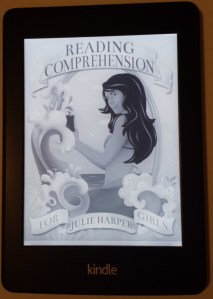
As you can see above, I used a picture of the Kindle book cover (as seen on the Paperwhite) for Julie Harper’s new release, Reading Comprehension for Girls, for this post. The cover was designed by Melissa Stevens (at theillustratedauthor.net).

It includes 48 fun short stories divided in 3 parts. Each story is followed by 4 multiple choice questions; answers can be found in the back. The print edition has 130 pages.

Chris McMullen

Copyright © 2014 Chris McMullen, Author of A Detailed Guide to Self-Publishing with Amazon and Other Online Booksellers

  • Volume 1 on formatting and publishing
  • Volume 2 on marketability and marketing