Why Does Your KDP Report Show all Zeroes?

Sales Zero

Showing All Zeroes

It’s now possible to see all zeroes across your month-to-date Kindle Direct Publishing (KDP) sales report.

In the past, if you didn’t have any sales, returns, or borrows for a title, that title simply wouldn’t show up on your month-to-date report.

Things have changed with the introduction of the new KDP sales dashboard.

You may observe a discrepancy between your KDP sales dashboard and the KDP month-to-date report.

Why?

Evidently, when a customer buys the book, the sale shows in your sales dashboard, but the sale doesn’t show up in your month-to-date report until the payment is processed. There can be a significant delay.

As a result, something strange can now happen.

If a title that hasn’t yet sold in the current month suddenly sells, the order shows up on your sales dashboard and a string of zeroes shows up on your month-to-date report for that book at KDP.

You’ll see a zero for sales, returns, borrows, and freebies when this happens.

Eventually, once the payment is processed, one of the zeroes will change to indicate the sale.

It would have been interesting to notice this for the first time today, on Friday the 13th (with a full moon, even). 🙂

Copyright 2014 © Chris McMullen

KDP now Supports HTML Descriptions

HTML pic

Amazon Book Description HTML

How it was:

  • Kindle Direct Publishing (KDP) didn’t used to support HTML for the book description.
  • In order to use boldface, italics, ordered lists, and unordered lists, it used to be necessary to visit Author Central (https://authorcentral.amazon.com).
  • Once you used Author Central for your Kindle e-book description, republishing the e-book at KDP wouldn’t have any effect. You had to return to Author Central to revise the blurb.

It’s changed:

  • KDP now supports HTML for your description. (I know this because I just tried it and it worked.)
  • The HTML at KDP is the same as the Author Central HTML (e.g. there is a funny space in the linebreak tag, <br />).
  • If you republish your Kindle e-book, whatever description you have with KDP now overrides your Author Central description.

If there was any announcement regarding this, I missed it. I just discovered it by checking my product pages after republishing and hearing from others who’ve done the same.

Important notes:

  • Just a small change, like modifying your price, causes your Amazon book description to revert to whatever you have at KDP.
  • Before you republish at KDP, visit Author Central, edit your book description, select the HTML option, copy the description, save one copy in Notepad, and paste it into the description you have at KDP.
  • After your updated book goes live on Kindle, check your blurb at Amazon.

Good news:

  • This is better because now the Kindle description can include formatting when the book first goes live.
  • Although you can’t preview the description at KDP, you can edit the description with an existing book at Author Central and preview it there (then simply cancel the edit so it doesn’t affect your other book).

You don’t need the <p> tag to make paragraphs. Just use two consecutive <br /> tags; they work like using the Enter key twice to create a blank line between paragraphs.

Note that KDP respects the Enter key. Therefore, if you’re using <p> tags and using the Enter key, you may get much wider linespacing than you expect. Ordinary HTML ignores the Enter key. Author Central ignores the Enter key (in HTML mode). But KDP doesn’t.

Basic KDP Blurb HTML:

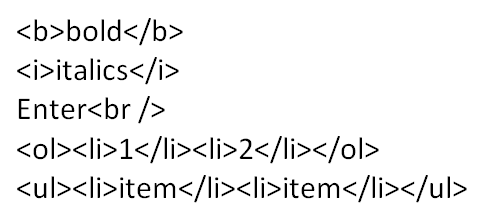
  • Place text between <b> and </b> to make boldface, as in <b>bold</b>.
  • Place text between <i> and </i> to make italics, as in <i>italics</i>.
  • Use <br /> at the end of a line to have the same effect as the Enter key.
  • Use <br /><br /> to create a blank line between paragraphs.
  • Don’t use the Enter key in addition to the <br /> tag.
  • If you use <p> tags, don’t use the Enter key in addition to the <p> tags. (Use <p> at the beginning of a paragraph and </p> at the end. Don’t press Enter between paragraphs.)
  • Use <ol> to start an ordered list (with numbers) and </ol> to end an ordered list.
  • Use <ul> to start an unordered lists (just bullets) and </ul> to end an unordered list.
  • Use <li> to create an item on a list and </li> to end that item.

You don’t actually need to know HTML to format your description with it:

  • Edit a book description for any book at Author Central.
  • Type the description with boldface, italics, the Enter key, bullets, or ordered lists.
  • Preview the description to see how it turned out.
  • Switch to HTML mode. (There is a little yellow rectangle for HTML and another called Compose. Click the HTML rectangle to switch to HTML mode.)
  • Copy the HTML for your book description into Notepad.
  • Cancel the edit at Author Central so it doesn’t affect the book’s actual description at Amazon. (That’s why it didn’t matter which book you used.)
  • Paste the HTML into KDP. (If you also want to use it at CreateSpace, remove the spaces from the <br /> tags. You can do a find and replace in Notepad.)

There is an important difference between KDP, Author Central, and CreateSpace HTML: At Author Central and KDP, the linebreak tag <br /> has a funny space, while at CreateSpace there is no space, <br/>. If you use the linebreak tag in your HTML, be sure to adjust the space between CreateSpace and the two other sites.

Also noteworthy is that KDP, CreateSpace, and Author Central all permit descriptions of 4000 characters (it used to be 2400 at Author Central).


About Me

Chris McMullen, Author of A Detailed Guide to Self-Publishing with Amazon and Other Online Booksellers

  • Volume 1 on formatting and publishing
  • Volume 2 on marketability and marketing

Follow me at WordPress, find my author page on Facebook, or connect with me through Twitter.

Kindle Educational Content: Calling Authors

Chem Basics Cover

Educational Authors

Do you write educational books? Any age. College material, high school, middle grades, elementary, kindergarten, preschool. Doesn’t matter.

Or have you been thinking about writing educational books?

Have you had any troubles or concerns with writing or publishing educational content for Kindle?

If so, I would like to hear from you. Not just me. Maybe even Kindle will talk with you.

Kindle Educational Team

A couple of weeks ago, I received an email from the Kindle Educational Team.

Wow!

Personal service. Kindle Direct Publishing (KDP) is a self-service website. Amazon is huge. The number of authors is huge. Personal service is a real treat. As you might expect, the Kindle Educational team’s role doesn’t ordinarily consist of contacting authors.

Kindle has plenty of fiction. They are looking for ways to make more quality educational content available to Kindle customers.

Evidently, they asked CreateSpace to identify some authors who have published educational material in print and who have opted to receive emails from Amazon. Lucky me, my name came up.

A few days following the email, the Kindle educational team actually called me. I was able to speak with two representatives on the phone.

They were interested in my concerns about publishing on Kindle. I mentioned such things as formatting challenges, difficulty with visibility on Amazon (I’ve gotten specific, like mentioning that if a customer goes to Amazon, clicks children’s books, and then clicks the K-12 Teachers link, CreateSpace and Kindle books rarely show up there), and category issues.

It looks like the Kindle educational team wants to help with visibility on Amazon, and it looks like they are thinking about long-term self-service options that can aid in formatting and publishing educational books.

Note that fixed-layout currently has features that might help with children’s book formatting and technical textbook formatting: http://www.amazon.com/gp/feature.html?docId=1000729511. Hopefully, this will become easier for the average self-publisher to implement. The Kindle Comic Creator looks promising.

Are You Interested?

At the end of the telephone conversation and in a follow-up email, I’ve been asked if I know other educational authors.

Do you write educational books?

If so, let me know. I can pass along your interest.

Maybe Kindle will speak with you, too.

(Of course, nobody asked me to write this post. I took this upon myself.)

Chris McMullen, Author of A Detailed Guide to Self-Publishing with Amazon and Other Online Booksellers

Follow me at WordPress, find my author page on Facebook, or connect with me through Twitter.

Check Your KDP Dashboard. Cool New Feature.

New 2

Finally!

Visit your Kindle Direct Publishing (KDP) bookshelf and check out the new, totally amazing Sales Dashboard.

It may not help you get more sales, but it will make it easier to track what sales you do get:

  • The best feature may be the running totals at the bottom (under the chart), showing you exactly how much you’re making in each country (well, borrows can’t be figured into this since). Change the period from the last 30 days to month-to-date and click the update report button to see how much you’ve made in each country this month.
  • A graph shows you your sales over a period of time. This will help to keep track of which days are better or worse for sales and how a promotion impacts your sales frequency.
  • For KDP Select authors, the graph shows borrows separately from sales (and if you do a freebie, those are shown separately, too). Uncheck a box at the bottom of the chart for any data you don’t want to see.
  • The left filter lets you see all marketplaces together, or you can pick a specific country.
  • You can also see data for a specific book rather than all titles.
  • Note that the report defaults by showing you data for the last 30 days. If you prefer to see what you’ve sold just this month, for example, change this to month-to-date. There are 5 time periods to choose from.
  • You can also create your own time period by using the calendars.
  • Click the button at the right (Update Report) when you wish to make a change.
  • Try the button at the bottom called Generate Report. This gives you a customizable Excel table.

I’d like to see one more thing in this report: Why not add a column at the bottom showing the total number sold in each country? If you’d also like to see this, send KDP an email. They won’t know if this may be a popular feature unless they hear from you.

What do you think of the new report?

Chris McMullen, Author of A Detailed Guide to Self-Publishing with Amazon and Other Online Booksellers

Follow me at WordPress, find my author page on Facebook, or connect with me through Twitter.

Series Changes with Kindle

Series

Kindle is changing the way that series appear at Amazon:

  • The change will make it easier for customers to see that a given book is part of a series.
  • The change will clearly show the volume number to help customers find the next volume of a series and to read a series in order.
  • The change will show the series name to help customers find all of the volumes of a given series.

Example

You publish an e-book with Kindle Direct Publishing (KDP) and enter the following information in the publishing fields:

  • Title: Mr. Wrong Feels Oh So Right
  • Series Title: Bad Romance
  • Volume: 3

When people search for your e-book on Amazon, they will see the following in search results:

  • Mr. Wrong Feels Oh So Right (Bad Romance Book 3)

The parentheses show that this book is part of a series. The “Book 3” makes it clear that this is the third volume of a series.

What If

Are you wondering whether it matters if your book is a stand-alone book that could be read all by itself out of sequence?

  • Doesn’t matter. If you publish your book with a series title, your book is part of a series and will include the series title and volume number in parentheses.
  • Anything that comes in multiple volumes will be treated as a series.

Impact

Personally, I like it. When I first published The Visual Guide to Extra Dimensions, volumes 1 and 2, Amazon included Volume 1 and Volume 2 with the title and subtitle in search results.

Several months later, the volume numbers disappeared from search results, and sales did slow a little along with it. Before, it had been very clear that two separate volumes were available. I had contacted CreateSpace and Amazon, and the volume numbers have reappeared and vanished a couple of times.

As a customer, I had trouble buying Robert Jordan’s Wheel of Time. It wasn’t clear which volume was which, or how many volumes there were. It seems to make sense to wave a flag that says, “Over here, I’m volume 7, buy me next.”

If Amazon is making this change, it appears that someone high up has realized that either (A) this will help to improve sales by helping customers find the books they are looking for or (B) this will improve the customer buying experience because customers have been buying books that they hadn’t realized were parts of series. Maybe both.

Do you have a series published on Kindle? If so, you might want to check what you have entered under the title, subtitle, series, and volume fields. You can update this information as needed to help improve the transition.

Right now, it seems that Amazon is doing this for Kindle. I’d like to see it for print books, too (which would make sense, as many Kindle editions are linked to print editions).

How do you feel about it?

(Speaking of changes, WordPress seems to have made a nice one recently. Now, I can copy and paste from one of my blog articles to another and it retains formatting and links. I like it.)

Publishing Resources

I started this blog to provide free help with writing, publishing, and marketing. You can find many free articles on publishing and marketing by clicking one of the following links:

Chris McMullen, Author of A Detailed Guide to Self-Publishing with Amazon and Other Online Booksellers

Follow me at WordPress, find my author page on Facebook, or connect with me through Twitter.
Kindle e-book Prices and Royalties

Prices

What Is the Best Kindle Price?

That’s the million-dollar question. The answer also varies from book to book.

A recent article from TechCrunch points out that the $9-10 price range is the most profitable list price for e-books in the United States, evaluating sales data for all books—i.e. it includes both traditionally and indie published e-books. Click here to check it. It’s short and makes some informative points for both US and UK pricing.

However, the article doesn’t make a few points that may be particularly significant for indie authors:

  • Thousands of traditionally published e-books are priced at $9.99 and sell frequently because the authors are quite popular. Think about it: If a hardcover is selling dozens of copies per day at $35 or if a trade paperback is selling frequently at $25, then $9.99 is an enticing e-book price.
  • Many e-books that would be priced between $10 and $20 are selling at $9.99 because the publisher actually makes a greater royalty with a $9.99 list price. Kindle offers a 70% royalty on books with a list price of $9.99, so the royalty on a $9.99 e-book can be as high as $6.99 (it will be somewhat lower due to the 15 cents per Mb delivery fee). A Kindle e-book priced at $19.99 draws the same royalty of $6.99 because the royalty rate is 35%. Think about it: Would you rather sell your book at $9.99 or $19.99 if either way the royalty will be $6.99? Therefore, the $9-$10 price range is selling many, many more e-books than other price ranges above and below this—it’s kind of like ten price ranges in the same slot.
  • Technical nonfiction—especially, textbooks—tends to sell for higher prices.

I’m not advocating cheap e-book prices. I’m just warning that e-book prices of $7.99 to $9.99 might not turn out to be as profitable as this article might suggest for newbie fiction authors.

Low Prices

The article also shows that many e-books sell at low prices. One reason is that there are tens of thousands of books selling for free, 99 cents, $1.99, and $2.99. These are very popular price points, especially among indie authors. New authors often feel that they have a better chance to get discovered with a more enticing price. Others use this strategically, hoping that readers will get hooked and check out the author’s other books.

There is something important to note about low prices:

  • Kindle e-books priced 99 cents to $2.98 earn a 35% royalty. A 99-cent e-book earns a royalty of 34 cents and a $1.99 e-book earns a royalty of 69 cents.
  • A Kindle e-book priced at $2.99 which qualifies (public domain books, for example, do not) for the 70% royalty and has a small delivery fee earn royalties of up to $2.09.
  • In this case, you would have to sell 6 times as many e-books at 99 cents as you would at $2.99 or you’re losing profits.
  • Similarly, you would have to sell 3 times as many e-books at $1.99 as you would at $2.99 just to break even.
  • Amazon seems to have made recent changes to the sales rank algorithm to factor in list price. This would make sense, as Amazon would prefer to sell 100 books at $2.99 than 100 books at 99 cents.
  • Books enrolled in KDP Select can benefit from Countdown Deals. Books priced under $2.99 aren’t eligible for Countdown Deals.

Perception

Most authors expect to sell more books at lower prices and fewer books at higher prices, but it doesn’t always work out that way. Many customers believe that you get what you pay for, and this perception affects the economics of e-book sales. Even if you do sell more e-books at a lower price, you might make more profit at a higher price (since you draw less royalty per sale at the lower price).

Some authors have actually raised their prices from $1.99 to $299 or $2.99 to $3.99, for example, and started selling books at a higher frequency. This doesn’t happen for all books, but it does happen for some.

It depends in part on the value that your book provides, how it appeals to the target audience, and on the buying habits of your specific subgenre or subcategory.

There are many customers who have been disappointed with e-books that they purchased for 99 cents to $2.99, who now shop for e-books priced from $3.99 to $6.99.

Another factor is marketing. If you market your book effectively and reach potential readers on a personal level, they may be willing to spend more money on your book.

Suggestions

Here are some things to consider when deciding on the price of your Kindle e-book:

  • Research books that are very similar to yours, including top sellers. Buyers will know what the typical price range is. If your book seems underpriced, they might wonder what’s wrong with it, and if it seems overpriced, it might not seem to be worth the money.
  • Consider the length of your e-book and the value it provides. Customers like to feel that they are receiving good value for their money.
  • Most e-book buyers want to save at least 50% off the print price.
  • Some buyers will also purchase both print and e-book editions through MatchBook. If you use MatchBook, set your list price high enough that the MatchBook price may seem like a compelling option.
  • A boxed set may help to create the perception of value. The $5.99 to $9.99 price point may be more profitable for a boxed set than for a single volume by a new fiction author. Ideally, the individual volumes would be priced so as to help the boxed set seem like a good value.
  • Technical nonfiction books that provide significant content are generally worth more to buyers.
  • If you succeed in selling multiple print books per day priced $20 or higher, you have much better prospects for selling e-books at a $9.99 list price.
  • Authors who will be signing up for Kindle Select have an incentive to price their e-books between $2.99 and $9.99 in order to take advantage of the Kindle Countdown Deal. This allows you to create a short-term sale to help stimulate sales.
  • Amazon’s algorithm for sales rank may currently factor in the list price. Only Amazon knows for sure, but some authors have expressed recently that this seems to be the case now, and this is consistent with my observations, too.
  • If you have several similar books for sale, a compelling price on one book may help to generate interest in your other books.
  • If you have a series, offering the first book cheap may help to hook readers in the series.
  • How professional does the book look, in terms of both content and formatting? A higher price does command higher expectations.
  • What is the demand for your book? If the content is very specialized, this may warrant a somewhat higher price.
  • What are your specific objectives? Is your goal to draw the most royalty? Is your goal to maximize your readership? Is your goal to get on a bestseller list? When a higher price may draw a greater net profit, if you’re more focused on sales than royalties, then a lower price may fit your objectives better.

Publishing Resources

I started this blog to provide free help with writing, publishing, and marketing. You can find many free articles on publishing and marketing by clicking one of the following links:

Chris McMullen, Author of A Detailed Guide to Self-Publishing with Amazon and Other Online Booksellers

Follow me at WordPress, find my author page on Facebook, or connect with me through Twitter.
International Kindle Prices & the 70% Royalty

International Prices

When you publish an e-book with Kindle, you must set your price for the United States, Great Britain, Canada, Australia, Europe, India, Mexico, Brazil, and Japan.

Most authors will focus on the price in one or two countries, usually the United States and Great Britain, and not put much thought into the others.

At first, this makes sense. For one, most authors sell very few e-books in countries where English isn’t the dominant language; for another, most authors who publish with Kindle are much less familiar with the other currencies and markets.

There is an EASY button: Just let KDP automatically determine the price in each country.

However, a little refinement may be worthwhile.

Examples

For example, if the suggested Great Britain pricing is £1.83, your e-book won’t be eligible for a Countdown Deal in the United Kingdom. If you’re enrolled in KDP Select and considering use of this tool, you should set your Great Britain price to at least £1.93.

As another example, suppose the suggested price for India is ₹423. If your e-book is enrolled in KDP Select and qualifies for the 70% royalty rate, you could draw a higher royalty by reducing the price to ₹399. In India, the maximum list price for a 70% royalty is ₹399 (but note that the rate is 35% in India, regardless of the list price, for e-books that are not enrolled in KDP Select).

The chart above shows the minimum and maximum list prices by country for the 70% royalty option. The asterisk (*) designates countries where 70% is only available through KDP Select enrollment (India, Brazil, Japan, Mexico). (This is a relatively minor benefit of KDP Select. It’s not compelling to make you switch to KDP Select, but if you’re in KDP Select for other reasons, you might as well take advantage of it.)

Another reason to consider refining your price is to change the ending. Suppose the suggested price in Japan is ¥673. You might raise it to ¥695 or ¥699, for example. (Or you might check out the sale price of your e-book in other countries after adding Value-Added Tax, VAT, and reset your price based on the actual selling price.)

Here is a link to the KDP pricing page: https://kdp.amazon.com/help?topicId=A301WJ6XCJ8KW0

Publishing Resources

I started this blog to provide free help with writing, publishing, and marketing. You can find many free articles on publishing and marketing by clicking one of the following links:

Chris McMullen, Author of A Detailed Guide to Self-Publishing with Amazon and Other Online Booksellers

Follow me at WordPress, find my author page on Facebook, or connect with me through Twitter.

Kindle Countdown to the New Year

54321

I love KDP’s new Kindle Countdown Deal tool. I did a couple of preliminary tests with it when it first came out in November, 2013. I used it with several e-books on Read Tuesday, December 10. I even ran a couple of free promos on Read Tuesday so I could compare the results to the Countdown Deals. I used the Countdown Deal once again after Christmas, when e-book sales are usually on the rise.

What is it?

Let’s begin with what it isn’t. It’s not a cure-all for any e-book that doesn’t sell. If your e-book isn’t selling, the Countdown Deal probably isn’t the answer. Instead, you need to reassess whether the content, writing, and packaging are marketable. At least one of these areas needs to be improved to get your book selling.

If you have a marketable book, the Countdown Deal can help to stimulate sales. A short-term sale price can help you create added interest in your book, especially if you market the promotional price effectively.

Here are the main details of the new Kindle Countdown Deal:

  • If your Kindle e-book is priced from $2.99 to $24.99 in the US or £1.93 to £14.99 in the UK, you can put your e-book on sale for as little as one hour or as many as 7 days consecutively in a 90-day KDP Select enrollment period. (Many e-books with a $2.99 price in the US have a UK price below £1.93. If so, you need to republish and raise the UK price to £1.93 before running a Countdown Deal in the UK.)
  • Customers will see both the sale price and the list price during the promotion, so they will know exactly how much they are saving. There will also be a countdown timer, showing customers when your sale ends, which helps to create a sense of urgency.
  • The sale price must be at least $1.00 off in the US and £1.00 off in the UK and must end with .99.
  • Your e-book must be enrolled in KDP Select, which requires publishing the e-book edition of your book exclusively with Kindle. Your e-book must be enrolled in Select for at least 30 days before you can run a Countdown Deal.
  • If you change your list price, you must wait 30 days before running a Countdown Deal. You must also wait 14 days after the promotion to change your list price.
  • You must schedule your Countdown Deal at least 24 hours in advance of the day on which your promotion would begin. You need 24 hours notice to cancel a Countdown Deal.
  • Note that you can only run a single Countdown Deal in a 90-day enrollment period, even if your first Countdown Deal didn’t use the full 7 days. (This is in contrast to the free promo, where you can run up to five separate one-day promotions or use them all at once.)
  • If your book is on the 70% royalty plan, you will still earn 70% after subtracting the delivery fee even if your sale price is $0.99 or $1.99. However, if you have a large file size, which is typical if there are several images, you might actually earn more money during the Countdown Deal on the 35% royalty plan. In fact, your royalty could be zero on the 70% plan. Unfortunately, KDP doesn’t show you in advance what your Countdown Deal royalty will be; you need to figure this out yourself. On the 70% royalty plan, subtract the delivery fee (find this in Step 2 of the publishing page) from the promotional price, then multiply by 0.7. Compare this to 0.35 times the promotional price for the 35% royalty rate. You can switch plans by republishing before (it must go live 24 hours before the day your promotion starts) and again after the promotion (but then you earn 35% for sales for a day before and the period after your promotion while your e-book is being republished).

Comparing the Countdown Deal to the free promo

Kindle’s Countdown Deal solves many problems that the free promo suffers from:

  • Since customers are paying money for your e-book, most of your customers will actually read your e-book. A huge problem with the free promo is that many people who take the e-book for free never get around to reading it.
  • Since customers are paying money for your e-book, most shoppers will actually read your blurb, check out reviews, and explore the Look Inside prior to making a purchase. Another huge problem with the free promo is that many shoppers don’t bother seeing if the e-book actually appeals to them since it’s free.
  • Customers are more likely to be in your e-book’s specific target audience. This means they are more likely to have reasonable expectations for your genre. The free promo attracts customers from outside your genre, who then compare apples to oranges. This sometimes shows up in critical reviews.
  • Unfortunately, there are many outspoken individuals who strongly loathe freebies. Some, with mean spirits, actually ‘buy’ freebies with the preconceived idea of slamming them. By running a Countdown Deal, your e-book won’t attract the freebie haters, and if someone does wish to slam the e-book, at least they must make the purchase first if they want it to show as an Amazon Verified Purchase.
  • You earn royalties during the Countdown Deal. You don’t earn one penny during a free promo. The hope of the free promotion is that some customers will actually read the e-book, like it, and help spread the word. It’s a big risk. The Countdown Deal has the same benefits, without the risk. Sales during the Countdown Deal affect your paid sales rank, whereas a free promo only affects your free sales rank. Your paid sales rank actually slides during a free promo, but will most likely rise during a Countdown Deal.
  • There are fewer freebies saturating the market with the introduction of the Countdown Deal. There are also fewer Kindle e-books priced at 99 cents and $1.99 because those e-books aren’t eligible for a Countdown Deal. More Kindle e-books now have a regular price of $2.99 and higher. This helps everyone create a better perception of value. Those e-books that are on sale during a Countdown Deal can only be on sale for up to one week out of 90 days, so most of the time they are not cheap.
  • Websites that link to Kindle e-books through Amazon Associates are discouraged from promoting freebies, but have an incentive to promote Countdown Deals. It would be smart to search for sites that promote Countdown Deals for your genre. It’s a win-win situation, since they can earn money through Amazon Associates by promoting your e-book.

My experience

I ran a Countdown Deal on several e-books during Read Tuesday, a Black Friday type of sale just for books on Tuesday, December 10. I actually ran my promotions from December 9 to December 11. I sold more e-books on average on the 9th and 11th, but had the greatest surge in sales on the 10th, the day in which Read Tuesday was being promoted. On December 10, my sales of e-books for the month doubled what they had done all together from the 1st to the 9th. Several other authors also ran Countdown Deals on Read Tuesday. Of those who have shared their results with me, all but one had similar successes, and some had a far better yield than I had.

A Countdown Deal can be highly effective for a marketable e-book that is promoted effectively.

I ran a couple of free promos on December 10, also, so that I could compare the two programs. I did get a few sales of those e-books after the free promos ended, but those sales paled in comparison to the Countdown Deals.

In early November and late December, I also tested the Countdown Deal on a couple of other e-books (you can only run one Countdown Deal on a given e-book in its 90-day enrollment period in KDP Select). On these occasions, I didn’t promote the sale. I did this with one of my better sellers, with the result of increasing the sales frequency by a factor of 3.4. Trying this also with a couple of e-books that ordinarily don’t sell much, I confirmed that a Countdown Deal isn’t the solution to an e-book that lacks marketability.

You still need to promote your sale

You will certainly get the most out of your Countdown Deal if you effectively market your promotion. As already mentioned, you should search online for websites that actively promote Countdown Deals. If they use Amazon Associates, they have an incentive to help you promote your e-book, so don’t be too shy to search and ask.

There are also several websites that specialize in announcing e-book promotions, e.g. by emailing readers who are subscribed to daily newsletters. For example, check out these sites: BookBub, Ereader News Today, Kindle Books & Tips, Book Gorilla, Book Blast, and Pixel of Ink. You want to learn about stats to help you with your decision. For example, the BookBub pricing page provides data for subscribers by genre, average downloads, and average sales.

The exclusivity drawback

You must enroll your Kindle e-book in KDP Select in order to take advantage of the Countdown Deal tool. This requires publishing your e-book exclusively with Kindle during the 90-day enrollment period. You can’t publish your e-book with Smashwords, Nook, Kobo, Apple, or any other e-readers besides Kindle during this period. However, you may publish a paperback edition of your book with CreateSpace, for example; the exclusivity clause only pertains to electronic versions of your book.

It’s also possible to initially enroll in KDP Select, then 90 days later opt out and publish your e-book with every e-reader. This allows you to test the water; the 90-day period also gives you a chance to prepare your e-book for the other e-reader formats.

Some e-books sell very well on Nook, Kobo, Sony, or Apple, while others sell primarily on the Kindle. The only way to know for sure is to try it out. If your e-book sells very well with Nook, for example, you probably don’t want to enroll in KDP Select. However, if your e-book rarely sells anywhere but Kindle, you might as well take advantage of the program. Select also has other benefits, like earning royalties on borrows from Amazon Prime members.

Attention, Amazon: You need a Countdown Deal for CreateSpace paperbacks, too

It would be very cool to have a Countdown Deal for CreateSpace paperbacks. This would solve a major problem. The Expanded Distribution channel limits how low you can set the list price for a CreateSpace paperback. If you want to run a short-term promotion, you can simply lower your list price temporarily. However, if you have Expanded Distribution, you might need to temporarily disable it in order to make a compelling sale price.

Amazon and CreateSpace could get together, potentially, and create a Countdown Deal that only lowers the Amazon sale price, but not the list price or Expanded Distribution price, during the promotion. If you like this idea, please feel free to contact Amazon and CreateSpace with your suggestion. The more authors who suggest this, the more likely they will consider the idea.

Presently, the Countdown Deal only applies to Kindle in the US and UK. Hopefully, they will add this to Australia, Canada, and other websites for Kindle sales soon.

Happy 2014

I started this blog to provide free help with writing, publishing, and marketing. You can find many free articles by clicking one of the following links:

Chris McMullen, Author of A Detailed Guide to Self-Publishing with Amazon and Other Online Booksellers

Follow me at WordPress, find my author page on Facebook, or connect with me through Twitter.

Chance to Improve a Kindle Pricing Issue

Change

When you run a Kindle Countdown Deal, if you have a paperback edition linked to the Kindle edition, the paperback product page shows the regular list price of the Kindle edition, and not the sale price.

Why not? Wouldn’t showing the sale price improve the chances of getting a sale?

Is Amazon trying to push paperback sales? Does Amazon figure that customers who have a Kindle will check out the Kindle page anyway, then when they see the even lower price, this will help stimulate a sale? Is Amazon hoping the customer will buy both editions, taking advantage of MatchBook? Or did Amazon simply overlook this pricing issue?

Would you rather have the paperback product page show the sale price of the Kindle edition?

If you’d like to see a change, the best way to proceed is to voice your opinion. Be clear and concise, and avoid triggering KDP’s auto-responses (e.g. if you mention that your paperback edition is published with CreateSpace, KDP might send you a message that you need to contact CreateSpace).

I contacted KDP to point out this issue and suggest changing it to show the sale price of the Kindle edition on the paperback page. Their response stated that the paperback product page shows the regular Kindle price because the CountDown Deal is not presently available for paperbacks. (What does that have to do with the price of tea in China?) KDP did say that they understand the issue and will forward my suggestion to their business team, who can make such decisions.

I’ve submitted dozens of suggestions to Amazon, CreateSpace, Kindle, and AuthorCentral over several years. A few of them have actually been implemented. To be clear, they didn’t implement my suggestion. Several other customers made a similar suggestion. That’s the key. One voice is likely to be lost in the wind. When changes have occurred, I’ve heard from many other customers who had submitted similar suggestions. So if you want to improve the chances of a change occurring, you must voice your own opinion.

Do you have other suggestions? If you keep them to yourself, they probably won’t make a difference. (Don’t make all of your suggestions at once. Spread them out here and there.) Here are a few other things that you might consider:

  • A total at the bottom of the KDP month-to-date sales report.
  • Consolidating KDP sales reports for other countries into a single report.
  • Showing the subtitle in the cart at CreateSpace so you can see exactly what you’re buying (if you have multiple books with similar titles and only the ending is different, you can’t tell which it is when checking out).
  • Give us the option of 35% or 70% on CountDown Deals without having to republish a couple of days in advance (if you have a large file size, you might actually draw a larger royalty from a CountDown Deal at the 35% rate).
  • Show us what the royalty will be while we’re scheduling a CountDown Deal (you’d hate to find out later that you only made one penny per sale, for example). (I love math, so this doesn’t bother me, but I’m thinking this would be convenient for some.)
  • Allow UK authors to order proofs from CreateSpace printed from the UK instead of the US (Amazon UK orders are fulfilled that way, so why not proofs?). (Again, this doesn’t affect me as I live in the US.)
  • Any other issues you come across and would like to see improvement. Tell others about the issue and encourage them to send in suggestions if they feel the same way.

Don’t flood Amazon with tons of suggestions all at once. Please don’t tell them that I sent you. 🙂 I didn’t. You have a mind of your own. Do what you feel is best.

Love books? Check out Read Tuesday, a Black Friday event just for books (all authors can sign up for free) on Tuesday, December 10: website, Facebook page, Twitter

Chris McMullen, author of A Detailed Guide to Self-Publishing with Amazon and Other Online Booksellers, Volume 1 (formatting/publishing) and Volume 2 (packaging/marketing), Facebook page, Twitter

Volumes 1 and 2 will be on sale on December 9 thru 11 as part of Read Tuesday on December 10. These books haven’t been on sale all year, so this is a rare opportunity. The Kindle edition of Vol. 1 will be $1.99 (60% off from $4.99) in the US and 1.99 pounds (37% off from 3.14 pounds) in the UK, while Vol. 2 will be $0.99 (80% off from $4.99) in the US and 0.99 pounds (70% off from 3.25 pounds) in the UK. The paperbacks will also be 40% off ($5.99 instead of $9.99) at CreateSpace:

Updating a Book at CreateSpace or Kindle Direct Publishing

Update

Today I will share my experience of updating books at Amazon. I recently updated Volume 1 of A Detailed Guide to Self-Publishing with Amazon and Other Online Booksellers at CreateSpace and Kindle Direct Publishing (KDP). The paperback now includes a comprehensive 18-page index, and both the paperback and eBook include minor updates (such as mention of recent changes at CreateSpace, Amazon, and Kindle and correcting a few minor typos).

If you need to revise your interior or cover file at CreateSpace, first study your sales rank history (you want to know the time of the sales, not the time that the royalties report) to help choose the time where you’re least likely to sell books. Your book will be unavailable for sale while the new file is being reviewed, so you don’t want it to interfere with sales (unless your revision is more urgent, then you just have to do it immediately).

It takes approximately 12 hours for your files to be reviewed. The biggest concern is how Murphy’s law will get you:

  • One way is for CreateSpace to make changes to your cover, even when you didn’t change the cover file and it had been perfect. The best thing to do is resubmit your files for review and hope the next reviewer doesn’t make changes to your cover. This is another 12 hours. But if you call, they put in a request to research the problem, and this can take a couple of days (and may not even resolve the problem). There is, unfortunately, a worst-case scenario where your book is offline for several days. You just have to cross your fingers and hope it doesn’t happen to you. Let me add that this rarely happens, so most likely it won’t be an issue. I didn’t mean to scare you. Just prepare for the worst, then if something does happen, you won’t be surprised by it.
  • Another way is for you to make a minor revision, which winds up causing major changes to the layout of your book. You see, revising a phrase on page 3 could cause a crazy page break on page 8. Take the time to scroll page by page through your book in the Digital Proofer to ensure that there aren’t any crazy layout problems and you might be able to avoid this problem.
  • Then there is conservation of typos, whereby you introduce a new typo in the process of correcting others.
  • Finally, there is the Doh! moment when you click Approve Proof and suddenly remember something else that you should have done.

Very often, your book is again available for sale in 12 to 24 hours after uploading the revised file.

A crazy thing is that you can actually order the paperback directly from Amazon after the revision and receive the older version. This evidently happens when they already have your older version stocked in their warehouse (e.g. if there was a returned copy to resell or if they had ordered some in advance to stock up).

What I like about KDP is that your previous edition remains available for sale while your new eBook is in the process of publishing. This way you don’t miss out on any sales in the meantime.

I put a note on the copyright page indicating when the eBook was last updated. This way, when I viewed the Look Inside at Amazon, I knew I was looking at the updated version.

I like the way the Look Inside turned out. The Look Inside when viewing on a PC is the greatest formatting challenge. I went into the HTML in my effort to perfect this. The indents look large on the PC, but that’s because I set them to a percentage instead of a value in inches. That way, the indents will look fairly reasonable from a cell phone to an iPad.

Another thing to consider is updating the description. I updated the paperback description from CreateSpace, using the basic HTML that’s allowed to create linebreaks, boldface, italics, and bullets. I used Author Central to do this for the eBook. The paperback description begins with a note about the new index that has been added.

The paperback was ranked around 14,000 on Amazon, but has now dropped down to 45,000. It’s amazing what a 16-hour window of no availability can do to sales rank. On the other hand, the eBook edition jumped up to 40,000 from the 100,000’s. I guess when the paperback wasn’t available, people decided to go with the eBook (ordinarily, I sell many paperbacks for each eBook that sells).

For those who may have purchased the original paperback without the index, there is a free index available in PDF format online: https://chrismcmullen.wordpress.com/index-for-a-detailed-guide/

Now I need to work on an index for Volume 2.

Volume 1 eBook: http://amzn.com/B00AA5CJ7C

Volume 1 paperback: http://amzn.com/1480250201

Volume 2 eBook: http://amzn.com/B00CSDUP66

Volume 2 paperback: http://amzn.com/1484037243

Chris McMullen, author of A Detailed Guide to Self-Publishing with Amazon and Other Online Booksellers, Vol. 1 (formatting/publishing) and Vol. 2 (packaging/marketing), Facebook page, Twitter

Check out Read Tuesday (a Black Friday event just for books): website, Facebook page, Twitter