Kindle Unlimited Back Above Half a Penny Per Page

Image from ShutterStock.

Image from ShutterStock.

KINDLE UNLIMITED

I remember, many months ago, when the Kindle Unlimited per-page rate first dropped below half a penny per page. This was early after the switch to paying for pages read.

There were many prophecies that it would continue to plunge deeper and deeper and would soon be worthless.

Yet many months later, it has again exceeded half a penny per page (though barely). Not only that, the KENP read rate has held fairly steady for eight months.

All the while, the KDP Select Global Fund has climbed up to $16.2 million, though it had been several million lower when the transition to pages read was made.

Both are signs that Kindle Unlimited is thriving.

Update:  If you’re looking for the exact figure, it is $0.005189724 per KENP read.

Chris McMullen

Copyright © 2016

Self-Publishing Education & Textbooks on Kindle via Amazon KDP

Pattern Puzzles

KINDLE FOR EDUCATION & TEXTBOOK AUTHORS

Amazon recently added a quote from me to their KDP website for Education & Textbooks. Check it out here:

https://kdp.amazon.com/edu

(Thank you, Amazon.)

I started out self-publishing print books with CreateSpace in 2008. Back then, Kindle wasn’t a very good fit for most textbooks.

Textbooks tend to have many pictures, equations, bullet points, and other kinds of rich formatting, which makes the transition from print to Kindle a challenge.

Amazon’s solution to this problem is the Kindle Textbook Creator.

The main benefit of the Kindle Textbook Creator is convenience. It’s actually PDF friendly, and preserves the layout of your print book.

It’s good for textbooks and other books with many images or rich formatting. (It’s not good for a novel.)

The trade-off for convenience is that since one printed page fits on the Kindle screen, and since many customers have a fairly small screen, the e-book is designed to work with pinch-and-zoom, and it won’t be available on all devices.

There are other factors to consider, too. For example, using the Kindle Textbook Creator allows you to embed audio or video, which is great for educational books (but these features will only be available to customers who read your book on a third-generation or newer Kindle Fire device).

I have a free article on using the Kindle Textbook Creator:

https://chrismcmullen.wordpress.com/2015/01/23/how-to-use-amazons-new-kindle-textbook-creator-tutorial/

Chris McMullen

Copyright © 2016

Chris McMullen, Author of A Detailed Guide to Self-Publishing with Amazon and Other Online Booksellers

Click here to view my Goodreads author page.

  • Volume 1 on formatting and publishing
  • Volume 2 on marketability and marketing
  • 4-in-1 Boxed set includes both volumes and more
  • Kindle Formatting Magic (coming soon)

Follow me at WordPress, find my author page on Facebook, or connect with me through Twitter.

Comments

Click here to jump to the comments section.

Celebrate Great Indie Writing #PoweredByIndie

Badge

CELEBRATE GREAT INDIE BOOKS

Indie authors often support one another.

Wouldn’t it be wonderful if a giant company with huge marketing power took a month to highlight many wonderful indie authors?

We all know that Amazon gave indie authors a chance when they opened the self-publishing door. And Amazon occasionally highlights indie author success stories.

But now Amazon is actually celebrating great indie books for the month of October.

Check out Amazon’s Powered By Indie page:

  • Visit www.amazon.com/poweredbyindie.
  • Note the image text: Celebrating great writing.
  • There are 4905 Kindle e-books listed, including 154 new releases (and 5 coming soon).
  • Only about 1/3 are in Kindle Unlimited.

YOU, too, can celebrate great indie writing:

  • Use the #PoweredByIndie hashtag when you post related tweets (select stories will be shared).
  • This is a great time to post a list of indie books that you’ve enjoyed.
  • Or post what you love about being an indie author.
  • Share Amazon’s Powered By Indie webpage with other authors (and readers).
  • Read, read, read. 🙂

Chris McMullen

Copyright © 2016

Chris McMullen, Author of A Detailed Guide to Self-Publishing with Amazon and Other Online Booksellers

Click here to view my Goodreads author page.

  • Volume 1 on formatting and publishing
  • Volume 2 on marketability and marketing
  • 4-in-1 Boxed set includes both volumes and more
  • Kindle Formatting Magic (coming soon)

Follow me at WordPress, find my author page on Facebook, or connect with me through Twitter.

Comments

Click here to jump to the comments section.

Kindle Unlimited Per-Page Rate for July, 2016

Images from ShutterStock.

Images from ShutterStock.

WHAT DID KINDLE UNLIMITED PAY PER PAGE IN JULY, 2016?

The Kindle Unlimited per-page rate held steady at $0.00481 per KENP page read for July, 2016.

For the past 4 months, the per-page rate hasn’t drifted below $0.004686 (May) or above $0.00495663 (April).

This stability is nice. (It’s also a lot higher than January’s rate of $0.00411.)

The KDP Select Global Fund was $15.5M for July, 2016, slightly higher than each of the past two months.

Even the Global Fund is showing stability.

Write happy, be happy. :-)

Chris McMullen

Per-Page Rate Back Up for June, 2016 (Kindle Unlimited)

KINDLE UNLIMITED PER-PAGE RATE FOR JUNE, 2016

Kindle Unlimited paid $0.004925 per page read, which is up 5% from May’s rate of $0.004686, almost back to April’s rate of $0.00495663.

The per-page rate has flip-flopped up and down 5% every month since March, but every month has been considerably higher than January’s rate of $0.00411.

The KDP Select Global Fund for June was $15.4M for June, 2016, slightly higher than May’s $15.3M.

To see the payout in other countries, see here:

http://the-digital-reader.com/2016/07/17/kindle-unlimited-payout-funding-jumps-in-june-2016/

What does all this mean?

  • The per-page rate has held fairly stable for half a year, between $0.0045 and $0.0050 per page.
  • The per-page rate has risen as high as 5% on multiple occasions. So while it occasionally dips as much as 5%, it rises almost as often.
  • There was a tendency for the per-page rate to dip initially, which also happened when Prime borrows were first introduced, and also happened when Kindle Unlimited was first introduced, but both of those programs stabilized after the first handful of months. It appears that Kindle Unlimited v2.0 has finally reached a point of stability.
  • Kindle Unlimited is thriving. Amazon is paying $15M per month in royalties just for pages read (and that’s on top of All-Star bonuses). The KDP Select Global Fund is still on the rise.
  • Since the Global Fund continues to rise, whereas the per-page rate appears to have stabilized, it looks like the Kindle Unlimited program continues to grow.

Write happy, be happy. :-)

Chris McMullen

How Much Did Kindle Unlimited Pay per Page Read in April, 2016? (Good News)

Image from ShutterStock.

Image from ShutterStock.

KINDLE UNLIMITED PAGES READ: APRIL, 2016

The Kindle Unlimited per-page rate improved nearly 4% up to $0.00495663 for April, 2016. (Compare this to $0.00477885 for March, 2016.)

This is up 21% over January’s rate of $0.00411. A nice trend.

The KDP Select Global Fund held steady at $14.9M for April, 2016 (identical to March).

The improved per-page rate and steady global fund are positive indicators. The nearly $15M per month global fund is a huge amount paid out in royalties to indie authors (and that’s on top of royalties for sales). The per-page rate has almost returned to half a penny per page. When many critics have predicted a drop below $0.004 to come fast, the payment has nearly returned to $0.005.

These trends are consistent with seasonal effects of the original Kindle Unlimited version as well as the original Prime KOLL borrows back before Kindle Unlimited was introduced. The payments for borrows were always lower during the holidays and increased significantly afterward.

In other countries:

  • United Kingdom: £0.00315 per page (British pounds).
  • Germany: €0.00333 per page (Euro).
  • Canada: $0.00487 per page (Canadian dollars).
  • India: ₹0.108 per page (Indian rupees).
  • Brazil: R$0.0114 per page (Brazilian Real).

Write happy, be happy. :-)

Chris McMullen

Copyright © 2016

Chris McMullen, Author of A Detailed Guide to Self-Publishing with Amazon and Other Online Booksellers

Click here to view my Goodreads author page.

  • Volume 1 on formatting and publishing
  • Volume 2 on marketability and marketing
  • 4-in-1 Boxed set includes both volumes and more
  • Kindle Formatting Magic (coming soon)

Follow me at WordPress, find my author page on Facebook, or connect with me through Twitter.

Comments

Click here to jump to the comments section.

Kindle Unlimited Pages Read: March, 2016

Kindle Image

KINDLE UNLIMITED PAGES READ: MARCH, 2016

The Kindle Unlimited per-page rate held steady at $0.00477885 for March, 2016. It’s nearly identical to the $0.00479 for February, 2016.

Both February and March are up considerably (about 17%) over January’s rate of $0.00411.

So it’s nice to see the per-page rate hold steady at about $0.0048 per page.

There is more good news: The KDP Select Global Fund increased to $14.9M for March, 2016, up 6% from February’s $14M.

This combination is a good sign. Ordinarily, the Global Fund increases when the per-page rate decreases, and the Global Fund decreases when the per-page rate increases. The per-page rate and Global Fund usually exhibit inverse behavior, as shown here.

This time, the per-page rate held steady while the Global Fund increased 6%. Amazon paid $900,000 more in March compared to February, and they paid it at the same per-page rate.

What does this mean? It means that more pages were read in March, and Amazon didn’t reduce the per-page rate to compensate. It’s probably a sign of more Kindle Unlimited subscriptions.

With KDP Select books earning $14.9M in royalties per month just from Kindle Unlimited and Amazon Prime borrows, it’s clear that Kindle Unlimited has become a huge market. Any book not enrolled in KDP Select is missing out on this $15M per month market share, and needs to make up the difference through other venues. Not an easy task, though sales and even borrows usually don’t come easily.

The Kindle Unlimited market itself is highly competitive, with 1.3M books vying for a share of the approximately $15M monthly Global Fund. (But vying against 1.3M books for a slice of $15M is better than vying against 4.4M e-books for sales. The market for sales is much tougher than the market for borrows. The borrows actually help with potential sales, as each borrow helps sales rank.)

This means the average KDP Select book earns about $11 per month from borrows ($15M divided by 1.3M books), though hardly any books actually draw in this exact average. The top books, the KDP Select All-Stars, see a million or more pages read in many cases.

If your book gets over 2300 pages read per month, it’s doing better than the average KDP Select book. (That’s how many pages read it takes to earn the average $11 per month.)

A few other countries:

  • United Kingdom: £0.00303 per page (British pounds). Almost identical to February.
  • Canada: $0.0047 per page (Canadian dollars).
  • India: ₹0.1 per page (Indian rupees).

Write happy, be happy. 🙂

Chris McMullen

Copyright © 2016

Chris McMullen, Author of A Detailed Guide to Self-Publishing with Amazon and Other Online Booksellers

Click here to view my Goodreads author page.

  • Volume 1 on formatting and publishing
  • Volume 2 on marketability and marketing
  • 4-in-1 Boxed set includes both volumes and more
  • Kindle Formatting Magic (coming soon)

Follow me at WordPress, find my author page on Facebook, or connect with me through Twitter.

Comments

Click here to jump to the comments section.

Countdown Deals and KDP Select Free Promos: What’s the Current Status?

Image from ShutterStock.

Image from ShutterStock.

COUNTDOWN DEALS & KDP SELECT FREE PROMOS

WHAT’S THE VALUE IN 2016?

The effectiveness of Kindle Countdown Deals and free promos for e-books enrolled in KDP Select has changed over time.

In the beginning, when KDP Select free promos were first introduced, they were highly effective, often being grabbed by the thousands without any effort on the part of the author. But the success of unadvertised free promos dwindled quickly, as more and more authors began giving away their e-books away for free and as the perceived value diminished from the customer’s perspective. For a couple of years, free promos seemed to have a bad rap.

When the Kindle Countdown Deal came along, many authors who had previously used the KDP Select free promos switched to Countdown Deals. This actually helped in a couple of ways:

  • There were fewer free e-books on the market, since you can’t run a free promo during the same 90-day enrollment period in which you run a Countdown Deal.
  • Many authors raised their prices, so there were also fewer e-books priced at 99 cents and $1.99. You need a higher price point in order to take advantage of a Countdown Deal.

One consequence is that the KDP Select free promo became somewhat more effective. Fewer authors were complaining about free e-books, with fewer freebies on the market, and fewer customers were stockpiling more freebies than they could possibly read.

The free promo has never returned to its original effectiveness. In most cases, it’s not even close. But it has rebounded somewhat, and can be used effectively.

Neither the KDP Select free promo nor the Kindle Countdown Deal are likely to provide desirable results if unadvertised:

  • It can help greatly to get external promotion from BookBub, E-reader News Today, or one of the top e-book promotion sites. (BookBub is the one site where paying a hefty fee has reasonable potential. For other sites, I recommend free or very low cost, and doing research off-site before any investing.)
  • It can also help to gain free exposure from bloggers, fellow authors, or websites that share an audience similar to yours. (Here, I recommend free and organic.)

But you can find more value than just immediate sales.

For example, here are a couple of things that you can learn from running a Countdown Deal:

  • Are you considering a lower price point? Run an unadvertised Countdown Deal to test the waters. If you don’t earn more royalties during the period of the promotional price than you normally would, then you know that lowering the price isn’t the solution to your sales woes.
  • Does an Amazon Giveaway (now available to e-books from US product pages) or does AMS advertising help with short-term sales during a Countdown Deal? If you have data for a Countdown Deal where you didn’t run a giveaway or advertisement, this gives you the basis for comparison.

Sometimes, a KDP Select free promo or Countdown Deal might be geared toward branding your image as author or helping to build an initial fan base to the extent that you may be okay with a short-term loss, with your sights set toward long-term gains. (But you want to minimize any short-term losses, and you want to have effective long-term marketing in place, such a content-rich website that can generate hundreds of visitors per day after about 12 months. Otherwise, you may never recover your loss.)

Chris McMullen

Copyright © 2016

Chris McMullen, Author of A Detailed Guide to Self-Publishing with Amazon and Other Online Booksellers

Click here to view my Goodreads author page.

  • Volume 1 on formatting and publishing
  • Volume 2 on marketability and marketing
  • 4-in-1 Boxed set includes both volumes and more
  • Kindle Formatting Magic (coming soon)

Follow me at WordPress, find my author page on Facebook, or connect with me through Twitter.

Comments

Click here to jump to the comments section.

Kindle e-book Giveaways now at Amazon (#AmazonGiveaways for #ebooks)

Gift Kindle

AMAZON GIVEAWAYS FOR KINDLE E-BOOKS

I’m really excited about Amazon’s latest announcement: Amazon e-book giveaways. (I’ve already tested it out, too: I love it!)

Note: As of October, 2019, the Amazon Giveaway program has been canceled. However, Goodreads Giveaways are still available.

Every time I post information about Amazon or Goodreads Giveaways, I hear from authors who wish they could give e-books away through the contest.

Well, now you can. (On Amazon. Not Goordeads.) Amazon just expanded their giveaway program so that all KDP authors (even if you’re not in Select) can run Amazon Giveaways for their Kindle e-books.

You no longer need to run giveaways for print books. This makes the giveaway process much more affordable, since e-books are less expensive and there are no shipping charges.

WHY RUN AN AMAZON GIVEAWAY

I received a publicity email about this new feature (which went out to newsworthy sources), which included some helpful statistics. Let me quote a few:

  • Traffic to Amazon product pages increased by more than 40% during the week of an Amazon Giveaway. That’s quite a boost! (Only a fraction of that traffic will convert to sales.)
  • Over 300,000 Amazon followers of Author Central pages have been added as a direct result of Amazon Giveaways. My prediction: This number will shoot through the roof in the coming weeks, now that giveaways have expanded to include Kindle e-books.
  • Over 2,800,000 Twitter followers of authors have been added as a direct result of Amazon Giveaways.

So there are two reasons you should run periodic Amazon Giveaways:

  • Drive more traffic to your product page for increased exposure.
  • Grow the number of Amazon followers of your Author Central page. When you release a new Kindle e-book, you will receive an invitation to send an announcement through Amazon to your followers. You can require contest entrants to follow you on Amazon.

GIVEAWAY RECOMMENDATIONS

I’ve run several dozen giveaways in the past, and tested out this new e-book feature. Here are my recommendations for how to get the most out of your contest:

  • Sign up for Author Central and add your Kindle e-book, if you haven’t already done so.
  • Search the Kindle Store on your computer for one of your e-books. Open the product page. Scroll down toward the bottom of the page to find the giveaway option.
  • Choose Random (or Lucky Number). I prefer Random, but you have to give away more than one book to guarantee good exposure. I like to give at least 3 books away per contest.
  • Making the odds long, like 1 in 2000, offers greater exposure per dollar, but also reduces the likelihood of having a winner. Some contestants pay attention to the odds, and may not want to follow you unless the odds are compelling. If you offer better than average odds, like 1 in 150, it can be a selling point in your tweet, but greatly limits your exposure. Somewhere in between is a happy medium (not worth advertising in your tweet). Popularity also varies depending on the subject or genre. Make higher odds the first time, and if you don’t have a winner, choose the option to make a new giveaway, this time improving the odds.
  • Choose the option to require entrants to follow you on Amazon through Author Central. This way, you can send them an email through Amazon when you release your next Kindle e-book.
  • Include the front cover of your book when you create the giveaway. Scale it down somewhat to be safely under the 1 megabyte limit. You’ll receive an error message if it’s slightly under 1 MB; it needs to be well clear of the limit. Around 1200 pixels high usually works for this for jpeg format.
  • The “Sorry, you didn’t win” wording can generate interest, if you use this space wisely. (Tip: Enter several book giveaways to get ideas for how other authors use this space.)
  • Compose a tweet with the #AmazonGiveaway hashtag after your giveaway goes live. This spreads the news of your giveaway on Twitter.
  • Press the Twitter button in your (second!) email from Amazon (they send you two emails after your purchase), then edit Amazon’s default message to cater to your needs. It will automatically include a link to your giveaway page.
  • Don’t include an image as part of your tweet. Your cover will automatically show up on the giveaway page. In my experience, you get better exposure when you don’t add an image to your tweet.
  • You can delete the title of your book and replace it with a compelling description, strap line, keywords, hashtags, whatever you think will draw interest in your contest or book. You can delete the “See this,” the extra dots (…), etc.
  • Don’t delete the NoPurchNec part. This is required in your tweet. Don’t delete the #AmazonGiveaway hashtag. Don’t delete the link to your contest.
  • You can add hashtags (or change keywords in your book’s title to hashtags). The right hashtags can offer additional exposure for your giveaway. (Research done in the past suggested that tweets with two hashtags received better exposure on Twitter; this is not an Amazon stat, it’s a generic Twitter stat.)
  • You can also share your contest on Facebook.

CHANGES TO AMAZON GIVEAWAYS

Here is a brief summary of recent changes:

  • Contests can now last up to 30 days (used to be 7 days).
  • Readers who have already purchased the e-book are not eligible to enter the contest.
  • Any un-awarded e-books can be rolled over into new giveaways, or you can opt to distribute them directly.
  • E-books purchased for giveaways are non-refundable.
  • Redesigned layout and entry experience better highlights the book and author.
  • Every e-book entrant who doesn’t win will receive an offer of the free sample.
  • You can cancel a giveaway before it is launched.

HOW DOES IT LOOK

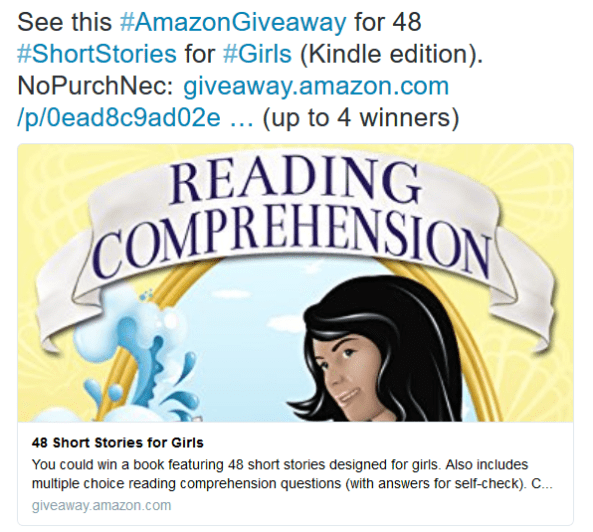
After you tweet about your giveaway with the #AmazonGiveaway hashtag, contestants can find your giveaway. Your tweet will look something like this:

Giveaway Ebook

Note that only the top portion of your book shows. If you design your book cover so it has appeal when only viewing the top portion of the front cover, you have an advantage with the giveaways.

Here is another example:
Giveaway Ebook 3

The contest page looks something like this:

Giveaway Ebook 2

HOW TO FIND GIVEAWAYS

First of all, you should enter the giveaway for my self-publishing book (volume 1). I’m giving away 10 free copies:

Chance to win 1 of 10 copies of A Detailed Guide to Self-Publishing with Amazon (Vol. 1)

Since I included an example of what Julie Harper’s giveaway looks like in a picture above (used with permission), let me also include a link to her giveaway:

Chance to win 1 of 4 copies of 48 Short Stories for Girls by Julie Harper

Find giveaways on these Twitter pages. The first link is handy, but not easy to find, and when you do find it, you need to click the Live button or you just see the most popular ones. But my first link below is special, as it goes straight to the Live feed. The second link is lacking the visual element, but is easier to find on your own.

https://twitter.com/hashtag/amazongiveaway?f=tweets&vertical=default&src=hash

https://twitter.com/GiveawayLinks

7 DAYS OF GIVEAWAYS

amazon.com/7days

Write happy, be happy. 🙂

Chris McMullen

Copyright © 2016

Chris McMullen, Author of A Detailed Guide to Self-Publishing with Amazon and Other Online Booksellers

Click here to view my Goodreads author page.

  • Volume 1 on formatting and publishing
  • Volume 2 on marketability and marketing
  • 4-in-1 Boxed set includes both volumes and more
  • Kindle Formatting Magic (coming soon)

Follow me at WordPress, find my author page on Facebook, or connect with me through Twitter.

Comments

Click here to jump to the comments section.

How Much Does Amazon Pay Kindle Unlimited ALL-STARS?

All Stars

KDP SELECT ALL-STARS

I researched what Amazon pays KDP Select All-Stars for pages read in Kindle Unlimited.

(My reason for doing this is to estimate how many Kindle Unlimited subscribers there are, but that will be the subject of a coming post.)

If you want to see the Amazon KDP help page where I found my information, it’s right here:

https://kdp.amazon.com/help?topicId=A2X66QXB12WV2

Amazon presently pays about one million dollars (perhaps a little more, depending on exchange rates) in KDP Select All-Star Bonuses based on KENP pages read during the month (books must be claimed through Author Central to be eligible):

  • $500,000 is awarded to the top 100 authors for US pages read: $25,000 to the top 10, $10,000 to the 11th thru 20th, $5,000 to the 21st thru 30th, $2500 to the 31st thru 50th, and $1000 to the 51st thru 100th.
  • $90,000 is awarded to the top 100 books for US pages read: $2500 to the top 10, $1000 to the 11th thru 50th, and $500 to the 51st thru 100th. (It pays better to be a top author than to have a top book.)
  • £77,500 is awarded to the top 100 authors for UK pages read: £2000 to the top 10, £1500 to the 11th thru 20th, £750 to the 21st thru 30th, and £500 to the 31st thru 100th. (The US pays much better bonuses than the UK.)
  • £20,000 is awarded to the top 100 books for UK pages read: £500 to the top 10, £250 to the 11th thru 50th, and £100 to the 51st thru 100th.
  • €310,000 is awarded to the top 100 authors for DE pages read: €7500 to the top 10, €5000 to the 11th thru 20th, €3500 to the 21st thru 30th, €2500 to the 31st thru 50th, €1500 to the 51st thru 100th, and €500 to the 100th thru 150th. (Germany pays very well, and even pays 50 additional authors.)
  • €50,000 is awarded to the top 100 books for DE pages read: €750 to the top 10, €500 to the 11th thru 50th, and €250 to the 51st thru 100th.
  • $31,250 is awarded to the top 100 illustrated kids’ books (as Amazon deems eligible) for pages read in the US: $1000 to the top 5, $750 to the 6th thru 10th, $500 to the 11th thru 30th, $250 to the 31st thru 50th, and 150 to the 51st thru 100th.
  • £2500 is awarded to the top 100 illustrated kids’ books (as Amazon deems eligible) for pages read in the UK: £100 to the top 25.

These books and authors are already earning good money for the pages read (many of these are in the millions of pages read per month), and that’s on top of sales.

Amazon obviously throws in this incentive to encourage the top authors to keep their books enrolled in KDP Select.

You’re probably wondering: If Amazon didn’t pay roughly one million dollars in All-Star Bonuses, what impact would that have on the per-page rate? In January, it would have raised the per-page rate from $0.0041 to $0.0043. It’s probably worth it to attract the most read indie authors and books into the program, as they help to attract customers to Kindle Unlimited.

Write happy, be happy. 🙂

Chris McMullen

Copyright © 2016

Chris McMullen, Author of A Detailed Guide to Self-Publishing with Amazon and Other Online Booksellers

Click here to view my Goodreads author page.

  • Volume 1 on formatting and publishing
  • Volume 2 on marketability and marketing
  • 4-in-1 Boxed set includes both volumes and more
  • Kindle Formatting Magic (coming soon)

Follow me at WordPress, find my author page on Facebook, or connect with me through Twitter.

Comments

Click here to jump to the comments section.