Short Stories & Kindle Unlimited: The good, the bad, and the whacko

Short

INTRODUCTION

I will make two points in this article:

  1. Don’t sweat the myth that Kindle Unlimited promotes shorter works. It doesn’t.
  2. There is an opportunity to market shorter works through Kindle Unlimited. But it won’t be easy.

If you have short stories that you want to market on Kindle, the second point will present ideas for how to do this effectively.

However, as the first point will stress, Kindle Unlimited won’t open the door for the get-rich-quickly-through-short-works bandwagon.

I’ll explain why I believe that Kindle Unlimited doesn’t actually favor short fiction, while at the same time showing that it is possible to market short stories.

It’s not really contradictory: The key is that selling shorter works is neither easy, automatic, nor obvious. This explains why most short pieces won’t take off, even though it will be possible to market them effectively.

SHORTER BOOKS, BIGGER PROBLEMS

A big myth going around presently is that Kindle Unlimited favors shorter books.

The underlying idea seems to be that it’s easier for customers to reach 10% of shorter books, and 10% is the critical number for getting paid for Kindle Unlimited downloads. (Need an introduction to Kindle Unlimited? Click here.)

Customers could easily get 30% through a short story before realizing that they don’t actually want to finish it, but for a 200,000-word book, they must read 20,000 words before the author will get paid.

But here’s the thing: All books aren’t created equal. There isn’t equal likelihood of customers downloading shorter books and longer ones. This is where most short books are greatly disadvantaged.

Here are several hurdles that authors must overcome in order to succeed in the short reads market with Kindle Unlimited customers:

  • Kindle Unlimited customers tend to be avid readers. It costs $9.99 per month, which amounts to $120 per year, to subscribe to Kindle Unlimited. This will attract avid readers, who will easily get their money’s worth. Spending $10 per month to read short stories won’t seem like a good value to many customers.
  • Avid readers tend to be smart book shoppers. They aren’t likely to be fooled by authors trying to game the system. They are likely to consider the value of books when they shop. Page count will be a factor. So will price.
  • Kindle Unlimited customers may prefer to download higher-priced e-books. It takes ten 99-cent e-books just to get your $9.99’s worth for the month, but if you download five $6.99 e-books, you get a $35 value. Short books are likely to be priced at 99 cents. Simply raising the price of a short story to $5.99 won’t work: Customers will see a large price on little content… and… remember, avid readers are smart book shoppers.
  • Shorter books require even better writing. A few mistakes in a 300-page novel: no problem. One mistake in a 20-page short story: ouch! It’s not just the mistakes, but the mechanics of the writing, the flow of the story, the characterization, the plot, a satisfying ending… the idea has to be fantastic. When you write 100,000 words, you can have a few weaknesses provided that your strengths make the bulk of the book intriguing and enjoyable. In a short work, mistakes of any sort really stand out. The challenge of writing an effective blurb shows how much harder it can be to write much less and do it very well.
  • Writing that works for short stories is different from the kind of writing that works for novels. So if you simply produce a very short version of novels that you’re familiar with, it probably won’t work. You have to research which kinds of short works sell and come to understand how they are effective. (Now the devil’s advocate will say that all writers should try writing short stories—despite the fact that they might be much harder to sell, in general—because learning how to write a short piece well can be highly instructive for writers. Write a short story for what you can gain from it in the long run.)
  • Although readers could take a chance on a short story since little commitment and investment is involved, it’s also true that readers may be pickier when choosing which short stories to read. There certainly are enough short stories out there to choose from. One story doesn’t satisfy a reader for long. What’s the reward for liking the short story? Will there be another 200,000 words worth of writing to enjoy by the same author? You see, when you find a novel that you like, if the author has a few other novels, the reward is a lot more where that came from. If you just have a dozen short stories out, a reader could blitz through the whole collection in a day; you aren’t offering a huge supply of reading material as a potential reward if the reader likes your style.
  • There is much competition from free and low-priced stories. Why should people read your short stories when they can get the entire Sherlock Holmes collection for 99 cents or free? There are many classic short story collections out there at great prices. This comes back to my last point: If you like Sherlock Holmes, or any other classic short work, there is a ton of similar material to satiate your craving for it. If you like a short story by a modern author, often there are just a few more short stories—not enough to satisfy a reader for long.
  • Visibility is a huge issue. Suppose, for example, you want to write a short romance story, hoping to take advantage of the huge romance market. Do you think Amazon wants your short story to show up among hundreds of popular novels when customers search for romance? That could create confusion. So instead your short story should be listed among Short Reads or short story collections. 99% of romance readers will instead be browsing the romance category, looking for novels. There is a marketing challenge here: You’re not just selling a book to romance customers, you’re selling a short story specifically to the very few romance readers who want to read a short story. There is a market for that, just not nearly as wide as the romance novel market.
  • Another marketing challenge is the Look Inside. The shorter your ‘book’ (if you can call it that in this case), the shorter the Look Inside. The Look Inside is a valuable sales tool. A short story has a very short Look Inside. There may easily not be enough there to catch the reader’s interest. You could just give the title, author name, and start the story, moving the copyright notice to the end, but you still need the Look Inside (10%) to be long enough to sell the book.
  • Effective marketing is more costly and time-consuming for a series of short works. It’s fairly affordable to hire out quality cover design and editing for a full-length novel, but can be quite expensive to buy several covers for short pieces or have several short works edited.
  • For those hoping to game the system with short works, customer reviews will be an equalizer. Especially, if they are hoping to benefit from Kindle Unlimited, as avid readers tend to be smart book shoppers.
  • Another equalizer is experience. Customers don’t have to get ‘burned’ too many times to become wiser shoppers. Time favors quality and good value.
  • Even if short works do gain traction, as soon as it becomes popular and fashionable, the market will be flooded with short works. (This really doesn’t affect other authors, as the cream rises to the top. It’s always easy to find books that have achieved success; the not-so-good stuff really isn’t in the way—it falls to the bottom, out of the way.) The thing is, the flood will make it ineffective for authors hoping to generate high rewards with little effort, which means the flood won’t last. Those who succeed through quality writing, satisfying a niche audience, will continue to thrive—hard work, good ideas, and effective marketing will always help such authors thrive.

There are different kinds of short books. Let’s do authors a favor and not generalize them. Some authors slap something short together quickly, hoping to get rich. Other writers craft short pieces with masterful storytelling. These are the two extremes, then there is much in the middle. We would do a great disservice to masterful storytellers who specialize in short fiction by saying bad things about all short works.

A few of my points above specifically address the gamers, but the rest are hurdles that all short works authors must overcome in order to thrive in the short reads market.

BOOK CHOPPING

Okay, there is another extreme that I should address: book chopping. Again, I can’t imagine this being effective, and I will explain why.

Here is what I mean by book chopping: An author takes a regular-length novel and divides it up into smaller chunks (as short as a chapter, perhaps, or it could just be a few parts).

The idea behind this ‘strategy’ is that Kindle Unlimited customers can download several books without paying an extra penny, while the author earns a royalty every time a customer reads 10% of one of his or her books.

So, you could sell a novel and earn $1.80 or so for one download, or you could split that same novel into 5 parts, earning $9 from every customer who finishes the novel. Why stop there? Split it into 20 parts and you make $36 for that single book, right?

Except… Kindle Unlimited customers aren’t likely to reward this behavior, for the many reasons listed above.

On top of that, you have several ‘chapters’ cluttering up your Kindle, and you can only store 10 Kindle Unlimited downloads at a time. Suppose you’re reading Chapter 32 and would like to go back to Chapter 4 to refresh your memory of something that happened earlier. INCONVENIENCE doesn’t sell books!

Sure, some unscrupulous authors might find a way to abuse the system in the short run with this, but (A) they won’t find substantial or long-term success by chopping books and (B) Amazon tends to learn how to prevent authors from taking advantage or catch and provide a fit punishment for those who game the system. It’s not going to work to achieve anything significant, and even for those who are so unscrupulous, the benefits definitely don’t outweigh the risk.

Series are an exception. When each volume of a work reaches a natural division, and where each volume provides a complete, satisfying reading experience, then it’s not a chopped book—it’s a series. Many customers appreciate series, and series authors often do well. You can be a successful series authors, and marketing a series has many advantages. It’s even possible to develop and market a series of short pieces, but this won’t be a chopped novel—each piece will be effective by itself.

MARKETING SHORT WORKS

It is possible to succeed with short fiction or nonfiction pieces.

It’s not easy. You have to overcome the many challenges that I’ve outlined above.

It will take hard work and effective marketing. Find ways to use hard work and brain power to overcome these challenges, and you can stand out from the crowd and succeed with short pieces.

Following are some ideas to help you with this.

  • You need to cultivate a culture for your series of short works. You need to play an angle that gives your short reads an edge. You need to find a concise way to announce this clear and up front, e.g. in a subtitle, through a strap line, as a cover byline, in your blurb, with a slogan, on all of your marketing materials, etc. It’s the card you have to play. Take full advantage of it. Sometimes, it’s not enough to fill a need: You have to show people that they have a need, and you have what they didn’t know they needed. See my next bullet for some specific suggestions. But, whatever angle you play, focus on fostering a culture. This is the key to long-term success.
  • Here are some possible angles. Commuter fiction—read on a plane, subway, or train: Market to commuters, show how your series is tailored for this. Lunchtime reading—have some free time at lunch, but can’t really go anywhere to enjoy it. Morning inspiration—short motivating reads to help people get their days started on the right foot. Bedtime reading—a leisurely way to wind down for a good night’s sleep. People aren’t going to think of the angle for you. You need to find the angle that suits your short works best, and make this point abundantly clear. Don’t sell the book: Sell the benefit.
  • You can get good visibility through wise choices for your categories and keywords. The problem is that you only get to choose 2 categories and 7 keywords, so you must do some research and choose wisely. Find short works similar to yours selling well on Amazon and see which categories they are listed under, and see which keyword searches they show up in. The most relevant category may be Kindle Short Reads (click here) at Amazon.com, but this category is not available through the publisher’s choice (see here); yet there are 700,000 Kindle e-books in this category (with 250,000 in KDP Select), so although it’s said to be ‘restricted,’ evidently it’s easy (or automatic) to get in just by having your book the proper length.
  • Check out the Kindle Short Reads page, as it provides a useful guide for how long it takes to read how many pages. You need to know this. If you’re selling your book as commuter fiction or lunchtime fiction, for example, you need a reliable estimate for how long it will take to read your book. This number is valuable. “Have 30 minutes to read on your lunch or on a train ride? This 15-page book will hit the spot.”
  • Research a couple of specific keywords that may be relevant for your short work. Start typing in the search field at Amazon and it will show you popular matches. You want matches that are both popular and specific to your book; that helps you gain visibility (it doesn’t help to be the last book in a search with many results). Note that popularity varies whether you search in all departments, books, Kindle, Short Reads, or a specific category: So test them all out. Note that “commuter fiction,” for example, doesn’t even pull up a match presently, so don’t waste your keyword with things like this that are never searched for. “Short reads,” on the other hand, is a popular search (with 1250 results, though, so you need to be high up on that list).
  • You want to create a series of short works that stand out and are easy to find. You could put “commuter fiction,” “lunchtime fiction,” “Lisa’s shorts,” “inspirational stories,” or something in a subtitle or series title (though you have to number series with Kindle) or in parentheses, making it easy to find your brand—while also declaring it a short work. If the subtitle or parenthetical note, which will be visible in search results, also emphasizes the advantage of your book’s length (e.g. Commuter Fiction), even better.
  • The covers of your series need to send a clear, unique brand. Have a dozen short stories? You want them all to look uniform. You want them all to be very easy to find. A customer sees any of your short books and immediately recognizes the series. Branding is vital. You want new customers to see that you have a wealth of similar books, i.e. the reward for trying you out and liking your writing is much more where that came from. You want old customers to easily find your other pieces. An appealing (to your target audience) visual brand that creates a unique signature, that’s what you want.
  • Write several similar short books. You’re not likely to sell a ton of short books if you only write one or a few; one-hit wonders aren’t likely in short fiction. If you succeed in hooking some customers on the benefits of your short works, where you really stand to benefit is when you get customers to buy several of your books. It also shows new customers that you’re a serious author, and that there is plenty of reading material similar to any of the short pieces that you offer.
  • Once you succeed in growing a fan base, you want timely releases. They’re short, so you can write, say, one a month. (Say, you spend a month writing. You pass it onto your editor, getting it back weeks later. You also wait for your cover designer. It might take a few months before it’s publish-ready. But once the train gets started, you can have one to publish every month.) You want to publish regularly, so fans start to look forward to the 15th of every month (or whenever, but they know when to expect it). An advantage of releasing a short piece in 30-day intervals is that you always have a book in the Last 30 Days new release category.
  • Amazon tends to help authors who (scrupulously) help themselves. Effective premarketing and marketing can pay big dividends, not just in immediate sales. Another factor on your side is word-of-mouth. Learn the craft and produce quality short reads, and it can lead to long-term success.
  • Look for marketing groups, e.g. in Facebook or at Goodreads. Some groups will correspond to your genre, e.g. fantasy or romance. Also look for groups dedicated to short reads (heck, you could start a group). If you’re using Kindle Unlimited, look for groups associated with this, too.
  • Make one short read free. You should plan to publish dozens of similar books, so, really, why can’t you afford to make one good one permanently free? The freebie won’t be in KDP Select. Publish it on Kobo, Smashwords, etc. At Kobo and Smashwords, you can make it free, and then you (or customers) can notify Amazon of the lower price, politely requesting a price match. The hope is that your freebie will encourage many readers to try out your other stories. Remember, your work has to be good enough to make readers want more of the same. Making junk free isn’t helping anybody.
  • Educate your audience. Show them the benefits of Kindle Unlimited, e.g. how for $9.99 per month they can read your series of dozens of books without paying an extra penny. Show them how to find short reads (include the link to the Kindle Short Reads category). Explain how they might benefit from short reads, e.g. during commutes or lunchtime. Of course, you mention your series at the end of your marketing endeavor. If you’re promoting commuter or lunch fiction, remind your readers to stock up on the weekends, so they don’t waste precious time during their commutes or lunch breaks just searching for the next read.

Chris McMullen

Copyright © 2014 Chris McMullen, Author of A Detailed Guide to Self-Publishing with Amazon and Other Online Booksellers

  • Volume 1 on formatting and publishing
  • Volume 2 on marketability and marketing

Follow me at WordPress, find my author page on Facebook, or connect with me through Twitter.

Comments

Click here to jump to the comments section:
https://chrismcmullen.wordpress.com/2014/08/18/short-stories-kindle-unlimited-the-good-the-bad-and-the-whacko/#comments

Learn Much about Self-Publishing by… Blogging

Blog First

Hands-on Self-Publishing Experience

Blogging at WordPress can teach you more about self-publishing than you might realize.

Think about this, and strive to get the most out of it.

It would be wise to blog before self-publishing for the hands-on experience every authorpreneur needs to be successful.

But even if you’ve already self-published, it’s not too late to make the connection between blogging and indie publishing.

Here are several ways that blogging at WordPress can help you become a more successful authorpreneur:

  • Crafting the title. You have to write titles for your blog articles, so you get plenty of experience trying out titles and seeing how much attention your posts get. The title is a very important part of your book. Without blogging, most authors would have no experience or practice writing titles and seeing what interest they stimulate. Study the titles of articles from popular bloggers.
  • Content popularity. Writing about different topics, you can see which seem to be more popular or less popular among bloggers. The best way to learn what people like is through first-hand experience.
  • Keywords and categories. Gain experience choosing categories and tags for your articles at WordPress. You’ll need to choose categories and keywords when you publish. For your blog, you can type phrases in Google to see how popular they are, and for your book, you can try phrases out at Amazon’s home page. When you come across popular blog articles similar to what you write, check out the tags and categories that they used.
  • Cover design. Preparing or linking to images in your posts gives you some feedback regarding how to attract an audience visually. You also see images that evidently attract much attention to popular blog articles. The more you prepare your own images, the more you learn little tips.
  • Look Inside. In the WordPress reader, people only see a short sample. Bloggers strive to learn how to use the beginning of the article to create interest in the article. Similarly, at Amazon, you need to write an engaging blurb and Look Inside.
  • Writing practice. Blogging offers writing practice for self-published authors. You can even try out a new style or genre, with real readers to offer feedback.
  • Build your brand. At WordPress, you strive to build your blogging brand. This will carry over to becoming an authorpreneur, where you need to develop brands as an author and for your books.
  • Learn about marketing. You get firsthand experience trying to market your blog, which will carry over to book marketing. You get to see what other authors do in the way of marketing. Plus, blogging helps you build helpful relationships that can help you with your marketing when your book comes out. Some of your followers will serve as your initial fan base, too.
  • Monitor traffic. WordPress shows several stats that help you analyze your blog traffic. This can help give you a sense of the potential of your blog to help with marketing—a small percentage may be your initial fan base, but more importantly, the search engine traffic helps you see what frequency of outside visitors discover your website daily. The number of likes per post gives you some idea of your active following, which can pale in comparison to your total following; the search engine traffic is the number with the greater potential.
  • Get support. Relationships that you build on WordPress can support you with advice, reblogs, feedback, and more when you begin your self-publishing journey.
  • Explore formatting options. You have to format your posts here at WordPress. As you try new things in your articles, you gain some formatting experience. An e-book formats much like a webpage.
  • Test an idea. Got an idea that you want to test out? Try a sample on your blog and get some feedback.
  • Meet your audience. A thin slice of your WordPress following will include readers from your target audience. These interactions are golden.
  • Device management. Over time, you happen to view your blog from your pc, laptop, a friend’s iPad, a cell phone, etc. This gives you some idea about how various things format on different devices. That’s good experience for the challenge of formatting e-books that read well across all devices.
  • Analyze stats. Stats at Amazon are pretty limited—royalties, sales rank, reviews. You get many more stats here at WordPress—countries, views, likes, follows, shares, comments, etc. Such data can be valuable. You could even make a graph of your blog views for the month and compare it with your sales graph to see if there may be any correlation.
  • Website development. Indie publishers need to have websites, Facebook author or book pages, author profiles, etc. The experience you gain transforming your blog into a website will help you anytime you need to create a webpage or website.
  • SEO. You write articles hoping to pull in traffic from search engines. You gain experience with SEO as you try out categories, experiment with how to include keywords in headings and body text, etc.
  • Grow a following. You’ll develop a following here at WordPress. Setup an author page at Facebook and link to it at the end of your posts, and feed your WordPress posts into Facebook (but don’t also feed Facebook into WordPress or you’ll get double posts). Similarly, feed your blog into Twitter (but don’t feed from Twitter to WordPress or Facebook, or again you’ll get double or triple posts). Create profiles at Google Plus and LinkedIn, and your WordPress traffic can help you grow a following everywhere.
  • Build connections. Meet fellow authors, editors, graphic designers, small publishers, and more in your WordPress interactions. Indie authorship is a supportive community, for the most part.
  • Create buzz. When you release a book, your blog will help you create buzz for it.

Of course, there are many other benefits to blogging. For example, you can make some great online friends, and you can find some excellent material to read for free here at WordPress. Arguably, friendships and great reading material are the BEST parts of WordPress.

Chris McMullen

Copyright © 2014 Chris McMullen, Author of A Detailed Guide to Self-Publishing with Amazon and Other Online Booksellers

  • Volume 1 on formatting and publishing
  • Volume 2 on marketability and marketing

Follow me at WordPress, find my author page on Facebook, or connect with me through Twitter.

Comments

Click here to jump to the comments section:
https://chrismcmullen.wordpress.com/2014/08/03/learn-much-about-self-publishing-by-blogging/#comments

Does Front and Back Matter Matter?

Matter

Front & Back Matter

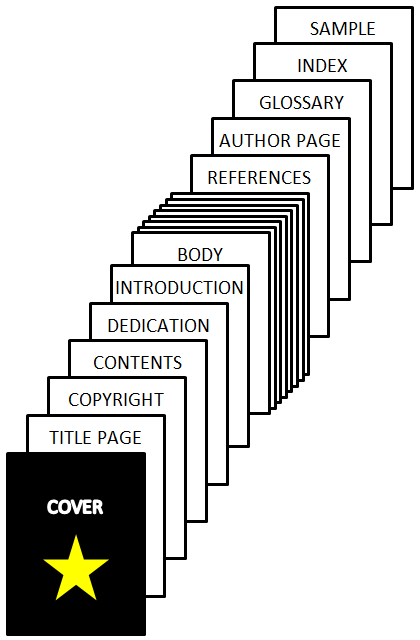
Here are some points to consider when preparing the front and back matter for your self-published book:

  • Back matter can get in the way of an important page in your e-book. The very end encourages the customer to review the book.
  • Include your blog and social media url’s on your author page (with hyperlinks for your Kindle e-book). Add a note that gives readers a reason to visit your sites (e.g. free interactive map).
  • Series authors can include a short sample of the next volume at the end of each book.
  • A reader might close the Look Inside, bored with a prologue, never reaching Chapter 1, which might grab attention better. Ask yourself if you really need that prologue.
  • Use the table of contents wisely. Chapter 1, Chapter 2, etc. is a wasted opportunity. Create short names that catch interest for fiction or that reveal content for nonfiction.
  • The more front matter you add, the longer it takes to reach Chapter 1. Ask yourself which sections you really need.
  • Short e-books might have very little writing sample to offer if there is much front matter.
  • If there is virtually no front matter, that might seem odd to the customer. Didn’t the author use other books as models?
  • Front matter must look professional to make a good impression. Nobody studies a copyright page, but when they pass by, if it doesn’t look right, it leaves an impression.
  • Publishers lead off with all kinds of too-good-to-be-true quotes. This might have merit from a well-known source, not necessarily otherwise (though they could—it really pays to know your target audience well).
  • Arguably, the most important part of the book is in Chapter 1. Come out punching with your best stuff. Unfortunately, a slow build can cost new readers. Make it easy to reach the first chapter.
  • You don’t have to have the exact same front and back matter in both your print book and e-book. An index, for example, isn’t necessary in an e-book, which doesn’t have page numbers for one, and where customers can simply search for keywords for another.
  • At CreateSpace, page number is a consideration. It can affect whether or not you can use spine text (minimum 102 pages, 130 recommended), the minimum inside margin, or how much the book costs to produce. Every page you add costs you money (unless you have fewer than 24 pages for color or 102 pages for black and white). So think about what front and back matter you really need. But if you’re between 100 and 130 pages, extra pages help you with better spine text potential. If you may be selling copies in person or to bookstores, you want front matter that looks professional and helps sell the book; and you don’t want to be missing sections that they expect to see.
  • Something cool in the front matter can attract attention, if done right. It could be a nontrivial effect with formatting or professional design marks, for example, but it has to look like it belongs there. For an e-book, add a short GIF image (important with text, since the background may not be white) with a publisher logo beside a few lines of text. You ordinarily see images below and above text, not wrapped beside it, so it could be that professional touch that makes the difference. See my example below (the logo was designed by Melissa Stevens).

Math Fluency

Chris McMullen

Copyright © 2014 Chris McMullen, Author of A Detailed Guide to Self-Publishing with Amazon and Other Online Booksellers

  • Volume 1 on formatting and publishing
  • Volume 2 on marketability and marketing

Follow me at WordPress, find my author page on Facebook, or connect with me through Twitter.

Comments

Click here to jump to the comments section:

https://chrismcmullen.wordpress.com/2014/08/03/does-front-and-back-matter-matter/#comments

Good News for Indie Authors

Good News

July, 2014 Author Earnings Report

Check out the July, 2014 author earnings report:

http://authorearnings.com/report/july-2014-author-earnings-report

It has some good news for self-published authors:

  • Indie authors found success with the Amazon bestseller lists, topping the Big 5 numbers in some statistics.
  • Indie authors drew in good revenues from bestselling e-books.

Also worth noting:

  • The Big 5 e-books made more revenue for Amazon than indie e-books, even though indie e-books drew more author revenue.
  • It’s worth reading the note about DRM being a bad idea. See the graph to see which price ranges this affects most (in some cases, the difference is slight; for others, it’s significant).
  • Check the graph that sorts data by genre. You can see that indies do well in more genres/subjects than just romance.
  • The charts also include small and medium publishers.

Successful Indie Authors

Here is a recent article from Yahoo Finance, highlighting recent indie author successes:

http://finance.yahoo.com/news/independent-romance-writers-get-the-last-laugh-%E2%80%94-all-the-way-to-the-bank-213437913.html?soc_src=mediacontentsharebuttons

While this article looked specifically at romance writers, the previous report showed that indie are having success in other genres and subjects, too.

The big thing to remember is that there are millions of books to choose from:

  • You need a cover that attracts your target audience. If it attracts the wrong audience, it will cost you much traffic. If the cover doesn’t look quite right, it’s a lost opportunity.
  • The blurb and Look Inside are your only sales tools at the point-of-sale. They need to be immaculate. They need to engage the reader immediately and keep it throughout.
  • It’s worth perfecting the content. Word-of-mouth sales are golden. You need excellent ideas that will attract readers, and a writing style to match.
  • Market for long-term success. Real success takes much time and patience to build up.

Chris McMullen

Copyright © 2014 Chris McMullen, Author of A Detailed Guide to Self-Publishing with Amazon and Other Online Booksellers

  • Volume 1 on formatting and publishing
  • Volume 2 on marketability and marketing

Follow me at WordPress, find my author page on Facebook, or connect with me through Twitter.

Comments

Click here to jump to the comments section:

https://chrismcmullen.wordpress.com/2014/08/03/good-news-for-indie-authors/#comments

What the Dreck?

Slush Pile

The Dreaded Slush Pile

Two popular terms among authors and readers make me cringe every time I see them—which is much too frequently. There are some very strong opinions about this subject, too.

  • dreck
  • slush pile

These terms generally refer to the ‘worst’ of the books, but this definition by itself creates some problems.

  • There is more than one way to define the word ‘worst.’ Do you mean editing, subject matter, sales rank, very short books, web content disguised as books, or something else entirely?
  • Thus, some authors take this the wrong way. “Are you talking about my book?”

Any one of these things, by itself, doesn’t necessarily make a book bad:

  • Maybe an author has a fantastic story, but on a low budget, chose not to invest in an editor without knowing if the book would sell. Given a choice, I’d rather have a great story that needs editing over a lousy story with superb editing. (But there are many excellent stores with good editing to choose from, so this isn’t a decision that we really have to make.) My point is that editing alone doesn’t imply that a book is bad.
  • Similarly, if the book simply has poor formatting, it could still have great content. I wouldn’t call a book poor just because it could use some tender-loving formatting care.
  • A miserable sales rank—or no rank at all—doesn’t make a book lousy. Maybe the cover and blurb aren’t attracting attention, but the story is amazing. Perhaps the author didn’t attempt any marketing. Or maybe there is a very tiny audience for the book. These things don’t determine that a book is poor. (Just that the author isn’t getting rich from that particular book. At least not presently—for all you know, it could have sold like hot cakes when it first came out, but just hasn’t sold in recent months.)
  • How about a very short book—just a few pages? If the information is valuable, people will want it. If it’s very well written, what’s the problem? The beauty is that customers can decide if that appeals to them. More people writing short books doesn’t mean that other books won’t sell. It doesn’t mean that shorter books are selling. Kindle Unlimited makes it easier for customers to reach 10% of shorter books, but Kindle Unlimited doesn’t encourage customers to download shorter books. Why borrow ten very short books? Customers spending $120 per year may be more inclined to get the best possible value for their money. But let’s just say that shorter books do start selling more. This means that those books are appealing to customers. If those short books truly are dreck, customers will stop buying them. So if they sell frequently, they must not be dreck just because they’re short.
  • Perhaps you’d like to judge the content as dreck—e.g. certain kinds of romance novels, sales pamphlets, get rich schemes. Return to my last point. If it’s selling and continues to sell, apparently it’s satisfying readers. How can you call something dreck if readers appreciate it? Because if there is something that you’re sure is better, then wouldn’t readers also agree that it’s better and stop buying the ‘dreck’? But again, even if it’s not selling, that doesn’t necessarily mean that the book is bad.
  • There are, indeed, books that we may agree are lousy. Maybe we can judge by the intention of the author. If the author made a poor effort, and was just hoping to turn a quick buck, perhaps that could properly be classified as lousy. If the author tries to deceive readers, does that make the book lousy? If the author recruits dozens of reviews to make a book seem far better than it actually is, when the author knows that nobody would have bought the book otherwise, can’t we call that book lousy?

The worst of the worst, however you want to define them, are important for two good reasons:

  • When a reader experiences a book that turns out far worse than the reader was expecting, it leaves a significant impact on the customer’s reading experience (and it tends to change the customer’s book buying habits).
  • When one of the worst books sells, it frustrates authors who have worked very hard to master their craft and publish a quality book.

Not all mention of the ‘slush pile’ stems from good intentions, though:

  • Some authors feel a sense of superiority and mention the slush pile with a sense of arrogance and disdain. This isn’t expressed as the frustration of an author who worked hard, but comes out as an “I’m better than you” feeling.
  • Some authors feel a sense of inferiority and mention the slush pile to feel better about themselves.
  • It may be in the financial interest of traditional publishers to advertise the slush pile as often as possible, hoping to create a perception that self-published books aren’t worth reading so that more customers will, hopefully, buy traditionally published books.
  • Editors and book formatters may advertise the slush pile, hoping to encourage authors to hire their services. (Editing and formatting are important. I’m not saying you shouldn’t pay for such services, just that this might be one of the motivations for advertising it.)
  • Some readers want to feel superior in terms of what they are reading. For example, they might feel superior reading literary works, and thus denounce everything else as dreck.

Personally, I feel that not enough people read. A greater selection improves the chances that everyone can find a book that he or she would like to read.

Here are some truths about the ‘dreck,’ including reasons that I cringe every time I hear it mentioned. (Am I a hypocrite for mentioning it here? My hope is to help improve the perception, and that some good may come from the following points).

  • Every indie author who mentions the slush pile or dreck is marketing a poor image for indie books, which in turn hurts his or her own sales indirectly. Oops!

  • The worst books aren’t in the way of better books. Lousy books that don’t sell quickly fall in the rankings and fall down into the depths of obscurity. Why worry about lousy books that are hard to find?

  • When a self-published author says derogatory things about other authors’ books, how does that affect his or her image? Brand a positive image for yourself. It might even help your sales.

I’m not saying that we should ignore books that have problems.

Here are some positive ways to address this issue:

  • Don’t advertise lousy books.

  • Don’t use the words ‘dreck’ or ‘slush pile.’

  • Do find a few excellent examples of self-published books and advertise those instead of the bad ones.

  • Don’t put other authors down.

  • Do find indie authors who are producing quality books and bring those authors up.

  • If you know a friend or acquaintance who is a newbie author, offer some helpful tips that will result in a better first book.

  • Occasionally share tips in your social media posts that would help fellow authors produce better books

  • Help motivate self-published authors to perfect their books.

  • Do your best when you self-publish. Do some research. Seek feedback. Don’t view your first book as an experiment. You only get one chance to make a good first impression.

Chris McMullen

Copyright © 2014 Chris McMullen, Author of A Detailed Guide to Self-Publishing with Amazon and Other Online Booksellers

  • Volume 1 on formatting and publishing
  • Volume 2 on marketability and marketing

Follow me at WordPress, find my author page on Facebook, or connect with me through Twitter.

Comments

Click here to jump to the comments section:

https://chrismcmullen.wordpress.com/2014/07/30/what-the-dreck/#comments

How to Cook the Look of Your Book

Total IndieChoosing Your Book’s Style

Consider a few things you know about style and perception:

  • A suit makes a more professional impression, right? Yet many consumers are more apt to trust a t.v. model in blue jeans and a t-shirt.
  • Worn clothes with holes reflect poor quality, yes? But have you ever seen anyone pay extra money for designer jeans that look worn and feature holes? And there is a famous tale where Ed McMahon sat down during a sales pitch, when the clients spotted a hole in the sole of his shoe and things began turn around favorably for him.
  • Would anyone be caught dead wearing outdated fashions? Yes! It happens all the time. Not everyone thinks the same way.

Now think about some things you may have heard regarding self-publishing:

  • Don’t include the word ‘by’ on the cover or the words THE END on the last page.
  • Justify full. Don’t use ragged right.
  • Times New Roman looks amateurish.
  • Show more, tell less.
  • We could make a really long list. Some designers are very picky.

There are reasons for these perceptions:

  • There are beautifully designed books that are recognized as top brands, like a Mercedes of books.
  • Some of the perceptions reflect what is typical of many traditionally published books.
  • Book designers want to sell their services, so they want authors to believe that they can’t design books well enough on their own.
  • Publishers, agents, and traditionally published authors want consumers to prefer traditionally published books, so they want to market the perception that their books are better.

Is It Really Better, or Is It a Matter of Style?

Here’s the funny thing.

Many readers may actually prefer to buy books that look a little self-published.

Who is your target audience?

  • If you expect to receive a lot of support from the millions of indie supporters—which include indie authors and their friends, family, acquaintances, coworkers, fan base— then you should design your book around people who will support self-publishing. They expect your book to look a little self-published. They expect your book to list CreateSpace Independent Publishing Platform as the publisher; heck, many indie supporters specifically search for CreateSpace on Amazon, since they know they are supporting indie authors when they buy CreateSpace books (or when they buy Kindle e-books for which the paperback is a CreateSpace book).
  • Most readers who prefer model books buy traditionally published books. Starting your own imprint that nobody’s ever heard of isn’t likely to drive those readers away from the Big 5 publishers. (Though it is possible to come out with dozens of professional looking books and establish a significant small publisher label. If that’s your long-term goal, keep that in mind as you read this article, as things may be somewhat different for you.)
  • If your book is an apple, maybe you’ll have more success by making it look like a delicious apple, instead of trying to make it look like an orange. Even if you do persuade people to buy your orange, as soon as it tastes like an apple, your marketing will backfire. That is, dress your indie book up as an indie book and play the indie card; trying to make it look like something it’s not may actually backfire.

There are several reasons that indie supporters might prefer their books to look a little self-published.

  • If it reads a little self-published, it might be easier for indie supporters to read. Much of this audience isn’t looking for Pulitzer-Prize-winning fiction. Rather, they’re looking for easy reading, easy comprehension, vocabulary they can make sense of, and grammar that makes sense to them. Sometimes, the rules of grammar seem like they’re wrong when they’re right. For example, it’s correct to say, “It is I,” and incorrect to say, “It is me,” because conjugations of the verb “to be” take a subject instead of an object. But if you know and follow this rule, it might upset much of the indie support system.
  • Not everyone has the same style. People who favor the style of traditionally published books are more likely to favor those books. People hoping for something different are more likely to support indie books.
  • If your Look Inside appears too professional, it might seem that you’re already successful. Some readers are hoping to find a diamond in the rough—i.e. one that doesn’t look like a diamond, but turns out to be. They’d like to support someone who could use a boost.
  • If your Look Inside appears too good, it might be confused for a published book. Not by people looking for published books; they know the real thing when they see it. But by people looking to support books that appear to be self-published; they might get confused by the difference. (Naturally, there will be some exceptions.)
  • If your book has a bunch of five-star reviews early on, it may deter indie support. Traditionally published books are expected to have a lot of five-star reviews, and they send out hundreds of advance review copies to get them; their customers expect it. Indie supporters expect to see some criticism, and know that reviews are hard to come by (and that’s OK). While many readers will support indie authors, many change their attitude where they suspect abuse of the review system (keep in mind they are suspicious of critical reviews, too). Many stellar reviews, with no bad ones, without a sales rank (relative to the publication date) to suggest many sales, arouses customer suspicion.
  • If your book has a bunch of review quotes, you’re playing the same game as traditionally published authors. Readers of traditionally published books know those quotes will be there, but tolerate it. A great thing about indie books is that you often don’t have to put up with that. Talk about hand-picking just the best reviews, this common game among traditional publishers takes that to an extreme.

Notice what I didn’t say. I didn’t say that you could make your book very self-published. I didn’t say that editing, cover design, formatting, and such aren’t important.

I’m saying it’s okay to be different in some ways, but there are some ways where being different can really kill your sales. It’s important to learn the difference.

Don’t Take This the Wrong Way

There are, of course, very important exceptions:

  • The cover is vital. When I say it’s okay to look a little self-published, I mean in every way except for the actual ‘look.’ The cover absolutely has to please your target audience. It doesn’t need to be a cover cliché—like a hunk on a romance cover—but it does need to appeal to the style of your potential readers. Cover appeal is critical. Not everyone wears the same kind of clothing, but everyone has a sense of style and wears clothes that appeal to them. Design a cover that appeals to nobody and you’ll sell books to… nobody. (But you can get away with more in nonfiction. For example, it’s very important for the keywords of nonfiction books to stand out well, and this can make up for otherwise looking a little self-published. For fiction, visual appeal can be everything.)
  • Consistency is key. The most important factor in the design and writing of your book is consistency. Whether you use justified or ragged right isn’t as important as consistent formatting. If some paragraphs are justified, while others are ragged right, that book won’t appeal to anyone. Your book needs to have a definite style.
  • Editing does matter. It’s not so much about having perfect grammar, as it is about (A) having consistency, (B) knowing which rules you can or can’t break, and (C) not having many obvious mistakes. If you’re a writer, everyone who knows the difference between “your” and “you’re,” for example, will expect you to know such basic rules, too. The subtle rules you can get away with to some extent. Occasional mistakes are okay; frequent mistakes can be a disaster. And often the mistakes are far more frequent than the author realizes.
  • Bookstores are different. If getting bookstores to stock your book is important to you, then it’s very important to bring a highly professional looking book with you.
  • Image is everything. You’re trying to gain publicity, so you must be careful not to get negative publicity. For example, one of the big no-no’s is commenting on reviews. Reacting emotionally in the comments section can destroy your reputation even among indie supporters. You don’t have a free license to do whatever you want, if you wish to sell books successfully.

There are some highly popular self-published books (I won’t name names, but I bet you can think of a few) that gained their success while looking a bit self-published. There are some highly professional looking self-published books that are struggling to get by. Just making the book look professional isn’t, by itself, a sales magnet. Just like a salesman with a hole on the sole of his shoe, sometimes it might be best to look a little self-published. Not a lot. Just a little. In the right places.

Be Proud of Who You Are

  • I’m an indie, and I know it.
  • I’m proud to be an indie.
  • I wear the indie badge.
  • See my name. It’s right there.
  • I wear the name proudly, but I wear it well, too.
  • I work hard at it. I’m not lazy.
  • I strive to do my best. I learn more each day.
  • But I have my own style. And that’s okay.
  • I don’t go overboard.
  • I don’t try to be what I’m not.
  • I simply carry out my own style as best I can.
  • It’s not a solo act.
  • We indies are a team.
  • We support one another. Scrupulously, of course.
  • We hear your criticism. It motivates us to do even better.
  • Go, indies!

Badge

Chris McMullen

Copyright © 2014 Chris McMullen, Author of A Detailed Guide to Self-Publishing with Amazon and Other Online Booksellers

  • Volume 1 on formatting and publishing
  • Volume 2 on marketability and marketing

Follow me at WordPress, find my author page on Facebook, or connect with me through Twitter.

Comments

Click here to jump to the comments section:

https://chrismcmullen.wordpress.com/2014/07/28/how-to-cook-the-look-of-your-book/#comments

How to Insert a Dropcap in a Textbox in Microsoft Word

Drop 8

Drop Cap in Textbox in Word

It’s not easy to insert a drop cap into a textbox in Microsoft Word. (Inserting a drop cap at the beginning of a chapter is easy; doing it in a textbox is another matter.)

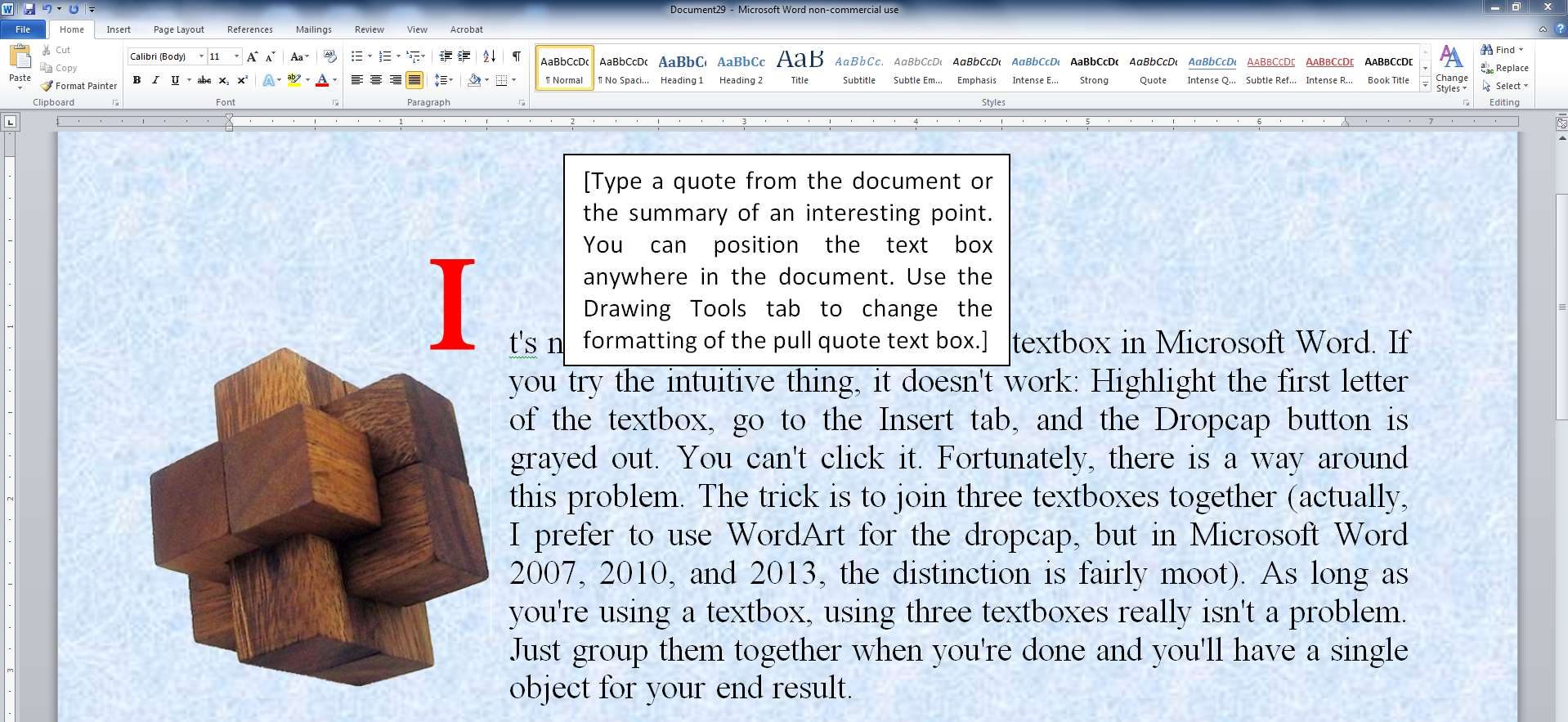
If you try the intuitive thing, it doesn’t work: Highlight the first letter of the textbox, go to the Insert tab, and the Dropcap button is grayed out. You can’t click it.

Fortunately, there is a way around this problem.

The trick is to join three textboxes together (actually, I prefer to use WordArt for the drop cap, but in Microsoft Word 2007, 2010, and 2013, the distinction is fairly moot).

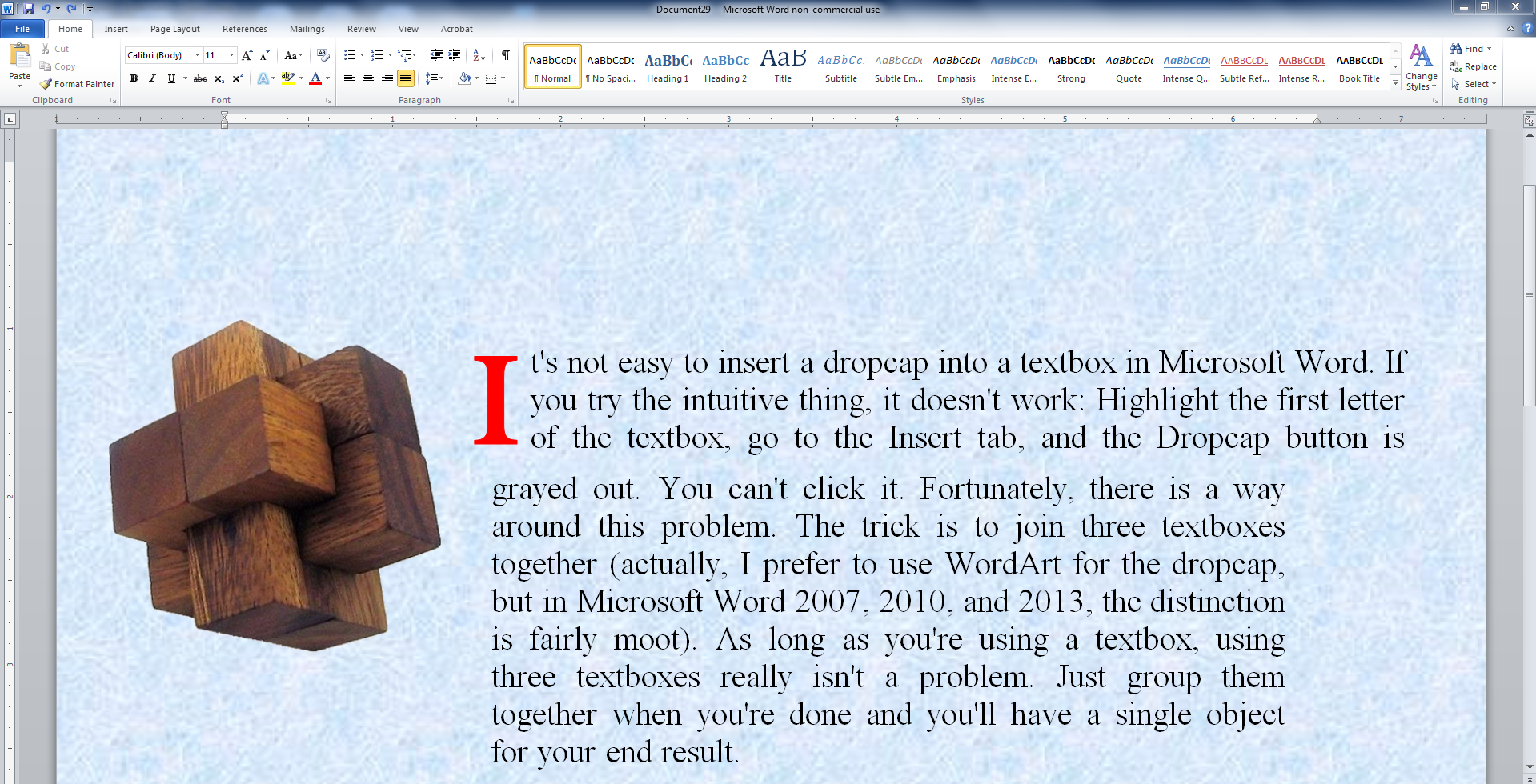
As long as you’re using a textbox, using three textboxes really isn’t a problem. Just group them together when you’re done and you’ll have a single object for your end result.

Here are the step-by-step directions, then following these you can find some screenshots that illustrate key steps:

  1. Put the first letter in its own textbox. You may prefer WordArt for the single letter. Use Insert > Text Box or Insert > WordArt.
  2. Put the first lines of the paragraph in one textbox. For example, if the drop cap will have a height of three lines, put the first three lines of the paragraph in one textbox.
  3. If the paragraph needs to be justified full, place your cursor at the end of the paragraph and press Shift+Enter to make the last line justified.
  4. Place the remaining lines of the paragraph in another textbox.
  5. Select each textbox and go to Format to set the Shape Fill and Shape Outline to No Fill and No Outline, respectively.
  6. Select each textbox and go to Format > Wrap Text > In Front of Text. (They need to be free-floating so you can position them. Once they are joined, you can change the text wrap to something else.)
  7. You will need to adjust the widths of your textboxes. That is, the lower textbox needs to be longer than the higher textbox.
  8. Position the textboxes to form your paragraph. Align the boxes precisely. You want even line spacing between the two parts of your paragraph, alignment at the right edge of your paragraph, and alignment between the left edge of the dropped cap and the left edge of the lower textbox.
  9. You may need to transfer words from one textbox to the other as you adjust their widths. The last line of the upper textbox can have really wide gaps, for example, if there is room for more words on that line and you used Shift+Enter. If so, transfer the first words of the lower textbox onto that line.
  10. If you used WordArt, you’ll need to format it. If you want to remove the automatic shadow effect, for example, click on the WordArt and go to Format > Text Effects > Shadow > No Shadow. You can manually format the font style instead of choosing a default effect.
  11. Ensure that the formatting of the upper and lower textboxes are identical.
  12. To make a single object, select the three textboxes and go to Format > Group > Group. To select multiple objects, grab one, then press and hold down Ctrl while selecting the others.


Drop 1


Drop 2

Drop 3

Drop 4

Drop 5

Drop 6

Drop 7

Drop 8

Chris McMullen

Copyright © Chris McMullen, Author of A Detailed Guide to Self-Publishing with Amazon and Other Online Booksellers

  • Volume 1 on formatting and publishing
  • Volume 2 on marketability and marketing

Microsoft Word Tutorials

Find more free Microsoft Word tutorials here: https://chrismcmullen.wordpress.com/word-tutorials.

Comments

Click here to jump to the comments section:

https://chrismcmullen.wordpress.com/2014/07/24/how-to-insert-a-dropcap-in-a-textbox-in-microsoft-word/#comments

More KDP Select Books on Bestseller Lists

Best Seller

Amazon Bestseller Changes

In the past week, several books enrolled in KDP Select have landed themselves on the bestseller lists at Amazon.

This is according to data tabulated at Publishers Lunch: http://lunch.publishersmarketplace.com/2014/07/daily-update-influence-kindle-unlimited-amazon-bestsellers-grows/.

You can easily check the top 100 bestsellers at Amazon to see the current list.

The reason for the change is the introduction of Kindle Unlimited, Amazon’s new $9.99 per month subscription service (learn more here).

Many customers are signing up for Kindle Unlimited, then downloading Kindle e-books from Amazon.

This is boosting the sales ranks of participating books, while hurting the sales ranks of other books.

600,000 titles are participating in Kindle Unlimited. This includes 100,000 published titles (such as Harry Potter) and all 500,000 KDP Select books.

So who’s benefiting?

  • Self-published KDP Select books that are attracting Kindle Unlimited customers.
  • Amazon Publishing books. (Did you know that Amazon publishes books? I don’t mean self-publishing. Amazon has its own imprints, too.)
  • Small presses that agreed to participate in KDP Select.

Who’s not?

  • Big traditional publishers and other publishers that aren’t presently participating in Kindle Unlimited.
  • Self-published books that aren’t enrolled in KDP Select.

We’re only a few days into Kindle Unlimited, yet bestseller lists have already seen a big swing, with roughly double the number of self-published KDP Select books landing on the charts.

Kindle Unlimited isn’t helping every book in the program, but many books are receiving boosts to their sales ranks through it.

It appears that Kindle Unlimited is—at least in the early going—having a strong influence on Amazon sales rank.

Obviously, landing on the bestseller lists is amazing for exposure, and falling off really hurts exposure.

Love it or hate it, one thing is for sure: Kindle Unlimited is creating an impact, and it’s having some fascinating effects.

Chris McMullen

Copyright © 2014 Chris McMullen, Author of A Detailed Guide to Self-Publishing with Amazon and Other Online Booksellers

  • Volume 1 on formatting and publishing
  • Volume 2 on marketability and marketing

Follow me at WordPress, find my author page on Facebook, or connect with me through Twitter.

Comments

Click here to jump to the comments section:
https://chrismcmullen.wordpress.com/2014/07/24/more-kdp-select-books-on-bestseller-lists/#comments

Marketing Books with QR Codes

author-2

QR Codes

Why should you care about them?

Three good reasons:

  • Humans are more likely to pursue an option that allows them to be lazy. Extra work deters sales.
  • People can easily make mistakes when typing a website address. Typos cost sales.
  • Many of your potential customers are into the latest technology. Give them an opportunity to play with their toys.

QR codes make it easy for your customers to find your Author Central page, book’s product page at Amazon, Facebook author page, Twitter page, WordPress blog, Goodreads author page, or other websites.

What Is a QR Code?

A QR code is a two-dimensional barcode. QR stands for Quick Response.

It’s very common in the consumer industry for a QR code to contain the information for a website url.

You can see a sample QR code above in the image I used for this post.

Here’s how the QR code works:

  • You visit a website that allows you to generate a QR code for your website. Some QR websites do this for free.
  • Then you download the JPEG or PNG file for your QR code.
  • Include your QR code on your book marketing materials.
  • Smartphone users can download free apps that scan QR codes.
  • The customer uses the QR scanner on his/her smartphone to scan the QR code. It’s just the phone’s camera reading the QR code.
  • When the QR code is scanned, the phone’s browser opens the website address associated with the QR code.
  • You can even track statistics associated with QR code scans, which is great for marketing.

Quick and Easy

Really, it’s incredibly easy.

If you have a smartphone, you just open the app, which opens your phone’s camera, point the camera at the QR code, and that’s it. The phone beeps, the phone’s internet browser opens, and the webpage appears on the phone.

Many smartphone owners have already installed free apps on their phones to scan QR codes. Many people recognize QR codes when they see them and scan them.

If you’ve never scanned a QR code before, what are you waiting for?

  • Get your cell phone out and search for apps.
  • Type QR code into the search query. Browse for free QR scanners.
  • I have an android phone. I tried a few. I like one called QR Droid.
  • Install the QR scanning app on your phone.
  • Test it out. You can scan the QR code above if you like (it will take you to my Amazon author page). Or the next time you buy a soft drink in a fast food restaurant, see if there is a QR code on the cup.

It’s just as easy for authors to generate free QR codes to help market their books. You just find a free website, enter your website url, and download an image file with your QR code.

Marketing with QR Codes

There are several websites that specialize in generating QR codes. Many offer free QR codes. Many allow you to track statistics.

I tried scanova.io and really liked it. I tested out Scanova and some other popular QR generators, and found Scanova most suitable for my needs.

When searching for a QR code generator, consider these features:

  • Will customers see advertisements on your website? Some of the generators require you to pay a monthly fee to avoid this.
  • Do the QR codes work reliably? Make a free one and test it out.
  • Do they offer free tracking of statistics?
  • How many trackable QR codes can you get?
  • How many trackable QR codes do you need?
  • Do they offer color or visual QR codes?
  • Is there a limit to how many QR scans customers can do per month? Some charge a fee to raise or remove this limit.
  • One of the fancy paid QR services that I explored in my research offered you the chance to create a QR code that goes to one page that shows your website, Facebook, blog, Twitter, etc. It was an all-in-one page. Of course, you could create your own free webpage somewhere and put all this together on that page, then use a free QR code to go to that page instead of paying for this special feature.

Don’t like the way QR codes look? Not a problem. Scanova and other QR code generators offer visual QR codes. You upload an image, such as a logo, and they turn it into a visual QR code.

Plain QR codes are more likely to be instantly recognized as QR codes, and it’s possible that they will be easier to read. You can test out a visual QR code and a plain one to compare them.

Book Marketing

You want customers to visit your author page, blog, social media sites, Amazon product page, etc.

So make it easy for the customer to do this. That’s what QR codes are for. Why type that url when you can just scan it.

Online, the customer would simply click on the link. That’s easy. But what about when it’s not online?

Anytime you print your url, add your QR code, too:

  • On the author page of your print book, include the QR codes to your WordPress blog, Facebook author, and Twitter pages.
  • When you print bookmarks for your book, add the QR code to the book’s product page at Amazon.
  • Add a QR code for your Amazon author page to your business cards.
  • Create flyers for a Goodreads giveaway or Rafflecopter contest. A QR code makes it easy to enter.
  • Send postcards to your client lists, notifying them (with a personal touch!) when your new book comes out—with a convenient QR code.

If you want to go overboard, you can even tattoo a QR code on your forearm or paint one on the door of your car! (Hey, you just might get the local news to make a story out of it for extra publicity.) Be sure to put a QR code on your pet’s id tag! 🙂

Really, you don’t have to do extra work to use QR codes in your book marketing. Just add a QR code to anything you’d ordinarily print, including your book, bookmarks, business cards, etc.

It’s free. It’s really not extra work. So why aren’t you using QR codes? What’s there to lose?

In addition to helping you generate additional traffic, QR codes offer tracking statistics. If you succeed in getting customers to scan QR codes that take them to your book’s product page at Amazon, you get tracking data that you wouldn’t ordinarily obtain.

Are QR Codes Dead or Alive?

I’m not saying that QR codes are so popular that everyone is scanning them, and that this is the easy solution to all your marketing woes.

What I am saying is that QR codes are easy to make, easy to use, and can help you generate additional traffic without much extra work.

Who can’t use extra traffic without extra expense and with very little work?

QR codes are in use. Many big-name fast food restaurants include QR codes on their disposable products, such as soda cups. Big retailers are keeping QR codes alive. You can take advantage of this.

There are alternatives to QR codes, but again, there are many people who recognize and use QR codes, you can make them for free, it makes it easy for customers to find your website, it offers you tracking data, and it requires almost no work to take advantage of this free marketing resource.

You

That’s right! You! 🙂

What can you do?

Install a free QR scanner on your smartphone.

The next time you come across an author’s QR code and you’re curious about the author or the author’s book, scan the QR code and check out the website.

Chris McMullen

Copyright © 2014 Chris McMullen, Author of A Detailed Guide to Self-Publishing with Amazon and Other Online Booksellers

  • Volume 1 on formatting and publishing
  • Volume 2 on marketability and marketing

Follow me at WordPress, find my author page on Facebook, or connect with me through Twitter.

Comments

Click here to jump to the comments section:

https://chrismcmullen.wordpress.com/2014/07/13/marketing-books-with-qr-codes/#comments

Dictionary Phobias in the Digital Age

Fear of Long Words

Reading in the Digital Age

—Have you heard the argument that most readers want easy reading, which doesn’t frequently send them to the dictionary? This is the subject of much heated debate, which isn’t the focus of this article (though I would say different authors have different styles and different audiences—if there is a significant audience for a style that you can write, it would make sense for you to write to that audience). Put your opinion on whether or not we should make reading vocabulary friendly aside for a moment. As I mentioned, I didn’t bring this up with intention of stirring that debate. I want to just call attention to the fact that there is a dictionary phobia in the Digital Age. Doesn’t it strike you as odd that there is one? Technology should be making it easier to deal with and improve vocabulary. If so, why are many people still afraid of encountering words they might not know? Here is my point:

  • I just opened a book on my Kindle Fire.
  • I encountered a word I didn’t know.
  • I touched the word with my finger until it was highlighted in blue.
  • A window popped up showing me the pronunciation key and definition.

Back when I was a kid (and we had to walk uphill both ways—if you want to enjoy a little humor, look for my ‘proof’ of this toward the end of this article—into the wind, too!)… …There was a mammoth unabridged dictionary sitting on its own table in every classroom. If a student asked a teacher what a word meant, said student would soon be standing at that table thumbing through said dictionary. …Sometimes, we’d be reading on the bus, with no dictionary in sight. Now it’s so easy. If you’re reading a digital book, all you need to do is touch the word. It’s almost like having a magic genie, except it’s a hundred times easier to press the word than it would be to rub the lamp and make a wish (and then you only get three wishes and each wish has unintended side effects).

When it’s so easy to look up a word, why are so many people afraid of seeing words they didn’t already know?

I think it’s a good question. There are probably some answers. That is, some reasons. I really mean, some ways to explain why it is the way it is. But maybe that isn’t the way it should be. Reading is a great way to develop better grammar, improve your vocabulary, and improve your writing. Now it’s so easy to look up any word you don’t already know. Okay, let me address the obvious exception:

  • If you have to look up every other word, even pressing the word in an e-book will become a chore and detract from story enjoyment. My question relates to occasional words, not this extreme.

Proof that we had it harder when I was a kid

So, I said, albeit in jest, that we had to walk to school and it was uphill both ways. I’m sure you ‘know’ that can’t be true, so I’m going to apply my knowledge of physics to prove you wrong. Here’s the deal. As illustrated below, the school was located on the side of a mountain. The school was very tall. The town was situated halfway up the mountain. First period was at the top of the school, so we had to walk up to get to the top of the school. Last period was at the bottom of the school, so we again walked up to get back home in town. QED.

Uphill Battle

Hippopotomonstrosesquipedaliophobia

Isn’t that a great word? You gotta love it!

How do you pronounce hippopotomonstrosesquipedaliophobia? What does hippopotomonstrosesquipedaliophobia mean? Forgive me for my repetition, but any chance to use hippopotomonstrosesquipedaliophobia in a sentence just can’t be squandered. 🙂

  • Hip·po·po·to·mon·stro·ses·quip·e·da·li·o·pho·bi·a (Hip’-uh-paw-tuh-mahn-stroe’-ses-kwip’-uh-dah-lee-owe-foe’-bee-ah) n. (hippopoto– Greek-derived for fear, –mostr– Latin for monstrous, –sesquipedali– Latin for long word, and –phobos Greek for fear)—fear of long words.

Chris McMullen

Copyright © 2014 Chris McMullen, Author of A Detailed Guide to Self-Publishing with Amazon and Other Online Booksellers

  • Volume 1 on formatting and publishing
  • Volume 2 on marketability and marketing

Follow me at WordPress, find my author page on Facebook, or connect with me through Twitter.

Comments

Click here to jump to the comments section:

https://chrismcmullen.wordpress.com/2014/07/11/dictionary-phobias-in-the-digital-age/#comments