Self-Publishing Boxed Set: Cover Reveal & Question

Self Publishing Omnibus

A recent publishing trend is to release a boxed set some time after completing a series. Once buzz for the final volume seems to settle, a boxed set provides an opportunity to revitalize interest in your series. It will also get your series back into the new release categories one last time.

Each volume can only be on sale periodically. If priced at a good value, even when the boxed set is at its regular list price, it still has the allure of being on sale—because readers save money compared to each volume individually. Another thing the boxed set can do is entice readers to buy the entire series up front, rather than one volume at a time (thereby avoiding some of the readers who might not reach the end).

(It doesn’t necessarily have to be a series, although a boxed set is most common for series; it could be a set of very similar books.)

The boxed set helps to establish the perception of great value.

You could add bonus material, but you may want to consider this carefully. Is the bonus material available separately? Your loyal fans who have purchased each volume separately might not appreciate having to also buy the boxed set just to get the bonus material. If you can solve this problem, then it can add further value to your boxed set without upsetting your fans.

Cover Reveal

I don’t have any boxed sets yet, but as you can see with my cover reveal, I have one in the works. Please share your feedback on the cover design (while keeping in mind that I don’t intend to redo the original covers of Volumes 1 and 2, and therefore intend to preserve this aspect of the boxed set design).

Question

Here’s my question: What would you call a nonfiction boxed set?

Of course, it could just be called a boxed set. The term omnibus is used frequently for boxed sets. Would you use omnibus for nonfiction, or you do think it should be used for fiction only? Can you suggest an alternative? I appreciate any suggestions. Thank you in advance.

Publishing Resources

I started this blog to provide free help with writing, publishing, and marketing. You can find many free articles on publishing and marketing by clicking one of the following links:

Chris McMullen, Author of A Detailed Guide to Self-Publishing with Amazon and Other Online Booksellers

Follow me at WordPress, find my author page on Facebook, or connect with me through Twitter.

Is This a List of Stupid Questions?

Question 2

  1. What kind of fool would ever ask this question?
  2. Would anyone be foolish enough to answer this question?
  3. Why can’t you have your cake and eat it, too?
  4. Would you like some mustard for your ice-cream sundae?
  5. For crying out loud, how else would you cry?
  6. Which way did you go, George?
  7. What do you say after you ask, “Are we there yet?” and your father replies, “Yes,” although you clearly aren’t?
  8. Do you, answer, take this question to be your lawfully wedded partner, for better or for worse, till death do you part?—that is the question.
  9. You do realize that this isn’t a yes-no question, don’t you?
  10. Does a question really need to end with a question mark.
  11. This sentence, disguised as a question, is confusing, perhaps, to you.
  12. Are you you?
  13. Am I I?
  14. If a bus has 28 passengers, 6 get on and 3 get off, then 4 get on and 5 get off, then 2 get on and 9 get off, and you’re doing the math right now, why didn’t you wait to find out what the question would be before you bothered?
  15. How stupid would it be to ask this question twice?
  16. How stupid would it be to ask this question twice?
  17. What is the meaning of multiple question marks???????
  18. Is this question really loud?!!!!!!!
  19. Will you get upset if I tell you that this question really isn’t a question?
  20. Can you believe someone actually wrote this?
  21. How many more of these questions will you read?
  22. What makes a question smart?
  23. Why ask why?
  24. Why not ask why?
  25. Why ask, “Who cares?” when you don’t care who cares?
  26. When will this list be over?
  27. Did you really just waste your time reading this list of stupid question?
  28. If you leave a comment, will the reply be yet another stupid question?
  29. Is this work copyrighted © 2014 by Chris McMullen?
  30. Should we throw in another question just because?

What Does a Good Cover Do?

Cover designed by Melissa Stevens at http://www.theillustratedauthor.net

What a good book cover should do depends on your primary objective. For example,

  • If your main goal is to interest relevant readers in your book, then the cover is effective if it attracts your target audience.
  • If your main goal is to create fashion for your book, then the cover is effective if readers appreciate its style.
  • If your main goal is to please your family, then your cover should be geared to them.

I will focus on cover design geared toward attracting the target audience. This is what most authors and publishers strive to achieve.

The Importance of Cover Design

100% of readers see your book’s cover before they open the book. Some won’t open the book unless it looks inviting.

There are several ways that an effective cover may help to inspire interest or deter sales:

  • Customers see thumbnails in search results. Most covers have just a few seconds to catch the shopper’s attention and appeal to the shopper’s interests.
  • People see your cover in your various marketing endeavors. Your cover is a big part of your branding process.
  • Your cover makes the first impression on a buyer. You only get one chance to make a good first impression.
  • Books are read on airplanes, in trains, on park benches, and left on coffee tables. The cover is a marketing opportunity.
  • A readers will set the book down periodically. A good cover helps to renew interest in the story.

Designing the Cover

Focus on attracting the target audience:

  • It’s not just to grab attention. It needs to appeal to the specific target audience.
  • It needs to clearly signify the genre and content. Three seconds or no deal.
  • The cover must look professional. Buyers expect it to reflect the quality of the content.
  • The text must be easy to read. Key words should be especially clear.
  • The colors need to work well together.

How to Do It

Here are some tips:

  • Research and study the covers of top-selling books similar to yours, especially those which aren’t selling because of the author’s or publisher’s name recognition. This is what your target audience is accustomed to seeing. When they see covers like these, they ‘know’ (in three seconds) that these books are a good fit.
  • The main image (and cover as a whole) must attract the target audience and signify the genre and content. This image can make or break the sale. If your book has highly marketable content, it’s well worth the extra time or reasonable expense to find the ‘right’ image.
  • Don’t make the cover too busy. One central image sends a quicker, clearer signal.
  • Placing the main image according to the rule of thirds may attract more interest than placing it in the center of the front cover.
  • Many top covers follow the three-color rule: 60% primary, 30% secondary, 10% accent. Study color coordination (there are many free online resources) to find colors that work well together. If designing a paperback cover, note that colors often print much darker than they appear on the screen.
  • Select a font that fits the cover, genre, and content well. The font style plays a more pivotal role than most people realize. Buyers themselves often pass up a book based on font without even realizing it.
  • Get feedback from your target audience. This may also help you create a little buzz for your book.

When your cover is finished, remember your main objective. What matters most is whether or not it will attract the target audience.

Example

Look at the thumbnail that I included with this post. It’s for Cursive Handwriting Practice Workbook for Teens by Julie Harper; the cover was designed by Melissa Stevens (www.theillustratedauthor.net).

I’ll admit that when I first saw this book, I wondered if the artist and author had taken a risk with this cover. Then I realized that I’m not in the target audience. I think the art does appeal to teens. Especially, if you consider what typical educational resources look like, this might be a ‘cool’ alternative. The cursive element might be a little subtle: You see this with the first word in the title, a few words of the title written in cursive, and less obvious in the background. Most handwriting workbooks emphasize the handwriting element with a few very large handwritten letters or words. This cover went against the grain, which generally can be a risk. But the most important thing is if the book appeals to the specific target audience. This book does a good job of saying, effectively, “If you’re looking for a handwriting workbook that isn’t geared toward small children, check me out.”

Let me emphasize that this cover wasn’t designed (that’s my impression) to go against the grain. It was designed to attract the specific target audience. Focus on this element of cover design. It might also break a couple of the ‘rules’ of cover design. Remember, what matters most is how the cover appeals to the target audience and signifies the proper genre and content. Everything else is just a guideline.

Publishing Resources

I started this blog to provide free help with writing, publishing, and marketing. You can find many free articles on publishing and marketing by clicking one of the following links:

Chris McMullen, Author of A Detailed Guide to Self-Publishing with Amazon and Other Online Booksellers

Follow me at WordPress, find my author page on Facebook, or connect with me through Twitter.

Powerful Words

Powerful

Twenty-six different symbols arranged in different combinations.

Forty-five different sounds put together in different ways.

That’s all they are.

Yet, when we see these words or hear these words, they can be so much more.

.

String three ordinary words together and they can cut like a knife.

“How could you?”

Add in an accusatory tone; one that you’d never heard before.

Introduce them in the right context.

They can etch into your mind. Torture you.

Powerful words.

.

When three ordinary words slip out they can ruin your life.

These words weren’t even on your mind.

They were buried deep down in your subconscious.

“I don’t care!”

But you do care. You didn’t mean to say them.

You can take back money, possessions, almost everything.

But you can’t take back the words.

Powerful words.

.

Three ordinary words can bring peace.

They can save a world on the brink of war.

“I promise you.”

It’s a simple vow. But it carries much honor.

You give your word.

It can be the greatest thing you ever give.

And when you keep it, it can be the greatest thing you ever have.

Powerful words.

.

Three ordinary words can give your life meaning.

When you say them with passion.

When you realize you’ve met your other half.

“I love you.”

They might be the hardest words you ever utter.

But if they’re reciprocated, they might be the best words you ever hear.

Powerful words.

.

Copyright © 2014 Chris McMullen

International Kindle Prices & the 70% Royalty

International Prices

When you publish an e-book with Kindle, you must set your price for the United States, Great Britain, Canada, Australia, Europe, India, Mexico, Brazil, and Japan.

Most authors will focus on the price in one or two countries, usually the United States and Great Britain, and not put much thought into the others.

At first, this makes sense. For one, most authors sell very few e-books in countries where English isn’t the dominant language; for another, most authors who publish with Kindle are much less familiar with the other currencies and markets.

There is an EASY button: Just let KDP automatically determine the price in each country.

However, a little refinement may be worthwhile.

Examples

For example, if the suggested Great Britain pricing is £1.83, your e-book won’t be eligible for a Countdown Deal in the United Kingdom. If you’re enrolled in KDP Select and considering use of this tool, you should set your Great Britain price to at least £1.93.

As another example, suppose the suggested price for India is ₹423. If your e-book is enrolled in KDP Select and qualifies for the 70% royalty rate, you could draw a higher royalty by reducing the price to ₹399. In India, the maximum list price for a 70% royalty is ₹399 (but note that the rate is 35% in India, regardless of the list price, for e-books that are not enrolled in KDP Select).

The chart above shows the minimum and maximum list prices by country for the 70% royalty option. The asterisk (*) designates countries where 70% is only available through KDP Select enrollment (India, Brazil, Japan, Mexico). (This is a relatively minor benefit of KDP Select. It’s not compelling to make you switch to KDP Select, but if you’re in KDP Select for other reasons, you might as well take advantage of it.)

Another reason to consider refining your price is to change the ending. Suppose the suggested price in Japan is ¥673. You might raise it to ¥695 or ¥699, for example. (Or you might check out the sale price of your e-book in other countries after adding Value-Added Tax, VAT, and reset your price based on the actual selling price.)

Here is a link to the KDP pricing page: https://kdp.amazon.com/help?topicId=A301WJ6XCJ8KW0

Publishing Resources

I started this blog to provide free help with writing, publishing, and marketing. You can find many free articles on publishing and marketing by clicking one of the following links:

Chris McMullen, Author of A Detailed Guide to Self-Publishing with Amazon and Other Online Booksellers

Follow me at WordPress, find my author page on Facebook, or connect with me through Twitter.

Must the Fate of the Universe Hang on the Line?

apocalypse

I was reading a science fiction book last week. I was content with it for much of the book. It started out on earth with realistic characters. Then, as with all science fiction, things have to get a little far-fetched to make contact with another world. This part was no surprise. Things began to gradually grow more and more unbelievable with the introduction of new creatures with more incredible features. The storyline had been engaging prior to this, so I began to wonder, “Was this necessary?”

Eventually, the story turned into apocalyptic fiction, as the fate of the universe turned out to be at stake. Then I really had to wonder, “Why?”

I didn’t select the book because I was looking for apocalyptic fiction. In fact, I had no idea this was coming. If this element wasn’t there to sell the book to apocalyptic fiction readers, then why was it there? Surprise, you’re reading apocalyptic fiction; you’re halfway through the book, so you might as well keep on reading, like it or not.

It made me reflect how many apocalyptic and post-apocalyptic novels there are.

Does the fate of the universe really need to be at stake in order to make a book worth reading? If the universe might not end, does that make the book unimportant?

Surely, a book can please readers through storyline, characterization, cool ideas, style, word flow, and other aspects. It shouldn’t have to seem like the most important thing in the universe to be worth reading, right?

Personally, I’d like things to be somewhat less ambitious, somewhat more plausible. However, I’m just one reader, and that’s not a good statistical sample. Many readers do seem to be into apocalyptic fiction. As an author, if you’re hoping to sell more books, you should try to learn the tastes of your specific target audience.

This varies by genre, too. If you’re writing about zombies, post-apocalyptic fiction may be the norm; for a whodunit, this would be an unusual twist.

How do you feel about this? Do you want the fate of the universe to hang in the balance of your novels?

Publishing Resources

You can find many free articles on publishing and marketing by clicking one of the following links:

Chris McMullen, Author of A Detailed Guide to Self-Publishing with Amazon and Other Online Booksellers

Follow me at WordPress, find my author page on Facebook, or connect with me through Twitter.

Go, Indies, Go!

Three Cheers

Look at that indie author go!

She’s writing chapter thirty-four.

See how wonderfully her words flow,

So motivated to write more.

.

Look at that indie author go!

His cover is quite fantastic.

He went the extra mile, you know,

To get a cover that would click.

.

Look at that indie author go!

Three editors have had a hand

In shaping her story just so.

Now her writing is truly grand.

.

Look at that indie author go!

This is the tenth book he’s published.

He has a lot of sales to show,

Approaching what he had once wished.

.

Look at that indie author go!

She has written a top seller.

Although things began very slow,

They turned into something stellar.

.

Look at that indie author go!

He wrote a book straight from his heart,

Not concerned about making dough.

Readers called it a piece of art.

.

Copyright © 2014 Chris McMullen

.

Afterword

Many indie authors are doing great things.

I’ve seen some of the most amazing covers on indie books. Those authors clearly believe in their books and have invested to give their books an edge. Not all indie books have great covers, but those with fantastic covers are worthy of our cheers.

I’ve had the pleasure of reading a few very well-written, well-edited, and well-formatted indie books. These authors didn’t have the benefit of a publisher’s editing team; they recruited several readers or hired editors. When the result shows high quality, the effort is quite commendable.

I see many diligent, self-motivated indie authors undertaking a wide variety of creative marketing strategies. Many of these authors show much passion for their books, and market their books to share their passion. It’s a wonderful sight to see.

I hear about indie authors with excellent sales ranks, hundreds of reviews, winning awards, and otherwise succeeding in the publishing business. Go, indies, go!

It’s quite a challenge to perfect every aspect of book publishing. When an indie author does something splendid, it merits our applause.

You can find books with lousy qualities and focus on those if that’s what you wish to look for. Or you can choose to find features that are remarkable; indie authors who made the right choices to do something above and beyond. Personally, I prefer to think of the positives.

Go, Authors, Go!

I have nothing against traditionally published authors. I support authorship, in general; I support good books. The indie author doesn’t have the benefit of a publishing team, but any author who achieves something great deserves recognition for it. Go, authors, go!

Publishing Resources

I started this blog to provide free help with writing, publishing, and marketing. You can find many free articles by clicking one of the following links:

Chris McMullen, Author of A Detailed Guide to Self-Publishing with Amazon and Other Online Booksellers

Follow me at WordPress, find my author page on Facebook, or connect with me through Twitter.

Why Don’t You Just Make Your Book Free?

Free

Has anyone ever asked you why you don’t just make your book free?

In a conversation, you might mention that you don’t write for money or that your main goal is to reach as many readers as possible. The intuitive response is, “Why don’t you just make it free?”

If you don’t write for money, you should be prepared for it (so you don’t sound silly or dumbfounded when this inevitable question comes up).

Here are a variety of ideas to consider:

  • Many customers believe that you get what you pay for. If a book is free, some shoppers will take this as a sign that the book lacks quality. An author who honestly doesn’t care about royalties might still prefer to have a fair list price that reinforces the perception that the book is of high quality.
  • Simply making your book free doesn’t get you instant readers. There are many books free every day that struggle to find readers. Even if the book is free, you still have the problem of your target audience discovering your book among millions. Also, it’s not really free for the reader: Time is money, and much time must be invested to read a book. So cover design, an effective blurb, and marketing are still important for free books. Therefore, making the book free may not be the answer to getting more readers.
  • There is a distinction between the author who is motivated by money, researching what kind of ideas and writing sell, and gearing the book around sales, and the author who writes as an artist without sales in mind. Most authors lie somewhere between these two extremes. But let’s look at the extreme author who writes as a pure artist: Just because this author didn’t write for money, this doesn’t mean that the author can’t accept royalties for any sales. For this author, the writing itself is sufficient reward, while the royalties are a pleasant bonus. (If you do good deeds all your life, and one grateful soul includes you in his will, should you decline the offer simply because you hadn’t done the good deeds with any intention of receiving money? Surely, this is a person most deserving of the proceeds.)
  • You put much time into writing the book. You put more time into cover design, editing, and formatting, and may even pour money into these services. You may put yet more time into marketing. Even if you don’t care about money, from all this work (and especially, any expense), you certainly deserve to earn something for your efforts.
  • Many people who download free books are just hoarding them, download more books than they will get around to reading, or don’t realize until later that the books weren’t really what they wanted. While making a book free may greatly increase the number of downloads, the number of actual readers may be much less than the number of downloads.
  • Readers are more likely to appreciate your book if they are in your target audience. Free books attract many readers from outside the target audience. Some of those readers may have unreasonable expectations because they aren’t familiar with similar books. Other readers don’t check a book out carefully when it’s free, and wind up getting something that isn’t a good fit for them. Authors may prefer to sell books, rather than give them away, in order to improve the chances that the readers will have reasonable expectations.

Some authors do use free book promotions effectively. For example, series authors often make the first book free, temporarily or even permanently, hoping that many readers who start the series will finish it.

My goal with this post isn’t to knock the free promotion. Rather, I’m thinking of the author who doesn’t want to give away free books, for whom this question comes up in a conversation.

Publishing Resources

I started this blog to provide free help with writing, publishing, and marketing. You can find many free articles by clicking one of the following links:

Chris McMullen, Author of A Detailed Guide to Self-Publishing with Amazon and Other Online Booksellers

Follow me at WordPress, find my author page on Facebook, or connect with me through Twitter.

Dun Writin’—Now Whut? A series by Susan Uttendorfsky – Owner of Adirondack Editing – (08 Using Song Lyrics in your Manuscript)

Thinking about using song lyrics in your book? Then you should read this excellent advice. 🙂

Commuter Fiction—Making a Case for Short Kindle e-books?

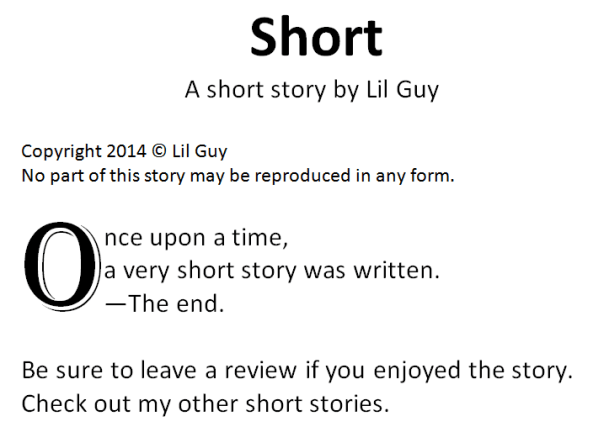
Short

When I want to shop for something to read on my Kindle, I visit Amazon’s homepage on my PC and click on the Kindle books link. It’s called ‘Kindle books,’ so intuitively what you might expect to see are ‘books,’ right?

After a half hour of searching, I may finally find one that suits my mood. Then I examine the product page closely to learn that it’s 36 pages long. Wait a minute. Is that a book?

Sometimes, I check out the Look Inside of a prospective book. I see the cover, title, copyright notice… where’s the rest? Wow! How short must a book be not to show anything from the first chapter?

A Kindle e-book can have just 12 pages. It can have 6 pages. Is there a lower limit? At 6 pages, I hope there isn’t a title page, copyright page, about the author section, and free sample of another book taking up space inside… I also hope the ‘book’ is self-contained. It would be awfully frustrating to learn that it was really one chapter in a series, where you don’t get any sense of closure until the series is complete.

Of course, despite the fact that all of these ‘books’ are listed under ‘Kindle books,’ they aren’t all books. These Kindle e-books include short stories, booklets, presentations, and novellas, too.

Until recently, I was troubled by the growing number of short e-books. I was thinking, “Don’t customers want good value for their money?” “Are customers getting tricked, buying what they expect to be a book only to discover it’s really a short story?” “Are more authors getting lazier, writing and publishing shorter pieces?”

I understood reasons for the short e-books, but I was still troubled by it.

Customers can easily return e-books if they are dissatisfied. (Many do.) They can also check the page count before purchasing, and read the description carefully. If the Look Inside is brief, that’s a big hint. If they’re getting fooled by short books, they can get their money back or leave a review about it. The customer is certainly protected.

Writers are posting short e-books for a variety of reasons. Some don’t want to commit too much into their self-publishing endeavors, so a short piece is a way to experiment. Some are hoping to see what sort of customer feedback may come for short writing samples before laying their hearts on the line for full-length novels. Some plan to compile short works into an omnibus later on, such that the omnibus will look like a good value. There are other reasons, too. Not all of the reasons may be justified.

It’s not easy to get discovered as a new writer, whether writing full-length novels or short stories. Even 99 cents is a lot of money to invest in for one short story from a relatively unknown author; the story will be over quickly, so just imagine what you’ll spend for several hours of reading buying individual short stories. On the other hand, a full-length novel is a long commitment to make for a reader with a new author.

Is it easier to get readers to try out your short story, enjoy your book, and give your full-length novel a shot? Or is it easier to get new readers to appreciate the value of your full-length novel and commit to that as the first thing they read by you? Neither is ‘easy’ for most authors.

Commuter Fiction

I recently discovered this phrase in the KDP community forum. I like the concept. It’s changing my view of short e-books.

The idea behind commuter fiction is to write a short work that travelers can enjoy at a single sitting on an airplane or bus, for example. If you have a three-hour flight, for example, wouldn’t it be perfect to buy an e-book that you could read in three hours?

Authors and publishers have discovered that there is a market for short fiction, and they’ve responded with a way to make short fiction marketable.

You can call your short story a short story. You can call your novella a novella. You can list the word count. Kindle will estimate the page count. But that might not be the way to market your short e-book.

Consider selling it as commuter fiction. Maybe it would be handy to know approximately how many hours it would take the average reader to finish your e-book. A commuter might be interested in that figure.

Truck drivers have been listening to audio books for years. They buy books by the hour. If a truck driver is going on an eight-hour drive, it would be ideal to have an audio book that lasts eight hours (or four audio books that last two hours each), for example.

The same concept applies to passengers of buses, airplanes, and trains who are reading e-books on Kindles, tablets, laptops, and cell phones. What they would really like to know is how long it will take to read the e-book. Of course, this varies from person to person because we all read at different rates. If they can deduce an average, though, that will help them judge this.

I’m not saying that you should write short e-books. It might be harder to sell than full-length books. (Who knows?) Personally, as a customer, I like to receive a good value for my money. However, there are many customers who behave differently than I do.

What I am saying is this: If you’re going to write a short book, maybe you can improve its marketability by selling it as commuter fiction.

Publishing Resources

I started this blog to provide free help with writing, publishing, and marketing. You can find many free articles by clicking one of the following links:

Chris McMullen, Author of A Detailed Guide to Self-Publishing with Amazon and Other Online Booksellers

  • Volume 1 on formatting and publishing (236 pages, 8″ x 10″; it’s a real ‘book’)
  • Volume 2 on marketability and marketing (212 pages, 8″ x 10″; it’s a real ‘book’)

Follow me at WordPress, find my author page on Facebook, or connect with me through Twitter.