Traditional & Indie Publishing: A Symbiotic Relationship?

I’m borrowing the word ‘symbiotic’ from biology, which is used when two different types of organisms live together (rather intimately) to their mutual benefit.

For example, there is a rather brave bird (called a ‘plover’) which shares a symbiotic relationship with the crocodile. Incredibly, the crocodile opens its mouth and lets the plover pick meat out of its teeth, not harming the plover. The plover gains a meal, while the crocodile gets its teeth cleaned.

Perhaps this wasn’t the best example. I’m not implying that the traditional publisher is like a crocodile and indies are bravely picking its teeth. I am implying that the relationship may be symbiotic, but not quite that way. 🙂

In biology, the relationship may not always be mutually beneficial, but that’s what I have in mind by applying this concept to the publishing world. I believe the relationship between traditional and indie publishing to be mutually beneficial, not parasitic.

Here are some ways in which traditional and indie publishing are mutually beneficial:

  • Authors have the opportunity to avoid possible rejection letters by self-publishing. This benefits traditional publishing by reducing the number of proposals that need to be filtered.
  • Self-publishers provide ample business to print-on-demand publishers like CreateSpace and Ingram Spark. Traditional publishers benefit from this service, too, keeping titles ‘in stock’ which would otherwise be retired. The combined use of this service helps to keep the cost low for everybody.
  • Small publishers have increased their business by offering formatting, editing, and cover design services to self-publishers. This helps self-publishers improve their books.
  • The presence of indie authors significantly enhances the population of authors overall, which helps boost participation in author support groups – like writing groups, blogging communities, and social media sites. Many traditional authors in these communities have much experience to share.
  • The combined number of books – i.e. indie plus traditional – has led to an increased number of writing contests, review sites, magazines, etc. This increases the opportunities for all authors to improve their exposure and branding.
  • The combined number of e-books – i.e. indie plus traditional – impacts the price of e-readers in a positive way for consumers, and the availability of e-book publishing services for authors.
  • Both types of authors draw readers, especially when the books are very readable, enjoyable, or informative. I personally buy and read many more books now than when there only used to be traditionally published books available, and there are many others like me in this regard. Both types of books may generate sales for the other type through customers-also-bought lists.

Let me take the analogy a step farther.

The crocodiles could eat the plovers. They would gain some meals in the short run, but their teeth would be dirty in the long run. Even worse, the plovers could bite the crocodiles’ tongues.

Now imagine traditional publishers marketing negative things about indie books or vice-versa. If successful, this would be bad business for everybody. Many customers buy Kindles not just to read traditional e-books and not just to read indie e-books. If marketing efforts portray a lousy image for many e-books, it makes the e-reader itself less attractive.

If you could put a huge dent in either type of publishing, that would reduce the usage of print-on-demand services and e-readers both, which would impact pricing, competitiveness, and availability of services. It would also put a huge dent in readership.

The relationship between indie and traditional publishing may not be ‘obligate,’ meaning that survival of one entirely depends on the existence of the other. However, if either form were to vanish, it would have a major impact on the other.

From a marketing perspective, it makes sense to say good things about books, e-books, readers, authors, and publishers of all kinds. Putting time and effort into marketing your own book would be partially negated by also spreading a negative image for books at large. That negative image would decrease sales overall, which would come back to haunt you, statistically. Spreading a positive image of all kinds of books helps to reinforce your own marketing.

Similar books may also share a symbiotic relationship. Customers usually don’t buy one-or-the-other, but buy several similar books (if not all at once, spread over time – thinking, “Where can I get more like this?”).

Foolish authors who blast the competition shoot themselves in the foot. If successful at hurting the sales of similar books, they also hurt their own books.

When instead similar books are thriving, they all tend to thrive together – e.g. through customer-also-bought associations.

It’s not like there is only one book at the top and nothing else sells. There is plenty of room for readable, enjoyable, or informative books. Similar books can thrive together in symbiotic relationships.

It used to be that a paperback book selling about once a day had a sales rank around 50,000 at Amazon. Now it might sell once a day and have a sales rank well over 100,000. This shows that the total number of books selling frequently has increased. Much of this may be the result of symbiotic relationships among similar books, plus the increased number of good books to read and an increase in readership, as well as an increase in e-readers and e-books.

Chris McMullen, author of A Detailed Guide to Self-Publishing with Amazon and Other Online Booksellers, Vol. 1 (formatting/publishing) and Vol. 2 (packaging/marketing)

Traditional vs. Indie Publishing: Which Is More Rewarding?

The rewards of traditional publishing include:

  • If you get traditionally published, you can experience the euphoria of acceptance. This can be especially gratifying after receiving several rejection letters. You get a stamp of approval.
  • There is much better potential for getting stocked on bookstores’ shelves, getting large-scale media coverage, and receiving editorial reviews that have wide circulation. Seeing your book in a bookstore or reading about your book in a newspaper can be quite satisfying.
  • You should expect to have a book with a professionally designed cover and professional editing. The better the quality of your book, the more you appreciate the result of your hard work. (Of course, professional cover design and editing are options with self-publishing, too.)
  • The top traditionally published books have many potential benefits. For example, they may be more likely to sell paperbacks in some genres, which may help with some bestseller ranks, and they can arrange for e-book preorders at Amazon. A highly successful book can be very rewarding. If you’re able to become one of the bestselling traditionally published authors, you can achieve very high levels of success. It’s not easy to achieve this, which makes doing so very rewarding.
  • There is a self-publishing stereotype. Through traditional publishing, you can escape this, and you’re more likely to receive praise from the critics of self-publishing. People are more likely to be impressed if a big publisher accepts your book or if they can find your book in a store. It’s satisfying to have friends and family praise your success.

Indie publishing has some nice rewards, too:

  • Self-publishing offers independence and freedom of expression. A traditional publisher may want you to change ideas, style, or wording in order to broaden the potential audience or to avoid offending anyone. It can be satisfying to exercise freedom and independence.
  • If you achieve success (at least mildly), the feeling of being self-made is very satisfying. The more challenging path offers the potential of a greater reward. I hold a great deal of respect for the indie authors who have made their own success.
  • The indie author whose book cover and editing rival those of the top traditionally published books has much reason to be proud of the finished product. For a traditionally published book, this is expected; but for indie publishing, it’s an option – it’s also an investment, which carries some risk. Therefore, it’s more rewarding for the indie author to produce a professional looking book.
  • There is a strong sense of community and a great support group available to indie authors. Being part of the WordPress community, for example, is a great feeling. (Of course, traditionally published authors can take advantage of this, too.) Experienced indie authors may also enjoy the feeling of helping newbies out.
  • It’s more rewarding to get a bookstore to carry an indie book, to get the local media to feature an indie book in the paper, or to get a serious reviewer to cover an indie book. Access tends to be easier for traditionally published books, which is a benefit of traditionally published, but at the same time it makes the achievement more rewarding for the indie author.
  • Being part of the indie movement has its rewards, too. Indie publishing is growing stronger with modern technology and support from major businesses like Amazon. It’s a revolution in the book industry. Publishing a professional indie book helps to break the stereotypes. Succeeding as an indie author helps to open doors for others.
  • There is a great deal to learn just to self-publish: writing skills, editing, formatting, cover design, marketing, public relations, and more. Learning can be very rewarding.

It’s not a war. It’s not traditional authors against indie authors. All authors are in it together.

It’s not a choice between traditional or indie publishing. Either way, you write a book and share your ideas with readers.

The fact is that many authors are doing both. Many traditionally published authors are self-publishing, too. They may accomplish this using a pseudonym for one or both. The author who publishes both ways definitely can’t knock self-publishing! There are many benefits of publishing both ways – e.g. maybe some of your ideas are more suitable for traditional publishers than others. You get all of the rewards from both lists when you publish both ways.

Some authors also self-publish hoping to make names for themselves and eventually become traditionally published. If you succeed as a self-published author, maybe you will find this to be highly rewarding. Perhaps you will want to continue to be self-made. Or maybe you will want to prove to yourself that you could also succeed as a traditionally published author.

Chris McMullen, author of A Detailed Guide to Self-Publishing with Amazon and Other Online Booksellers, Vol. 1 (formatting/publishing) and Vol. 2 (packaging/marketing)

Selling Books Directly – How to Do It and Why You Should

Books

Some authors are highly successful with direct sales – i.e. copies they sell personally – as well as getting local booksellers to stock their books. There are a few simple things that anyone can do that would help with direct sales. You don’t have to be a car salesman to effectively move your books. We’ll return to this point shortly.

First, there are several benefits from selling directly:

  • Author copies are very reasonable for paperback books from CreateSpace, which allows you to discount the book and still make a significant royalty. Any discount you offer from the list price works as an incentive – like being on sale – for readers to buy your book.
  • You may sell some books to customers who wouldn’t have bought the book otherwise. This widens your exposure. The more people who read your book, the better your prospects for reviews and word-of-mouth sales.
  • People often buy on impulse. Once that moment has passed, you may have lost your chance. If you tell someone about your book, by the time they get home and log onto the computer, they might change their mind or forget about it. When you sell directly, you can avoid this delay.
  • Selling directly is a very personal form of marketing, and you combine the marketing and selling into a single step. Readers often enjoy the chance to meet and interact with the author, and this improves the chances for them to buy your book. You have the chance to charm them.
  • Nobody is as passionate about your book as you are. Therefore, you are your own best salesman. There is no salesman at all when customers shop online. When you sell directly, you have the opportunity to let your passion show through. (Instead, if you don’t show much interest in your own book, it will be difficult for readers to imagine enjoying your book.)
  • Holding a book in your hands is different from viewing the cover, blurb, and Look Inside online. A professional looking paperback or hardcover book can make a positive impression. People do buy books because they seem interesting (that’s why they have books lying around the house that they’ve never even opened, but intend to read someday).

Don’t view yourself as a salesperson. Think of it as marketing. You’re the author. Let your passion for your work show naturally (don’t overdo it). You’re trying to help people in your target audience discover your book, and by offering a discount (if you choose to do this – and check if you’re beating Amazon’s price, since that may be discounted, too), you’re helping them save money.

Here are some tips for selling books directly:

  • Put the book in the customer’s hands. Be discreet about this, and be insistent. Your goal is to get the book in the customer’s hands and keep it there. When the customer tries to hand the book back to you, you want to have your hands full or busy or to be positioned in such a way that the customer won’t simply hand you the book in return. But you have to be natural and smooth. If the customer succeeds in returning the book (setting it on a table, for example), at some point you want to naturally pick it up and try to put it back in the customer’s hands. If the customer gets the book out of his or her hands, the customer is more likely to walk away without buying it.
  • Offer to sign the book for the customer. This is a way that you can create a perception of added value to the product. It’s another incentive for the customer to make the purchase. If you succeed in getting the customer to hold onto the book, after the sale is made, get out a pen and ask the customer how he or she would like the book to be signed. Once the transaction is complete, you don’t have to worry about the customer letting go of the book temporarily. Don’t mention signing the book too early – you might be able to use it to help close the deal later.
  • Smile. Be confident (it’s very important that you appear to believe in your book – otherwise, why should the customer?). Be courteous. Let your passion show through naturally. Talking about some aspect of the book you love is a great way to take your mind off your nervousness and quench those butterflies. Let a little creativity show. Charm helps.
  • You can have too few books, but not too many. Keep a stack of nicely packaged books in the trunk of your car (well, maybe not in extreme heat or humidity). Whenever your book comes up in the topic of conversation, you want to have a copy handy. Being out of stock is a good way to lose sales.
  • Format your book so that the cover and interior look professional. The more professional your book appears and the more the cover fits the genre, the better your chances of making the sale.
  • Strive to have the voice of a confident author and not the voice of a desperate salesperson. If you don’t want to feel like a salesperson, the first step is to realize that you aren’t really a salesperson and shouldn’t feel that way. You’re the author. People have the chance to meet the author in person and get a signed copy.
  • Don’t be a pressure salesperson. Create a relaxed ambiance.
  • Very often, the customer wants to buy a product, but is kind of stuck in limbo. If you see this hesitation, that’s the moment you’re waiting for to say the magic words. Maybe they are, “How would you like me to sign this?” Don’t ask, “Would you like to buy this book?” If it’s a yes-no question, you give the customer a chance to say, “Not today.”
  • Every salesperson understands the value of add-ons. “Would you like a bookmark to go with that?” (Bookmarks are also helpful marketing tools, especially since they may actually get used by readers.) “Your daughter might enjoy this children’s book I’ve written.”
  • If your list price is $12.95, consider selling it for $10 in person. Round numbers make it easy for customers to pay and help relieve the issue of making change. Come prepared with denominations that you may need to make change. At a large event, you want to be setup with PayPal on a laptop, for example.
  • Offer a discount for buying multiple books. For example, $8 each or $20 for the trilogy. (Look at your cost – don’t forget shipping you pay to get the books – and potential royalties first – don’t just make up numbers.)

You don’t have to sell just paperback or hardcover in person. You can sell an e-book directly, too. Transfer the file directly. Once you figure out how to transfer the file successfully a couple of times, you’ll have the confidence to pull this off at the point-of-sale.

Where and how should you be selling your books directly?

  • Readings and signings. You can’t set these up if you don’t try. Try to be professional. Prepare a press release kit. Some managers are just trying to gauge whether you’re an amateur or a professional. If you’re not having luck with bookstores, look elsewhere: local stores (antique stores, perhaps) that sell books, coffee shops that might like to sell some coffee to anyone who shows up, have a picnic at the park – be creative (arrange a zombie race and have your signing at the end of it). Work to populate these events so you don’t wind up with zero audience. Schedule your event on your AuthorCentral page, then add a photo of it there afterward.
  • Anyone you interact with who shows interest in your book. Remember to always have a stack of neatly packaged books nearby (e.g. in the trunk of your car). Print out a nice looking coupon with a discount code and your CreateSpace eStore in case you don’t have a book handy, or at least have a business card or bookmark with your website on it. However, you’re more likely to sell a book that you have handy than get a sale later from a website.
  • Booksellers. Not just bookstores and libraries. You may have better success in local shops that sell a few books. Start small and try to work your way up; you’ll gain experience with each attempt. A press release kit may come in handy. You prefer to sell copies directly (they’ll want a hefty discount, which should be okay since author copies are low cost), but they may prefer to do consignment (this gives them less incentive to sell, and your copies may be bruised or lost – plus what happens if the store goes out of business?). Consignment is better than nothing; there is a little risk, but all investments carry risk. They can order your books from Ingram or CreateSpace Direct, but selling your author copies may be the best option.
  • Seminars. Whenever you give a presentation, you want to have a table stacked with books when it’s over. You can arrange a workshop where you teach some valuable skill that relates to your book, you may get invited to give a seminar, you might volunteer to teach a skill at a senior center, etc. Where there is a will, there is a way.
  • Relevant stores. For example, if you wrote a grammar workbook, look for teacher supply stores, educational stores, and any other stores that sell workbooks. Schools may also have an interest. Look for home school teachers, too. Look online, too. For example, for workbooks, there is a website called Teachers Pay Teachers. If you didn’t write a workbook, think about what other kinds of stores sell such books. Try going to the store in person, first. If you contact them by mail, you want to prepare professional documents like those in a press release kit.

When people look on your AuthorCentral page or blog and see that you’ve been giving seminars on this topic or have a schedule for signings and readings, it looks impressive. It’s the sign of a serious author.

The more people in your target audience you interact with, the more people who may buy your book and the better the prospects for reviews and referrals. So the more people you meet through direct sales avenues, the better.

Plus, when you look at what makes people buy books, personal interactions is one of the main factors that applies to authors who don’t have big names. The other big factors include being on the bestseller list, referrals, and top search results. The most accessible factor for most authors is personal interactions. You have to aim for this (and if you succeed, it may help your book benefit from the other factors).

People like to buy books from authors they’ve met and interacted with where they enjoyed the interaction. By trying to sell books directly, you have a chance to make a big impact.

People you interact with personally are not just more likely to buy your book, they are also more likely to review it and refer it to friends. So you have every reason to try to meet people in your target audience and try to interact with them. You can do it. 🙂

Chris McMullen, self-published author of A Detailed Guide to Self-Publishing with Amazon and Other Online Booksellers

Hear Indies Roar!

You don’t have to listen closely. The roar can be heard throughout the world of books: The roar of the indies.

The best indie books have many wonderful benefits:

  • Many fictional works are designed around e-readers. The paragraphs are shorter so as not to overwhelm the reader, the story is designed to grab attention right away and keep it so that there is an action-packed flow, and the language is geared toward the audience. Not all indie books are like this, but many top-selling indie e-books are.
  • Traditional publishers have applied a different philosophy for years. Their editors sometimes screen great storytelling or great writing for various reasons. The audience may be too specialized. The author’s qualifications may not look impressive on paper. The proposal may not have followed standard guidelines. Etc. Now such stories have the opportunity to be shared. Not all writing screened by publishers is good writing, but some great indie stories wouldn’t have been published without e-books and print-on-demand.
  • Editors sometimes revise good writing for various reasons. Perhaps it would offend a few readers. Perhaps it doesn’t agree with the editor’s sense of style. All writing needs some degree of editing, and traditional publishers fill a demand for reading material that meets a high editing standard. However, it’s also nice to read material as the author intended it, without revising it to save our eyes from possible offense and without corrupting the author’s unique style. Some indie books have also been through several rounds of editing, but with the author having the final say. Well-written indie books have some merit this way.
  • An idea may actually be too creative for a traditional publisher to take a chance on it. As a result, you can find some incredibly creative self-published books that are actually quite good. They may not be easy to find, but if you can find the gems, they are worth the search.
  • Time-sensitive material can reach the audience very quickly when it is self-published. Traditionally published writing can take dozens of months to reach the market.

My next point, I believe, is really huge and sometimes overlooked. In fact, I would say it’s often turned against indies, when it should be the other way around.

Indie authors will often give you personal attention:

  • Some traditional publishers and their editors strive to market a bad image for indies with statements like, “You’d never see Stephen King commenting on his own reviews,” and pointing out instances where indie authors don’t handle criticism well. They do have a valid point here, but there are many successful indie authors who behave quite professionally. Plus, indie authors often do some things that big-name authors can’t or won’t do, which may be beneficial to readers.
  • It’s often easier to get in touch with indie authors, they can give you more time in personal interactions, they are likely to place higher value on helpful feedback, etc. Being smaller-scale authors, they simply have more time and one customer makes a much bigger difference to the indie than to the big-name traditional author. This has some advantages. Many indie authors are happy to meet their readers and will strive to make each reader feel special. The top indie authors are likely to give you the benefits without the disadvantages. A few rotten eggs in one restaurant shouldn’t spoil dessert in every restaurant.

Some indie authors have made big names for themselves:

  • Have you heard of Amanda Hocking, E. L. James, or Hugh Howey, for example? If not, check out their stories. There are several highly successful indie authors.
  • More and more traditionally published authors are switching over to self-publishing. Why not? Once they have already made names for themselves, why not reap the benefits of self-publishing? A small-time traditionally published author might run into a few roadblocks with bookstores or the media, for example; but if you have a name like J. K. Rowling and self-publish (and make your popular name well-known if adopting a different one), a bookstore manager or journalist would have to be really foolish not to roll out the red carpet.

Many indie authors are working very hard to help you find books that are likely to be relevant to you:

  • It’s really challenging to discover good new books – there are just too many books out there (even within traditional publishing). The traditionally published author who receives a big advance may not feel nearly as motivated as the self-published author who isn’t selling any books without actively marketing. As a result, indies are working hard to find members of their target audience, bloggers in their target audience who may review their books, etc. They are trying to deliver good books to you. Not everyone goes about this the right way, but there are successful indie authors who are striving to unobtrusively help you find good books to read.

Indies have a huge community:

  • There are hundreds of thousands of indie authors. Add to this number their relatives, friends, acquaintances, and coworkers. You don’t need a calculator to see that there is overwhelming support for self-published authors. The number of books combined with the number of people in this immediate support group leads to an astronomical number of sales. A single small-time indie author may not provide much business, but overall the amount of business is staggering. Indie-friendly companies like Amazon, Kobo, Smashwords, CreateSpace, Lulu, and Ingram Spark are reaping many benefits.
  • There is a huge support group for indie authors. This starts with ample free help with tips on writing, editing, marketing, formatting, cover design, etc. There are numerous discussions in community forums for indie authors to interact with one another. There are wonderful support groups on blogs and social media.
  • Many indie authors read and review indie books. Since there are so many indie authors, this leads to many sales and reviews from within the indie community itself. Add to this their friends, family, and acquaintances, and you can see that many readers support the self-publishing concept. (I’m not talking about friends reviewing the book of an author, which Amazon is doing a great job of minimizing. I’m talking about an author and his or her friends and family reviewing books of unknown indie authors, simply because they support the indie concept.)

When you take the time to search through the haystack, every gem that you discover provides you with an incredibly wonderful feeling.

Just because there are some indie books out there that seem to have lousy covers, lousy grammar, lousy spelling, lousy formatting, lousy stories, lousy writing, or appear to have just been slapped together quickly with the hope of earning a few bucks, this shouldn’t detract from the many indie authors who have great writing skills, took the time to edit and format carefully, thought of great stories, produced fantastic covers, and otherwise published wonderful books. (Personally, I’m not in favor of calling anyone’s hard work and passion lousy.)

Let those who have done well define the world of indie books, not those who are deemed to have done poorly. The most successful indie authors show the true potential of self-publishing. Let’s focus on this.

We can do our best, we can try to help others, but we can’t be responsible for every other author out there. Should we not judge each author individually, rather than create a stereotype for all indies?

It takes much courage for a great writer to pursue self-publishing. There are also many benefits to reap for doing so successfully. And those who do succeed help to open doors for the rest.

Let me make it clear that I have nothing against traditional publishers or traditionally published authors. They provide helpful products and services. We need them.

My point is that many indie authors are also providing helpful products and services, and we need them, too.

I read both traditionally published books and self-published books. I enjoy both, and for different reasons.

Both self-publishing and traditional publishing are very large entities. The indie roar is growing, and is no longer being drowned out by the traditional roar.

Chris McMullen, self-published author of A Detailed Guide to Self-Publishing with Amazon and Other Online Booksellers

Goofy Branding

I took my daughter to Disneyland a couple of weeks ago, and the experience got me thinking about branding.

My daughter loves Mickey Mouse and Cinderella. These are the big stars, the main brands. How can the small guys compete with the big names? I’ll get to this question if you have some patience.

We saw Mickey Mouse a couple of years ago. We waited in a very long line in Toontown to meet him. It was a great experience; we got good photos and everyone was very nice. But it was such a long line, and once you get your turn it’s time to rush a new group in.

One year, we accidentally entered a line to meet Tinkerbell. After several minutes and scarcely moving forward, we finally realized the long line wasn’t for a ride and got out of it. This year, there was what looked like a reasonable line to meet Cinderella and other Disney princesses. However, in several minutes we hardly moved at all. Fortunately, my daughter decided that her time would be better spent waiting to go on a ride.

On our way to eat lunch, we saw Tiana. There were only a few other girls in line to see her. My daughter got to see her very quickly. I was really impressed that Tiana sat down to get down to my daughter’s level. She spent good time with her, we got great pictures, and my daughter felt very special to get such personal attention from a princess. Tiana moved way up on my daughter’s list of favorite characters (and mine, too).

We got to see several characters during the parade. Goofy came over and patted my daughter on the head during the parade. He scored major points with us from this simple wow-factor.

This reminds me, if you want to see Donald Duck, Goofy, or Pluto in Toontown, you can very often do so with a very short line. You also see them at other parts of the park from time to time, and they are usually very accessible.

What struck me is that the small guys can compete with the big names. Personal attention, little personal touches, a simple wow-factor – these kinds of things can make a huge, lasting impression.

If you’re one of the small guys (like me), striving to brand your own image, personal interaction is something you can use to help stand apart. Branding is about getting people to remember your name (or the name of your product or business), getting recognized, getting associated with some quality, and the potential for word-of-mouth referrals. Personal interactions with members of your target audience can help to achieve this.

Are you just selling a product? Or are you selling an experience?

Have you ever bought a product from someone where without that interaction you never would have bought that product? Maybe you happened to walk by a shop and noticed it. If it had been a vending machine, you never would have put money into it. But after a nice experience with a sales associate, you made the purchase. Not because the salesperson twisted your arm, but you enjoyed the personal interaction. Has this ever happened to you?

Chris McMullen, self-published author of A Detailed Guide to Self-Publishing with Amazon and Other Online Booksellers

Free Books with Goodreads Giveaways

One way for authors to help create some buzz for their upcoming or newly released books is through the Goodreads giveaway program.

It’s also an opportunity for readers to potentially receive free books that interest them.

http://www.goodreads.com/

You have to have a physical book in order to enter it into the giveaway program. You can make a paperback through CreateSpace, for example. You must supply both the books and pay the shipping and handling. Package your books carefully and spring for delivery confirmation (so you can show, if needed, that you did fulfill your end of the bargain).

If you elect to enter the program, be sure to read the terms and conditions (you can find them from your author dashboard at Goodreads).

You can give just one copy away, but if you’re hoping to receive some reviews, it’s probably worth giving away 5 to 10 copies. Let your giveaway run for about a month to help generate some interest in your book.

Winners are encouraged to leave reviews, but reviews aren’t guaranteed. Reviews may be good, bad, or neutral. Authors may hope that reviewers will be in a good mood because they received a free book, and most will probably appreciate winning the contest, but of course all reviews won’t always be good. They may be more likely to post the review on Goodreads than Amazon, but some people are likely to do both. Keep in mind that if they do post the review on Amazon, it won’t show as a verified purchase (although, with Amazon owning Goodreads now, it seems like they could do this if they wanted – it sure would be a nice feature).

I’m presently trying this out. I entered volume 2 of my self-publishing book into the giveaway. There are 10 copies available (and so far, only 43 people have entered the giveaway – thus, presently the odds are very good). If you enter the giveaway, but don’t win one of the free books, contact me after the giveaway ends if you’d still like a free book (assuming I don’t receive hundreds of requests – I wish I had that kind of popularity, but I don’t – I’ll be happy to oblige).

http://www.goodreads.com/book/show/17863881-a-detailed-guide-to-self-publishing-with-amazon-and-other-online-booksel

Check out other books that are enrolled in the giveaway program.

http://www.goodreads.com/giveaway

Click on a tag to narrow the search results, or use the search field (just above the list of tags) to enter a tag that interests you.

Here is a short sample of giveaways:

Amaze Every Customer Every Time

Shep Hyken

http://www.goodreads.com/book/show/17723505-amaze-every-customer-every-time

Cursive Handwriting Workbook for Girls

Julie Harper

http://www.goodreads.com/book/show/18233806-cursive-handwriting-workbook-for-girls

The Magdalene Mystery

Christine Sunderland

http://www.goodreads.com/book/show/18128152-the-magdalene-mystery

I Was a Teenage Mad Scientist

Derek J. Goodman

http://www.goodreads.com/book/show/18196669-i-was-a-teenage-mad-scientist

Bankrupting Physics

Alexander Unzicker and Sheilla Jones

http://www.goodreads.com/book/show/16059515-bankrupting-physics

One thing I noticed as I searched through the giveaways was that some of the descriptions state that they are for Advance Review Copies, Autographed Copies, or Signed Copies, for example. In my giveaway, I’m just giving away an ordinary copy.

Chris McMullen, self-published author of A Detailed Guide to Self-Publishing with Amazon and Other Online Booksellers

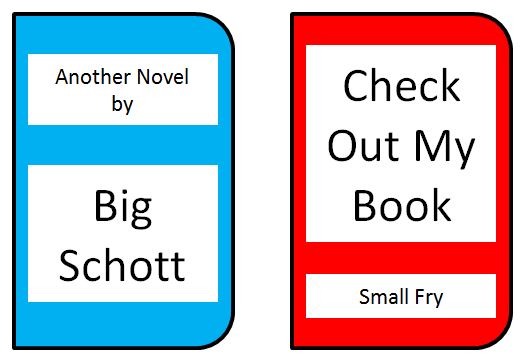
Challenging How Big the Author’s Name Should Be

Name Pic

The consensus among critics is that the author’s name should be relatively small (compared to the title) unless you’re famous.

Why? There are two popular reasons for this:

  1. The marketing view says that if the author’s name appears too large on the cover, it will distract the shopper’s attention from more important keywords in the title. If you’re famous, then it’s important to throw your name out there because your name has sales value.
  2. The critical view feels that the author’s name should take on a humble role on the cover (i.e. out of the way) if the author doesn’t have name recognition.

But is this correct?

Maybe not.

There are a couple of reasons to reconsider this point:

  1. Do you primarily expect to sell books to family, friends, acquaintances, coworkers, social media followers, and people you interact with personally through marketing? If so, then you do have name recognition with your target audience. Make your name larger for their benefit and disregard the potential critics. Why not?
  2. Are you branding your name in your marketing efforts? If you are effective at this, then you want your name to be easily visible (but perhaps not dominating) on the thumbnail image of your cover. Potential customers who recognize your name from your marketing endeavors who see your name in the thumbnail may check out your book.
  3. Part of marketing is about creating a perception. If you’re thinking big, then you want to create a big name for yourself. If you’re going all out to try to make it big, then starting out with a big name on your cover might be a good fit. Make that big name for yourself and prove the cover critics wrong.
  4. If you’re a nonfiction author with a title (Dr., Ph.D., M.D., etc.), you may want your qualifications to be visible in the thumbnail image. However, if you don’t have a relevant title and aren’t well-known in your field, it may be better to place emphasis on a few important keywords instead of your name.

What is your personality? What fits you? A big name? A small name?

Chris McMullen, self-published author of A Detailed Guide to Self-Publishing with Amazon

Dealing with Writing Stress

It’s amazing how much anxiety authors tend to experience:

  • Trying to reach daily writing goals.
  • Wondering if the book will ever get finished.
  • Hoping that people like it.
  • Doubting whether it will sell.
  • Learning how to format.
  • The frustrations of the publishing process itself.
  • Searching for professional help.
  • Monitoring sales reports.
  • Waiting for reviews.
  • Receiving critical feedback.
  • Cyberbullying.
  • The scary world of marketing.
  • Deadlines (often self-imposed).

(So you want to be an author, huh?)

Authors can manage this anxiety.

One trick is to not let yourself get frustrated over things that are beyond your control. You just have to let those things go. First you have to realize that you just can’t do anything about them. The only thing you can do is get upset, and that doesn’t help at all.

You can’t control what other people say or do.

(No doubt, if you could, that universe would be incredibly boring to live in.)

You can do your best. If you do, this knowledge should provide its own satisfaction. Remind yourself of this.

Your behavior can also limit your anxiety.

If you frequently monitor your sales reports and product pages (looking for reviews), emails, blog activity, etc., you’re more likely to be disappointed.

Suppose for example you sell an average of 4 books per day. This means that you sell an average of 1 book every 6 hours. If you check your sales report every hour, 83% of the time you will be disappointed.

I know, when you see that sale, it gives you a temporary euphoria. But being disappointed by no sales most of the time isn’t worth it.

If you sell 4 books per day, just check your sales report once a day, and most of the time you will be happy to see some activity.

Try to wait long enough to see at least 10 sales, and don’t monitor your reports more frequently than that.

When you receive critical feedback, try to stay offline for a couple of days and engage in healthy activities. Keep your mind busy with those. Then see if the criticism offers something that you can use to improve. If so, use it and consider the matter settled. If not, discard it and forget about it.

Diet and exercise are highly important for writers.

We don’t get much exercise while writing. Think about that. We sometime keep irregular hours, staying up overnight to finish our thoughts. We sometimes don’t eat well – taking whatever is convenient – and eat in a rush.

Lack of exercise, poor diet, and especially anxiety can lead to stomach aches, irritable bowel syndrome, depression, and a host of other serious problems.

Exercise is a great way to help your mind deal with stress, besides being something that your body needs. Walk (but don’t pace), jog, ride a bike, play tennis, or go golfing, for example. If you can’t leave the house, buy an elliptical or treadmill and make like a hamster.

Balance. The more you check your sales reports and read reviews, the more you should exercise.

Avoid nervous habits like biting your nails.

Writing should be fun.

It is. Remember that.

We tend to make it far more stressful and less fun than it really is.

Focus on enjoying the art of writing. It may help to think of something far worse that you could be doing instead. A little perspective never hurts. 🙂

And here is something I’ve said before: Don’t compare yourself to others. Instead, compare yourself to your former self.

Chris McMullen, self-published author of A Detailed Guide to Self-Publishing with Amazon

A Model for Pricing Books

Pick two.

If you want to go out to eat, the best you can hope for is two out of three.

The three options are:

  • Quality
  • Service
  • Price

If you want top quality – i.e. excellent taste, fresh food, amazing cleanliness, incredible ambiance, superb view – and awesome service – i.e. friendly greeting, quick seating, fantastic personality, everything you want just when you want it – then you should expect to pay for it.

It’s not reasonable to expect perfect quality, perfect service, and super low prices.

So if you want low prices, you should expect to sacrifice either quality or service to some extent.

Pick two. If you can get two of the three, that’s very good.

Sometimes you only get one. When it’s really bad, you strike out.

The ‘pick two’ idea has been around for some time. It’s worth considering when pricing books.

The first step regarding price is to try to find other books that are very similar to what you’re selling. Customers will be comparing your book to other books like yours when they shop.

Now the question is whether you should be at the high end or low end of this price range – or somewhere in between.

Don’t assume that you need to be at the bottom end of this price range in order to sell books. Don’t assume that you can’t compete with top selling authors or big publishers.

It’s intuitive to most people that a lower price should lead to more sales. It seems like a basic law of economics, right? But it often doesn’t work out that way.

One major reason is that so many people believe that you get what you pay for. Another issue is that several buyers have some experience with poor quality.

Thus, there are cases of authors selling fewer books after lowering the price or actually selling more books after raising the price. It doesn’t always work out this way, but sometimes it does.

Price doesn’t drive sales.

Look at it as two out of three. Price is only one factor.

Quality and service are two other factors.

If you have a high-quality book, setting the price at the low end of the range for similar books may be a problem. People who are looking for better quality may not be browsing the low end of the price range. Where are the readers who are thinking, “Nah, I don’t want quality”? Readers who’ve had a poor experience at the low end of the price range may be exploring somewhat higher prices, hoping to get something better.

Quality doesn’t just mean one thing. It includes good editing, good writing style, good formatting, good characterization, good plot, ease of understanding, entertaining, creativity, professional touches, evoking strong feelings, etc. It also includes a great cover, great blurb, and great Look Inside – since these features help readers judge quality when they’re about to make a purchase.

Then there is also service. For authors, this comes through marketing.

Marketing drives sales. Price doesn’t drive sales. Price may deter sales, if too low or too high. But price doesn’t create sales. Quality and service (i.e. marketing) help to stimulate book sales.

Marketing can be a service. For one, marketing helps bring the book to the customer, whereas it’s such a challenge to find the right book through a search.

A good review online or at a blog from a credible source helps customers find a book in a genre that they read, which may potentially be high in quality. That’s two out of three already, so the price shouldn’t be at the bottom end of the spectrum.

Personal interaction helps to sell books. Interact with the target audience in person. That’s a service that the author provides to the reader.

Readings and signings are services, too.

If you have a quality book and you market effectively, your book shouldn’t be at the bottom end of the price range.

If your book is at the bottom end of the price range, shoppers may be wondering what the book may be lacking. If it’s not lacking anything, it should be worth paying for.

If a cup of coffee made in less than a minute can sell for three bucks, a book that reflects months of hard work should be worth more than that. 🙂

One last word about price. Just having a low price doesn’t suggest a great deal. It suggests that quality is lacking.

But having a sale may stimulate sales. If the price is normally higher, a temporary reduction in price may have this effect. Not from the random customer who just discovered the book – this customer doesn’t know that the price is usually higher. You have to promote a sale for this to work.

Promotion is a form of marketing. As long as you’re going to the trouble to spread the word about your book, you might want to earn a higher royalty for your effort.

A sale can be useful if the copies sold at the promotional price are likely to draw in additional sales. Promoting the first book in a series or discounting an omnibus may have such an effect, especially when the first book is very good at compelling readers to want more (this isn’t the case with all series).

A sale is also more effective when it’s not too frequent. Otherwise, people will just wait for the sale, and it will be hard to sell books in between sales.

Finally, you want your promotion to be targeted at new customers. If you’re advertising your sale to people who’ve already bought your book, you’re not reaching new customers – instead, you might be frustrating buyers who’ve paid more.

Chris McMullen, self-published author of A Detailed Guide to Self-Publishing with Amazon

Improving Writing and Publishing Habits

In every aspect of life, we tend to pick up bad habits much more readily than good ones:

  • When we hear others complain, we tend to become complainers ourselves – even if the complaints that we heard spoiled our good moods. We applaud positive reactions to adversity, but those reactions don’t spread the way that complaints do.
  • In golf, it’s natural to lift the head up too soon, hoping to see a beautiful shot, but when the head comes up early, inevitably the shot isn’t worth watching. We must train ourselves to overcome such tendencies. The more we practice the natural tendency, the worse the bad habit becomes.
  • After hearing others swear, we tend to unconsciously curse in similar circumstances. But when someone stubs her toe and says, “Oh dear, that smarts,” this gentler reaction doesn’t spread the same way. It takes a conscious effort to develop this milder habit.
  • A common mistake in chess is to focus on what you’re trying to do, and to overlook what the opponent is trying to do. It generally takes many losses to retrain our brains to overcome this natural tendency.

The same is true with writing and publishing:

  • If you aren’t well versed in the rules of writing, the more you write without learning the rules, the more you will continue to develop poor writing habits. Even if you hire an editor, the fewer mistakes you make in the first place, the easier it will be to perfect the manuscript. And editors themselves make mistakes, so you must know the rules in order to spot the editor’s mistakes.
  • Every writer has a unique style. Some elements of style tend to work better than others, and often the natural tendency isn’t best. For example, it’s natural to tell what happened instead of show what happened, but showing is often more effective. We can become better writers by identifying our natural tendencies and determining which ones we must consciously work to overcome.
  • When we see other writers complaining – which is all too common – about sales, reviews, and so on, it spreads negativity to others. And complaining in public adversely affects the author’s image. We must strive to maintain a positive outlook and behave professionally.
  • A natural reaction to a critical review is to take it personally and respond to the review with a comment, but this often turns out to be a mistake. If you learn that it’s a mistake and understand why, and have this in mind when checking your reviews, you may be able to profit from overcoming your natural tendency.
  • Authors tend to publish their books without a plan. It takes a lack of sales to convince most authors that a marketing plan may have been necessary. If you’re aware of this, you may invest the time to put together a marketing plan prior to publishing.

In physics, inertia is the natural tendency of an object. According to Newton’s first law of motion, objects tend to maintain constant momentum. That is, once an object is set in motion, it tends to stay in motion naturally according to its inertia; that’s why it’s hard to stop a boulder that’s rolling down a hill. If instead the object is at rest, its momentum is zero, and so it tends to stay at rest. It takes a net external force to overcome an object’s inertia.

You have natural writing and publishing tendencies. You must work to identify them and overcome any that may inhibit your chances of success. Following is a sample of some things to look for:

  • Not checking spelling, vocabulary, or rules of grammar while using a word or rule that the author is unsure of (or at least take the time to write * check * to remind yourself to look into it later).
  • Not thinking through contractions, like seeing “it’s” as “it is.” This helps to avoid confusing words like “it’s” with “its,” “they’re” with “there,” etc.
  • Not checking for potential homophone mistakes, like using “their” when it should be “there,” “our” when it should be “are,” etc. (You can easily find such lists on Google, then use the find tool in Word.)
  • Not checking for consistency in tense, person, number, etc. (Of course, there may be reasons to change them. For example, you might be writing in the present tense, but need to describe an event from the past.)
  • Telling the reader what happened in a situation where showing the reader would work better.
  • Not putting enough time and effort into editing.
  • Repeating words, as in, “I wrote this this word twice.” This is especially common when one word appears at the end of one line, while the other word begins the next line. Search for “the the,” “that that,” and other common words (but without the quotes, of course) to help find some of this repetition.
  • Not joining a writer’s group or approaching it with the right attitude to make the most of it.
  • Not writing with a specific target audience in mind. It’s a very common mistake to try to write for too wide an audience (like mystery, romance, and suspense combined together) or to write a book for which an audience will be quite a challenge to find (e.g. there isn’t a browse category for it at Amazon).
  • Not realizing that writing, like singing, is an art that takes some talent as well as time and effort to develop and master.
  • Expecting everyone to compliment your work. Criticism and complaints are very common, so we must expect it, and some of the criticism helps authors grow as writers.
  • Finding faults in others, but not looking for them in ourselves. How often do we have advice for others, but not follow the same advice ourselves? And how often do we get upset with or ignore advice from others, instead of considering whether or not it may have merit? And how readily do we give advice, versus how often do we seek it?
  • Not researching similar books to learn what kinds of covers, blurbs, writing styles, storylines, and characterizations tend to attract your target audience.
  • Not researching similar books’ sales ranks to see whether or not the book idea may be worth the effort.
  • Formatting a book without using similar traditionally published books as a guide, and without learning basic formatting concepts like how to make different headers for each chapter, how to use Roman numerals for front matter and Arabic numbers afterward, and what to do about widows, orphans, and rivers.
  • Formatting an e-book without learning about common issues, like which characters are supported, how to properly size and compress pictures, and how to modify and use Word’s styles.
  • Not designing a cover and blurb that instantly identify the book’s genre to potential shoppers.
  • Not learning about marketing and how to brand a name or image.
  • Advertising the book openly, rather than working to get discovered. For example, “You should check out my new book,” versus waiting for the question, “So what have you done lately?”
  • Not contemplating where to meet and interact with your target audience.
  • Underestimating the value of meeting people in person, letting them discover that you’re a writer, and charming them with your personality.
  • Not developing a following over the course of several months prior to publishing.
  • Thinking that Facebook and Twitter provides a complete marketing campaign.
  • Not coming up with a marketing plan prior to publishing.
  • Not thinking hard about how to create buzz for your upcoming book.
  • Not making it easy for readers to contact you.
  • Complaining about sales, reviews, etc.
  • Not staying positive throughout the writing and publishing process, and beyond. Strive to not let negativity bring you down.
  • Expecting to be an instant success.
  • Expecting writing, publishing, marketing, and sales to all be easy.
  • Giving up too soon. Be patient and constantly strive to improve.

Millions of books are available.

Only the top couple hundred thousand sell at least a book per day, on average.

Most self-published books feature one or more of these natural tendencies.

Make your book stand out by identifying your natural tendencies and striving to overcome those that need improvement.

Imagine for a moment that you’re a professional tennis player instead of a writer. You come on the scene with a great serve, strong forehand, and weak backhand. What’s going to happen? Everyone will try to hit the ball to your backhand side. You can lose many matches with your weak backhand, or you can acknowledge that you have room for improvement and strive to become a better player.

Find your weak writing and publishing ‘backhand’ and work to improve it in order to become a more successful author.

Remember, bad habits are easier to get and harder to overcome than good habits.

Look for great habits that you see in others to find other great things that you could be doing. Remember that you must consciously work to overcome your natural tendencies.

Chris McMullen, self-published author of A Detailed Guide to Self-Publishing with Amazon and Other Online Booksellers