How to Make a Partially Transparent Layer in PhotoShop

Background image from ShutterStock.

Background image from ShutterStock.

TRANSPARENT IMAGE IN PHOTOSHOP

I will show you how to make a partially transparent image in PhotoShop.

Specifically, I will show this for Adobe PhotoShop CC 2015 (since I have the Creative Cloud), but it works similarly in other versions, too.

You can see in the image above a couple of examples: I added transparency to the hearts and text. If you look closely, you will see that the background shows through them.

What you actually adjust is called opacity. You reduce the opacity to a layer in PhotoShop.

First, find the window that lists your layers. This probably shows at the far right of your screen.

Next, right-click on the desired layer, i.e. the image that you wish to add transparency to.

Look for Blending Options, which should be at the top of the list.

Near the top of the pop-up window, you will see the option for Opacity. It’s initially set to 100%. Reduce the opacity to create transparency.

You can type in a percentage, or you can slide the bar right or left. The scrollbar is convenient, as you can see the impact as you scroll.

The Blending Options pop-up window comes in handy. You can find a lot of other cool options here, too, like the option to create a custom gradient.

Write happy, be happy. 🙂

Chris McMullen

Author of the Improve Your Math Fluency series of workbooks and self-publishing guides

Kindle Unlimited KENP Read for September, 2015

Image from ShutterStock.

Image from ShutterStock.

KINDLE UNLIMITED PAGES READ FOR SEPTEMBER, 2015

Good news, I think:

Kindle Unlimited paid $0.00507 per KENP read for September, 2015.

That’s just over half a penny per page.

Why is this good news?

Because in August, 2015, Kindle Unlimited paid $0.00514 per normalized page read.

We now have two consecutive months with only a very slight change in the Amazon payment for pages read.

Recall that the payment for July was somewhat higher: $0.00580.

When July’s $0.00580 dropped to August’s $0.00514, I was concerned with this 11% drop.

I was worried about stability.

But with September’s $0.00507 roughly matching August’s $0.00514, I see prospects for stability.

It’s still early. We only have three months of data for the new Kindle Unlimited payout.

But we do have a year of data for the previous Kindle Unlimited payout, along with a few years of payouts for Amazon Prime borrows.

And that data shows that the payout tends to approach a fairly stable number (until significant changes to the program were introduced).

So there is reason to expect the payment to stabilize. Will it stabilize at or near half a penny per normalized page? Good question, but for two months in a row, that’s about what it is.

There is a little more good news, too:

The KDP Select Global Fund has risen to $12M for September, 2015.

This figure has steadily grown, and has been fairly stable.

The KDP Select Global Fund for August was $11.8M, and it was approximately $11M in May, June, and July.

This represents a very large, indie-friendly customer base. Amazon is paying over $100M per year just for KDP Select books borrowed through Kindle Unlimited and Amazon Prime.

This customer base is not just very large, its stable; if anything, it appears to be growing a little.

Write happy, be happy. 🙂

Chris McMullen

Copyright © 2015

Chris McMullen, Author of A Detailed Guide to Self-Publishing with Amazon and Other Online Booksellers

Click here to view my Goodreads author page.

  • Volume 1 on formatting and publishing
  • Volume 2 on marketability and marketing
  • 4-in-1 Boxed set includes both volumes and more
  • Kindle Formatting Magic (coming soon)

Follow me at WordPress, find my author page on Facebook, or connect with me through Twitter.

Comments

Click here to jump to the comments section.

You Can Extend the Deadline for AMS ads via KDP

Image from ShutterStock.

Image from ShutterStock.

AMS AD DEADLINE

When you create an advertisement for KDP Select books via AMS, you must choose an end date.

The end date must be within the next 6 months.

But suppose you have a successful advertisement running, but when the deadline approaches, you don’t want to stop your AMS ad campaign.

Especially, if you spent several hours handpicking books to target, and your ad is doing well; you don’t want to have to do that research again, and you might not choose such a good list next time.

Fortunately, you can extend the deadline of your KDP ad.

Extend the deadline before the ad runs its course.

When the deadline is near, simply view your AMS ad report.

Click the Edit button next to your ad.

Revise the end date. It will let you choose a date up to six months from today.

Click save.

Return to your ad report, just to check that the end date has properly updated.

When the new deadline comes up, you can repeat the process, if you want.

A FEW TIPS

The real trick is getting the AMS ad to work well enough that you actually want to extend the deadline when the time comes.

So here are a few tips:

  • Don’t overbid. Most authors can’t afford to spend 50 cents or more per click. Start out very low. Wait three days (or more) because ad report data can be significantly delayed (if it seems like nothing’s happening, wait 3 days to find out if indeed nothing is happening, or if you’ve already spent a lot of money that just hasn’t posted to your report yet because of delays). If nothing happens after a few days, raise your bid just a little. Then wait a few more days. This strategy gets you affordable clicks. It won’t drive a ton of daily traffic to your book, but it will help you generate some interest without overspending. Time is on your side. Take what you can afford to get, even if it comes very slowly. Too many authors bid much higher than they should, blowing their budgets before they realize it with little to show for it. I have several ads that perform well, with very low bids, even though it may take weeks for them to deliver significant results. Personally, I prefer to be patient and get a good return on my investment.
  • Test it out. I ran a few dozen tests in the first couple of months before I learned the most effective ways to make these ads work for my books. You’re not obligated to spend the entire $100 budget. You can pause or terminate your ad at any time. (But if you bid high, you can blow your budget without realizing it because there can be significant delays.) So you can try an ad over a short period, then cancel it and start a new ad. Maybe you try changing your targeting list, or maybe you try a different catch phrase. Some trial and error can help you learn more effective ways to use this advertising tool.
  • Close the deal. If your sales to clicks ratio is 3% or less, this suggests that you could improve (A) your targeting or (B) your product page. Is your product page closing the deal as well as it could? Does the cover properly suggest what to expect? Does it achieve this goal in the tiny ad thumbnail, too? Does the book description arouse interest and curiosity without giving away too much? Does the Look Inside grab the reader right away? Does everything look professional? The great thing about AMS is that you can test out the performance of your product page. You can get two weeks of data, then revise your book description, get another two weeks of data, and compare. Did changing the product page actually make a difference, for better or for worse? Your AMS ad report can be a tool to help you perfect your product page. A closing rate of around 5% is reasonable achieve; a closing rate of 10% or more is rare, but it can be done. A closing rate of 1% or less isn’t good, but it happens.

Write happy, be happy. 🙂

Chris McMullen

Copyright © 2015

Chris McMullen, Author of A Detailed Guide to Self-Publishing with Amazon and Other Online Booksellers

Click here to view my Goodreads author page.

  • Volume 1 on formatting and publishing
  • Volume 2 on marketability and marketing
  • 4-in-1 Boxed set includes both volumes and more
  • Kindle Formatting Magic (coming soon)

Follow me at WordPress, find my author page on Facebook, or connect with me through Twitter.

Comments

Click here to jump to the comments section.

Fun with English

Image from ShutterStock.

Image from ShutterStock.

FUN WITH ENGLISH

Language can seem funny sometimes.

§

Did you know that left can be right?

Left is right when right is dead wrong.

On what side of your body is your heart?

Left is right. Right is incorrect.

§

Similarly, wrong can be right.

Wrong is sometimes correct.

What’s a synonym for injustice?

Wrong is a correct answer. Right is dead wrong.

§

Even the word literal can’t always be taken literally.

Sometimes, we use literally to mean figuratively.

I’m hungry enough to eat an elephant.

Literally! (Just not in the literal sense…)

§

I is speaking with poor grammar, right?

You can’t say, “I is.” It has to be, “I am.”

But check this out: I is a pronoun.

Find the mistake in that.

§

Everything is something.

Nothing is something.

If A=C and B=C, then A=B, right?

So everything is nothing! (Not quite.)

§

I can be here and there at the same time.

I think of myself as being here.

You think of me as being there.

So I am both here and there; it’s all relative.

§

If you don’t have anything, you have naught.

The number zero is called the nought.

The opposite of having something, of course, is not.

It’s enough to tie your brain in a knot.

§

Write happy, be happy. 🙂

Chris McMullen

Copyright © 2015

Chris McMullen, Author of A Detailed Guide to Self-Publishing with Amazon and Other Online Booksellers

Click here to view my Goodreads author page.

  • Volume 1 on formatting and publishing
  • Volume 2 on marketability and marketing
  • 4-in-1 Boxed set includes both volumes and more
  • Kindle Formatting Magic (coming soon)

Follow me at WordPress, find my author page on Facebook, or connect with me through Twitter.

Comments

Click here to jump to the comments section.
Goodreads Giveaways: Recent Changes

Image from ShutterStock.

Image from ShutterStock.

GOODREADS GIVEAWAYS

Goodreads has recently improved their Goodreads giveaway program.

Authors who sign up with Goodreads can run Goodreads giveaways for their books.

  • It must be a print book. (CreateSpace is great for self-publishing a paperback.)
  • Goodreads sends the author a list of winners. The author ships author copies directly to the winners.
  • You can give away as little as 1 copy, so you can get some good exposure for a reasonable price.
  • If you give multiple copies away, it improves your chances of getting reviews at Goodreads (but winners are less likely to post a review on Amazon).
  • One benefit of the giveaway is that hundreds of readers are likely to add your book to their to-read list, which makes your book’s Goodreads page seem somewhat more popular.
  • The giveaway may not have a noticeable direct impact on sales. It can help with exposure and to generate some activity on your book’s Goodreads page.
  • Most of the contest traffic comes on the first and last days. However, the days in between add up, so you get the most exposure for your contest by running it for at least 30 days. You might as well generate as much exposure for it as you can.
  • Many giveaways seem to start on the 1st of the month and end at the end of the month, so if you avoid those days, you might be able to avoid the crowd somewhat. The first and last days of your contest give you the most exposure, so plan these dates wisely.

Goodreads has recently updated its giveaway program. Here are a few changes that they have made:

  • You now choose up to two categories instead of entering tags. This will make it easier for giveaway hunters to find the kinds of books they like to read (unfortunately, you still see the tag system when searching for giveaways, but it seems like this should change over soon).
  • The book no longer needs to be a new release; they have removed the 6-month restriction. When you enter the release date, you choose from a dropdown menu that goes back to the early 1900’s. However, if you run a contest for an older book, you might want to make this clear in the giveaway description so as to avoid possible confusion.
  • You must now schedule your Goodreads giveaway at least 7 days in advance, so plan ahead.
  • The terms and conditions now appear in a pop-up window. You must scroll down and click the Agree button at the bottom.

Want to enter for a chance to win a free book? Here are some sample Goodreads giveaways (these authors don’t know that I’ve given them a little exposure here on my blog, but these caught my eye when I was browsing for giveaways—though you may remember I also featured Jenny Pearson’s coloring book on my blog a couple of posts ago):

Coloring Book for Teens or Adults by Jenny Pearson

Click here to find Coloring Book for Teens or Adults on Amazon.

Chick Lit {And Other Formulas for Life} by Abby Rosmarin

Click here to find Chick Lit on Amazon.

A Bit Witchy by Danielle Fisher

Click here to find A Bit Witchy on Amazon.

The Dust in Sunlight by Christopher Rees

Click here to find The Dust in Sunlight on Amazon.

Camille’s Itchy Twitchy Eczema by Candis Butler

Click here to find Camille’s Itchy Twitchy Eczema on Amazon.

4,500 Multiplication Problems with Answers Practice Workbook by Chris McMullen, Ph.D.

Click here to find 4500 Multiplication Problems with Answers on Amazon.

More Goodreads Giveaways

Click here to see all Goodreads giveaways. If you’ve browsed for giveaways in the past, check it out to see how it’s changed.

Write happy, be happy. 🙂

Chris McMullen

Copyright © 2015

Chris McMullen, Author of A Detailed Guide to Self-Publishing with Amazon and Other Online Booksellers

Click here to view my Goodreads author page.

  • Volume 1 on formatting and publishing
  • Volume 2 on marketability and marketing
  • 4-in-1 Boxed set includes both volumes and more
  • Kindle Formatting Magic (coming soon)

Follow me at WordPress, find my author page on Facebook, or connect with me through Twitter.

Comments

Click here to jump to the comments section.
Kindle Unlimited Pages Read Rate for August, 2015

Image from ShutterStock.

Image from ShutterStock.

KINDLE UNLIMITED PAGES READ

Amazon paid $0.00514 per KENP read in August, 2015.

Compare that to the $0.005779 pages read rate in July, 2015.

That’s a drop of 11%. If you had 10,000 pages read in July, would earned $57.79, but for the same 10,000 pages read in August, you only earned $51.40.

On the one hand, an 11% drop is significant, but on the other hand, unless you had a million pages read through Kindle Unlimited and Amazon Prime, that 11% doesn’t amount to a whole lot.

And if you had a million pages read, you’re thriving in the program (compared to most authors).

But the concern really isn’t over one drop in the payout of 11%.

The concern extends beyond that. 11% is a pretty sizable change. It’s not a small fluctuation.

So one concern is stability.

If it drops 11% in August, another 11% in September, another 11% in October, and so on, that would really add up.

Since these are the early days of KENP, we don’t have much data to go on. We don’t yet have a pattern of KENP payouts established to lend us a feeling of stability.

What we really need is more data. But authors also want to make sound decisions now. And it will take a few months to get solid data.

I expected the pages read rate to drop toward $0.0050. What I didn’t expect is for it to jump straight there in one fell swoop.

And hence stability is in question.

But I think it’s premature to run for the hills.

One drop of 11% isn’t too much for me. Maybe stability will be there. I need a few months’ more data to assess this.

If it levels off around $0.0050, that will be what I had been expecting anyhow; it will just have gotten there faster than I was predicting.

If it drops even below $0.0050, the question will be how much below. What’s your magic number, where if it goes below that, you feel like KDP Select isn’t worth it? This magic number will be different for everyone, but it’s worth thinking about. We’re not near my magic number yet.

And what’s your backup plan for the worst-case scenario? It wouldn’t hurt to sketch out a backup plan and store it in a safe place. If you’re not below your magic number, I wouldn’t initiate the backup plan yet. But it’s smart to have a plan in mind, just in case.

I feel I’ve given too much attention to this lone 11% drop. Who knows what next month will bring? We don’t have enough data yet to see a pattern emerge.

POSITIVE INDICATORS

But there are other positive indicators that may help offset that 11% drop. Let’s look at a few of these.

GLOBAL FUND STABILITY

The KDP Select Global Fund is suddenly more stable than ever.

It was approximately $11M for May, June, July, and now $11.8M in August.

It’s starting at $11M for September.

They used to commit a mere $3M to the pot, and then raise it to $8M or more.

Now they commit to $11M on a regular basis.

So while the pages read rate may have dropped 11%, the KDP Select Global Fund has been very stable, more stable than ever.

KINDLE UNLIMITED IS THRIVING

KDP Select authors are earning a combined $10M per month just from KENP read.

Amazon has paid out over $100M in royalties just for KDP Select borrows in 2015.

Approximately 2 billion pages of KDP Select books are read through Kindle Unlimited and Amazon Prime per month.

That’s a huge readership. And it’s been a consistent readership (if anything, it appears to be growing).

And this readership supports indie books. Not every indie book, but the top KDP Select books are thriving in Kindle Unlimited.

Most of these readers are reluctant to buy books any other way.

AMAZON PAID MORE ROYALTIES OVERALL

Although the per-page rate dropped from $0.005779 to $0.00514, the KDP Select Global Fund rose from $11.5M to $11.8M.

Amazon paid $300,000 more in KDP Select royalties in August than they paid in July.

Overall, KDP Select authors earned more than ever.

So although they paid 11% less per page, there were more than enough additional pages read to compensate overall, enough such that Amazon actually paid more money in royalties overall.

Either there were (A) more Kindle Unlimited subscribers or (B) Kindle Unlimited customers are reading more than usual.

Either way, in general, KDP Select books benefited from this additional reading and the extra $300,000 paid in KDP Select royalties in August compared to July.

MORE BOOKS IN KINDLE UNLIMITED

Another sign that the program is thriving is that the number of books in Kindle Unlimited steadily rises.

Even through the new Kindle Unlimited 2.0.

Even through the 11% drop in the per-page rate.

The number of books in Kindle Unlimited keeps climbing.

It’s up to 1.1M presently. It was about 1M just a few months ago, but despite the new program and even the drop in the per-page rate in August, still 100,000 more books have added in the past few months than have dropped out.

127,000 books were added to Kindle Unlimited in the past 90 days. Whereas only about 27,000 have dropped out during this same time. For every book that has dropped out, 4 more were added in.

44,000 books were added just in the last 30 days. The number of books added to Kindle Unlimited each month keeps rising.

There is plenty of content for customers, and plenty of new content each month.

The top KDP Select books are thriving with millions of pages read per month, and the customers enjoying those top books want more top books to read. And those authors feel motivated to write more similar books. And other authors want to become KDP Select All-Stars, so they’re working to try to please Kindle Unlimited customers.

Many books benefited from the extra pages read and higher KDP Select Global Fund for August.

For many books, overall, this made August better than July, even though the per-page rate dropped.

WHAT IF YOUR BOOK DIDN’T BENEFIT?

If your book didn’t benefit from the extra pages read and the higher KDP Select Global Fund, there are a number of possible reasons:

  • There are many complicating factors involved in a book’s sales. Most books go through sales slumps at some time all on their own. If your book’s sales slumped in August, it’s quite possible that it had nothing to do with Kindle Unlimited. In fact, more pages were read through Kindle Unlimited than ever, and the payout was $300,000 more than in July.
  • August is typically a slow season for very many books. If your book’s sales slumped in August, it may just be a seasonal effect. The interesting thing is that more pages were read in Kindle Unlimited in August, even though sales often slump in August. Overall, this seasonal effect didn’t impact KDP Select borrows (although it surely did for some KDP Select books, overall there were more pages read in August than July).
  • Many authors changed their publishing and marketing strategies when Kindle Unlimited 2.0 rolled out. Many authors believed that Kindle Unlimited 1.0 favored short books, and now many authors believe that Kindle Unlimited 2.0 favors long books. What Kindle Unlimited 2.0 favors is reader engagement. As many other authors adjust their marketing strategies, that impacts other books.

Here are a few proactive ideas:

  • Marketing, of course. For a book that has appealing content, the trick is to get more customers to learn about your book. Learn free and low-cost marketing strategies, and try them out.
  • Marketability is another factor. Are you writing the kinds of books that appeal to Kindle Unlimited customers? Are the cover, blurb, and Look Inside helping to close sales? If so, your book is more likely to benefit from KDP Select borrows in addition to sales, and those borrows can help your sales rank.
  • Are you making the most of Kindle Countdown Deals? Just scheduling the promotion isn’t apt to be as effective as searching out websites that can help you promote the Countdown Deal.
  • Are you using AMS wisely? Most authors tend to overbid. The safer route is to bid very low, wait a few days, raise your bid only slightly if necessary, wait a few more days, and use patience and frivolity to your advantage. It may take a month or more to generate significant activity, but it’s less risky that way. Also, once you have several similar books out, with good marketability, that improves your prospects for advertising success.
  • Personal interactions can go a long way. When you interact with your target audience, a personal interaction is more likely to inspire a sale during a slow period, and it’s also more likely to lead to a review. Get a few sales in a slow period and it can help you rebound.
  • Write more books. And do some research to see what kinds of books are selling. Which are a good fit for you to write. For which customers are likely to support indie books.

THE OTHER SIDE OF THE FENCE

Is the grass greener in KDP Select or outside of it?

That’s a good question, and it may depend in part on the particular book, as well as the marketing capabilities of the author.

If you can build a strong following all on your own, you stand better prospects of growing a readership outside of KDP Select. But it’s not easy to do.

Another big factor is sales momentum.

If you start in KDP Select, once you get initial borrows and sales, you have sales momentum. Each Kindle Unlimited or Amazon Prime borrow helps your sales rank.

If you now opt out of KDP Select, you lose that benefit on sales rank. You lose your momentum.

Sales momentum is really tough to build. Once you have it, you don’t want to lose it. But you lose part of it when you switch to the other side.

Similarly, if you have sales momentum on several sites and join KDP Select, you lose it on those other sites.

Kindle Unlimited has a huge readership (2 billion pages read per month of KDP Select), which supports very many indie books (through KDP Select).

This audience can potentially benefit new authors. (But it takes a marketable book and marketing to improve your chances.)

Hence, it’s appealing to start out in KDP Select.

You can opt out after 90 days (but you must uncheck the auto-renewal box to do this successfully). But you risk losing that sales momentum.

Unless, of course, you hardly have any sales to speak of. But Kindle is the main market. If you hardly have any sales to speak of, the sales aren’t likely to be found elsewhere. But it can happen, and you might feel like there is nothing to lose in trying. (The real problem may be with the marketability of the book, or with marketing.)

One intriguing idea floating around is to write multiple series (or similar books) under multiple pen names, and rotate one (or more) of these series in and out of KDP Select. One idea behind this is diversification, and to try to reach customers on the other side of the fence.

But the risk in this strategy is that rotating a title in or out of KDP Select will hurt sales momentum.

It is wise to have a backup plan in place. But I wouldn’t do anything to risk hurting sales momentum unless and until the per-page rate goes below your magic number.

I’M STILL IN

KDP Select has been good to me.

I have pages read, but where I’ve seen the largest increases are (A) Kindle sales and (B) paperback sales.

I have no doubt that this is largely due to KDP Select.

First, all those KDP Select borrows improve my sales ranks.

Secondly, I’ve learned how to make effective use of AMS. It took a couple of months of overbidding to develop my low-bid strategy, and to refine my targeting, and it’s begun to pay dividends.

Not every one of my books has benefited (nor are they all in ‘my’ name), but overall my Kindle sales and paperback sales have improved.

Not all authors are thriving in KDP Select. But many are, and the potential is there.

Write happy, be happy. 🙂

Chris McMullen

Copyright © 2015

Chris McMullen, Author of A Detailed Guide to Self-Publishing with Amazon and Other Online Booksellers

  • Volume 1 on formatting and publishing
  • Volume 2 on marketability and marketing
  • 4-in-1 Boxed set includes both volumes and more
  • Kindle Formatting Magic (coming soon)

Follow me at WordPress, find my author page on Facebook, or connect with me through Twitter.

Comments

Click here to jump to the comments section.

Puzzle Post: Three Words You Should Never Say…?

Image from ShutterStock.

Image from ShutterStock.

PUZZLE POST

What three words should you never say?

Let me clarify: You should never say these three words in succession.

It’s been a while since I’ve made a puzzle post.

I put some lines of text here.

To try to create some space between the puzzle…

…and the answer.

So if you don’t want to bump into the answer…

SPOILER ALERT

…then scroll back up until you’re ready.

🙂

HISTORY

There is a little history to this puzzle. Let me describe this to provide a little extra space between the puzzle and the answer.

Maybe it will also provide a bit of a hint, if you want one.

When I was in junior high school, one of our teachers preached to us to never say these words.

Unfortunately, it was natural for us to say these words.

Quite often.

So we heard his admonishment regularly.

And it worked. I remember it today whenever I hear these three words.

It’s a very common expression.

ANSWER

Ready or not, here comes the answer.

Perhaps with a bit of irony.

If you felt that you couldn’t figure it out, you probably did.

Did you find yourself thinking, “I don’t know”?

If so, then by not knowing, you actually solved the puzzle.

The answer is: I don’t know.

Those are the three words you should never say.

WHY NOT?

Why should you never say, “I don’t know”?

Let me first explain what the answer isn’t. It doesn’t mean you should know the answer to every question. That would be impossible.

Sure, you should strive to be well-prepared so that you don’t find yourself thinking, “I don’t know,” when your credibility is at stake.

But the reason that you should never say, “I don’t know,” goes much deeper.

These are wasted words. I don’t know. If you don’t answer the question directly, it’s obvious that you don’t know.

It’s not helping the inquirer advance toward a solution.

Be resourceful. Think of ways to help. Consider how to go about finding the answer. This kind of thinking is productive. Thinking, “I don’t know,” isn’t productive.

Suppose you have a problem and you really need help finding the solution. But you’re pretty sure nobody you know has the answer. Who will you ask for help?

The kind of person who always has helpful advice, even when he or she doesn’t know the answer. That’s who.

Not the kind of person who instinctively answers, “I don’t know.”

It’s about credibility, branding your reputation, feeling self-confident, improving your resourcefulness.

These are all valuable skills. If you avoid those three words, “I don’t know,” it helps you build these valuable skills.

MY NEW PUZZLE BOOK

Do you enjoy puzzles?

I do. I love puzzles, especially math puzzles.

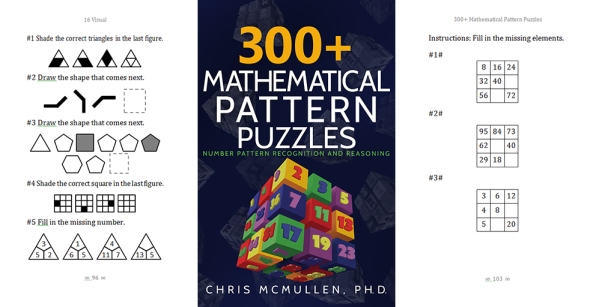
So it’s no surprise that I have a new book of math puzzles, the latest in my Improve Your Math Fluency series of math workbooks.

It includes quite a variety, such as visual puzzles, prime numbers, the Fibonacci series, and much more. It starts out easy and the challenge grows steadily.

Available both in print and for Kindle. Cover designed by Melissa Stevens at theillustratedauthor.net.

Write happy, be happy. 🙂

Chris McMullen

Copyright © 2015

Chris McMullen, Author of A Detailed Guide to Self-Publishing with Amazon and Other Online Booksellers

  • Volume 1 on formatting and publishing
  • Volume 2 on marketability and marketing
  • 4-in-1 Boxed set includes both volumes and more
  • Kindle Formatting Magic (coming soon)

Follow me at WordPress, find my author page on Facebook, or connect with me through Twitter.

Comments

Click here to jump to the comments section.
All about Adult Coloring Books: For customers (stress relief) and authors (how to publish)

Image used with permission from artist Jenny Pearson.

Image used with permission from artist Jenny Pearson.

ADULT COLORING BOOKS

Coloring books for grown-ups are all the rage these days.

  • 2 of the top 5 books overall on Amazon are adult coloring books.
  • An adult coloring books has been #1 overall on Amazon periodically for the past few months.
  • 994 adult coloring books have been published in the last 30 days.
  • It takes about a sale per day to be in the top 500 of all adult coloring books, which shows that very many are selling. The top books are selling several copies per day.
  • At least one of the bestselling adult coloring books has sold over a million of copies.

STRESS RELIEF & RELAXATION

Adult coloring books have much appeal:

  • They provide stress relief: You get absorbed in coloring the design, getting your mind off your problems.
  • They are relaxing. Don’t try to overthink it. 🙂
  • Almost everybody can color.
  • It seems like a simple activity, yet many of the designs are complex, and you yourself can make it complex with your choice of color. Or you can keep it simple.
  • People like to get together and have coloring parties, contests, etc. It can be something fun to do together.
  • They make great gifts, too.

EXAMPLES OF ADULT COLORING BOOKS

Secret Garden by Johanna Basford has been #1 overall in all of books on Amazon, and has received national publicity for it.

Balance by Angie Grace lists CreateSpace Independent Publishing Platform in the publishing field and is #29 overall in all of books (and #1 in two different subcategories).

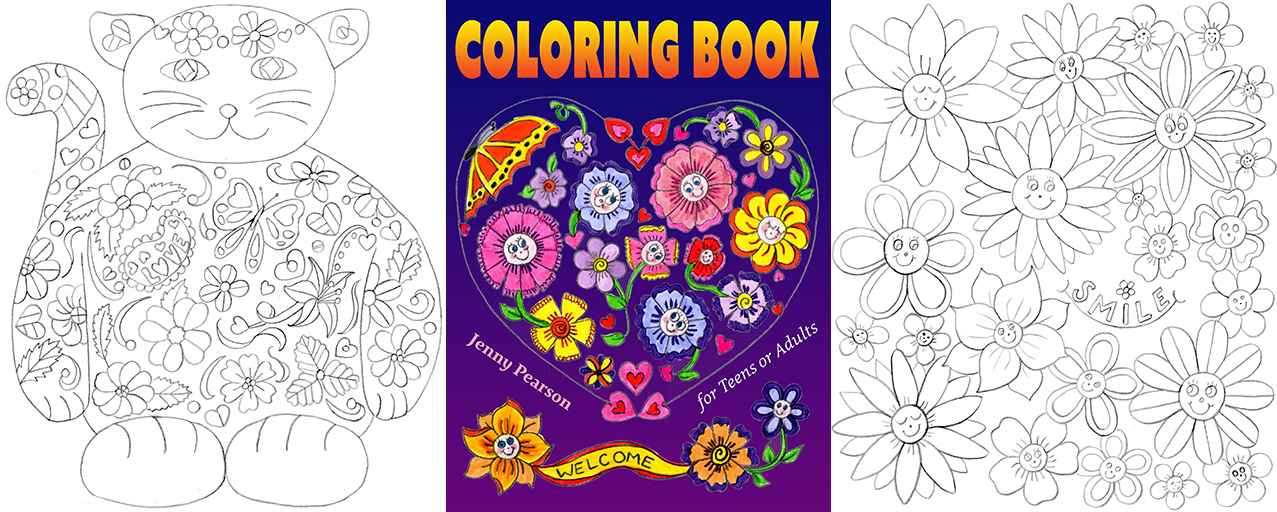
Coloring Book for Teens or Adults by Jenny Pearson is among the many new releases. It was published just a few days ago.

There are all kinds of adult coloring books:

  • mandalas
  • anatomy (cool concept)
  • cats
  • animals
  • flowers
  • Christmas
  • cultural
  • there is even one featuring “ugly sweaters” (that’s what it says)

HOW TO PUBLISH A COLORING BOOK

Many artists are tempted to try and publish an adult coloring book.

  • The top books are selling very well.
  • As of today, there are only 3700 books listed under coloring books for grown-ups.

However, it’s not easy; sales aren’t automatic.

  • 994 books were added to the coloring books for grown-ups category in the last 30 days. This category is presently being flooded.
  • Most customers gravitate toward the top sellers. It’s not easy to gain exposure.
  • Even if you click the last 30 days filter, there are still 86 pages of adult coloring books. A newly published book will be on page 86. Nobody will find it there.
  • Indeed, I discovered some adult coloring books that have never sold a single copy (there was no sales rank).
  • Most of the books have appealing designs on the cover, in my opinion. It will take more than just making a great book to get sales.

Yet it can be done:

  • There are self-published adult coloring books ranked in the top 100 overall in all of books on Amazon.
  • A few of the 994 published in the last 30 days are already selling well (even though many are not).

As always, the trick is learning how to be among the few that sell well, rather than the many that don’t sell much.

I have some tips to help with that:

  • Interact with people, do some pre-marketing, build some buzz. You need some early support to give you a few sales in the first few weeks, to search for your book on Amazon through various keywords. It will take some traffic to your product page and sales to help stand out among the other 1000 adult coloring books published in the last 30 days, and the 3700 (and rapidly growing) other adult coloring books.
  • Study other successful adult coloring books. You want to see a few bestsellers to try to understand why they sell. Look at a few that don’t sell to try to learn the difference. Check out books that are selling that either list CreateSpace or a publisher you’ve never heard of, as they gained traction without the support of a giant publisher. Check out books that were recently published that somehow managed to get early sales.
  • In your research, look at cover design ideas (layout, color schemes, font styles), product descriptions, front matter, thickness and darkness of the lines used in the designs, categories the books are listed in, even author biographies. Customers are checking out other books, so you should know what customers will see.
  • What’s your angle? What makes your book unique? Which features will readers appreciate most? Use this to help choose your second category (see below for the main category suggestion) and to choose one or two of your keywords. It will help differentiate your book from others (starting with the title and cover image). It will give you ways to get discovered, e.g. when people search for “cats,” or “aliens,” or “fairies,” or whatever it is that makes your book unique. Remember to play your angle in your marketing (beginning with your description, and in your personal interactions, too).
  • Make copies of sample pages. These are valuable marketing assets. (Be sure to put the book title and author name somewhere on the page, but unobtrusively.) Distribute these to senior centers and all kinds of local organizations where people may appreciate this stress relief activity. Put a free PDF of one or two pages on your author website or blog.
  • Learn other marketing techniques and interact with your target audience. For example, you can organize coloring events for adults.
  • Look for local support in small bookstores and other stores that aren’t primarily bookstores (bring some evidence that adult coloring books are really hot right now).
  • If you self-publish through CreateSpace, don’t sweat the BISAC category too much. Pick what you think is best there. But just after you click Approve Proof, contact CreateSpace support and request the two categories that you’d like your book listed in at Amazon. One should be Books > Crafts, Hobbies & Home > Crafts & Hobbies > Coloring Books for Grown-Ups.
  • If you self-publish through CreateSpace, you can only choose keywords and keyphrases of up to 25 characters. Tip: Don’t put a space after each comma, or that will waste a character. If you want one keyphrase to be coloring books for grownups, you’ll have to remove the “s” from grownups to make it work. If you want to add coloring books for teenagers, you must choose between coloring books for teens and coloring books teenagers. (I’m not suggesting it’s worth expanding into the teen market. I’m just giving an example of making the best use of the 25-character limit.) Note that any words already in your title or subtitle don’t need their own separate keywords.

FREE COLORING PAGE

Here is a free coloring page courtesy of author Jenny Pearson.

Click the following link to open a free PDF file featuring a cool cat drawn by Jenny Pearson.

Adult Coloring Cat

Thank you, Jenny, for letting me include a few of your images with my coloring book post.

Feel free to check out Jenny Pearson’s author page.

Write happy, be happy. 🙂

Chris McMullen

Author of A Detailed Guide to Self-Publishing with Amazon and Other Online Booksellers

  • Volume 1 on formatting and publishing
  • Volume 2 on marketability and marketing
  • 4-in-1 Boxed set includes both volumes and more
  • Kindle Formatting Magic (now available)

Great Suggestion for Friends & Family Reviews on Amazon…?

Background image from ShutterStock.

Background image from ShutterStock.

REVIEW SUGGESTION FOR AMAZON

Friend and family reviews are a touchy subject among both authors and customers:

  • For the customer review system to be effective, customers need to be able to trust the system. This is why Amazon removes and blocks reviews suspected of being posted by the author’s friends or family members.
  • For the customer who posted the review, having it blocked or removed is time wasted, and discourages the customer from posting reviews in the future.
  • For the self-published author, an invaluable part of marketing entails creating personal relationships. Sometimes, the occasional personal interactions with a fan who didn’t previously know the author causes a book review to be blocked or removed.
  • Unlike the big publishers, self-published authors and indie presses can’t afford to send out hundreds of review copies to strangers. They can get friends to help get the ball rolling, except that friend reviews often get blocked, and they can interact with their target audience in person, although that sometimes leads to blocked reviews, too.
  • Amazon itself thrives on content engagement, one of their best marketing tools. Amazon wants to get customers (and authors) to frequently return to their website. Blocking or removing reviews discourages customers from writing future reviews, which limits their content engagement.
  • Although Amazon frequently blocks and removes 4- and 5-star reviews, Amazon almost never removes a 1- or 2-star review, which brings the average star rating down and discourages sales overall. It allows jealous authors and spiteful exes to prevent sales of books at Amazon that may otherwise sell.

Lighthouse24, a member of the CreateSpace community forum who provides frequent helpful posts, offers a great compromise. (Check out Lighthouse’s website for Helpful Links with valuable self-publishing info.)

  • Instead of blocking or removing the review, Amazon should keep the review, but clearly mark it as having detected a possible relationship with the author.
  • Let each individual customer decide how that matters to them. Some customers may see that designation and discard the review completely, a few may feel disgusted and move on, but in this way, Amazon would let the customer make the decision. Other customers won’t be put off by the designation, and may appreciate the comments. Yet other customers will approach those designated reviews cautiously. One thing we know is that every customer interprets reviews in a different way. So why not let each customer choose what to do with a potential friend or family review?
  • In addition to clearly marking such reviews as being from customers with potential relationships with the author, they could separate those reviews so they show in a slightly different area (perhaps one set above the other, or a different column) so that customers can easily tell the difference.
  • There is a precedent at Goodreads, which allows reviews from friends and family, but which clearly denotes reviews from friends. Surely, Amazon could do this, too.
  • Amazon could first give the customer the opportunity to disclose the relationship, then mark the review as a Family Review, Friend Review, or Fan Review, for example. If the customer doesn’t check one of these boxes, Amazon could then include a note that they discovered a possible relationship with the author and give that review yet another name (e.g. Reviewer May Know the Author).

This would solve a few key problems with the current customer review system:

  • Customers would see that X number of reviews were left by friends or family members. This is disclosed up front. Presently, customers assume that some reviews are from friends and family, without knowing how many, and customers don’t realize that most of those are actually blocked and removed. With full disclosure, customers will begin to realize that Amazon can often tell the difference.
  • Indie authors and small publishers won’t be so disadvantaged compared to big publishers who can send out hundreds of advance review copies. Amazon does want to give indie authors a fair chance, which is why indie authors now have pre-orders, AMS ads for KDP Select, and other new features that used to be only available for big publishers.
  • Amazon will enhance their customer engagement, i.e. have more activity on their website, which is one of their top marketing strategies. Customers won’t be discouraged by having their reviews removed, and thus will be more likely to post reviews in the future.
  • Authors who put the personal touch on their marketing, meeting new people in their target audience, won’t be penalized when Amazon discovers a possible relationship with the author, when in fact that customer had previously been a complete stranger until interacting with the author as a fan.
  • By not blocking and removing so many 4- and 5-star reviews, this would help to achieve a more balanced picture, and limit the effectiveness of jealous authors or spiteful exes striving to prevent a book from selling.

Lighthouse24 recommends that both authors and customers who like this idea should share this suggestion with Amazon. Sounds like a good plan to me.

Write happy, be happy. 🙂

Chris McMullen

Copyright © 2015

Chris McMullen, Author of A Detailed Guide to Self-Publishing with Amazon and Other Online Booksellers

  • Volume 1 on formatting and publishing
  • Volume 2 on marketability and marketing
  • 4-in-1 Boxed set includes both volumes and more
  • Kindle Formatting Magic (coming soon)

Follow me at WordPress, find my author page on Facebook, or connect with me through Twitter.

Comments

Click here to jump to the comments section.

What’s in a Name?

Name

DOES A NAME MATTER?

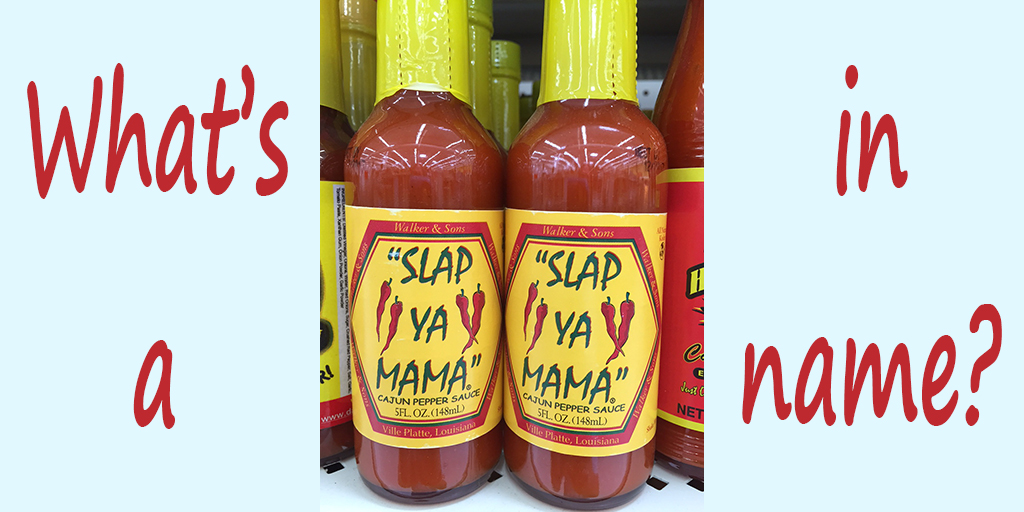
I run into this brand of hot sauce in Wal-Mart (at least in Louisiana), and it always gets me thinking about brand names, book titles, and character names.

It also makes me wonder, “What in the world were they thinking?”

If you happen to pass the hot sauce aisle while shopping with a friend, it also generates a ton of laughter.

Whoda thunkit: A brand of hot sauce named “Slap Ya Mama.”

I guess they’re trying to say that the sauce has a little kick to it.

If they’re trying to get a reaction, it certainly worked.

And it works for brand recognition: I’ll never forget it.

But I’ve never tried it either… Perhaps more than a few people wouldn’t feel comfortable walking up to the counter with a bottle of Slap Ya Mama hot sauce.

I can imagine teenage boys daring one another to buy a box of tampons and a bottle of Slap Ya Mama cajun pepper sauce. The look on the cashier’s face would be so worth it.

Maybe the target audience for their hot sauce doesn’t mind the name, so maybe it attracts more sales than it deters. Maybe a good portion like the name…

What if this were a book? I shudder to think of a dozen authors reading this post, all thinking, “Wow! That would be a great book title.”

Research shows that names do matter: Whether choosing brand names, book titles, or character names, these decisions can make a big impact.

When the name doesn’t work, it can deter sales. When it’s just right, it can help sales.

Three words or less, especially words easy to understand and remember, aid in brand recognition.

When the words clearly signify the product, even better.

And they have to fit. It has to sound right. These two points are important with the art of choosing character names, too.

Naming a character is like naming a baby. Except you have dozens of characters, and probably won’t have as many babies.

So what do you think about a novel named: Slap Ya Mama—A romance with a little kick to it? (A cajun romance, of course.)

Write happy, be happy. 🙂

Chris McMullen

Copyright © 2015

Chris McMullen, Author of A Detailed Guide to Self-Publishing with Amazon and Other Online Booksellers

  • Volume 1 on formatting and publishing
  • Volume 2 on marketability and marketing
  • 4-in-1 Boxed set includes both volumes and more
  • Kindle Formatting Magic (coming soon)

Follow me at WordPress, find my author page on Facebook, or connect with me through Twitter.

Comments

Click here to jump to the comments section.