The Read Tuesday Website, Twitter, and FaceBook

It's going to be HUGE!

It’s going to be HUGE!

We’ve made some progress with the Read Tuesday website, Twitter (@ReadTuesday), and Facebook page. Although these sites aren’t perfect yet, we need your help with some BIG ideas to help publicize the event (see below).

We want to create buzz for Read Tuesday to help make the event a success. Although December 10 is still two months away, there is significant marketing potential if we can get the ball rolling quickly.

For example, imagine if Smashwords or Kindle took an interest in Read Tuesday, and considered mentioning us somewhere (like in a newsletter or on a website). Or if we want to get media coverage or publish an article somewhere visible. There is a large audience for this material and Read Tuesday will be a HUGE event, so there is much potential here. However, these big ideas require time for big companies to implement. That’s why we want to get the ball rolling quickly.

Suppose we contact these businesses to tell them about Read Tuesday, hoping to earn a little support from them. If they show any interest, the first thing they will do is try to learn a little more about the program.

So the greater the initial support for the event, the better this will look to them.

Here is how you can help:

  • Visit the Read Tuesday website at www.readtuesday.com. I’ll add the counter if at some point there are enough views to generate a little interest.
  • Show your support as a reader, gift-giver, or author. Choose one (or more) of these pages at the Read Tuesday website. Post a brief comment to show what you’re looking forward to.
  • As usual, you can show support via Likes or Follows at the website, Twitter, or FaceBook. There aren’t any posts at any of these sites yet, but that’s because we haven’t built up a following yet. Now that the sites are live, we can build up support.
  • Help spread the word about Read Tuesday. It’s going to be HUGE! (Feel free to use this HUGE line.) You’re welcome to use the images (you can find the full set on the Read Tuesday website). Add one to your sidebar to show support, for example. If you make a post about Read Tuesday, feel free to include one of the images with it.
  • I’ll announce when the participation and catalog forms are available (soon; I’m working on it). Then you can use these forms to show your support and enroll your books. (I’ll also be describing ways that you can participate in a coming post.)

In my next post, I’ll outline ways that we can try to get support for Read Tuesday, such as contacting Smashwords or KDP, the media, or trying to publish articles. The more initial support we can get quickly, the bigger Read Tuesday will look to anyone who checks it out.

In case you haven’t heard, Read Tuesday will be a big day for selling and gifting books, like Black Friday, except for books. You can learn more about Read Tuesday (but note that the name has changed) through the link below:

https://chrismcmullen.wordpress.com/2013/09/21/red_tuesday_idea_for_boosting_book_sales/

I can’t wait for Read Tuesday to get here. It’s going to be HUGE! πŸ™‚

Chris McMullen

Read Tuesday Images Are Here :-)

RT Logo 21 (2)

In case you haven’t heard, Read Tuesday will be a big day for selling and gifting books, like Black Friday, except for books. You can learn more about Read Tuesday (but note that the name has changed) through the link below:

https://chrismcmullen.wordpress.com/2013/09/21/red_tuesday_idea_for_boosting_book_sales/

Anyone who wishes to participate in the Read Tuesday event, or to help promote it, in a positive way is welcome to use the image above or the images below. πŸ™‚

Melissa Stevens, www.theillustratedauthor.net, artist and cover designer, created these images and has granted us permission to use them in support of Read Tuesday.

You’re welcome to show your support, for example, by adding one of the images below to the sidebar of your blog. You might include a caption like, “It’s going to be HUGE,” or something else you might prefer to help promote the event. Feel free to include a link to the website, www.ReadTuesday.com. It has a picture, but won’t be quite ready for a day or two. We’re working on it.

If you post or write anything about the coming Read Tuesday event, you’re welcome to use one of these images with it. There is an opportunity here for you to promote your own books while simultaneously helping to create buzz for the Read Tuesday event.

The more we use the Read Tuesday images, the more this will help to visually brand the event. If we have any consistency with a phrase like, “It’s going to be HUGE,” it will help to brand that, too.

In coming posts, I will share some suggestions about different ways that authors can participate in the event, ideas for how to help create buzz for Read Tuesday, and other ideas (maybe a couple of big onesβ€”I’ll need your help to pull them off). When the forms become live (for the various catalogs), I will announce this, too.

I also added a Read Tuesday page to my blog here. As you can see, it’s not quite ready yet, either. I’ll post links for Read Tuesday social media pages once they’re ready.

If you check out the Read Tuesday website, www.ReadTuesday.com, please feel free to share comments or suggestions about color, structure, style, theme, etc. (Of course, the text hasn’t yet been adjusted from the default text.)

I included “gold” (yellow) confetti stars on the sides, but I can change that to color stars (and you might find color there when you visit…). Feel free to express your opinions.

You can use the images on some websites by right-clicking the image and copying the link to the image location. If you need the jpeg (including the confetti), please let me knowβ€”I can send it by request.

If you make any posts related to Read Tuesday, I encourage you to let me know. We might be able to help spread the word about your post.

I’m looking forward to Read Tuesday. I hope you are, too. πŸ™‚

Chris McMullen

RT FB Banner (2)

RT Banner 250x250

RT Banner 240x400

RT Banner 160x600

Read Tuesday Picturesβ€”Last Call for Opinions

RT Logo 21

A variety of opinions have been expressed on the possible Read Tuesday images that we can use for the website banner, headers for anyone to use on posts about Read Tuesday, and a logo that anyone can use to show support for Read Tuesday. Hopefully, we can make our final selection after this post. If so, then we will make the image in a few different aspect ratios and let you know as soon as they are ready to be used. Then we’ll launch Read Tuesday (culminating in the actual Read Tuesday on December 10).

I wonder if the picture above might be a fair compromise of the variety of opinions that we received. One big issue that was expressed was not to obscure the date. Of those with stars, these stars seem to be less obtrusive. A couple of comments suggested going with a cleaner look. While not as clean as having no stars, perhaps this is a fair compromise. There was a vote or two for a red bow, but it seemed that there were more votes for gold bows. It’s a challenge to please everyone, but my hope with the Read Tuesday concept is that it would reflect us a whole more than one individualβ€”after all, Read Tuesday is intended to help many authors and readers, not just one person or small group.

What do you think? Will this image work for you?

The Read Tuesday image was designed by Melissa Stevens (www.theillustratedauthor.net).

You can see the alternatives by clicking on the links below:

https://chrismcmullen.wordpress.com/2013/10/02/read-tuesday-pictures-second-try/

https://chrismcmullen.wordpress.com/2013/10/01/read-tuesday-pictures-need-suggestions/

In case you haven’t heard, Read Tuesday will be a big day for selling and gifting books, like Black Friday, except for books. You can learn more about Read Tuesday (but note that the name has changed) through the link below:

https://chrismcmullen.wordpress.com/2013/09/21/red_tuesday_idea_for_boosting_book_sales/

Chris McMullen

MatchBook and Kindle Sales Rank (A Hard-to-Get Answer)

When I went to enroll my books in Kindle MatchBookβ€”a new program from Kindle Direct Publishing (KDP); you can learn more about MatchBook by clicking this linkβ€”an important point occurred to me:

  • Will the MatchBook sales improve your Kindle sales rank?
  • If so, if you make the MatchBook price free, will that also affect your sales rank?

Note: As of October, 2019, the Matchbook program has been canceled.

Here’s why it’s important: If the MatchBook freebies would improve your Kindle sales rank, that would serve as an incentive to offer print customers a free Kindle edition.

I checked my email, the September KDP newsletter, and the information about MatchBook available from a link on my KDP bookshelf (which all boiled down to the same information), and this point wasn’t clarified. I then posted this as a question in the KDP community forum; there was some interest in the answer, but nobody there apparently knew the answer, either.

Next, I contacted KDP. They responded in a day, but only to tell me that they needed 5 more days to figure out the answer. (!) Today, KDP responded (yep, today was day number five).

If I was informed correctly, 99 cent, $1.99, and $2.99 MatchBook sales will improve your Kindle sales rank, whereas free MatchBook sales will instead count toward your free sales rank.

Wait a minute. Something seems strange here.

When you make an e-book free through KDP Select, the book is free all day. During this time, the e-book has a free sales rank. When the free promotion ends, the e-book returns to the paid sales rank.

But MatchBook won’t be free all day! People can buy your Kindle e-book at any time. So if one customer “buys” your e-book for free through MatchBook, three seconds later someone else might pay for it at the Kindle sales price.

What’s going to happen? Will the book have a free sales rank and a paid sales rank at the same time? Will your book be ranked among freebies and paid books simultaneously?

It seems it may be so, based on what I’ve been told. (Or your book could toggle back and forth between the free and paid sales ranks with every free or paid purchase.)

Chris McMullen, author of A Detailed Guide to Self-Publishing with Amazon and Other Online Booksellers, Vol. 1 (formatting/publishing) and Vol. 2 (packaging/marketing)

CreateSpace & Kindle Keyword and Category Tips

The first “secret” is to visit the following KDP help page. This page tells you how to use different combinations of keywords to get your book listed in “special” categories. Once there, cick on a category from the list.

https://kdp.amazon.com/help?topicId=A200PDGPEIQX41

At CreateSpace, you can select one BISAC category and enter up to 5 keywords separated by commas in one of the publishing steps (same page as where you enter the description). At Kindle, you can select up to two categories and enter up to 7 keywords.

First, you should try searching for similar books on Amazon by keyword. As you start typing a keyword, common search results will pull up. This will help you see if customers ever search for the keywords that you’re trying. See which books similar to yours show up in the search results. Are the top searches all bestsellers, or have lesser known authors achieved visibility on these searches?

The most important thing about the keywords that you choose for your book is that they are a good fit for your book. That is, people searching for those books are very likely to be in your target audience. If not, the keyword is wasted. The second thing to consider is this: You want to balance popular keyword searches (i.e. ones that customers are likely to use frequently) with your chances of being visible in that search. Guess how many super-popular books show up if you simply search by “romance,” for example. You might be better off trying to find specific romance searches that are highly relevant for your book and which customers actually search for periodically.

Here is a handy keyword tip for CreateSpace: Don’t put spaces after your comma. The 25-character limit includes that space. So if you include a space after the comma, CreateSpace will reject an otherwise 25-character long keyword. (Obviously, you have to have spaces between separate words, just don’t put one after the comma that separates two keywords). Note that Kindle Direct Publishing (KDP) doesn’t impose this limit on characters.

Words in your title, subtitle, author name, and imprint are already searchable, as is the word “book.” So, for example, if your subtitle has the word “mystery” in it, you’re wasting a keyword if you choose “mystery book” as a keyword because it would already be searchable that way. Plurals may make a slight difference in the order of search results, but you shouldn’t waste a keyword to change something like “soldier” to “soldiers,” for example (if you have one or the other, your book will show up in both searches, though not necessarily in the same place).

As you find books similar to yoursβ€”especially books where the author wasn’t well-known, but which are selling wellβ€”see which categories they are listed in. You want to choose the most relevant category for your book.

Although you can only choose one BISAC category at CreateSpace, you can actually get your book listed in two relevant categories at Amazon. After your book is published, simply contact member support and politely as CreateSpace if they could please add your book to one more category. First go to Amazon to find the browse pathβ€”something like Books > Romance > Contemporary.

You have to make a separate request for Amazon US and Amazon UK. Note that the category choices are different on both sites, so you have to find the category that you want on each site before making the request.

You can’t add your book to a second category in children’s or teen unless your BISAC category is in juvenile. If you want one category in children’s or teen and one category different from this, first choose your BISAC category within juvenile and then request to add the other category on Amazon.

When your book first goes live, it may be way down the list (several pages, perhaps) in search results. Through successful marketing, if your book gets searched more and sells after being searched, this will help to improve the book’s position in the ordering of search results. You can’t expect a new book to pass bestsellers in the results, can you? It takes time for Amazon’s program to establish relevance.

Chris McMullen, author of A Detailed Guide to Self-Publishing with Amazon and Other Online Booksellers, Vol. 1 (formatting/publishing) and Vol. 2 (packaging/marketing)

Authors Have Two Audiencesβ€”not One

Two Audiences Pic

Marketing is most effective when the content, packaging, and marketing are all geared toward attracting the target audience.

But there’s a catch: There isn’t just one audience; there are two.

One audience consists of the readers who are likely to enjoy your book, but who haven’t read it yet. The second audience includes fans who have already read your book.

This distinction is important.

For example, a fan doesn’t need to see reminders or hints to purchase a book that he or she has already read. A fan who enjoyed the book enough to find your blog or email you would probably enjoy bonus material.

On the other hand, if you catch the interest of people who read your genre who haven’t read your book, you want to give them opportunities to discover your book. Some supplemental material is less likely to interest people who haven’t read your bookβ€”especially fiction, maps, images, or poems that are best understood by someone who is familiar with the book.

Fans may be interested in learning more about you on your blog, whereas content relevant for your target audience is more likely to attract new readers to your blog. You could mix in a little of each, or you can put some of this on a fan page.

If you have a series, fans are looking forward to the release of your next book, whereas you want new readers to discover the first volume.

When you promote a temporary sale price, you want new readers to learn about this, while fans might be a little frustrated to see the discount if they paid full price.

When you interact with people in person or online, if you’re able to determine whether or not they have read your book, this can help you. For example, when communicating by email, you can have a signature line that links to your book for people who haven’t read your book, but a signature line that links to a fan page that has supplemental material for fans.

Part of your online platform should be geared toward new readers, while there should also be some place that fans will appreciate.

Think about your dual audience and how it might impact your marketing efforts. For one, marketing pages that you include at the end of the book should be geared toward fans, since, obviously, they have already read your book.

Chris McMullen, author of A Detailed Guide to Self-Publishing with Amazon and Other Online Booksellers, Vol. 1 (formatting/publishing) and Vol. 2 (packaging/marketing)

Read Tuesday Picturesβ€”Second Try

RT Logo 23

Melissa Stevens (www.theillustratedauthor.net) read the opinions expressed in my previous post and offered the images that you see at the top and bottom of this post.

Thank you to everyone who provided feedback on the first round of images. Although it’s impossible to please everyoneβ€”especially, when opinions may be contradictoryβ€”since we will all be able to use the Read Tuesday images, I would like for everyone to be happy with them.

Let me add my opinions, which I didn’t express in the previous post. In the originals, I favored the stars and the gold bow, and was also concerned about clutter around the date. In this new set, the stars are more concentrated around the bag (to me, it’s as if they just popped out of it). The gold stars don’t seem as obtrusive to the text. I kind of like the red bow if we go with the gold stars.

But Read Tuesday isn’t my event, its our event. So your opinions are just as important. You are encouraged to express them.

In case you haven’t heard, Read Tuesday will be a big day for selling and gifting books, like Black Friday, except for books. You can learn more about Read Tuesday (but note that the name has changed) through the link below:

https://chrismcmullen.wordpress.com/2013/09/21/red_tuesday_idea_for_boosting_book_sales/

Chris McMullen

RT Logo 16

RT Logo 17

RT Logo 18

RT Logo 19

RT Logo 20

RT Logo 21

RT Logo 22

Read Tuesday Picturesβ€”Need Suggestions

RT Logo 15

Artist and cover designer Melissa Stevens (www.theillustratedauthor.net) has put together these drafts for the Read Tuesday image. You can find the alternates at the bottom of this post.

I need your help with this.

  • Do you like this concept?
  • What would you like to change?
  • There are many possibilities, like changing colors, brightening or darkening, adding or removing elements, adding other details. The door is wide open.
  • Which version appeals to you best?
  • Which colors or features do you like best?
  • Which colors or features do you like least?
  • What could we do to make this better?
  • If you would prefer something vastly different, please say what you would like.

Read Tuesday is for everyone, so if you have any opinions, please share them.

In case you haven’t heard, Read Tuesday will be a big day for selling and gifting books, like Black Friday, except for books. You can learn more about Read Tuesday (but note that the name has changed) through the link below:

https://chrismcmullen.wordpress.com/2013/09/21/red_tuesday_idea_for_boosting_book_sales/

Chris McMullen

RT Logo 14

RT Logo 13

RT Logo 12

RT Logo 11

RT Logo 10

RT Logo 9

Draft of Author Sign-Up Form for Read Tuesday

Read Tuesday Curtains

I made a draft of the author sign-up form for Read Tuesday. (In case you haven’t heard about it yet, you can learn more about Read Tuesdayβ€”a bookselling event like Black Fridayβ€”by clicking on the link below.)

https://chrismcmullen.wordpress.com/2013/09/21/red_tuesday_idea_for_boosting_book_sales/

The draft has ten questions and a note at the top. Some of the questions will be optional, most will be required (which are required should be clear when filling out the form).

Please look the draft over. If you have comments or think of something we should consider adding, please let me know.

We’ll have a separate form to sign up books (rather than authors), and we can also add separate forms for any small publishers or booksellers that may wish to participate in the event.

Remember, it’s just a draft. (So don’t try to complete the form yet.) Once it’s ready, I’ll post a link to the form, and all you’ll have to do to participate is complete the form online and press a magic submit button. Then I can create a database of the answers at anytime.

Click on the link below to open the form. (It’s a PDF file. Be sure to scroll down to the subsequent pages, or you’ll only see the first few questions.)

Author Sign-up for Read Tuesday

In the note at the top, you can see that I gave myself a silly title, just to show you that I’m really unimportantβ€”that’s what titles are for, right? (Read Tuesday is about many authors providing a great program for thousands of readers, not about any one person or group of people.)

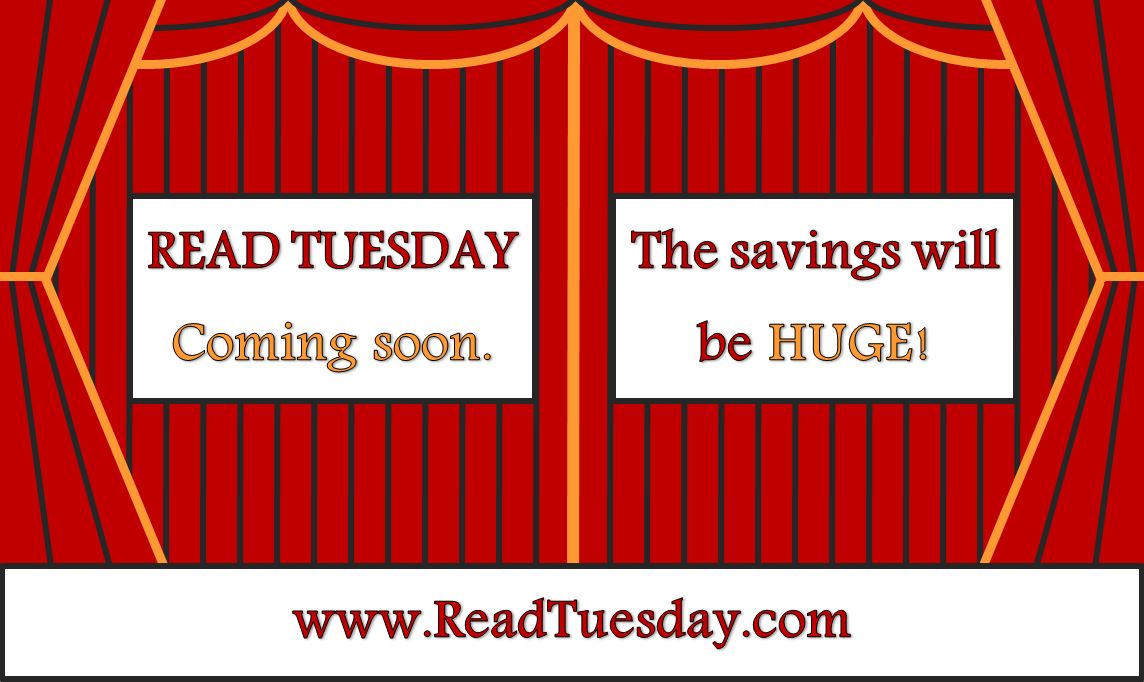
Regarding the image above with the red curtains… I got this idea that we might be able to stir up a little pre-launch buzz for Read Tuesday, and I thought closed curtains like you see in a theater just before a big show might be a good idea. However, the primitive method that I used resulted in a highly pixelated image. I put an image on the Read Tuesday website, the Twitter page, and the Facebook fan page, so at least anyone who visits these sites will see that something is in the works. (These sites are otherwise empty.) I was going to suggest that we post this picture on our blogs, and perhaps even create a few posts to try to stir up some pre-launch buzz for the Read Tuesday event (you can see one image on my sidebar to the right), but since it’s rather pixelated, I decided not to suggest this.

Actually, it’s hard to notice the pixelation on the small sidebar image, so adding these red curtains to all our sidebars might not be a bad idea after all. Feel free to add it to yours and to spread the word. You’re welcome to copy the red curtain image (either above or from the sidebar).

In about a week, we should have much nicer images to work with to help brand the Read Tuesday program. When these are available, I will let you know, and that’s when the Read Tuesday sites will launch.

Chris McMullen

Authors: Try Giving Yourself Advice

If another author asked you for advice and you checked out the other author’s book, would suggestions come to your mind? Maybe you would comment on what you do or don’t like about the cover. You might have suggestions for the blurb. If you found something in the Look Inside that put you off, would you mention it?

People generally love to give out advice. That’s why everyone tends to receive a lot of advice, even when it wasn’t sought. People form opinions easily, and many people don’t hesitate to share them.

Even if you don’t share your opinion so freely, you still form opinions. Suppose you’re checking out a book. You’ll know in an instant if you like or dislike the cover, if the blurb attracts your interest or not, and if there is something that you do or don’t like about the book.

But a funny thing about advice is that while people love to give it to others, they often don’t take their own advice.

  • Evidently, you don’t have to have a good track record in your own relationships in order to give dating advice to others.
  • Apparently, you don’t need to have any skill in a sport yourself in order to give tips to others.
  • Clearly, you don’t have to make the best work-related decisions in order to advise others about their career paths.

Here’s my point. If you’re looking at someone else’s cover, you might find yourself wondering, β€œHow can you put that on your book?” But if it’s your own cover, you don’t tend to be as critical. If you’re shopping for a book, you might think to yourself, β€œThat blurb doesn’t try to catch my interest at all.” But when it’s your own blurb, you’re already interested in it. When you pay five bucks for a book, you tend to get disappointed if you catch several typos. But when it’s your own book, you often read what you meant to write instead of what you actually wrote.

There are two things you can learn from this:

  • You need to try to step aside and evaluate your work critically. Take a break from it and try to approach it as if you were seeing it for the first time, and try to evaluate it as if it were someone else’s book.
  • No matter how hard you try, you can’t see your own work as if it were written by someone else. There is no substitute for external opinions. Getting this before you publish is invaluable.

I know a few authors who will think that they judge themselves more harshly than anyone else – i.e. you feel that you are your own toughest critic. Many of us feel that way.

But we’re our toughest critics only in certain aspects. You’re not your own toughest critic in every aspect. You judge yourself harshly only in the areas that you care about most. You give yourself a large allowance in areas that you don’t care much about.

However, those areas that aren’t so important to you might be very important to shoppers. So even if you are your own toughest critic in some regards, honest external feedback – if you can get it – is still very likely to help you find ways to improve your book.

You shouldn’t necessarily change everything based on external feedback. But first you need to know what that feedback is before you can decide whether or not you feel it merits attention.

Have you ever come across books where the cover, blurb, Look Inside, category selection, or something else probably could have benefited from a little advice? Of course, if you send advice to all of those authors and publishers, some of them won’t want it. I’m not telling you to go advise others about how to publish their books. I’m suggesting that we all need to evaluate our own books more critically, and especially to benefit from more external feedback prior to publishing.

We just don’t look at other books the same way that we look at our own. In this regard, books are kind of like kids. Your book is your baby. It’s not like other books, is it?

Chris McMullen, author of A Detailed Guide to Self-Publishing with Amazon and Other Online Booksellers, Vol. 1 (formatting/publishing) and Vol. 2 (packaging/marketing)