Beautiful Rainbow at Sunset in Texas (with Secondary)

Rainbow 3


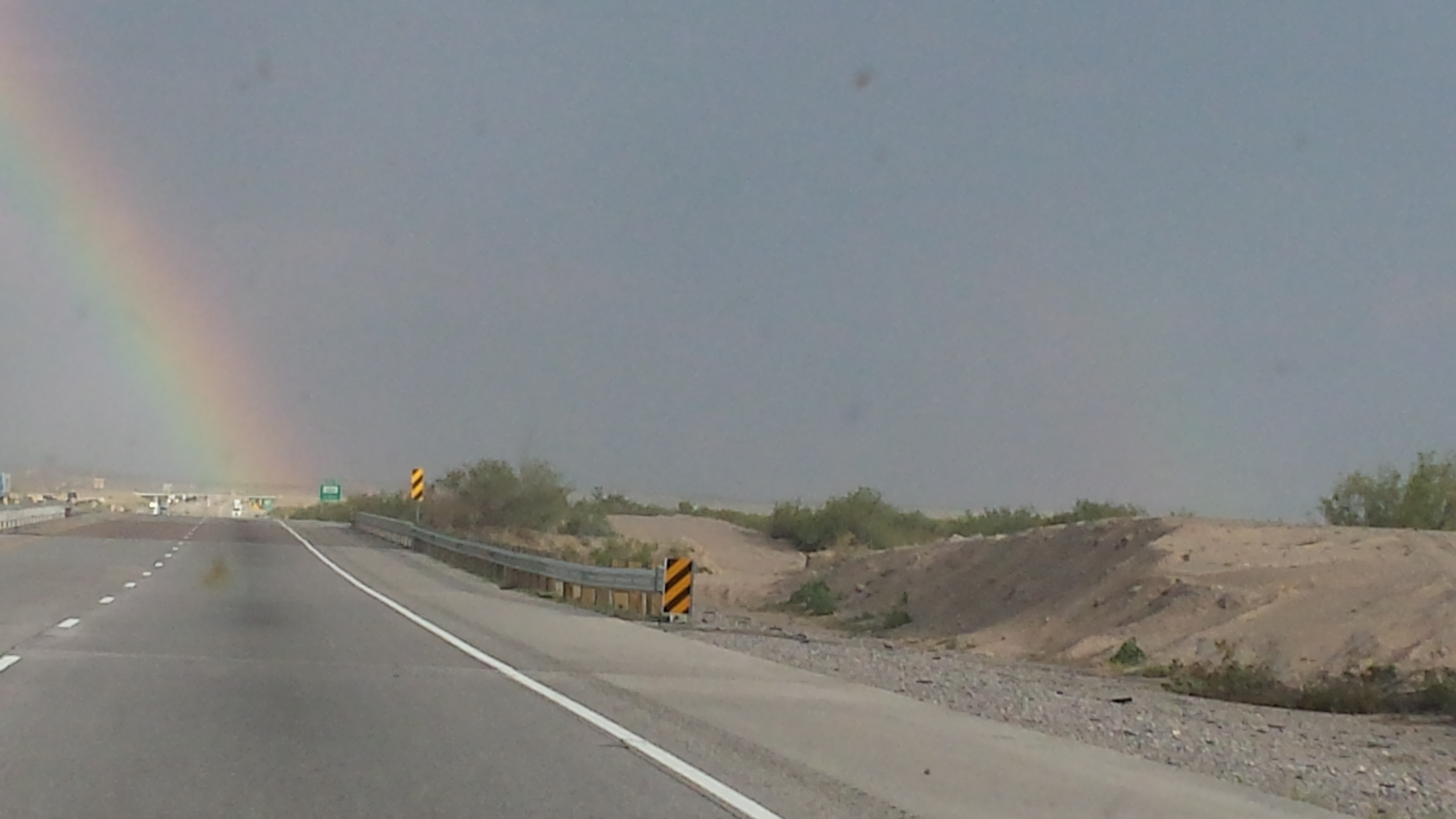
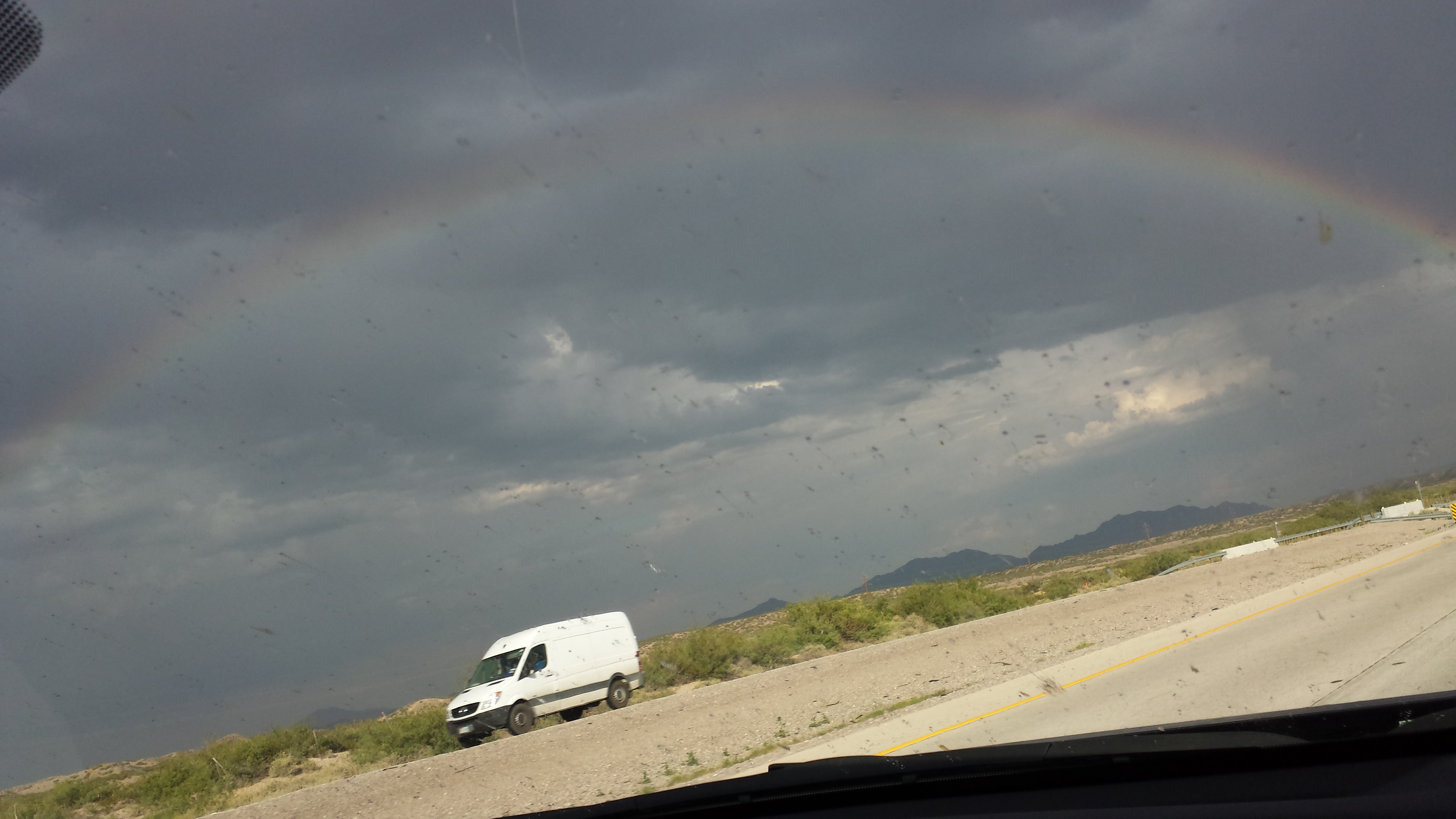
This beautiful rainbow was formed over the I-10 about an hour east of El Paso, Texas. Since the rainbow ended right on the highway, it looked like we were driving toward a pot of gold. Unfortunately, I didn’t see any leprechauns. I did, hopefully, check my royalty reports (not while driving, of course!), but, alas, there was no pot of gold to be found. Evidently, the pot of gold was in the beauty of the rainbow itself. That was plenty, but you can always hope for more, right?

If you look closely, you can see the faint secondary rainbow beside the primary (look to the right of the primary in the photo above – look closely because it’s very faint), with the colors reversed. Of course, the sun is behind us (the next time you see a rainbow, look behind you and you will see that the sun is behind you when you view a rainbow).

Rainbow 1

Another great thing about this drive was that the speed limit was 80 mph. I had never seen it above 75 mph before. A couple of years ago, the speed limit on the main Texas highways was 70, and 65 at night. The old speed limit wasn’t consistent with the message that everything is big in Texas. It used to be frustrating to drive 75 mph through Arizona and New Mexico, then enter Texas (which is extremely long if you enter at El Paso and leave through Waskom) to drive at 70 mph – then if it gets dark, suddenly it was 65 mph.

Instead, this time it was exciting to see 80 mph in Texas. It’s nice to see the speed limit up from 65 at night in the largest continental state. It was also a little scary. Especially, around curves or in the rain, I was a bit under speed. I noticed a couple of cars pulled over, though. I couldn’t help but wonder why those drivers had not been content with this generous speed limit. I guess some people will never be happy…

Rainbow 2

Chris McMullen, self-published author of A Detailed Guide to Self-Publishing with Amazon

Challenging How Big the Author’s Name Should Be

Name Pic

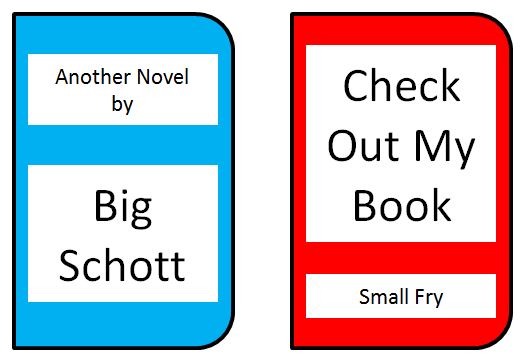
The consensus among critics is that the author’s name should be relatively small (compared to the title) unless you’re famous.

Why? There are two popular reasons for this:

  1. The marketing view says that if the author’s name appears too large on the cover, it will distract the shopper’s attention from more important keywords in the title. If you’re famous, then it’s important to throw your name out there because your name has sales value.
  2. The critical view feels that the author’s name should take on a humble role on the cover (i.e. out of the way) if the author doesn’t have name recognition.

But is this correct?

Maybe not.

There are a couple of reasons to reconsider this point:

  1. Do you primarily expect to sell books to family, friends, acquaintances, coworkers, social media followers, and people you interact with personally through marketing? If so, then you do have name recognition with your target audience. Make your name larger for their benefit and disregard the potential critics. Why not?
  2. Are you branding your name in your marketing efforts? If you are effective at this, then you want your name to be easily visible (but perhaps not dominating) on the thumbnail image of your cover. Potential customers who recognize your name from your marketing endeavors who see your name in the thumbnail may check out your book.
  3. Part of marketing is about creating a perception. If you’re thinking big, then you want to create a big name for yourself. If you’re going all out to try to make it big, then starting out with a big name on your cover might be a good fit. Make that big name for yourself and prove the cover critics wrong.
  4. If you’re a nonfiction author with a title (Dr., Ph.D., M.D., etc.), you may want your qualifications to be visible in the thumbnail image. However, if you don’t have a relevant title and aren’t well-known in your field, it may be better to place emphasis on a few important keywords instead of your name.

What is your personality? What fits you? A big name? A small name?

Chris McMullen, self-published author of A Detailed Guide to Self-Publishing with Amazon

How to Change the Publication Date at CreateSpace…

(I intended to include this in my previous post. Better late than never?)

First, note that once you click Approve Proof, it is no longer possible to change the publication date.

As mentioned in my previous post, after you enter the title information, much time can pass before you approve your proof (from making revisions). So if you enter the publication date as ‘today’ when you enter the title information, by the time you approve your proof, this date can be a few weeks old. The problem with this is that you would then have very little time in the ‘Last 30 Days’ section.

At CreateSpace, when you enter the title information, if you click on the ‘What’s This?’ link, you’ll see that you don’t actually have to enter any date at all. Just leave this field blank and CreateSpace will automatically set the publication date to the day when you first click the Approve Proof button. This gives you approximately 30 days on the ‘Last 30 Days’ list (since it may take a day or more for your book to show up at Amazon).

If you didn’t know this and entered an actual date in the title information, when you go to the title section, you may find that everything appears to be ‘locked.’ If so, contact CreateSpace and explain the situation. Make it clear that you have not clicked Approve Proof (even in the past) for this title, and ask CreateSpace if they could please reset the date for you.

Hey You! Yeah you! Come a little closer…

A great message that everyone needs to hear. (Also worth checking out the other posts on this blog, too.)

Just Patty's avatarpetitemagique

I m doing something a little different today…

The more I get to know you all, the more I noticed a lot of people have the same problem as I do.

‘And what would that be?’ I can hear you ask. Well, it’s a common problem actually and a lot of people suffer from it.

It goes under different names: Insecurity, Not Worthy, Not good enough and a lot of others like that.

Basic line: Not being happy with what you are.

Well, that’s not exactly right, some of us are actually happy with who we are, but we don’t believe others like us that way as all.

Let me tell you this:

You are all unique and wonderful people! (yes, you too) No, don’t go shaking your head, it’s true.

And yes, I know I am not a shining example myself, because I have trouble believing people actually like…

View original post 171 more words

Publishing Tip: Change the Publication Date

If you hope to sell many books online through discovery in search results, the publication date is very important.

Why?

At Amazon, customers can filter search results by clicking the ‘Last 30 Days’ or ‘Last 90 Days’ new release links. These filters give your book a window of opportunity. Customers looking for new releases in their favorite genres may discover your book this way.

Now consider the following scenario.

You go through the entire publishing process. You set the publication date to be today’s date, since it won’t let you enter a date in the future. Then you discover one or more typos in the proof. After correcting those, there is suddenly a problem with the cover. When you fix the cover, you find more typos. A few weeks later everything seems to be just fine. So you click the magic button to approve your proof.

Oops!

You forgot to update the publication date. Your book won’t be listed in the ‘Last 30 Days’ results for an entire month. If it took three weeks to fix all of those problems, your book will only appear in the ‘Last 30 Days’ results for about a week.

Unless you remember to change the publication date before you publish.

If you’re debating whether to enter the publication date as ‘today’ or some date in the past, there is a distinct advantage to using ‘today.’ If the book you are publishing now is a new edition, for example, then why not give this edition a new publication date?

When you explore the ‘Last 30 Days’ and ‘Last 90 Days’ filters, you may also notice a ‘Coming Soon’ filter.

How do you get your book listed under ‘Coming Soon’?

First, you have to publish a paperback or hardcover. You won’t be able to do this if you publish exclusively an e-book edition.

Next, you must learn how to setup preorders at Amazon Advantage. There are some very helpful discussions on this very topic at the CreateSpace community forum. Check them out.

Chris McMullen, self-published author of A Detailed Guide to Self-Publishing with Amazon

Amazon, Disneyland, and Branding

 DrMac-Aug2013-disneyland 239

Amazon and Disneyland are two huge, successful businesses that specialize in selling entertainment.

I love them both, but for different reasons.

Amazon has branded itself as a giant, which fits the name of the company. When I go to Amazon, I expect great selection coupled with low prices. I also expect quick shipping. Amazon has also branded itself as being a supporter of the small guy – i.e. small businesses and indie authors.

This last point works multiple ways. Third-party sellers and customer resale help to bring low prices to the customer through competition, and customers have the opportunity to support indie authors and small businesses. Amazon features indie success stories on their homepage.

Indie books and small business products also greatly enhance the selection of books and other products on their website.  Finally, most customers know indie authors (or are indies themselves), so there is inherently much support for this concept.

I love Amazon for giving the small guy such an amazing opportunity.

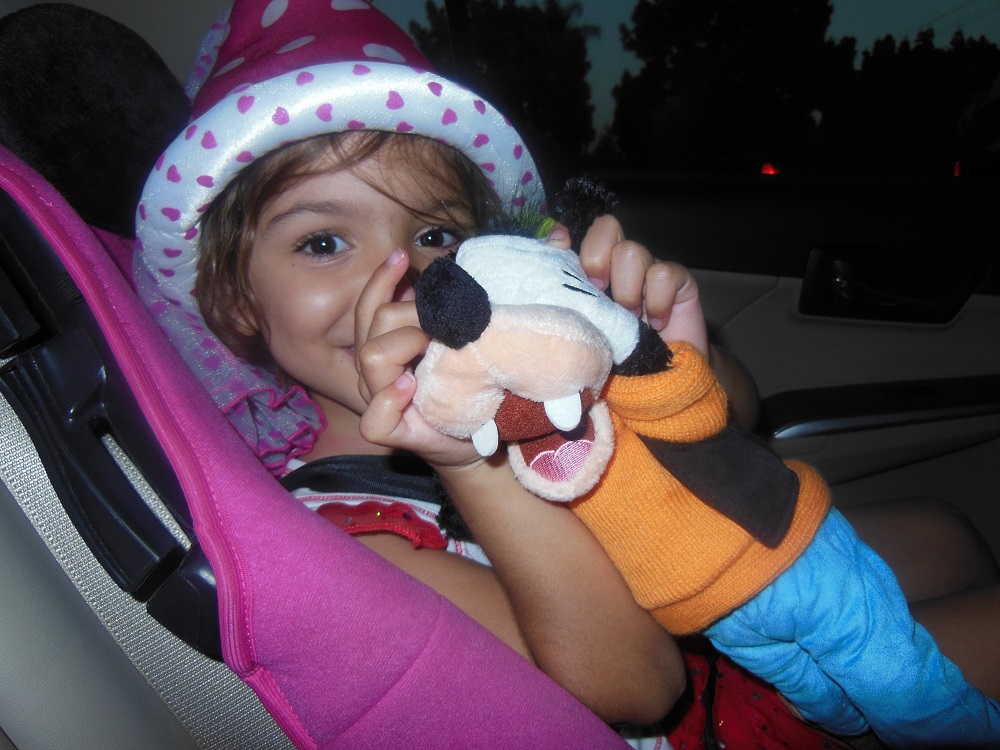
Disneyland has branded itself as a bringer of happiness, which fits its slogan, “The happiest place on earth.” My daughter doesn’t know the slogan, but she associates Disneyland with happiness: She was bouncing up and down, smiling in the car for a couple of hours on the way there.

The employees who interact with customers at Disneyland are obviously trained to place much emphasis on bringing a happy experience to customers. Another thing that’s very important is also subtle: Disneyland pays incredible attention to detail. There is evidently a high priority on cleanliness on their grounds. The service and ambiance are such a high priority in order to brand the happiness image that these details are vital to their success. Goofy came over and patted my daughter on her head during the parade – that’s a wow-factor.

I love Disneyland for attempting to make many people’s lives happier, even if just temporarily.

Of course, Amazon and Disneyland are huge companies which are geared toward making money. Aren’t all businesses striving to make money? The question is what goods and services they provide for the money, and whether or not it’s a good value.

Amazon supports the small guy in its aim to make money and Disneyland provides happiness in its aim to make money. Provided that the cost is reasonable, these seem like highly respectable ways – in my humble opinion – to go about making money.

These are positive images to brand.

Amazon and Disneyland aren’t perfect. Who is?

Personally, I would like to see Amazon become a little more like Disneyland. Wouldn’t it be awesome if Amazon were, say, “The happiest place online”? At least, a few steps in this direction would make for a nice improvement.

But, alas, in customer reviews, customer comments, and discussion forums, we sometimes see unhappiness. We sometimes see highly spiteful remarks (even though spitefulness is supposed to be a violation of the terms and conditions of use) or even cyberbullying.

This is odd, as it seems to contradict some of Amazon’s branding efforts. When I contact Amazon as a customer or author, they usually provide excellent customer service. If they’re so oriented toward great customer service, why not go all out and provide a great customer ambiance in the review and discussion forums, too? Why provide a rotten ambiance there, but great service by phone or email? It seems totally incongruent. So there is one way in which Amazon could improve, in my estimation.

Even as they are, I still love Amazon and Disneyland.

We can learn from their successful branding:

  • How do you want to be branded? You need this in the planning stages.
  • How do you want your product to be branded? Work toward this.
  • An image that people are likely to support on a wide scale (like supporting the small guy), which fits with your product or service, has much potential.
  • An image that people crave (like happiness), which fits with your product or service, has much potential.
  • Choose a title that fits this image.
  • Mickey Mouse is a simple image, easy to recognize, great for branding. (You can’t copy this image. Duh! But you can learn from the effectiveness of this simplicity.)
  • Pay attention to detail.
  • The product, service, marketing, blog, and even your daily personal interactions matter. Send a unified message that supports your branding.
  • Consistently brand the same image. Avoid changing the main title or picture. Choose these wisely in the beginning.

Chris McMullen, self-published author of A Detailed Guide to Self-Publishing with Amazon

Thank You, Reviewers

Thank You Pic

Thank you, Readers

For taking the time to review books,

To express what you enjoyed,

To suggest what could be better.


Thank you, Shoppers

For reading customer book reviews,

For trying to sort out which comments are helpful,

For comparing feedback to the Look Inside.


Thank you, Customers

For not being afraid to share your feedback,

Despite the few who don’t handle criticism well,

For realizing that most authors aren’t this way.


Thank you, Bloggers

For investing so much time to read many books,

For posting book reviews on your blogs,

For helping out so many authors.


Thank you, Authors

For not reviewing your own books,

For not blasting the competition,

For not lashing out at reviewers.


Thank you, Everyone

Who has taken time to post a review,

Who hasn’t abused the review guidelines,

Who supports the wonderful world of books.


We need you,

Readers, Customers, Bloggers, Reviewers.

We would be nowhere without you.

Thank you so much.


Chris McMullen

Wow, What an Amazing Book!

If you’re an author, don’t you wish you were reading a post entitled, “Wow, What an Amazing Book,” that was about your book? Don’t you wish people were telling this to their friends, family, acquaintances, and coworkers? Don’t you wish the reviews were saying this? Don’t you wish readers were contacting you to tell you this?

(Well, of course, you want more than this. You want them to explain why it’s amazing, not just say that it’s amazing. But that’s not the point of this article.)

There are tens of millions of books out there. People aren’t going to think that they’re all amazing. Amazing is relative. To amaze people, your book must do something much better.

Only the top couple hundred thousand books sell once a day or more on average.

There are two ways to have a top-selling book: (1) Market your book effectively and (2) write an amazing book.

It’s important to realize that these points go together. People won’t realize how amazing your book is if they don’t discover it. And no matter how well you market your book, if the book isn’t good, it won’t matter much.

If you take the extra time and effort to make your book amazing in some way, this should help give you some motivation and confidence in your marketing.

What makes a book amazing?

What will cause readers to slam your book on the table and dance around, thinking, “Wow! That was unbelievable! Where can I get more of that?”

Let’s begin with what won’t make your book amazing:

  • It won’t be amazing simply because you hope people will be amazed by it. (You need to work for it, not just hope for it.)
  • It won’t be amazing just because your name is on the book, and you think you’re amazing. (You probably are amazing, but people won’t judge your book by judging you.)
  • It won’t be amazing merely because you completed the monumental task of writing and publishing a book. (This is worthy of my applause, but isn’t enough to impress readers.)
  • It won’t be amazing only because you have a talent for writing. (There are millions of talented writers. You need to stand above the crowd.)
  • It won’t be amazing solely because you put much effort into preparing a very good book. (This is what readers expect. To amaze readers, you must go beyond their expectations.)

Self-publishing isn’t a lottery. In a lottery, every ticket has an equal chance of winning. In publishing, some books are simply better than others. (Furthermore, some books have a wider audience than others, some books are packaged better to help the audience find them, and some books are marketed more effectively than others.)

So how can a book amaze readers?

  • Highly creative problem-solving. For example, the protagonist gets in a jam, the readers think there is no possible way out, and the author does something creative to get the protagonist out of it. The bigger challenge is pulling this off in a way that satisfies readers. You don’t want them thinking that it’s unrealistic or broke the rules of the game, for example.
  • Incredible characterization. This includes heroes and supporting characters that people will fall in love with, but also includes villains. Think about characters that amaze you and especially why they amaze you, and how you can achieve this effect in your own writing.
  • Crowd pleaser. Study the kinds of things in books and movies that tend to please crowds. The better you understand people – especially, your target audience – the greater your chances for amazing them with your book.
  • Impressive formatting. I don’t mean avoiding formatting mistakes or knowing about things like widows, orphans, and rivers. Good formatting is expected, not amazing. Maybe the book is beautifully decorated with little professional touches that fit the theme of the book and don’t distract the reader. Impressive formatting (combined with good editing) helps to put the reader in a good mood. If people know you’re self-published through your marketing efforts, yet your book looks highly professional, they will be amazed that you’ve produced something beyond their expectations.
  • Unique and creative in a pleasing way. If you write a romance that’s very similar to countless other romance novels, that’s not going to amaze anyone; it may please many readers, but this meets their expectations, rather than exceeding them. Do you want people saying, “That’s another good book,” or, “That book is incredible”? But let me warn you that this is both challenging and risky. Much of the time, novelties displease readers. They won’t be amazed by anything that’s different. You have to really know your audience well (focus or writing groups may help). Will people love this change, or will they hate it? If you have a gift for answering this question correctly, you can write an amazing book that will sell well. (Warning: Something new that doesn’t fit into a well-defined genre or that doesn’t have a significant audience will be a very hard sell.)
  • Eye-catching cover that clearly identifies the genre and content. This helps to attract your target audience, create interest in your book, and put them in a good mood every time they see your cover. You don’t want the cover to be the only impressive feature of your book, but if your book amazes readers in other ways, a great cover can really pay off.
  • Make their dreams come true. First, you have to know your audience. Many teenagers, for example, wish they suddenly discovered that they had special powers and that their lives had much more meaning. There are many books that fill this need, however, so you must pull it off in an amazing way.
  • Do something better. Research similar books. Can you make a book like those, only do something much better? It’s not easy. In nonfiction, there are many books written by renowned experts. But maybe you can explain things more clearly in layman’s terms. In fiction or nonfiction, if you can find a way to do something better, this may amaze readers.

The more your book seems amazing to readers, the much greater your prospects for the most valuable sales of all – word of mouth referrals.

Your book has to have the goods, not just the advertising. If you advertise that it’s better in some way, but it doesn’t live up to the expectations that you create, readers are likely to be frustrated and disappointed. You want a book that delivers beyond the readers’ expectations. This will amaze readers and lead to referrals and good reviews.

Think of how you can put a wow-factor in your book.

Chris McMullen, self-published author of A Detailed Guide to Self-Publishing with Amazon

Exclusive: Story “Shifting” Secrets of Bestselling Authors

Transitions are very important. This article has some handy ideas.

Cyber Bullying

This poem expresses the problem quite well.

willowdot21's avatarwillowdot21

So now you have it , you have exposed your soul. Here it is laid bare

You have opened up your entire life, have a care.

Not everyone is as loving and caring as you.

If you lay your life open have a care of what unkind souls might do.

Once they get inside your head

They can check you out and manipulate anything you’ve said.

They can eat you up and plague you, spit you out and leave you dead.

OH! you must beware

They will strip you down and leave you bare.

They don’t know who you are

They don’t care, it is easier for them your mind to scar.

They will expose your secrets and sell your soul

Tell lies about you and expose your whole.

View original post