Book Marketing through Paid Advertisements

Fourth Quarter Pic

The first question is whether or not it may be worth paying to advertise a book. See my previous post for more information on that.

Once you decide to advertise, there are many advertising services to choose from.

What you really want to know when making this decision is this:

  • What percentage of the people who see your advertisement are in your book’s target audience? Don’t buy advertisements that aren’t effective at reaching your target audience.
  • How many people are likely to see your advertisement? (It will certainly not be 100% of the readership or viewership. It will only be a fraction of the published circulation number.)
  • Do the possible additional short-term sales and/or long-term prospects outweigh the costs of the advertisement?
  • How good will your advertisement be (image, strapline, and any additional description)? Will it interest your target audience? Your advertisement needs to be marketable and geared toward your specific target audience in order to be effective.
  • Is your book highly marketable? Advertisements won’t help a book that lacks marketability.

There are many different ways to advertise.

Social media sites like Twitter and Facebook offer advertising which is geared toward businesses hoping to get views (branding), clicks (visits to their websites), Likes (popularity), Follows (interest), and reposts or comments (interaction). The question is whether or not you can effectively target your audience and, if so, how responsive those people will be to an advertisement for a book in this context. Note that Twitter lets you target followers of specific people (could be authors of similar books). If you’re going to target a category, make sure it’s a very good match for your specific target audience (targeting books or readers, for example, is way too broad to be effective).

Goodreads has a similar advertising structure compared to Twitter and Facebook, while being focused on books and reading. On the other hand, there are several authors and publishers advertising on Goodreads, and many of these ads look highly professional and flash different images to get attention. The basic self-service advertisement (which is much cheaper) shows a very tiny image (it says 50 x 66 pixels) and is static. It may be tough for indie authors to compete with advertising on Goodreads. However, the giveaway program is much less expensive (just the cost of the book plus shipping). You might not get any reviews or sell any books through a giveaway (it happens), but you might get a few hundred to a thousand (or so) views. This is an affordable way to gain some exposure, create a little buzz, and help a little with branding. The possible long-term benefits may be worth the small investment even if the giveaway doesn’t help with short-term sales or reviews.

There are a variety of websites and email newsletter subscription services that may be helpful for short-term promotional discounts (not necessarily free). Examples include BookBub, Ereader News Today, Kindle Books & Tips, Book Gorilla, Book Blast, and Pixel of Ink. Note that some of these specifically service e-books. Some of these services have minimum average-star or other requirements, but some don’t. These services can be very helpful in getting more exposure from a free promotion, and can also help to promote a sale that isn’t free. (In the case of a freebie, you have to ask yourself if you really want to invest money in the advertisement on top of giving away books. If you’re going to advertise, it might seem desirable to recover some of the investment quickly with some early royalties. If you have a series, though, a promoted freebie may lead to sales for the other books in your series.) Yet another consideration is whether the market is primarily in the US, UK, or elsewhere.

You can find many other websites online where you can advertise. Search for online websites, magazines, newsletters, and activities that are likely to attract your specific target audience. If you can find a place to advertise that’s a good fit for your target audience, that may turn out to be more effective than going with websites with bigger names.

Another route is the blog tour. Depending on the tour, it may be better for you to plan ahead and try to contact bloggers individually. Also, people you follow and interact with regularly may be more receptive, since you have a rapport together and often support one another, than a stranger; this also gives you more insight into the blogger and lets you see firsthand how many active participants there are on the blog and how many of those are a good fit for your target audience. If you’re looking for exposure from bloggers, you definitely want to ensure that the blog is a good match for your specific target audience.

There is also the potential for offline advertising, like small newspapers, magazines, and circulars. Once again, the magic words are “specific target audience.”

Research the advertising service.

Advertising services generally publicize relevant statistics, such as:

  • Size of the viewership, readership, or circulation.
  • Classification of the circulation by genre (e.g. what percentage is mystery, romance, fantasy, etc.).
  • Average percentage of views, clicks, Likes, follows, or sales. The average isn’t a guarantee, but is a compromise between ineffective and highly effective advertising. The marketability of your book and of your advertisement are very important, as are additional promotional activities (especially, free and low-cost marketing to supplement your advertisement). Some authors who have large fan bases to begin can drive these averages up.

Even if you don’t have any intention of advertising on Twitter, Facebook, or Goodreads, it’s worthwhile to check out their advertising options because they have a lot of helpful information and tips. Also, when you check out the stats of other advertising services, you can compare it to the information that you see at these websites. Any data you find here will give you some type of benchmark, like the average percentage of clicks at Goodreads.

In addition to numbers, try to find authors who have used the service and learn what they have to say about it. (Another issue is how much you can trust the published numbers.)

Only a fraction of the circulation number will see your advertisement.

The first question to ask yourself is how much of the circulation consists of other authors. Authors who want to advertise with an email newsletter probably subscribe to it first as readers to check it out.

However, authors are readers, too, and many indie authors are likely to read other indie books when they aren’t writing. So to some extent it’s okay if there is a healthy percentage of authors in the circulation. But it’s probably desirable to have many readers who aren’t authors in the circulation, too.

Many people won’t open an email newsletter that they have subscribed to; or they may only open it once in a while—e.g. when they happen to be in the mood for a book.

No matter how you advertise, some people in the circulation won’t see your ad. Even on television, some people watching the show will be in the bathroom, cooking, or on the telephone during a commercial. In a magazine, most people who read it won’t see every page. And so on.

Of those who see an advertisement, only a tiny fraction will actually click on it, visit the website, Like a page, Follow you, or buy a book. Just the percentage who click on it compared to those who see it is typically very low—although this number can vary considerably depending on the marketability of the book and the effectiveness of the advertisement. It can also vary considerably from one advertising service to another.

Gear your advertisement toward your specific target audience.

Any image in your advertisement needs to attract your target audience. It’s just as important as cover design is for marketability. The image might even be your book cover (but not necessarily). Check the size of the image, aspect ratio (you definitely don’t want this to be distorted), and quality (e.g. pixilation). Ensure that the text is legible and crisp on the photo for the ad.

You need a good strapline that’s likely to draw interest from your target audience. If you’re advertising a short-term discount, contest, or free content of some kind, for example, this may draw more interest than simply advertising your book.

Check all of your writing very carefully. Any mistakes in the little writing you do in the advertisement won’t bode well for the quality of thousands of words written in a book. Remember that the goal of any writing in an advertisement is to catch the interest of your target audience and make them curious for more. Get feedback from others (especially, in your target audience) before placing your ad.

The cost of an advertisement can be calculated in different ways.

Some services charge a flat fee—e.g. $80 to place the ad.

Some services charge a fixed fee that depends on choices you make, such as the price of your book. For example, it might be $60 to place an ad for a freebie, $120 if the price is 99 cents, or $180 if the price is $1.99.

Some services charge a fee based on activity (like a fee per click, or a fee per Like or Follow).

Some services require you to bid on the ad. For example, you might bid 5 cents to a few dollars. In this context, different ads compete with one another for the chance to be viewed. You can usually place an upper limit on your daily spending and/or on the total amount for your campaign. For example, you might bid 25 cents for the ad with a maximum daily limit of $5.

When you bid on your ad, very often views of the ad are free, but you pay based on activity (e.g. a click, Like, or Follow). In this case, your ad may actually benefit from hundreds of views without any charge to you. What percentage of people view your ad actually click, Like, or Follow can vary significantly depending on the effectiveness of the ad and the content you’re advertising. Also, at some sites, clicks, Likes, or Follows are much more likely than at other sites.

The bid is usually the maximum that you’re willing to pay, and will often be less. For example, if you bid 50 cents for the ad, sometimes you may be charged less than 50 cents (any number from the minimum bid to 50 cents). Your ad competes against other ads in an auction format, so when you bid 50 cents, you’re basically saying, “50 cents is the most I’ll pay, but if possible I’d like to pay less.”

I recommend starting out at the minimum bid with a cap on your daily spending. Monitor your stats for a few days before raising your bid. This way, you can see what effect your bid has while keeping the risk low in the beginning. If you’re happy with the results, then you can safely avoid higher bids.

Don’t rely on the advertisement to do all the work for you.

I discussed the need to supplement advertisements with free and low-cost marketing in my previous post. Advertising isn’t a substitution for the need to market your book; it’s a supplement that can help improve the sales of a marketable book.

How would you like to participate in a Black Friday type of sales event designed specifically for books? Check out Read Tuesday. It’s going to be HUGE!

Chris McMullen, author of A Detailed Guide to Self-Publishing with Amazon and Other Online Booksellers, Vol. 1 (formatting/publishing) and Vol. 2 (packaging/marketing)

Yesterday She Was

This heartfelt poem moved me emotionally. It just seems to me that poetry like this needs to be shared.

Paid Advertising Options for Book Sales

Fourth Quarter Pic

The success of any book depends on a combination of effective marketing and the degree of marketability.

  • Effective marketing strategies help customers in the target audience discover a book.
  • Creating a highly marketable book improves the chances that a customer who discovers the book will purchase the book.

There are numerous free and low-cost marketing ideas out there. Some of these can be quite effective. The great thing about free and low-cost marketing strategies is that there is very little financial risk.

There are also ways to invest money in the marketing. One way to invest money in marketing is through paid advertisements. This is the focus of this article.

What advertising won’t do.

Let me begin by saying what paid advertising won’t do. It doesn’t do the marketing for you.

If you’re tentative about marketing or inexperienced with marketing, paying for advertisements is not a substitution for marketing. You can’t just throw money somewhere to relieve yourself from having to market your book.

So if you were hoping that paid advertising would be the solution to your marketing dilemma, think again. If you’re in this boat, I recommend putting several months of effort into free and low-cost marketing to develop some firsthand marketing experience.

First gain some marketing experience.

If you want paid advertisements to be effective, you will need that marketing experience. There are decisions you must make and things that you need to design where poor marketability decisions will render the advertisement ineffective. You need this marketing experience to help make better advertising choices.

Furthermore, you need to promote the advertisements in some cases, and in any case you need other marketing strategies in place to supplement the advertisements. It will take marketing experience to do this effectively. It will also take connections to help with your promotions. The more time you spend marketing with free and low-cost methods, the more connections you will build through networking in the process. Remind yourself that you’re not just trying to promote your book: You’re also networking and hoping to develop helpful connections (especially, win-win situations, where help runs both ways).

Identify your goals.

What are you hoping for the advertising to accomplish?

If your main goal is to turn a profit, then you need to do a cost-benefit analysis and weigh the risks versus the possible rewards carefully. Figure out how many books you must sell to recover you investment. Try to research data that can help you project how plausible this is.

However, if you are more concerned about initial exposure, but aren’t concerned about recovering your investment quickly, then you should be focusing more on what kind of exposure you might gain from the venture. The risk still matters. The distinction is whether you’re more focused on long-term potential or short-term profit.

What’s your net?

Advertising may lead to an increase in sales. If you have a steady baseline (how many books you sell per day on average), this will help you gauge the effect of your advertising. Specifically, this tells you how many additional sales you are getting per day on average.

What you really want to know is your net profit or loss. Compute your net additional royalty and subtract your advertising expenses.

Keep in mind that sales can fluctuate, increase, or decrease all on their own. There are many complicating factors that you’re likely not to be aware of. The more data you have prior to your advertising campaign, the better you can gauge this statistically.

Advertising doesn’t always lead to an increase in sales. Like any investment, advertising carries risk. The more experience you have with marketing and the better you understand marketability and marketing, the better your advertising prospects; but even then, there are no guarantees.

Some of the benefits are long-term.

Advertising isn’t just about generating short-term sales.

There are many other possible benefits of advertising:

  • Build buzz to hopefully stimulate initial sales, reviews, and word-of-mouth news.
  • Help the target audience discover a new product.
  • Tell people about a short-term sale.
  • Try to boost sales to get onto bestseller lists, which may help to stimulate sales further.
  • Try to stay on bestseller lists once getting there.
  • Brand the title or author name through repetition.
  • Brand the cover by sight through repetition.
  • Get people to associate your book with a distinguished quality.

Commercials very often don’t generate immediate sales. What they tend to do is create a brand name through repetition. Months later, when the customer is buying a product, the customer is most likely to choose a product that sounds familiar. This is called branding. It’s a very important aspect of marketing.

Branding requires patience. It can take many months before a customer has seen your book enough times to recognize it, and then it may take many more months before the customer is in the market for a book like yours.

Advertising can be one part of your branding efforts.

The more people in your target audience hear your book’s name, your name, and see your cover, the more branding occurs.

Advertising can help with this, especially if the ads are targeted to your specific audience. However, advertising shouldn’t be your only attempt at branding. You need to get your cover, title, and name out in front of your target audience through a variety of different resources (a blog, website, social media, blog interviews, blogger reviews, etc.) to improve the chances for the same potential customer to see your book multiple times. This is one more reason that you need to combine free and low-cost marketing with paid advertisements. (You don’t necessarily need to do the paid advertising; that’s optional. You definitely need to do the free and low-cost stuff.)

Advertising books is different from advertising household products.

You’re probably familiar with commercials and other advertisements for household products that you buy in stores or online. What you need to realize is that advertising books is much different.

How many different brands of toilet paper do you need to choose from at the grocery story? You can probably count them on your fingers. You probably recognize a few of these brands from t.v.

Now think about going to buy a book. If you want to buy a mystery, for example, you have to choose from thousands of books. There are many, many more alternatives.

Advertising toilet paper is cost-effective because millions of people will use it and there are only a few brands to choose from. Although millions of people read books, there are also millions of books to choose from.

There are thousands of other authors trying to promote their books. There are also many publishers doing this. Some of the bestselling authors and top publishers invest a considerable sum of money into their advertising campaigns.

All these factors make it a challenge for you to reap a short-term reward from advertisements.

Since advertising is a risk that may result in a loss, the safe thing to do is stick with the many free and low-cost marketing alternatives.

What else can you advertise besides your book?

When you advertise your book, people immediately realize that it’s an advertisement. People generally don’t like advertisements because they are interruptions. For this reason, most people don’t click on advertisements and most people don’t buy the product in the near future. However, the people who see your advertisement and don’t click on it or buy the product may still recognize your book in the future. Advertisements are often more effective through branding than they are in short-term sales.

However, there are other things that you can advertise besides your book. Some of these things may be more effective at generating clicks or sales.

  • Advertise a website rather than the book. If the website has content that will attract the target audience and this is clear in the advertisement, then customers may be more likely to click on it.
  • Advertise a short-term sale. This may help to create a sense of urgency.
  • Advertise a contest. The chance to win something may generate interest. (On the other hand, there are many people who feel that they never win anything, so don’t bother to enter, and there are so many contests that it would be a lot of work to enter them all. Not everyone thinks this way, though, and some people still love contests.)
  • Advertise something that’s free and that your target audience will want to have. There are many possibilities. A free PDF booklet, for example, won’t cost you any money to make, and if it looks nice and has information that your target audience will want, it may draw interest. This can help to get people from your target audience to visit your website and discover your book.
  • Advertise a series. You don’t have to actually advertise a series in the advertisement. You could advertise the first book or the most recent book, and this may help to draw interest in the whole series. If you have a set of books, this makes advertising more economical when you think about the cost per book.
  • Advertise an event, like a workshop or start a special week that relates to your book.

How marketable is your book?

Paid advertisements won’t make up for poor marketability.

A highly marketable book will sell through free and low-cost marketing.

It doesn’t take paid advertisements to sell a highly marketable book; it just takes discovery.

If a book doesn’t have marketability, advertising isn’t likely to help.

Advertising can help a marketable book get discovered and thereby sell more frequently.

See the following link for help assessing your book’s marketability:

https://chrismcmullen.wordpress.com/2013/09/10/marketing-why-isnt-it-working/

In one of my next posts, I’ll discuss some specific advertising options at a few websites that many authors are familiar with.

Chris McMullen, author of A Detailed Guide to Self-Publishing with Amazon and Other Online Booksellers, Vol. 1 (formatting/publishing) and Vol. 2 (packaging/marketing)

Image

Cat & Dog Staring Contest

Cat Dog

Sample Detail Page Recommended by Amazon Rep

I received an email from Amazon’s marketing department from an inquiry I sent. The representative sent me a link to this sample detail page:

http://amzn.com/0385347316

The way it was worded, the link was just to show what an example of a book’s detail page looks like at Amazon, but it was in the context of selling an advertising campaign to direct traffic toward a book’s product page. (This was not what I inquired about, but obviously if you contact a marketing department for a huge company like Amazon, if they respond, they will probably try to sell you one of their services. They are probably pretty good at this, if they work for Amazon.)

I think this product page is interesting, especially in the context in which I encountered it. Can we learn anything from it? That’s the purpose with which I write this post—to see if there is anything that we can learn from it in the way of marketability and marketing. (The rep didn’t specifically say that their campaign had been applied to this book, but maybe there is an inference to draw here.)

  • The cover didn’t impress me. Simplicity of design can be effective, and with nonfiction the cover doesn’t need to be so eye-popping, but there seems to be room for improvement. (The copyright page even notes a special jacket art designer.) There is a lot of text, although this is often done in nonfiction. At least, the title is easy to read in a thumbnail and the cover concept gets through. What I was thinking was, WHY did Amazon’s marketing rep pick THIS cover? (Are they trying to show that their marketing services can help a book sell even if the cover isn’t hot?)
  • Check out the sales rank. When I looked, it was #63 in books, and 1 and 2 in various categories. The author rank also shows right on the author page, varying from 11 to 81 in several categories. The publication date is October 8, 2013, which is just 6 days ago. Keep in mind that we’re looking at the hardcover edition. There were 16 reviews, mostly 5 stars, including a top 500 reviewer (Vine Voice).
  • The main thing that impressed me on the product page and Look Inside is the encyclopedic list of praising quotes for the book. I guess if that many qualified people say a book is good, it has to be.
  • On the Look Inside, the first page that mentions the title has only that, and the second one is fairly plain, too. Most of the interior is fairly plain. The main exception is the use of the HEAL acronym, using a letter from this word sort of as (but not quite) a bullet, and this is content-oriented as each letter has a specific meaning. The title page does have a publisher logo and another design mark between the title and author.
  • If you look at the author page, you see a resume that nonfiction publisher’s are looking for. There are also five author videos there.
  • From the author page, you can click on a link to the author’s blog to see his website. At the top is the option to subscribe to a newsletter—that’s one marketing tactic. Now look at the bottom of the website to find another. You’ll see an offer for a bonus gift, advertised as a $49 value, for free with purchase. The same thing is actually advertised at the top of the page, but in different wording (and it was so large I missed it the first time). One thing I notice about the cover now is that the color scheme seems to fit with the website—not my favorite, but a consistent color scheme for the book, blog, and beyond can help with branding.
  • The content is a hot commodity. Who doesn’t want happiness? And the author’s qualifications fit well with the content.

Of course, if you have mega qualifications and a big publisher picks you up, you have a big advantage. Still, to be successful, buyers still have to choose your book. So what is selling this book?

  • I don’t think it’s the thumbnail image that’s wowing buyers. It’s still getting a lot of attention. At least, the cover doesn’t seem to be deterring sales.
  • The author had a large fan base to begin with, which is clear if you look at his prior publications. Having an existing fan base is a great help when you release a new book that fits the same audience.
  • There is a top 500 reviewer and there are several initial reviews. The publisher and/or author probably made use of advance review copies. Building buzz for a book helps.
  • With nonfiction, qualifications can be highly important, and this author has a relevant resume posted on his author page. This helps a great deal.
  • Since Amazon’s marketing rep pointed me to this page, I’m wondering if their marketing services helped improve this book’s visibility. I’m not suggesting that you should spend big $$$ to advertise your book. The more you spend on advertising, the more books you have to sell just to break even, and there is a greater risk that you won’t even do that. There are many effective free and low-cost marketing ideas that all authors can use. If the book is highly marketable, free and low-cost will likely be effective; and if it’s not so marketable, paid advertising will have a tough time overcoming that.

If you’re hoping to improve your sales, it can be very helpful to research other books’ product pages (and their authors’ websites). You may get useful packaging or marketing ideas that way.

Chris McMullen, author of A Detailed Guide to Self-Publishing with Amazon and Other Online Booksellers, Vol. 1 (formatting/publishing) and Vol. 2 (packaging/marketing)
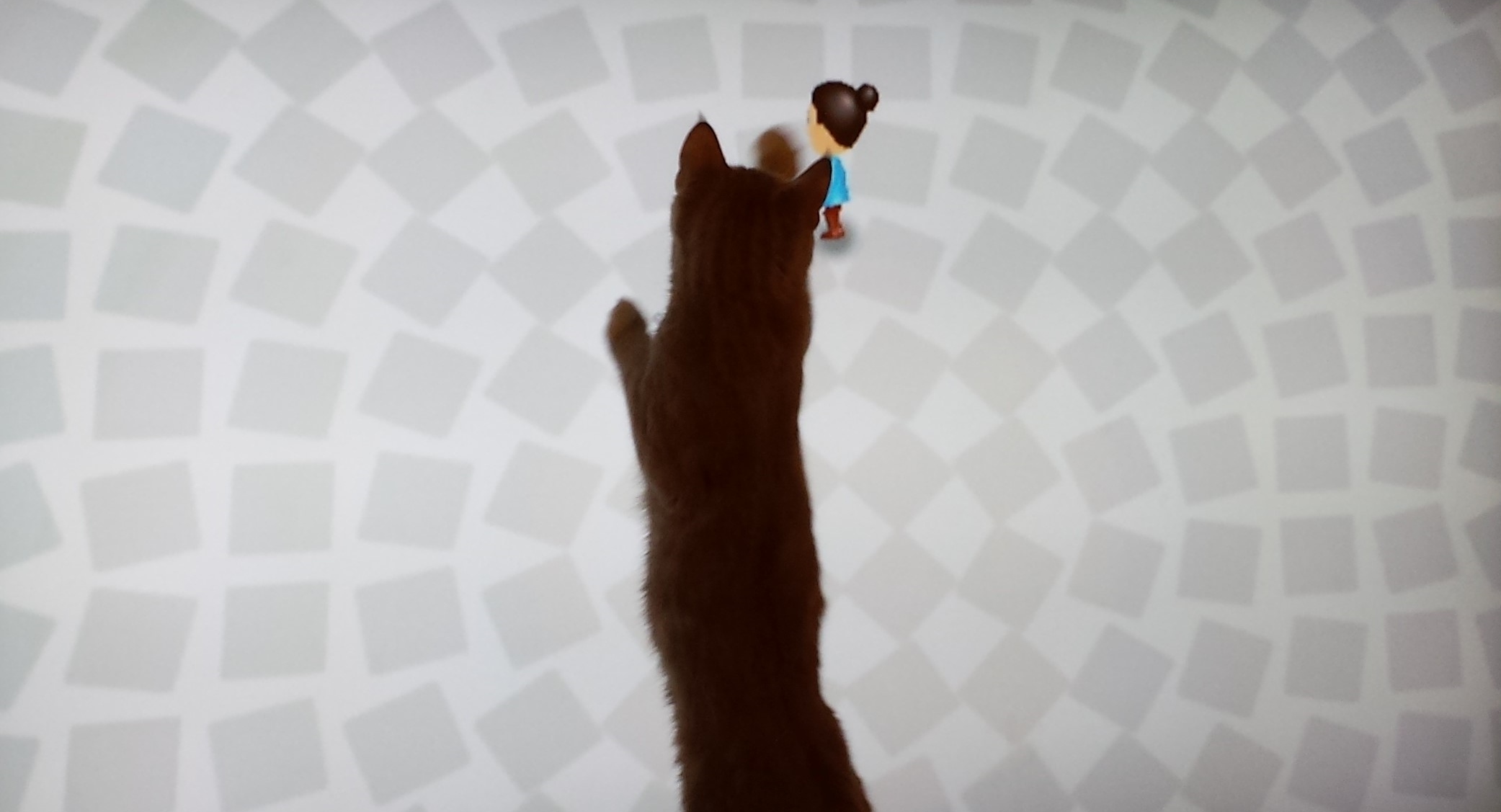
Photo Puzzle: What in the World Is This?

Puzzle Photo 2

I was browsing through a photo gallery and this caught my eye.

I knew what the foreground was, but the background didn’t seem familiar at first.

The reason I didn’t recognize the background initially was that it didn’t seem to be a logical match for the foreground object.

When I recognized the foreground object, I was thinking of all the possible places that it could have been, and the puzzling part was that this background didn’t seem possible.

SPOILER ALERT. I will soon say exactly what both the foreground and background are.

The foreground object is our new cat, which you may recognize from a previous post.

The background is the television. That’s why I didn’t recognize the background at first.

Once I realized that the cat was standing up in front of the t.v., I recognized the background image.

My daughter was playing a video game with her Nintendo Wii.

You see this image on the t.v. when the player is in the Mii settings.

The cat jumped up onto the entertainment center, stood up, and was pawing at one of the characters.

Naughty kitty, we have proof that you were up to no good.

At least, I didn’t have to hire a detective. 🙂

I expect you recognized the cat pretty quickly. You probably didn’t recognize the video game unless you’ve seen someone playing it before. If not, did you realize it was a t.v.?

The Importance of Feedback on Marketability, Pre-Marketing, and Marketing

Feedback is important for both marketability and marketing.

Let me illustrate this with Read Tuesday.

There are four reasons that I’ve been seeking feedback on many stages of the development of Read Tuesday:

  • Marketability. Feedback from members of the target audience helps you assess your product’s marketability in addition to possibly giving you useful ideas or pointing out the need for revisions. This is something that every author should do with every book.
  • Pre-marketing. As you’re putting your next book together, if you seek input for the title, cover reveal, draft of a blurb, draft of the Look Inside portion, and so on before you publish, this helps to build buzz for your book.
  • Marketing: If your interactions involve other authors, publishers, editors, publicists, etc., in the process of receiving feedback, you may also establish useful leads and connections. This may lead to blog interviews, reblogs, and many other forms of help, especially if they like your idea or feel that they have become involved in the process.
  • Content: In my case, it provides some examples of things that authors can do with their own marketing. Many of the ideas you see going into Read Tuesday are things you might consider for your own marketing.

So keep these things in mind with your own books, and when you see me request feedback, consider how it might relate to your marketing.

I actually have a fifth reason. We’re all in Read Tuesday together. I want this to be inclusive, rather than exclusive. While I can’t use every idea, I do consider every idea, and I have tried to incorporate most of the ideas I’ve received. I value everybody’s input. This fifth reason doesn’t apply to writing books. Most good stories weren’t written democratically like this. So you probably don’t want to borrow my fifth reason, at least in regards to authorship.

I’m working on a press release kit for Read Tuesday, and I’m also thinking of other ways to show the Read Tuesday catalog. So this post offers another chance for anybody to provide feedback, ideas, suggestions, etc.

The main thing I’m looking for with the press release (however, feel free to share ideas for any part of it) is a sample of participation. I don’t want to leak pricing information early, but it may be helpful to show samples of authors or books that will be participating. The big problem is which books or authors to feature.

Naturally, every author should want to be featured. I could feature a different set of authors in different press releases, but I can’t include every author. So how do I choose? There are many ways this could be done. If you have ideas, I’ll consider them.

You can use the Contact Us form on Read Tuesday (or just click on my Gravatar on the sidebar and email me) if you’d like me to consider using your book. So far, very few authors have used the Contact Us forms, so if this continues as usual, your chances would be very good this way. 🙂

Also, do you have suggestions for the Read Tuesday catalog? You can check it out on the Read Tuesday website. I’ve only posted the very preliminary book catalog of the first books to sign up. I need to update it, and I also haven’t added the author catalog yet.

What I see on my end is a spreadsheet. I can sort it by genre or other information that was entered into the catalog. I didn’t include every column on the preliminary catalog, so there are a couple of things that I can add to it. If you have ideas for how the catalog could be better and it turns out to be fairly easy to implement it, please let me know.

Once the catalog grows large enough, I will probably post subcatalogs on different pages—e.g. one page for children’s fiction, or even one page for mystery if the list is long enough. I think this will help with organization (along with a menu).

If you haven’t already filled out the Google Docs forms to add yourself and books to the catalog, it’s not too late to do it. Remember, you don’t have to worry about price at this stage. Just click on the Author link on the Read Tuesday website to find the forms. It’s easy. (But if you have any issues, please let me know.)

Chris McMullen, author of A Detailed Guide to Self-Publishing with Amazon and Other Online Booksellers, Vol. 1 (formatting/publishing) and Vol. 2 (packaging/marketing)

Which Genre Is Best?

Genre Pic

ROMANCE: Everyone knows I’m the best genre. I give readers the happy ending they crave.

EROTICA: Honey, you’re just a tease. I have what they really want.

SELF-HELP: That’s not quite true. What people really want is a healthy relationship with a warm, breathing body. A romance provides an escape from reality. But with a relationship guide, people can have a better reality.

ADULT: It’s not the relationship part that’s the challenge; it’s the intimacy. I’m the three-letter word that everybody wants, but most people are afraid to talk about.

MYSTERY: Relationships are fueled by passion. What kind of romance are you going to have if you need to read a guide to learn how to do it? People want books to entertain them. I give them a puzzle to solve to engage their interest.

SUSPENSE: If you want to really engage your audience, you need elements of suspense.

COMEDY: What’s more entertaining than humor? Everybody loves a good laugh.

FANTASY: Why not have it both ways? I offer the reader a better reality and I entertain the reader.

SCI-FI: But your reality is too far-fetched to be believable. I do it with a better version of the real universe.

HISTORICAL FICTION: Are you kidding? Jumping through wormholes, extra dimensions, aliens, going back in time… Who are you calling unbelievable? What I do is take events that have actually occurred in reality and make them better.

PUZZLES: You’re living in the past. I give people a way to make the present more fun.

COMICS: Exactly. And I do it in color with pictures.

CURRENT EVENTS: What’s wrong with reality? I show readers that the real universe in the present is really quite fascinating. It turns out that the truth is stranger than fiction.

POLITICAL SCIENCE: Ain’t that the case? And there isn’t a more fascinating current event than politics.

ETHICS: Where have you been? Politics is the reason reality is so screwed up right now. If everyone read me, the world would be a much better place.

HOW-TO: People can read you, but you’re not going to change people. The way to make reality a better place is to read a how-to guide. We have a guide for everything.

TEXTBOOK: Technology makes the world a better place. You can’t do rocket science or brain surgery with a how-to guide. You need a technical book deep in knowledge.

SPIRITUAL: Don’t you see the problems in society caused by having so much technology without the wisdom and spiritual harmony to go along with it? Look at the happy children playing with rocks and sticks, and the unhappy spoiled children with cell phones and video games. What we really need to teach is how to get along with other people, how to believe in ourselves, and how to overcome adversity.

RELIGION: And what would be better than the word of God himself to show you exactly how to do that?

PHILOSOPHY: That would be a lot easier if there weren’t so many gods and religions to choose from.

CHILDREN: The important thing is to get kids reading early. Teach them the fundamentals they need to succeed in life. Give them the gift of reading. If they don’t learn how to read as children, every genre will be out of business.

TEEN: The critical stage is when the child turns into a teenager. Most people want to ignore teens, or just punish them for bad behavior. What we need is to understand the problems of the teenager and help them through this critical stage of their lives. It can have a drastic impact on their adult lives.

SPORTS: That’s where I come in. I give them something they enjoy doing, provide plenty of exercise, keep them too busy to get into trouble, and teach valuable teamwork skills.

POETRY: Really? Then why are so many professional athletes getting into trouble with drugs and legal problems? Let’s face it. No matter what you do, people will have problems. I help people understand the human experience better, and I inspire them through creativity.

DRAMA: Nobody can illustrate the tragedies of life better than I can.

TRAVEL: When life beats you up, you just need to get away from it all. I can take them to the perfect place and help them enjoy it while they’re there.

COOKING: You can’t run away from your problems. Everybody feels better after a good meal.

LEGAL: That’s a good idea. I’m starving. Let’s all have a good meal. Besides, if you think you’re better than I am, I’ll just sue you for it.

Copyright © 2013 Chris McMullen

Readers and Authors, What Constitutes Self-Promotion?

Self Promo

This is an important issue for both readers and authors. Authors know they need to be discovered through marketing, and so readers come across countless attempts by authors to get their books discovered by them.

At the same time, it isn’t easy for readers to navigate through hundreds of thousands of books to discover those few that most interest them. Authors want to be discovered, and readers want to discover books they will enjoy. Successful marketing helps readers find books that are likely to be a good fit for them. This helps readers. In contrast, ineffective marketing can be quite a nuisance, and distracts readers from the opportunity to discover books that are likely to interest them.

The most obvious attempts by authors to get discovered by readers come in the form of spam, where an author repeatedly posts about the book with high frequency. Many authors realize that this is more likely to develop a bad reputation or simply be ignored than it is to succeed. It’s also prohibited on most forums and online platforms if done too frequently.

There is a danger in being branded as an annoying insect if posting too frequently on social media platforms. Borderline spamming might get the title or author name out there for possible branding—“I recognize this book,” or, “This must be a big-name author because I see that name all over the place”—but it’s also likely to be tuned out or to brand a negative image—“I hate that author for spamming the boards all the time,” or, “I think I’ll click that Unfollow button so I can find the posts I like.”

One step down from spamming the board is explicit self-promotion. For example, “Hello, I just wrote a book called Best Book Ever by Self Promoter. Please buy it.”

Some community forums—like the Amazon customer discussions (which attract some authors because they expect to find customers there, but may not be the ideal place to get a book discovered)—don’t allow explicit self-promotion like this. Even where explicit self-promotion is permitted, it’s often frowned upon by various (and sometimes outspoken) community members.

Aside from this, explicit self-promotion has the problems of overt advertising. Most people prefer to avoid commercials. We put up with commercials on television, radio, and magazines for lack of a free alternative (though you can pay for commercial-free alternatives). Except when you need a bathroom break in the middle of a movie, you usually aren’t pleased to have your show interrupted. (If you want to shout “Infomercial,” I’ll grant you a point.)

On the other hand, some level of self-promotion is what authors need to do. Spam and explicit self-promotion to the point that it seems that your post served no other purpose may not be in your best interest even where they are allowed. However, if you want to be discovered, you do need to promote yourself in some way.

Effective marketing requires visibility among your target audience. You need your target audience to see your book cover and read or hear your book’s title and your name for branding to do its work.

Essentially, this is self-promotion. You’re trying to get discovered. You have to tell people about your book for this to happen. Yet spam and too much self-promotion can backfire.

The trick is to get discovered in a way that doesn’t come across as self-promotion.

This begs the question: Exactly what do people perceive as self-promotion? Part of the problem is that everybody doesn’t agree on the answer.

Following are a few suggestions to help judge this:

  • Does it seem like you are present mainly just to promote your book? Or are you providing relevant and meaningful contributions?
  • Does the mention of your book seem out of place? Or are you mentioning your book at your own site, or to establish your expertise or experience as an author, or to provide a reference to relevant content?
  • Does it look like you’re trying to grab everyone’s attention? Or does it seem like you’re just hoping to get discovered by those who enjoy interacting with you. (For example, it could be the distinction between coming right out and telling anyone about your book versus mentioning this when asked or only offering this information in your profile.)
  • Is your book irrelevant for much of the audience? Or does your audience closely coincide with the target audience for your book?

Context is important, too. If you’re running a special one-day sale, you want to get the word out, and people in your target audience may be grateful for the discount. Also, more self-promotion is to be expected on your own turf than otherwise (but posting too much about yourself isn’t as likely to attract an audience as providing meaningful content for your target audience).

Self-promotion isn’t just an issue online. It’s also important when interacting in person.

How do you feel about self-promotion as a reader or as an author? How do you define the line between what’s acceptable and what’s not? Do you think there is a type of self-promotion that needs to be done, but another type of self-promotion that should be avoided? What kinds of marketing do you consider not to be self-promotion?

Well, we’ve reached the end of this post so I better mention my book now. I might as well promote Read Tuesday while I’m at it. 🙂

Chris McMullen, author of A Detailed Guide to Self-Publishing with Amazon and Other Online Booksellers, Vol. 1 (formatting/publishing) and Vol. 2 (packaging/marketing)

Read Tuesday: It’s going to be HUGE!

Need Help with Read Tuesday News Story

I wrote a news story about Read Tuesday, with hopes to get the article some visibility.

I don’t want to post the draft here, for the benefit of whatever news agency or site may be willing to publish it—i.e. they can be the first to reveal it. However, I will try to briefly describe what this story does. If and when it gets posted somewhere, I’ll provide a link so you can check it out. (Maybe there will be more than one kind of story.)

First, it explains what Read Tuesday is. I emphasized how it will help to spread literacy and reading, which I believe is a good cause. Next, I describe how it’s a coordinated effort among indie authors, made possible by the fact that indies control their prices. I think the fact that it’s not driven by big business, but is unity among indies from around the world, is newsworthy. Finally, I briefly outlined the problem with Black Friday and Cyber Monday in regards to books, explaining how Read Tuesday creates a special sale for book lovers.

I could use a little help. For example, it would be nice to have a few quotes about the event. Some of you have expressed your sentiments about Read Tuesday on your blog, as comments here, and elsewhere. If there is a remark that you wouldn’t mind being included in the news story (and I’ll mention your name and briefly your qualifications, e.g. indie author of Your Book—I’ll let you decide how you’d like this to appear), please let me know. I think the news will be better if it reflects more than just one person’s opinion (i.e. mine).

If you have any ideas that I might consider regarding this news story, please feel free to share them.

Feel free to write your own news story. If you get it published somewhere, this could be nice exposure for you (with your name, Author of Your Book, at the bottom).

Chris McMullen, author of A Detailed Guide to Self-Publishing with Amazon and Other Online Booksellers, Vol. 1 (formatting/publishing) and Vol. 2 (packaging/marketing)